APMoodle
Adaptive and Personalized e-Learning System
Rawad K M Hammad
eLearning Center, Information Technology affairs, Islamic University of Gaza (IUG)
Gaza, Palestine [email protected]
Abstract— Due to the diversity of e-learning usage in different disciplines (practical or theoretical, lifelong learning, formal versus informal education, etc) There are different and multipurpose platforms available in the market and in the educational sector. Personalization and Adaptation techniques are the most new factors that give e-learning environments effectiveness and efficiency.
The main goal of this research is to help the academic institutions achieving their learning objectives via implementing new innovative teaching technologies in e-learning environments. To Achieving this goal, I will go through answering the main research question which is: how to personalize and adapt the learning material for each student? I build a framework that constitutes mainly from two components. One is the user Model that is based on mining student data to recommend a learning path for a given student. The second component is the adaptation and personalization engine that is responsible of live adaptation for student path according to his progress in the course. Then, I implemented the framework on the Moodle open-source virtual learning environment.
Keyword: data mining; adaptation; personalization; user modelling;intelligent tutoring systems; e-learning
I. INTRODUCTION
Using Information and Communication Technology (ICT) has increased during the last two decades and the investment in developing Educational systems is growing continuously. Different titles were given to educational-based systems, but the common principle is the strategy of delivering learning material, which can be described as “one-size-fits-all” [1]. This means that instruction is delivered to all students regardless of their individual needs. This way of instruction raises criticism
against using educational technology by educators,
philosophers, and educational managers due to the fact that it lacks the support and attention provided by teachers or professors through face-to-face teaching/learning process. However, this research tries to introduce a relatively new approach for educational systems, approach that provide customized and personalized learning for a specific user. Generally, this strategy helps the academic institutions to achieve their objectives via implementing new innovative teaching technologies.
Education is more than showing materials to students where learning most of the time “happens outside classroom” from collaboration and communications among learners and environment elements. Moreover, there is a hot debate about
cognitive skills and emotional aspects whether they can or cannot be represented in a proper way via computerized techniques. No doubts that recent research has made a great success in specific areas of computerized emotions and machine consciousness, but there is a need for more development since some issues remain unsolved philosophical conundrum.
This research will try to model the student behavior based on his/her interaction with the e-learning system? Meanwhile, there is a need to answer sub questions like: are there relations among specific learner parameters and their performance? What are the most significant rules that can predict or control student behavior? I will use the data mining techniques in order to model the users, and the implementation of these steps will be embedded in Moodle elearning system.
Finally, this research is going to discuss the earlier works in the coming section, section two. Then a detailed look at the research problem will be explained in section three. Section four will describe the design framework with all of its related issues. This will be followed by implementation phase. Finally, I will conclude the whole project.
II. EARLIER WORKS
A great effort in intelligent learning systems has been done under different titles. This section explains different techniques that are related to my project.
A. Intelligent Tutoring Systems
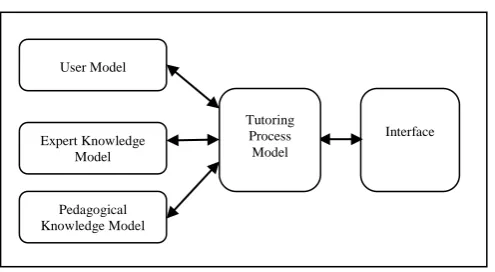
Intelligent tutoring systems (ITS) are one of the active techniques used as intelligent learning systems. According to Martens [2], the main components of ITSs are: First, expert knowledge model which stores the true knowledge and facts
about specific domain knowledge like mathematics,
engineering, etc. Second, user model which stores information about student/learner from his own responses and interaction with the system. Third, pedagogical knowledge model which plays the role of pedagogical/educational consultant. In other words this model should be able to extract useful input from user model for a specific user and adapt the learning material, which is originally coming from expert knowledge model. The last component is the interface which cares about interaction with user.
how this component is complicated according to its role in the system. To get a closer look at it, think about modeling the cognitive abilities or implicit status of students like the work illustrated by Lagud and Rodrigo [3] when they examine the relation between high and low student performance and his experience of affects like confusion, frustration, etc. This modeling process requires accurate tracking for student behavior through specific advance techniques and technical ability to grow up in user model.
Martens [4] takes an advanced step toward developing the classical structure of ITS via raising the question “which of ITS components control the process of adaptation?” She proposes a new approach to separate the content from delivery through developing tutoring process model (TBM) as shown in figure 1.
TBM is defined through a set of equations to provide a successful case-based learning. This learning strategy shows real-life examples that need to be handled by learners.
B. Adaptive Hypermedia
No doubt that there is a gap between the common way of using technology in education which is deploying learning web sites and web-based educational systems from one side and the new generation of adaptive hypermedia (AH) from the other side. AH is relatively new field that grows saliently in the past ten years. The two main scaffoldings for AH are the user modeling and hypermedia.
Brusilovsky [5] shows a constructive literature review for adaptive hypermedia and explains that the dramatic change in AH after 1996 which leads to developing noticeable adaptive hypermedia systems like PAKMAS . To connect both fields: ITS and AH, Nicholas and Martin [6] propose a combination scheme between them. They argue that each system has its own strengths and weakness points. Through ITS students will be able to gain skills like solving mathematical equations or writing correct English statements [7]; while AH is more appropriate in teaching concepts and general knowledge. So, Nicholas and Martin propose a methodology for combining ITS and AH through using a new component called knowledge space. In this methodology, knowledge space is supposed to control both learner model and domain model. All of the required information will be transmitted to learner ITS or AH based on learning scenario needs, then ITS or AH will take the suitable decision on how to instruct this learner?
Additionally, Mérida et al [8] introduce a framework that is able to work as a dynamic content generator for adapting a specific hypermedia system. Basically, their framework enquires about the type of the device used by user to access the system, and then store this information at “device characteristics” component. Later, information from device characteristics will be combined with other information coming from “user preferences” component. This combination will be passed to the “decision engine” that is supposed to decide the type of learning and pass it to the assembler component that will produce the learning content. Within this context, one version of web site will offer different contents to the users based on their needs and types of their devices as well.
C. Personalization
In addition to what has been mentioned in previous sections, there is another technique that is so useful in enhancing the educational systems, which is Personalization. Personalization is strongly connected to both adaptive hypermedia and user modeling. Simply, personalization cares about providing appropriate contents or activities for a given user based on his/her user model. Personalization is used in many sectors; for example, it can be used in commerce and e-business as mentioned by Ulbrich et al [9]. In this study, researchers show that the cost of marketing research decreased noticeably due to the better understanding of customer needs. This result is also supported by Jones et al work that shows the impact of Personalized Recommendations on future user behavior [10].
Particularly the importance of personalization in the area of e-learning stems from the widespread of e-learning applications. According to the ICT and elearning report [11], e-learning is used in different ways and on distinguished scales in different institutions. That means there is a real need to apply the personalization concept in e-learning. However, there are specific technical issues that limit the enthusiasm of applying personalization. Security or user privacy is one of those issues that have been mentioned by Brar and Kay [12]. For that purpose researchers propose a framework for providing personalized services taking into account the user's privacy. Despite the novelty of their work, there are serious challenges facing their solution like the diversity of software and hardware as well. Additionally, there is no link between this framework and the other well-known standards and to what extent this link can be effective.
On the other hand, the intimate link between personalization engine and user model may restrict the efficiency and reuse of both of them. Due to this fact Gu and Sumner suggest a structure for a centralized learner's model that is able to support a better personalization [13]. Constructing a user model especially a lifelong one is an exhaustive process as it depends mainly on two types of processes. First, Accretion which handles the issue of collecting evidences on a given user. Second, resolution which refers to the understanding of the data and interrelationship or determination of the meaning of collected data [14].
D. User Modeling
[image:2.595.37.285.224.360.2]User Modeling is an important research field, most researchers in ITS and AH cannot avoid mentioning this part
Figure 1: Intelligent Tutoring System Structure
loping TBM
Interface User Model
Pedagogical Knowledge Model
Tutoring Process Model Expert Knowledge
since it is the starting point of providing any adaptive techniques in AH as well as ITS. This affirms how much important it is to have an effective user model which implies the main question of what the best way to get information about a specific user is. This depends on the goal of user modeling; it is widely affected by the area of the application since modeling used for medical applications differ from e-commerce applications. However, user modeling in education is not easy in general, but it becomes more critical when talking about modeling users’ cognitive abilities.
III. RESEARCH PROBLEM
Enhancing educational process is still in the core of the interest of different community levels: professors, educational institutes, management, etc. This shows how much important is to invest in developing educational technology as well as the complexity of this investment. This complexity stems from the interdisciplinary of this research area; i.e. education, pedagogy, psychology, different aspects of computing, etc. Researchers from computing made a great effort in developing educational technologies/hypermedia over a long period of time including: Learning Management Systems (LMS), ITS and Adaptive Hypermedia System (AHS), to name but a few.
Most of education researchers mention the efficiency of one-to-one teaching approach; this approach is not applicable today according to the huge number of student. Furthermore, in the future, educational institutes will have a larger number of learners as the demand of education is growing noticeably. Therefore, these developments can be considered as technical steps done based on educational theory and instructional design (ID) models.
As I mentioned previously, the main idea of ITS is breaking down the educational system into different components. One of the ITS core components is the user model. Basically, user model stores useful information about specific learner to help the system recognizing the user and provide him with the most appropriate contents [15]. User modeling techniques are not employed for educational purposes only; they are applied in financial and banking systems, e-commerce, marketing, etc.
Modeling users attracts too much interest as well as criticism in terms of what can be modeled? Or to what extent computer can model a given user? How computer model a user? For example, modeling user preferences (page colors, type of messages read, etc) differ than modeling complicated emotional aspect of learner as mentioned by Sarrafzadeh [16] and cognitive skills. Modeling user emotions has been discussed thoroughly through developing Affective Tutoring Systems (ATSs). Sarrafzadeh describes ATSs as ITSs that have the ability to adapt teaching strategies to the affective state of learners. Mainly ATS and ITS structure are similar; however user model in ATS contains some advanced features as shown in figure 2. In addition to traditional student responses, user model contains specific parameters from analyzing facial and gesture expressions of learners. The most advanced input devices the more effective parameters ATS has since new technologies showed good progress in detecting implicit aspects of learners like inattention, confusion, motivation, and anxiety.
User Modeling can be implemented via different techniques like Neural Networks (NN), Data Mining (DM), or Machine Learning (ML). The main goal of user modeling is to develop an adaptive and personalized elearning environment that should be able to provide a specific education for each learner based on his behavior, characteristics, and learning preferences. To achieve this goal, I depend on educational data mining.
Harrigan et al illustrate the need for adaptive learning systems [16]. Their research covers twenty seven European academic institutions and the findings are interesting. Firstly, it reflects the high use of LMSs and VLEs over a broad range of academic institutions. This result is also supported by Dillenbourg study on VLE Use [17]. Secondly, there is a limited and weak support of adaptation by both open-source and commercial LMSs. Also their research shows that the highest number of interviewees would like to have a LMS that is able to provide an individualized teaching and learning. Also the movement towards adaptive and personalized elearning systems is undistinguishable on the levels of in-house, commercial, or open-source systems. This fact is supported by Epic report on open-source LMS which shows that Moodle is used by 56 % of UK higher education institutions [18]. This high usage of Moodle pushes towards a faster development and this is one of the reasons behind choosing Moodle to be the environment of this research.
In the light of the previously mentioned factors and statistics, I decide to use the Moodle learning management system as a platform for this research with the aim of developing adaptive and personalized learning material.
Back to the main question of this research, which is how to personalize the learning material via adapting the learning path for each learner according to his/her behavior, interaction with the e-learning system, performance in other courses? That’s means each learner should have a model in the system. In this project, I am going to use data mining techniques for dividing users into specific groups and then showing the appropriate learning material for them.
IV. DESING AND IMPLEMENTATION
This section describes the process of developing the APMoodle in two phases. The first one is the design and the second is the implementation.
Figure2: Affective Tutoring Systems
Structure
Interface
Expert Knowledge
Model Pedagogical Knowledge
Model User Model
Gesture Parameters Facial Parameters
A. Design
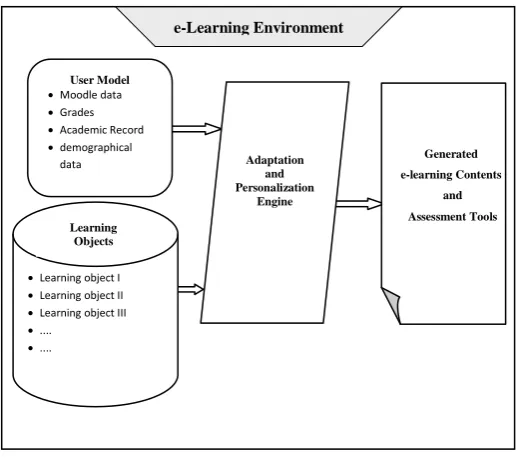
Based on the previous explanation for the research problem researcher develops a framework, shown in figure 3, that is supposed to answer the research questions. Moreover, data set from the elearning system at the Islamic University of Gaza was collected in order to test this framework.
Below is a description of the framework component:
1) User Model: this component contains: moodle data, grades in courses, academic profile. In this stage, I use data mining algorithms to classify the students to different categories in terms of two factors. First one is difficulty level of the learning content. their ability to understand learning contents (lower, intermediate, advanced level). The second factor is related to learner preferred learning style (theoretical-oriented or practical-(theoretical-oriented contents).
2) Learning Object database: contains database of learning objects.
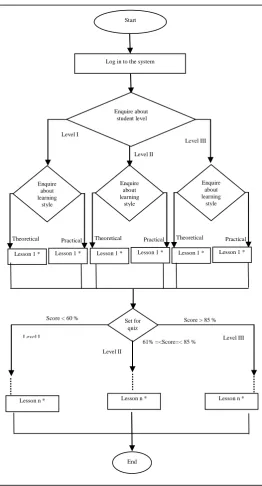
3) Adaptation and Personalization Engin: is responsible for taking the appropriate decision of which learning path should be followed by a specific student during the learning process. the engine will receive specific information about the appropriate learning path for a given user; then it will track student progressand grades in quizzes to adapt his/her learning path dynamically.
4) Generated elearning content and assessment tools:this is the output of the whole process
B. Implementation
[image:4.595.310.559.53.264.2]Here I explain the way of implementing the previous framework. This chapter is dedicated to describe the implementation process of the proposed framework. The following sections are prepared to show the different stage in analyzing data and implementing the actual code of this project.
Figure 4: APMoodle Structure
I can summarize the above structure, shown in figure 4, in the steps of building the system based on data mining technique; then establishing a connection between learning contents (lessons) and quizzes in order to make the system dynamically adaptable. Steps are listed as follow:
1) Data gathering: gathering data from its source at IUG: Since the information systems at IUG are not fully integrated with moodle, the process of gathering data was complicated. In other words, Moodle data was exported from Moodle; grades and academic profile was exported from student record system; student demographical data was exported from a special application for student social status.
2) Data pre-processing: five different tables were gotten from the previous steps, that’s why I developed an application to merge all of them in one table
3) Applying data mining techniques: I use Weka application with SimpleKMeans algorithm to cluster the student to different groups as I introduced previously.
4) Get and explain the results: after applying data mining technique, each student classified as shown in the figure 5. Each student has a specific level of understanding and the way he prefer to learn through (theoretical, practical).
e-Learning Environment
Generated e-learning Contents
and Assessment Tools Adaptation
and Personalization
Engine User Model
Moodle data
Grades
Academic Record
demographical data
Learning object I
Learning object II
Learning object III
....
.... Learning
[image:4.595.32.292.125.354.2]Objects Database
Figure 3: Proposed Framework
Communications
* Chat * Email * Forum * Wiki
Contents
* Lessons * Resources * Web pages * ISM Content
Packages * SCORM * Glossary
Assessment and Evaluation
* Assignments * Surveys * Quizzes * Wikis
Researcher main contribution in developing techniques for adaptation and personalization
Another Component
APMoodle
Theoretica l oriented Practical
oriented Data Set
Level I (Basic)
Level II (Intermediate)
Level III (Advanced)
Theoretica l oriented Practical
oriented
Theoretica l oriented Practical
oriented
[image:4.595.308.560.548.718.2]Having this framework implemented, each student has to pass through one of the learning paths shown below in figure 6.
V. DISCUSSION AND CONCLUSION
Through this paper, I developed a framework that is able to provide specific student with his/her preferred way for learning based on mining data about his/her record in previous courses. After assessing the student the system checks the learning path for each student and adapts it dynamically. My framework is in its early stages, there are some difficulties that need to be considered such as the ability of this model to fit with instructional design strategies (i.e. ADDIE, Dick and Carey model, etc).
On the other side, the findings of this phase of data mining offers insightful indications on how effective is applying further data mining techniques in learning environments such as using text and web mining instead of considering the number of posts in forums and email messages read or sent by a specific user
Finally, making this solution as embedded data mining block in the Moodle will make it very effective and useful.
REFERENCES
[1] Brusilovsky, P., Maybury, M., (2002). “From adaptive hypermedia to the adaptive web”, Communications of the ACM, v.45 n.5
[2] Martens, A. (2003) “Centralize the Tutoring Process in Intelligent Tutoring Systems”. Proceedings of the 5th International Conference on New Educational Environments, ICNEE, Lucerne, Switzerland. [3] Lagud, M., Rodrigo, M. (2010) ,The Affective and Learning Profiles of
Students Using an Intelligent Tutoring System for Algebra, Intelligent Tutoring Systems. Springer
[4] Martens, A. (2006) “Modelling of Adaptive Tutoring Process”. Web-based intelligent e-learning systems, Information Science Publishing, London, UK
[5] Brusilovsky, P. (2001) Adaptive Hypermedia. In User Modelling and User-Adapted Interaction 11.Kluwer Academic Publishers. Netherlands. [6] Nicholas, A. and Martin, B. (2008). Merging Adaptive Hypermedia and
Intelligent Tutoring Systems Using Knowledge Spaces. In Nejdl et al. (Eds.): AH 2008, LNCS 5149, pp. 426–430.Springer-Verlag Berlin Heidelberg
[7] Hsieh, C., Tsai, T., Wible, D., Hsu, W. (2002) “Exploiting knowledge representation in an intelligent tutoring system for English lexical errors” Proceeding of International Conference on Computers in Education., IEEE
[8] Mérida, D., Fabregat, R., Marzo, J.L. (2002) “SHAAD: Adaptable, Adaptive and Dynamic Hypermedia System for content delivery.” In: Workshop on Adaptive Systems for Web Based Education. WASWE 2002, Málaga España
[9] Ulbrich, A. et al., “First steps towards personalization concepts in elearning,” Lecture Notes in Informatics, GI, Gesellschaft für Informatik, Bonn. 2003. Pp. 229-233. Editors: Ulrich Reimer, Andreas Abecker, Steffen Staab, Gerd Stumme (eds.).
[10] Jones, N., Pu, P. and Chen, L. (2009) “How users perceive and appraise personalized recommendations”. In UMAP 2009 Proceedings of the 17th International Conference on User Modeling, Adaptation, and Personalization, pages 461–466, Berlin, Heidelberg, Springer-Verlag. [11] (2006) “The ICT Impact Report: A review of studies of ICT impact on
schools in Europe”
[12] Brar, A. and Kay, J. (2005). Privacy and security in ubiquitous personalized applications. Technical Report 561, School of Information Technologies, University of Sydney.
[13] Gu, Q. & Sumner, T. (2006). Support personalization in distributed e-learning systems through learner modelling. Proceedings of the 6th International Conference on Advanced Learning Technologies (ICALT’06). 24–28 April 2006. Volume 1, 610-615.
[14] Lane, H., Core, M., Gomboc, D., Birch, M., Hart, J., and Rosenberg, M. (2009) “Using written and behavioural data to detect evidence of continuous learning”. In Proceedings of the UMAP 2009 Workshop on Lifelong User Modelling, 2009.
[15] Octavia, J., Coninx, K., and Raymaekers, C., (2010) “Enhancing User Interaction in Virtual Environments through Adaptive Personalized 3D Interaction Techniques”. In De Bra, P., Kobsa, A. and Chin, D. (Eds.): UMAP 2010, LNCS 6075, pp. 423–426, Springer-Verlag Berlin Heidelberg
[16] Harrigan, M., Krav£ík, M., Steiner, C., Wade, V.: What Do Academic Users Want from an Adaptive Learning System? Technical Report, Trinity College Dublin (2009)
Level III Level I
Level III
Level II Start
Log in to the system
Enquire about student level
Theoretical Practical Enquire
about learning
style
Lesson 1 * Lesson 1 * Theoretical Practical
Enquire about learning
style
Lesson 1 * Lesson 1 *
Theoretical Practical Enquire
about learning
style
Lesson 1 * Lesson 1 *
Lesson n * Lesson n *
Lesson n *
End
61% =<Score=< 85 % Set for
quiz
Score < 60 % Score > 85 %
Level I
[image:5.595.29.292.95.582.2]Level II
[17] Dillenbourg, P. (2000). “Virtual learning environments”. In Proceedings of the EUN conference 2000: Learning in the new millennium: Building new education strategies for school.