FEBRUARY
1958
•
VOL. 7 -
NO.2
An Electro-Mechanical Model of Simple Animals
Comparing Digital Computing Systems
Automatic Programming for Business Applications
In BOBBIN CORES,
you
need PRECISION
tNUt
~d.
~1fHItd;n,A/W()Q)
Ultra-thin tape for bobbin cores is rolled to high precision standards for thickness and :finish on our own 20-high Sendzimir cold reducing mi11, beta-ray controlled.
(j)Jri$1fYu
BULLETIN TC-108A "TAPE-WOUND BOBBIN CORES FOR COMPUTER APPLICATIONS" Includes essential data on applications and properties, fabrication and testing of Arnold B.obbin Cores; lists standard sizes, etc.ADDRESS'DEPT. CA-82
2
• For use In shift registers, coinCldent ployed are Deltamax, Permalloy and
current matrix systems, pulse trans- Supermalloy, in standard thicknesses formers, .c;tatlC magnetic memory ele- of .001", .0005", and .00025". Core ments, harmonic generators and ~imi- properties include quite rectangular lar equipment, Arnold Bobbin Cores hysteresis loops, relatively low co-meet the most exacting requirements. ercive values and high saturation
Quality and uniformity? You'/l find densities, plus the ability to shift in
them no problem-because, as a fully a few microseconds from negative integrated producer with highly mod- remanence to positive saturation, and ern facilities, we're able to maintain vice versa, under conditions of pulse close control over every step. excitation. • Let Arnold supply your Arnold Bobbin Cores are available requirements for Bobbin Cores-or in a wide range of sizes, tape thick- other tape-wound cores, powder nesses, widths and number of wraps cores, permanent magnets, etc.-from depending on the ultimate use of the the most complete line of magnetic core. Magnetic materials usually em- materials in the industry. wsw 6399
.ENGINEEiiiG ..
···C6~p~l
<, " , ,:'~"", • ,~,' ' ; ' , ~,~->t~:1<,
'. 'Main
'Office
,&, PI~n't:Marengo, Illinois,''',
,,',,};L;.}:
Repath Pociflc Dlv'Aon Plantt 641, Eost'61.t 'Street, LO$ Anget~'J calif~(::*"
, ',' : " "" ;','
'Oi$t~ici:SQ/~$:Office$::',' ... " "
<,~,{";~<':'Boston: 49 Waltham St.~ texl!'lgfon "Lo~ Angeles: 3450 Wi/5hire Blvd.: ':
New York: '35Q 'Fifth
A,n.
;W(l$hi~gf~~~ D'.C.~"1001 .. 15tt; Sf'J N.W. ,.'" , " . , ' , ' . . . , " ,Readers' and Editor's Forum
FRONT COVER: MACHINA VERSATILIS
THE FRONT COVER (which is also Figure 1 of the first article in this issue) shows an electro-mechanical animal, the September, 1957, model of Machina Versa-tilis, made by Ivan Sutherland. This machine is a suc-cessor to the earlier models made by William R. Suther-land and Malcolm G. Mugglin. This machine has two wheels forward (each separately driven) and one rolling caster rear (none visible in the picture), two "eyes" (photoelectric cells) inside the dark plastic at the top of the central post, and a bumper of plastic all the way around, to sense obstacles. The coin gives an idea of the size. Different plug-in circuits vary the behavior and the intelligence of the animal.
CO-OPERATION IN HORROR
ONE OF the papers recently submitted to COM-PUTERS and AUTOMATION to consider for publica-tion was entitled something like "diffusion calculapublica-tions on the [trade name] electronic computer." It came from a writer at the U.S. Army Chemical Corps, and referred to a "chemical munition, which is designed to disseminate an agent in the form of a gaseous or aerosol cloud which will travel near the surface of the earth." The phrase "poison gas" was avoided, but that is the concept which leapt into your editor's mind.
This paper reminded me of some of the problems which the Nazis put into arithmetic books for young German boys to study in the days when Hitler was de-veloping the Nazi state. One problem, as I remember, asked the youngster to calculate how many bombs would be required to destroy a circular town, given that one bomb would destroy such and such an area, and given the diameter of the town.
I can well imagine that if automatic electronic digital computers had been available in Nazi Germany, they would have been applied to computations such as find-ing out how much nerve gas would be economically necessary to kill stated numbers and distributions of Jews in the concentration camps of Buchenwald Dachau Maidanek, . . . (The Nazis in fact put to d;ath ove; 6,000,000 Jews, unarmed and captive.)
There are weapons which can be used for defense and not for offense, like a radar warning network. There are weapons that can be used for defense and for offense both, like a fighter aircraft. And there are weapons that can. be used for offense only, like poison gas and bio-logiCal warfare, such as the spreading of a mortal disease that only one combatant has an antitoxin for.
(Inci-de.nta~ly success~u.l biological warfare is probably more sCIentlfically effiCtent than any kind of atomic bomb
beca~se
it selects human beings and puts them to death: leavtng enemy property intact and the air of Earthuncon-~,amin~~e~ by any radioactivity - a weapon completely .clean m the language of the Atomic Energy Commis-s1On.)
To look back in history, there are other weapons used for offense only, and especially against captives: torture, starvati?n, operations to change the character or virility of a pnsoner, the torture of a prisoner's wife and chil-dren in front of him, . . .
All these fields are open to science, the scientific
~et~od of investigation and experiment, the solving of mtncate problems by automatic computing machinery.
But is there no horror point?
Is there no point at which a self-respecting human being should say "I cannot do this - I cannot study this, investigate this, publish this . . . I cannot have anything to do with this: this is horrible"?
President Eisenhower on Jan. 10 in his State of the Union Message to Congress said "In the last analysis, there is only one solution to the grim problems that lie ahead. The world must stop the present plunge toward more and more destructive weapons of war, and turn the corner that will start our steps firmly on the path toward lasting peace."
In agreement with that view, we trust that it will be a very long time if ever before COMPUTERS and
AUTOMATION publishes articles dealing with "diffu-sion calculations" on the spreading of poison gas.
IRE 7TH REGIONAL CONFERENCE AND TRADE SHOW - SACRAMENTO, CALIF. APRIL 30-MA Y 2, 1958
Ewald W. Berger
Chairman of Conference Sacramento, Calif.
WE ARE CALLING for papers for this forthcoming conference and show, particularly first-rate technical papers on the Conference Theme "Accelerated Progress m Elec.tronics." We are interested in the following categones:
Aeronautical & Navigational Electronics Antennas & Propagation
Audio
Circuit Theory
Communications Systems Electronic Computers Electronic Devices Engineering Management Industrial Electronics Instrumentation
Microwave Theory & Technique Military Electronics
Vehicular Communications
Abstracts outlining the subject matter of the paper
shoul~ be forwarded promptly for consideration by the techntcal program committee; closing date is February
28. Address all entries or inquiries to the Technical Program Chairman, IRE 7th Region Conference, Senator Hotel, Sacramento, California.
COMPUTERS
and
AUTOMATION
DATA PROCESSING
•
CYBERNETICS
•
ROBOTS
Volume 7
Number 2
FEBRUARY,
1958
Established September 1951
FRONT COVER
Machina Versatilis 1,6
ARTICLES
An Electro-Mechanical Model of Simple Animals 1, 6
WM. R. SUTHERLAND, M. G. MUGGLIN, and IVAN SUTHERLAND
Comparing Digital Computing Systems: An
In-creasing Problem . 10
JOHN A. McGANN
Automatic Programming for Business Applications 14
GRACE M. HOPPER
READERS' AND EDITOR'S FORUM
Co-operation in Horror 3
IRE 7th Regional Conference and Trade Show-Sacramento, Calif., April 30 - May 2, 1958 3 Western Joint Computer Conference-Los
Ang-eles, May 6 - 8, 1958 13
DAVID PARRY
Small Automatic Computers and Input/Output Equipment - A Report from the Manufacturers
- May 9, 1958 13
FRED GRUENBERGER
International Conference on Scientific Information
- Request for Papers 13
INDUSTRY NEWS NOTES
Digital Tape System: 90,000 Characters a Second. 17 Digital Computer Controlling Oil Process 17 Millions of Tiny Ferrite Memory Cores 17 Electronic System for Avoiding Air Collisions . 17 Double-Length Double-Strength Magnetic Tape 17
High-Speed Printer . 17
EJITO::l.: Edmund C. Berkeley ASSISTANT EDITOR: Neil D. Macdonald
SERVICE AND SALES DIRECTOR
M. L. Kaye, 535 Fifth Ave, New York 17, N. Y .. Murray Hill 2-4194 CONTRIBUTING EDITORS
Andrew D. Booth Ned Chapin John W. Carr, III Alston S. Householder
ADVISORY COMMITTEE
Samuel B. Williams Herbert F. Mitchell, Jr. Howard T. Engstrom Alston S. Householder H. Jefferson Mills, Jr. George E. Forsythe
Morton M. Astrahan ADVERTISING REPRESENTATIVES
New England: Ed Burnett, 815 Washington St., Newtonville 60, Mass. . . . . Decatur 2-5453 Middle Atlantic States: Milton L. Kaye, 535 Fifth Ave., New York 17, N.Y • . . . Murray Hill 2-4194
4
Selecting Areas in Punched Paper Tape According
to Address . 17
Post Office Operations - A Report on Progress of
Mechanization . 18
A Ball Point Pencil--- Is a Computer? 19
TED F. SILVEY
Oil Industry Comments on Computers 20
Instruction . 21
REFERENCE INFORMATION
Books and Other Publications 26
Automatika I Telemechanika . 28
INDEX OF NOTICES
Advertising Index . 36
Change of Address: If your address changes, please send us both your new address and your old address (as it appears on the magazine address sticker), and allow three weeks for the change to be made.
THE COMPUTER DIRECTORY AND BUYERS' GUIDE, 1958
is the June, 1958, issue of COMPUTERS AND AUTOMA-TION. We plan that it will be printed by letterpress, and will contain at least 75 pages. It will hold more information than last year's directory, which contained over 700 Organization entries and over 1300 Product and Service ~ntries.
BE SURE TO SEND US YOUR ENTRIES Write us for information: COMPUTERS AND AUTOMATION
815 Washington Street Newtonville 60, Mass.
San Francisco 5: A. S. Babcock, 605 Market St . . . Yukon 2-3954 Los Angeles 5: W. F. Green, 439 S. Western Ave ... Dunkirk 7-8135 Elsewhere: The Publisher, BerkelE:Y Enterprises, Inc., 815 Wash-ington St., Newtonville 60, Mass ... Decatur 2-5453 or 2-3928 COMPUTERS and AUTOMATION is published monthly at 160 Warren St., Roxbury 19, Mass., by Berkeley Enterprises, Inc. Printed in U.S.A.
SUBSCRIPTION RATES: (United States) $5.50 for 1 year, $10.60 for 2 years; (Canada) $6.00 for 1 year, $11.50 for 2 years; (For-eign) $6.50 for 1 year, ~12.50 for 2 years.
Address all Editorial and Subscription Mail to Berkeley Enterprises, Inc., 815 Washington St., Newtonville 60, Mass.
ENTERED AS SECOND CLASS MATTER at the Post Office at Bos,ton 19, Mass. Postmaster: Please send all Forms 3579 to Berkeley Enterprises, Inc., 160 Warren St., Roxbury 19, Mass.
Copyright, 1958, by Berkeley Enterprises, Inc.
•
mch .companY .offers
mi\Xll\\um saVUlgs on
custom-built delay lines?
COMPUTE RS and AU
• no
submits the most
complete laboratorY reports
with
all
custom-built
delay \ine prototypes?
j}
$[tc
O~~~';"';--lfl'I-pO~rtant
Question~o.l
An Electro-Mechanical Model of
Simple Animals
William R. Sutherland Malcolm G. Mugglin, and
I van Sutherland
Scarsdale and Troy, N.Y.
(Based in part on a thesis submitted by W. R. Sutherland and
M. G. Mugglin to the Department of Electrical Engineering, Rensselaer Polytechnic Institute, Troy, N.Y.)
O
UR SUB ]ECT lies in a novel and relatively unex-plored field: to make a machine that mimics some of the characteristics of living things. To do this requires a combination of electronics and biology; yet it is diffi-cult to -bridge the gap between two fields so far apart. However, we have constructed and studied some electro-mechanical models of simple animal life, and the pur-pose of this article is to report on what we have studied and constructed and to discuss some of the implications. We should like to acknowledge our indebtedness to W. Grey Walter, Claude Shannon, W. R. Ashby, and other scientists who have examined automata and robots, either theoretically or with working models. For exam-ple, W. Ross Ashby in England has built a device which he calls a homeostat. It behaves like a sleeping cat which when poked finds a comfortable position and goes backto sleep. It has a very large number of possible stable states so that whenever it is disturbed it methodically searches until a new stable state results.
W. Gr~y Walter has published an account of the "life and habits" of an electro-mechanical creature which he built and named mock-biologically "Machina Specu-latrix." When placed in a room or other suitable en-vironment it would immediately begin to explore follow-ing a cycloidal pattern. Speculatrix would turn from its wanderings to investigate lights. l,t was attracted to light of medium intensity and repelled from strong light. When it bumped into an obstacle it would back and turn until it had freed itself. During the time it was escaping from an obstacle, Speculatrix had no in-terest for lights. This singleness of purpose is necessary for it to avoid becoming caught on the horns of a dilemma. Neither could it be caught between two lights of equal intensity but would go first to one and then
to the other. It was also capable of recognizing itself in a mirror because of a pilot light on the creature it-self. Last but by no means least, when its battery began
to run down it would seek out its "hut" and go there
to be recharged. A later attachment was added to [he animal so that it could learn. This involved the analogy of a conditioned reflex so that it could be taught that "sound means light" and hence would come into the room on hearing a whistle.
It is becoming increasingly apparent today that there are similarities between the behavior of electronically controlled machines and that of certain animals. Since we design computing machines to carry out operations
6
that seem logical to us, we should not be so surprised when they show some of the same tendencies and sus-ceptibilities that animals do; nevertheless we are. Some-how we find it difficult to admit that machines may be-have in a life-like manner.
An electro-mechanical model has many advantages over the animal it imitates. Parts are interchangeable, closer control and measurement are possible, and a better understanding of the mechanisms involved may be afforded.
Desirable Characteristics
Some of the characteristics that are inherent in animals are difficult to accomplish in machines. The problem of learning and forgetting is one of these. Computing machines learn instantly and retain the information in-tact until cleared, whereupon they forget instantly as well. This is a desirable characteristic in a computing machine but is not a characteristic of life, which learns slowly and forgets slowly. The same objection may be raised in the case of Claude Shannon's mechanical mouse which fidgets its way through a maze bumping into the walls until it eventually reaches its goal. The second time it goes through the maze it remembers its way perfectly making no mistakes. It does not forget unless the machine is turned off, clearing the memory. A more life-like model should learn gradually through repeated trials and forget slowly if the experience is not repeated.
Another problem is that of getting some sort of un-predictable or experimental behavior. This is a rather knotty problem, and in the machines we have con-structed it is solved in only a limited fashion, but in a way not inconsistent with the machine's low intelligence. The machine has a set of alternatives to choose from when it encounters a given situation. Which alternative it chooses is tied in with the problem of learning as we shall see presently. However, it should be obvious that if the model is to have any interest for most investi-gators, it must be somewhat unpredictable.
Another important characteristic to put in a life-like machine is curiosity. When placed in a strange environ-ment, an animal will begin to explore, encountering many varied situations. This was lacking in one of our earlier models. The lazy thing just couldn't be bothered to look for some fun but preferred to sit idly until some-thing stimulating it came along.
A model of an animal should also have a more than
passing interest in its surroundings. It should actively seek some goal such as a light as a moth does. Curios-ity plus goal-seeking provides a basis on which more complex behavior can be built.
It is of course inevitable that such a model will run into many obstacles during its explorations. Some means of escaping from these "stumbling blocks" must be pro-vided.
A group or small society of these mechanical animals must also have some way of communicating in a very simple fashion. Without this characteristic there would be little chance of getting any cooperation or analogous group behavior.
Finally, it is important to point out that there is a difference between models that imitate the appearance
of life and those that imitate the behavior of living
organisms. There was at one time a toy beetle on the market that illustrates this point quite well. It had two rear driving wheels and a front transverse driving wheel. It was so constructed that a feeler was in contact with the table top where it rested and the feeler was long enough and positioned so that it prevented the trans-verse driving wheel from resting on the table. The beetle would run forward until its feeler ran off the edge. The transverse driving wheel then would fall on the table and turn the beetle away from the edge. The same type of mechanism has also been mounted in a toy car. The important thing is not whether it looks like a beetle or an automobile, but rather that we have here a mech-anism with a built-in "instinct" for self-preservation in a hostile environment.
These are some of the desirable characteristics of a model of animal life; however it is sometimes a problem of no mean proportions to design a working mechanism having these characteristics.
Power for Electro-Mechanical Animals
All life depends on energy obtained from some kind of food. A model of life must likewise obtain energy and should be able to store it for future use. However, the choice of a power supply for a model animal is some-what limited. The power supply must be portable and therefore reasonably light; it must be independent of its environment except for "meal-times;" and it must not be too difficult to construct.
A gasoline or steam engine would be light and easily "fed" but, besides being difficult to connect to the driv-ing wheels, a convenient size is not available. Further-more, the fumes are a problem.
Compressed air would be a better source of power. We have experimented with an air tank and a wind-shield wi per motor and found that, although this sys-tem worked, it was too hard to control. Then too, high pressure air is not easily available.
A storage battery seems to be the most practical. It
has some disadvantages, namely a low energy storage, high weight, and a long recharging time, but these are outweighed by its availability and ease of connection. Previous experience that we had with the electro-me-chanical squirrel Squee of E. C. Berkeley, which used a six volt Willard wet battery, showed that a higher voltage source was definitely desirable. A higher voltage system would have less current drain, simplifying the control problem and extending the operating time be-tween chargings. A surplus 28 volt Willard battery of
COMPUTERS and AUTOMATION for February, 1958
reasonable size was available and was the supply of the June 1957 models. In addition, some small but power-ful 28 volt, DC series wound motors were cannibalized from surplus fans and became the driving motors.
But subsequently we transistorized and lightened the whole model animal. The September 1957 model (see Figure 1) contains three sets of dry batteries: about ten size D flashlight batteries; about six penlite batteries (for the transistors); and 2 Burgess 67¥2 volt batteries.
Steering and Driving
For steering, both Walter's Turtle and Berkeley's Squee made use of a single front wheel for both steering and driving. There were two rear wheels for support, free-running, much like a child's tricycle. This method has at least one serious drawback: it is mechanically difficult to construct. The driving motor must be mounted on the steering column, making it bulky and requiring brushes and slip rings. Therefore, we decided to use two independent front driving wheels and one free-rolling rear caster. Driving one wheel or the other provides a method of steering somewhat analogous to that of a caterpillar tractor.
Our first model animal (Spring, 1956) showed the advantages of these basic changes. As expected, the driving and steering systems worked well, and the higher voltage was a definite asset. Nevertheless this animal still left much to be desired. Its bumpers were unsatisfactory, and the battery needed to be mounted so as to be accessible without dismantling the machine. In addition the dynamotor, which was the plate supply for the vacuum tubes, drew too much current. We decided to switch to transistors and get rid of the vac-uum tubes. Doing this had double effect; it eliminated not only the dynamotor but the filament current as well. During the summer and fall of 1956 we started con-structing a second model, which included desirable features lacking in the first model. The second model had a cast aluminum body, and its battery could be removed through the bottom. The battery was covered by a plastic case which supported the bumpers and many of the components. The bumpers themselves were bent out of plastic and hung from the battery case by four spring wires.
Permanent Senses and Active Responses Once the power supply and the basic mechanics of the model were decided upon and worked out, our next problem was making the permanent senses. These senses are sight, hearing, and touch; and the responses are moving, squealing, and lighting up.
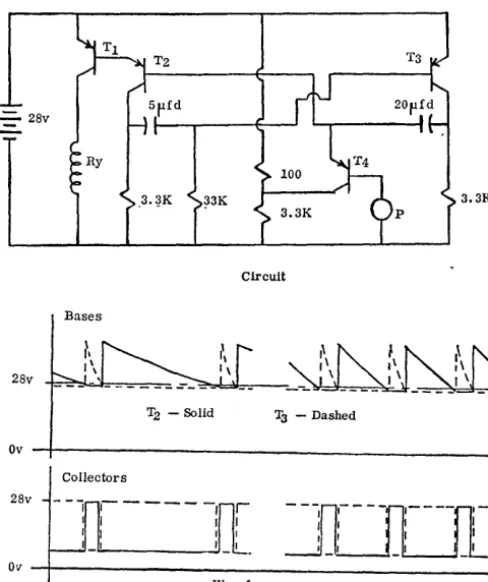
To control the motors, we need relays, but instead of a simple on-off control, each relay was run by a multivi-brator, which pulsed it periodically (see Figure 2). Varying the repetition rate of the pulses provided a variable motor speed. This system proved to be quite satisfactory. The only drawback is sparking at the relay contacts. Each motor had an additional relay to control its direction (see Figure 3).
The model's eyes directly controlled the repetition rate of the multivibrator. The motor relays receive a pulse every two to five seconds when the model is in complete darkness. When the eye sees light, its re-sistance decreases, the pulses become more frequent, and the motor speed increases.
=
28v3.31\
Circuit
Bases
28v
T3 - Dashed
Ov
-1---Collectors 28v
Ov - ; - - - -__________________________________ ___
[image:8.604.42.286.17.308.2] [image:8.604.307.541.369.564.2]Waveforms
Figure 2. Multivibrator Motor Control. Note how T 4 provides a variable time constant which changes the
spacing of the short on-pulses. T 1, T 2, T 3 - -Clevite
1032. Ry -- Motor relay. T4 --Raytheon CK 722, low leakage. P -- Photocell, Clairex CL 3.
Each eye consists of a cadmium selenide "retina" (photo-cell) mounted in an eye socket. The socket limits the field of vision to a 30° cone. The eyes are mounted on a circular "head" so that the animal may be made to look in any direction. If the eyes are set at a slightly diverging angle, a light directly ahead will be seen by both eyes while a light moving to one side will pass out of one eye's field of vision before the other's. Connecting each eye to the opposite motor enables the model to follow a light. A light illuminat-ing only one eye will drive the opposite motor, turnilluminat-ing the machine until both eyes see equally well. If the head is p'ointed forward, lights are attractive. If the head is positioned sideways, a wary circling results. If
made to look "over its shoulder," the model slinks away from the light like some forlorn nocturnal creature. The plastic bumpers provide the model animal's sense of touch, enabling him to detect obstacles. The circuit adopted for obstacle evasion is shown in Figure 4. Each motor's direction is controlled by a neon tube oscillator and oscillates between forward and reverse. The two oscillators are independent of each other, making the resulting motion a random jigging that will eventually take the animal clear of the obstacle. The rest of the circuit is a delay which continues the jigging for about three seconds after the bump signal ceases.
Communication
The one construction problem we did not finish to our satisfaction was communication between animals. Making a voice was easy, but the model's ear was an
8
inherently difficult problem. The motors are noisy; the ear must reject this noise but yet pick up sounds from the other animals. This means either using a very loud "voice" in each animal or else filtering out the motor noise. Several attempts at filtering were made, none successful. So it seemed best to bypass the problem by moving the frequency into the rf range. 425 mega-cycles provides a reasonable antenna size (~ wave-length is 7 inches) and we had a small transmitter for that frequency. The receiver for each animal, however, has not yet been built. The use of this "hearing aid" transmitter to rebroadcast audible sound should cause no change in the external behavior of the model. In fact an observer could not tell the difference.
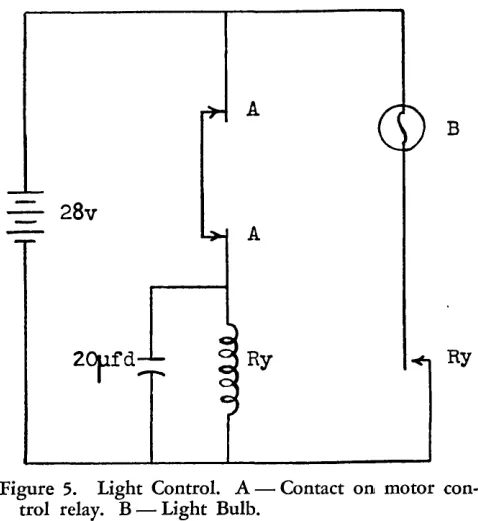
The last response included is a light mounted on each animal and controlled by a relay (see Figure 5). At present the light is connected so that it is on when the animal is moving slowly and goes out when motion be-comes rapid.
To make the models versatile the components are mounted in interchangeable printed circuits. The wir-ing is made from a copper clad formica board by pro-tecting the desired layout with tape, and then etching away the undesired copper.
The animal's brain, where the senses are connected to the responses, is also easily changed. It is mounted on a small chassis which plugs into the animal. Thus by changing brains a cowardly animal may be made into a ferocious beast.
28v
28v
Reverse relay
Field
Armature
(a) (b)
Figure 3. Motor Direction Control
Characteristics of a Brain
The most basic type of behavior is instinctive. In-stinct is possessed by all animals. In fact, the lower forms of life operate purely as a result of it. If we were to consider the brain of an animal as a "black box," instinct would dictate that the inputs and outputs be directly connected. That is, the same stimulus would always produce the same response.
As we progress up the ladder toward higher forms of life, we find what might be called a "capacity for learning." This implies that there is a physical pro-vision for switching between stimuli and responses, whether this provision is ever used or not. It is,
there-[Continued on page 23]
GUIDANCE and CONTROL
in SPACE TECHNOLOGY
It is becoming increasingly apparent that many of the techniques and analyses, and much of the equipment, developed for the present Air Force ICBM-IRBM pro-grams will have a wide future application in space technology. For instance, many of the guidance and con-trol techniques for ICBM's are applicable to the space vehicles of the near future.
An important element of these applications is preci-sion. The precision required of the guidance and control system for vehicles aimed at the moon or one of the planets is not substantially greater than that required for the Air Force ICBM-IRBM programs. And, the precision needed to guide a vehicle into a near-circular orbit of Earth is even less than that required for ICBM's.
The problem of communication with lunar and plane-tary vehicles is, of course, made more difficult by the much greater distances involved. This, however, is not an insurmountable difficulty if today's trends continue in the use of higher transmitted power, narrower com-munication bandwidths and amplifiers with very low noise-figures.
The problems of operating electronic equipment in the space beyond our atmosphere are already encountered on present ballistic missile trajectories. The principal dif-ference in the case of space vehicle applications is the
requirement for longer equipment lifetimes. Electronic equipment and power supplies will have to last for several hours or days or weeks, instead of a few minutes, under conditions of vacuum pressure, zero "g" fields, and bom-bardment by micrometeorites, high-energy particles, and' radiation.
The preceding examples serve to illustrate some of the ways in which the ICBM-IRBM programs are advancing the basic techniques of space technology.
Since 1954, Space Technology Laboratories has been providing over-all systems engineering for these pro-grams. Both in support of this responsibility and in antici-pation of future system requirements, the Laboratories are presently engaged in a wide variety of advanced analytical and experimental work directed toward the exploration of new approaches in space vehicle elec-tronics, propulsion, and structures.
The scope of STL's work requires a staff of unusual technical breadth and competence. Engineers and scien-tists who are interested in advanced experimental devel-opment projects (as distinct from develdevel-opment for manufacturing, in which STL is not engaged) are invited to investigate the many opportunities on the Laboratories' Technical Staff.
SPACE TECHNOLOGY LABORATORIES
A Division of The Ramo - Wooldridge Corporation
15730 ARBOR VITAE STREET. L.OS ANGEL.ES 45. CAL.IFORNIA
Comparing Digital Computing Systems:
An Increasing Problem
John A. McGann
Alwac Corp. and Consultant Williston Park, N.Y.
T
HE CHOICE between differing systems and ap-proaches is a problem plaguing consultants, pros-pective users, and manufacturers of digital computers, alike. This mounting problem can be divided into two areas for exploration: the development of overlapping scales of equipment; and the advancing capabilities of peripheral equipment. A third area, the poteiuialities of special purpose devices in integrated systems, could be a further area to be considered; but the first two areas will be sufficient, however, to illustrate the topic being discussed.When the approach to data processing problems was as simple as the input, memory, arithmetic, control, and output explanations of computers, the evaluation of a system was much less of a problem. Input, output, and files were defined; time was approximated; and cost was calculated. The early proposals prepared by consultants or manufacturers seemed to present a straightforward justification of a system under consideration. Many problems in applying systems had not come to the sur-face; but the concept of a definite array of equipment to do a job was not clouded with the considerations of alternate arrays utilizing differing system approaches.
Overlapping Scales
The first area of difficulty in planning occurred with the appearance of computing systems covering a wide range of costs and capabilities. The large-scale Univac, E.R.A., and I.B.M. 700 systems, and the medium-scale I.B.M. 650, Alwac, and Datatron systems, originally divided the field into the fixed and separated areas just mentioned. Then, developments of peripheral equip-ment made it possible to build up the price of the me-dium systems mentioned, and of more recent meme-dium systems such as the File Computer, until the cost as well as processing capabilities in some instances fell into the large-scale range. This encouraged competition be-tween medium-scale computers utilizing a variety of input-output equipment and larger systems.
The same effect can be noted between the large scale systems mentioned and the "giants" that have recently appeared on the market, such as Datamatic, Bizmac, etc. The problem is more intense between the medium and large scale systems, however, since there are more sys-tems available in these areas.
Also, there are systems under development which will fall in between the scale classifications mentioned, and this will add to the difficulties of comparison. It has been suggested that these systems, which include the Alwac 800, N.C.R. 304, and Datatron 220, be classified as intermediate, but there will be a tendency to discuss their capabilities as large-scale and show that their prices start in the medium-scale region.
10
The consultant or prospective user realizes that his system considerations must not. only include the
ap-proaches that could be taken with a large-scale system but also those that could be taken with a medium-scale (or intermediate) system utilizing a stated quantity of peri-pheral equipment. These considerations may also have to pit a large-scale system against 2 or 3 medium-scale systems. The, two or three medium-scale computers might approach the job in the same fashion as a large-scale computer; or they might divide the job ve!:tically,
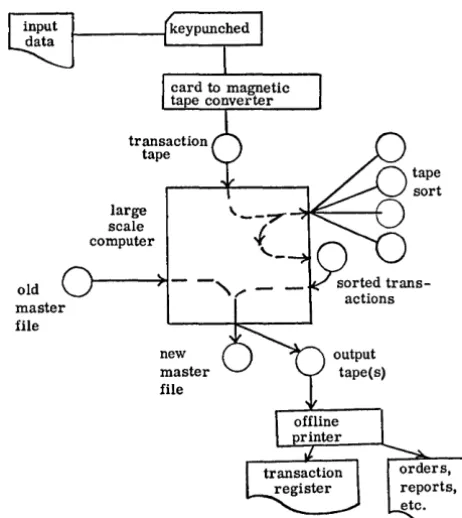
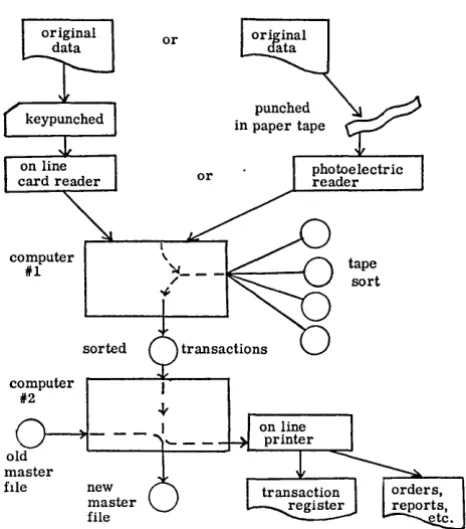
each computer handling a specific phase of the toGd job. The accompanying diagrams (Figure 1 and Figure 2) illustrate this difference in system approach in terms of a generalized area of file maintenance, inventory con-trol.
This job shown in Figure 1 could be divided on two medium scale computers so that half of the master file would be updated on Computer 1 and the other half would be updated on Computer 2. Or, the job could be divided vertically as shown in Figure 2.
old
master
file
large scale computer
new
master
[image:10.599.301.532.387.646.2]file
Figure 1. Inventory Control on a Large Computer (Generalized)
Of course there are other variations of these systems. In addition, the cost of one large system may be so high as to allow a three computer system to compete. Before discussing other approaches, it will be necessary to ex-plore peripheral equipment. Then, a more extensive
computer
ill
computer 112
master hIe
sorted
new master
file
transactions
[image:11.597.56.289.16.280.2]tape sort
Figure 2. Inventory Control Using Two Medium-Scale Computers
comparison of systems and an elaboration of techniques of comparison can be introduced.
The Capabilities of Peripheral Equipment Peripheral equipment has expanded to embrace a variety of on-line and off-line equipment. The on-line equipment, or devices which operate directly from or to the computer, include card readers and punches, paper tape readers and punches, low-speed and high-speed printers, magnetic tape systems, and random access de-vices. The off-line devices which operate to or from magnetic tape apart from the central computer, include card readers and punches, low and high-speed printers, and graph plotting devices.
The development of efficient on-line buffering and editing devices has made it difficult to compare the relative benefits of on-line and off-line equipment. In effect, it may be possible to prepare efficient techniques utilizing either alternative although particular problems may favor the concentration of output for off-line printing, reading input in order from an on-line device, etc.
In addition to the foregoing deluge of possibilities, magnetic tape systems have been improved and modified.
It is now possible to search magnetic tape systems for a specific field of data recorded on tape or to search for a location on tape. Some tape systems have also been provided with buffers that make simultaneous tape work possible. On-line record searching, and random access from normal tape units, are applications possible with these tape systems.
This situation in regard to peripheral equipment has made it possible for a problem to be processed in a variety of ways utilizing the same computer with differ-ent arrays of associated equipmdiffer-ent. Consequdiffer-ently, the prospective user, consultant, or manufacturer must con-stantly juggle different arrays and varying approaches as processing is planned.
Moreover, this problem is hardly static: the equip-ment available can hardly be isolated and examined, for there are not only new computers but new peripheral devices flowing from the cornucopia of the industry.
Varying System Approaches Illustrated
Let us consider some more variations of equipment for the inventory problem, different arrays of equipment and different system approaches, all directed toward a generalized inventory control application.
Figure 3 shows two medium-scale computers dividing the job horizontally. This system could also provide output by having both computers supply an output mag-netic tape for off-line printing by a high-speed printer.
Figure 4 shows a vertical division of processing, ac-complished with an off-line sorting of transactions, and selection of active records by an off-line magnetic tape processing device.
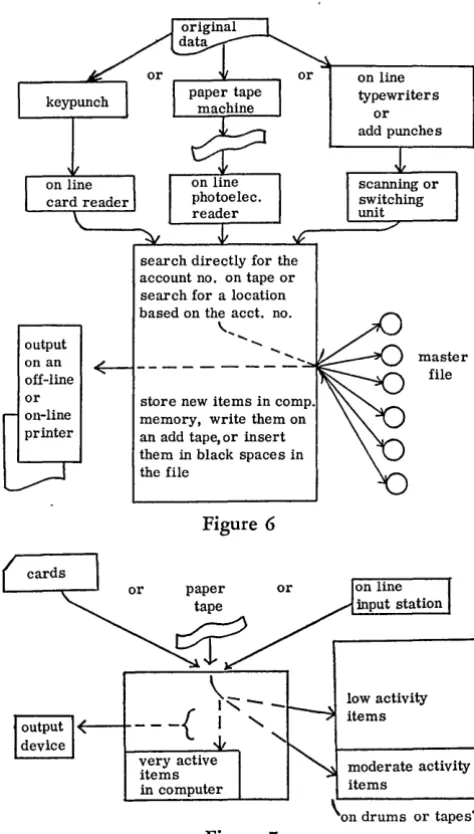
Figure 5 shows a medium-scale computer with one (or more) random access units. Two or more medium-scale random storage systems could divide the job horizontally. Figure 6 shows one (or more) medium scale systems using advanced magnetic tape drives and an additional form of input, on-line typewriters or add-punches.
The inventory file could be rewritten weekly, monthly, etc., with the additions incorporated. For the tape sys-tems which can search on the actual contents of a word, the additions would be inserted in an account number order in accordance with the dictates of the particular application or company. In the systems which search for a location, the additions would be placed in open spots or at the end of the file in accordance with the computer techniques of calculating location.
Figure 7 shows a medium-scale system dividing the inventory on different types of storage as to frequency of activity.
There are many additional areas in which these sys-tems may vary, such as:
1. Inquiry: (a) an on-line manual system; (b) an off-line magnetic tape or drum inquiry system; (c) spe-cial inquiry transactions entered through the normal
[image:11.597.316.555.483.738.2]tape sort
mag. tape processor
mag. tape processor
sorted trans.
updated records
paper tape punch
master file
mag. tape processor'
--
-'"
/computer sorted trans.
new master file
' - - - '
Figure 4
in storage unit
'-
..
- -~,... [image:12.597.38.280.23.506.2] [image:12.597.302.539.322.739.2]---new items stored in the computer or placed in the storage unit
Figure 5
random access storage unit(s)
input scheme; (d) an off-line printout to be used for inquiries; (e) special inquiry periods during which the computer is to be interrogated with on-line devices.
2. Final output preparation: (a) the output may be prepared with on-line or off-line printers (an off-line printer will make a tape available, the one used to create the printout, for other purposes such as off-line inquiry, permanent records, source of later printouts, etc.); (b) one high speed printer with a plugboard (but no counters), or two or more low-speed printers with plug-boards and counters could be employed. Both types of printers can be employed on-line or off-line.
3. Account number system: (a) The account number system can be determined outside of the computer area in relation to the requirements of the particular com-pany and application. (b) The account number system can be determined by computer area requirements. The account number could refer to the location of a par-ticular record on magnetic tape or on a drum. (c) The account number system could be a mixture of the types
12
(a) and (b). The first two digits of a 5-digit account number might refer to a general area of computer stor-age. The last three digits might refer to the require-ments of the application. This would reduce computer searching or look-up to some extent. (d) Computer searching could also be reduced by having the computer generate the tape or drum location of a particular record by a mathematical treatment of the account number used. If this were done, there would be limitations upon the account numbers chosen for new accounts outside of the computer area. In the generation of a location from an account number (or from a name and address), redundancy, or the generation of the same location from different alphanumeric combinations is always possible.
The Problem of Multiplicity
These facts illustrate the multiplicity of choices that are available in planning a data processing installation. These choices involve not only many arrays of equip-ment but also the variety of system approaches that are possible with different devices.
The multiplicity of choices, however, has its advan-tages. In fact, the major aspects are encouraging for the development of commercial and scientific data pro~ess
ing. The greater range of capabilities that are now avail-able, make this possible.
output on an off-line
search directly for the account no. on tape or search for a location based on the acct. no.
\., ...
store new items in compo memory, write them on an add tape, or insert them in black spaces in the file
Figure 6
very active items in computer
or
Figure 7
on line typewriters
master file
moderate activity items
\:on drums or tapes]
The greater range of capabilities has a strong influ-ence on system planning. The prospective user can de-vote more attention to his requirements and less to the reorganization that previously might have been necessary in order to make use of the limited capabilities of a com-puting system. Although a prospective user may find it helpful to understand the types of devices that are present in the field, he may not have to know fine de-tails of particular devices.
Since each manufacturer will try to interest a prospect in the most economic system using his own equipment when he is competing against other manufacturers, much of the burden of weighing peripheral systems is removed from the prospect and placed on the manufac-turer. The prospect can examine proposals from the standpoint of asking which system will accomplish the job for the least amount of cost (direct and indirect). The computing systems, together with peripheral equip-ment, which are most favorable, can be examined further.
Safeguards in this type of examination should be introduced, however. It might be necessary to test part of a job at a contract computing center on equipment like the equipment being considered or examine a pro-duction line or installation already using the equip-ment. These steps would be for the two purposes: to make sure that the machinery is or will be available; to make sure that it can accomplish the processing being considered.
Many computer prospects, however, are rather over-whelmed with the comparison of various systems and conflicting system approaches. For them the general type of approach discussed may not be usable. Some-times these prospects may have to pioneer systems them-selves, or await future developments, and study for some time the experience of others. However, in gen-eral, the present variety of computing systems has brought the possibilities of electronic data processing to a much larger market of users. Their solution to the multiplicity of choices will basically depend on cost, power, air conditioning, space, inquiry time, personnel, system material (reels of magnetic tape, paper, etc.), etc. These parameters will be computed for many different combinations of equipment, until solution very likely to be the best is reached.
Readers' and Editor' s Forum
[Continued from page 4]
WESTERN JOINT COMPUTER CONFERENCE-LO'S ANGELES, MAY 6 TO' 8, 1958
David Parry
Los Angeles, Calif.
A NATIONAL SYMPOSIUM on modern computer design methodss and application techniques, at which
lead-ing authorities in the field will argue the relative merits of various systems and components, will take place in Los Angeles beginning May 6 at the Ambassador Hotel, at the 1958 Western Joint Computer Conference. An unusual panel discussion, with the general theme of "Contrasts in Computers," will devote three full days to a thorough debate of six controversial subjects in the field of computer design and application.
The idea, according to Montgomery Phister, Jr., Tech-nical Program Chairman, is that: many different
organ-COMPUTERS and AUTOMATION for February, 1958
izations all over the United States are designing and using computers in many different ways. Each organization has developed its own set of procedures and, although it is aware of other ways of doing things, it is generally con-vinced its own way is the best. The purpose of the de-bate is to bring these contradictory points of view to-gether at one place and time so that they can be argued and compared.
The topics scheduled for this debate are: "Logical Design Methods," contrasting block diagrams and logical equations; "Active Elements for the Machine," contrast-ing magnetic cores, cryotrons, transistors, and special vac-uum tubes ;,"Logical Circuitry for Transistor Computers,'· examining the comparative values of resistor-transistor, direct-coupled, symmetrical and STRETCH logic and "Solution of Ordiriary Differential Equations," which will consider the relative advantages, in this respect, of gen-eral-purpose computers, analog computers, combination digital and analog, and digital differential analyzers; "Command Structure;" and "Very Large Files."
In addition to the panel discussions, individual papers will be presented during the course of the conference, which is scheduled for May 6, 7 and 8.
SMALL AUTO'MATIC COMPUTERS AND INPUT/O'UTPUT
EQUIPMENT-A REPORT FROM THE MEQUIPMENT-ANUFEQUIPMENT-ACTURERS- MANUFACTURERS-MAY 9, 1958
Fred Gruenberger
Santa Monica, Calif.
THE LOS ANGELES Chapter of the Association for Computing Machinery is sponsoring a one-day sympo-sium on the topic "Small Automatic Computers and Input/Output Equipment - A Report from the Manu-facturers." This symposium is in conjunction with and immediately following the 1958 Western Joint Com-puter Conference, and will be held on May 9, 1958.
The program will be announced shortly. The talks will be restricted to the newest, most advanced, and most recently publicized equipment, and will stress the viewpoint of the user of the equipment, rather than the logical designer or circuit designer.
A similar symposium held in conjunction with the 1957 Western Joint Computer Conference was devoted to large-scale computers, and attracted over 600 people. Persons interested should write for further informa-tion to Program Chairman, Fred Gruenberger, The RAND Corporation, 1700 Main Street, Santa Monica, California.
INTERNATIO'NAL CONFERENCE O'N SCIENTIFIC
INFORMATIO'N-REQUEST FOR PAPERS
Secretariat, ICSI National Academy of Sciences
Washington 25, D.C.
WE WISH to ask for the co-operation of COMPUTERS
and AUTOMATION in publicizing the plans for the In-ternational Conference on Scientific Information, which is to be held in Washington in November of 1958.
Weare very eager that those persons in the computer field who are interested in the problems of storage and retrieval of scientific information shall have an
Automatic Programming for
Business Applications
Grace M. Hopper
Automatic Programming Development
Remington Rand Univac Division
Sperry Rand Corporation
Philadelphia, Pa.
(This paper was presented at the Armour Research Foundation symposium in Chicago, October 24, 1957, and is reprinted with permission.)
O
NE OF THE elements propelling the industrial rev-olution was the principle of division of labor. Itinvolved breaking down the work of the craftsman into component tasks and designing techniques and machin-ery to carry out these operations in order to mass-produce goods. It predicted using highly trained people only on tasks where their training was required and assigning simple, repetitive work to less skilled employees or to machines.
Studies of the costs of programming business data-processing problems indicate that these costs are too high, for the initial job of getting a system on a com-puter, for the changes required for normal maintenance of the programs, and for the alterations suggested by the evolution of a smoothly running system. Use of the computer itself to assume part or all of the coding burden was indicated by experience with automatic coding for mathematical and engineering problems. The substitution of the machine to execute a part of the pro-gramming task demonstrated a need for re-examination of the whole task and for evaluation of its component parts.
It was found that the definition of programming was vague. To some it meant only producing and debugging computer coding; for others it included system analysis and problem definition. Traditionally - if there can be tradition in such a youthful industry - the program-mer's task had included numerical analysis and selection of the approximation technique, flow-charting, prepar-ing computer code, debuggprepar-ing, and finally, supervisprepar-ing the production running of the problem. Programmers were selected for training on the basis of degrees or backgrounds in the mathematical and exact sciences. Learning another symbology - the computer code-was a normal development in the working life of a mathematician. The problems with which he dealt were stated in familiar concepts and symbols.
At first the professional mathematician was attracted by the new problems of minimizing storage require-ments and increasing computational speeds, but it was not too long before this mathematical programmer be-came bored with the continual rewriting and recopying of groups of instructions which could be included by more powerful symbols. This line of thinking, together with the desire to write such "subroutines" into a
pro-l4
gram only once in order to conserve storage space, led to the "interpretive" routines. These systems served to reduce training time, to make the computer more di-rectly available to scientific personnel, and to shorten debugging time.
However, the interpretive routine increased compu-tation time by the amount of time required for the inter-pretation of the pseudo- or macro-instructions. Compil-ing routines met this problem by interpretCompil-ing the pseudo-code only once and writing a computer-coded program ready to run the problem. Starting in 1952, compiling routines for mathematical problems have steadily achieved greater degrees of sophistication both in the pseudo-codes and in the efficiency of the running-program produced.
Simultaneously with the development of interpretive and compiling routines, the techniques of coding in a relative notation were developed. These permitted sub-division of programs and assignment of sections to sev-eral individuals. Assembly routines are used to combine these sections, allocate storage, and reduce latency time if so required. The interpretive and compiling routines were aimed at assisting the non-coder. The assembly sys-tems, some of which shared abilities of compilers, were designed primarily to assist the programmers and coders. The first attempts to carry automatic coding techniques into the data-processing field met with almost complete rejection. "The programs were not of the ultimate efficiency." "The pseudo-codes were incomprehensible." "The systems were cumbersome." Reactionary program-mers could not believe that a computer could produce a routine which could compete effectively with hand-tailored coding.
At this time, it became acutely necessary to re-examine the entire sequence of events by which a "problem" or business system was transferred onto an electronic com-puter. Clearly, there were several steps in this procedure and each step required a different type of background and training of the personnel involved. Briefly recapitulat-ing, the discernible elements are:
Type of task Type of personnel required
Analysis and definition Systems, methods, and procedures personnel; business-trained. Programming Logically minded personnel;
pos-sibly mathematically trained.
Coding
Operating
Personnel trained in manipulation of the details of the computer code.
Personnel trained, not only in the operation of the computer, but also conversant with coding, with service routines, and with debugging aids.
On the basis of previous experience in programming scientific problems, it was clear that the first possible point of attack was to replace the coder with the machine itself, keeping in mind the hope of eventually assisting the pro-grammers, and ultimately the system analysts. Thus the problem could be stated some two years ago as: given some form of block chart or flow chart, required a program to produce computer coding for production running. This implied designing a system including a charting technique, a pseudo-code, a method of describing data, a compiler and its library, service routines, and operating and debugging aids.
Several basic objectives could then be immediately stated. 1. The charting technique and pseudo-code to be em-ployed must describe the system - the problem - not a computer program. This condition led to the further state-ment, that the pseudo-code must be independent of any particular computer hardware, that it must be easy for the analysts to use with a minimum of instruction and a minimum of new symbology to learn.
2. The system developed must produce a highly effi-cient production program taking full advantage of all of the computer hardware and facilities.
3. It must not only be a simple process to debug the resulting program but also, service routines must be pro-vided to facilitate debugging and for maintenance of the compiling system, just as service routines have been de-veloped for computers.
Since it is the task of any programming group to con-serve programming effort and design routines for as many applications as possible, it was clear that any such system must be a general purpose system. Careful study of the routines and programs in use in existing installations led to a major stumbling block. In almost no case were the subroutines alike in any two installations. Where it had been possible to freely transmit the mathematical sub-routines from one installation to another, it did not seem possible to exchange data-processing subroutines. While the computation of the square-root of a floating decimal number remained the same in Pittsburgh, Los Angeles, and New York, the computation of gross to net pay obviously did not remain the same even in two installations in the same city. Not only did the arithmetical steps differ, but the position and relationships of the input data in the several files varied greatly, causing corresponding sub-routines to bear but a skeletal resemblance to each other. Even in the cases of common computational sequence such as FICA, and income tax deductions, differences in the data-format gave rise to different subroutines. Obviously, it is a labor beyond the power of a Hercules to persuade business establishments to use a common data-format, ex-cept in the case of forms such as those required by the Internal Revenue Service.
Two requirements then are clear:
1) To provide a method of describing business data; i.e., files, items, records, messages, fields, etc ..
2) To provide a means of writing, for a particular opera-tion, the subroutine to execute that operation on the cor-responding data.
Envisioning then a system for coding business problems~
the concept takes shape as a compiling system with an as-sociated library of "generators," service and data descrip-tions. From the condition that the systems and methods personnel be permitted to state problems in their customary language, followed the conclusion that the pseudo-code must be English words forming comprehensive if tempo-rarily stilted sentences. Pursuing this line of thought, each sentence must correspond to an operation to be performed by the computer. Thus the sentences become imperative instructions to the computer. Further, since such sentences are to serve for any computer, the verbs initiating these operations must be sufficiently broad in action to transcend the computer hardware. Such orders as "compare inven-tory-on-hand with inventory-limit, if greater, go to opera-tion 19; otherwise go to operation 13," "deduct group-insurance-amount from adjusted-pay, increment accumu-lated-group-insurance, and increment total-other-deduc-tions," carry no implication that the computer involved has either drum or magnetic-core storage. The statement "in-put time-data file-A, payroll file-B" carries no indication that the data has been recorded on punched-cards, paper-tape or magnetic paper-tape. (A sample page of such pseudo-code is included in Appendix A).
The verbs of such sentences correspond to "generators" in the library of the compiler, the nouns correspond to "data descriptions" stored, either in the library or accom-panying the run description. Both terms require further definition. In the case of mathematical computation, it was sufficient to use a library of "two-word floating-decimal subroutines." It was then defined and completely deter-mined that quantities would be recorded in two com-puter words, the first containing the normalized mantissa and the second the required power of ten. In data-process-ing, the quantities treated are not necessarily numbers of a single type but will include names and addresses, deduc-tion codes, stock numbers, and stock numbers of substitute parts. Hence the data descriptions become more complex. For example, for each file it must be stated whether or not it is multireel, whether a block or record count is desired, the form of the reel labels, and any sentinels used in the file must be named. For each item or record, its noun name, its size (if standard) must be given, accompanied by the names of any keys used in sorting or merging the items. A field descriptor must include at least the size, the position of the field in the item, the positions of its sign and decimal point along with its name. Once such de .. scriptions have been written, meaning has been given to such nouns as master payroll file, inventory limit, stock entry, or shift-code. Each installation may thus define its own noun vocabulary as required by the work to be per .. formed and may retain its own familiar references.
file A and payroll file B," it refers to the file descriptions to discover that the payroll file is multi-reel and will require "servo-swaps," that its label is of the form PAYNNN YYMMDD (indicating payroll, reel NNN, date in the form year, month, day), etc. All the infor-mation necessary to write the intricate input-output coding is available to the generator. It should not be surprising that it is possible to build such powerful generating routines - a single generator may be able to produce anyone of thousands of possible specific static subroutines.
The procedure of program compilation is a data-processing procedure. Two files of information are sup-plied: the English sentences, (the pseudo-code) stating the sequence of operations to be performed, and the data descriptions, describing the subjects of the opera-tions. These two files of information are processed by the compiling and generating routines to produce a third file of computer instructions, the production pro-gram.
Such techniques lie at the heart of the automatic coding systems now available to produce the coding for business systems. Several such coding systems are avail-able with varying degrees of sophistication. These routines should not be written off as just another blue-sky automatic system. The savings in programming time and costs are greater than could have been an-ticipated. Naturally, the routines have been challenged and put to test. One such test presented to two Flow-Matic programmers a gross to net payroll run. They were given the pay regulations, the forms for the pay-roll register, and blank paychecks. It required just two weeks to prepare the process-chart, write the pseudo-code, compile the program, and run, correctly, a 4000-man sample.
A second test required that a systems man be trained in writing the "English" sentences. He charted the pay-roll and the labor distribution for a research activity. He developed a work-book and was able to turn over to a typist - a high school graduate of last June - the job of writing pseudo-code from the process chart. She also prepared the data-descriptions from his data-for-mats. She typed both sets of information onto tape and turned them over to a computer operator. The operator ran them through the compiling routine and ran test data through the resulting program. The test results were returned for checking to the systems man. They were correct. Meanwhile, the systems man had been freed to continue with the charting of another run.
. These two examples were selected for description be-cau,se they mark the attainment of several aims. The cost
~f coding can be materially reduced, the elapsed time
~hortened, debugging almost eliminated. The men who know the problem best can define the data-processing system and make use of the best coding supplied by- the experience of sophisticated programmers. What effect
~oes this have on the overall problem? One phase has been eliminated - the coding. A second phase, that of programming the system for the computer, has been a.ssisted. Some of the most intricate and tricky coding, the input-output, matching and ending routines, and (he logical manipulations tha( total at least 70% of all data-processing r!-lns, have been wrapped up in neat packages to be delivered by the generators at the
insti-16
gation of but two or three sentences. The systems analyst and the programmer are freed to spend their time on the definition and improvement of the system instead of on machine programming and coding.
There is a next step - two in fact. One of producing a compiler with which to make compilers and the other to advance into the area of programming itself. Build-ing on the existBuild-ing automatic coding systems, an auto_-matic programming system will be produced. It has been proved that such routines are feasible.
Where do these steps lead? The industrial growth of this country would have been severely limited had it not been for the conceptual and technical breakthroughs which led to what is now referred to as the industrial revolution. Just so the future and ultimate application of data-processing computers in the business environ-ment will depend upon the developenviron-ment of automatic techniques which will both facilitate and economize the process of application of the equipment, to new busi-ness problems. It is increasingly apparent that the surf-ace has hardly been scratched in exploiting the potential uses of computing systems in business. However, if electronic data-processing is ever to become an auto-matic, instantaneous, information source for business management, methods of automatic programming and automatic information control must be developed to a degree that can hardly be imagined today.
APPENDIX A
SAMPLE PSEUDO-CODE
(30) TEST EDUCATION (A) AGAINST 4; IF GREATER GO TO OPER'ATION 33; IF EQUAL GO TO TION 31; AGAINST 0: IF GREATER GO TO OPERA-TION 37; IF EQUAL GO TO OPERAOPERA-TION 5; AGAINST - IF EQUAL GO TO OPERATION 36; OTHERWISE GO TO OPERATION 5.
(31) INSERT 2 INTO EDUCATION (IA). (32) JUMP TO OPERATION 39.
(33) TEST EDUCATION (A) AGAINST 8; IF GREATER GO TO OPERATION 5; IF EQUAL GO TO OPERA-TION 36; OTHERWISE GO TO OPERAOPERA-TION 34. (34) INSERT 3 INTO EDUCATION (A).
(35) JUMP TO OPERATION 39.
(36) INSERT 4 INTO EDUCATION (A). (37) JUMP TO OPERATION 39.
(38) INSERT 1 INTO EDUCATION (A).
(39) TEST EMPLOYMENT (A) AGAINST 4; IF GREATER GO TO OPERATION 42; IF EQU~.L GO TO TION 40; AGAINST 0 IF GREATER GO TO OPERA-TION 45; IF EQUAL GO TO OPERAOPERA-TION 5 - IF EQUAL GO TO OPERATION 43; OTHERWISE GO TO OPERATION 5.
(40) INSERT 2 INTO EMPLOYMENT (A). (41) JUMP TO OPERATION 46.
(42) TEST EMPLOYMENT (tA) AGAINST 5; IF EQUAL GO TO OPERATION 43; OTHERWISE GO TO OP-ERATION 5.
(43) INSERT 3 INTO EMPLOYMENT (A). (44) JUMP- TO OPERATION 46.
(45) INSERT 1 INTO EMPLOYMENT (A).
(46) TEST FF (A) AGAINST 5; IF GREATER GO TO OP-ERATION 5; IF EQUAL GO TO -OPOP-ERATION '51 AGAINST 1 IF GREATER GO TO OPERATION 49; IF EQUAL GO TO OPERATION 47; AGAINST 0 IF EQUAL GO TO' OPERATION 47; OTHERWISE GO
TO OPERATION 5. •