I
t ,
3 ~1l1
computers
and people
The High Cost of Conversion to the Universal Product Code Computerized Data Base Systems
AMTRAK: Facts and Goals
Information, Power, and Complexity
SCIENCf:.
AND I:3U
January,
1976
Vol.
25,
No
.
1
for <>rly
Computers and Automation
LOVE
LOVE BUTTERFLIES
by Mutsuko Sasaki
- T. V. Sobczak
- R. G. Ross
- P. H. Reistrup
GAMES AND PUZZLES for Nimble Minds - and Computers
It is fun to use one's mind, and it is fun to use the artificial mind of a computer. We publish here a variety of puzzles and problems, related in one way or another to computer game playing and computer puzzle solving, or
NAYMANDIJ
In this kind of puzzle an array of random or pseudoran-dom digits ("produced by Nature") has been subjected to a "definite systematic operation" ("chosen by Nature") and the problem ("which Man is faced with") is to figure out what was Nature's operation.
A "definite systematic operation" meets the following requirements: the operation must be performed on all the digits of a definite class which can be designated; the result displays some kind of evident, systematic, rational order and completely removes some kind of randomness; the operation must be expressible in not more than four English words. (But Man can use more words to express it and still win.)
NAYMANDIJ 761
6 1 5 5 4 6 7 5 247 2 0 8 2 7 6 1 8 8
2 8 9 6 082 1 599 9 3 6 9 7 4 8 7 8
1 855 536 5 4 1 940 1 0 5 9 6 3 3
4 5 5 3 8 8 2 5 4 9 2 5 467 7 8 5 4 7
4 5 5 9 6 5 8 1 823 2 7 405 7 7 5 4
7 3 2 7 3 8 3 8 0 3 0 0 9 4 2 7 3 7 7 1
9 3 3 4 0 5 1 "7 4 2 7 3 4 8 8 5 3 2 2 1
5 3 4 0 8 7 691 4 1 751 0 5 3 9 8 9
6 9 9 0 527 583 250 1 9 5 7 3 4 8
6 4 9 8 4 7 5 407 1
7 3 0 7 263 2
MAXIMDIJ
In this kind of puzzle, a maxim (common saying, proverb, some good advice, etc.) using 14 or fewer different letters is enciphered (using a simple substitution cipher) into the 10 decimal digits or equivalent signs for them. To compress any extra letters into the 10 digits, the encipherer may use puns, minor misspellings, equivalents like CS or KS for X or vice versa, etc. But the spaces between words are kept.
MAXIMDIJ 761
I
ill·~
(J)
£
<D
X=\:_
*_·.>CD
ir~&
(])~([)£X
$~~<D
Neil Macdonald
Assistant Editor
to the programming of a computer to understand and use free and unconstrained natural language.
We hope these puzzles will entertain and challenge the readers of Computers and People.
NUMBLES
A "numble" is an arithmetical problem in which: digits have been replaced by capital letters; and there are two messages, one which can be read right away and a second one in the digit cipher. The problem is to solve for the digits. Each capital letter in the arithmetical problem stands for just one digit 0 to 9. A digit may be repre-sented by more than one letter. The second message, which is expressed in numerical digits, is to be translated (using the same key) into letters so that it may be read; but the spelling uses puns, or deliberate (but evident) mis-spellings, or is otherwise irregular, to discourage cryptana-lytic methods of deciphering.
U T
NUMBLE 761
x
M U C H H 0 N E Y C N T 0 A
S M C M E
T H M H N
E M EON
Y NeT H
H E E A 0 N C Y A
99085
93761
We invite our readers to send us solutions. Usually the (or "a") solution is
publish~d
in the next issue.SOLUTIONS
MAXIMDIJ 7512:
Even one enemy is one too many.NAYMANDIJ 7512:
Column 8, below 3.NUMBLE 7512:
He who knows most knows least.Our thanks to the following individuals for sending us
solutions: L. R. Chauvenet, Silver Spring, Md. : Naymandij
7511; Maximdij 7511; Numble 7511 - T. P. Finn,
Indian-apolis, Ind. : Maximdij 7511 - Ronald C. Graves, Ashland,
Mass. : Naymandij 7511; Maximdij 7511; Numble 7511
-Abraham Schwartz, Jamaica, N. Y. : Numble 7511
IMPORTANT NOTICE
TO: All foreign subscribers to "Computers and People"
(formerly "Computers and Automation") who are
outside the United States, Canada, and Mexico
FROM: Berkeley Enterprises Inc., publisher
Effective June 1, 1975:
1. No organization in Switzerland or Morocco is
author-ized by us or permitted by us to solicit
subscrip-tions for or to receive payments for "Computers and
People" or "The Computer Directory and Buyers' Guide".
2. If you did not receive the December, 1975 issue, we
ask you to write us immediately and tell us:
(1) up to what date your latest subscription
to our magazine is or was in force;
(2) when your subscription was paid for;
(3) how much you paid; and
(4) in what way you paid.
3. If you have failed to receive any issues to which you
believe you are entitled, please write us at once and
ask for those issues.
4. The price for subscriptions to "Computers and People"
outside of the United States and Canada is as follows:
Without
With
Directory
Directory
Period
Issue
Issue
One Year
$17.50
$32.50
Two Years
34.00
64.00
5. All subscriptions should be ordered directly (or
through a subscription agency outside of Switzerland
or Morocco) from:
Berkeley Enterprises Inc.
815 Washington St.
Newtonville, Mass. 02160, U.S.A.
6. All subscription correspondence should be
directed to us.
Vol.
25,No.1
January, 1976
Editor and Publisher Assistant to
the Publisher Assistant
Editors Art Editor Software
Editor Con trib u t ing
Editors
London Correspond ent
Edmund C. Berkeley
Judith P. Callahan
Barbara J. Wolmer
Neil D. Macdonald
Grace C. Hertlein
Stewart B. Nelson
John Bennett John W. Carr II I Grace C. Hertlein Linda Ladd Lovett
T eel Schoeters
Richard E. Sprague Edward A. Tomeski
Thomas Land
Advisory Ed Burnett
Committee James J. Cryan
Editorial Offices
Advertising Contact
Berkeley Enterprises, Inc. 815 Washington St. Newtonville, MA 02160
617-332-5453
The Publisher
Berkeley Enterprises, Inc. 815 Washington St. Newtonville, MA 02160
617-332-5453
"Computers and People," formerly "Computers and Automation," is published monthly, 12 issues per year, at 815 Washing-ton St., NewWashing-tonville, MA 02160, by Berkeley Enterprises, I nco Printed in U.S.A. Second Class Postage"paid at Boston, MA, and addi-tional mailing points.
Subscription rates: United States, $11.50 for one year, $22.00 for two years. Canada: add $1 a year; elsewhere, add $6 a year.
NOTE: The above rates do not include our publication "The Computer Directory and Buyers' Guide". I f you elect to re-ceive "The Computer Directory and Buyers' Guide," please add $12.00 per year to your subscription .rate in U.S. and Canada, and $15.00 elsewhere.
NOTE: No organization in Switzerland or Morocco is authorized or permitted by us to solicit subscriptions for or receive
payments for Computers and People or
The Computer Directory and Buyers Guide.
Such subscriptions and payments should be sent directly to us.
Please address mall to: Berkeley Enter-prises, Inc., 815 Washington St., Newton-ville, MA 02160.
Postmaster: Please send all forms 3579 to Berkeley Enterprises, Inc., 815 Washing-ton St., NewWashing-tonville, MA 02160.
© Copyright 1975, by Berkeley Enter-prises, Inc.
Change of address: If your address changes, please send us both your new address and your old address (as it ap-pears on the magazine address imprint), and allow three weeks for the change to be made.
computers
and people
formerly Computers and Automation
Computer-Readable Marking and Manufacturers
8 The Universal Product Code: and the High Cost and Long Task of Conversion to it, for Many Manufacturers
by Dr. Thomas V. Sobczak, Waldes Kohinoor Inc., Long Island City, NY
How much expense and how little gain is involved for many manufacturers with the Universal Product Code; and a specific example.
Computer Systems and Programming
6 What We Do Depends Upon What We Think by Edmund C. Berkeley, Editor
How faulty information from a "crime computer" led to police killing of an innocent man, and how that kind of wretched result may be avoided.
Computers and Monopoly Power
35 IBM, Though Late, May Get on the Supply Schedule of the U.S. Government After All, via a Secret Contract with the Department of Defense
by Becky Barna, Computer Industry Association, Rosslyn, Va.
The Computer Industry
28 Computerized Data Base Systems
by Ronald G. Ross, Dade County Public Schools, Miami, Florida
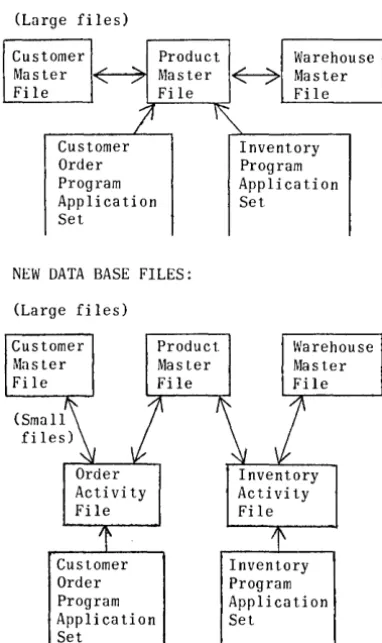
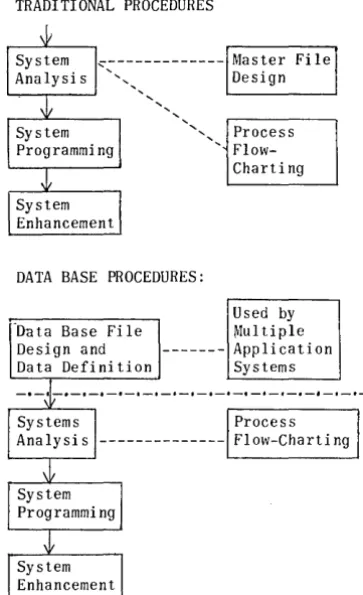
The contrast between physical data bases and logical data bases; and how to construct logical data bases out of physical data bases.
[A]
[E)
[F)
[A]
16 In Memory of August Dvorak [F)
by Philip Davis, Publisher of Quick Strokes, Irvington, NJ
7 Valentin Turchin, and Some Other Topics [F) by Dr. Gerard Salton, Chairman, Computer Science
Department, Cornell Univ., Ithaca, NY
35 The Revolution in the Computer and Business Equipment [F) Industry, Now and Coming
by E. Lawrence Tabat, Computer and Business Equipment Manufacturers Assn. (CBEMA), Washington, DC
Computer Applications
32 Looking at Winds of the Pacific Ocean To Determine [N] Wisconsin Weather Five Days Later
by Robert Ebisch, University of Wisconsin, Madison, Wisc.
32 The World's Biggest Model Railroad: A Simulation of [N] Seven Railroads and 30,000 miles of Track
by Jim Furlong, Computer Sciences Corp., EI Segundo, CA
4 COMPUTERS and PEOPLE for January, 1976
The magazine of the design, applications, and implications of
information processing systems - and the pursuit of truth in
input, output, and processing, for the benefit of people.
33 Talking in Music Language with a Computer by William T. Struble, Mass. Inst. of Technology,
Cambridge, Mass.
33 Computer Helps Doctors in Remote Areas Plan Radiation Treatment for Cancer
by AI Hicks, Univ. of California at Los, Angeles, Los Angeles, CA
32 Hockey Should be Computerized, Management Consultant Asserts
by Andrew S. Edson, Cresap, McCormick, and Paget, New York, NY
Computers and Society
23 Information, Power, and Complexity
by Abbe Mowshowitz, Dept. of Computer Science, Cornell Univ., Ithaca, NY
[N]
[N]
[N]
[A]
An explanation of the intellectual and moral significance of the complexity of society, and its relation to the centralization of power in modern advanced societies.
31 "Precision Journalism" Produces Rapid Payment of Over [N] $1 MiJlion in Delinquent Taxes
by Donald H. Reck, I BM, Data Processing Division, New York, NY
12 AMTRACK: The National Railroad Passenger Corp.: [A] Facts and Goals
by Paul H Reistrup, President, National Railroad Passenger Corp., Washington, DC
The problems that face AMTRAK, and the techniques being used to get at the problems and overcome them.
Computers and Thought
34 Artificial I ntelligence and Automatic Theorem Proving by Jim Hicks, University of Texas, Austin, Texas
Reference Information
[N]
17 Annual Index for Volume 24 (1975) of Computers and [R]
People
Notice
An index by author, title, and subject, to the 12 1975 issues of Computers and People (formerly Computers and Automation).
3 Important Notice to Foreign Subscribers
Computers, Puzzles, and Games
2 Games and Puzzles for Nimble Minds - and Computers [C]
COMPUTERS and PEOPLE for January, 1976
Front Cover Picture
The front cover shows "Love
Love Butterflies" by Mutsuko Sasaki,
Tokyo, Japan. He says: "A program
is constructed which eliminates
invis-ible areas and paints surfaces in
assigned ways. Basic data are sets of
numbers representing a butterfly
divided into parts. This figure is
drawn by using the program, and by
scattering many butterflies made from
the data with various sizes and
posi-tions. The calculation was made on
a FACOM 270-30 computer."
1975 Annual. Index -
Notice
The Annual Index for the 12 regular
issued in 1975 (Volume 24) of "Computers and People" (formerly
"Computers and Automation") not
including the 1975 "Computer Directory and Buyers' Guide"
(which was not printed early enough
for inclusion) is printed on pages 17
to 21 of this issue. We regret that
the index did not fit into four pages
pages - but the center four pages of
this issue can be removed, and only
one page (page 21) has to be
photo-copied in order to put together a complete separate index for binding
the 1975 volume (not including the
1975 "Computer Directory and
Buyers' GUide").
Key
[A] [C]
[E] [F] [N] [R]
Article
Monthly Column Editorial
Forum Newsletter Reference
NOTICE
*D ON YOUR ADDRESS IMPRINT MEANS THAT YOUR SUBSCRIP-TION INCLUDES THE COMPUTER DI RECTORY. ·N MEANS THAT YOUR PRESENT SUBSCRIPTION DOES NOT I NCLUDE THE COM-PUTER DIRECTORY.
EDITORIAL
What We Do Depends Upon
What We Think
Near Tallahasse, Florida, one day in early Decem-ber or late NovemDecem-ber, Frank D. Booth, an official of Brevard County, was in his car on his way to his father's funeral. He had parked on the shoulder of a highway, apparently seeking to control his grief, to pull himself together. A state trooper Robert E. Rennie, Jr., noticed the car and radioed the license number to the Florida State crime computer. The reply he received was that the license number was the number of a stolen car, and that it had been stolen in 1971. Booth's car was a 1975 Chrysler with an orange-on-white license plate issued in 1974 and validated with a 1975 decal . . But the trooper nevertheless approached the car with his .38 caliber pistol loaded and cocked. During the verbal encoun-ter that followed, Booth was shot and killed.
In the State of Florida, the same license numbers are issued repeatedly to different cars and drivers, and the differences in color of license plate serve as additional indicators of difference.
At present writing, the trooper is suspended from his duties, and a coroner's jury is to inquire into what happened and reach a verdict. But of course no verdict will restore Booth to life, nor relieve Rennie of the horrible knowledge that he shot and killed a totally innocent man.
I think this case focuses a searchlight on the system design of "crime computers". There is no doubt in my mind that a crime computer, properly designed, is a useful and nowadays a necessary ad-junct to law enforcement in the United States. But the socalled computer professionals who designed and installed the system in use in the Florida State crime computer allowed this kind of mistake to occur. They did not design into the system extra checking, extra built-in reliability. They are to my mind more culpable than Rennie.
For example, it ought to be possible to include in the system of the crime computer a requirement that any license numbers reissued by the State of
Florida which agree with the number of a stolen car should also be reported to an inquiring policeman. Rennie in this way could have been told by the com-puter that there were, say, four cars with the same Florida license number. Inevitably then the infor-mation, arriving on the trooper's radio at the crit-ical moment when he has to make a decision to approach and be prepared to arrest the occupant of a strange car, would then be the equivalent of "Wait a bit -- this is one of four cars -- which one might it be?"
Or, for example, it ought to be possible for the crime computer to require that the identifying color (signifying the year) of a license plate, in addi-tion to the number, should be supplied to the system BEFORE it will reply to the question, "Is this the number of a stolen car?" In this way it would again help the state trooper at the critical moment to make a correct decision instead of a faulty one.
At this late date, it is to be hoped that the computer professionals in charge of the Florida State crime computer system are saying to each other, "Let's modify this computer system so that this kind of mistake will never, never happen again." Feed-back should always be applied to improve the design of any system.
What we do depends upon what we think. A computer programmed -- is a modern tool to assist thinking. Let us make these tools as splendidly reliable as an Apollo spaceflight computer.
E~ck~.a~
Edmund C. Berkeley Editor
6 COMPUTERS and PEOPLE for January. 1976
em
MUL TI.ACCESS FORUM
VALENTIN TURCHIN, AND SOME OTHER TOPICS
1. From: Gerard Salton, Chairman Dept. of Computer Science Cornell Univ.
Ithaca, N. Y. 14850
Last summer the Christian Science Monitor ran a poll among its readership with the aim of identifying "America's Ten Most Livable Cities". Two lists were published representing respectively reader opinions, and selections made by the Monitor staff. Six cities appeared on both lists. They were San Francisco, Boston, Seattle, Denver, San Diego, and Minneapolis. As you know, the last two of these cities provided the locations for the ACM National Conferences of 1974 and 1975, respectively. Obviously we have been fortunate twice in a row. I found Minneapolis attrac-tive, with clean, good looking streets, interesting shopping areas, and friendly people.
The ACM Council met for ten hours in Minneapolis. On the whole, it was not a very productive meeting: a.number of political issues emerged whose disposi-tIon took a good deal of time; the list of accomp-lishments is thus rather meager. The problem never seems to be lack of good will, or of hard work; in
f~ct, the level of debate is often surprisingly hIgh. But difficulties are bound to emerge when an
a~tempt is made by 25 people with highly divergent
VIews to reach a consensus on any issue. This time around we had more than our normal share.
The financial news continues to be good. The net income of the Association for the fiscal year which
~nded on June 30, 1975, was approximately $450,000,
Instead of $100,000 as originally budgeted; and for the months of July and August 1975 for which data are available we are already about $50,000 ahead of the projected budget. Some people have suggested that we should promptly institute a reduction in dues. The officers feel, with some justification I think, that such a step would be premature at this time. Much of the income produced by membership dues and subscriptions is treated as "unearned" when re-ceived, in the sense that this income is used to pay for member services for the year which lies ahead. Thus when the Association shows cash reserves of a?out a million dollars, as it does at the present tIme, most of the money is clearly not available to be returned to the members. There is also a desire to increase the size of the reserves which should be carried and to allocate some amounts to new ventures, such as the new journal for all members (JAM),
Finally, the feeling is widespread that a dues de-crease, if instituted, should be maintained for some years. In short, no support exists for a dues de-crease at the present time. Fortunately, no one (except the Treasurer who is bound to make all sorts of contingency plans) speaks of any increase in dues for the foreseeable future . . .
Council spent time on a few additional issues: .... ; and then there was the matter of Valentin Turchin.
Turchin is a Russian computer expert who for some years has had increasingly serious problems with the Soviet authorities because of political activities with which the government there disagrees. His acti-vities include open support for Andei Sakharov and other Soviet dissidents, and the signing of petitions and appeals of which the Soviets do not approve. Unhappily for Turchin, he is not as prominent as Sakharov or Solzhenitsyn, and thus instead of being booted out, as Solzhenitsyn was, he is being denied the right to exercise his profession, and otherwise subjected to harassments of various kinds.
You may ask what all this has to do with the ACM. First Turchin is apparently an active computer scien-tist; second he is an ACM member because an American friend for reasons not entirely clear has recently paid Turchin's ACM dues; finally, Turchin has been offered a post as a visiting scholar at Columbia University, and the Soviet government has up to now refused to let him come.
I cannot go into all the details and ramifications the back-up material furnished to Council in this case covered over 150 pages. Suffice it to say that the Council was faced with a resolution "expressing the hope that Dr. Turchin will be permitted to accept the invitation by Columbia University, and voicing its concern that he may be prevented from doing so."
The resolution itself, I consider unexceptionable; scientists in many countries -- not only in the Soviet Union -- have been used as pawns by their respective governments for a long time, and the situation of dissident intellectuals is generally intolerable. On the other hand, one may ask oneself what the ACM Council can or should do about such matters. I my-self agreed with the ACM Constitution and Bylaws Com-mittee which suggested that no action be taken:
(please turn to page 11)
The Universal Product Code:
and the High Cost and Long "Task of
Conversion to it, for Many Manufacturers
Thomas C. Sobczak, Ph. D. Director, Information Processing" Waldes Kohinoor Inc.
47-16 Austel Place
Long Island City, N. Y. 11101
"In summary, the onetime cost to convert to the Distribution Code for at least one large inventory, low volume per part manufacturer could reach $1.4 millions if all possible costs were considered."
The distribution code for distributors is an off-shoot of the Universal Product Code presently being implemented wi thi n the Grocery Industry. The con-cept is being marketed by Distribution Codes, Inc., Washington, D.C. DCI is owned jointly by the Uniform Grocery Product Code Council and the National Associ-ation of Wholesalers/Distributors. NAW/D is an asso-ciation of assoasso-ciations. Each assoasso-ciation member is coordinating its activities concerning coding through Distribution Codes, Inc.
At the present time, the Universal Product Code exists under several names:
Name
National Drug Code Health Related
Items
Publication Code
Alcoholi c Bever-ages
Stationery &
Business Sup-plies Code
Electrical Sup-plies
Air Conditioning
Plumbing
Distribution Industries
Abbrev.
NDC
HRI
UPC
UPC
DC
DC
DC
DC
DC
Sponsoring Distributor Association
National Wholesale Druggists National Wholesale
Druggists
Council of Publication Distributors Wine and Spirits
Wholesalers
Business Records Manuf. Association
Nat. School Supply &
Equipment Association Paper, Stationery &
Tablet Manuf. Assn. Wholesale Stationers
Association
Nat. Assn. of Electrical Di st.
A/C-Refrigeration Wholesalers Nat. Assn. Plumbing
Wholesalers
NIDA/SIDA (Nat. & South-ern Industrial Dis-tributors)
UPC is growing continually, under its many dif-ferent names; therefore most people tend to under-estimate the power of its spreading.
The Domino Effect
Figure 1 shows the domino effect on industry as UPC moves from place to place. UPC was developed for the Grocery Industry but since Drugs and Health Related Items are sold in supermarkets, the Food and
Drug Administration was convinced (lobbied?) to change the National Drug Code and the Health Related Items Code to the UPC format. Books and Magazines are sold in Supermarkets; so the Publications Dis-tributors were next to embrace UPC. Recently the Alcoholic Beverage Commission was convinced to spe-cify the UPC. Outside of New York State, alcoholic beverages are sold in Supermarkets. The trend con-tinues with Stationery and Business Supplies. The logic is the same. In time, everything sold in Supermarkets must be scanned mechanically.
The mass merchandising (Discount) stores are ac-cepting UPC because it exists on products they buy. The Federal Department of Transportation is proposing to modify 49 CFR577, the law controlling manufacturer marking of auto parts. This opens the door to UPC. The code exists in wholesale electrical, air condi-tioning, refrigeration, and plumbing. UPC goes on and on and on without anyone realizing how quickly it grows or how much it affects their daily lives.
No Benefit to the Manufacturer
The large inventory, low volume per part manufac-turer has a massive problem in conversion to the "Distribution Code" variant of the Universal Product Code. His cost is excessive while his return on in-vestment is customer (distributor) goodwill plus some non-quantifiable savings i f he installs in-house scan-ners in the stockroom.
The first problem is to rationalize the transition from a perfectly good code which your customers are familiar with to an eleven digit, all numeric code where the first six digits identify the manufacturer and the next five digits randomly and non-signifi-cantly defi~e the product. This problem is compoun-ded, if the manufacturer sells to the Federal Supply Service, the Defense Supply Agency or the Department of Defense, because they utilize the Federal Stock Number or the National Stock Number. They are re-quired to utilize a uniform system of item identifi-cation and nomenclature to describe, classify and number each item included in the Federal Catalog System so that an item of supply is identified by a single stock number.
This is required by Title 10, United States Code, Chapter 145. Assuming most manufacturers will have to operate a dual code to convert to UPC, this means that a minimum of three codes will be effective sim-ultaneously if you sell to the government.
Assigning Distribution Codes
Before any operation within the manufacturer's plant is affected, he must decide how he wants to code. Let us assume a manufacturer, such as Waldes Kohinoor, has 17,685 separate and distinct parts in hi s inventory and follows the pamphlet "Guide Ii nes for Establishing Distribution Code (DC) Unique Pro-duct Numbers" as recommended by Distribution Codes, Inc.
It is recommended that Waldes should have a code which leaves the first 10,000 numbers blank. The remaining 80,000 numbers divided by 17,685 allows a spacing of four numbers between the numbers we assign (i.e.!, 6, 11, 16, etc.).
Assuming Waldes wants to group the twenty-nine standard styles of its retaining rings and twenty special styles, testing shows that they cannot as-sign clean blocks of numbers (i.e. thousands digits) to the part number. We immediately lose anything promised by the DCI pamphlet. The pamphlet was writ-ten for small inventory, large volume per part manu-facturers. Regardless of this fact, let us assume all items are coded.
At this point all 17,685 items have been assigned a distribution code. We must prepare a cross refer-ence list so that the new numbers can be aligned with the old numbers.
Our costs to this point are:
1. Major meeting of concerned Department Heads to explain code and establish coding committee.
2. Cost of coding (including tests for grouping similar styles)
3. Cost of typing and proofreading
$ 600
$ 6,000
$ 1,800
Quite a bit of detailed proofreading is required to be sure that there are no transpositions in the new non-significant numbers. If we had continued the old system, transpositions would have surfaced immediately. Under the new system, if a transposi-tion is typed into the initial cross reference list, a major problem occurs. You could have a duplicate number. As a check digit would be a twelfth digit, it cannot be considered on human readable labels.
The Distribution Code label
The next conversion cost encountered is the label for normal packaging. The Distribution Code Label, as specified now, matches the UPC bar code. The film master manufacturers presently charge $25 per film master. As Waldes Kohinoor has 17,685 separate and distinct parts, the film masters of the Distribution Code in Bar Code format will cost $442,125. (I have assumed that pieces per package are not considered for DC coding as they are for UPC, for Waldes has 6 package sizes. If the requirement is for total uni-queness within size, Waldes has 106,110 unique num-bers whose initial film masters would cost $2,652,750. An additional consideration is that Waldes, to retain its 4 number spacing would need five different manu-facturer numbers.)
Waldes presently uses a dozen label types which we prepare as needed in batches ranging from 2 labels for slow movers to 500 for fast movers. To keep our
perspective, some 3,500 items are the 20% Which, con-trols 80% of the movement. A check with printers capable of printing to the DCI specified parameters indicates that a minimum DC bar coded label printing run is 5,000 at a cost of $12.00 per lot (low esti-mate based on volume). This adds $212,220 to our conversion cost.
Based on a review of several drug and grocery manufacturers, we can assume that we will need cler-ical assistance to maintain masters and labels as well as coordinated issuance of new codes and dele-tion of displaced items. Using our prior extrapo-lation, three clerks handling 1,200 fast movers and 4,800 slow movers will be required. This adds $28,080 to our cost, assuming $120 per week salary and 50% fringes.
In summary the segment of conversion costs:
1. film masters $ 442,125
2. labels 212,220
3. clerical control 28,080
Sub-total $ 682,425
100,000 Boxes to Relabel
Next we move to the stockroom where Waldes Kohi-noor maintains several hundred million parts in packages ranging from 250 pieces to 50,000 pieces. There are packages in boxes, boxes in cartons (ship-ping containers), and cartons on pallets. All told over 100,000 boxes have to be relabelled. A decision is required. Do we stop shipping for the two weeks it will take to relabel? or do we relable piecemeal on weekends running the risk of confusion, misship-ments, and loss of business? If we shut down for two weeks, we lose approximately $600,000 in billing and several customers who cannot wait for delivery. If we shut down, do we still pay a payroll of $80,000 per week and $42,000 in outlays and $120,000 if com-petitors ship only 20% of what we cannot.
This segment of conversion costs:
1. relabelling $ 364,000
The Effect on Data Processing: The Cost of lowered Efficiency
Now that we are prepared to ship orders using the Distribution Code, let us examine the effect on data processing. Once the new code is decided upon, many decisions have to be made. The key management deci-sion required is "Do we abandon the existing code or do we maintain two codes?". Logic dictates that ini-tially we must keep two codes in order to maintain normal operations. A company can ill afford to con-fuse its blue collar workers. The learning curve is shallow and of long duration. In time everyone will learn the code. The cost of lowered efficiency can-not be really measured but it exists and is potenti-ally great.
Initially the cross reference table previously prepared has to be programmed so a table look-up routine can identify any new code being input on or-der forms. As an additional feature the new code must be added to all records and reports to facili-tate the transition. At Waldes Kohinoor, 398 pro-grams will have to be modified so that transaction and data records retain two codes and printer formats are expanded for the new code.
Another problem exists, in that, if someone wants to learn what was sold in a particular style, or in
a particular metal or finish, the new non-signifi-cant Distribution Code cannot accommodate this task. This means that at a minimum, in data processing, dual coding is a requirement which cannot be omitted.
In order to provide a continuity of sales history in the new code format all prior records maintained on magnetic files must be modified to identify the new DC code as well as the existing code. This means that every record in your sales history file, at Waldes some 51,600,000, will have to be modified.
New Costs Equal Savings
The foregoing are simply programming (software) changes. It is probable that at the same time these modifications are made, equipment (hardware) will be upgraded to "on-line" status to make use of the new code via scanners in the stockroom.
The approach is simple; each item ordered by a customer should be scanned so that the automated data capture reduces inventory, keys a new produc-tion requisiproduc-tion if required, generates the daily billing file, updates receivables, etc. While logi-cal, the task is so massive as to be a tangent from this analysis. Suffice it to say that over a three year period new costs equal savings.
The data processing conversion to "DC" costs:
1. Table lookup routine and modified Order Entry
System $ 3,000
2. Program Modification to expand data records and
Printer Formats $ 40,000
3. Tests and Debugging $ 15,000
4. New Forms $ 3,500
5. Scrap and Waste paper $ 2,000
$ 63,500
No effort has been made to extrapolate increased processing times, system documentation, user docu-mentation, etc. It exists and will cost money but the costs incurred depend on the depths of coverage in the documentation produced. As an example, Waldes "TRUARC" division order takers have a preprin-ted "how-to-do-it" manual which covers every conceiv-able incoming order/change condition. This loose-leaf manual is updated monthly. The "DC" change would require basically a total regeneration of this documentation.
"Tower of Babel"
Now we review the cost to the Marketing and Sales areas. Sales must, first, announce to its customers, OEM as well as Distributor, that the addition of a new part number has been made. They must be told that in time the old code will be phased out so that the customers have time to change their internal records. Sales Dept. must be prepared to deal with OEM manufacturers who might not be interested or willing to convert their records. Or, the OEM cus-tomer could say, "If you can use a distributor-im-posed part code, why not use my part code as well? I am X percent of your business." Mishandling this segment of the conversion will cause chaos, remini-scent of the "Tower of Babel".
While the new "DC" codes are bei ng prepared, i n-ternal sales personnel (order takers) must be trained to convert manually from the new part code (DC) to the old part code and vice versa. This requirement is imposed so that there is an orderly transition during the period when EDP is reprogramming and tes-ting its changes. Each time an order comes in this translation step must be effected.
The cost to sales for its segment of DC is:
1. Announcement Mailing
2. Training
$ 1,000
$ 4,000
$ 5,000
At this point no attempt is made to estimate the cost of sales calls to explain the code and convince OEM and non-association distributors to use it.
Reformat Entire Catalog
Marketing Dept. has to modify its plans and imple-ment changes to the catalog and price lists to allow for both codes, DC and old code. This initially sounds like a simple change. It is not. It is very expensive because you must reformat your entire cata-log to allow space for the new coding. It is possi-ble that a soft cover bound 8 ~ x 11 book will be inadequate. You would be required to go to a non-standard size to allow for the "DC" coding or you have to reduce your print size by image reduction to maintain a standard size. If this is the case you have the added problem of misinterpretation and mis-readings if your printing isn't perfect.
The Waldes "Truarc Retaining Ring Technical Man-ual: Design and Engineering Specifications" is in use by many schools as a text book for mechanical design; approximately 175,000 books have been issued. They would have to be replaced. The cost to redo the catalog is $70,000 (approx.) while printing costs $1.00 per copy (large volume including binding and
cove'r) .
This means that the catalog portion of DC conver-sion is:
1. Redo catalog
2. Replace current Manuals
Transpositions Go Unnoticed
$ 70,000
$ 200,000
$ 270,000
The price book must have the new distribution code (DC). Waldes price book is computer typeset. The addition of DC and refabrication of negatives would cost $15,000 and a reissue about $4,000. However, an additional consideration must be given to the potential for transposition previously mentioned. If a transposition should occur in your catalog or your price book, who would be liable for the effects? Using the significant code system transpositions be-come an outstanding characteristic of poor prepara-tion. Using the non-significant DC, they go unnot-iced until the problem appears.
The price book contributes:
1. Redo
2. Reissue
$ 15,000
$ 4,000
$ 19,000
Loss in Efficiency and Productivity
In summary the one-time cost to convert to the Distribution Code for large inventory, low volume per part manufacturers could reach $1.4 millions if all possible costs were considered. Assuming that catalogs and price books are needed in any case, the cost could be lowered to about $1.1 millions. Assum-ing another type label was allowed, the basic cost would be $1.45 million.
This sum does not ipclude the loss in efficiency and the loss of productivity during the conversion and learning cycle. A twist drill manufacturer in-dicates its two code format has been in existence for many years and that the company anticipates that it will not eliminate the code in the next twenty years.
Let us now consider the intangibles which will add costs that are not readily quantifiable until they have been experienced.
Further Modifications
The Merchandising/Public image people within mar-keting must analyze the package design, label for-mats, invoice forms, pick/packing slip forms and any piece of paper which leaves the company. All of . these exist with areas designated as the location of
the old code format. They must be modified to accept the Distribution Code as well, for a period of time and then be further modified to the new DC solely in the future.
Plans must be formulated to scrap or use up and then reorder paper stock as required. Paper stocks must be segregated to prevent using the wrong style form with a given computer processing. In all a conversion control center must be established to coordinate and to guarantee minimum disruption to normal activities during the conversion and subse-quent learning period.
The order picking instructions to stock clerks must be modified to conform to the new DC code. The computer must access the cross reference table to be sure the old code is listed. This requirement is imposed because the rearrangement of the stockroom to the DC coding will occur slowly over a prolonged period. Imagine the amount of confusion and delay when people start trying to pick five-digit randomly ordered "DC" code numbers while using their old code Translation dictionary.
Murphy's Law
To keep our perspective, while all the changes are going on, so are normal operations, both administra-tive and production. This means that the conversion and implementation are a long, stretched-out process. To speed the process, you have the option to increase your staff. Or you may have an outside consultant group. In any case, however you look at it, hidden costs will reveal themselves in the predictable man-ner of Murphy's Law.
In an industry which thrives on response to cus-tomer special requirements, Waldes finds that custo-mers quite frequently will order a product which is not in stock, with, for example, a particular plated finish. We presently take a similar product from stock in one finish and rework it to the finish being requested by the customer. We have been using a sig-nificant code for thirty years and the new code is forcing a change to a widely separated, not defin-able number which could force production to decide
to keep its old code and let the computer do conver-sions. Woe to the day of the broken-down computer. The factory stops.
The Potential for Problems
Information is collected during the production cycle at various operations where blue collar workers fill in times, feeds and speeds. The existing union agreement specifies what information the operator will or will not collect. It requires a negotiated contract modification to change the input presently being prepared. What will the manufacturer lose in this change? In reality the manufacturer cannot substi tute "DC" for "Old Code" for no one understands the "DC". Until the "DC" is learned, the union wor-ker must add data. The probability is that the union will call this extra effort and request salary ad-justments for affected workers.
Cementing the reality of a dual code is the envi-sioned confusion of each production worker and/or foreman with a manual which says this new DC code is really this old code. The cost of scrap and rework because of misinterpretations and lack of comprehen-sion has not been considered by the people developing the distribution code. A manufacturing professional rather. than a warehouse administrator is needed to analyze the effects of DC .
The Distribution Code may be fine when one consi-ders the operations of a DC in a warehouse, provided the warehouse is physically arranged to follow the code. However the potential for problems exists if coding is not thoroughly thought out. As an example, i f the size order is maintained, then "1 X 2 inch" plastic packages will be in place next to 3 inch high boxes. These in turn will be next to 6 inch boxes, etc. Wasted space could become the rule. Also spac-ing has to be left for new items; otherwise the stockroom cannot be maintained without a fourth code, the DC stockroom locator (Row A, Aisle 6, Shelf 14). Probably the locator is the safest control you can have in a DC stockroom.
Someone Has to Pay the Piper
In conclusion let us realize that this is the cost and some problems, with various options available, to the manufacturer I know best. People in large inventory, low volume per part, plants have not been faced with the spectre of a DC so they have not thought enough about the consequences of the transi-tion to make a valid decision concerning whether that transition should happen. Talk is cheap until some-one has to pay the piper.
Can U.S. manufacturers each afford to pay between
~ million and l-~ million dollars to test a theory, and perhaps tempt providence in a soft economy? I
think not. 0
Forum - Continued from page 7
I perceived a substantial political component in the manner in which Turchin recently became an ACM mem-ber, and in the reasons for which he was offered a visiting appointment at Columbia University. I am also unconvinced that an offici~l position makes any difference whatever in the Soviet Union or elsewhere -- when Jean Sammet some months ago transmitted a Council resolution to the U.S. State Department, she received no response, not even an official acknow-ledgement. Finally, as we venture forth into such areas, it will become increasingly difficult to draw the line anywhere. Injustices and untenable situa-tions occur allover the world; we might as well
(please turn to page 16)
A,MTRAK
-
The National Railro'ad Passenger
Corporation: Facts and Goals
Paul H. Reistrup, President National Railroad Passenger Corp. 955 L 'Enfant Plaza North, S. W. Washington, D. C. 20024
"Even today, more than 87% of the travel between American cities is still done in the automobile. That market is our target. To make inroads into that huge market, we are going to have to get our trains up to what used to be called 'Express Train' speeds, 80 miles an hour plus or minus."
We are what our history has made us. This coun-try is great because it has had a great banking sys-tem and because it has had a great railroad syssys-tem. These are not its only outstanding attributes, but they certainly rank among the top. And there is, and always has been, a strong relationship between banking and railroading. We have seen great years together. We have gone through some of the country's greatest emergencies together. Today banking and railroading are going through trying times. Perhaps at no time in our history have we had greater need to understand each other well and to stand together. Certainly we are at a most crucial period.
Unwanted Passenger Business
I want you to know something about Amtrak, the National Railroad Passenger Corporation. I want you to understand us. When Amtrak was created in 1971, one of the underlying purposes was to relieve the railroads of the unwanted passenger business on which they had been losing about $500 million per year. But this did not mean that the railroads went out of the business: it simply meant that Amtrak came in to assist them and the country. The actual operation of this 26,000 mile network is still carried out on the tracks of these same railroads, with enginemen up front who are still the employees of the railroads and with conductors in the trains who are still em-ployees of the railroads. Inevitably, the relation-ship between Amtrak and the railroads is very close and it must continue to be very close.
Reversal of Down-Trend
The significant point about Amtrak is that by its very existence, and I should add ... by dint of hard work, this company has brought about a reversal of a generation long downward trend in rail passenger transportation. This was an absolute necessity. Highways are congested: airways, airports and their facilities are overcrowded and our petroleum-based transportation system faces an uncertain future. It was absolutely essential in 1971 to create an alter-native to the automobile and in 1975 we can look back on the wisdom of that action.
But nothing happens by itself. Who would invest in a rail passenger system, especially in one which had to be stretched thin from coast to coast and from
Based on a talk before the Graduate School bf Banking, University of Wisconsin, Madison, Wisconsin, August 14, 1975.
border to bOrder with no hope -- at least at present -- for profitability? Where would those investors come from who would have to put up billions of dol-lars to recreate and to regenerate a system which for more than twenty years had done nothing but lose money and discourage passengers? This situation had to be faced and the solution had to be compatible with our free enterprise system. After all, the railroads of this nation are all private corporations. They own their own equipment. They own their right of way and they could hardly be expected to diminish their assets further to support an uncertain new enterprise.
New Solutions
It is perhaps a mark of the maturity of our free enterprise system that, as the economy of this nation matures, it is able to identify new problems and come up with new solutions. Here was a great national asset just falling apart. If we did not have this rail passenger potential in being today and we deci-ded that we had to build it now, from the ground up, we would certainly have to face the prospect of an initial investment in the nature of $100 billion dol-lars. Private enterprise alone could not afford the burden, yet the people of this country demanded that rail passenger service be saved. The result was the Rail Passenger Service Act of 1970 and the series of laws which derive from that basic act.
Running Trains and Using Track
Amtrak is a "for profit" corporation in concept, which has access to public funds. Amtrak is an oper-ations-oriented organization. Amtrak is, by law, not a policy-making agency of the Federal Government. We are designed to be implementors. I know how to run trains and how to coordinate with other organiza-tions that are running trains, and I know about track. We get things done within the parameters established by Congress and the will of the American people, and we do them in a thoroughly businesslike manner.
We are a public-sponsored organization operating on private property while the other major modes of transportation are private corporations operating on public property. This brings about some basic com-parisons which are not generally considered.
Subsidy vs. Investment
In most of the public discussions of Amtrak which appear in the media, references are made to the
vy subsidy" which has been poured into Amtrak from the Federal treasury. While the word "subsidy" is generally used to describe the some $200 million per year average which has been supplied to Amtrak since its inception, it is quite common to use the more palatable word "investment" for the billions of dol-lars each year which are poured into the other means of transportation. This needs to be put into per-spective.
Let's put this another way:
"It takes two lanes to move 40,000 people per hour across a bridge if they travel on trains; four lanes to move them on buses; twelve to move their cars and one to allow them to cross it on bikes. Of all vehicles, only the cycle can take the rider from door to door."
Ivan Illich, New York TIMES, Sept. 1973
And if energy requirements were equal for all modes, which of course they are not, just consider the energy savings which are apparent in the above statistics from the point of view of volume alone. The "investment" in rail transportation pays off on all counts.
$400 Billions for Highways: Subsidy or Investment?
This country has a major highway system which has already cost more than $400 billion and present esti-mates are that it will cost an additional $32 billion just to complete that part of the system which has already been started. This is all called an "invest-ment" and not a "subsidy". I have seen a recent re-port which states that funds "would be earmarked ... in support of a total highway program (at) the level of $8.5 billion for each fiscal year 1977 to 1978." Today there are 915,000 miles of Federal-aid highways and 25,000 miles of government built and maintained navigable waterways, plus the entire nationwide net-work of federally-supported airways, airports and air facilities. Now contrast this with the fact that there are 325,000 miles of railroad all privately owned and tax generating. It has been estimated, as recently as 1974, that just to overcome the backlog of deficiencies in highway maintenance (not construc-tion), the backlog alone would exceed $400 billion between 1973 and 1990. The annual Federal, State and local highway expenditure on highway maintenance alone is in excess of $23 billion and this is ade-quate to do only 50% of the requirement. And this is always termed "investment", not "subsidy".
3/4 of $1 Billion for Four Years for Railroads: Subsidy or Investment?
There is no need to add more of these statistics to the record. When the American public is paying such staggering sums for a highway system, and on top of that, more billions for a waterway and airway sys-tem, then calls that an "investment", it seems only reasonable to concede that the "subsidy" of Amtrak which has totalled $731.2 million from 1971 through FY 1975 is relatively a modest amount and that the money which will be required for future development is certainly not unreasonable. We just need to put things in perspective.
Start·Up Day
What is the American public getting for its "in-vestment" in the nationwide rail passenger system? On the day Amtrak started service, the number of
trains operating throughout the country dropped from more than 400 to about 186. These trains operated between 21 pairs of Congressionally designated end-point cities, over a 24,000 mile system so fragile that if one more route had been cut or if one or two end-point cities had been eliminated, there would have been no national system at all.
On that start-up day, Amtrak had no employees; Amtrak owned no railroad tracks, no stations, no terminals, no yards, no commissaries and no other essential facilities. Not even any passenger cars, no locomotives and no manufacturer in the United States had an open production line which was capable of manufacturing the type of cars needed for long-haul passenger service. That was a tough beginningl But we have turned things around in less than five years and we have shown not only that the American rail passenger system is worth saving but that it is potentially viable.
Performance
Last year we carried more than 18,000,000 passen-gers and in 1974 we grossed $257 million. That is more income than all the railroads together grossed in 1970 on passenger service with more than twice the service.
In our first years of operation we have improved our on-time performance substantially. During 1974, the first year of our new incentive contracts, on-time performance over all of Amtrak routes averaged 75.3% and is still on its way up.
Computerized Reservations
One of the most significant improvements made by Amtrak, is its interface with the American public. On June 28, 1974, our nationwide computerized reser-vation and information system went into effect. Where once we had been sorely abused for not answer-ing the telephone, we are now able to handle more than 78,000 calls per day and to provide correct, realtime information including the preparation and mailing of tickets on credit card data alone.
We have organized and staffed a major headquarters. This was no small task. Never before had a nation-wide rail passenger system of any kind existed nor had a staff ever been developed to handle problems involving passengers from coast to coast. More than 3,000 jobs previously performed by employees of the affiliated railroads have been transferred to Amtrak. All service functions, and most station service
func-tions, are now discharged by Amtrak personnel. Ten labor contracts have been concluded on behalf of nearly 8.000 Amtrak employees.
Available Cars
Yet, we still have some very real problems. Pro-blems which only time, hard work and money are going to be able to resolve. When Amtrak started, our rail-road men went out and looked over thousands of cars that had been in service for years. We bought some 2,000 of them and were forced to put them into ser-vice at once and as they were. They were (all we had and) thought to be the best for a national fleet that we could get at that time. They average now about 24 years in age and during their last years with the railroads, they got very little care. Those compan-ies knew they were going out of the passenger carry-ing business.
Now, four years later, we have put about 1,200 of them through an expensi ve refurbi shi ng program. It
has helped, but a 24 year old car has -- in most cases -- a 24 year old air conditioner, a 24 year old steam heating unit and 24 year old parts and wir-ing! These are things which you would not normally want to do business with, especially if you were
set-ting up a new business and trying to regenerate an old industry which had nearly expired. We have had to make do. We could not buy new cars right away. No one was making them and we did not have enough guaranteed credit at that time to induce any manufac-turer to open a new production line.
Available Locomotives
Fortunately, we were able to buy locomotives. At first the fleet we used, leased, borrowed was pretty poor. But there were factories making locomotives which we could use and we bought a number of them. We now own 150 new locomotives and most of our power problems are on the way to being solved.
With cars, it was a different story. We needed more "seats" out there on the rails. Our engineers went all over the world searching for "off-the-shelf" equipment. We found a very modern, utilitarian French Turboliner -- a five car set powered by two turbine engines, with seats for almost 300 people. To expedite its acceptance and delivery, we leased two sets and put them right to work on the Chicago-St. Louis run. They have been very popular and very reliable. We then ordered 4 more from France and the Rohr Company here in the United States will de-liver 7 more sets. In addition to the St. Louis op-eration, we now operate an all-turbine train service between Chicago and Detroit. This is by far the fastest growing route in Amtrak today. It takes new equipment and good service to do this.
New Cars
With each passing year, we needed new cars desper-ately. Eventually, we had accumulated sufficient guaranteed credit to interest the Budd Company in reopening their old Metroliner production line. We compromised with them and placed an order for Metro-liner-type cars but without the Metroliner's on-board motors for self-propulsion. They will be locomotive hauled and can be run where there is no electrifica-tion. We have 492 of these fine new cars on order and the first of them go in service this month. This is another significant breakthrough.
Financial Arrangements
As bankers, you may be intersted in how we have worked out "Leverage Leasing" for acquisition of much of our new rolling stock.
The first step was to place a conditional sale agreement with the manufacturer. We put down approx-imately 27% of the total cost, with the balance in 27 semi-annual payments. Title to the equipment res-ted with Amtrak at that point.
The next step was the assignment of the condition-al scondition-ale agreement by the manufacturer to an interim lender, who paid the balance of the purchase price, the 73% remaining, to the manufacturer. The interim lender received the assignment of the manufacturer's rights.
Then there was a "sale and leaseback" agreement made by Amtrak with a trustee. The trustee returned the original 27% down payment amount to Amtrak. The trustee assumed Amtrak's obligation under the condi-tional sale agreement and title to the equipment was transferred to the trustee prior to the first use.
Then an equipment lease arrangement was worked out between Amtrak and the trustee which covered a peri-od of 15 years at-a very attractive rate, which in all cases has been under 5%.
At this point, Amtrak's unique characteristic, as a quasi-federal corporation, played a part in this arrangement. The U.S. Government guarantee was placed over the entire package covering the exposure of the lender and the trustee. This was certified on behalf of Amtrak by the Federal Railroad Admini-stration.
Elaborate as this is, it provides a special in-sight into a particularly significant aspect of this corporation. As a private corporation, we have and make use of all of the advantages of that type of corporation; yet, as a quasi-federal corporation, we are able to take advantage of the necessary federal guarantees of these loans.
Bi-Level Cars
This year we h?ve entered into a contract with the Pullman-Standard Co. and have ordered 235 bi-level cars from them. These cars are going to be the finest long-haul service cars ever built. They are our own design and they will feature a double-deck arrangement which will drastically change the appearance and the style of American train travel. These cars will improve comfort, train reliability and the economics of operation. Car reliability and ease of maintenance, beyond anything ever designed into cars before, will be found on these new cars. Most of the passengers will enjoy "dome car" visi-bility from their seats as well as from the dining car. The climate within the train will be electri-cally controlled and a sound system will be available for communication with the passengers and for enter-tainment where desired.
The seats will be built for comfort. They will be spaced at least as far apart as first class air-line seats and they will have adjustable backs, foot rests and folding tray tables.
Some of these cars have been designed for food service. On the upper level they will be configured as a coach and on the lower level there will be bar-lounge space and facilities for the service of such food options as beverage choices, snacks and full hot meals which can be consumed at the passenger's seat.
In addition, other cars will be configured as diners with full food preparation facilities and storage on the lower level and a car-length combina-tion of lounge and dining area on the upper level. These will be the finest dining cars on the rails.
These cars will have a unique lower level central entry way and a stairway will connect upper and lower levels. Each car entry will have fold-out ramps, wide aisles and handrails to allow unassisted mobi-lity and access to all facilities by handicapped travelers including those confined to wheelchairs.
Better and Better Service
I have gone into this new car description in some detail because we at Amtrak have been burdened for almost five years now by our inability to make a ra-pid response to what we all know is the paramount public demand ... better and better service. We are now in a position where we can see the first of these major steps coming over the horizon. From now on, it will be our job to get these new cars into operation as quickly as possible and then to provide the excel-lence of service which was at one time the tradition of the railroads.