© 2019, IRJET | Impact Factor value: 7.211 | ISO 9001:2008 Certified Journal
| Page 4296
METHODOLOGY FOR MODULAR FIXTURING SYSTEM
Sanyukta L. Ghayal
1, Atharva M. Deshpande
2, Pushkar B. Datir
3, Basavaraj S. Chitwadgi
4,
Prof. Jayashri P. Wagh
51,2,3,4
Students, Department of mechanical engineering, Pimpri Chinchwad college of engineering, Pune, India
5
Professor,
Department of mechanical engineering, Pimpri Chinchwad college of engineering, Pune, India
---***---Abstract -
A modular fixture plays a vital role in industrieswhere there is increase in product variety and shorter life cycles. This system enables to change between varieties of products and reduces the usage of resources. It should be able to accommodate a product family into a single fixture which is changeable for different product variants. Also, it should be able to adapt to introduction of new products since the product families evolve over time. This paper represents the general methodology and guidelines for designing a modular fixture. This method is validated by applying it to an industrial grinding task, which is used to grind special tool inserts, each of specific shape and size. Initially it required different fixtures for each insert. This paper demonstrates the methodology of modular fixture applied to above application which illustrates the changeability approach and improved design in the fixturing system.
Key Words: fixture, modular, product family, changeability, methodology.
1. INTRODUCTION
Current trend in industry is changing rapidly, so the products also change accordingly. Hence, due to shorter life cycle of a product, fluctuating volumes, and increased product variety, we need to have a generic system which can cope up with the said features and provide the desired output. These days’ industries are switching to newer products more quickly than anticipated. This change is driven by customer demands and market scenario. Obsoleting of products and services is more common in Industry 4.0 and 5.0. Industry 4.0 is a name given to the current trend of automation and data exchange in manufacturing technologies. It includes cyber-physical systems, the Internet of things, cloud computing and cognitive computing. The characteristics given for the Industry 4.0 strategy are: the strong customization of products under the conditions of highly flexible mass production. The required automation technology is improved by the introduction of methods of self-optimization, self-configuration, self-diagnosis, cognition and intelligent support of workers in their increasingly complex work. The major challenge faced by industry 4.0 and 5.0 are Unclear economic benefits and excessive investment.
Probable failure of the new design accounts for unclear economic benefits. Industry 4.0 and 5.0 demands quick shifting between products and services. This requires quick changing of architecture and infrastructure. This requires constant changes in the design; hence re-design is highly involved here. The reliability of new design is a very crucial parameter. Anticipated economic benefits can only be extracted from design process if the design works successfully. If the new design is not reliable, then the chances of failure are high. Failure incurs additional cost. Hence the economic benefits from new design are curbed. The additional cost incurred during the adaptive process of design is excessive investment.
The above discussion leads to the fact that instead of dedicated manufacturing system (DMS), the flexible manufacturing system (FMS) is highly recommended for Industry 4.0 and 5.0. A flexible manufacturing system (FMS) is a manufacturing system in which there is some amount of flexibility that allows the system to react in case of changes, whether predicted or unpredicted. Thus, co-evolution and co-development of product and production systems become truly important when designing fixture architectures, which are capable of coping with the variety of both existing and new products. This paper presents with a variant of FMS that deals with generic product line, which can adapt to minor changes in the product design and give the satisfactory output. The case study provided with the paper deals with a fixturing device for grinding of multiple special jobs at a time on a single machine. Here the system is designed to accommodate different products of same product line.
1.1
Concept formulation:
It majorly deals with design thinking. While designing a particular fixture, the emphasis on modularity should be given from phase of concept formulation. Objectives of initial design are –
1. Modularity
2. Hierarchical structure
3. Granularity
© 2019, IRJET | Impact Factor value: 7.211 | ISO 9001:2008 Certified Journal
| Page 4297
5. Scope of system6. Fulfilment of required accuracy
7. Productivity and ergonomics
If these objectives are satisfied, the design outcomes are well optimised. Since all these parameters are taken into account in concept formulation, it is very essential to incorporate the objective of changeability at the very beginning phase of design. This confronts decisions on appropriate amount of design parameters mentioned above, namely, modularity Hierarchical structure, Granularity, Functional requirements, Scope of system, Fulfilment of required accuracy, Productivity and ergonomics. This in turn is limiting or expanding the part or product family, considering existing needs and to decide on trade-off between modularity and integration, which to some extent translates into flexibility to adapt to different parts of same product family versus possess good efficiency.
The objective of changeable fixture should not only meet the existing variants of product family but also to anticipate the changes that the product family would have in near future and adapt to those chances as well. Hence product family and production system should evolve and develop together.
2. MODULAR FIXTURING
Accurate positioning and orientation of work piece is essential parameter of work holding or fixturing. While processing multiple products of a product family, if the batch size is less, then frequent change-overs of fixture are required. Due to such frequent change-overs following losses occurs at manufacturer end-
1. Increase in set-up time of fixture 2. Increase in temporary rejection
3. Increase in machine cost due to low output 4. Increase in operator fatigue
5. Increase In operator cost
To overcome all these fallouts, modular fixturing is advised. In modular fixturing flexibility is achieved by assembling modular elements to obtain various configurations. One of the major advantages of modular fixtures is the cost savings. A modular fixturing system is initially more expensive than a dedicated fixture; however, it can be used over and over to hold a variety of parts, making it less expensive in the long run.
Time savings is another important advantage. Where it can take days to weeks to design and build a dedicated work holding fixture, a modular fixture can be designed and assembled from available components in minutes to hours, depending on the complexity of the job. That provides a
tremendous competitive advantage in terms of delivery: Job orders received today can be set up tonight and machined tomorrow.
2.1 Methodology:
The methodology for designing of a modular fixture is slight addition to the design methodology of the general fixture. Modular fixture needs to accommodate to the changes in the geometry of product of same product family for similar operation. Hence these additions in the design procedure are justified.
Guidelines for designing the modular fixture are as follows:
1. Modular fixture should accommodate the changes that occur in product family. The fixture should not be designed for specific type of product, but should be designed for a product family.
2. The fixture should be adaptive to possible changes to the product line. This is very essential to the dynamic products. Sometimes, products have a very short life span due to changes in market, or some products those are custom made have a very short life. Modularity of fixture saves a lot of future investment.
3. Modular fixture should adapt to the changing requirements of production. This means that modular fixtures should be designed in such a way that one should be able to use the fixture on other machines for same products.
4. To design the modular fixture, one must have the exact account of requirements prior to designing. These requirements involve nature of job, chances of changeability, nature of variations, type of machining process and required accuracy of the job. 5. Identify the changeability requirements. The changeability requirement is defined by variation in the job or process.
© 2019, IRJET | Impact Factor value: 7.211 | ISO 9001:2008 Certified Journal
| Page 4298
7. Formulation of structurally and functionally stabledesign. The fixture is designed according to points discussed above.
8. Grouping of components of fixture into family. The grouping is done to reduce the complications in nomenclature and inventory. The groups are formed as collection of functionally equivalent parts which when assembles form a fully functional unit. A family will include a product in a specific product line and all the allied fixturing elements which will fully make the system functional
9. Virtual and digital mock-up of the assembly. Prior to physical manufacturing of the fixture, digital mock-up of fixture is done, so as to assess the fixture 10. Assess the potential of fixture as a modular system.
The modularity and integration of fixture are assessed, based on that the fixture is rated. The optimum design will result in high degree of modularity for adequate integration.
Chart -1: Methodology
3. CASE STUDY:
The case study for modular fixture is based on an actual case of a problem encountered in grinding of small jobs on a grinding machine in a MNC. The production time of job was high and fixture change over time for different jobs of same family was high. The industry is mass production MNC type. The particular case under observation is a typical job, of size
approximately 15 to 30 mm, with currently available 3 varieties within product family. The job needs to be processed on a grinding machine. Earlier, the machine capacity was one job at a time. But, this reduces productivity of machine in significant extent.
3.1 Existing Situation at Shop-Floor:
The machine is in operation and need one full time operator for the process. The manpower reduction program in the organization has focused to reduce the number of machine operators by 1 person for 2 machines. They intend to do this by improving productivity by means of fixturing and automation.
On previous fixture, only one job was getting proceeded at a time and cycle time was 15 sec for 1 cycle. There were separate fixtures for different jobs of same family. So, while changing the job, the fixture had to be changed. This caused following problems –
1. Increased machining time 2. Increased machine idle time
3. Increased operator idle time (because the fixture changing does not contribute to the output) 4. Increased non value adding activities.
5. More rejection (as some jobs are rejected while setting the fixture)
6. Increased fatigue to the operator 7. Overall loss of productivity
Considering all these fall outs, the machine was taken under fixture development program. Considering the variations in the jobs, the modular fixture development was taken under advisement. The modular fixture, thus, was essential for the same application. The details of methodology followed for modular fixture development are as above.
3.2 Concept Of Cassette and Clamp on fixture :
3.2.1 Concept:
© 2019, IRJET | Impact Factor value: 7.211 | ISO 9001:2008 Certified Journal
| Page 4299
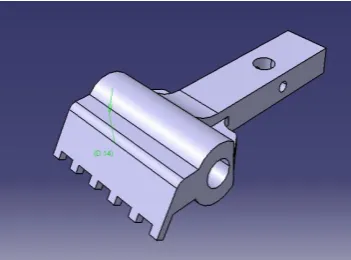
3.2.2 Types of cassettes:Each type of insert will have a different cassette. The shape of the cassette will be in accordance with the geometry of the insert. Due to the varying geometry of the different types of inserts the same type of cassettes cannot be used for holding different cassettes. There would be three types of cassettes. Depending on the cutting plane, geometry, shape, size, and manufacturing tolerances of the inserts, the supporting and clamping positions of the inserts on the cassettes will change.
Fig -1: 3D model of cassette
3.2.3 Clamp:
The pneumatic clamp is the clamping device which is used to clamp the inserts on the cassette. It has two holes at the end for the air pipes. The clamping force exerted on the inserts by the clamp is 6 bar i.e. 6*105 N/mm2. It is made from M.S.
The clamp is a crucial part because it will be responsible to hold the insert in place (i.e. on the cassette) and prevent its displacement during the grinding operation. It also has a hole so that it can be fixed on the fixture.
Fig -2 3D model of pneumatic clamp 3.2.4 Fixture body:
The fixture is the foundation of our design that holds together the entire assembly. The fixture is designed
according to the space constraints on the machine. This is the component that holds the cassette
and clamps jobs. The cassette is positioned on roller pins as shown in assembly diagram. The accurate positioning of jobs is done using gravity positioning of cassette, i.e. cassette is positioned on fixture by gravitational force. The fixture has a vent in which the pneumatic clamp is mounted.
Fig-3: 3D model of fixture
3.3 Modularity Approach By Grouping Parts Into
Families:
All the inserts are subjected to grinding to obtain the required specific profile, dimensions, and size. Grinding is a dynamic machining process that requires high degree of accuracy. Standard inserts have standard machines for their machining which have very specific codes and programs for the control of their machining operation. But special inserts are machined on special customized machines which are manual or semi automatic.
[image:4.595.73.249.519.649.2]© 2019, IRJET | Impact Factor value: 7.211 | ISO 9001:2008 Certified Journal
| Page 4300
Hence we have provided a family which is variantfor different inserts. It includes the inserts, cassette and jaw of same type. This whole family needs to be changed for other inserts.
3.4 Fixture family –
A fixture family would constitute of main fixture, cassette (for particular type of job) and a clamping jaw (for same type of job). Hence while assembling the fixture for a particular job processing; a single fixture family would come into play. Every family will have unique cassette and jaw, but the fixture component will be same. This will reduce the change over time as changing the entire fixture incurs more time. Also, this will reduce setting time on fixture, as the fixture is unchanged, also, it will reduce the operator fatigue.
The fixture family is an example of modular fixture. In this case, the main fixture remains constant; therefore we manufacture multiple jobs belonging to same product family on the same fixture.
Fig-4 : Direction of grinding
Fig-5: Assembly of fixture
3.5 Analysis of pneumatic clamp:
Fig-6: Total deformation of clamp
Fig-7: Equivalent Strain on Clamp
Fig-8: Equivalent Stress on Clamp
3.6 Cost Evaluation:
For purpose of cost estimation, we submitted the dummy manufacturing drafts to an outside supplier. The details of quotation are as follows. The price estimation is by considering all parts to be made of SS, as the actual material was not to be disclosed.
© 2019, IRJET | Impact Factor value: 7.211 | ISO 9001:2008 Certified Journal
| Page 4301
Table -1: Cost evaluation3.7 TESTING RESULTS:
Testing was carried out for grinding operation for a special insert. For testing 5 fully functional cassettes were manufactured and were circulated 5 times through the fixture
Fig-9: Test report
4. CONCLUSIONS
A modular fixturing system is presented in the paper, and this fixture have been proposed and designed intuitively. This paper presents a methodology for changeable fixture architecture. Each step of the methodology tells us about a number of relevant tools, to support each step of the methodology. This methodology is applied to an industrial process for evaluating the steps and implications of the methodology. For validating the results of the methodology and to evaluate the implications, a 3D model of a changeable fixture adhering to the resulting architecture is designed, and a simulation is performed illustrating that the fixture can be changed for different product components.
Generally, tangible contributions demonstrating how to solve design issues is lacking within the field of changeable manufacturing systems. This paper provides coherency between contributions within this field and provide a practically applicable methodology for such fixture architecture design.
REFERENCES
[1] Koren, Y., Shpitalni, M., 2010, Design of
Reconfigurable Manufacturing Systems. Journal of Manufacturing Systems, 29/4:130– 141
[2] ElMaraghy, H.A., 2009, Changing and Evolving
Products and Systems models and Enablers. in ElMaraghy HH.A.A, (Ed.) Changeable and Reconfigurable Manufacturing Systems. Springer, pp.pp.25–45.
[3] ElMaraghy, H., Schuh, G., ElMaraghy, W.,
Piller, F., Schönsleben, P., Tseng, M., etal, 2013, Product Variety Management. CIRP Annals Manufacturing Technology, 62/2:629–652.
[4] Hu,S.J., Ko,J., Weyand,L., ElMaraghy, H.,
Lien,T., Koren,Y.,etal,2011, Assembly System Design and Operations for Product Variety. CIRP Annals Manufacturing Technology, 60/2:715–733.
Sr.
no. Part name Required quantity Cost
1 Fixture body 1
2 Cassette body 1
3 Cassette housing plate 1
4 Clamping jaw 1
5 Clamping nut 1
6 Clamping jaw pin 1
7 Insert resting 1
Total quantity and cost
7