warwick.ac.uk/lib-publications
Original citation:
Glebov, Roman, Hoppen, Carlos, Klimosova, Tereza, Kohayakawa, Yoshiharu, Králʼ, Daniel and Liu, Hong. (2017) Densities in large permutations and parameter testing. European Journal of Combinatorics, 60 . pp. 89-99.
Permanent WRAP URL:
http://wrap.warwick.ac.uk/81931
Copyright and reuse:
The Warwick Research Archive Portal (WRAP) makes this work by researchers of the University of Warwick available open access under the following conditions. Copyright © and all moral rights to the version of the paper presented here belong to the individual author(s) and/or other copyright owners. To the extent reasonable and practicable the material made available in WRAP has been checked for eligibility before being made available.
Copies of full items can be used for personal research or study, educational, or not-for-profit purposes without prior permission or charge. Provided that the authors, title and full bibliographic details are credited, a hyperlink and/or URL is given for the original metadata page and the content is not changed in any way.
Publisher’s statement:
© 2016, Elsevier. Licensed under the Creative Commons Attribution-NonCommercial-NoDerivatives 4.0 International http://creativecommons.org/licenses/by-nc-nd/4.0/
A note on versions:
The version presented here may differ from the published version or, version of record, if you wish to cite this item you are advised to consult the publisher’s version. Please see the ‘permanent WRAP URL’ above for details on accessing the published version and note that access may require a subscription.
Densities in large permutations and parameter
testing
Roman Glebov
∗Carlos Hoppen
†Tereza Klimoˇsov´
a
‡Yoshiharu Kohayakawa
§Daniel Kr´
al’
¶Hong Liu
kSeptember 16, 2016
Abstract
A classical theorem of Erd˝os, Lov´asz and Spencer asserts that the den-sities of connected subgraphs in large graphs are independent. We prove an analogue of this theorem for permutations and we then apply the methods used in the proof to give an example of a finitely approximable permuta-tion parameter that is not finitely forcible. The latter answers a quespermuta-tion posed by two of the authors and Moreira and Sampaio.
1
Introduction
Computer science applications that involve large networks form one of the main motivations to develop methods for the analysis of large graphs. The theory of graph limits, which emerged in a series of papers by Borgs, Chayes, Lov´asz, S´os, Szegedy and Vesztergombi [4, 5, 6, 18], gives analytic tools to cope with problems related to large graphs. It also provides an analytic view of many standard concepts, e.g. the regularity method [19] or property testing algorithms [14, 20].
∗School of Computer Science and Engineering, Hebrew University, Jerusalem, 9190401.
E-mail: [email protected].
†Instituto de Matem´atica, UFRGS – Avenida Bento Gon¸calves, 9500, 91509-900, Porto
Alegre, RS, Brazil. E-mail: [email protected].
‡Department of Applied Mathematics, Faculty of Mathematics and Physics, Charles
University, Malostransk´e n´amˇest´ı 25, 118 00 Praha 1, Czech Republic. E-mail:
§Instituto de Matem´atica e Estat´ıstica, USP – Rua do Mat˜ao 1010, 05508–090 S˜ao Paulo,
SP, Brazil. E-mail: [email protected].
¶Mathematics Institute, DIMAP and Department of Computer Science, University of
War-wick, Coventry CV4 7AL, UK. E-mail: [email protected].
kMathematics Institute and DIMAP, University of Warwick, Coventry CV4 7AL, UK.
In this paper, we focus on another type of discrete objects, permutations, and we give permutation counterparts of some of classical results on large graphs. It is worth noting that not all results on large graphs have permutation analogues and vice versa as demonstrated, for example, by the finite forcibility of graphons and permutons [9] (vaguely speaking, finite forcibility means that a global structure is determined by finitely many substructure densities).
Both our main results are related to the dependence of possible densities of (small) substructures. In the case of graphs, Erd˝os, Lov´asz and Spencer [8] considered three notions of substructure densities: the subgraph density, the induced subgraph density and the homomorphism density. They showed that these types of densities in a large graph are strongly related and that the densities of connected graphs are independent in the sense that none of the densities can be expressed as a function of the others. The result has a natural formulation in the language of graph limits, which are called graphons: the body of possible densities of anyk connected graphs in graphons, which is a subset of [0,1]k, has
a non-empty interior (in particular, it is full dimensional).
Our first result asserts that the analogous statement is also true for permu-tations. As in the case of graphs, it is natural to cast our result in terms of permutation limits, called permutons. The theory of permutation limits was ini-tiated in [12, 15] (also see [21]) and successfully applied e.g. in [14, 17]. To state our first result, we use the notion of a indecomposable permutation, which is an analogue of graph connectivity in the sense that an indecomposable permutation cannot be split into independent parts. Let Tq be the body of possible densities
of indecomposable permutations of order at mostqin a permuton (a precise def-inition and further details can be found in Section 2.1). Our first result says that
Tq has a non-empty interior for every q. In particular, it contains B(w, ε), for
some vectorwand someε >0, whereB(w, ε) denotes the ball of radiusεaround
w.
Theorem 1. For every integer q ≥ 2, there exist a vector w ∈ Tq and ε > 0
such that B(w, ε)⊆Tq.
Our second result is related to algorithms for large permutations. Such al-gorithms are counterparts of extensively studied graph property testing, see e.g. [2, 3, 10, 11, 22]. In the case of permutations, two of the authors and Moreira and Sampaio [13, 14] established that every hereditary permutation property is testable with respect to the rectangular distance and two of the other authors [16] strengthened the result to testing with respect to Kendall’s tau distance. In addi-tion to property testing, a related noaddi-tion of parameter testing was also considered in [14] where testable bounded permutation parameters were characterized.
that is not finitely forcible. Our second result gives a positive answer to this question.
Theorem 2. There exists a bounded permutation parameter f that is finitely approximable but not finitely forcible.
Informally speaking, we utilize the methods used in the proof of Theorem 1 to construct a permutation parameter that oscillates on indecomposable permu-tations, with bounded amplitude, so that the parameter testable though it fails to be finitely forcible.
2
Preliminaries
In this section, we introduce the notions used throughout the paper. Most of our notions are standard but we include all of them for the convenience of the reader.
2.1
Permutations
Apermutation of ordern is a bijective mapping from [n] to [n], where [n] denotes the set {1, . . . , n}. The order of a permutation σ is denoted by |σ|. We say a permutation is non-trivial if it has order greater than 1. We denote by Sn
the set of all permutations of order n and let S = S
n∈NSn. An inversion of
a permutation σ is a pair (i, j), i, j ∈ [|σ|], such that i < j and σ(i) > σ(j). An interval I in [m] is a set of integers of the form {k | a ≤ k ≤ b} for some
a, b∈[m]. An interval I is proper if a < b and I 6= [m].
We say that a permutation σ of order n is indecomposable if there is no 1≤m < n such thatσ([m]) = [m]. Note that
Pr
σ∈Sn
(σ is not indecomposable) ≤
Pn−1
m=1m!(n−m)!
n! =
n−1
X
m=1
n m
−1
(1)
≤ 2
n +
n−2
X
m=2
n m
−1
≤ 2
n + (n−3)
2
n(n−1).
Thus, limn→∞Prσ∈Sn(σ is indecomposable) = 1.
We say that a permutation σ issimple if it does not map any proper interval onto an interval. For example the permutation (σ(1), . . . , σ(4)) = (2,4,1,3) is simple.
Albert, Atkinson and Klazar [1] showed that a random permutation is sim-ple with a probability bounded away from zero. Specifically, they proved the following.
lim
n→∞Pσ∈Sn(σ is simple) =e
Let π be a permutation of order k and σ a permutation of order n. We introduce three ways in whichπ can appear inσ: as a subpermutation, through a monomorphism and through a homomorphism. We say thatπis asubpermutation of σ if there exists a strictly increasing function f : [k] → [n], such that π(i) > π(j) if and only if σ(f(i))> σ(f(j)) for every i, j ∈[k]. We then say that f([k]) induces a subpermutation π in σ. Let Occ(π, σ) be the set of all such functions
f from [k] into [n] and let Λ(π, σ) =|Occ(π, σ)|. The densityofπ inσ is defined as
t(π, σ) =
Λ(π, σ) nk−1 if k ≤n and
0 otherwise.
A non-decreasing functionf : [k]→[n] is ahomomorphismofπ toσ ifσ(f(i))> σ(f(j)) for every i, j ∈ [k] such that i < j and π(i) > π(j), that is, f preserves inversions. Amonomorphism is a homomorphism that is injective.
Let Hom(π, σ) and Mon(π, σ) be the sets of homomorphisms and monomor-phisms ofπ toσ, respectively, and let Λhom(π, σ) and Λmon(π, σ) denote the sizes
of the respective sets. Note that Occ(π, σ) ⊆ Mon(π, σ) ⊆ Hom(π, σ). The ho-momorphism densitythom andmonomorphism densitytmon are defined as follows:
tmon(π, σ) =
Λmon(π, σ) nk
−1
if k≤n and
0 otherwise,
thom(π, σ) = Λhom(π, σ)
n+k−1
k
−1
.
The three densities that we have just introduced are analogues of the induced sub-graph density, homomorphism density and subsub-graph density for sub-graphs studied in [8].
Let q be an integer and let {τ1, . . . , τr} be the set of all non-trivial
indecom-posable permutations of order at mostq. We consider the following three vectors
tq(σ) = (t(τ1, σ), . . . , t(τr, σ)),
tqmon(σ) = (tmon(τ1, σ), . . . , tmon(τr, σ)), and tqhom(σ) = (thom(τ1, σ), . . . , thom(τr, σ)).
Our aim is to understand possible densities of subpermutations in large permuta-tions. This leads to the following definitions, which reflect the possible asymptotic densities of the indecomposable permutations of order at mostqin permutations:
Tq ={v∈Rr | ∃(σ
n)∞n=1 such thattq(σn)→v and |σn| → ∞},
Tmonq ={v∈Rr | ∃(σ
n)∞n=1 such thatt
q
mon(σn)→v and |σn| → ∞}, and
Thomq ={v∈Rr | ∃(σ
n)∞n=1 such thatt
q
hom(σn)→v and |σn| → ∞}.
In Section 2.2, we will see that Tq and Tmonq have another, simpler definition in language of permutons. Now we give three observations on how the sets Tq,
Tq
mon and T
q
Observation 3. The sets Tmonq and Thomq are equal for every q∈N.
Proof. Observe that for every fixed integer k,
Λhom(τ, σ)−Λmon(τ, σ)≤
k
2
nk−1 =O(nk−1),
for every σ of order n and τ of order k.
Hence, for every permutation τ and every realε >0 there existsn0 such that |tmon(τ, σ)−thom(τ, σ)|< εfor every permutationσwith|σ|> n0. The statement
now follows.
In view of Observation 3, we will discuss onlyTq
mon in the rest of the paper.
Observation 4. For every q ∈N, the set Tq
mon is closed.
Proof. Consider a convergent sequence (wn)n∈N⊆T q
mon and let w= limn→∞wn.
For each n, choose σn such that ktqmon(σn)−wnk ≤1/n. Observe that tqmon(σn)
converges to w.
Observation 5. The set Tq is a non-singular linear transformation of Tq
mon for
every q∈N.
Proof. Note that Λmon(π, σ) =
P
π0∈PΛ(π0, σ), where P is a set of permutations
π0 of the same order as π such that the identity mapping is a monomorphism fromπ toπ0. Consequently,tmon(π, σ) =
P
π0∈Pt(π0, σ). This gives thatTmonq is a linear transformation ofTq. Observe that if we order τ1, . . . , τr by the number of
inversions, the coefficient matrix of the induced linear mapping is upper triangular with diagonal entries equal to 1. We conclude that the linear transformation of
Tq is non-singular.
2.2
Permutation limits
In this subsection, we survey the theory of permutation limits, which was intro-duced in [12, 15] (a similar representation was used in [21]). We follow the termi-nology used in [17]. An infinite sequence (σi)i∈Nof permutations with|σi| → ∞is
convergent if t(τ, σi) converges for every permutation τ ∈S. Observe that every
sequence of permutations has a convergent subsequence. A convergent sequence can be associated with an analytic limit object, a permuton. A permuton is a probability measure Φ on theσ-algebra of Borel sets of the unit square [0,1]2such that Φ hasuniform marginals, i.e., Φ ([α, β]×[0,1]) = Φ ([0,1]×[α, β]) =β−α
for every 0≤α ≤β ≤1. We denote the set of all permutons by P.
Given a permuton Φ, a Φ-random permutation of order n is a permutation
σΦ,n obtained in the following way. Samplen points (x1, y1), . . . ,(xn, yn) in [0,1]2
at random with the distribution given by Φ. Note that the values of xi are
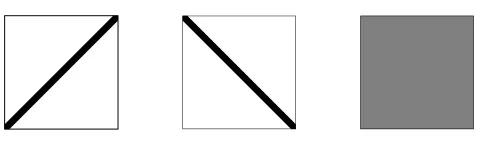
Figure 1: The limits of sequences (π1
i)i∈N, (π 2
i)i∈N, (π 3
i)i∈N.
i1, . . . , in ∈ [n] be such that xi1 < xi2 < · · · < xin. Then the permutation σΦ,n is the unique bijective mapping from [n] to [n] satisfying thatσΦ,n(j)< σΦ,n(j0)
if and only if yij < yij0 for every j, j
0 ∈ [n]. Informally speaking, the values
xi determine the ordering of the points and the relative order of the values yi
determines the relative order of the elements of the permutation.
If Φ is a permuton and σ is a permutation of order n, then t(σ,Φ) is the probability that a Φ-random permutation of ordernisσ. We say that a permuton Φ is alimit of a convergent sequence of permutations (σi)i∈N if
lim
i→∞t(τ, σi) = t(τ,Φ)
for every τ ∈ S. Every convergent sequence of permutations has a limit and the permuton representing the limit of a convergent sequence of permutations is unique.
We now give some examples of the notions we have just defined (the cor-responding permutons are depicted in Figure 1). Let us consider a sequence (π1
i)i∈N such that π 1
i is the identity permutation of order i, i.e., πi1(k) = k for
k∈[i]. This sequence is convergent and its limit is the permuton I with support
{(x, x), x∈[0,1]} and measure uniformly distributed on its support. Similarly, the limit of a sequence (π2
i)i∈N, where π 2
i is the permutation of order idefined as
π2i(k) =i+ 1−k fork ∈[i], is the permuton with support{(x,1−x), x∈[0,1]}
and measure uniformly distributed on its support. Next, consider a sequence (π3
i)i∈Nsuch that πi3 is a uniformly random permu-tation of order i. This sequence is convergent with probability one and its limit is the uniform probability measure on [0,1]2 with probability one.
Similarly to the subpermutation density, we can define the monomorphism density of a permutation τ in a permuton Φ as the probability that the identity mapping to a random Φ-permutation is a monomorphism of τ. Since we view permutons as representing large permutations, if we defined homomorphism den-sities in a natural way, they would coincide with monomorphism denden-sities. So, we restrict our study to subpermutation densities and monomorphism densities in permutons. By analogy to the finite case, we define the vectors
Figure 2: The permuton Φvσ for σ = (2,4,3,1) and v= (1/6,1/4,1/12,1/4).
whereq ∈N and {τ1, . . . , τr} is the set of all non-trivial indecomposable
permu-tations of order at most q.
If Φ is a permuton and σi is a Φ-random permutation of order i, then the
sequence (σi)i∈N is convergent with probability one and Φ is its limit. In par-ticular, this means that for every finite set of permutations P and every ε > 0, there exists a permutation ϕ such that |t(π,Φ)−t(π, ϕ)| < ε for every π ∈ P. This yields an alternative description ofTq as the set{tq(Φ)|Φ∈P}. Similarly,
Tmonq ={tqmon(Φ)|Φ∈P}.
2.3
Permuton constructions
In this section we introduce constructions ofstep-uppermutons and a direct sum of permutons, which we use in Section 3, and we derive formulas for densities of indecomposable subpermutations in the constructed permutons.
The step-up permutons are permutons with simple structure corresponding to a weighted permutation. They are defined as follows. Let σ be a permuta-tion of order n and let v = (v1, . . . , vn) ∈ Rn+ be such that
P
i∈[n]vi ≤ 1, where R+ is the set of positive reals. The step-up permuton of σ and v is the
per-muton Φvσ such that the support of the measure Φvσ is formed by the segments between the points (P
j<ivj,
P
σ(j)<σ(i)vj) and (
P
j≤ivj,
P
σ(j)≤σ(i)vj) fori∈[n]
and the segment between the points (Pn
j=1vj,
Pn
j=1vj) and (1,1). Note that this
uniquely determines the permuton Φvσ because it must have uniform marginals. See Figure 2 for an example.
We now define the direct sum of permutons with weights. For k ∈ N, a sequence of permutons (Φi)i∈[k] and (pi)i∈[k] ∈ Rk+ such that
P
i∈[k]pi ≤ 1, the
direct sum of permutonsΦi with weightspi is denoted by Φ =
L
i∈[k](pi,Φi) and
is defined as follows:
Φ(S) =
k+1
X
i=1
piΦi(θi(S∩Ci))
Φ1
Φ2
[image:9.612.242.342.104.207.2]Φ3
Figure 3: The permuton (1/3,Φ1)⊕(1/6,Φ2)⊕(1/4,Φ3).
1−Pk
i=1pi,
Ci =
"i−1 X
j=1
pj, i
X
j=1
pj
#2
(3)
and θi is a map from Ci to [0,1]2 defined as
θi((x, y)) =
x−Pi−1
j=1pj
pi
,y−
Pi−1
j=1pj
pi
!
for every i∈[k+ 1]. See Figure 3 for an example.
For a permutationτ of orderk, we call an ordered partition P = (P1, . . . , P`)
of [k] a τ-compressive partition if
• Pi is an interval for everyi∈[`],
• a < b for every a∈Pi and b ∈Pj with i < j, and
• for every i∈[`], there exists an integerci, such thatτ(a) =a+ci for every
a ∈Pi. (In particular, τ(Pi) is an interval for every i∈[`].)
We denote the set of allτ-compressive partitions byR(τ). Note that for every permutationτ, there exist at least oneτ-compressive partition: the partition into singletons.
For a permutationτ of orderkand aτ-compressive partitionP = (P1, . . . , P`),
letτ /P be a subpermutation ofτ of order`induced by{a1, . . . , a`}whereai ∈Pi
for every i∈[`]. Note that τ /P is unique, in particular, it is independent of the choice of the elements ai.
In other words, the permutation τ /P is a permutation that can be obtained from τ by shrinking each interval Pi and its image into single points, without
Observation 6. Let τ be a non-trivial indecomposable permutation of order k,
σ a permutation of order n ≥ k and let p = (p1, . . . , pn) ∈ Rn+ be such that
P
i∈[n]pi ≤1. It follows that
t(τ,Φpσ) =k! X P∈R(τ)
X
ψ∈Occ(τ /P,σ)
|P|
Y
i=1
p|Pi|
ψ(i) |Pi|!
.
Proof. Consider k distinct points in the support of Φp
σ and label them (xi, yi),
i∈[k], in such a way thatxi < xj if i < j for everyi, j ∈[k]. Leti1 < i2 <· · ·<
ik0 be the indices of the segments of the support (numbered from left to right) that contain at least one of the points and let P = {P1, . . . , Pk0} be a partition of [k] such that i∈Pj if the point (xi, yi) lies on theij-th segment.
Assume that the points yield the permutationτ. Then, P is a τ-compressive partition and the subpermutationσ0 of σ induced by {i1, . . . , ik0} is τ /P. (Note that since τ is irreducible, none of the points lies on the (k + 1)-st segment of the support of Φpσ.) The converse is also true; fix k0 segments with indices 1 ≤ i1 < · · · < ik0 ≤ n and a τ-compressive partition P = {P1, . . . , Pk0} such that the subpermutationσ0 ofσ induced by{i1, . . . , ik0}isτ /P. Then any choice of points (x1, y1), . . . ,(xk, yk) where each (xt, yt) lies on the segmentij such that
t∈Pij yields the permutation τ.
Note that k random points chosen based on the distribution Φp
σ are
dis-tinct and lie in the support of Φpσ with probability one. The probability that they correspond to a given τ-compressive partition P and ψ ∈ Occ(τ /P, σ) is
k!Q|P|
i=1
p|Pi|
ψ(i)/|Pi|!
. Since these events are disjoint for different pairs (P, ψ), the result follows.
Observation 7. Let τ be a non-trivial indecomposable permutation of order
k and let m be a positive integer. Let Φ1, . . . ,Φm be permutons and let x =
(x1, . . . , xm)∈Rm+ be such that
P
i∈[m]xi ≤1. The permutonΦ
x=L
i∈[m](xi,Φi)
satisfies
t(τ,Φx) =
m
X
i=1
xkit(τ,Φi).
Proof. Observe that, if k random points chosen based on the distribution Φx
yield an indecomposable permutation, then all the points lie in the same Ci,
for some i ∈ [m] (where Ci is given by 3 in the definition of the direct sum of
permutons). The probability that all the points are inCi isxki since Φx(Ci) =xi.
Conditioned on this event, the probability that the points yieldτ ist(τ,Φi). The
result follows.
2.4
Testing permutation parameters
A permutation parameterf is a function fromS toR. A parameter f isfinitely forcibleif there exists a finite family of permutationsA such that for every ε >0 there exist an integer n0 and a real δ >0 such that if σ and π are permutations
of order at least n0 satisfying |t(τ, σ)−t(τ, π)|< δ for everyτ ∈ A, then|f(σ)−
f(π)|< ε. The set A is referred to as a forcing family for f.
A permutation parameter f is finitely approximable if for every ε > 0 there exist δ > 0, an integer n0 and a finite family of permutations Aε such that if σ
and π are permutations of order at least n0 satisfying |t(τ, σ)−t(τ, π)| < δ for
every τ ∈ Aε, then |f(σ)−f(π)|< ε.
A permutation parameterf istestableif for every ε >0 there exist an integer
n0 and ˜f : Sn0 → R such that for every permutation σ of order at least n0, a randomly chosen subpermutationπ ofσ of sizen0 satisfies|f(σ)−f˜(π)|< εwith
probability at least 1−ε. The following was given in [14].
Lemma 8. A bounded permutation parameter f is testable if and only if it is finitely approximable.
3
Properties of the sets
T
qand
T
monqIn this section, we show that densities of non-trivial indecomposable permutations are mutually independent and, more generally, thatTq contains a ball. We start
by considering the linear span of Tq.
Lemma 9. For everyq∈N, span(Tq) =Rr, wherer is the number of non-trivial indecomposable permutations of order at most q.
Proof. Let{τ1, . . . , τr} be the set of all non-trivial indecomposable permutations
of order at most q. For a contradiction, suppose that span(Tq) has dimension
less than r, i.e., there exist reals c1, . . . , cr, not all of which are zero, such that
r
X
i=1
civi = 0
for every (v1, . . . , vr)∈span(Tq). Therefore,
r
X
i=1
cit(τi,Φ) = 0
for every permuton Φ∈P.
Consider the permutations τi such that ci 6= 0. Among these pick a τk of
maximum order. Observation 6 yields that the following holds for s = |τk| and
every x= (x1, . . . , xs)∈Rs+ such that
Ps
r
X
i=1
cit(τi,Φxτk) =
r
X
i=1
ci|τi|!
X
P∈R(τi)
X
ψ∈Occ(τi/P,τk) |P|
Y
j=1
x|Pj|
ψ(j) |Pj|!
=p(x1, . . . , xs),
where p is a polynomial. We now argue that p is a polynomial of degree s (and therefore it is a non-zero polynomial). Clearly, the polynomial p has degree at most s. Since Occ(τ0, τk) = ∅ for every τ0 of order s such that τ0 6= τk,
cks!x1x2· · ·xs is the only term of p containing the monomial x1x2· · ·xs with
nonzero coefficient. Therefore, there exists x such that Pr
i=1cit(τi,Φxτk) 6= 0, which is a contradiction.
Now, we will prove the main result of this section, Theorem 1. It shows that the interior of Tq is non-empty. Observation 5 yields the same conclusion for
Tq
mon.
Proof of Theorem 1. Let {τ1, . . . , τr} be the set of all non-trivial
indecompos-able permutations of order at mostq and let Φ1, . . . ,Φr be permutons such that
{tq(Φi) | i = 1, . . . , r} spans Rr. Consider the matrix V = (vi,j)ri,j=1, where
vi,j =t(τj,Φi). Observe that the matrix V is non-singular.
Consider a vectorx= (x1, . . . , xr)∈(0, r−1)r and let Φx=
L
i∈[r](xi,Φi). By
Observation 7, we have
t(τj,Φx) = r
X
i=1
x|τj|
i t(τj,Φi) = t
X
i=1
x|τj|
i vi,j.
Let Ψ be a map from Rr to
Rr such that
Ψj(x) = r
X
i=1
x|τj|
i vi,j for all j ∈[r].
Since we have Ψ(x) =tq(Φx), we get that
Ψ((0, r−1)r) ={Ψ(x)|x∈(0, r−1)r} ⊆Tq.
The Jacobian Jac(Ψ)(x) is a polynomial inx1, . . . , xr. Since forx1 =· · ·=xr = 1
we have
Jac(Ψ) = det(vi,j· |τj|)ri,j=1 =
r
Y
j=1 |τj|
!
detV 6= 0,
Jac(Ψ) is a non-zero polynomial.
Hence, there exists x∈(0, r−1)r for which Jac(Ψ)(x) 6= 0. Consequently, Tq
Theorem 1 implies that for every finite family A of indecomposable permu-tations, there exist permutons Φ and Φ0 and an indecomposable permutation τ
such that t(π,Φ) = t(π,Φ0) for every π ∈ A and t(τ,Φ) 6= t(τ,Φ0). The fol-lowing lemma shows that an analogous statement holds for any finite family of permutations, not only for indecomposable permutations.
Lemma 10. For every finite set of permutations A = {τ1, . . . , τk}, there exists
a permutation τ and permutons Φ and Φ0 such that t(τi,Φ) = t(τi,Φ0) for every
i∈[k] and t(τ,Φ)6=t(τ,Φ0).
Proof. LetB={π1, . . . , πk+1} be a family of indecomposable permutations each
of order n with n > |τi| for every i ∈ [k], such that for every πj ∈ B, there
is no ` < n satisfying πj(` + 1) = πj(`) + 1. We call permutations with this
property thorough. By (1) in Section 2.1 a random permutation of order n is indecomposable with probability tending to one asn tends to infinity. Moreover, by (2) in Section 2.1 such permutations are thorough with probability bounded away from zero, because every simple permutation is thorough. Therefore, a familyB ofk+ 1 indecomposable thorough permutations exists for n sufficiently large.
Let Φu = L
i∈[k+1](ui,Φnπi) for u = (u1, . . . , uk+1) ∈ (0,
1
k+1]
k+1 where n =
(1/n, . . . ,1/n
| {z }
n×
).
Observe that for a thorough permutation π, the partition into singletons is the only π-compressive partition. Hence, by Observations 6 and 7, t(πi,Φu) =
n!(ui/n)n for every i ∈ [k+ 1]. For every j ∈ [k], the function u 7→ t(τj,Φu) is
continuous for everyj ∈[k]. We consider the continuous map Γ from (0,1/(k+ 1)]k+1 to
Rk such that
Γ(u) = (t(τ1,Φu), . . . , t(τk,Φu)).
Now, consider any k-dimensional sphere in (0,1/(k + 1)]k+1. The
Borsuk-Ulam Theorem [7] yields the existence of two distinct points on its surface that are mapped by Γ to the same point in [0,1]k. Hence, there exist distinct v = (v1, . . . , vk+1) andv0 = (v01, . . . , v
0
k+1) such thatt(τj,Φv) =t(τj,Φv
0
) for everyj ∈
[k]. However, if, say vi 6= vi0, then t(πi,Φv) =n!(vi/n)n 6=n!(vi0/n)n =t(πi,Φv
0 ). Therefore, we may take τ =πi, Φ = Φv, and Φ0 = Φv
0 .
4
Non-forcible approximable parameter
For this section, we fix a sequence (τi)i∈N of permutations of strictly increasing orders that satisfies the following: For everyk >1, there exist permutons Φk and
Φ0k such thatt(σ,Φk) = t(σ,Φ0k) for every permutation σ of order at most |τk−1|,
Φk and Φ0k for all k ∈Nfor the rest of this section. Let γk =t(τk,Φk)−t(τk,Φ0k)
for every k∈N.
Let (αi)i∈N be a sequence of positive reals satisfying Pi∈Nαi < 1/2 and
P
i>kαi < αkγk/4 for everyk. The main result of this section is that the
permu-tation parameter
f•(σ) =
X
i∈N
αit(τi, σ)
is finitely approximable but not finitely forcible.
Lemma 11. The permutation parameter f• is finitely approximable.
Proof. Letε >0 be given. Since the sum P
i∈Nαi converges, there exists k such
thatP
i>kαi < ε/2. Set A={τ1, . . . , τk} and δ=ε. Consider two permutations
σ and π that satisfy |t(τ, σ)−t(τ, π)|< δ for every τ ∈ A. We obtain that
|f•(σ)−f•(π)|=
X
i∈N
αi(t(τi, σ)−t(τi, π))
≤X
i∈N
αi|t(τi, σ)−t(τi, π)|
<X
i≤k
αiδ+
X
i>k
αi|t(τi, σ)−t(τi, π)|
< δ/2 +X
i>k
αi·1< ε.
It follows that the parameterf• is finitely approximable.
In the following lemma, we show that f• is not finitely forcible.
Lemma 12. The permutation parameter f• is not finitely forcible.
Proof. Suppose that f• is finitely forcible and that A is a forcing family for f•. Letτi, γi,Φi and Φ0i be as in the definition off• and let k be such that maximum order of a permutation in A is at most |τk−1|. We have t(ρ,Φk) = t(ρ,Φ0k) for
every ρ∈ A, t(τi,Φk) = t(τi,Φ0k) for everyi < k, and t(τk,Φk)−t(τk,Φ0k) =γk.
Let ε = αkγk/4. Let δ > 0 be as in the definition of finite forcibility of f•. Without loss of generality we may assume thatδ < ε.
There exist a Φk-random permutation σ and a Φ0k-random permutation σ
0
such that|t(ρ, σ)−t(ρ, σ0)|< δ for everyρ∈ A,|t(τi, σ)−t(τi, σ0)|< δ for every
definition of f• with the k-th term missing. X
i∈N,i6=k
αi(t(τi, σ)−t(τi, σ0))
= X i<k
αi(t(τi, σ)−t(τi, σ0)) +
X
i>k
αi(t(τi, σ)−t(τi, σ0))
<X i<k
αiδ+
X
i>k
αi <
αkγk
8 +
αkγk
4 <
αkγk
2
This leads to the following
|f•(σ)−f•(σ0)|=
X
i∈N
αi(t(τi, σ)−t(τi, σ0))
≥αk(t(τk, σ)−t(τk, σ0))−
X
i∈N,i6=k
αi(t(τi, σ)−t(τi, σ0))
> 3
4αkγk−
αkγk
2 =
αkγk
4 =ε.
This contradicts our assumption thatf• is finitely forcible.
Lemmas 11 and 12 imply Theorem 2. Recall that, by Lemma 8 the testable bounded permutation parameters are precisely the finitely approximable ones.
Acknowledgements
This work has received funding from the European Research Council (ERC) under the European Unions Horizon 2020 research and innovation programme (grant agreement No 648509) and under the European Union’s Seventh Framework Pro-gramme (FP7/2007-2013)/ERC grant agreement no. 259385. Glebov also ac-knowledges the support of the ERC grant “High-dimensional combinatorics”. Hoppen acknowledges the support of FAPERGS (Proc. 2233-2551/14-0), CNPq (Proc. 448754/2014-2 and 308539/2015-0) and FAPESP (Proc. 2013/03447-6). Hoppen and Kohayakawa acknowledge the support of the University of S˜ao Paulo, through NUMEC/USP (Project MaCLinC/USP). Kohayakawa was partially sup-ported by FAPESP (2013/03447-6, 2013/07699-0), CNPq (459335/2014-6, 310974/2013-5) and the NSF (DMS 1102086).
References
[1] M.H. Albert, M.D. Atkinson, and M. Klazar. The enumeration of simple permutations. J. Integer Seq., 6(2):3, 2003.
[2] N. Alon, E. Fischer, I. Newman, and A. Shapira. A combinatorial charac-terization of the testable graph properties: It’s all about regularity. SIAM J. Comput., 39(1):143–167, 2009.
[3] N. Alon and A. Shapira. Every monotone graph property is testable. SIAM J. Comput., 38(2):505–522, 2008.
[4] C. Borgs, J. Chayes, L. Lov´asz, V. T. S´os, B. Szegedy, and K. Vesztergombi. Graph limits and parameter testing. In Proceedings of the thirty-eighth an-nual ACM symposium on Theory of computing - STOC ’06, pages 261–270. Association for Computing Machinery (ACM), 2006.
[5] C. Borgs, J.T. Chayes, L. Lov´asz, V. S´os, and K. Vesztergombi. Convergent sequences of dense graphs II. multiway cuts and statistical physics. Ann. of Math., 176(1):151–219, 2012.
[6] C. Borgs, J.T. Chayes, L. Lov´asz, V.T. S´os, and K. Vesztergombi. Conver-gent sequences of dense graphs I: Subgraph frequencies, metric properties and testing. Adv. Math., 219(6):1801–1851, 2008.
[7] K. Borsuk. Drei S¨atze ¨uber die n-dimensionale euklidische Sph¨are. Fund. Math., 1(20):177–190, 1933.
[8] P. Erd˝os, L. Lov´asz, and J. Spencer. Strong independence of graphcopy functions. Graph Theory and Related Topics, pages 165–172, 1979.
[9] R. Glebov, A. Grzesik, T. Klimoˇsov´a, and D. Kr´al’. Finitely forcible graphons and permutons. J. Combin. Theory (B), 110:112–135, 2015.
[10] O. Goldreich, S. Goldwasser, and D. Ron. Property testing and its connection to learning and approximation. InProceedings of the 37th Annual Symposium on Foundations of Computer Science, FOCS ’96, pages 339–348, 1996.
[11] O. Goldreich and L. Trevisan. Three theorems regarding testing graph prop-erties. Random Structures Algorithms, 23(1):23–57, 2003.
[13] C. Hoppen, Y. Kohayakawa, C. G. Moreira, and R. M. Sampaio. Prop-erty testing and parameter testing for permutations. In Proceedings of the Twenty-first Annual ACM-SIAM Symposium on Discrete Algorithms, SODA ’10, pages 66–75, Philadelphia, PA, USA, 2010. Society for Industrial and Applied Mathematics.
[14] C. Hoppen, Y. Kohayakawa, C. G. Moreira, and R. M. Sampaio. Testing permutation properties through subpermutations. Theoret. Comput. Sci., 412(29):3555–3567, 2011.
[15] C. Hoppen, Y. Kohayakawa, C. G. T. de A. Moreira, and R. M. Sampaio. Limits of permutation sequences through permutation regularity. arXiv preprint arXiv:1106.1663, 2011.
[16] T. Klimoˇsov´a and D. Kr´al’. Hereditary properties of permutations are strongly testable. In Proceedings of the Twenty-Fifth Annual ACM-SIAM Symposium on Discrete Algorithms, SODA ’14, pages 1164–1173, Philadel-phia, PA, USA, 2014. Society for Industrial and Applied Mathematics.
[17] D. Kr´al’ and O. Pikhurko. Quasirandom permutations are characterized by 4-point densities. Geom. Funct. Anal., 23(2):570–579, 2013.
[18] L. Lov´asz and B. Szegedy. Limits of dense graph sequences. J. Combin. Theory (B), 96(6):933–957, 2006.
[19] L. Lov´asz and B. Szegedy. Szemer´edi’s lemma for the analyst. Geom. Func. Anal., 17(1):252–270, 2007.
[20] L. Lov´asz and B. Szegedy. Testing properties of graphs and functions. Israel J. Math., 178(1):113–156, 2010.
[21] C. B. Presutti and W. Stromquist. Packing rates of measures and a conjec-ture for the packing density of 2413. In Permutation patterns, volume 376 of London Math. Soc. Lecture Note Ser., pages 287–316. Cambridge Univ. Press, Cambridge, 2010.