warwick.ac.uk/lib-publications
Manuscript version: Author’s Accepted Manuscript
The version presented in WRAP is the author’s accepted manuscript and may differ from the
published version or Version of Record.
Persistent WRAP URL:
http://wrap.warwick.ac.uk/104496
How to cite:
Please refer to published version for the most recent bibliographic citation information.
If a published version is known of, the repository item page linked to above, will contain
details on accessing it.
Copyright and reuse:
The Warwick Research Archive Portal (WRAP) makes this work by researchers of the
University of Warwick available open access under the following conditions.
Copyright © and all moral rights to the version of the paper presented here belong to the
individual author(s) and/or other copyright owners. To the extent reasonable and
practicable the material made available in WRAP has been checked for eligibility before
being made available.
Copies of full items can be used for personal research or study, educational, or not-for-profit
purposes without prior permission or charge. Provided that the authors, title and full
bibliographic details are credited, a hyperlink and/or URL is given for the original metadata
page and the content is not changed in any way.
Publisher’s statement:
Please refer to the repository item page, publisher’s statement section, for further
information.
Structuring Clinical Decision Support rules
for drug safety using Natural Language
Processing
George DESPOTOUa,1, Ioannis KORKONTZELOSb, Nicholas MATRAGKASc, Eda
Bilicia, and Theodoros N ARVANITISa
aInstitute of Digital Healthcare, WMG, University of Warwick, UK. bDepartment of Computer Science, Edge Hill University, UK.
cDepartment of Computer Science, University of Hull, UK.
Abstract. Drug safety is an important aspect in healthcare, resulting in a number of inadvertent events, which may harm the patients. IT based Clinical Decision Support (CDS), integrated in electronic-prescription or Electronic Health Records (EHR) systems, can provide a means for checking prescriptions for errors. This requires expressing prescription guidelines in a way that can be interpreted by IT systems. The paper uses Natural Language Processing (NLP), to interpret drug guidelines by the UK NICE BNF offered in free text. The employed NLP component, MetaMap, identifies the concepts in the instructions and interprets their semantic meaning. The UMLS semantic types that correspond to these concepts are then processed, in order to understand the concepts that are needed to be implemented in software engineering for a CDS engine.
Keywords. Pharmacovigilance, drug safety, CDS, NLP
Introduction
Advances in interoperability and architecture of Health IT systems have enabled provision of new functions that allow integrating aspects of healthcare that were previously isolated. Examples include, integrating data sources under a single record, and provision of personalized care plans that can be accessed and evaluated by multiple stakeholders such as experts, family and the patients themselves [1]. Such health IT infrastructures, are based on collaboration amongst components, using messaging standards such as FHIR provide an overarching new capability.
Clinical Decision Support (CDS) modules often provide a means of checking the information exchanged between components for medical significance. For example improving drug safety, checking prescriptions for validity, as well as identifying adverse interaction between prescribed drugs, particularly to polypharmacy patients. Such check is the validation of a prescription against typical instructions, such as maximum dose during a time period. However, in order for this to be achieved by a health IT based system, these instructions need to be captured in a format that is executable by IT systems. The instructions need to be modelled in a way that an IT system can understand their
semantics, in order to be applied as rules when checking a prescription. The National Institute for Care Excellence (NICE) provides dose instructions for the drugs listed in their British National Formulary (BNF). The NICE BNF provides structured definitions of drug aspects such as drug to drug interactions, but uses free text for drug instructions. For example, “500mg 3 times a day”, and “300–900mg every 4–6hours as required; maximum 4g per day.”. Dose instructions are expressed using a number of (semantically) common concepts. For example, quantity of a substance, frequency, quantity checks (e.g., maximum 2g), as well as more complex logic including past or future events and checks. The work presented in this paper looks into the UK NICE BNF dose instructions, and using Natural Language Processing (NLP), identifies the types of semantic expression and investigates how we can generalize these types, and how they can be used to specify rules that can be applied to health IT systems that contribute to medication prescription. NLP has been used to extract semantic relations from clinical texts categorizing and mapping clinical knowledge [2, 3, 4, and 5].
1.Overview of the approach
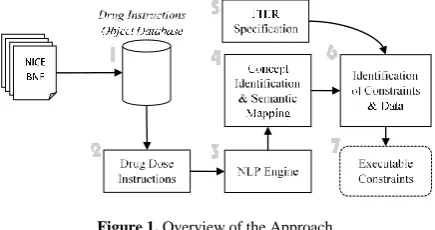
[image:3.595.189.407.443.558.2]Information about drugs are taken from the UK NICE section of the British National Formulary (BNF), a reference on pharmacology and prescribing. The drugs are stored in a structured way, as objects, in an Eclipse Modelling Framework model; this allows processing the elements of the model. The UK NICE BNF provides instructions for each combination of patient category, drug administration route, and indication. All instructions are exported in a format suitable for NLP analysis.
Figure 1. Overview of the Approach.
The instructions are then processed by MetaMap [6], an NLP tool that recognizes UMLS Metathesaurus concepts referred to in biomedical text entered in the NLP Engine. The UMLS, or Unified Medical Language System, is an interoperable collection of health and biomedical vocabularies. Concepts, i.e. vocabulary terms, are categorized in semantic types, i.e. broad subject categories, such as Activity, Genetic Function and Fungus.
whether the identified resources will be available, we are looking at how they can be matched with the data elements of the MedicationPrescription data structure of the Fast Healthcare Interoperability Resource (FHIR) standard. FHIR is a messaging exchange standard that has improved interoperability of health IT systems, by offering a standardized means of exchanging information. Although not a storage standard, any component complying to FHIR would be expected to provide a specific set of information, structured in a specific way. Figure 2 shows the class diagram equivalent of the MedicationPrescription FHIR resource which is of interest. The last stage of the process (7) is outside the scope of this paper.
Figure 2. UML class diagram showing some of the typical information concepts expected in a prescription, according to the FHIR MedicationPrescription resource.
2.NLP Concepts
[image:4.595.127.469.561.654.2]Table 1 presents the seven most frequent UMLS concepts that appear in the instructions, along with their associated semantic types.
Table 1. Frequency of the UMLS concepts in the NICE BNF drug instructions.
Position Frequency CUI Semantic Type Concept
1 4200 C0439210 Quantitative Concept MILLIGRAM (milligram)
2 2888 C0178602 Quantitative Concept DOSE (Dosage)
3 2757 C0332173 Temporal Concept /day (Daily)
4 1289 C0205265 Temporal Concept Initially
5 1015 C1883708 Temporal Concept Then
6 974 C0442805 Functional Concept Increased (Increase)
7 923 C0585361 Temporal Concept Twice Daily (Twice a day)
3.Designing rules based on FHIR resources
Concepts and semantic types can be mapped to specific rules that will be implemented in an executable format in a CDS engine. This section shows an example of how such rules can be specified using the Object Constraint Language (OCL). OCL can then be applied to any object oriented environment and transformed into relational database query and rule. For example, three of the most common concepts appearing were mg, dose and twice a day. This respectively correspond to Quantity, Dose, and Rate in the MedicationPrescription. Figure 3 shows how such a rule would be specified in OCL.
Figure 3. OCL rule using the Quantity, Dose, and Rate, FHIR resources.
4.Conclusions
The experiment offered two main conclusions. Firstly, there is a strong indication that drug instructions only need a limited number of concepts to be expressed. This can allow the specification of a controlled vocabulary language that can be used to define all potential instructions. Secondly, the concepts, and the even fewer semantic types they correspond to, allow their mapping to FHIR MedicationPrescription resources, which is the gold standard in health IT interoperability. This will allow the definition of CDS rules that can be imported and executed in any compliant module. Further work being planned entails a controlled vocabulary, as well as training of the NLP engine to recognize concepts specific to drug administration instructions. The latter will address a common limitation in NLP, which is the confidence with which the interpretation of the text is done.
References
[1]E.G.B. Laleci, M. Yuksel and T.N. Arvanitis, C3-Cloud: a federated collaborative care and cure cloud architecture for addressing the needs of multi-morbidity and managing poly-pharmacy, Informatics for Health 2017 / 24 – 26 April 2017.
[2]A. L. Minard and K. Kaiser, Supporting computer-interpretable guidelines’ modeling by automatically classifying clinical actions. In Process Support and Knowledge Representation in Healthcare 2013 (pp. 39-52). Springer, Cham.
[3]W. G. El-Rab, O. R. Zaïane and M. El-Hajj, Formalizing clinical practice guideline for clinical decision support systems. Health Informatics Journal. 2017;23(2):146-56.
[4]Z. Luo, M. Yetisgen-Yildiz and C. Weng. Dynamic categorization of clinical research eligibility criteria by hierarchical clustering. Journal of Biomedical Informatics. 2011;44(6):927-35.
[5]N. Hong, D. Li, Y. Yu, Q. Xiu, H. Liu, and G. Jiang, A computational framework for converting textual clinical diagnostic criteria into the quality data model. Journal of biomedical informatics. 2016;63:11-21. [6]A. R. Aronson and F. M. Lang, An overview of MetaMap: historical perspective and recent advances. Journal of the American Medical Informatics Association : JAMIA. 2010;17(3):229-236. doi:10.1136/jamia.2009.002733.
context Prescription inv correctDosage:
self.content.oclAsType(MedicationPrescription).dosageInstruc tions->forAll( i | i.dose -> forAll(d |
oclAsType(DoseQuantity).type = 'mg' and