warwick.ac.uk/lib-publications
Manuscript version: Author’s Accepted Manuscript
The version presented in WRAP is the author’s accepted manuscript and may differ from the
published version or Version of Record.
Persistent WRAP URL:
http://wrap.warwick.ac.uk/116365
How to cite:
Please refer to published version for the most recent bibliographic citation information.
If a published version is known of, the repository item page linked to above, will contain
details on accessing it.
Copyright and reuse:
The Warwick Research Archive Portal (WRAP) makes this work by researchers of the
University of Warwick available open access under the following conditions.
Copyright © and all moral rights to the version of the paper presented here belong to the
individual author(s) and/or other copyright owners. To the extent reasonable and
practicable the material made available in WRAP has been checked for eligibility before
being made available.
Copies of full items can be used for personal research or study, educational, or not-for-profit
purposes without prior permission or charge. Provided that the authors, title and full
bibliographic details are credited, a hyperlink and/or URL is given for the original metadata
page and the content is not changed in any way.
Publisher’s statement:
Please refer to the repository item page, publisher’s statement section, for further
information.
Selecting Effective Blockchain Solutions
Carsten Maple1and Jack Jackson2 [email protected]
1
University of Warwick, Coventry CV4 7AL, UK 2 Everledger, London, WC2H 9JQ, UK
Abstract. Distributed ledger technologies (DLT) are becoming increas-ingly popular and seen as a panacea for a wide range of applications. However, it is clear that many organisations, and even engineers, are selecting DLT solutions without fully understanding their power or limi-tations. Those that make the assessment that blockchain is the best solu-tion are provided little guidance on the vast array of types of blockchain; whether permissioned, permissionless or federated; which consensus al-gorithm to use; and a range of other considerations. This paper aims to addresses this gap.
Keywords: Distributed ledger technology, blockchain anatomy, blockchain
se-lection, consensus determination protocol
1
Introduction
II
chains, where fraudsters have long taken advantage of opaqueness in the prod-uct life-cycle; typically with expensive ramifications. The nature of communica-tions in such systems can help to eliminate intermediaries, allowing individuals and organisations to interact freely with one another. Considering that many industry infrastructures consist of such middlemen (such as distributors in sup-ply chain networks), this could vastly decrease the operational costs associated with running a business; consequently, providing a more open, transparent and competitive marketplace. The implementation of blockchain technology is also valuable within industries that are continuously subjected to rigorous regulation, as the meeting of such requirements can be both time consuming and expensive for an organisation.
The first notable implementation of DLT came in the form of the Bitcoin whitepaper [1], written by Satoshi Nakamoto. Since then DLT such as blockchain have become a panacea for a wide range of applications. They are often perceived as the cornerstone of technological innovation across industries. As such, many organisations show interest in implementing the technology within their industry. Companies wishing to adopt such mechanisms are faced with the challenge of selecting an appropriate configuration for their functional requirements. As the solutions landscape continues to grow, it becomes increasingly important that engineers and decision-makers within an organisation fully understand the power and limitations of the various technologies on offer [13, 14, 7, 8].
In this paper we present an anatomy of blockchain solutions, analysing their key technological features. This paper begins by considering existing work within the field, before proposing and analysing a generic anatomy. This is followed by a brief discussion of a number of developed platforms, before concluding and proposing areas for future work.
2
Existing Work
III
in byzantine-fault-tolerance (BFT) schemes. Notable emphasis is place upon the computational expense associated with each of the discussed mechanisms. The scalability constraints placed upon each approach are critically analysed, ad-dressing a long-term problem within the DLT community.
In a more critical sense, Daniel Kraft [4] focuses on analysing the compu-tation inefficiencies within existing blockchain technologies. In his paper, Kraft identified inefficiencies within the mining processes of both Bitcoin and Name-coin. He proposes a mechanism which is designed to work ”perfectly” across both constant and exponentially growing hash rates. Comparisons between his mechanism and more traditional methods are drawn from three core metrics: mining difficulty, average block-time and name expiration. The majority of aca-demic work within the field of DLT has been focused on analysing one core metric of the technology. Very little work has been directed at educating readers in the identification process for the appropriate solution for their requirements. This paper builds upon a number of previous works, allowing us to address this knowledge gap.
3
An Anatomy of Blockchain Solutions
We now consider some of the key features of a blockchain network. The feature list contained within this section does not fully encompass the topology of all blockchain solutions. Instead, they are a select subset of features used by us to create a generalized anatomy of a blockchain solution. Each block within a blockchain network contains a series of transactions, accompanied by the sig-nature of the sending network participant. Participation within a network is controlled by the permission-determination protocol adopted by the network. Network participants are often offered incentives to maintain the ledger. Within public networks this can be achieved through mining. Consensus mechanisms are used within blockchain networks to ensure that the ledger is maintained in a valid and correct state, reflecting thetrue series of transactions taking place.
3.1 Blocks
Each block within a blockchain network contains both a header and a body. The block header typically consists of information equivalent to metadata. The header is usually used to support the identification and verification of blocks and their body contents. The block body usually contains information surrounding the transactions within the block. However, the format of data and information contained within both the header and body, varies between implementation.
IV
parent. The block body contains a series of transactions accompanied by a trans-action counter. The maximum number of transtrans-actions contained within a block is dependent upon the size of both the block and the transaction contained within. In contrast, the Ethereum [14, 15] network block contains vastly different content. The block head within an Ethereum block (based on the yellow paper [15]) contains the: parent hash, ommers hash, beneficiary, state root, transactions root, receipts root, logs bloom, difficulty, number, gas limit, gas used, timestamp, extra data, mix hash and nonce. Whilst the body contains a list of transactions and an ommers list.
3.2 Smart Contracts
In essence, smart contracts [18] are a protocol which allow for the contribution, verification and implementation of actions within a contract. Smart contracts can be implemented to ensure the effectuation of embedded regulation, contrac-tual terms, business rules and other codifiable instructions. This allows for the enforcement of obligations along with the auditable tracking of that enforcement on the blockchain, in addition to transparency and third party integration. This creates a unique value proposition for users, as well a proven platform on which to further integrate partners systems and processes.
In the event that manual checks are required, smart contracts are capable of triggering an event which notifies relevant parties that action is necessary. This also extends to situations in which a combination of document submission and manual checking is required. When critically analysing these processes, it would be a waste of time to have a human perform an analysis if other supporting documents are either not present or invalid. A smart contract is capable of managing such scenarios, by first ensuring all supporting documents are present and valid, before prompting the human interaction with the process. Essentially, enabling effective time-management across an organisation.
While many blockchain platforms use smart contracts, such as: Ethereum [14, 15], Corda [13] and Hyperledger Fabric [12], not all do; with Monero [7] being a prime example of this.
Monero is a platform which claims to offer superior security and privacy to its competitors, through the implementation of mechanisms such as ring signatures. Implementing smart contracts into a platform increases the attack surface of the network. All of which is counter-intuitive for a privacy-focused platform such as Monero.
3.3 Transaction Signing
V
their own public and private keys. Parties use their private keys to sign transac-tions using the the elliptic curve digital signature algorithm (ECDSA). Signed transactions are then broadcast across the network for peer verification. Digital signature algorithms (DSA) such as ECDSA are used to ensure the authenticity of both the source and integrity of data. A great example of elliptic curves being implemented for transaction signing can be seen in the secp256k1 elliptic curve, which is implemented within: Bitcoin [1], Ethereum [14, 15] and Zcash [8]. Nu-merous different types of elliptic curves are used by blockchain networks in the signing process, including the Ed25519 curve used within Monero [7].
3.4 Permissions
Permissions control access parameters around participation within a network, and can either encourage open contribution from the general population, or restrict admittance to pre-trusted entities. This is extremely useful from an engineering perspective as it provides flexibility, adaptive to the specification requirements of the proposed solution. Blockchain has three core permission-determination protocols: permissionless, permissioned and federated.
Permissionlessblockchain networks [20] allow for external parties to
partic-ipate within an open network, without the need for traditional registration mech-anisms (permissionless access). This creates openness without imposing strong self-identification restraints on actors within the network. Since anyone can par-ticipate in the network freely, there is a requirement to offer a financial incentive for peer validation and system maintenance tasks. Incentives help to promote peer participation in the network, which in turn has a positive impact on the overall security provided by the system. For example, within the PoW consensus mechanism, a 51% network majority is required to enforce change.
Permissionedblockchains [20] are not controlled or manipulated by a single
entity, but by a consortia of entities, which provide selected parties with autho-rization to participate within the network. This affords the consortia the power to vet participants to a degree. Since permissioned networks operate under the supervision of a trusted consortium of validators, the cost of verifying transac-tions is significantly reduced. The infrastructure also supports the updating of protocols with relative ease. As all nodes are well known and regulated, there is negligible risk of network performance degradation or outage.
Federated blockchains also restrict access to the network. However, there
VI
3.5 Consensus
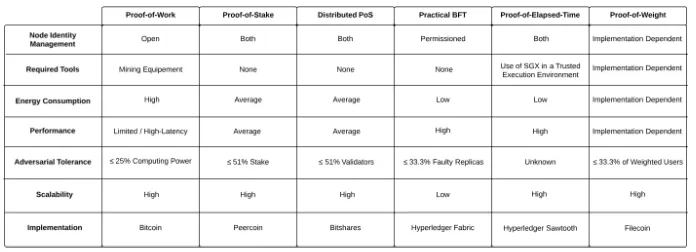
Consensus is the mechanism by which individuals within a network come to an agreement regarding a particular decision or view. Ideally, consensus mech-anisms are capable of mitigating the actions of dishonest individuals or groups; whilst offering a level of redundancy in the event that a subset of parties are unable to respond. Within blockchain technology, consensus is used to provide a degree of consistency across transactions within a ledger. Each consensus mecha-nism has varying degrees of tolerance around the level of redundancy, resilience, speed and security involved in the performance of their functionality. Common consensus determination algorithms used within blockchain platforms include: PoW [1, 3, 19], of-stake (PoS) [19], delegated of-stake (DPoS), proof-of-authority (PoA), proof-of-elapsed-time (PoET) [16], byzantine fault tolerance (BFT) [3, 9, 11].
Proof-of-Work [1, 3] is a piece of data that is both time consuming and
costly to produce, but easily verifiable by peers. Producing a PoW is essentially a random process with a low probability of success; thus, it is down to trial and error. Perhaps the most notable implementation of PoW can be seen within the Bitcoin network [1]. Within Bitcoin, block references are obtained through the double hashing of the blocks header content, using the SHA-256 hash function. Hashing, mining difficulty and threshold functions for PoW schemes are outlined within [19]. Due to the nature of PoW, an adversarial party would require 51% of the networks hash-rate (or computing power) to compromise the system.
Although PoW is a decentralized protocol, within networks such as Bitcoin, PoW is executed by an ever increasing centralized system of miners. Practically speaking, most people do not have the computational resources to participate in the mining process. As a result, to guarantee stable returns for participation, most miners pool their resources. This has effectively created a centralized mech-anism, revolving around so calledpool managers. Currently, the Bitcoin network, the five biggest mining pools control over 34 of all hashing power.
Proof-of-Stake [19] derives its consensus from the holdings of the
VII
favour of richer participants, who decide to stake more of their currency. To counter this problem a number of selection mechanisms have been created, such as randomized block and coin age based selection.
It is worth noting that a semi-centralized PoS algorithm known as delegated proof-of-stake also exists. Within DPoS, blocks are created by a select set of users within the system known as delegates. Stake within DPoS is used slightly differently than within PoS. For example, delegates may be elected based on their stake in proportion to the network. Additionally, delegates may receive votes from network participants. The voting power of participants is also reliant on their stake relative to the entire network. Delegates are rewarded for per-forming their role and punished for misbehaviour. There are two core functions performed by delegates: block building and signing. Each delegate is capable of individually generating blocks; however typically speaking, multiple delegates are required to sign a block. Signing is performed by a select subset of delegates. One notable exception to this rule is Tendermint [10], in which any user in the system canprovide a signature.
In essence, PoS systems are more computationally efficient than their PoW counterpart. A greater number of people are encouraged to run nodes and partic-ipate in the network as the cost of participation is affordable. As a result, they system becomes increasingly decentralized. Additional protection comes from the expense associated with executing an attack and the reduced incentive for attackers. An attacker would require a near majority of all network currency to manipulate the network. This is typically referred to as the monopoly problem.
Byzantine Fault Toleranceis commonly thought of in regard to the byzantine
generals problem [9]. With respect to the byzantine generals problem, byzantine fault tolerance is achieved when loyal generals come to a majority agreement on their strategy. Typically byzantine faults are the most challenging to deal with, as no restrictions or assumptions are made around the behaviour a node can exhibit. The most successful approach to date is known as practical byzantine fault tolerance (PBFT) [11].
PBFT is the core for many algorithms used for tasks, such as: terminating re-liable broadcast, group membership, view synchronous b-cast and state machine replication. PBFT processes can be categorised into three core types: clients, primaryn replicas and backupn replicas. Any client within the system can be faulty. In accordance with the 1/3rd corruption tolerance of BFT, the number of replicas present is calculated as follows;n= 3f + 1, wheref is upper bound of faulty parties.
Practical Byzantine Fault Tolerant Consensus[11] is achieved through
execu-VIII
tion in accordance with the preparation phase, whilst handling further garbage collection duties.
PBFT consumes less energy that both PoW and PoS mechanisms and also offers a higher level of performance in respects to latency and network through-put. Since it is a permissioned network protocol, its adversarial tolerance should not be compared to that of PoW, or permissionless PoS schemes. However, due to the nature of PBFT consensus, scalability becomes a significant issue. There-fore, we recommend using PBFT within small to medium size networks. PBFT is particularly effective within industries consisting of a strictly defined infras-tructure.
Proof-of-Elapsed-Time(PoET) [16] is designed to achieve a distributed
consensus in a lottery-type function. It was originally designed with the aim of creating a fair mechanism for distributing mining rights within permissioned networks.
PoET abide by a four-stage process flow. Firstly, each validator requests a randomly distributed wait-time period from a trusted enclave. Secondly, the validator with the shortest wait time wins the election and is awarded leadership for the transactional block in question. A function is used to create a timer for the transaction block that is guaranteed to have been created by the enclave. Another function is then used to verify the timer origin.
The enclave comes in the form of a secure CPU instruction-set, ensuring fairness in the randomness of selection across all participants. This is achieved through implementing in the low level, using Intel’s Software Guard Extensions (SGX) [17]. This facilitates the PoET algorithm in providing random distribu-tion of leadership across an entire populadistribu-tion of participants, in a fair manner. An attestation of execution provides verification of a participants claim to lead-ership, providing a low cost for participation. This offers a strong incentive for participation in the network, as the algorithm is perceived to be fair, just and accessible (due to the low cost infrastructure). Perhaps the most notable imple-mentation of PoET can be seen within the Hyperledger Sawtooth [16] network. The following diagram provides a comparison between the aforementioned consensus mechanisms (1).
4
Developed Platforms
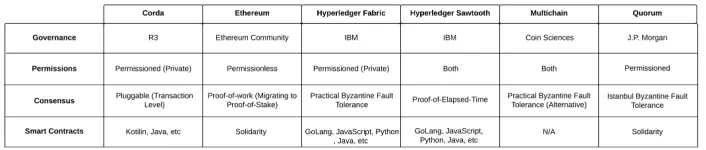
Once an engineer has determined that a blockchain solution is required it is then necessary for them to undertake the platform selection process. We discuss some of the key platforms here.
Corda[13] is an open-source DLT, which is targeted towards the financial
IX
Fig. 1.Consensus Protocol Comparison
b3i. Smart contracts within Corda are grounded in legal prose; allowing for the self-execution and automation of event-driven, legally binding agreements be-tween parties. This makes Corda ideal for financial records management and the automation of financial agreements.
Ethereum[14, 15] is a decentralized platform which affords developers the
ability to execute smart contracts within custom built blockchain networks. Ethereum allows for the creation of cryptocurrencies and storing of crypto-assets within the Ethereum Wallet. The wallet also allows for the writing, deployment and use of smart contracts. Perhaps the most interesting use case for Ethereum, can be seen within digital identity management systems. One great example of this is uPort, which aims to give users a more secure way to provide proof of their identity, by only offering critical information required to perform the desired function. For example, only providing an airport with the relevent in-formation when boarding an aircraft. Ethereum is ideal for such a use-case as it has an easy-to-use smart contract mechanism.
Hyperledger Fabric [12] is an open source, modular platform, currently
spearheaded by IBM (previously governed by the Linux Foundation). Fabric is a private permissioned platform, which supports the use of one or more networks. Each network manages the requirements of a different set of member nodes. Fab-ric offers users the ability to perform queries and updates to the ledger, through the use of a series of industry standard data store mechanisms, such as: key-based lookups, composite key queries and range-key-based searches. Fabric utilizes PBFT [11] and conducts consensus on a transactional level. Peers within Fabric networks are required to endorse transactions in accordance with a number of predefined policies. For a transaction within the network to be validated it must pass all policy checks and receive the signature of all endorsing peers submitting to the Fabricordering service.
X
seen within the Everledger organisation, in which Fabric is used to track and trace diamonds across the supply chain network.
Hyperledger Sawtooth[16] is also part of the Hyperledger family.
How-ever, it differs vastly from its sister Fabric network. Where Fabric was built for vast business networks, Sawtooth was developed as solution aimed at reducing the computational resource consumption within large distributed validator popu-lations. It achieves this through implemented the proof-of-elapsed-time (PoET) consensus protocol. Since consensus is performed within the CPU, which are contained within most consumer electronics, realistically speaking, almost any device can participate within consensus. Considering that PoET consensus is also exceptionally lightweight, this makes Sawtooth ideal for use cases in which IoT devices (which typically contain limited computing power) are implemented. Sawtooth is a great choice for supply-chain networks with IoT device tracking during transit.
MultiChain[21] offers a platform for building both permissioned and
per-missionless blockchain networks. Multichain differentiates itself from most other blockchain networks through its use of streams, which come in three core for-mats: A NoSQL key-value database or document store, an ordered time series database, or an identity-driven database with author-based entry classification. If the purpose of the blockchain product is to store information as opposed to function execution, MultiChain provides a fast and lightweight solution. For this reason, MultiChain is particularly useful for document storage systems, in which simple CRUD functionality is required. Development on the MultiChain plat-form is also exceptionally easy. Streams can be created and added to the network without the need to write code.
Quorum[22], similarly to Corda, is a financial service facing blockchain
net-work. However, unlike Corda, Quorum is actually a fork of an existing blockchain platform, Ethereum. The core changes Quorum makes within its fork, is the ad-dition of a different consensus protocol, encrypted storage and the change to a permissioned access structure. Quorum still provides access to the standard Ethereum features, such as a distributed ledger and smart contracts.Quorum solves two major existing problems preventing permissioned network implemen-tation upon the Ethereum platform. Firstly, within Ethereum anyone can con-nect to the network due to its permissionless nature. Secondly, all data inside of the smart contracts within Ethereum are visible to all participant nodes. Quorum addresses these issues by taking an off-chain approach to data storage. Quorum is particularly useful within use-cases in which privacy and security of transactions are a core concern.
5
Conclusion
XI
Fig. 2.Platform Comparison
existing technologies and protocols, providing solutions architects with a base-line upon which to build their products. However, this paper is meant to be used as a guideline, and is by no means abiblefor building blockchain solutions. From a practical perspective, within industry, it is necessary to consider a multitude of factors outside that of the technological functionality; for example, cost.
In future work, we aim to address a number of other key topics for consider-ation when building ontop of blockchain technologies, such as: off-chain storage requirements, privacy preservation, integration with existing systems (particu-larly legacy) and ease of use. This should provide engineers with further informa-tion, upon which to effectively build their solutions. Platforms such as Monero [7] which focus heavily on security would make for an interesting starting point for such work.
References
1. Satoshi Nakamoto. ”Bitcoin: A Peer-to-Peer Electronic Cash System”. https://bitcoin.org/bitcoin.pdf, 2008.
2. Rafael Pass, Lior Seeman, Abhi Shelat. ”Analysis of
the Blockchain Protocol in Asynchronous Networks”.
https://pdfs.semanticscholar.org/161c/24b98ce3af2c0f8a5e96d5055a367b81801e .pdf, 2016.
3. Marko Vukoli´c. ”The Quest for Scalable Blockchain Fabric: Proof-of-Work vs. BFT Replication”. https://allquantor.at/blockchainbib/pdf/vukolic2015quest.pdf, 2015.
4. Daniel Kraft. ”Difficulty Control for Blockchain-Based Consensus Systems”. https://allquantor.at/blockchainbib/pdf/kraft2016difficulty.pdf, 2015.
5. Zibin Zheng, Shaoan Xie, Hongning Dai, Xiangping Chen, and Huaimin Wang. ”An Overview of Blockchain Technology: Architecture, Consen-sus, and Future Trends”. https://www.researchgate.net/profile/Hong-Ning Dai/publication/318131748 An Overview of Blockchain Technology
Architecture Consensus and Future Trends/links/59d71faa458515db19c915a1/An-
Overview-of-Blockchain-Technology-Architecture-Consensus-and-Future-Trends.pdf, 2017.
XII
7. Nicolas van Saberhagen. ”CryptoNote v 2.0”. https://cryptonote.org/whitepaper.pdf, 2013.
8. Eli Ben-Sasson, Alessandro Chiesa, Christina Garman, Matthew Green, Ian Miers, Eran Tromer, Madars Virza. ”Zerocash: Decentralized Anonymous Payments from Bitcoin (extended version)”. http://zerocash-project.org/media/pdf/zerocash-extended-20140518.pdf, 2014.
9. Leslie Lamport, Rober Shostak, and Marshall Pease. ”The Byzantine Generals Problem”. https://people.eecs.berkeley.edu/ luca/cs174/byzantine.pdf, 1982 10. Jae Kwon. ”Tendermint: Consensus without Mining”.
https://tendermint.com/static/docs/tendermint.pdf, 2014
11. Miguel Castro and Barbara Liskov. ”Practical Byzantine Fault Tolerance”. http://pmg.csail.mit.edu/papers/osdi99.pdf, 1999
12. Christian Cachin. ”Architecture of the Hyperledger Blockchain Fabric”. https://pdfs.semanticscholar.org/f852/c5f3fe649f8a17ded391df0796677a59927f.pdf, 2016
13. Mike Hearn. ”Corda: A distributed ledger”. https://docs.corda.net/ static/corda-technical-whitepaper.pdf, 2016
14. Ethereum Contributors. ”White Paper”. https://github.com/ethereum/wiki/wiki/ White-Paper/3592dda1feca69cce8a9d9a624ea33b0999e1dcc, 2018
15. Ethereum Community. ”Ethereum Yellow Paper”. https://github.com/ethereum/yellowpaper/blob/e653258d1f94c6a29ff1c2c5b43e1 91f535fba49/README.md, 2018
16. Intel Corporation, https://sawtooth.hyperledger.org/docs/core/releases/1.0/ architecture.html, 2015-2017
17. Victor Costan and Srinivas Devadas. ”Intel SGX Explained”. https://eprint.iacr.org/2016/086.pdf, 2016
18. Clack, Bakshi, Braine. ”Smart Contract Templates: foundations, design landscape and research directions”. http://arxiv.org/abs/1608.00771, 2016.
19. BitFury Group. ”Proof of Stake versus Proof of Work”. https://bitfury.com/content/downloads/pos-vs-pow-1.0.2.pdf, 2015
20. Dylan Yaga, Peter Mell, Nik Roby, Karen Scarfone. ”Blockchain Technol-ogy Overview ”.http://img1.wsimg.com/blobby/go/60231649-12ce-4835-96f0-945ea7f2116c/downloads/1cb8a20ea 182905.pdf, 2018
21. Dr Gideon Greenspan, Founder and CEO, Coin Sciences Ltd. ”MultiChain Private Blockchain - White Paper”. https://www.multichain.com/download/MultiChain-White-Paper.pdf, 2015.