Bridging the Gap Between Underspecification Formalisms:
Minimal Recursion Semantics as Dominance Constraints
Joachim Niehren Programming Systems Lab
Universit¨at des Saarlandes [email protected]
Stefan Thater Computational Linguistics Universit¨at des Saarlandes
Abstract
Minimal Recursion Semantics (MRS) is the standard formalism used in large-scale HPSG grammars to model underspecified semantics. We present the first provably efficient algorithm to enumerate the read-ings of MRS structures, by translating them into normal dominance constraints.
1 Introduction
In the past few years there has been considerable activity in the development of formalisms for un-derspecified semantics (Alshawi and Crouch, 1992; Reyle, 1993; Bos, 1996; Copestake et al., 1999; Egg et al., 2001). The common idea is to delay the enu-meration of all readings for as long as possible. In-stead, they work with a compact underspecified resentation; readings are enumerated from this rep-resentation by need.
Minimal Recursion Semantics (MRS) (Copes-take et al., 1999) is the standard formalism for se-mantic underspecification used in large-scale HPSG grammars (Pollard and Sag, 1994; Copestake and Flickinger, ). Despite this clear relevance, the most obvious questions about MRS are still open:
1. Is it possible to enumerate the readings of MRS structures efficiently? No algorithm has been published so far. Existing implementa-tions seem to be practical, even though the problem whether an MRS has a reading is NP-complete (Althaus et al., 2003, Theorem 10.1). 2. What is the precise relationship to other un-derspecification formalism? Are all of them the same, or else, what are the differences?
We distinguish the sublanguages of MRS nets and normal dominance nets, and show that they can be intertranslated. This translation answers the first question: existing constraint solvers for normal dominance constraints can be used to enumerate the readings of MRS nets in low polynomial time.
The translation also answers the second ques-tion restricted to pure scope underspecificaques-tion. It shows the equivalence of a large fragment of MRSs and a corresponding fragment of normal dominance constraints, which in turn is equivalent to a large fragment of Hole Semantics (Bos, 1996) as proven in (Koller et al., 2003). Additional underspecified treatments of ellipsis or reinterpretation, however, are available for extensions of dominance constraint only (CLLS, the constraint language for lambda structures (Egg et al., 2001)).
Our results are subject to a new proof tech-nique which reduces reasoning about MRS struc-tures to reasoning about weakly normal dominance constraints (Bodirsky et al., 2003). The previous proof techniques for normal dominance constraints (Koller et al., 2003) do not apply.
2 Minimal Recursion Semantics
way these formulas can be plugged into each other. More formally, MRSs are formulas over the follow-ing vocabulary:
1. Variables. An infinite set of variables ranged over by h. Variables are also called handles. 2. Constants. An infinite set of constants ranged
over by x,y,z. Constants are the individual vari-ables of the object language.
3. Function symbols.
(a) A set of function symbols written as P. (b) A set of quantifier symbols ranged over
by Q (such as every and some). Pairs Qx are further function symbols (the variable binders of x in the object language).
4. The symbol≤for the outscopes relation.
Formulas of MRS have three kinds of literals, the first two are called elementary predications (EPs) and the third handle constraints:
1. h : P(x1, . . . ,xn,h1, . . . ,hm)where n,m≥0 2. h : Qx(h1,h2)
3. h1≤h2
Label positions are to the left of colons ‘:’ and argu-ment positions to the right. Let M be a set of literals. The label set lab(M) contains those handles of M that occur in label but not in argument position. The
argument handle setarg(M)contains the handles of
M that occur in argument but not in label position.
Definition 1 (MRS). An MRS is finite set M of
MRS-literals such that:
M1 Every handle occurs at most once in label and at most once in argument position in M.
M2 Handle constraints h1≤h2 in M always relate argument handles h1to labels h2of M.
M3 For every constant (individual variable) x in ar-gument position in M there is a unique literal of the form h : Qx(h1,h2)in M.
We call an MRS compact if it additionally satisfies:
M4 Every handle of M occurs exactly once in an elementary predication of M.
We say that a handle h immediately outscopes a handle h0in an MRS M iff there is an EP E in M such that h occurs in label and h0in argument position of E. The outscopes relation is the reflexive, transitive closure of the immediate outscopes relation.
everyx
studentx
readx,y
somey
booky
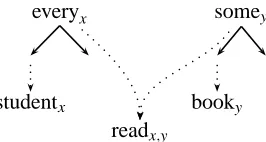
[image:2.612.360.493.76.147.2]{h1: everyx(h2,h4),h3: student(x),h5: somey(h6,h8), h7: book(y),h9: read(x,y),h2≤h3,h6≤h7}
Figure 1: MRS for “Every student reads a book”.
An example MRS for the scopally ambiguous sentence “Every student reads a book” is given in Fig. 1. We often represent MRSs by directed graphs whose nodes are the handles of the MRS. Elemen-tary predications are represented by solid edges and handle constraints by dotted lines. Note that we make the relation between bound variables and their binders explicit by dotted lines (as from everyx to readx,y); redundant “binding-edges” that are sub-sumed by sequences of other edges are omitted how-ever (from how-everyxto studentxfor instance).
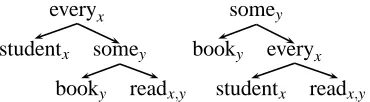
A solution for an underspecified MRS is called a configuration, or scope-resolved MRS.
Definition 2 (Configuration). An MRS M is a
con-figuration if it satisfies the following conditions.
C1 The graph of M is a tree of solid edges: handles don’t properly outscope themselves or occur in different argument positions and all handles are pairwise connected by elementary predications.
C2 If two EPs h : P(. . . ,x, . . .) and h0: Qx(h1,h2) belong to M, then h0outscopes h in M (so that the binding edge from h0to h is redundant). We call M a configuration for another MRS M0if there exists some substitutionσ:arg(M0)7→lab(M0) which states how to identify argument handles of M0 with labels of M0, so that:
C3 M={σ(E) |E is EP in M0}, and
C4 σ(h1)outscopes h2in M, for all h1≤h2∈M0.
The valueσ(E)is obtained by substituting all ar-gument handles in E, leaving all others unchanged.
everyx
studentx somey
booky readx,y
somey
booky everyx
[image:3.612.94.279.77.128.2]studentx readx,y
Figure 2: Graphs of Configurations.
Differences to Standard MRS. Our version de-parts from standard MRS in some respects. First, we assume that different EPs must be labeled with different handles, and that labels cannot be identi-fied. In standard MRS, however, conjunctions are encoded by labeling different EPs with the same handle. These EP-conjunctions can be replaced in a preprocessing step introducing additional EPs that make conjunctions explicit.
Second, our outscope constraints are slightly less restrictive than the original “qeq-constraints.” A handle h is qeq to a handle h0in an MRS M, h=qh0, if either h=h0 or a quantifier h : Qx(h1,h2) occurs in M and h2 is qeq to h0 in M. Thus, h=qh0 im-plies h≤h0, but not the other way round. We believe that the additional strength of qeq-constraints is not needed in practice for modeling scope. Recent work in semantic construction for HPSG (Copestake et al., 2001) supports our conjecture: the examples dis-cussed there are compatible with our simplification. Third, we depart in some minor details: we use sets instead of multi-sets and omit top-handles which are useful only during semantics construction.
3 Dominance Constraints
Dominance constraints are a general framework for describing trees, and thus syntax trees of logical for-mulas. Dominance constraints are the core language underlying CLLS (Egg et al., 2001) which adds par-allelism and binding constraints.
3.1 Syntax and Semantics
We assume a possibly infinite signature Σof func-tion symbols with fixed arities and an infinite setVar of variables ranged over by X,Y,Z. We write f,g for function symbols andar(f)for the arity of f .
A dominance constraint ϕ is a conjunction of dominance, inequality, and labeling literals of the following forms wherear(f) =n:
ϕ::=X/∗Y |X 6=Y |X : f(X1, . . . ,Xn)|ϕ∧ϕ0
Dominance constraints are interpreted over finite constructor trees, i.e. ground terms constructed from the function symbols inΣ. We identify ground terms with trees that are rooted, ranked, edge-ordered and labeled. A solution for a dominance constraint con-sists of a tree τ and a variable assignment α that maps variables to nodes ofτsuch that all constraints are satisfied: a labeling literal X : f(X1, . . . ,Xn)is sat-isfied iff the node α(X) is labeled with f and has daughters α(X1), . . . ,α(Xn) in this order; a domi-nance literal X/∗Y is satisfied iffα(X)is an ancestor ofα(Y)inτ; and an inequality literal X6=Y is satis-fied iffα(X)andα(Y)are distinct nodes.
Note that solutions may contain additional mate-rial. The tree f(a,b), for instance, satisfies the con-straint Y : a∧Z : b.
3.2 Normality and Weak Normality
The satisfiability problem of arbitrary dominance constraints is NP-complete (Koller et al., 2001) in general. However, Althaus et al. (2003) identify a natural fragment of so called normal dominance constraints, which have a polynomial time satisfia-bility problem. Bodirsky et al. (2003) generalize this notion to weakly normal dominance constraints.
We call a variable a hole ofϕif it occurs in argu-ment position inϕand a root ofϕotherwise.
Definition 3. A dominance constraint ϕis normal (and compact) if it satisfies the following conditions.
N1 (a) each variable ofϕoccurs at most once in the labeling literals ofϕ.
(b) each variable ofϕoccurs at least once in the labeling literals ofϕ.
N2 for distinct roots X and Y ofϕ, X 6=Y is inϕ.
N3 (a) if XC∗Y occurs inϕ, Y is a root inϕ. (b) if XC∗Y occurs inϕ, X is a hole inϕ. A dominance constraint is weakly normal if it satis-fies all above properties except forN1(b) andN3(b). The idea behind (weak) normality is that the con-straint graph (see below) of a dominance concon-straint consists of solid fragments which are connected by dominance constraints; these fragments may not properly overlap in solutions.
constraints can be compactified, provided that dom-inance links relate either roots or holes with roots.
Dominance Graphs. We often represent domi-nance constraints as graphs. A domidomi-nance graph is the directed graph(V, /∗]/). The graph of a weakly normal constraintϕis defined as follows: The nodes of the graph of ϕare the variables of ϕ. A labeling literal X : f(X1, . . . ,Xn) of ϕ contributes tree edges (X,Xi)∈/ for 1≤i≤n that we draw as X Xi; we freely omit the label f and the edge order in the graph. A dominance literal X/∗Y contributes a dom-inance edge (X,Y)∈/∗ that we draw as X Y . Inequality literals inϕare also omitted in the graph.
f
a g For example, the constraint graph
on the right represents the dominance constraint X : f(X0)∧Y : g(Y0)∧X0/∗Z∧ Y0/∗Z∧Z : a∧X6=Y∧X6=Z∧Y6=Z.
A dominance graph is weakly normal or a wnd-graph if it does not contain any forbidden subwnd-graphs:
Dominance graphs of a weakly normal dominance constraints are clearly weakly normal.
Solved Forms and Configurations. The main dif-ference between MRS and dominance constraints lies in their notion of interpretation: solutions versus configurations.
Every satisfiable dominance constraint has in-finitely many solutions. Algorithms for dominance constraints therefore do not enumerate solutions but solved forms. We say that a dominance constraint is in solved form iff its graph is in solved form. A wnd-graphΦis in solved form iffΦis a forest. The solved
forms of Φ are solved formsΦ0 that are more
spe-cific thanΦ, i.e.Φand Φ0 differ only in their dom-inance edges and the reachability relation of Φ ex-tends the reachability ofΦ0. A minimal solved form of Φis a solved form ofΦthat is minimal with re-spect to specificity.
The notion of configurations from MRS applies to dominance constraints as well. Here, a configu-ration is a dominance constraint whose graph is a tree without dominance edges. A configuration of a constraint ϕ is a configuration that solves ϕ in the obvious sense. Simple solved forms are tree-shaped solved forms where every hole has exactly one out-going dominance edge.
L1
L2
L3 L4
L2
L1
[image:4.612.326.527.69.172.2]L4 L3
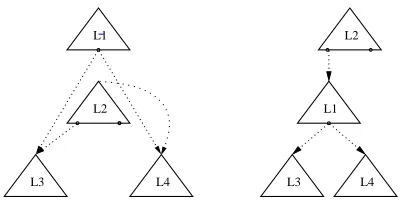
Figure 3: A dominance constraint (left) with a mini-mal solved form (right) that has no configuration.
Lemma 1. Simple solved forms and configurations
correspond: Every simple solved form has exactly one configuration, and for every configuration there is exactly one solved form that it configures.
Unfortunately, Lemma 1 does not extend to min-imal as opposed to simple solved forms: there are minimal solved forms without configurations. The constraint on the right of Fig. 3, for instance, has no configuration: the hole of L1 would have to be filled twice while the right hole of L2 cannot be filled.
4 Representing MRSs
We next map (compact) MRSs to weakly normal dominance constraints so that configurations are preserved. Note that this translation is based on a non-standard semantics for dominance constraints, namely configurations. We address this problem in the following sections.
The translation of an MRS M to a dominance con-straintϕMis quite trivial. The variables ofϕMare the handles of M and its literal set is:
{h : Px1,...,xn(h1, . . .) |h : P(x1, . . . ,xn,h1, . . .)∈M}
∪{h : Qx(h1,h2) |h : Qx(h1,h2)∈M} ∪{h1/∗h2 |h1≤h2∈M}
∪{h/∗h0 |h : Qx(h1,h2),h0: P(. . . ,x, . . .)∈M} ∪{h6=h0 |h,h0 in distinct label positions of M}
Compact MRSs M are clearly translated into (com-pact) weakly normal dominance constraints. Labels of M become roots in ϕM while argument handles become holes. Weak root-to-root dominance literals are needed to encode variable binding conditionC2
Proposition 1. The translation of a compact MRS
M into a weakly normal dominance constraint ϕM
preserves configurations.
This weak correctness property follows straight-forwardly from the analogy in the definitions.
5 Constraint Solving
We recall an algorithm from (Bodirsky et al., 2003) that efficiently enumerates all minimal solved forms of wnd-graphs or constraints. All results of this sec-tion are proved there.
The algorithm can be used to enumerate config-urations for a large subclass of MRSs, as we will see in Section 6. But equally importantly, this algo-rithm provides a powerful proof method for reason-ing about solved forms and configurations on which all our results rely.
5.1 Weak Connectedness
Two nodes X and Y of a wnd-graphΦ= (V,E)are weakly connected if there is an undirected path from
X to Y in(V,E). We callΦweakly connected if all
its nodes are weakly connected. A weakly connected component (wcc) of Φ is a maximal weakly con-nected subgraph ofΦ. The wccs ofΦ= (V,E)form proper partitions of V and E.
Proposition 2. The graph of a solved form of a
weakly connected wnd-graph is a tree.
5.2 Freeness
The enumeration algorithm is based on the notion of freeness.
Definition 4. A node X of a wnd-graph Φis called
free in Φ if there exists a solved form ofΦ whose
graph is a tree with root X .
A weakly connected wnd-graph without free nodes is unsolvable. Otherwise, it has a solved form whose graph is a tree (Prop. 2) and the root of this tree is free inΦ.
Given a set of nodes V0⊆V , we writeΦ|V0 for the restriction ofΦto nodes in V0 and edges in V0×V0. The following lemma characterizes freeness:
Lemma 2. A wnd-graphΦwith free node X satis-fies the freeness conditions:
F1 node X has indegree zero in graphΦ, and
F2 no distinct children Y and Y0of X inΦthat are linked to X by immediate dominance edges are weakly connected in the remainderΦ|V\{X}.
5.3 Algorithm
The algorithm for enumerating the minimal solved forms of a wnd-graph (or equivalently constraint) is given in Fig. 4. We illustrate the algorithm for the problematic wnd-graphΦin Fig. 3. The graph ofΦ is weakly connected, so that we can call solve(Φ). This procedure guesses topmost fragments in solved forms ofΦ(which always exist by Prop. 2).
The only candidates are L1 or L2 since L3 and
L4have incoming dominance edges, which violates
F1. Let us choose the fragment L2 to be topmost. The graph which remains when removingL2is still weakly connected. It has a single minimal solved form computed by a recursive call of the solver, whereL1 dominatesL3andL4. The solved form of the restricted graph is then put below the left hole of
L2, since it is connected to this hole. As a result, we obtain the solved form on the right of Fig. 3.
Theorem 1. The function solved-form(Φ) com-putes all minimal solved forms of a weakly normal dominance graph Φ; it runs in quadratic time per solved form.
6 Full Translation
Next, we explain how to encode a large class of MRSs into wnd-constraints such that configurations correspond precisely to minimal solved forms. The result of the translation will indeed be normal.
6.1 Problems and Examples
The naive representation of MRSs as weakly nor-mal dominance constraints is only correct in a weak sense. The encoding fails in that some MRSs which have no configurations are mapped to solvable wnd-constraints. For instance, this holds for the MRS on the right in Fig 3.
solved-form(Φ) ≡
LetΦ1, . . . ,Φkbe the wccs ofΦ= (V,E) Let(Vi,Ei)be the result of solve(Φi)
return(V,∪k
i=1Ei) solve(Φ) ≡
precond: Φ= (V, /]/∗)is weakly connected
choosea node X satisfying (F1) and (F2) inΦelse fail
Let Y1, . . . ,Ynbe all nodes s.t. X/Yi
LetΦ1, . . . ,Φkbe the weakly connected components ofΦ|V−{X,Y1,...,Yn}
Let(Wj,Ej)be the result of solve(Φj), and Xj∈Wjits root
return (V,∪k
j=1Ej∪/∪/∗1∪/∗2)where
/∗1={(Yi,Xj)| ∃X0:(Yi,X0)∈/∗∧X0∈Wj}, /∗2={(X,Xj)| ¬∃X0:(Yi,X0)∈/∗∧X0∈Wj}
Figure 4: Enumerating the minimal solved-forms of a wnd-graph.
... ...
(a) strong
.... ...
(b) weak
.
... ...
[image:6.612.73.272.309.422.2](c) island
Figure 5: Fragment Schemas of Nets
6.2 Dominance and MRS-Nets
A hypernormal path (Althaus et al., 2003) in a wnd-graph is a sequence of adjacent edges that does not traverse two outgoing dominance edges of some hole X in sequence, i.e. a wnd-graph without situa-tions Y1 X Y2.
A dominance net Φ is a weakly normal domi-nance constraint whose fragments all satisfy one of the three schemas in Fig. 5. MRS-nets can be de-fined analogously. This means that all roots ofΦare labeled inΦ, and that all fragments X : f(X1, . . . ,Xn) ofΦsatisfy one of the following three conditions:
strong. n≥0 and for all Y ∈ {X1, . . . ,Xn}there ex-ists a unique Z such that YC∗Z inΦ, and there exists no Z such that XC∗Z inΦ.
weak. n≥1 and for all Y ∈ {X1, . . . ,Xn−1,X}there exists a unique Z such that Y C∗Z in Φ, and there exists no Z such that XnC∗Z inΦ.
island. n=1 and all variables in{Y |X1C∗Y}are
connected by a hypernormal path in the graph of the restricted constraint Φ|V−{X1}, and there exists no Z such that XC∗Z inΦ.
The requirement of hypernormal connections in islands replaces the notion of chain-connectedness in (Koller et al., 2003), which fails to apply to dom-inance constraints with weak domdom-inance edges.
For ease of presentation, we restrict ourselves to a simple version of island fragments. In general, we should allow for island fragments with n>1.
6.3 Normalizing Dominance Nets
Dominance nets are wnd-constraints. We next trans-late dominance nets Φ to normal dominance con-straintsΦ0so thatΦhas a configuration iffΦ0is sat-isfiable. The trick is to normalize weak dominance edges. The normalizationnorm(Φ)of a weakly nor-mal dominance constraintΦis obtained by convert-ing all root-to-root dominance literals XC∗Y as fol-lows:
XC∗Y⇒XnC∗Y
if X roots a fragment of Φ that satisfies schema
weakof net fragments. IfΦis a dominance net then norm(Φ)is indeed a normal dominance net.
Theorem 2. The configurations of a weakly
con-nected dominance net Φ correspond bijectively to the minimal solved forms of its normalization norm(Φ).
solved forms with top-most fragmentsL1andL2 re-spectively. The former can be configured, in contrast to the later which is drawn on the right of Fig. 3.
Normalizing Φ has an interesting consequence: norm(Φ) has (in contrast to Φ) a single minimal solved form withL1on top. Indeed,norm(Φ)cannot be satisfied while placingL2topmost. Our algorithm detects this correctly: the normalization of fragment
L2is not free innorm(Φ)since it violates property
F2.
The proof of Theorem 2 captures the rest of this section. We show in a first step (Prop. 3) that the con-figurations are preserved when normalizing weakly connected and satisfiable nets. In the second step, we show that minimal solved forms of normalized nets, and thus ofnorm(Φ), can always be configured (Prop. 4).
Corollary 1. Configurability of weakly connected
MRS-nets can be decided in polynomial time; con-figurations of weakly connected MRS-nets can be enumerated in quadratic time per configuration.
6.4 Correctness Proof
Most importantly, nets can be recursively decom-posed into nets as long as they have configurations:
Lemma 3. If a dominance netΦhas a configuration whose top-most fragment is X : f(X1, . . . ,Xn), then the restrictionΦ|V−{X,X1,...,Xn}is a dominance net.
Note that the restriction of the problematic netΦ byL2on the left in Fig. 3 is not a net. This does not contradict the lemma, asΦdoes not have a configu-ration with top-most fragmentL2.
Proof. First note that as X is free inΦit cannot have
incoming edges (conditionF1). This means that the restriction deletes only dominance edges that depart from nodes in{X,X1, . . . ,Xn}. Other fragments thus only lose ingoing dominance edges by normality condition N3. Such deletions preserve the validity of the schemasweakandstrong.
Theislandschema is more problematic. We have to show that the hypernormal connections in this schema can never be cut. So suppose that Y : f(Y1)is an island fragment with outgoing dominance edges Y1 C∗ Z1 and Y1C∗Z2, so that Z1 and Z2 are con-nected by some hypernormal path traversing the deleted fragment X : f(X1, . . . ,Xn). We distinguish the three possible schemata for this fragment:
...
(a) strong
....
(b) weak
.
...
[image:7.612.320.523.83.173.2](c) island
Figure 6: Traversals through fragments of free roots
strong: since X does not have incoming dominance
edges, there is only a single non-trival kind of traver-sal, drawn in Fig. 6(a). But such traversals contradict the freeness of X according toF2.
weak: there is one other way of traversing weak
fragments, shown in Fig. 6(b). Let X C∗Y be the weak dominance edge. The traversal proves that Y belongs to the weakly connected components of one of the Xi, so theΦ∧XnC∗Y is unsatisfiable. This shows that the hole Xncannot be identified with any root, i.e.Φdoes not have any configuration in con-trast to our assumption.
island: free island fragments permit one single
non-trivial form of traversals, depicted in Fig. 6(c). But such traversals are not hypernormal.
Proposition 3. A configuration of a weakly
con-nected dominance netΦconfigures its normalization norm(Φ), and vice versa of course.
Proof. Let C be a configuration ofΦ. We show that
it also configures norm(Φ). Let S be the simple solved form ofΦthat is configured by C (Lemma 1), and S0be a minimal solved form ofΦwhich is more general than S.
Let X : f(Y1, . . . ,Yn) be the top-most fragment of the tree S. This fragment must also be the top-most fragment of S0, which is a tree sinceΦis assumed to be weakly connected (Prop. 2). S0 is constructed by our algorithm (Theorem 1), so that the evaluation of solve(Φ)must choose X as free root inΦ.
SinceΦis a net, some literal X : f(Y1, . . . ,Yn)must belong toΦ. LetΦ0=Φ|{X,Y1,...,Yn}be the restriction
weak fragments: there exists a unique weak
domi-nance edge XC∗Z inΦand a unique hole Ynwithout outgoing dominance edges. The variable Z must be a root inΦand thus be labeled. If Z is equal to X then
Φis unsatisfiable by normality conditionN2, which is impossible. Hence, Z occurs in the restriction Φ0 but not in the weakly connected components of any Y1,. . ., Yn−1. Otherwise, the minimal solved form S0 could not be configured since the hole Yn could not be identified with any root. Furthermore, the root of the Z-component must be identified with Yn in any configuration of Φ with root X . Hence, C satisfies
YnC∗Z which is add by normalization.
The restriction Φ0 must be a dominance net by Lemma 3, and hence, all its weakly connected com-ponents are nets. For all 1≤i≤n−1, the compo-nent of Yi inΦ0is configured by the subtree of C at node Yi, while the subtree of C at node Ynconfigures the component of Z inΦ0. The induction hypothesis yields that the normalizations of all these compo-nents are configured by the respective subconfigura-tions of C. Hence,norm(Φ)is configured by C.
strong or island fragments are not altered by
nor-malization, so we can recurse to the lower fragments (if there exist any).
Proposition 4. Minimal solved forms of normal,
weakly connected dominance nets have configura-tions.
Proof. By induction over the construction of min-imal solved forms, we can show that all holes of minimal solved forms have a unique outgoing dom-inance edge at each hole. Furthermore, all minimal solved forms are trees since we assumed connect-edness (Prop.2). Thus, all minimal solved forms are simple, so they have configurations (Lemma 1).
7 Conclusion
We have related two underspecification formalism, MRS and normal dominance constraints. We have distinguished the sublanguages of MRS-nets and normal dominance nets that are sufficient to model scope underspecification, and proved their equiva-lence. Thereby, we have obtained the first provably efficient algorithm to enumerate the readings of un-derspecified semantic representations in MRS.
Our encoding has the advantage that researchers interested in dominance constraints can benefit from
the large grammar resources of MRS. This requires further work in order to deal with unrestricted ver-sions of MRS used in practice. Conversely, one can now lift the additional modeling power of CLLS to MRS.
References
H. Alshawi and R. Crouch. 1992. Monotonic semantic interpretation. In Proc. 30th ACL, pages 32–39.
E. Althaus, D. Duchier, A. Koller, K. Mehlhorn, J. Niehren, and S. Thiel. 2003. An efficient graph algorithm for dominance constraints. Journal of
Algo-rithms. In press.
Manuel Bodirsky, Denys Duchier, Joachim Niehren, and Sebastian Miele. 2003. An efficient algorithm for weakly normal dominance constraints. Available at
www.ps.uni-sb.de/Papers.
Johan Bos. 1996. Predicate logic unplugged. In
Amster-dam Colloquium, pages 133–143.
Ann Copestake and Dan Flickinger. An open-source grammar development environment and broad-coverage English grammar using HPSG. In
Confer-ence on Language Resources and Evaluation.
Ann Copestake, Dan Flickinger, Ivan Sag, and Carl Pol-lard. 1999. Minimal Recursion Semantics: An Intro-duction. Manuscript, Stanford University.
Ann Copestake, Alex Lascarides, and Dan Flickinger. 2001. An algebra for semantic construction in constraint-based grammars. In Proceedings of the
39th ACL, pages 132–139, Toulouse, France.
Markus Egg, Alexander Koller, and Joachim Niehren. 2001. The Constraint Language for Lambda Struc-tures. Logic, Language, and Information, 10:457–485.
Alexander Koller, Joachim Niehren, and Ralf Treinen. 2001. Dominance constraints: Algorithms and com-plexity. In LACL’98, volume 2014 of LNAI, pages 106–125.
Alexander Koller, Joachim Niehren, and Stefan Thater. 2003. Bridging the gap between underspecification formalisms: Hole semantics as dominance constraints. In EACL’03, April. In press.
Carl Pollard and Ivan Sag. 1994. Head-driven Phrase
Structure Grammar. University of Chicago Press.