Modelling Events through Memory-based, Open-IE Patterns
for Abstractive Summarization
Daniele Pighin Google Inc.
Marco Cornolti∗
University of Pisa, Italy
Enrique Alfonseca Google Inc.
Katja Filippova Google Inc.
Abstract
Abstractive text summarization of news requires a way of representing events, such as a collection of pattern clusters in which every cluster represents an event (e.g.,
marriage) and every pattern in the clus-ter is a way of expressing the event (e.g.,
X married Y, X and Y tied the knot). We compare three ways of extracting event patterns: heuristics-based, compression-based and memory-compression-based. While the for-mer has been used previously in multi-document abstraction, the latter two have never been used for this task. Compared with the first two techniques, the memory-based method allows for generating sig-nificantly more grammatical and informa-tive sentences, at the cost of searching a vast space of hundreds of millions of parse trees of known grammatical utterances. To this end, we introduce a data structure and a search method that make it possible to efficiently extrapolate from every sentence the parse sub-trees that match against any of the stored utterances.
1 Introduction
Text summarization beyond extraction requires a semantic representation that abstracts away from words and phrases and from which a summary can be generated (Mani, 2001; Sp¨arck-Jones, 2007). Following and extending recent work in semantic parsing, information extraction (IE), paraphrase generation and summarization (Titov and Klemen-tiev, 2011; Alfonseca et al., 2013; Zhang and Weld, 2013; Mehdad et al., 2013), the represen-tation we consider in this paper is a large
[image:1.595.308.526.233.350.2]collec-∗Work done during an internship at Google Zurich.
[John Smith] and [Mary Brown] wed in [Baltimore]...
[Smith] tied the knot with [Brown] this Monday...
#21: death #22: divorce
#23: marriage
PER married PER PER and PER wed PER tied the knot with PER PER has married PER
John Smith married Mary Brown
e1: J. Smith (PER) e2: M. Brown (PER) e3: Baltimore, MD (LOC)
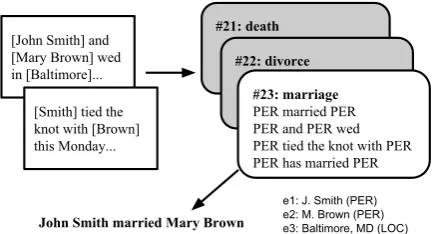
Figure 1: An example of abstracting from input sentences to an event representation and genera-tion from that representagenera-tion.
tion of clusters of event patterns. An abstractive summarization system relying on such a represen-tation proceeds by (1) detecting the most relevant event cluster for a given sentence or sentence col-lection, and (2) using the most representative pat-tern from the cluster to generate a concise sum-mary sentence. Figure 1 illustrates the summa-rization architecture we are assuming in this pa-per. Given input text(s) with resolved and typed entity mentions, event mentions and the most rele-vant event cluster are detected (first arrow). Then, a summary sentence is generated from the event and entity representations (second arrow).
However, the utility of such a representation for summarization depends on the quality of pattern clusters. In particular, event patterns must cor-respond to grammatically correct sentences. In-troducing an incomplete or incomprehensible pat-tern (e.g., PER said PER) may negatively affect both event detection and sentence generation. Re-lated work on paraphrase detection and relation extraction is mostly heuristics-based and has re-lied on hand-crafted rules to collect such patterns (see Sec. 2). A standard approach is to focus on binary relations between entities and extract
Event model Pattern
clustering News
clusters
Pattern extraction
News article
Pattern
extraction Inference
[image:2.595.73.287.62.137.2]Abstractive summary
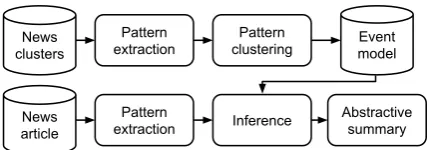
Figure 2: A generic pipeline for event-driven ab-stractive headline generation.
the dependency path between the two entities as an event representation. An obvious limitation of this approach is there is no guarantee that the extracted pattern corresponds to a grammatically correct sentence, e.g., that an essential preposi-tional phrase is retained like infile for a divorce.
In this paper we explore two novel, data-driven methods for event pattern extraction. The first,
compression-basedmethod uses a robust sentence compressor with an aggressive compression rate to get to the core of the sentence (Sec. 3). The second, memory-based method relies on a vast collection of human-written headlines and sen-tences to find a substructure which is known to be grammatically correct (Sec. 4). While the lat-ter method comes closer to ensuring perfect gram-maticality, it introduces a problem of efficiently searching the vast space of known well-formed patterns. Since standard iterative approaches com-paring every pattern with every sentence are pro-hibitive here, we present a search strategy which scales well to huge collections (hundreds of mil-lions) of sentences.
In order to evaluate the three methods, we con-sider an abstractive summarization task where the goal is to get the gist of single sentences by recog-nizing the underlying event and generating a short summary sentence. To the best of our knowledge, this is the first time that this task has been pro-posed; it can be considered asabstractive sentence compression, in contrast to most existing sentence compression systems which are based on selecting words from the original sentence or rewriting with simpler paraphrase tables. An extensive evalua-tion with human raters demonstrates the utility of the new pattern extraction techniques. Our analy-sis highlights advantages and disadvantages of the three methods.
To better isolate the qualities of the three ex-traction methodologies, all three methods use the same training data and share components of the
Algorithm 1 HEURISTICEXTRACTOR(T, E): heuristi-cally extract relational patterns for the dependency parseT
and the set of entitiesE. 1: /* Global constants /* 2: globalVp, Vc, Np, Nc
3: Vc← {subj, nsubj, nsubjpass, dobj, iobj, xcomp, 4: acomp, expl, neg, aux, attr, prt}
5: Vp← {xcomp}
6: Nc← {det, predet, num, ps, poss, nc, conj} 7: Np← {ps, poss, subj, nsubj, nsubjpass, dobj, iobj} 8: /* Entry point /*
9: P← ∅
10: for allC∈COMBINATIONS(E)do
11: N ←MENTIONNODES(T, C)
12: N0←APPLYHEURISTICS(T,BUILDMST(T, N))
13: P ←P∪ {BUILDPATTERN(T, N0)}
14: returnP
15: /* Procedures /*
16: procedureAPPLYHEURISTICS(T, N)
17: N0←N
18: while|N0|>0do
19: N00← ∅
20: for alln∈N0do
21: ifn.ISVERB()then
22: N00←N00∪INCLUDECHILDREN(n, Vc)
23: N00←N00∪INCLUDEPARENT(n, Vp)
24: else ifn.ISNOUN()then
25: N00←N00∪INCLUDECHILDREN(n, Nc)
26: N00←N00∪INCLUDEPARENT(n, Np)
27: N0←N00\N0
28: procedureINCLUDECHILDREN(n, L)
29: R← ∅
30: for allc∈n.CHILDREN()do
31: ifc.PARENTEDGELABEL()∈Lthen
32: R←R∪ {c} 33: returnR
34: procedureINCLUDEPARENT(n, L)
35: ifn.PARENTEDGELABEL()∈Lthen
36: return{n} 37: else return∅
very same summarization architecture, as shown in Figure 2: an event model is constructed by clus-tering the patterns extracted according to the se-lected extraction method. Then, the same extrac-tion method is used to collect patterns from sen-tences in never-seen-before news articles. Finally, the patterns are used to query the event model and generate an abstractive summary. The three differ-ent pattern extractors are detailed in the next three sections.
2 Heuristics-based pattern extraction
OLLIE (Schmitz et al., 2012), uses syntactic de-pendency templates to guide the pattern extraction process.
The heuristics used in this paper are inspired by Alfonseca et al. (2013), who built well formed re-lational patterns by extending minimum spanning trees (MST) which connect entity mentions in a dependency parse. Algorithm 1 details our re-implementation of their method and the specific set of rules that we rely on to enforce pattern gram-maticality. We use the standard Stanford-style set of dependency labels (de Marneffe et al., 2006). The input to the algorithm are a parse treeT and a set of target entitiesE. We first generate com-binations of 1-3 elements ofE(line 10), then for each combination C we identify all the nodes in
T that mention any of the entities inC. We con-tinue by constructing the MST of these nodes, and finally apply our heuristics to the nodes in the MST. The procedure APPLYHEURISTICS(:16) re-cursively grows a nodeset N0 by including chil-dren and parents of noun and verb nodes in N0 based on dependency labels. For example, we in-clude all children of verbs in N0 whose label is listed in Vc (:3), e.g., active or passive subjects,
direct or indirect objects, particles and auxiliary verbs. Similarly, we include the parent of a noun inN0if the dependency relation between the node and its parent is listed inNp.
3 Pattern extraction by sentence compression
Sentence compression is a summarization tech-nique that shortens input sentences preserving the most important content (Grefenstette, 1998; Mc-Donald, 2006; Clarke and Lapata, 2008, inter alia). While first attempts at integrating a com-pression module into an extractive summarization system were not particularly successful (Daum´e III and Marcu, 2004, inter alia), recent work has been very promising (Berg-Kirkpatrick et al., 2011; Wang et al., 2013). It has shown that drop-ping constituents of secondary importance from selected sentences – e.g., temporal modifiers or relative clauses – results in readable and more in-formative summaries. Unlike this related work, our goal here is to compress sentences to obtain an event pattern – the minimal grammatical struc-ture expressing an event. To our knowledge, this application of sentence compressors is novel. As in Section 2, we only consider sentences
mention-ing entities and require the compression (pattern) to retain at least one such mention.
Sentence compression methods are abundant but very few can be configured to produce out-put satisfying certain constraints. For example, most compression algorithms do not accept com-pression rate as an argument. In our case, sen-tence compressors which formulate the compres-sion task as an optimization problem and solve it with integer linear programming (ILP) tools un-der a number of constraints are particularly attrac-tive (Clarke and Lapata, 2008; Filippova and Al-tun, 2013). They can be extended relatively easily with both the length constraint and the constraint on retaining certain words. The method of Clarke and Lapata (2008) uses a trigram language model (LM) to score compressions. Since we are inter-ested in very short outputs, a LM trained on stan-dard, uncompressed text would not be suitable. In-stead, we chose to modify the method of Filippova and Altun (2013) because it relies on dependency parse trees and does not use any LM scoring.
Like other syntax-based compressors, the sys-tem of Filippova and Altun (2013) prunes depen-dency structures to obtain compression trees and hence sentences. The objective function to maxi-mize in an ILP problem (Eq. 1) is formulated over weighted edges in a transformed dependency tree and is subject to a number of constraints. Edge weight is defined as a linear function over a fea-ture set:w(e) =w·f(e).
F(X) =X e∈E
xe×w(e) (1)
In our reimplementation we followed the algo-rithm as described by Filippova and Altun (2013). The compression tree is obtained in two steps. First, the input tree is transformed with determin-istic rules, most of which aim at collapsing indis-pensable modifiers with their heads (determiners, auxiliary verbs, negation, multi-word expressions, etc.). Then a sub-tree maximizing the objective function is found under a number of constraints.
Apart from the structural constrains from the original system which ensure that the output is a valid tree, the constraints we add state that:
1. tree size in edges must be in [3, 6], 2. entity mentions must be retained, 3. subject of the clause must be retained, 4. the sub-tree must be covered by a single
Since we consider compressions with different lengths as candidates, from this set we select the one with the maximum averaged edge weight as the final compression. Figure 3 illustrates the use of the compressor for obtaining event pat-terns. Dashed edges are dropped as a result of constrained compression so that the output isJohn Smith married Mary Brownand the event pattern isPER married PER. Note that the root of a sub-clause is allowed to be the top-level node in the extracted compression.
Compared with patterns obtaines with heuris-tics, compression patterns should retain preposi-tional verb arguments whose removal would ren-der the pattern ungrammatical. As an example consider[C. Zeta-Jones] and [M. Douglas] filed for divorce. The heuristics-based pattern is PER and PER filed which is incomplete. Unlike it, the compression-based method keeps the essential prepositional phrasefor divorcein the pattern be-cause the average edge weight is greater for the tree with the prepositional phrase.
4 Memory-based pattern extraction
Neither heuristics-based, nor compression-based methods provide a guarantee that the extracted pattern is grammatically correct. In this sec-tion we introduce an extracsec-tion technique which makes it considerably more likely because it only extracts patterns which have been observed as full sentences in a human-written text (Sec. 4.1). However, this memory-based method also poses a problem not encountered by the two previous methods: how to search over the vast space of ob-served headlines and sentences to extract a pattern from a given sentence? Our trie-based solution, which we present in the remainder of this sec-tion, makes it possible to compare a dependency graph against millions of observed grammatical utterances in a fraction of a second.
4.1 Atree-trieto store them all. . .
Our objective is to construct a compact representa-tion of hundreds of millions of observed sentences that can fit in the memory of a standard worksta-tion. This data structure should make it possible to efficiently identify the sub-trees of a sentence that match any complete utterance previously ob-served. To this end, we build a trie of depen-dency trees (which we call a tree-trie) by scan-ning all the dependency parses in the news traiscan-ning
Algorithm 2 STORE(T, I): store the dependency treeT
in the tree-trieI. 1: /* Entry point /*
2: L←T.LINEARIZE()
3: STORERECURSION(I.ROOT(), L,0) 4: returnM
5: /* Procedures /*
6: procedureSTORERECURSION(n, L, o)
7: ifo==L.LENGTH()then
8: n.ADDTREESTRUCTURE(L.STRUCTURE())
9: return
10: if notn.HASCHILD(L.TOKEN(o))then 11: n.ADDCHILD(L.TOKEN(o))
12: n0←n.GETCHILD(L.TOKEN(o))
13: STORERECURSION(n0, L, o+ 1)
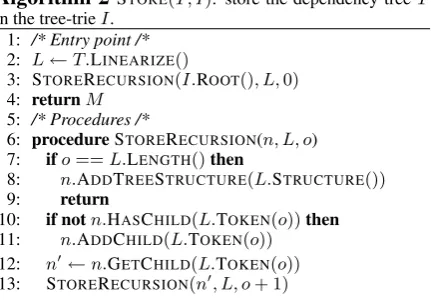
data, and index each tree in the tree-trie accord-ing to Algorithm 2. For better clarity, the process is also described graphically in Figure 4. First, each dependency tree (a) is linearized, resulting in a data structure that consists of two aligned se-quences (b). The first sequence (tokens) encodes word/parent-relation pairs, while the second se-quence (structure) encodes the offsets of parent nodes in the linearized tree. As an example, the first word “The” is a determiner (“det”) for the sec-ond node (offset 1) in the sequence, which is “cat”. In turn, “cat” is the subject (“nsubj”) of the node in position 2, i.e., “sleeps”. As described in Algo-rithm 2, we recursively store the token sequence in the trie, each word/relation pair being stored in a node. When the token sequence is completely consumed, we store in the current trie node the structure of the linearized tree. Combining struc-tural information with the sequential information encoded by each path in the trie makes it possi-ble to rebuild a complete dependency graph. Fig-ure 4(c) shows an example trie encoding 4 differ-ent sdiffer-entences. We highlighted in bold the path cor-responding to the linearized form (b) of the exam-ple parse tree (a).
The figure shows that the tree contains two kinds of nodes: end-of-sentence (EOS) nodes (red) and non-terminal nodes (in blue). EOS nodes do not necessarily coincide with trie leaves, as it is possible to observe complete sentences embed-ded in longer ones. EOS nodes differ from non-terminal nodes in that they store one or more struc-tural sequences corresponding to different syntac-tic representations of observed sentences with the same tokens.
[image:4.595.310.526.71.221.2]root Our sources report John Smith married Mary Brown in Baltimore yesterday root
root
subj subj obj in
[image:5.595.95.507.65.118.2]tmod
Figure 3: Transformed dependency tree with a sub-tree expressing an event pattern.
The cat sleeps under the table
root nsubj
det prep
pobj det
(a)
The det
cat nsubj
sleeps ROOT
under
prep thedet tablepobj
1 2 -1 2 5 3
(b)
The
det
dog nsubj
barked ROOT 1,2,-1
cat
nsubj
sleeps
ROOT
1,2,-1 soundly advmod 1,2,-1,2
under
prep thedet
table
pobj 1,2,-1,2,5,3
[image:5.595.309.528.348.517.2](c)
Figure 4: A dependency tree (a), its linearized form (b) and the resulting path in a trie (c), in bold.
store a complete tree-trie in memory, we adopt the following strategy. We replace the surface form of entity nodes with the coarse entity type (e.g., PER, LOC, ORG) of the entity. Similarly, we replace proper nouns with the placeholder “[P]”, thus sig-nificantly reducing lexical sparsity. Then, we en-code each distinct word/relation pair as a 32-bit unsigned integer. Assuming a maximum tree size of 255 nodes, we represent structure sequences as vectors of type unsigned char (8 bit per element). Finally, we store trie-node children as sorted vec-tors instead of hash maps to reduce memory foot-print. As a result, we are able to load a trie encod-ing 400M input dependency parses, 170M distinct nodes and 48M distinct sentence structures in un-der 10GB of RAM.
4.2 . . . and in the vastness match them
At lookup time, we want to use the tree-trie to identify all sub-graphs of an input dependency tree
T that match at least a complete observed sen-tence. To do so, we need to identify all paths in the trie that match any sub-sequencesof the lin-earized sequence of T nodes. Whenever we en-counter an EOS node e, we verify if any of the structures stored atematches the sub-tree gener-ated by s. If so, then we have a positive match. As a sentence might embed many shorter utter-ances, each inputT will generally yield multiple matches. For example, querying the tree-trie in Figure 4(c) with the input tree shown in (a) would yield two results, as bothThe cat sleeps andThe cat sleeps under the tableare complete utterances
stored in the trie.
Algorithm 3LOOKUP(T, I): Lookup for matches of
sub-set of treeT in the trie indexI. 1: /* Entry point /*
2: L←T.LINEARIZE()
3: M← ∅
4: LOOKUPRECURSIVE(T, L,0, I.ROOT(),∅, M) 5: returnM
6: /* Procedures /*
7: procedureLOOKUPRECURSIVE(T, L, o, n, P, M)
8: for alli∈[o, L.LENGTH())do
9: ifn.HASCHILD(L.TOKEN(i))then
10: n0←n.GETCHILD(L.TOKEN(i))
11: P0←P∪ {i}
12: for allS∈n0.TREESTRUCTURES()do
13: ifL.ISCOMPATIBLE(S, P0)then
14: M←M∪ {T.GETNODES(P0)}
15: LOOKUPRECURSIVE(L, i, o+ 1, n0, P0, M)
Sheet6
Page 1
0 10 20 30 40 50 60 70 80 90
1.0E-05 1.0E-04 1.0E-03 1.0E-02 1.0E-01 1.0E+00 1.0E+01
f(x) = 1.9E-07 x^3.3E+00
[image:6.595.81.291.70.213.2]Tree size (number of nodes) Time (seconds)
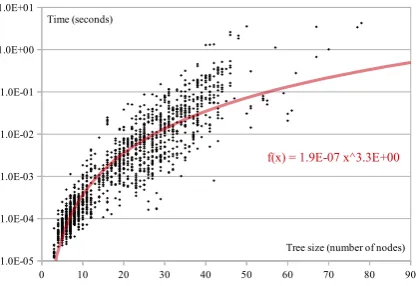
Figure 5: Time complexity of lookup operations for inputs of different sizes.
offseti(line 11), and the recursion continues from the matching trie node n0 and offset i (line 15). Every time a partial match is found, we verify if the partial match is compatible with any of the tree structures stored in the matching node. If that is the case, we identify the corresponding set of matching nodes in T and add it to the result M
(lines 12-14). A pattern is generated from each complete match returned by LOOKUPafter apply-ing a simple heuristic: for each verb nodevin the match, we enforce that negations and auxiliaries in
T depending fromxare also included in the pat-tern.
Time complexity of lookups. Letkbe the max-imum fan-out of trie nodes, d be the depth of the trie and n be the size of an input tree (num-ber of nodes). If trie node children are hashed (which has a negative effect on space complex-ity), then worst case complexity of LOOKUP() is
O(nk)d−1. If they are stored as sorted lists, as in
our memory-efficient implementation, theoretical complexity becomes O(nklog(k))d−1. It should
be noted that worst case complexity can only be observed under extremely unlikely circumstances, i.e., that at every step of the recursion all the nodes in the tail of the linearized tree match a child of the current node. Also, in the actual trie used in our experiments the average branching factorkis very small. We observed that a trie storing 400M sentences (170M nodes) has an average branching factor of 1.02. While the root of the trie has unsur-prisingly many children (210K, all the observed first sentence words), already at depth 2 the aver-age fan-out is 13.7, and at level 3 it is 4.9.
For an empirical analysis of lookup complexity, Figure 5 plots, in black, wall-clock lookup time
as a function of tree sizen for a random sample of 1,600 inputs. As shown by the polynomial re-gression curve (red), observed lookup complexity is approximately cubic with a very small constant factor. In general, we can see that for sentences of common length (20-50 words) a lookup operation can be completed in well under one second.
5 Evaluation
5.1 Experimental settings
All the models for the experiments that we present have been trained using the same corpus of news crawled from the web between 2008 and 2013. The news have been processed with a to-kenizer, a sentence splitter (Gillick and Favre, 2009), a part-of-speech tagger and dependency parser (Nivre, 2006), a co-reference resolution module (Haghighi and Klein, 2009) and an entity linker based on Wikipedia and Freebase (Milne and Witten, 2008). We use Freebase types as fine-grained named entity types, so we are also able to label e.g. instances ofsports teamsas such instead of the coarser label ORG.
Next, the news have been grouped based on temporal closeness (Zhang and Weld, 2013) and cosine similarity (using tf·idf weights). For each of the three pattern extraction methods we used the same summarization pipeline (as shown above in Figure 2):
1. Run pattern extraction on the news.
2. For every news collectionColland entity set
E, generate a set containing all the extracted patterns from news in Coll mentioning all the entities inE. These are patterns that are likely to be paraphrasing each other.
Original sentence Abstractive summary (method) Two-time defending overall World Cup champion Marcel Hirscher won the
challenging giant slalom on the Gran Risa course with two solid runs Sunday and attributed his victory to a fixed screw in his equipment setup.
Marcel Hirscher has won the giant slalom. (C)
Zodiac Aerospace posted a 7.9 percent rise in first-quarter revenue, below
mar-ket expectations, but reaffirmed its full-year financial targets. Zodiac Aerospace has reported a rise inprofits. (C) Australian free-agent closer Grant Balfour has agreed to terms with the
Balti-more Orioles on a two-year deal, the BaltiBalti-more Sun reported on Tuesday citing multiple industry sources.
Balfour will join the Baltimore Orioles. (H)
Paul Rudd is ’Ant-Man’: 5 reasons he needs an ’Agents of SHIELD’
appear-ance. Paul Rudd to play Ant-Man. (H)
Millwall defender Karleigh Osborne has joined Bristol City on a two-and-a-half
year deal after a successful loan spell. Bristol City have signed Karleigh Os-borne. (M) Simon Hoggart, one of the Spectator’s best-loved columnists, died yesterday
[image:7.595.74.527.80.250.2]after fighting pancreatic cancer for over three years. Simon Hoggart passed away yesterday.(M)
Table 1: Abstraction examples from compression (C), heuristic (H) and memory-based (M) patterns.
Method Extractions Abstractions
HEURISTIC 24,630 956
COMPRESSION 15,687 657
[image:7.595.92.272.296.346.2]MEMORY-BASED 11,459 967
Table 2: Patterns extracted in each method, before Noisy-OR inference.
and pattern clusterci, the network provides
p(pj|ci)—the probability thatci will
gener-atepj— andp(ci|pj) —the probability that,
given a pattern pj, ci was the hidden event
that generated it.
At generation time we proceed in the following way:
1. Given the title or first sentence of a news ar-ticle, run the same pattern extraction method that was used in training and, if possible, ob-tain a patternpinvolving some entities. 2. Find the model clusters that contain this
pat-tern,Cp ={cisuch thatp(ci|p)>0}.
3. Return a ranked list of model patterns
output = {(pj, score(pj))}, scored as
fol-lows:
score(pj) =
Y
ci∈Cp
p(pj|ci)p(ci|p)
wherepwas the input pattern.
4. Replace the entity placeholders in the top-scored patternspj with the entities that were
actually mentioned in the input news article.
In all cases the parameters of the network were predefined as 20,000 nodes in the hidden layer (model clusters) and 40 Expectation Maximization (EM) training iterations. Training was distributed across 20 machines with 10 GB of memory each.
For testing we used 37,584 news crawled dur-ing December 2013, which had not been used for training the models. Table 3 shows one pattern cluster example from each of the three trained models. The table shows only the surface form of the pattern for simplicity.
Pattern cluster (MEMORY-BASED)
organization1getsorganization0nod for drug
organization1getsorganization0nod for tablets
organization0approvesorganization1drug
organizations0approvesorganization1’s drug
organization1getsorganization0nod for capsules
Pattern cluster (HEURISTIC)
organization0to buyorganization1
organization0to acquireorganization1
organization0buysorganization1
organization0acquiresorganization1
organization0to acquireorganizations1
organization0buysorganizations1
organization0acquiresorganizations1
organization0agrees to buyorganization1
organization0snaps uporganization1
organization0to purchaseorganizations1
organization0is to acquireorganization1
organization0has agreed to buyorganization1
organization0announces acquisition oforganizations1
organization0may bid fororganization1
organization1sold toorganization0
organization1acquired byorganization0
Pattern cluster (COMPRESSION)
thesports team1have acquiredperson0from thesports team2
thesports team1acquiredperson0from thesports team2
thesports team2have tradedperson0to thesports team1
sports team1acquired the rights toperson0fromsports team2
sports team2acquired fromsports team1in exchange forperson0
sports team2have acquired from thesports team1in exchange forperson0
[image:7.595.308.526.496.696.2]5.2 Results
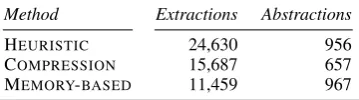
Table 2 shows the number of extracted patterns from the test set, and the number of abstractive event descriptions produced.
As expected, the number of extracted patterns using the memory-based model is smaller than with the two other models, which are based on generic rules and are less restricted in what they can generate. As mentioned, the memory-based model can only extract previously-seen structures. Compared to this model, with heuristics we can obtain patterns for more than twice more news ar-ticles. At the same time, looking at the number of summary sentences generated they are com-parable, meaning that a larger proportion of the memory-based patterns actually appeared in the pattern clusters and could be used to produce sum-maries. This is also consistent with the fact that us-ing heuristics the space of extracted patterns is ba-sically unbounded and many new patterns can be generated that were previously unseen –and these cannot generate abstractions. A positive outcome is that restricting the syntactic structure of the ex-tracted patterns to what has been observed in past news does not negatively affect end-to-end cover-age when generating the abstractive summaries.
Table 1 shows some of the abstractive sum-maries generated with the different methods. For manually evaluating their quality, a random sam-ple of 100 original sentences was selected for each method. The top ranked summary for each origi-nal sentence was sent to human raters for evalua-tion, and received three different ratings. None of the raters had any involvement in the development of the work or the writing of the paper, and a con-straint was added that no rater could rate more than 50 abstractions. Raters were presented with the original sentence and the compressed abstraction, and were asked to rate it along two dimensions, in both cases using a 5-point Likert scale:
• Readability: whether the abstracted com-pression is grammatically correct.
• Informativeness: whether the abstracted compression conveys the most important in-formation from the original sentence.
Inter-judge agreement was measured using the Intra-Class Correlation (ICC) (Shrout and Fleiss, 1979; Cicchetti, 1994). The ICC for readability was 0.37 (95% confidence interval [0.32, 0.41]),
Method Readability Informativeness
HEURISTIC 3.95 3.07
COMPRESSION 3.98 2.35
MEMORY-BASED 4.20 3.70
Table 4: Results for the three methods when rating the top-ranked abstraction.
and for informativeness it was 0.64 (95% confi-dence interval [0,60, 0.67]), representing fair and substantial reliability.
Table 4 shows the results when rating the top ranked abstraction using either of the three dif-ferent models for pattern extraction. The abstrac-tions produced with the memory-based method are more readable than those produced with the other two methods (statistically significant with 95% confidence).
Regarding informativeness, the differences be-tween the methods are bigger, because the first two methods have a proportionally larger number of items with a high readability but a low informa-tiveness score. For each method, we have man-ually reviewed the 25 items where the difference between readability and informativeness was the largest, to understand in which cases grammatical, yet irrelevant compressions are produced. The re-sults are shown in Table 5. Be+adjectiveincludes examples where the pattern is of the formEntity is Adjective, which the compression-based systems extracts often represents an incomplete extraction.
read-Method Be+adjective Wrong inference Info. missing Possibility Disambiguation Opposite
HEURISTIC 0 7 14 3 1 0
COMPRESSION 3 10 10 0 0 2
[image:9.595.71.523.153.285.2]MEMORY-BASED 0 17 4 2 0 2
Table 5: Sources of errors for the top 25 items with high readability and low informativeness.
Original sentence Pattern extracted (method) Abstraction David Moyes is happy to use tough love on Adnan Januzaj
to ensure the Manchester United youngster fulfils his
mas-sive potential. David Moyes is happy. (C)
Fortune will start to favour David Moyes.
The Democratic People’s Republic of Korea will “achieve nothing by making threats or provocation,” the United States said Friday.
The United States said
Fri-day. (C, H) United States officials saidFriday.
EU targets Real and Barca over illegal state aid. EU targets Real Madrid.(H) EU is going after RealMadrid.
EU warns Israel over settlement construction EU warns Israel. (M) EU says Israel needs re-forms.
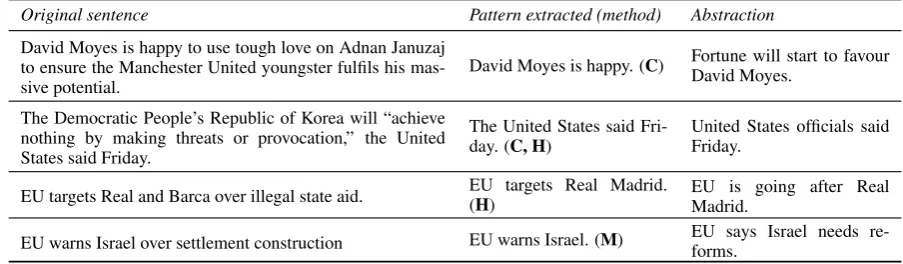
Table 6: Examples of compression (C), heuristic (H) and memory-based (M) patterns that led to abstrac-tions with high readability but a low informativeness score. Both incomplete summary sentences and wrong inferences can be observed.
ability score is much smaller, so there were less of these examples. And most of these examples be-long to the class of wrong inferences (patterns that are related but not equivalent, so we should not abstract one of them from the other, but they were clustered together in the model). Our conclusion is that the examples with missing information are not such a big problem with the MEMORY-BASED system, as using the trie is an additional safeguard that the generated titles are complete statements, but the method is not preventing the wrong infer-ence errors so this class of errors become the dom-inant class by a large margin.
Some examples with high readability but low informativeness are shown in Table 6.
6 Conclusions
Most Open-IE systems are based on linguistically-motivated heuristics for learning patterns that ex-press relations between entities or events. How-ever, it is common for these patterns to be incom-plete or ungrammatical, and therefore they are not suitable for abstractive summary generation of the relation or event mentioned in the text.
In this paper, we describe a memory-based ap-proach in which we use a corpus of past news to learn valid syntactic sentence structures. We discuss the theoretical time complexity of look-ing up extraction patterns in a large corpus of
syntactic structures stored as a trie and demon-strate empirically that this method is effective in practice. Finally, the evaluation shows that sum-mary sentences produced by this method outper-form heuristics and compression-based ones both in terms of readability and informativeness. The problem of generating incomplete summary sen-tences, which was the main source of informative-ness errors for the alternative methods, becomes a minor problem with the memory-based approach. Yet, there are some cases in which also the mem-ory based approach extracts correct but misleading utterances, e.g., a pattern like PER passed away
from the sentencePER passed the ball away. To solve this class of problems, a possible research direction would be the inclusion of more complex linguistic features in the tree-trie, such as verb sub-categorization frames.
References
Enrique Alfonseca, Daniele Pighin, and Guillermo Garrido. 2013. HEADY: News headline abstraction through event pattern clustering. InProceedings of the 51st Annual Meeting of the Association for Com-putational Linguistics,Sofia, Bulgaria, 4–9 August 2013, pages 1243–1253.
Taylor Berg-Kirkpatrick, Dan Gillick, and Dan Klein. 2011. Jointly learning to extract and compress. In Proceedings of the 49th Annual Meeting of the As-sociation for Computational Linguistics, Portland, OR, 19–24 June 2011.
Domenic V Cicchetti. 1994. Guidelines, criteria, and rules of thumb for evaluating normed and standard-ized assessment instruments in psychology. Psycho-logical Assessment, 6(4):284.
James Clarke and Mirella Lapata. 2008. Global in-ference for sentence compression: An integer linear programming approach. Journal of Artificial Intelli-gence Research, 31:399–429.
Hal Daum´e III and Daniel Marcu. 2004. A tree-position kernel for document compression. In Pro-ceedings of the 2004 Document Understanding Con-ference held at the Human Language Technology Conference of the North American Chapter of the Association for Computational Linguistics,,Boston, Mass., 6–7 May 2004.
Marie-Catherine de Marneffe, Bill MacCartney, and Christopher D. Manning. 2006. Generating typed dependency parses from phrase structure parses. In Proceedings of the 5th International Conference on Language Resources and Evaluation, Genoa, Italy, 22–28 May 2006, pages 449–454.
Anthony Fader, Stephen Soderland, and Oren Etzioni. 2011. Identifying relations for open information ex-traction. InProceedings of the 2011 Conference on Empirical Methods in Natural Language Process-ing,Edinburgh, UK, 27–29 July 2011, pages 1535– 1545.
Katja Filippova and Yasemin Altun. 2013. Overcom-ing the lack of parallel data in sentence compression. InProceedings of the 2013 Conference on Empirical Methods in Natural Language Processing, Seattle, WA, USA, 18–21 October 2013, pages 1481–1491. Dan Gillick and Benoit Favre. 2009. A scalable global
model for summarization. InProceedings of the ILP for NLP Workshop,Boulder, CO, June 4 2009, pages 10–18.
Gregory Grefenstette. 1998. Producing intelligent telegraphic text reduction to provide an audio scan-ning service for the blind. InWorking Notes of the Workshop on Intelligent Text Summarization, Palo Alto, Cal., 23 March 1998, pages 111–117.
Aria Haghighi and Dan Klein. 2009. Simple coref-erence resolution with rich syntactic and semantic
features. InProceedings of the 2009 Conference on Empirical Methods in Natural Language Process-ing,Singapore, 6-7 August 2009, pages 1152–1161. Inderjeet Mani. 2001. Automatic Summarization.
John Benjamins, Amsterdam, Philadelphia.
Ryan McDonald. 2006. Discriminative sentence com-pression with soft syntactic evidence. In Proceed-ings of the 11th Conference of the European Chap-ter of the Association for Computational Linguistics, Trento, Italy, 3–7 April 2006, pages 297–304. Yashar Mehdad, Giuseppe Carenini, and Frank W.
Tompa. 2013. Abstractive meeting summariza-tion with entailment and fusion. In Proceedings of the 14th European Workshop on Natural Lan-guage Generation, Sofia, Bulgaria, 8–9 August, 2013, pages 136–146.
David Milne and Ian H. Witten. 2008. An effective, low-cost measure of semantic relatedness obtained from Wikipedia links. InProceedings of the AAAI 2008 Workshop on Wikipedia and Artificial Intelli-gence,Chicago, IL, 13-14 July, 2008.
Joakim Nivre. 2006. Inductive Dependency Parsing. Springer.
Michael Schmitz, Robert Bart, Stephen Soderland, Oren Etzioni, et al. 2012. Open language learn-ing for information extraction. In Proceedings of the 2012 Conference on Empirical Methods in Natu-ral Language Processing,Jeju Island, Korea, 12–14 July 2012, pages 523–534.
Patrick E Shrout and Joseph L Fleiss. 1979. Intraclass correlations: uses in assessing rater reliability. Psy-chological bulletin, 86(2):420.
Karen Sp¨arck-Jones. 2007. Automatic summaris-ing: A review and discussion of the state of the art. Technical Report UCAM-CL-TR-679, University of Cambridge, Computer Laboratory, Cambridge, U.K. Ivan Titov and Alexandre Klementiev. 2011. A Bayesian model for unsupervised semantic parsing. InProceedings of the 49th Annual Meeting of the As-sociation for Computational Linguistics, Portland, OR, 19–24 June 2011, pages 1445–1455.
Lu Wang, Hema Raghavan, Vittorio Castelli, Radu Flo-rian, and Claire Cardie. 2013. A sentence com-pression based framework to query-focused multi-document summarization. In Proceedings of the 51st Annual Meeting of the Association for Com-putational Linguistics,Sofia, Bulgaria, 4–9 August 2013, pages 1384–1394.