Article
Using different ML algorithms and hyperparameter
optimisation to predict heat meters’ failures
Przemysław Pałasz1and Radosław Przysowa2,*
1
2
3
4
5
6
7
8
9
10
11
12
13
14
15
16
17
18
19
20
21
22
1 RappEnserv,Hochstrasse100,4018Basel,Switzerland;[email protected]
2 InstytutTechnicznyWojskLotniczych,ul.Ksi˛eciaBolesława6,01-494Warszawa,Poland;
* Correspondence:[email protected]
FeaturedApplication:Designofadvancedheatingsystemsforsmartbuildingsandoptimisation ofstocksandmaintenanceprocessesinexistingheatmeternetworks.
Abstract:Theneedtoincreasetheenergyefficiencyofbuildingsaswellastheuseoflocalrenewable heatsourceshascausedthatheatmetersareusednotonlytocalculatetheconsumedenergybutalso fortheactivemanagementofcentralheatingsystems.Increasingthereadingfrequencyandtheuse ofmeasurementdatatocontroltheheatingsystemexpandstherequirementsforthereliabilityof heatmeters.Theaimoftheresearchistoanalysealargesetofmetersintherealnetworkandpredict theirfaultstoavoidinaccuratereadings,incorrectbilling,heatingsystemdisruptionandunnecessary maintenance.Thereliabilityanalysisofheatmetres,basedonhistoricaldatacollectedoverseveral years,showssomeregularitieswhichcannotbeeasilydescribedbyphysics-basedmodels.Thefailure rateisalmostconstantanddoesdependonthepastbutisanon-linearcombinationofstatevariables. Topredictmeters’failuresinthenextsettlementperiod,threeindependentmachinelearningmodels are implementedand comparedwithselected metrics becauseeven the highperformance of a singlemodel(87%TruePositiveforNeuralNetwork)maybeinsufficienttomakeamaintenance decision. Additionally, performinghyperparameters optimisation boosts models’performance byafewpercent. Finally,threeimprovedmodelsareusedtobuildanensembleclassifierwhich outperformstheindividualmodels. Theproposedprocedureensuresthehighefficiencyoffault detection(>95%),whilemaintainingoverfittingattheminimumlevel.Themethodologyisuniversal andcanbeutilisedtostudythereliabilityandpredictfaultsofothertypesofmetersanddifferent objectswiththeconstantfailurerate.
Keywords:heatmeter,districtheating,faultdetection,predictivemaintenance,MachineLearning (ML);ArtificialNeuralNetwork(ANN);BaggingDecisionTree(BDT),SupportVectorMachines (SVM),hyperparameteroptimisation,ensemblemodel
23
1. Introduction 24
Sustainable development and controlling climate change can only be achieved with a safe and
25
low-emission energy system. Its transformation involves, i.a. decarbonization of buildings responsible
26
for approximately 36% of all CO2emissions in the European Union. Almost 50% of the consumption 27
of final energy is spent on heating and cooling, from which 80% is used in buildings. This sector is
28
treated as pivotal in accelerating the reduction of emissions of the energy system. It is also a strategic
29
industry in the context of energy safety, since according to the forecasts, till 2030, heating and cooling
30
will account for about 40 % of the consumption of renewable energy sources [1].
31
Heat metres are used in central heating systems to calculate the consumed energy both in
32
multi-family houses and single apartments or offices. Smart heat metres ensure that costs are settled
33
based on the actual consumption and contributes to saving heat by inhabitants and to reducing
34
emissions, particularly in buildings with many tenants.
35
Currently, approximately half of the installed heat meters, which are under research in this
36
article, are read manually. However, year by year increases the number of meters read remotely,
37
which belong to smart meters. It is a fact that more and more electricity meters are connected to
38
the wide-area network, the so-called Smart Grid. The application of smart meters enables regular
39
monitoring of power consumption and access to flexible rates [2,3]. Smart Grids and Smart Buildings
40
feature optimised asset management, increase operational efficiency, ensure stable power supply, allow
41
monitoring of system operation in real time or introduce the network’s ability to reconfigure and
42
self-heal.
43
It is necessary to develop a uniform communication system to introduce the IoT technology
44
for the billing of media and enable the delivery of telemetric data to one node. Such an attempt
45
was made in 2015, creating the OMS (Open Metering System) group. Initially, it was intended to be a
46
non-profit organisation gathering leading meter manufacturers. Its objective is to create a protocol of
47
communication as well as to develop a common standard of smart meters (not only electricity meters).
48
To date, the group operates mainly in Europe.
49
Smart meters and advanced heating systems contribute to reduced emissions by limiting energy
50
grid losses and the possibility to adjust heat supplies to weather conditions [4]. Recording heat
51
consumption with the use of a smart meter can take place in one-hour intervals or even shorter. The
52
information on the meter state can be directly sent to the plant, thanks to which it is possible to monitor
53
and manage it regularly.
54
In smart cities and buildings, it is of utmost importance to create a prediction system, thanks to
55
which the operation of the heat distribution network will be better adjusted to the needs of recipients.
56
In consequence, it all enables to reduce the transfer losses, costs of heat purchase and pumping
57
costs. Facilitating the measuring system is associated with the improvement of the efficiency of
58
communication with distributed elements, remote control and monitoring of technological processes.
59
Building smart homes and cities aims to improve the quality of life of its inhabitants and the
60
protection of natural environment. Interdisciplinary cooperation in the area of collecting, storing and
61
analysing a significant amount of data as well as using, servicing, exchanging and maintaining IoT
62
devices is needed to achieve this goal. The issue of reliability of smart meters has a fundamental
63
significance for heat distributors and consumers, since the reliability of collecting data, the correctness
64
of billing of heat and taking proper decisions in managing heat distribution network depends on it.
65
Topics similar to the subject of this article are discussed in [5] and [6]. The studies on the
66
optimisation of the heating system in residential buildings are carried out in the paper [7]. The Authors
67
utilised an optimised ANN model to determine the optimal start time for a heating system in a
68
building. Also an ANN has been applied in [8] to evaluate the energy input, losses, output, efficiency,
69
and economic optimisation of a geothermal district heating system. This has been used to determine if
70
the existing system is operating at its optimal level, and will provide information about the optimal
71
design and profitable operation of the system.
72
More recent studies on optimising heat usage can be found in [9]. To minimise the energy
73
consumption and maintain a good comfort level anticipating the thermal behaviour of the building
74
and external disturbances, a neural predictive controller for single-speed ground source heat pumps
75
systems was developed. Still, according to our knowledge, studies dealing with reliability of heat
76
meters are scarce. Furthermore, using a set of different ML models in parallel is unique. We show that
77
these problems are crucial to implement smart buildings.
78
This article attempts to broaden our knowledge on the operation and reliability of the currently
79
applied heat meters and create an effective and universal model to predict their failures.
2. Materials and Methods 81
2.1. Heat meters 82
A heat meter is a microprocessor measuring device which calculates the consumption of heat in
83
kWh by measuring the flow rate of the heat transfer medium1and the difference between supply and
84
return temperature (Fig.1). The meter has an in-built flow meter, which measures the volume of the
85
flowing medium, and two temperature sensors for the inflow and outflow fluid.
86
Temperature sensors consist of a measuring element, that is a thermistor, which is usually
87
platinum. It changes resistance depending on the temperature. In heat meters usually Pt100 or Pt500
88
sensors are used. The higher is the resistance of platinum in the sensor ( respectively 100Ω, 500Ω), the
89
greater is the accuracy of temperature measurement.
90
Figure 1.Principle of the heat meter
2.1.1. Maintenance of heat meters
91
Heat meters are generally considered as reliable. However, like all devices, they sometimes break
92
down and require technical maintenance. Premature meter failures affect all parties, i.e. tenants,
93
building managers and the billing firm, significantly disturbing the scheduled maintenance and
94
causing losses. The consequences include incorrect readings, understated invoices and customer
95
complaints.
96
The replacement of meters is a complex logistic process, which must be planned in detail. The
97
old meters have to be removed from the network and delivered to a service centre or recycled. The
98
installation of new meters is usually done in stages and it is convenient to carry out the service works
99
in a limited area before proceeding to the next one. It is necessary to arrange meetings with building
100
managers or tenants.
101
The whole procedure can generate high costs related to the work of qualified installers, planning
102
and delivering of components, final inspection of the installed devices and updating the operational
103
data regarding meters. It is often more efficient to replace a functioning device during a scheduled
104
maintenance check if there are any indications of a possible failure in the next billing period.
105
Developing a method for predicting the occurrence of the meter failure in the subsequent period
106
is the subject of this article.
107
1 Most often it is water, although in the case when the system is also used for cooling, it can be water with appropriate
Heat meters are as a rule the subject of planned maintenance. In the majority of the European
108
countries, their verification should take place every five years due to metrological requirements.
109
During this time, heat meters accumulate mineral deposit from water (especially warm and hot), which
110
results in the wear of mechanical elements due to being moved by the stream flowing through the
111
equipment.2.
112
Reverification is time-consuming. Heat meters have to be dismounted from the network and
113
delivered to the verification point. For the verification period, the older heat meters are replaced with
114
the new ones, which have a valid heat meter verification marking. However, nowadays, the majority
115
of the companies plan only one verification visit due to logistical costs. Once the verification is done,
116
the dismounted heat meters are installed in other locations. Before the verification, the heat meters
117
are cleaned, regulated and sealed so that they could work for another 5 years meeting metrological
118
requirements. It is not uncommon that heat meters are verified two or even three times.
119
The users decide to replace them due to three reasons: new equipment has a longer warranty
120
than the older verified one (5 years instead of 2 years), new heat meter is much more technologically
121
advanced, or the old heat meter was broken, and the repair is impossible or useless.
122
2.1.2. Review of typical faults
123
The most common causes of meters’ failures include:
124
• Failure of flow transducer (in case of a mechanical meter) caused by the accumulation of deposit
125
on mechanical elements. The repair involves exchanging the rotor or the whole transducer.
126
• Failure of temperature meter – most frequently it occurs in the case of non-mechanical heat meters
127
and is usually caused by rodents (rats) damaging the conductors. The repair is based on the
128
replacement of temperature meter.
129
• Exhaustion of the battery. Despite the theoretical calculations that mounted batteries should
130
work for 5-7 years (exceeding the required verification period), it frequently happens that the
131
batteries run out already after 2-3 years of usage. The repair of such equipment requires only the
132
replacement of the battery.
133
2.2. Data 134
Information on installation, operation and replacement of heat meters was accumulated over the
135
last ten years in a relational database. Using a meter consists in cyclical readout of its current value
136
necessary to calculate the energy consumption in a defined billing period. Potential failure should be
137
detected at the time of meter readout at the latest. The billing period usually lasts 12 months (but it
138
can also last 6, 18 or 24 months) and starts at the beginning of the chosen month (often it is January,
139
June or September). Some modern smart meters also store the monthly values – although they do not
140
impact the final billing.
141
The discussed database also includes many other items of information used for the billing of
142
utilities (approximately 150 relational tables – some of them consist of 20 million records – in total,
143
250 GB of data) as well as data regarding other types of meters (water meters and heat distributors).
144
However, the authors decided to focus on the heat meters addressed in the introduction. The available
145
data may offer clues to many questions concerning the operation of heat meters. For economic reasons,
146
the most significant problem is detecting and predicting a failure; thus, the data was prepared for this
147
purpose.
148
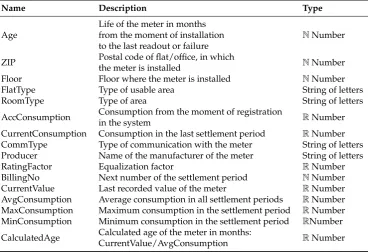
After data preparation and initial statistical analysis, sixteen parameters are selected for further
149
processing (table1).
150
Table 1.16 selected features
Name Description Type
Age
Life of the meter in months from the moment of installation to the last readout or failure
NNumber
ZIP Postal code of flat/office, in which
the meter is installed NNumber
Floor Floor where the meter is installed NNumber
FlatType Type of usable area String of letters
RoomType Type of area String of letters
AccConsumption Consumption from the moment of registration
in the system RNumber
CurrentConsumption Consumption in the last settlement period RNumber CommType Type of communication with the meter String of letters Producer Name of the manufacturer of the meter String of letters
RatingFactor Equalization factor RNumber
BillingNo Next number of the settlement period NNumber CurrentValue Last recorded value of the meter RNumber AvgConsumption Average consumption in all settlement periods RNumber MaxConsumption Maximum consumption in the settlement period RNumber MinConsumption Minimum consumption in the settlement period RNumber
CalculatedAge Calculated age of the meter in months:
CurrentValue/AvgConsumption RNumber
The type of the usable surface (e.g. flat, office or storeroom), as well as the type of room (e.g.
151
room, kitchen, bathroom and corridor), were represented by enumerations. In the case of an unclear
152
situation, the valueotherwas used. The authors decided to distinguish sixteen types of rooms and
153
five types of usable surface. Since some models accept only numbers, each type of room was assigned
154
a successive natural number. The same was done in the case of meters’ manufacturers (16 different
155
values).
156
Rating factoris a real number from the interval (0-1]. It is used in case of rooms which an increased
157
consumption of heat, e.g. due to adjacency to external walls of the building. This ensures a fair
158
distribution of the heating costs of the whole building between all tenants – irrespective of the fact
159
whether they have an external flat or not.
160
An important parameter is also the method of communication with the equipment (CommType).
161
There are four communication types:
162
• bus– meters regularly send their updates to the central panel installed in the same building which
163
also collects data from other meters – cable connection
164
• funk– similar as bus, but the connection of the meter with the control panel does not require the
165
additional wiring system
166
• walk by– on specific days (programmed) the meter sends data, which has to be collected by the
167
technician sent to the neighbourhood and equipped with the receiving device
168
• without a module– the reading has to be donemanuallydirectly on the meter
169
The correction and normalisation of the data set are described in more detail in [10].
170
2.3. Data analysis 171
Preparation of data and selection of observation parameters theoretically enables to build
172
prediction models. In practice, however, it is necessary to better understand data, on which the
173
studies will be conducted [11]. By its very nature, a machine learning model is acutely sensitive to
174
the quality of the data and it is of low-quality. Because of the huge volume of data required, even
175
relatively small errors in the training data can lead to large scale errors in the system’s output. Finding
176
and analysing the relations between particular parameters facilities to draw correct conclusions and
enables the proper interpretation of the results [12]. Apart from this, such knowledge can be useful by
178
selecting the appropriate machine learning model or its parameters [13].
179
In our work we used the Python language, which offers advanced tools for machine learning and
180
data analysis. In order to train and evaluate selected models, authors used the following components
181
and applications:
182
• Python 3.6.3
183
• Keras 2.2.0 — Open Source library for creating neural networks
184
• TensorFlow 1.8.0 — Open Source library written by Google Brain Team for linear algebra and
185
neural networks
186
• Scikit-learn 0.19.1 — Open Source library implementing many different methods of machine
187
learning
188
2.4. Machine Learning Algorithms 189
To ensure a high degree of independence between the models, we use three significantly different
190
machine learning algorithms: SVM (Support Vector Machine) with therbf kernel, ANN (Artifical
191
Neural Network) and BDT (Bagging Decision Trees) in standard implementations. Underlying theory
192
can be found in [14–18].
193
Next, we will show how to use the general method of hyperparameters optimisation to improve
194
the obtained results. At the end, such improved models will be used to build an ensemble classifier.
195
The purpose of this procedure is to obtain a model that will be able to best predict the failure rate of
196
meters, while maintaining its generalisation, i.e. minimising overfitting.
197
For training selected models, the default parameters of the algorithms will be used as well as all
198
the features of the observations presented in the table1. Building and evaluation of the models were
199
always based on the same dataset (51890 records), randomly divided into the training set (80% - 41512
200
records) and the testing set (20% - 10378 records).
201
3. Results 202
3.1. Statistical analysis 203
One of the first steps in exploratory research is usually constructing a correlation matrix [19].
204
Frequently, its analysis allows to eliminate the irrelevant parameters and may be a starting point
205
for PCA analysis. Apart from that, the correlation matrix may reveal some dependencies between
206
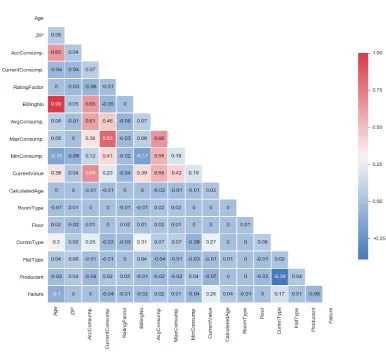
particular variables, their mutual relations and potential redundancies [20]. To visualise such
207
information, we applied a thermal map. By analysing the correlations presented in the figure 2,
208
a very weak relation of failure from all other parameters ( the last row of matrix) can be observed.
209
The highest correlation coefficient at 0.26 has a parameter of a current meter value. Such
210
correlation value is relatively small and most often omitted. On this basis, it can be concluded
211
that failures do not directly depend on any single meter feature, but perhaps on some nonlinear
212
combination of state variables.
213
A very strong correlation can be observed between the meter age and the number of billing
214
(nearly 1). Presumably, one of these parameters is unnecessary (redundant) in further analysis. A little
215
smaller, but also significant correlation can be seen between the maximum and the current energy
216
consumption. Also, this relation is rather apparent and does not require any more explanations.
217
There are no rows below the current meter value, which demonstrate higher correlation with
218
other parameters and can be treated as linearly independent. Attention is drawn only to the small
219
correlation between the manufacturer and the type of communication, which is at 0.4. It indicates the
220
situation, where manufacturers specialise themselves in making meters for particular communication
221
types but also the maintenance company is supplied with particular types of meters not only by the
222
selected manufacturers.
Figure 2.Correlation matrix – heat map
During the analysis of the correlation matrix, it should not be forgotten that a strong correlation
224
does not necessarily imply a cause and effect – correlation is not causation.
225
3.1.1. Communication type
226
Because the minimisation and predictability of failures is crucial for cost optimisation, we will
227
examine the dependence of the number of failures on other factors. The numerical dependence of
228
failure on the meter communication type was presented in the table2.
229
Table 2.Dependence of failure on the type of communication
Communication type Meaters # Failures # % of Failures
Walk by 1 045 18 1.72 %
Funk 10 996 1 716 15.61 %
Bus 12 631 1 778 14.08 %
Without communication 27 577 8 273 30.00 %
The meters of "walk by" type have a very low percentage of failures, but the sample is small in
230
relation to other types of communication, so the conclusion that they are the most reliable is a bit
231
premature. You can see that meters without a communication module fail almost twice as often as
232
those with communication. We can certainly conclude that the meters with remote communication –
233
in other words the new generation of devices – are much less likely to fail.
234
Using the methods presented in [10], we can determine the distribution of the probability vector.
235
On the figure3each state from 1 to 10 represents the age of meter in years. We can observe that,
also in long term, there is a significant difference in failure rate between meters with and without
237
communication. The linearity visible on that figure confirms, that the failures’ intensity is poorly
238
dependent on the meter’s operating time. Except that information about stationary distribution allows
239
for better planning of inventory.
240
Figure 3.Stationary probability distribution
Therefore, in the context of smart meters and smart homes, devices with remote reading are
241
definitely a better choice. Not only are more ’user friendly’ (the presence of resident is not required
242
during readings) but they are also more reliable.
243
3.1.2. Producer
244
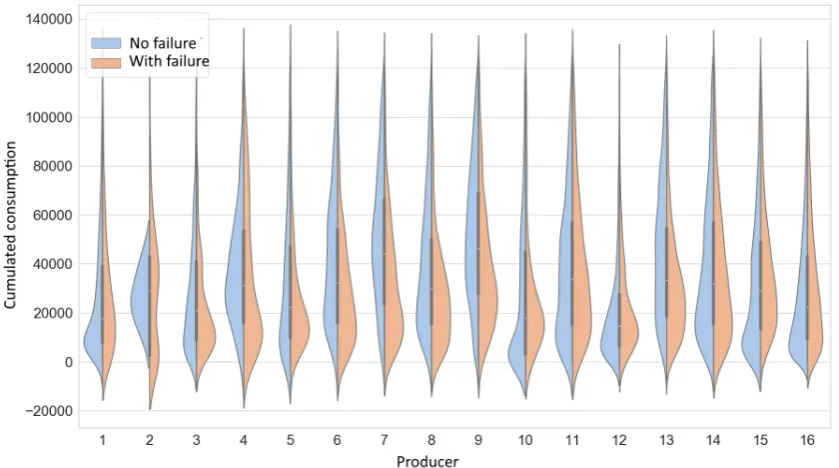
Similarly to the grouping by the type of communication, we can present the violin charts with the
245
division into the producer (fig.4). The curves of Kernel Density Estimator (defined in [21]) for the
246
number of devices from manufacturers No. 2 and 4 have their maxima above consumption of 20’000
247
kWh, which suggests that purchases have been abandoned and there are no new installations anymore.
248
In the case of producer no. 10, the failures are slightly delayed in relation to the number of new meters,
249
but it is difficult to draw any more specific conclusions here.
250
The complement of the violin charts for producer is tab.3. The failure results presented here are
251
certainly influencing Rapp’s purchasing policy. On the one hand, we have a strong leader (producer
252
No. 16), which maintains the failure rate of its devices at a relatively low level of 13%. On the other
253
hand, we see diversification and an attempt to become independent of this producer. The reason for
254
the resignation from the services of the producer No. 2 was the high failure rate of over 90%, even in a
255
few years.
256
Table 3.Failures by producer in numbers
Producer Meters # Failures # % of failure
1 2 555 290 11.35 %
2 118 114 96.61 %
3 1 674 281 16.79 %
4 671 303 45.16 %
5 713 187 26.23 %
6 823 345 41.92 %
7 1 708 438 25.64 %
8 1 494 603 40.36 %
9 1 832 443 24.18 %
10 2 026 332 16.39 %
11 1 853 600 32.38 %
12 2 440 234 9.59 %
13 3 348 1 859 55.53 %
14 3 506 655 18.68 %
15 3 977 2 059 51.77 %
16 23 511 3 042 12.94 %
The above observation strongly supports the thesis, that statistical analysis performed on big data
257
set can create significant savings and should be used in process of designing and maintaining smart
258
buildings.
259
3.2. Reliability analysis 260
The cumulative heat consumption is a meter feature, which can be treated as an equivalent of
261
operating time. In article [10] we showed that the distribution of probability of failures is exponential:
262
f(t) =λe(−λt) (1)
It is characterised by the constant intensity of failures, i.e.λ= 3.08∗10−5. It means that failures 263
occur as external random events and does not depend on usage time-they appear randomly with the
264
fixed intensity. Such feature is c a ’memoryless’ of exponential distribution and implies that if we know
265
that in momentxthe element was fit for use, thus, counting from that moment, the fitness time has the
266
same distribution as a distribution of a new element [22–24].
267
It can be stated that during these 10 years, the intensity of failures of heat meter is poorly
268
dependent on the usage time. It is crucial since it enables the prediction of failures, which is
269
independent of the history of operation. We do not have to possess information on how and when the
270
equipment was used - if we know its parameters, it is entirely sufficient.
271
The above conclusion, as well as correlation matrix, suggest the selection of algorithms of machine
272
learning to those, which perform well in classification problems with non-linear separable classes.
273
3.3. Machine learning 274
3.3.1. Metrics
275
There are a lot of different metrics which can be used to compare performance of trained ML
276
models – each has its strong and weak sides (compare [25,26]). Due to the character of the data (high
predominance of records without failure – approximately 80%), as well as the goal of the model
278
(equally important as predicting failure is predicting whether the meter will continue working), we
279
focused on two metrics:Area Under the ROC Curve– AUC andMatthews Correlation Coefficient– MCC.
280
The MCC takes values from[−1, 1](more means better) and AUC takes values from[0, 1], whereby 0.5
281
means a random classifier. Detailed information about each of metric can be found in [27]. For the
282
more comprehensive image we will provide also accuracy, precision, recall and f1for both classes. 283
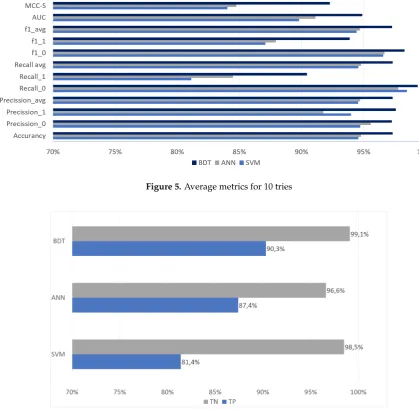
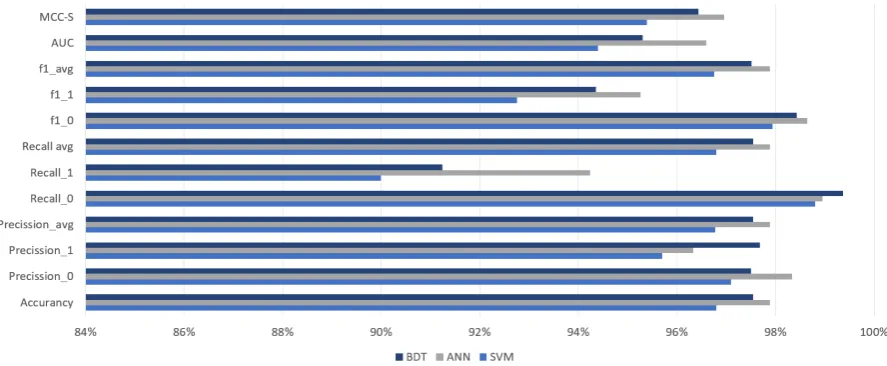
The figure5shows the results of all 3 models in various metrics. The figure6presents a part of
284
the confusion matrix regarding true predictions (True Positive and True Negative).
285
Figure 5.Average metrics for 10 tries
Figure 6.True Positive and True Negative
As you can see, BDT is the best and SVM is the worst. All models are much less successful in
286
detecting meter failure than predicting survival for the next accounting period. Although we have not
287
yet optimised the tested models, the results are very good. They mainly result from preprocessing and
288
data normalisation, as well as proper selection of parameters.
289
3.3.2. Hyperparameter optimisation
290
Hyperparameter optimisation is a problem of finding a minimum of a certain objective function,
291
the domain of which is the space of parameters of the examined model. The parameters can be
292
continuous, discrete or categorical and additionally they can be dependent on each other [28]. It is
worth highlighting that calculating the objective function is extremely expensive – it involves the full
294
training and evaluation of the model.
295
There are different strategies of looking for optimum hyperparameters. The easiest way is ‘manual’
296
tuning. However, it requires expert knowledge of the model and the data, which does not foster
297
generalisation. The other strategy is either full or random search of parameters’ domain, the so-called
298
‘grid search’. Checking all combinations is usually unrealistic due to the high costs. It has been
299
confirmed that random search can work well in the case of a model with many parameters, out
300
of which only some play a key role in its quality [29]. The next method of searching for optimum
301
parameters of a classifier is a SMBO (Sequential Model-Based Optimisation) method. To put it simply,
302
it consists in constructing a surrogate model approximating the objective function, the minimum of
303
which we look for. Most frequently GP (Gaussian Process), RFR (Random Forest Regressions) or TPE
304
(Tree-structured Parzen Estimator) are used as surrogate models. The selection of subsequent domain
305
points (values of hyperparameters) is calculated in a way to optimise the selection function – here we
306
most frequently use the EI function (Expected Improvement). Such a strategy usually provides the
307
best results and eliminates the element of randomness [30].
308
To optimise the hyperparameters of models described in this paper the authors decided to use
309
SMBO with TPE model. As the objective function, the AUC metrics was applied.
310
After optimising the hyperparameters, each of the models improved its performance – especially
311
in failure detection. This was also the main goal of the optimisation that was achieved. It can be
312
noticed that the larger the hyperparameters of the tested model, the easier it can be optimised. The
313
neural network, noted the highest progress in each metric (compare7). Significant progress is also
314
visible in the SVM model.
315
Figure 7.Models’ metrics after optimisation
In general, most of the metrics show progress in the range of 3-5%, which is a very good result,
316
especially considering that the quality of the examined models before the optimisation exceeded 92%.
317
3.4. Ensemble model 318
The ensemble classifier, as in the case of random forest (BDT) is a meta-classifier that internally
319
uses several, preferably strongly independent models, respectively aggregating their predictions,
320
generates the result [31]. The assumption about the differentiation of models is important because
321
the similar classifiers make the same mistakes, so the final group model would only duplicate them.
322
Sufficient differentiation can be achieved for the same algorithms by appropriate division of the
323
training set into subsets (bagging). It also happens that subsets of data attributes are used instead of
324
data subsets. In this paper, the authors decided on a different approach, namely the use of already
trained (and optimised) models and building of a collective classifier using the most popular voting
326
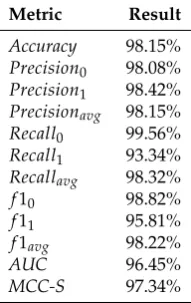
algorithms with weights. The results of the obtained ensemble classifier can be seen in the table4.
327
Metric Result
Accuracy 98.15%
Precision0 98.08% Precision1 98.42% Precisionavg 98.15%
Recall0 99.56%
Recall1 93.34%
Recallavg 98.32%
f10 98.82%
f11 95.81%
f1avg 98.22%
AUC 96.45%
MCC-S 97.34%
Table 4.Ensemble classifier – average for 10 tries
For the most important metrics (MCCandAUC), the ensemble classifier is better than the average
328
of the optimised models by more than one percent, which gives respectively 22% and 29% of the total
329
possible improvement. The increase in detectability of failures by more than 1.5% for thePrecission1, 330
Recall1and f11metrics is also important. 331
4. Discussion 332
Access to large data sets containing information about the operation of already installed devices in
333
residential buildings is nowadays relatively easy. The analysis of these data provides significantly new
334
knowledge about their exploitation and can be treated as an intermediate step in the implementation
335
of smart meters or smart homes. Using the reliability analysis tools, we have discovered that the failure
336
intensity of the heat meters is random and weakly dependent on the time of their use. In addition to
337
statistical analysis, the appropriate use of machine learning algorithms, including neural networks and
338
ensemble models, allows a better understanding of the operation of such devices. Next to the failure
339
prediction model presented in this work, you can also try to predict water usage, heat consumption or
340
periods when such consumption will be minimal. Such knowledge can be used to optimise the costs of
341
media transmission as well as to reduce costs for individual users (compare [32]). Similar approach
342
has been shown in [33], but authors the used an adaptive neuro-fuzzy network.
343
The knowledge needed for data analysis and model building is available to researchers and fairly
344
well-established. However, studies that use hyperparameter optimisation are not common, which
345
encouraged us to present this issue a bit more widely. We also showed that this is an important step to
346
improve the efficiency of machine learning models.
347
It should be emphasised that the preparation of data for analysis is a complex and laborious
348
process, but extremely important for the quality of future models. As stated in [12], many ML methods
349
are very sensitive to the type and quality of the data. To increase the quality of predictions, you
350
can build an ensemble model with help of several (preferably independent) models. As a rule, its
351
results are better than its individual components. However, the choice of algorithms in that case can
352
not be accidental. In the presented example, we showed, on the basis of the correlation matrix, that
353
selected parameters of heat meters are linearly independent. This means that, for example, the logistic
354
regression method would be a weak choice.
355
5. Conclusions 356
It is not possible to replace all heat meters currently being in use at once. Therefore in order to
357
realise the idea of smart homes, we need to get known the devices much better. We have shown that
358
both statistical analysis and prediction models provide a significant new knowledge on the operation
and failures of heat meters. The reliability of heat meters (especially those with remote communication)
360
seems to be good enough for smart city applications and optimisation of heat consumption.
361
Currently, most applications of machine learning are primarily based on neural networks. It is
362
understandable that this method is very flexible and probably the only one suitable for solving many
363
types of problems such as regression, classification, clustering, reinforcement. Consequently, other
364
types of algorithms are rarely considered. We showed that prior exploratory data analysis, the right
365
choice of parameters, hyperparameters optimisation and the construction of the ensemble classifier
366
can significantly enhance the quality of predictions and create a solution which outperforms the results
367
of an individual neural network.
368
Presented data analysis and results of created models lead to following findings and implications:
369
• The intensity of failures of heat meters is almost independent on the operating time.
370
• Due to the high reliability of the meters and their considerable cost, condition-based or predictive
371
maintenance of heat meters is justified and possible. It was shown, that required 5 years
372
verification period could be extended.
373
• Collecting different parameters about devices in use, makes sense even if they are not required at
374
the moment. It allows to build more general and better ML models in future.
375
• Heat meter data allow to build a ranking list of their producers and optimise deliveries.
376
• Heat meters with remote communication are twice as reliable as ones with manual reading.
377
This article is one of the few which deal with reliability and predictability of heat meters’ failures.
378
It is also, according to our knowledge, the first attempt to use more independent ML models based on
379
a single database. Achieving the result above 95% for the AUC metric by the model, while maintaining
380
overfitting at the minimum level, is a remarkable outcome.
381
It is not certain whether the developed models achieve equally good efficiency for meters and data
382
derived from other sources. Due to the fact that training data supplied by only one meters’ operator,
383
the models can be biased. However, the presented approach and methodology of model construction
384
shall perform well independent of data sources. The methods applied by us are so universal that they
385
can be utilised to study the reliability and predict failures of other types of meters, e.g. water meters or
386
heat cost allocators.
387
The developed Machine Learning model and the acquired knowledge will be used in the design
388
of new heating systems as well as for optimisation of stocks and maintenance actions in existing heat
389
meter networks, which will bring significant benefits for their operators, tenants and the environment.
390
In particular, the optimisation of meters’ maintenance in large buildings will allow companies to save
391
both time and resources. Such optimisation is also crucial for the tenants, who are the end users of
392
heat meters. It does not only shorten the time needed for their presence during replacement, but it also
393
guarantees accurate meter readings and the fair distribution of heating costs.
394
Supplementary Materials:Due to the sensitivity and ownership of the data, datasets used will not be publicly
395
available. Under special circumstances the access can be granted by Rapp Enserv AG. In that case please contact 396
Rapp Enserv, Hochstrasse 100, 4018 Basel, +415859577744. 397
Author Contributions: P. Pałasz and R. Przysowa conceived and designed the research; P.P. processed and
398
analysed the data; R.P. verified and evaluated the results. P.P. and R.P. drew conclusions and produced the paper. 399
Funding:This research received no external funding
400
Acknowledgments: We are very grateful to Rapp Enserv AG for allowing us to use and analyse the data. We
401
would like to thank Prof. Józef ˙Zurek from Instytut Techniczny Wojsk Lotniczych for sharing his expertise with us 402
during the course of this research. We are also much obligated to Krzysztof Przysowa for his comments on an 403
earlier version of the manuscript, although any errors are our own and should not tarnish the reputations of these 404
esteemed persons. Special thanks should be given to Magda Tomaszewska for English language editing. 405
Conflicts of Interest:The authors declare no conflict of interest. Rapp Enserv AG did not sponsor this research
406
and had no role in the design, execution, interpretation, or writing the study. The views, information, or opinions 407
expressed herein are solely those of the authors and do not necessarily represent the position of any organisation. 408
The following abbreviations are used in this manuscript: 410
411
ANN: Artificial Neural Network AUC: Area Under the ROC Curve BDT: Bagging Decision Tree LDA: Linear Discriminant Analysis MCC: Matthews Correlation Coefficient
MDPI: Multidisciplinary Digital Publishing Institute ML: Machine Learning
PCA: Principal Component Analysis rbf: Radial Basis Function
ROC: Receiver Operating Characteristic SMBO: Sequential Model-Based Optimisation SVM: Support Vector Machine
TPE: Tree-structured Parzen Estimator 412
413
1. European Commission. Energy Efficiency, 2019. 414
2. Makonin, S.; Wang, Z.J.; Tumpach, C. RAE: The rainforest automation energy dataset for smart grid meter 415
data analysis. Data2018, 3, 8. doi:10.3390/data3010008. 416
3. Zhang, G.; Wang, G.G.; Farhangi, H.; Palizban, A. Data mining of smart meters for load category 417
based disaggregation of residential power consumption. Sustainable Energy, Grids and Networks2017, 418
10, 92–103. doi:10.1016/j.segan.2017.03.006. 419
4. Khairalla, M.; Abdrabou, A.; Dahir, A.; Gaouda, A. Fault location based on smart meters time synchronized 420
measurements. Smart Grid and Renewable Energy (SGRE), 2015 First Workshop on. IEEE, 2015, pp. 1–6. 421
doi:10.1109/sgre.2015.7208720. 422
5. Lee, J.Y.; Yeo, M.S.; Kim, K.W. Predictive control of the radiant floor heating system in apartment buildings. 423
Journal of Asian Architecture and Building Engineering2002, 1, 105–112. 424
6. Javed, A.; Larijani, H.; Ahmadinia, A.; Emmanuel, R. Comparison of the robustness of RNN, MPC and 425
ANN controller for residential heating system. 2014 IEEE Fourth International Conference on Big Data 426
and Cloud Computing. IEEE, 2014, pp. 604–611. 427
7. Yang, I.H.; Yeo, M.S.; Kim, K.W. Application of artificial neural network to predict the optimal start time 428
for heating system in building. Energy Conversion and Management2003, 44, 2791–2809. 429
8. Keçeba¸s, A.; Alkan, M.A.; Yabanova, ˙I.; Yumurtacı, M. Energetic and economic evaluations of geothermal 430
district heating systems by using ANN. Energy policy2013, 56, 558–567. 431
9. Yabanova, ˙I.; Keçeba¸s, A. Development of ANN model for geothermal district heating system and a novel 432
PID-based control strategy. Applied Thermal Engineering2013, 51, 908–916. 433
10. Pałasz, P.; ˙Zurek, J.; Przysowa, R. Markov reliability model for heat meters. Journal of KONBiN2018, 434
45, 83–96. doi:10.2478/jok-2018-0005. 435
11. Witten, I.H.; Frank, E.; Hall, M.A.; Pal, C.J. Data Mining: Practical machine learning tools and techniques; 436
Morgan Kaufmann, 2016; chapter 4. 437
12. Gudivada, V.; Apon, A.; Ding, J. Data quality considerations for big data and machine learning: Going 438
beyond data cleaning and transformations. International Journal on Advances in Software2017, 10, 1–20. 439
13. Hall, M.A. Correlation-based feature selection of discrete and numeric class machine learning. Proceedings 440
of the Seventeenth International Conference on Machine Learning, 2000, pp. 359–366. 441
14. Goodfellow, I.; Bengio, Y.; Courville, A.; Bengio, Y. Deep Learning; Vol. 1, MIT press Cambridge, 2016. 442
15. Pérez, R.; Vásquez, C. Fault location in distribution systems with distributed generation using support 443
vector machines and smart meters. Ecuador Technical Chapters Meeting (ETCM), IEEE. IEEE, 2016, pp. 444
1–6. doi:10.1109/etcm.2016.7750857. 445
16. Quinlan, J.R.; others. Bagging, boosting, and C4.5. AAAI/IAAI, Vol. 1, 1996, pp. 725–730. 446
17. Sapna, S.; Tamilarasi, A.; Kumar, M.P.; others. Backpropagation learning algorithm based on Levenberg 447
18. Zhang, D.; Zhou, X.; Leung, S.C.; Zheng, J. Vertical bagging decision trees model for credit scoring. Expert 449
Systems with Applications2010, 37, 7838–7843. doi:10.1016/j.eswa.2010.04.054. 450
19. Johnson, R.A.; Wichern, D.W. Applied Multivariate Statistical Analysis, 6 ed.; Prentice Hall, 2007. 451
20. Biały, J.; Rurak, A.; Tomaszewska, J.; Toru ´n, A.; Woch, M.; Zieja, M.; ˙Zurek, J. Statistical Analysis of the 452
Volume of Passenger Air Traffic in Europe in years 2004-2015. Transportation research procedia2018, 453
35, 72–79. 454
21. Martinez, W.L.; Martinez, A.R.; Solka, J. Exploratory data analysis with MATLAB; Chapman and 455
Hall/CRC, 2017. 456
22. Bradley, E. Reliability Engineering A Life Cycle Approach; CRC Press Taylor & Francis Group, 2017. 457
23. He Ren, X.C.; Chen, Y. Reliability Based Aircraft Maintenance Optimization and Application; Aerospace 458
Engineering, Academic Press Elsevier, 2017. 459
24. Rykov, V. Reliability of Engineering Systems and Technological Risks; John Wiley & Sons, Inc.: Hoboken, 460
NJ, USA, 2016. doi:10.1002/9781119347194. 461
25. Murphy, K.P. Machine Learning: A Probabilistic Perspective; Number 12 in Adaptive computation and 462
machine learning series, MIT Press: London, England, 2013. 463
26. Domingos, P. The Master Algorithm: How the Quest for the Ultimate Learning Machine Will Remake Our World; 464
Basic Books, 2015; p. 354. 465
27. Davis, J.; Goadrich, M. The relationship between Precision-Recall and ROC curves. Proceedings of the 23rd 466
international conference on Machine learning. ACM, 2006, pp. 233–240. doi:10.1145/1143844.1143874. 467
28. Bergstra, J.; Yamins, D.; Cox, D.D. Making a science of model search: Hyperparameter optimization in 468
hundreds of dimensions for vision architectures. ICML2013. 469
29. Bergstra, J.; Bengio, Y. Random search for hyper-parameter optimization. Journal of Machine Learning 470
Research2012, 13, 281–305. 471
30. Snoek, J.; Larochelle, H.; Adams, R.P. Practical bayesian optimization of machine learning algorithms. 472
Advances in neural information processing systems, 2012, pp. 2951–2959. 473
31. Zhang, C.; Ma, Y. Ensemble machine learning: methods and applications; Springer, 2012. 474
32. Sajjadi, S.; Shamshirband, S.; Alizamir, M.; Yee, L.; Mansor, Z.; Manaf, A.A.; Altameem, T.A.; Mostafaeipour, 475
A. Extreme learning machine for prediction of heat load in district heating systems. Energy and Buildings 476
2016, 122, 222–227. 477
33. Shamshirband, S.; Petkovi´c, D.; Enayatifar, R.; Abdullah, A.H.; Markovi´c, D.; Lee, M.; Ahmad, R. Heat 478
load prediction in district heating systems with adaptive neuro-fuzzy method. Renewable and Sustainable 479