Joining Statistics with N L P for Text C a t e g o r i z a t i o n
P a u l S.
J a c o b sArtificial I n t e l l i g e n c e L a b o r a t o r y G E R e s e a r c h a n d D e v e l o p m e n t C e n t e r
S c h e n e c t a d y , N Y 12301 U S A p s j a c o b s @ c r d . g e . c o m
Automatic news categorization systems have pro- duced high accuracy, consistency, and flexibility using some natural language processing techniques. These knowledge-based categorization methods are more pow- erful and accurate than statistical techniques. However, the phrasal pre-processing and pattern matching methods that seem to work for categorization have the disadvan- tage of requiring a fair amount of knowledge-encoding by human beings. In addition, they work much better at certain tasks, such as identifying major events in texts, than at others, such as determining what sort of business or product is involved in a news event.
Statistical methods for categorization, on the other hand, are easy to implement and require little or no hu- man customization. But they don't offer any of the ben- efits of natural language processing, such as the ability to identify relationships and enforce linguistic constraints.
Our approach has been to use statistics in the knowl- edge acquisition component of a linguistic pattern-based categorization system, using statistical methods, for ex- ample, to associate words with industries and identify phrases that information about businesses or products. Instead of replacing knowledge-based methods with statis- tics, statistical training replaces knowledge engineering. This has resulted in high accuracy, shorter customiza- tion time, and good prospects for the application of the statistical methods to problems in lexical acquisition.
1 I n t r o d u c t i o n
Text categorization is an excellent application domain for natural language processing systems. First, it is a task in which NLP techniques have born fruit, producing high accuracy along with other benefits [Hayes and We- instein, 1990; Kuhns, 1990; Tong et al., 1986]. Second, it provides an easy way of measuring success, by comparing system responses with "expert" category assignments. Third, it is a ripe domain for exploring statistical meth- ods for automated knowledge acquisition. Published work on text categorization has focused on the first item above, arguing convincingly for knowledge-based tech- niques and their accuracy, but has not yet opened the way for the investigation of category assignment as a way of testing NLP methods or on the prospects for ac- quisition. This work focuses on combining statistics and NLP in a knowledge-based categorization system, using statistics as way of augmenting hand-coded knowledge.
The context of this research is a commercially- developed system [Rau and Jacobs, 1991] that automat- ically assigns categories to news stories for "custom clip- ping" and other markets. Like Construe/TIS [Hayes and Weinstein, 1990], the work derives from, and coordinates with, NLP efforts, but the system primarily uses a lexico- semantic pattern matcher for categorization [Jacobs et al., 1991]. Categorization tasks vary greatly in difficulty, but the recall and precision results produced in our tests are similar to those reported by other systems, with cov- erage of over 90% on topic assignment and performance better than human indexers on most aspects of the task. Figure 1 shows a typical example of a news story, with associated human-assigned categories. Retrieval is per- formed by matching a desired set of categories (termed a query or profile) against those assigned in the text database. Our system, known as NLDB, mimics these category assignments, extracting company names [Rau, 1991], topics or subject indicators, industries, and others (including, for example, stock exchanges and geographic regions). The program also incorporates portions of the S C I S O R system [Jacobs and Rau, 1990], which can fill certain other fields, such as the target and suitor of a takeover.
This sort of system has a simple appeal: the "answers" (the set of category assignments) are usually clear-cut, yet they clearly require some detailed content analysis. On the other hand, the technologies that could con- tribute to this analysis are bafflingly complex, from dis- course methods that distinguish topics from background events to word sense techniques that help to distinguish, for example, COMMUNICATIONS from BROADCASTING and
HEALTH CARE from PHARMACEUTICALS.
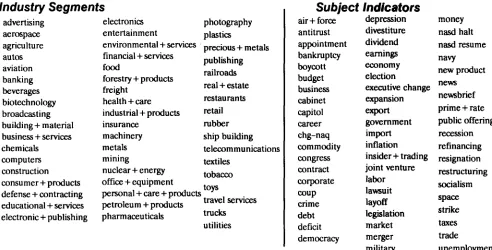
Figure 2 shows the complete list of industry and topic assignments currently in use to categorize texts in the N L D B system.
C o m p a n i e s Industries Topics O t h e r
ARGOSYSTEMS AVIATION BUSINESS CORPORATE
ARGOSYSTEMS INC DEFENSE CONTRACTING CONTRACT NEWSGRID
BOEING ELECTRONICS NYASE
BOEING CO(BA) OTC
UTL USA
UTL CORP(UTLC)
BOEING'S ARGOSYSTEMS SUBSIDIARY TO MAKE TENDER OFFER FOR ALL UTL CORE SHARES
SEATTLE (JULY 31) PR NEWSWIRE - The Boeing Co. (NYSE: BA) has announced its agreement to cause its whol- ly-owned subsidiary ARGOSystems of Sunnyvale, Calif., to make a cash tender offer at $4.75 per share for all shares of UTL Corp. (NASDAQ: UTLC) of Dallas.
The transaction is valued at approximately $20 million. The boards of ARGOSystems and UTL have approved the transaction.
The tender offer will commence no later than Aug. 6. Upon completion of the tender offer, the agreement calls for a merger in which the remaining UTL stockholders will also receive $4.75 in cash per share. The tender offer is subject to certain conditions including the tender of at least a majority of the outstanding UTL shares.
UTL Corp. designs, develops, manufactures and markets electronic warfare systems used for reconnaissance and sur. veillance. The systems provide information on the location and identification of radar and communications emitters ....
Figure 1: Input Text and Assigned Categories
2 O v e r a l l R e s u l t s
Figure 3 summarizes the overall results of this experi- ment, including the results of assigning topic categories (the task generally reported in this sort of work) and in- dustry categories with statistics only, natural language, and the combination; and the overall effect of the com- bined approach.
Recall here has essentially the same meaning as in information retrieval; i.e. the percentage of human- assigned categories that the system also produced. Pre- cision is the percentage of system-assigned categories that also appeared in the human indices. These statis- tics make the dubious (and often incorrect) assumption that the human-assigned categories are always correct. In Figure 1, for example, NLDB included AEROSPACE on the industry list--This hurts precision because it is not included on the human list.
The major achievement here is that the combination of statistical analysis and natural language based cate- gorization is considerably better than either alone. The system uses statistical methods where they do better (i.e. industries) and NLP where it does better (i.e. topics), and shows that combined NLP and statistics can be bet- ter than either technique alone within a particular task. The results tend to understate the real impact of this combination, in part because of the large differences in difficulty among sets of categories, and in part because of the portion of the human-assigned categories that are incorrect. In analyzing sample texts where the human categories differ from the automatically-assigned cate- gories, we have found that the system tends to be cor- rect about as often as the human indexer, with many
cases so difficult to judge that multiple independent as- sessments differ. Since this means that the system recall against the human is higher than human recall against the system, the results indicate that the system's overall performance is better than human performance. How- ever, for the purpose of this experiment, we use these results to compare different system configurations, and not to illustrate an absolute measure of accuracy.
3 C a t e g o r i z a t i o n ~ N a t u r a l L a n g u a g e
While it is easy to attain a certain level of accuracy in text categorization using a single layer of techniques and to combine all texts and all categories in evaluating the results, this aggregation of results obscures many of the real problems where NLP and categorization come to- gether. Each type of category can highlight a different set of NLP issues, and different texts reveal different pro- cessing problems. For example, the problem of mistaking a totally irrelevant text for a text of a particular category is very different from the subtle task of distinguishing texts about one category from another. Similarly, NLP results in processing texts within a category are quite different from results in assigning texts to categories, for reasons that will be explained below.
[image:2.612.60.563.67.336.2]Industry Segments
advertising electronics photography aerospace entertainment plastics
agriculture environmental + services ' precious + metals autos financial + services publishing
aviation food railroads
banking forestry + products
beverages freight real + estate
biotechnology health + care restaurants broadcasting industrial + products retail building + material insurance rubber business + services machinery ship building chemicals metals telecommunications
computers mining textiles
construction nuclear + energy tobacco
consumer + products office + equipment toys defense + contracting personal + care + products
travel services educational + services petroleum + products
electronic + publishing pharmaceuticals trucks utilities
Subject Indicators
air + force depression money antitrust divestiture nasd halt appointment dividend nasd resume bankruptcy earnings navy boycott economy new product budget election
business executive change news cabinet expansion newsbrief capitol export prime + rate career government public offering chg-naq import recession commodity inflation refinancing congress insider + trading resignation contract joint venture restructuring corporate labor socialism coup lawsuit
crime layoff space
debt legislation strike deficit market taxes democracy merger trade
military unemployment Figure 2: Keywords for Industry and Topic Segments
Categorization Task
Topic assignment (NL)
Topic assignment (Stats)
Topic assic~nment (Stats + NL /
Industry assignment (NL)
Industry assignment (Stats}
Industry
assignment (Stats+ NL)
Recall
.94
.73
.95
.34
.64
.67
Precision
.61
.79
.65 .18
.50 .46
All
categories (NL).74
All categories (Stats + NL)
.79
.64
Figure 3: Overall Results
3.1 W o r d W e i g h t s f o r I n d u s t r y A s s i g n m e n t For example, in the news categorization task described earlier, natural language delivered the weakest perfor- mance relative to statistics on the assignment of indus- try categories. Performance on topic assignment was generally much higher using natural language, and com- pany name extraction and variation was handled using a separate mechanism [Rau, 1991]. T h e two most ob- vious differences between topic assignment and industry assignment are:
1. It is generally easy to determine where the topic of a story is expressed, either in the first sentence or by spotting certain words and phrases that are good indicators, while the industries involved can appear almost anywhere in a story,
2. T h e breadth of language t h a t expresses topic is much narrower than the breadth required to handle
the different industries; for example, it is quite easy to identify texts dealing with bankruptcies, lawsuits, and mergers using a few key words and phrases (vo- cabularies of no more than 20 or 30 words per topic): but a single industry can be indicated by any num- ber of words or expressions, including names of spe- cific customers, products, or devices.
For these reasons, statistics have the upper hand in the identification of industries, and the first pass at the N L D B system used linguistic methods for topic assign- ment and statistical methods for industries. This wa~ unsatisfying, because we quickly came across errors in the results that might have been prevented using simple NLP methods, as well as places where the results could have helped to augment or correct linguistic knowledge
[image:3.612.97.589.63.313.2] [image:3.612.100.578.341.498.2]obvious errors resulting from these methods were finding a good indicator in the wrong place (either in irrelevant text or in background text), and finding a good indica- tor used in a different way. These errors pervade the re- sults of statistical categorization, with the most obvious problems coming when the results clearly derived from the misinterpretation of individual words and phrases.
For example, the word brewing occurred 14 times in a sample of about 11,000 news stories. In 9 out of those 14 cases, or 64%, the story was correctly categorized under the industry BEVERAGES, which includes less than 1% of the stories. By most any statistical metric, brewing is a strong indicator for BEVERAGES (better, in fact, than
beer and beverages, although not quite as good as Pepsi).
However, the statistical categorization method failed, for example, on the following text, incorrectly assigning the text to BEVERAGES:
T h e issue first surfaced M o n d a y w h e n D a w e s complained there is a "black hole" of in- formation about h o w Richards deposited state m o n e y while the S & L crisis was brewing I
T h e word gas is not quite as good an indicator as
brewing--in 5 5 % of occurrences it indicates PETROLEU• PRODUCTS, and 1 1 % of the time UTILITIES, with scat- tered other interpretations. But gas is m u c h more fre- quent than brewing, occurring 835 times in the same training sample where brewing occurred 14 times. So, in terms of overall performance, knowing w h e n gas is a good indicator of an industry can m a k e more of a differ- ence. T h e problem is with texts such as the following:
O f 55 check-ups of the 17 patients, mild di- arrhea was reported during 2 percent of check- ups, nausea or vomiting in about 3 percent and a moderate increase in intestinal gas in about 10 percent.
While the problem with brewing above can easily be solved by using any simple method of filtering out ir- relevant text (the sentence appears in the middle of a story about a political campaign), this is not the case with gas. T h e gas example, like many similar errors, ap- pears in relevant text describing the health effects of bran cereal, which could be correctly categorized as HEALTH CARE and FOOD.
Note also that it is difficult to compensate for errors in individual word weights by using combined statistical weights for categorization. This point will he discussed more in Section 5, but the main problem is that content words like patients, nausea and check-ups simply don't have enough information content to act as good discrim- inators compared to gas.
3.2 R e c a l l a n d P r e c i s i o n
While it is easy to spot places where statistics tend to introduce erroneous categories, thus lowering precision
in examples such as brewing and gas above, it is harder to understand why statistical methods also fail to pro- duce enough information to assign a category, thus pro- ducing low recall. Since the task of assigning industries
aitalics added
depends more on what businesses companies are in than what an individual story is about, the information about the industry is often localized, perhaps even in a single mention of a company or product. For example, the following is a typical, though difficult, story about an executive change:
.... James W. Nelson has been named vice president-manufacturing and distribution for the household products group at Lehn & Fink Products, maker of such well-known brands as Lysol, Love My Carpet, Resolve, Chubs, Mop & Glo, Ogilvie, Minwax and Thompson's.
Lehn & Fink Products, headquartered in Montvale, is a leading international marketer of household and do-it-yourself products.
The human categorizer assigned the story to the categories of CONSUNER PRODUCTS and PERSONAL CARE PRODUCTS, although the latter is probably an error. While CONSUMER PRODUCTS is the strongest category in- dicated statistically, from words such as household and
brands, it is still weakly indicated; in fact, it would be difficult to get a statistical measure to admit CONSUMER PRODUCTS without also including RETAIL, BEVERAGES, BUILDING MATERIAL, and even TEXTILES, which are loosely coupled with terms such as brands, do-it-yourself
and carpet. It is also quite difficult, because of the high independent frequencies of the words, to identify house- hold products as a collocation or combination that should be considered.
T h e key to getting good recall and precision on texts such as these is to consider the weights of the individual words and phrases to determine what industries could be involved, but to use the structure of the texts to help determine where the industry information might be. Phrases like X is a leading marketer of Y or X
is the maker of Y appear throughout news stories, and are sure indicators of industry information, even though they do not point to any particular industry. Linguistic approaches probably won't help to guess that Love My Carpet is a consumer product, but they can help to de- termine that the industry discriminators lie in the text following patterns such as X is the maker of Y. Statistics can then guess the industries associated with Y.
The NLP m e t h o d used in N L D B associates categories with linguistic patterns. We will next describe the pat- tern language, then explain how statistical methods can automatically add simple patterns.
4 L e x i c o - S e m a n t i c P a t t e r n s
type of knowledge structure has proven effective for topic identification as well as other forms of pre-processing.
Because the p a t t e r n m a t c h e r is designed as an efficient "trigger" mechanism and an aid in parsing, the p a t t e r n s are mostly simple combinations of lexical categories. T h e p a t t e r n s largely a d o p t the language of regular expres- sions, including the following t e r m s and operators:
• Lexical features t h a t can be tested in a p a t t e r n • Logical combination of lexical feature t e s t s - - O R ,
A N D , and N O T
• Wild cards
• Variable assignment ( ? X = )
• Grouping o p e r a t o r s - - < > for grouping, D for dis- junctive grouping
• R e p e t i t i o n - - * for 0 or more, + for 1 or more
• R a n g e - - a N f o r 0 t o N , -¢-Nfor l t o N • Optional C o n s t i t u e n t s - - {} for optional
While this p a t t e r n language provides a tool for rec- ognizing linguistic constructs, most p a t t e r n s for cate- gorization are simple lexical items, semantic categories, or combinations. For example, the word root dividend
and the phrase holders of record are good indicators of a
D I V I D E N D story.
Most topics have rules t h a t include such sure-fire sin- gle words and phrases, along with some more complex patterns. For example, the following two rules help to recognize stories a b o u t mergers and acquisitions:
(or tender merger) offer => C-TAKEOVER ;
• " C 1 . . . a n n o u n c e d . . . acquisition of ... C2
J
? C l = ~ c n a m e ~ * $ a n n o u n c e - v e r b * $merger-verb • 5 [of with] $ ?C2=~cname}
=> (C-TAKEOVER (r-agent ?Cl) (r-target ?C2))
In addition to helping to catch a broader range of con- structs t h a t indicate takeovers, the more complex pat- terns like the second one above can make preliminary as- signments of roles, which can greatly speed and aid pars- ing in s y s t e m s t h a t p e r f o r m b o t h parsing and categoriza- tion. T h e ability to construct and add these more sophis- ticated p a t t e r n s by hand is a m a j o r advantage, which ac- counts for much of the benefit of knowledge-based meth- ods over statistical means. However, the more simple p a t t e r n s are required, the more labor-intensive this pro- cess can be, and the more manual tuning must be done in order to get accurate results.
Statistical m e t h o d s have the advantage of building rules automatically from a training set. But, in order to get the benefit of statistics, the m e t h o d s used must add knowledge in the same form as the knowledge-based rules, and m u s t produce a clear result t h a t is accessible for knowledge engineering. In other words, the statis- tical m e t h o d s themselves m u s t be an aid rather t h a n a replacement for knowledge acquisition. T h e next section describes how this is accomplished.
5
S t a t i s t i c s a n d
Acquisition
T h e strategies for statistical training described here all
u s e a "training" set of 11,500 news stories, including
a b o u t 3,000,000 words, with human-assigned categories assigned to each story. T h e "test" set used was a new sample of one day's news, or 700 stories including 200,000 words.
Many statistical m e t h o d s in information retrieval use probahilistic weights of individual terms [Salton and McGill, 1983], where a t e r m can be a single word, root, or combination of words. T h e techniques we explored include various weighting schemes, with the end goal be- ing to use heavily-weighted t e r m s as the building blocks for patterns. A t e r m can be weighted with respect to its overall relevance, or with respect to its ability to deter- mine a particular category. T h e "pure" statistical results reported earlier s u m m e d the weights of all t e r m s in a text with respect to each industry category.
A u t o m a t i n g the process of acquiring lexico-semantic p a t t e r n s poses a n u m b e r of distinct problems. First, there has to be some means of distinguishing where in- dustry information might a p p e a r in a text. Second, sin- gle words should he distinguished f r o m phrases in certain cases where the individual words might be misleading. Third, the statistical m e t h o d s m u s t produce individual actions, not weights t h a t m u s t be combined to derive the final answer or answers. Fourth, there has to be some good way of determining when the statistical results were bound to introduce errors.
All of these requirements come together to assure t h a t the statistical m e t h o d s can be used to improve existing sets of p a t t e r n - a c t i o n rules, t h a t manual m e t h o d s will not counteract the results of acquisition, and t h a t the statistical and N L P m e t h o d s can interact gracefully.
5.1 I d e n t i f y i n g R e l e v a n t T e x t
Many of the errors with statistical m e t h o d s , especially when single words and phrases are used for categoriza- tion, come from unusual occurrences in background or irrelevant texts, such as the brewing e x a m p l e earlier. A similar case is the word Yankee which is an excellent in- dicator of NUCLEAR ENERGY (because of the New Hamp- shire Yankee Power Plant), except in an isolated cluster of articles a b o u t George Steinbrenner, the owner of the New York Yankees.
We tried two m e t h o d s of correcting for such problems. First, we noted t h a t most industry information is con- tained in the headline, first, and last p a r a g r a p h s of texts, and tested using only these p a r a g r a p h s for categoriza- tion. Second, we tried a simple filter to score how much each p a r a g r a p h was like a first or last p a r a g r a p h , using the following calculation for the relevance weight of a term:
1000 d log 2 b
Where b is n u m b e r of occurrences of each t e r m in the first and last p a r a g r a p h s of text, and d is the ratio oI occurrences in these texts to all occurrences, minus a constant.
• A separate relevance filter produced some improve- ment over simple t e r m weighting, a b o u t 3 points in precision, and a larger improvement, a b o u t 5 points, when only "in-or-out" p a t t e r n s were used. This was above and beyond a comparable gain from consid- ering only headline, first, and last paragraphs. • Almost all combinations of looking at first, last, and
additional relevant p a r a g r a p h s ended up with a b o u t the same results. In other words, looking at only p a r a g r a p h s with high relevance scores t h a t were also
at the beginning or end of a story produced a b o u t the same results, combining recall and precision, as looking at highly relevant p a r a g r a p h s in addition to the first and last paragraphs. We settled on using only first and last p a r a g r a p h s with relevant scores because this simply minimizes the amount of text t h a t must be processed.
• Using only first and last p a r a g r a p h s for training, as well as categorizing, produced no improvement in results. We think t h a t this is because the improve- ment from having a more accurate training sample is neutralized by having less text to train on. This suggests using a still larger training sample. These tests showed t h a t a simple relevance filter pro- duced a consistent, small, advantage in accuracy over using the whole text of each story. However, surpris- ingly, it was hard to see any gain from considering the middle p a r t s of stories where those parts had high rel- evance scores. This suggests t h a t further work could produce b e t t e r indicators of relevance t h a t get industry information out of the middle parts without introducing more extraneous categories.
5.2 C o l l o c a t i o n s a n d N a m e s
Statistical m e t h o d s looking for sure-fire indicators must, by their nature, consider overwhelming statistical evi- dence even when these indicators are relatively infre- quent. Unfortunately, even when a word or phrase cor- relates with an industry 100% of the time in a sample, this does not mean t h a t it will be a sure indicator in a new sample. This is especially a problem with proper names and names of locations, but is also an issue with words t h a t occur frequently in collocations.
Treating words as individual indicators when they re- ally are p a r t of a n a m e or collocation can hurt precision by increasing the chance t h a t the single word will a p p e a r independently. It can also hurt recall, because the com- bined evidence derived from a n a m e or collocation can be strong even when the individual words contribute little. As evidence of the problem with proper names, the words Flint (a city in Michigan where General Motors produces cars and trucks), Donahue (the name of a pop- ular daytime T V show), and Warner (a communications conglomerate) are all good statistical indicators. In fact, in the training sample of a b o u t a m o n t h ' s worth of news,
Donahue was an indicator of BROADCASTING 18 out of 18 times, making it a better indicator even t h a n Pepsi. But in the one-day test sample, Donahue occurred only once, in a story a b o u t the president of Nike (the athletic shoe company). Flint occurred in a story a b o u t an art display
in the Michigan town, and Warner as a n a m e unrelated to the communications company.
While accurate recognition of proper names is neces- sary for good precision, it is also a requirement for recall. A c o m p a n y m a y be involved in industries t h a t are diffi- cult to get from either the parts of the name or the sur- rounding context. For example, household is a weak indi- cator for CONSUMER PRODUCTS, but the c o m p a n y House- hold International is in the IIDUSTRIAL PRODUCTS cat- egory. Similarly, Digital Equipment is in a different in- dustry from Digital Communications. Since these names are so i m p o r t a n t for industry assignment, we found t h a t the best results came from handling all proper names separately and being much more lenient a b o u t when to admit an industry n a m e based on the n a m e of a company t h a n for individual words and phrases.
With other compounds, there were again problems with both recall and precision. Recall problems came from common words t h a t have a special meaning when conjoined, such as real estate--both real and estate fre- quently occur, and have no significance with respect to industry, but real estate is a good indicator of the REAL ESTATE category. Television is a weak indicator of several industry categories, but television viewers and television networks are strong indicators.
We took a simple approach to handling such col- locations, by computing m u t u a l information statistics [Church et al., 1989] for bigrams (two-word sequences) in the training corpus, and treating combinations with a high degree of mutual information as if they were sin- gle terms. So real estate would be t r e a t e d as an atom, the individual words not being considered for catego- rization. This yielded fair results, but p r o b a b l y is not as good a method as looking for discriminators specifically when the individual words are indicators of multiple cat- egories.
T h e following are some of the key results from separate processing of names and collocations:
• C o m p a n y name extraction was the best contribu- tor to accuracy, with a 10% i m p r o v e m e n t in re- call and no significant loss of precision over treat- ing c o m p a n y names as any other word. This is an especially compelling result because the individual components of c o m p a n y names are often themselves good indicators, and because the size of the train- ing set is not nearly large enough to cover m a n y of the companies t h a t occur in a given test (hence the training d a t a inherently miss a fair number of companies).
• T h e use of bigrams yielded a b o u t a 6% gain in pre- cision with no real effect on recall. We expect t h a t the n u m b e r of bigrams was not adequate to have a m a j o r positive i m p a c t on recall, while the method of ignoring the individual c o m p o n e n t words can neu- tralize some of the positive effect.
5.3 S e t t i n g W o r d T h r e s h o l d s
other weights. This way, a rule can combine hand-coded knowledge with automatically-acquired data by looking for industry information in a particular place and get- ting the industry from a single indicator in that place, as in the company manufactures satellites.
Because work in information retrieval [Salton and McGill, 1983] has suggested that combinations of weighted terms could be more accurate than single in- or-out assignments, we compared a number of different weighting methods with a number of different methods for discriminating key indicators. We found that, in gen- eral, the combination of weighted terms produced better results than simply taking the union of the industries activated by the "best" terms. However, the results for the best discrete assignment of industries to individual terms were very close to those of the weighted terms, and the benefits of this approach--including the ability to integrate statistics with knowledge-based methods, the identification of i m p o r t a n t ambiguities in word mean- ing, and speed and simplicity--suggest that statistical thresholds for individual terms, without any combining of weights, is a good approach.
We had to devise a statistical means of distinguish- ing only those terms t h a t were very good indicators by themselves of a particular category, without having to compute a score for each paragraph. This would not have worked without the pre-processing of relevant text, name and collocation extraction. In fact, the perfor- mance of categorization using single in-or-out terms was more than 10% lower in precision than the combina- tion of weights without the pre-processing, but about the same with the combined method. T h e apparent ex- planation for this is t h a t most of the error introduced in using single terms as discriminators comes from the confusion of terms either in special combinations or in irrelevant text.
T h e following is the formula for weighting terms that are individual indicators of a particular category:
(200d)(log2 b)(log~ r)
where b is number of times a term appears is a story about a particular category, d is the difference between that number and the overall percentage of words in texts of that category, and r is the ratio of combined proba- bilities to the product of independent probabilities, the mutual information statistic.
With a threshold of 100, this weight identifies terms that are good independent indicators of each topic. These terms can then be used automatically, either by themselves or in combination with other terms, to create patterns in the knowledge base.
5.4 C o m b i n i n g I n f o r m a t i o n
T h e statistical pre-processing methods and calculations of relevance weights and weights for category indicators lay the groundwork for automatically constructing lin- guistic patterns for categorization. Because these indi- vidual discriminators can be combined with hand-coded knowledge, the statistical recognition of these terms is sufficient to augment a knowledge base automatically, and the combination of the hand-coded rules with the
statistical patterns is b e t t e r than either alone (although it could always be argued that, with a little more work, the same rules could have been hand-coded).
These results are not completely satisfying. The sta- tistical acquisition m e t h o d uses only a fraction of the power of the p a t t e r n language, and the error rate of the system could still be reduced. We tried three different types of methods-finding exceptions, co-indicators, and
meta-indicators-to try to improve results using combina- tions rather than single term rules. These three methods are described as follows:
E x c e p t i o n s : Exceptions spot secondary terms that would override a category indicated by a "good" term, for example, if oil appears in a text about the automobile industry rather than petroleum, it might appear near motor or engine.
C o - l n d i c a t o r s : Co-indicators spot combinations of words, where at least one was a "good" term, where the combination was a much better indicator that the single term.
M e t a - l n d i c a t o r s : Meta-indicators spot terms such as
produces and manufactures, which are not them- selves indicators of a particular industry, but often appear near terms t h a t indicate an industry. For this process, we compiled a set of tables cover- ing, for each good discriminator, the words that ap- peared as neighbors of that t e r m along with the num- ber of times those words appeared in texts about the "right" category vs. texts not about the category. This was a computation-intensive process for 3 million words, so much so that we had to reduce the size of the table by considering only terms with m o d e r a t e f r e q u e n c y - - t h e highest frequency terms are "stop" words, and the lowest frequency terms are not good discriminators.
T h e following are the major results of this analysis: • Using exception lists to try to correct for precision
problems turned out to be of surprisingly little value (about 2% precision). While it is possible that dif- ferent methods would yield b e t t e r results, it seems t h a t the d a t a on exceptions are just too sparse--it is much easier to get good d a t a on positive examples from the training set than negative examples. • Using co-indicators, or second order relations, ap-
peared to be much more promising than exceptions. Like the use of bigrams, this produced only a small effect (about 2% in both recall and precision), but any technique that improves recall without a loss of precision is worth exploring.
• T h e use of recta-indicators, while also not produc- ing a major effect on results, looks like the most promising method. Like co-indicators, these meta- indicators rely mainly on positive examples from the text, but they have the additional advantage of be- ing able to use much larger volumes of data.
6 F e r t i l e A r e a s f o r F u t u r e R e s e a r c h
of this evaluation is the prospect for new areas where statistics can help natural language and vice versa. We have identified three critical research areas that are likely to improve both system performance and general NLP performance.
T h e first major area of research is in discourse, or text structure analysis. This experiment showed that the first and last paragraphs of a news story give much more accu- rate information than others, and that a general assess- ment of relevance of a paragraph serves as a good filter for the extraction of information from that paragraph. However, this simple filter falls far short of really identi- fying where the information in a story lies. For example, in many stories the "last" paragraph really comes in the middle of a text, with some additional material coming at the end because of incidental information or strange editing. Similarly, in more complicated texts, there can be more than one introductory paragraph, multiple con- eluding paragraphs, and other critical information in the middle. Statistical techniques are a very weak means of guessing this type of structural information. We expect that we can improve the results slightly with some more sophisticated discourse analysis; and, perhaps more im- portantly, this type of evaluation can measure how well a structural theory of text can perform.
T h e second area to explore is developing generalized patterns from detailed statistical analysis. The first- order logarithmic measures used for acquisition here are overly simplistic, and assume that relationships between words and categories are basically independent. This as- sumption is false, because the words are a manifestation of concepts and linguistic relations in the text that the statistics are ignoring. We are investigating a variety of more complex means, including multivariate discrimi- nant analysis, that help to determine when, for example, the effect of combining satellite with weapon is really an effect of combining satellite with any military concept.
T h e third, more linguistic, area is in identifying the- matic roles. In meta-indicators described earlier, we are really identifying potential function words in the text, such as produces or manufactures. Since the use of these terms in category assignment really assumes that any company or industry appearing around them is involved in the function or operation, it should be possible to use more detailed parsing to check whether this assumption fits linguistically, and to use the statistical analysis to acquire functional or thematic relations that can help in more detailed analysis.
7
S u m m a r y and Conclusion
This paper has addressed the area where statistical and linguistic analysis come together with an application focus - - the assignment of categories to news stories, particularly the identification of topics and industries. The experiments reported here show that using statis- tical methods to acquire simple lexical patterns helps knowledge-based processing and leads to a substantial improvement in overall system performance. In addition, this method promises to ease the burden of hand-coding knowledge for each application, by automatically identi- fying the significant terms and combinations of terms to
use knowledge-intensive NLP applications.
R e f e r e n c e s
[Church et al., 1989] K. Church, W. Gale, P. Hanks, and D. Hindle. Parsing, word associations, and predicate- argument relations. In Proceedings of the Interna- tional Workshop on Parsing Technologies, Carnegie Mellon University, 1989.
[Hayes and Weinstein, 1990] Philip J. Hayes and Steven P. Weinstein. C O N S T R U E / T I S : A system for content-based indexing of a database of news stories. In Proceedings of the Second Annual Conference on Innovative Applications of Artificial Intelligence, May 1990.
[Jacobs and Rau, 1990] Paul Jacobs and Lisa Ran. SCISOR: Extracting information from on-line news.
Communications of the Association for Computing Machinery, 33(11):88-97, November 1990.
[Jacobs et al., 1991] Paul S. Jacobs, George R. Krupka, and Lisa F. Rau. Lexico-semantic pattern matching as a companion to parsing in text understanding. In
,Fourth DARPA Speech and Natural Language Work- shop, pages 337-342, San Mateo, CA, February 1991. Morgan-Kaufmann.
[Krupka et al., 1991] George R. Krupka, Paul S. Jacobs, Lisa F. Rau, and Lucja Iwafiska. Description of the G E NLToolset system as used for MUC-3. In Proceed- ings of the Third Message Understanding Conference (MUC-3), San Mateo, CA, May 1991. Morgan Kauf- mann Publishers.
[Kuhns, 1990] Robert Kuhns. News analysis: A nat- ural language application to text processing. In Paul S. Jacobs, editor, Text-Based Intelligent Sys- tems: Current Research in Text Analysis, Information Extraction, and Retrieval, pages 147-150. September 1990. GE Research and Development Center Report CRD90/198.
[Ran and Jacobs, 1991] Lisa F. Rau and Paul S. Jacobs. Creating segmented databases from free text for text retrieval. In Proceedings of the 14th International Conference on Research and Development in Infor- mation Retrieval, pages 337-346, October 1991. [Ran, 1991] Lisa F. Ran. Extracting company names
from text. In T i m Finin, editor, Sixth IEEE Con- ference on Artificial Intelligence Applications. I E E E Computer Society Press, Miami Beach, Florida, February 1991.
[Salton and McGill, 1983] G. Salton and M. McGill.
An Introduction to Modern Information Retrieval.
McGraw-Hill, New York, 1983.