Proceedings of the 49th Annual Meeting of the Association for Computational Linguistics, pages 856–864, Portland, Oregon, June 19-24, 2011. c2011 Association for Computational Linguistics
Rule Markov Models for Fast Tree-to-String Translation
Ashish Vaswani Information Sciences Institute University of Southern California
Haitao Mi
Institute of Computing Technology Chinese Academy of Sciences
Liang Huang and David Chiang Information Sciences Institute University of Southern California
{lhuang,chiang}@isi.edu
Abstract
Most statistical machine translation systems rely on composed rules (rules that can be formed out of smaller rules in the grammar). Though this practice improves translation by weakening independence assumptions in the translation model, it nevertheless results in huge, redundant grammars, making both train-ing and decodtrain-ing inefficient. Here, we take the opposite approach, where we only use min-imal rules (those that cannot be formed out of other rules), and instead rely on a rule Markov model of the derivation history to capture dependencies between minimal rules. Large-scale experiments on a state-of-the-art tree-to-string translation system show that our approach leads to a slimmer model, a faster decoder, yet the same translation quality (mea-sured using Bleu) as composed rules.
1 Introduction
Statistical machine translation systems typically model the translation process as a sequence of trans-lation steps, each of which uses a transtrans-lation rule, for example, a phrase pair in phrase-based tion or a tree-to-string rule in tree-to-string transla-tion. These rules are usually applied independently of each other, which violates the conventional wis-dom that translation should be done in context. To alleviate this problem, most state-of-the-art sys-tems rely on composed rules, which are larger rules that can be formed out of smaller rules (includ-ing larger phrase pairs that can be formerd out of smaller phrase pairs), as opposed to minimal rules, which are rules that cannot be formed out of other
rules. Although this approach does improve trans-lation quality dramatically by weakening the inde-pendence assumptions in the translation model, they suffer from two main problems. First, composition can cause a combinatorial explosion in the number of rules. To avoid this, ad-hoc limits are placed dur-ing composition, like upper bounds on the number of nodes in the composed rule, or the height of the rule. Under such limits, the grammar size is man-ageable, but still much larger than the minimal-rule grammar. Second, due to large grammars, the de-coder has to consider many more hypothesis transla-tions, which slows it down. Nevertheless, the advan-tages outweigh the disadvanadvan-tages, and to our knowl-edge, all top-performing systems, both phrase-based and syntax-based, use composed rules. For exam-ple, Galley et al. (2004) initially built a syntax-based system using only minimal rules, and subsequently reported (Galley et al., 2006) that composing rules improves Bleuby 3.6 points, while increasing
gram-mar size 60-fold and decoding time 15-fold.
to-string translation (Liu et al., 2006; Huang et al., 2006). We make three new contributions.
First, we carry out a detailed comparison of rule Markov models with composed rules. Our experi-ments show that, using trigram rule Markov mod-els, we achieve an improvement of 2.2 Bleu over
a baseline of minimal rules. When we compare against vertically composed rules, we find that our rule Markov model has the same accuracy, but our model is much smaller and decoding with our model is 30% faster. When we compare against full com-posed rules, we find that our rule Markov model still often reaches the same level of accuracy, again with savings in space and time.
Second, we investigate methods for pruning rule Markov models, finding that even very simple prun-ing criteria actually improve the accuracy of the model, while of course decreasing its size.
Third, we present a very fast decoder for tree-to-string grammars with rule Markov models. Huang and Mi (2010) have recently introduced an efficient incremental decoding algorithm for tree-to-string translation, which operates top-down and maintains a derivation history of translation rules encountered. This history is exactly the vertical chain of ancestors corresponding to the contexts in our rule Markov model, which makes it an ideal decoder for our model.
We start by describing our rule Markov model (Section 2) and then how to decode using the rule Markov model (Section 3).
2 Rule Markov models
Our model which conditions the generation of a rule on the vertical chain of its ancestors, which allows it to capture interactions between rules.
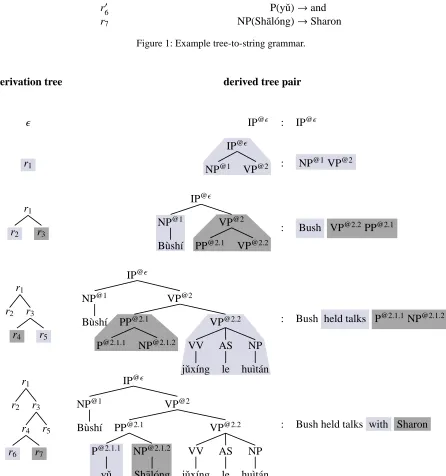
Consider the example Chinese-English tree-to-string grammar in Figure 1 and the example deriva-tion in Figure 2. Each row is a derivaderiva-tion step; the tree on the left is the derivation tree (in which each node is a rule and its children are the rules that sub-stitute into it) and the tree pair on the right is the source and target derived tree. For any derivation node r, let anc1(r) be the parent of r (orǫ if it has no
parent), anc2(r) be the grandparent of node r (orǫif
it has no grandparent), and so on. Let ancn1(r) be the
The derivation tree is generated as follows. With probability P(r1|ǫ), we generate the rule at the root
node, r1. We then generate rule r2 with probability
P(r2|r1), and so on, always taking the leftmost open
substitution site on the English derived tree, and gen-erating a rule riconditioned on its chain of ancestors
with probability P(ri | ancn1(ri)). We carry on until
no more children can be generated. Thus the proba-bility of a derivation tree T is
P(T )=Y
r∈T
P(r|ancn1(r)) (1)
For the minimal rule derivation tree in Figure 2, the probability is:
P(T )=P(r1|ǫ)·P(r2 |r1)·P(r3 |r1)
·P(r4 |r1,r3)·P(r6|r1,r3,r4)
·P(r7|r1,r3,r4)·P(r5 |r1,r3) (2)
Training We run the algorithm of Galley et al. (2004) on word-aligned parallel text to obtain a sin-gle derivation of minimal rules for each sentence
pair. (Unaligned words are handled by attaching them to the highest node possible in the parse tree.) The rule Markov model
can then be trained on the path set of these deriva-tion trees.
Smoothing We use interpolation with absolute discounting (Ney et al., 1994):
Pabs(r|ancn1(r))=
maxnc(r|ancn1(r))−Dn,0 o
P
r′c(r′ |ancn
1(r
′))
+ (1−λn)Pabs(r|ancn1−1(r)), (3)
where c(r |ancn1(r)) is the number of times we have seen rule r after the vertical context ancn1(r), Dn is
the discount for a context of length n, and (1−λn) is
set to the value that makes the smoothed probability distribution sum to one.
We experiment with bigram and trigram rule Markov models. For each, we try different values of D1 and D2, the discount for bigrams and trigrams,
respectively. Ney et al. (1994) suggest using the fol-lowing value for the discount Dn:
rule id translation rule
r1 IP(x1:NP x2:VP)→x1 x2
r2 NP(B`ush´ı)→Bush
r3 VP(x1:PP x2:VP)→x2 x1
r4 PP(x1:P x2:NP)→x1 x2
r5 VP(VV(jˇux´ıng) AS(le) NPB(hu`ıt´an))→held talks
r6 P(yˇu)→with
r′
6 P(yˇu)→and
[image:3.612.85.531.184.660.2]r7 NP(Sh¯al´ong)→Sharon
Figure 1: Example tree-to-string grammar.
derivation tree derived tree pair
ǫ IP@ǫ : IP@ǫ
r1
IP@ǫ
NP@1 VP@2
IP@ǫ
NP@1 VP@2 : NP
@1VP@2
r1
r2 r3
IP@ǫ
NP@1
B`ush´ı
VP@2
[email protected] [email protected] IP@ǫ
NP@1
B`ush´ı
VP@2
[email protected] [email protected]
: Bush [email protected]PP@2.1
r1
r2 r3
r4 r5
IP@ǫ
NP@1
B`ush´ı
VP@2
[email protected] NP@2.1.2
VV
jˇux´ıng AS
le NP
hu`ıt´an IP@ǫ
NP@1
B`ush´ı
VP@2
[email protected] NP@2.1.2
VV
jˇux´ıng AS
le NP
hu`ıt´an
: Bush held talks [email protected]@2.1.2
r1
r2 r3
r4
r6 r7
r5
IP@ǫ
NP@1
B`ush´ı
VP@2
yˇu
Sh¯al´ong
VV
jˇux´ıng AS
le NP
hu`ıt´an IP@ǫ
NP@1
B`ush´ı
VP@2
yˇu
Sh¯al´ong
VV
jˇux´ıng AS
le NP
hu`ıt´an
: Bush held talks with Sharon
Figure 2: Example tree-to-string derivation. Each row shows a rewriting step; at each step, the leftmost nonterminal symbol is rewritten using one of the rules in Figure 1.
Here, n1and n2are the total number of n-grams with
exactly one and two counts, respectively. For our corpus, D1 = 0.871 and D2 = 0.902. Additionally,
we experiment with 0.4 and 0.5 for Dn.
Pruning In addition to full n-gram Markov mod-els, we experiment with three approaches to build smaller models to investigate if pruning helps. Our results will show that smaller models indeed give a higher Bleuscore than the full bigram and trigram
models. The approaches we use are:
• RM-A: We keep only those contexts in which more than P unique rules were observed. By optimizing on the development set, we set P= 12.
• RM-B: We keep only those contexts that were observed more than P times. Note that this is a superset of RM-A. Again, by optimizing on the development set, we set P=12.
• RM-C: We try a more principled approach for learning variable-length Markov models in-spired by that of Bejerano and Yona (1999), who learn a Prediction Suffix Tree (PST). They grow the PST in an iterative manner by start-ing from the root node (no context), and then add contexts to the tree. A context is added if the KL divergence between its predictive distri-bution and that of its parent is above a certain threshold and the probability of observing the context is above another threshold.
3 Tree-to-string decoding with rule Markov models
In this paper, we use our rule Markov model frame-work in the context of tree-to-string translation. Tree-to-string translation systems (Liu et al., 2006; Huang et al., 2006) have gained popularity in recent years due to their speed and simplicity. The input to the translation system is a source parse tree and the output is the target string. Huang and Mi (2010) have recently introduced an efficient incremental decod-ing algorithm for tree-to-strdecod-ing translation. The de-coder operates top-down and maintains a derivation history of translation rules encountered. The history is exactly the vertical chain of ancestors
correspond-IP@ǫ
NP@1
B`ush´ı
VP@2
yˇu
Sh¯al´ong
jˇux´ıng
le
[image:4.612.322.531.70.181.2]hu`ıt´an
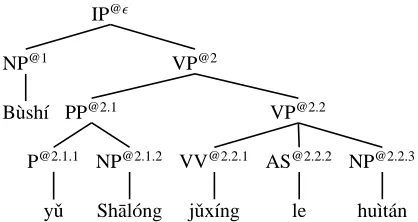
Figure 3: Example input parse tree with tree addresses.
makes incremental decoding a natural fit with our generative story. In this section, we describe how to integrate our rule Markov model into this in-cremental decoding algorithm. Note that it is also possible to integrate our rule Markov model with other decoding algorithms, for example, the more common non-incremental top-down/bottom-up ap-proach (Huang et al., 2006), but it would involve a non-trivial change to the decoding algorithms to keep track of the vertical derivation history, which would result in significant overhead.
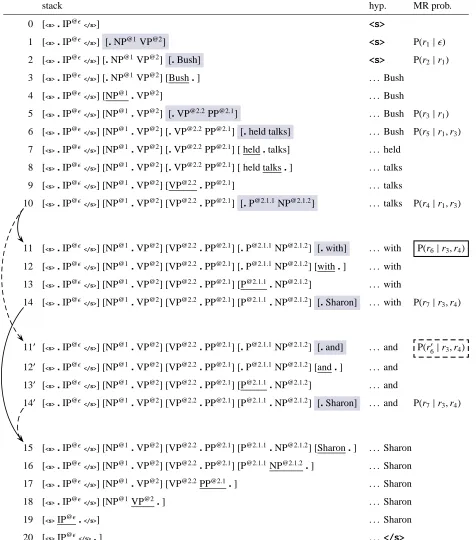
Algorithm Given the input parse tree in Figure 3, Figure 4 illustrates the search process of the incre-mental decoder with the grammar of Figure 1. We write X@ηfor a tree node with label X at tree address
η(Shieber et al., 1995). The root node has addressǫ, and the ith child of nodeηhas addressη.i. At each step, the decoder maintains a stack of active rules, which are rules that have not been completed yet, and the rightmost (n−1) English words translated thus far (the hypothesis), where n is the order of the word language model (in Figure 4, n=2). The stack together with the translated English words comprise a state of the decoder. The last column in the fig-ure shows the rule Markov model probabilities with the conditioning context. In this example, we use a trigram rule Markov model.
After initialization, the process starts at step 1, where we predict rule r1(the shaded rule) with
prob-ability P(r1 | ǫ) and push its English side onto the
stack, with variables replaced by the correspond-ing tree nodes: x1 becomes NP@1 and x2 becomes
VP@2. This gives us the following stack:
stack hyp. MR prob.
0 [<s>IP@ǫ</s>] <s>
1 [<s>IP@ǫ</s>] [NP@1VP@2] <s> P(r1|ǫ)
2 [<s>IP@ǫ</s>] [NP@1VP@2] [Bush] <s> P(r2|r1)
3 [<s>
IP
@ǫ</s>] [
NP
@1VP@2] [Bush
] . . . Bush
4 [<s>IP@ǫ</s>] [NP@1VP@2] . . . Bush
5 [<s>IP@ǫ</s>] [NP@1VP@2] [[email protected]@2.1] . . . Bush P(r3|r1)
6 [<s>IP@ǫ</s>] [NP@1VP@2] [[email protected]@2.1] [held talks] . . . Bush P(r5|r1,r3) 7 [<s>IP@ǫ</s>] [NP@1VP@2] [[email protected]@2.1] [ heldtalks] . . . held
8 [<s>IP@ǫ</s>] [NP@1VP@2] [[email protected]@2.1] [ held talks] . . . talks
9 [<s>IP@ǫ</s>] [NP@1VP@2] [[email protected][email protected]] . . . talks
10 [<s>IP@ǫ</s>] [NP@1VP@2] [[email protected][email protected]] [[email protected]@2.1.2] . . . talks P(r4|r1,r3)
11 [<s>IP@ǫ</s>] [NP@1VP@2] [[email protected][email protected]] [[email protected]@2.1.2] [with] . . . with P(r6|r3,r4) 12 [<s>
IP
@ǫ</s>] [NP@1
VP
@2] [VP@2.2
PP
@2.1] [ P
@2.1.1NP@2.1.2] [with
] . . . with 13 [<s>IP@ǫ</s>] [NP@1VP@2] [[email protected][email protected]] [[email protected][email protected]] . . . with
14 [<s>IP@ǫ</s>] [NP@1VP@2] [[email protected][email protected]] [[email protected][email protected]] [Sharon] . . . with P(r7|r3,r4)
11′ [<s>IP@ǫ</s>] [NP@1VP@2] [[email protected][email protected]] [[email protected]@2.1.2] [and] . . . and P(r′ 6|r3,r4) 12′ [<s>IP@ǫ</s>] [NP@1VP@2] [[email protected][email protected]] [[email protected]@2.1.2] [and] . . . and
13′ [<s>
IP
@ǫ</s>] [NP@1
VP
@2] [VP@2.2
PP
@2.1] [P@2.1.1
NP
@2.1.2] . . . and
14′ [<s>
IP
@ǫ</s>] [NP@1
VP
@2] [VP@2.2
PP
@2.1] [P@2.1.1
NP
@2.1.2] [
Sharon] . . . and P(r7|r3,r4)
15 [<s>IP@ǫ</s>] [NP@1VP@2] [[email protected][email protected]] [[email protected][email protected]] [Sharon] . . . Sharon
16 [<s>
IP
@ǫ</s>] [NP@1
VP
@2] [VP@2.2
PP
@2.1] [P@2.1.1NP@2.1.2
] . . . Sharon
17 [<s>IP@ǫ</s>] [NP@1VP@2] [[email protected]@2.1] . . . Sharon
18 [<s>IP@ǫ</s>] [NP@1VP@2] . . . Sharon
19 [<s>IP@ǫ</s>] . . . Sharon
[image:5.612.70.546.109.649.2]20 [<s>IP@ǫ</s>] . . .</s>
Figure 4: Simulation of incremental decoding with rule Markov model. The solid arrows indicate one path and the dashed arrows indicate an alternate path.
VP@2
[email protected] [email protected]
yˇu
VP@2
[email protected] [email protected]
yˇu
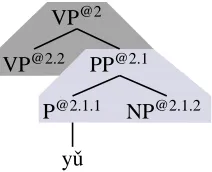
[image:6.612.133.239.69.155.2]Figure 5: Vertical context r3 r4 which allows the model to correctly translate yˇu as with.
the English word order. We expand node NP@1first with English word order. We then predict lexical rule r2 with probability P(r2 | r1) and push rule r2 onto
the stack:
[NP
@1VP@2] [
Bush]
In step 3, we perform a scan operation, in which we append the English word just after the dot to the current hypothesis and move the dot after the word. Since the dot is at the end of the top rule in the stack, we perform a complete operation in step 4 where we pop the finished rule at the top of the stack. In the scan and complete steps, we don’t need to compute rule probabilities.
An interesting branch occurs after step 10 with two competing lexical rules, r6and r6′. The Chinese
word yˇu can be translated as either a preposition with (leading to step 11) or a conjunction and (leading to step 11′). The word n-gram model does not have enough information to make the correct choice, with. As a result, good translations might be pruned be-cause of the beam. However, our rule Markov model has the correct preference because of the condition-ing ancestral sequence (r3,r4), shown in Figure 5.
Since [email protected] has a preference for yˇu translating to
with, our corpus statistics will give a higher proba-bility to P(r6 | r3,r4) than P(r6′ | r3,r4). This helps
the decoder to score the correct translation higher.
Complexity analysis With the incremental decod-ing algorithm, adddecod-ing rule Markov models does not change the time complexity, which is O(nc|V|g−1), where n is the sentence length, c is the maximum number of incoming hyperedges for each node in the translation forest, V is the target-language vocabu-lary, and g is the order of the n-gram language model (Huang and Mi, 2010). However, if one were to use
bottom-up decoder (Liu et al., 2006), the complexity would increase to O(nCm−1|V|4(g−1)), where C is the maximum number of outgoing hyperedges for each node in the translation forest, and m is the order of the rule Markov model.
4 Experiments and results
4.1 Setup
The training corpus consists of 1.5M sentence pairs with 38M/32M words of Chinese/English, respec-tively. Our development set is the newswire portion of the 2006 NIST MT Evaluation test set (616 sen-tences), and our test set is the newswire portion of the 2008 NIST MT Evaluation test set (691 sen-tences).
We word-aligned the training data using GIZA++ followed by link deletion (Fossum et al., 2008), and then parsed the Chinese sentences using the Berkeley parser (Petrov and Klein, 2007). To extract tree-to-string translation rules, we applied the algo-rithm of Galley et al. (2004). We trained our rule Markov model on derivations of minimal rules as described above. Our trigram word language model was trained on the target side of the training cor-pus using the SRILM toolkit (Stolcke, 2002) with modified Kneser-Ney smoothing. The base feature set for all systems is similar to the set used in Mi et al. (2008). The features are combined into a standard log-linear model, which we trained using minimum error-rate training (Och, 2003) to maximize the Bleu
score on the development set.
At decoding time, we again parse the input sentences using the Berkeley parser, and convert them into translation forests using rule pattern-matching (Mi et al., 2008). We evaluate translation quality using case-insensitive IBM Bleu-4,
calcu-lated by the scriptmteval-v13a.pl.
4.2 Results
Table 1 presents the main results of our paper. We used grammars of minimal rules and composed rules of maximum height 3 as our baselines. For decod-ing, we used a beam size of 50. Using the best bigram rule Markov models and the minimal rule grammar gives us an improvement of 1.5 Bleuover
grammar rule Markov max parameters (×10
6) Bleu time
model rule height full dev+test test (sec/sent)
minimal None 3 4.9 0.3 24.2 1.2
RM-B bigram 3 4.9+4.7 0.3+0.5 25.7 1.8
RM-A trigram 3 4.9+7.6 0.3+0.6 26.5 2.0
vertical composed None 7 176.8 1.3 26.5 2.9
composed None 3 17.5 1.6 26.4 2.2
None 7 448.7 3.3 27.5 6.8
[image:7.612.94.517.72.195.2]RM-A trigram 7 448.7+7.6 3.3+1.0 28.0 9.2
Table 1: Main results. Our trigram rule Markov model strongly outperforms minimal rules, and performs at the same level as composed and vertically composed rules, but is smaller and faster. The number of parameters is shown for both the full model and the model filtered for the concatenation of the development and test sets (dev+test).
These gains are statistically significant with p <
0.01, using bootstrap resampling with 1000 samples (Koehn, 2004). We find that by just using bigram context, we are able to get at least 1 Bleu point
higher than the minimal rule grammar. It is interest-ing to see that usinterest-ing just bigram rule interactions can give us a reasonable boost. We get our highest gains from using trigram context where our best perform-ing rule Markov model gives us 2.3 Bleupoints over
minimal rules. This suggests that using longer con-texts helps the decoder to find better translations.
We also compared rule Markov models against composed rules. Since our models are currently lim-ited to conditioning on vertical context, the closest comparison is against vertically composed rules. We find that our approach performs equally well using much less time and space.
Comparing against full composed rules, we find that our system matches the score of the base-line composed rule grammar of maximum height 3, while using many fewer parameters. (It should be noted that a parameter in the rule Markov model is just a floating-point number, whereas a parameter in the composed-rule system is an entire rule; there-fore the difference in memory usage would be even greater.) Decoding with our model is 0.2 seconds faster per sentence than with composed rules.
These experiments clearly show that rule Markov models with minimal rules increase translation qual-ity significantly and with lower memory require-ments than composed rules. One might wonder if the best performance can be obtained by combin-ing composed rules with a rule Markov model. This
rule Markov D1
Bleu time
model dev (sec/sent)
RM-A 0.871 29.2 1.8
RM-B 0.4 29.9 1.8
RM-C 0.871 29.8 1.8
[image:7.612.340.515.264.335.2]RM-Full 0.4 29.7 1.9
Table 2: For rule bigrams, RM-B with D1=0.4 gives the best results on the development set.
rule Markov
D1 D2
Bleu time
model dev (sec/sent)
RM-A 0.5 0.5 30.3 2.0
RM-B 0.5 0.5 29.9 2.0
RM-C 0.5 0.5 30.1 2.0
[image:7.612.332.522.385.457.2]RM-Full 0.4 0.5 30.1 2.2
Table 3: For rule bigrams, RM-A with D1,D2=0.5 gives the best results on the development set.
is straightforward to implement: the rule Markov model is still defined over derivations of minimal rules, but in the decoder’s prediction step, the rule Markov model’s value on a composed rule is cal-culated by decomposing it into minimal rules and computing the product of their probabilities. We find that using our best trigram rule Markov model with composed rules gives us a 0.5 Bleu gain on top of
the composed rule grammar, statistically significant with p<0.05, achieving our highest score of 28.0.1
4.3 Analysis
Tables 2 and 3 show how the various types of rule Markov models compare, for bigrams and trigrams,
1For this experiment, a beam size of 100 was used.
parameters (×106) Bleudev/test time (sec/sent)
dev/test without RMM with RMM without/with RMM
2.6 31.0/27.0 31.1/27.4 4.5/7.0
2.9 31.5/27.7 31.4/27.3 5.6/8.1
[image:8.612.148.470.71.141.2]3.3 31.4/27.5 31.4/28.0 6.8/9.2
Table 6: Adding rule Markov models to composed-rule grammars improves their translation performance.
D2
D1
0.4 0.5 0.871 0.4 30.0 30.0
0.5 29.3 30.3
[image:8.612.125.246.186.245.2]0.902 30.0
Table 4: RM-A is robust to different settings of Dnon the
development set.
parameters (×106) Bleu time dev+test dev test (sec/sent)
1.2 30.2 26.1 2.8
1.3 30.1 26.5 2.9
[image:8.612.88.282.293.355.2]1.3 30.1 26.2 3.2
Table 5: Comparison of vertically composed rules using various settings (maximum rule height 7).
respectively. It is interesting that the full bigram and trigram rule Markov models do not give our high-est Bleuscores; pruning the models not only saves
space but improves their performance. We think that this is probably due to overfitting.
Table 4 shows that the RM-A trigram model does fairly well under all the settings of Dnwe tried.
Ta-ble 5 shows the performance of vertically composed rules at various settings. Here we have chosen the setting that gives the best performance on the test set for inclusion in Table 1.
Table 6 shows the performance of fully composed rules and fully composed rules with a rule Markov Model at various settings.2 In the second line (2.9 million rules), the drop in Bleuscore resulting from
adding the rule Markov model is not statistically sig-nificant.
5 Related Work
Besides the Quirk and Menezes (2006) work dis-cussed in Section 1, there are two other previous
efforts both using a rule bigram model in machine translation, that is, the probability of the current rule only depends on the immediate previous rule in the vertical context, whereas our rule Markov model can condition on longer and sparser derivation his-tories. Among them, Ding and Palmer (2005) also use a dependency treelet model similar to Quirk and Menezes (2006), and Liu and Gildea (2008) use a tree-to-string model more like ours. Neither com-pared to the scenario with composed rules.
Outside of machine translation, the idea of weak-ening independence assumptions by modeling the derivation history is also found in parsing (Johnson, 1998), where rule probabilities are conditioned on parent and grand-parent nonterminals. However, be-sides the difference between parsing and translation, there are still two major differences. First, our work conditions rule probabilities on parent and grandpar-ent rules, not just nonterminals. Second, we com-pare against a composed-rule system, which is anal-ogous to the Data Oriented Parsing (DOP) approach in parsing (Bod, 2003). To our knowledge, there has been no direct comparison between a history-based PCFG approach and DOP approach in the parsing literature.
6 Conclusion
In this paper, we have investigated whether we can eliminate composed rules without any loss in trans-lation quality. We have developed a rule Markov model that captures vertical bigrams and trigrams of minimal rules, and tested it in the framework of tree-to-string translation. We draw three main conclu-sions from our experiments. First, our rule Markov models dramatically improve a grammar of minimal rules, giving an improvement of 2.3 Bleu. Second,
model is faster. Finally, when we compare against full composed rules, we find that we can reach the same level of performance under some conditions, but in order to do so consistently, we believe we need to extend our model to condition on horizon-tal context in addition to vertical context. We hope that by modeling context in both axes, we will be able to completely replace composed-rule grammars with smaller minimal-rule grammars.
Acknowledgments
We would like to thank Fernando Pereira, Yoav Goldberg, Michael Pust, Steve DeNeefe, Daniel Marcu and Kevin Knight for their comments. Mi’s contribution was made while he was vis-iting USC/ISI. This work was supported in part by DARPA under contracts HR0011-06-C-0022 (subcontract to BBN Technologies), HR0011-09-1-0028, and DOI-NBC N10AP20031, by a Google Faculty Research Award to Huang, and by the Na-tional Natural Science Foundation of China under contracts 60736014 and 90920004.
References
Gill Bejerano and Golan Yona. 1999. Modeling pro-tein families using probabilistic suffix trees. In Proc. RECOMB, pages 15–24. ACM Press.
Rens Bod. 2003. An efficient implementation of a new DOP model. In Proceedings of EACL, pages 19–26. Yuan Ding and Martha Palmer. 2005. Machine
trans-lation using probablisitic synchronous dependency in-sertion grammars. In Proceedings of ACL, pages 541– 548.
Victoria Fossum, Kevin Knight, and Steve Abney. 2008. Using syntax to improve word alignment precision for syntax-based machine translation. In Proceedings of the Workshop on Statistical Machine Translation. Michel Galley, Mark Hopkins, Kevin Knight, and Daniel
Marcu. 2004. What’s in a translation rule? In Pro-ceedings of HLT-NAACL, pages 273–280.
Michel Galley, Jonathan Graehl, Kevin Knight, Daniel Marcu, Steve DeNeefe, Wei Wang, and Ignacio Thayer. 2006. Scalable inference and training of context-rich syntactic translation models. In Proceed-ings of COLING-ACL, pages 961–968.
Liang Huang and Haitao Mi. 2010. Efficient incremental decoding for tree-to-string translation. In Proceedings of EMNLP, pages 273–283.
Liang Huang, Kevin Knight, and Aravind Joshi. 2006. Statistical syntax-directed translation with extended domain of locality. In Proceedings of AMTA, pages 66–73.
Mark Johnson. 1998. PCFG models of linguistic tree representations. Computational Linguistics, 24:613– 632.
Philipp Koehn. 2004. Statistical significance tests for machine translation evaluation. In Proceedings of EMNLP, pages 388–395.
Ding Liu and Daniel Gildea. 2008. Improved tree-to-string transducer for machine translation. In Proceed-ings of the Workshop on Statistical Machine Transla-tion, pages 62–69.
Yang Liu, Qun Liu, and Shouxun Lin. 2006. Tree-to-string alignment template for statistical machine trans-lation. In Proceedings of COLING-ACL, pages 609– 616.
Haitao Mi, Liang Huang, and Qun Liu. 2008. Forest-based translation. In Proceedings of ACL: HLT, pages 192–199.
H. Ney, U. Essen, and R. Kneser. 1994. On structur-ing probabilistic dependencies in stochastic language modelling. Computer Speech and Language, 8:1–38. Franz Joseph Och. 2003. Minimum error rate training in
statistical machine translation. In Proceedings of ACL, pages 160–167.
Slav Petrov and Dan Klein. 2007. Improved inference for unlexicalized parsing. In Proceedings of HLT-NAACL, pages 404–411.
Chris Quirk and Arul Menezes. 2006. Do we need phrases? Challenging the conventional wisdom in sta-tistical machine translation. In Proceedings of NAACL HLT, pages 9–16.
Stuart Shieber, Yves Schabes, and Fernando Pereira. 1995. Principles and implementation of deductive parsing. Journal of Logic Programming, 24:3–36. Andreas Stolcke. 2002. SRILM – an extensible
lan-guage modeling toolkit. In Proceedings of ICSLP, vol-ume 30, pages 901–904.