Experiments with Interactive Question-Answering
Sanda Harabagiu, Andrew Hickl, John Lehmann, and Dan Moldovan
Language Computer Corporation Richardson, Texas USA
Abstract
This paper describes a novel framework for interactive question-answering (Q/A) based on predictive questioning. Gen-erated off-line from topic representations of complex scenarios, predictive ques-tions represent requests for information that capture the most salient (and diverse) aspects of a topic. We present experimen-tal results from large user studies (featur-ing a fully-implemented interactive Q/A system named FERRET) that demonstrates that surprising performance is achieved by integrating predictive questions into the context of a Q/A dialogue.
1 Introduction
In this paper, we propose a new architecture for
interactive question-answering based on predictive questioning. We present experimental results from
a currently-implemented interactive Q/A system, named FERRET, that demonstrates that surprising performance is achieved by integrating sources of topic information into the context of a Q/A dialogue. In interactive Q/A, professional users engage in extended dialogues with automatic Q/A systems in order to obtain information relevant to a complex scenario. Unlike Q/A in isolation, where the per-formance of a system is evaluated in terms of how well answers returned by a system meet the specific information requirements of a single question, the performance of interactive Q/A systems have tradi-tionally been evaluated by analyzing aspects of the
dialogue as a whole. Q/A dialogues have been evalu-ated in terms of (1) efficiency, defined as the number of questions that the user must pose to find particu-lar information, (2) effectiveness, defined by the rel-evance of the answers returned, (3) user satisfaction. In order to maximize performance in these three areas, interactive Q/A systems need a predictive di-alogue architecture that enables them to propose re-lated questions about the relevant information that could be returned to a user, given a domain of inter-est. We argue that interactive Q/A systems depend on three factors: (1) the effective representation of the topic of a dialogue, (2) the dynamic recognition of the structure of the dialogue, and (3) the ability to return relevant answers to a particular question.
In this paper, we describe results from experi-ments we conducted with our own interactive Q/A system, FERRET, under the auspices of the ARDA AQUAINT1program, involving 8 different dialogue scenarios and more than 30 users. The results pre-sented here illustrate the role of predictive question-ing in enhancquestion-ing the performance of Q/A interac-tions.
In the remainder of this paper, we describe a new architecture for interactive Q/A. Section 2 presents the functionality of several of FERRET’s modules
and describes the NLP techniques it relies upon. In Section 3, we present one of the dialogue scenar-ios and the topic representations we have employed. Section 4 highlights the management of the inter-action between the user and FERRET, while Sec-tion 5 presents the results of evaluating our proposed
1AQUAINT is an acronym for Advanced QUestion
Answer-ing for INTelligence.
Dialogue Management
Collection Document
Question Similarity
Answer Fusion
(PDN) Network Dialogue Predictive
Answer Fusion Context
Management Dialogue Shell
Online Question Answering
Topic Predictive Dialogue
Question
Answer
Decomposition Question
Information Extraction
Representation
Off−line Question Answering Database (QUAB)
[image:2.612.93.524.56.171.2]Question−Answer
Figure 1: FERRET- A Predictive Interactive Question-Answering Architecture.
model, and Section 6 summarizes the conclusions.
2 Interactive Question-Answering
We have found that the quality of interactions pro-duced by an interactive Q/A system can be greatly enhanced by predicting the range of questions that a user might ask in the context of a given topic. If a large database of topic-relevant questions were available for a wide variety of topics, the accuracy of a state-of-the-art Q/A system such as (Harabagiu et al., 2003) could be enhanced.
In FERRET, our interactive Q/A system, we store
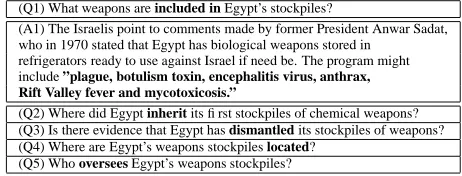
such “predicted” pairs of questions and answers in a database known as the Question Answer Database (or QUAB). FERRET uses this large set of topic-relevant question-and-answer pairs to improve the interaction with the user by suggesting new ques-tions. For example, when a user asks a question like (Q1) (as illustrated in Table 1), FERRETreturns an answer to the question (A1) and proposes (Q2), (Q3), and (Q4) as suggestions of possible continua-tions of the dialogue. Users then choose how to con-tinue the interaction by either (1) ignoring the sug-gestions made by the system and proposing a differ-ent question, or by (2) selecting one of the proposed questions and examining its answer.
Figure 1 illustrates the architecture of FERRET. The interactions are managed by a dialogue shell, which processes questions by transforming them into their corresponding predicate-argument struc-tures2.
The data collection used in our experiments was
2We have employed the same representation of
predicate-argument structures as those encoded in PropBank. We use a semantic parser (described in (Surdeanu et al., 2003)) that rec-ognizes predicate-argument structures.
(Q1) What weapons are included in Egypt’s stockpiles?
(A1) The Israelis point to comments made by former President Anwar Sadat, who in 1970 stated that Egypt has biological weapons stored in
refrigerators ready to use against Israel if need be. The program might include ”plague, botulism toxin, encephalitis virus, anthrax, Rift Valley fever and mycotoxicosis.”
(Q2) Where did Egypt inherit its first stockpiles of chemical weapons? (Q3) Is there evidence that Egypt has dismantled its stockpiles of weapons? (Q4) Where are Egypt’s weapons stockpiles located?
[image:2.612.310.541.208.296.2](Q5) Who oversees Egypt’s weapons stockpiles?
Table 1: User question and proposed questions from QUABs
made available by the Center for Non-Proliferation Studies (CNS)3.
Modules from the FERRET’s dialogue shell
inter-act with modules from the predictive dialogue block. Central to the predictive dialogue is the topic repre-sentation for each scenario, which enables the pop-ulation of a Predictive Dialogue Network (PDN). The PDN consists of a large set of questions that were asked or predicted for each topic. It is a net-work because questions are related by “similarity” links, which are computed by the Question Simi-larity module. The topic representation enables an Information Extraction module based on (Surdeanu and Harabagiu, 2002) to find topic-relevant infor-mation in the document collection and to use it as answers for the QUABs. The questions associated with each predicted answer are generated from pat-terns that are related to the extraction patpat-terns used for identifying topic relevant information. The qual-ity of the dialog between the user and FERRET de-pends on the quality of the topic representations and the coverage of the QUABs.
3The Center for Non-Proliferation Studies at the Monterrey
GENERAL BACKGROUND
1) Country Profile
3) Military Operations: Army, Navy, Air Force, Leaders, Capabilities, Intentions 4) Allies/Partners: Coalition Forces
5) Weapons: Chemical, Biological, Materials, Stockpiles, Facilities, Access, Research Efforts, Scientists 6) Citizens: Population, Growth Rate, Education
8) Economics: Growth Domestic Product, Growth Rate, Imports
9) Threat Perception: Border and Surrounding States, International, Terrorist Groups 10) Behaviour: Threats, Invasions, Sponsorship and Harboring of Bad Actors
13) Leadership:
7) Industrial: Major Industrires, Exports, Power Sources
14) Behaviour: Threats to use WMDs, Actual Usage, Sophistication of Attack, Anectodal or Simultaneous Serving as a background to the scenarios, the following list contains subject areas that may be relevant to the scenarios under examination, and it is provided to assist the analyst in generating questions.
2) Government: Type of, Leadership, Relations
SCENARIO: Assessment of Egypt’s Biological Weapons
As terrorist Activity in Egypt increases, the Commander of the United States Army believes a better understanding of Egypt’s Military capabilities is needed. Egypt’s biological weapons database needs to be updated to correspond with the Commander’s request. Focus your investigation on Egypt’s access to old technology, assistance received from the Soviet Union for development of their pharmaceutical infrastructure, production of toxins and BW agents, stockpiles, exportation of these materials and development technology to Middle Eastern countries, and the effect that this information will have on the United States and Coalition Forces in the Middle East. Please incorporate any other related information to your report.
11) Transportation Infrastructure: Kilometers of Road, Rail, Air Runways, Harbors and Ports, Rivers 12) Beliefs: Ideology, Goals, Intentions
15) Weapons: Chemical, Bilogical, Materials, Stockpiles, Facilities, Access
Figure 2: Example of a Dialogue Scenario.
3 Modeling the Dialogue Topic
Our experiments in interactive Q/A were based on several scenarios that were presented to us as part of the ARDA Metrics Challenge Dialogue Work-shop. Figure 2 illustrates one of these scenarios. It is to be noted that the general background consists of a list of subject areas, whereas the scenario is a narration in which several sub-topics are identified (e.g. production of toxins or exportation of
materi-als). The creation of scenarios for interactive Q/A
requires several different types of domain-specific knowledge and a level of operational expertise not available to most system developers. In addition to identifying a particular domain of interest, scenar-ios must specify the set of relevant actors, outcomes, and related topics that are expected to operate within the domain of interest, the salient associations that may exist between entities and events in the sce-nario, and the specific timeframe and location that bound the scenario in space and time. In addition, real-world scenarios also need to identify certain op-erational parameters as well, such as the identity of the scenario’s sponsor (i.e. the organization spon-soring the research) and audience (i.e. the organiza-tion receiving the informaorganiza-tion), as well as a series of
evidence conditions which specify how much
verifi-cation information must be subject to before it can be accepted as fact. We assume the set of sub-topics mentioned in the general background and the sce-nario can be used together to define a topic structure that will govern future interactions with the Q/A sys-tem. In order to model this structure, the topic rep-resentation that we create considers separate topic
signatures for each sub-topic.
The notion of topic signatures was first introduced in (Lin and Hovy, 2000). For each subtopic in a sce-nario, given (a) documents relevant to the sub-topic and (b) documents not relevant to the subtopic, a sta-tistical method based on the likelihood ratio is used to discover a weighted list of the most topic-specific concepts, known as the topic signature. Later work by (Harabagiu, 2004) demonstrated that topic sig-natures can be further enhanced by discovering the most relevant relations that exist between pairs of concepts. However, both of these types of topic rep-resentations are limited by the fact that they require the identification of topic-relevant documents prior to the discovery of the topic signatures. In our ex-periments, we were only presented with a set of doc-uments relevant to a particular scenario; no further relevance information was provided for individual subject areas or sub-topics.
In order to solve the problem of finding relevant documents for each subtopic, we considered four different approaches:
Approach 1: All documents in the CNS col-lection were initially clustered using K-Nearest Neighbor (KNN) clustering (Dudani, 1976). Each cluster that contained at least one key-word that described the sub-topic was deemed relevant to the topic.
then served as input to the KNN clustering al-gorithm described in Approach 1.
Approach 3: In this approach, relevant docu-ments were discovered simultaneously with the discovery of topic signatures. First, we asso-ciated a binary seed relation for each each
sub-topic
. (Seed relations were created both
by hand and using the method presented in (Harabagiu, 2004).) Since seed relations are by definition relevant to a particular subtopic, they can be used to determine a binary partition of the document collection into (1) a relevant
set of documents (that is, the documents
rel-evant to relation ) and (2) a set of non-relevant
documents -. Inspired by the method
pre-sented in (Yangarber et al., 2000), a topic sig-nature (as calculated by (Harabagiu, 2004)) is then produced for the set of documents in.
For each subtopic
defined as part of the
di-alogue scenario, documents relevant to a cor-responding seed relation are added to
iff
the relation meets the density criterion (as
defined in (Yangarber et al., 2000)). If rep-resents the set of documents where is
recog-nized, then the density criterion can be defined as:
. Once is added to
, then
a new topic signature is calculated for .
Rela-tions extracted from the new topic signature can then be used to determine a new document par-tition by re-iterating the discovery of the topic signature and of the documents relevant to each subtopic.
Approach 4: Approach 4 implements the tech-nique described in Approach 3, but operates at the level of discourse segments (or texttiles) rather than at the level of full documents. As with Approach 2, segments were produced us-ing the TextTilus-ing algorithm.
In modeling the dialogue scenarios, we consid-ered three types of topic-relevant relations: (1)
structural relations, which represent hypernymy
or meronymy relations between topic-relevant con-cepts, (2) definition relations, which uncover the characteristic properties of a concept, and (3)
ex-traction relations, which model the most relevant
events or states associated with a sub-topic.
Al-though structural relations and definition relations are discovered reliably using patterns available from our Q/A system (Harabagiu et al., 2003), we found only extraction relations to be useful in determining the set of documents relevant to a subtopic. Struc-tural relations were available from concept ontolo-gies implemented in the Q/A system. The definition relations were identified by patterns used for pro-cessing definition questions.
Extraction relations are discovered by processing documents in order to identify three types of rela-tions, including: (1) syntactic attachment relations (including subject-verb, object-verb, and verb-PP relations), (2) predicate-argument relations, and (3) salience-based relations that can be used to encode long-distance dependencies between topic-relevant concepts. (Salience-based relations are discovered using a technique first reported in (Harabagiu, 2004) which approximates a Centering Theory-style ap-proach (Kameyama, 1997) to the resolution of coreference.)
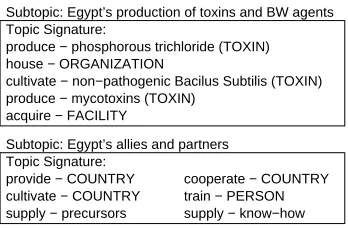
Subtopic: Egypt’s production of toxins and BW agents Topic Signature:
produce − phosphorous trichloride (TOXIN) house − ORGANIZATION
cultivate − non−pathogenic Bacilus Subtilis (TOXIN) produce − mycotoxins (TOXIN)
acquire − FACILITY
Subtopic: Egypt’s allies and partners Topic Signature:
provide − COUNTRY cultivate − COUNTRY supply − precursors
[image:4.612.337.511.348.462.2]cooperate − COUNTRY train − PERSON supply − know−how
Figure 3: Example of two topic signatures acquired for the scenario illustrated in Figure 2.
We made the extraction relations associated with each topic signature more general (a) by replacing words with their (morphological) root form (e.g.
wounded with wound, weapons with weapon), (b)
by replacing lexemes with their subsuming category from an ontology of 100,000 words (e.g. truck is re-placed byVEHICLE,ARTIFACT, orOBJECT), and (c) by replacing each name with its name class (Egypt
with COUNTRY). Figure 3 illustrates the topic
sig-natures resulting for the scenario illustrated in Fig-ure 2.
the score associated with each relation is given by: !
, where " #"
rep-resents the cardinality of the documents where the relation is identified, and !
represents sup-port associated with the relation .
!
is de-fined as the sum of the relevance of each document in : !
$ %'&)(
*,+
. The relevance
of a document that contains a topic-significant re-lation can be defined as: */+
.-0214365 (,7 143 8
9, where:
represents the topic signature of the subtopic4. The accuracy of the relation, then, is given by: 8
; < %'&)( */+>=@? .-A3 %CBEDF */+>=HG
.-9. Here, *,+
?
measures the
rel-evance of a subtopic
to a particular document
-, while */+ G
measures the relevance of
-to an-other subtopic,
B .
We use a different learner for each subtopic in or-der to train simultaneously on each iteration. (The calculation of topic signatures continues to iterate until there are no more relations that can be added to the overall topic signature.) When the precision of a relation to a subtopic
is computed, it takes
into account the negative evidence of its relevance to any other subtopic
JI
B . If
8
JKML ,
the relation is not included in the topic signature, where relations are ranked by the score
) N 8 + O ! 9.
Representing topics in terms of relevant concepts and relations is important for the processing of ques-tions asked within the context of a given topic. For interactive Q/A, however, the ideal topic-structured representation would be in the form of question-answer pairs (QUABs) that model the individual segments of the scenario. We have currently cre-ated two sets of QUABs: a handcrafted set and an automatically-generated set. For the manually-created set of QUABs, 4 linguists manually gener-ated 3210 question-answer pairs for each of the 8 dialogue scenarios considered in our experiments.
In a separate effort, we devised a process for au-tomatically populating the QUAB for each scenario. In order to generate question-answer pairs for each subtopic, we first identified relevant text passages in the document collection to serve as “answers” and then generated individual questions that could be
an-4Initially,
P Q contains only the seed relation. Additional relations can be added with each iteration.
swered by each answer passage.
R
Answer Identification: We defined an
an-swer passage as a contiguous sequence of sentences
with a positive answer rank and a passage price of K 4. To select answer passages for each
sub-topic
, we calculate an answer rank, SUTWV
SXY % ?
Z , that sums across the scores of each
relation from the topic signature that is identified in the same text window. Initially, the text window is set to one sentence. (If the sentence is part of a quote, however, the text window is immediately ex-panded to encompass the entire sentence that con-tains the quote.) Each passage withSUTWV
SX\[]L is
then considered to be a candidate answer passage. The text window of each candidate answer passage is then expanded to include the following sentence. If the answer rank does not increase with the addi-tion of the succeeding sentence, then the price (!
) of the candidate answer passage is incremented by 1, otherwise it is decremented by 1. The text window of each candidate answer passage continues to ex-pand until!
_^ . Before the ranked list of candidate
answers can be considered by the Question Genera-tion module, answer passages with a positive price!
are stripped of the last!
sentences.
ANSWER
In the early 1970s, Egyptian President Anwar Sadat validates that Egypt has a BW stockpile.
Predicate−Argument Structures P1: validate
arguments: A0 = E2: Answer Type: Definition A1 = P2: have
arguments: A0 = E3 A1 = E4 ArgM−TMP: E1: Answer Type: Time
P3: admit
Reference 4 (relational)
Egyptian President X
E5: BW program
Reference 2 (metonymic) Reference 3 (part−whole)
QUESTIONS
Definition Pattern: Who is X?
Q1: Who is Anwar Sadat?
Pattern: When did E3 P1 to P2 E4?
Q2: When did Egypt validate to having BW stockpiles?
Pattern: When did E3 P3 to P2 E4?
Q3: When did Egypt admit to having BW stockpiles?
Pattern: When did E3 P3 to P2 E5?
Q4: When did Egypt admint to having a BW program? E1: "in the early 1970s"; Category: TIME
E2: "Egyptian President Anwar Sadat"; Category: PERSON E3: "Egypt"; Category: COUNTRY
E4: "BW stockpile"; Category: UNKNOWN 4 entities
2 predicates: P1="validate"; P2="has"
PROCESSING
[image:5.612.318.534.395.591.2]Reference 1 (definitional)
Figure 4: Associating Questions with Answers.
R
Question Generation: In order to automati-cally generate questions from answer passages, we considered the following two problems:
is “interesting” enough to the scenario such that it deserves to be mentioned in a topic-relevant question. For example, Figure 4 illustrates an answer that includes two predicates and four entities. In this case, four types of reference are used to associate these linguistic objects with other related objects: (a) definitional reference, used to link entity (E1) “Anwar Sadat” to a cor-responding attribute “Egyptian President”, (b)
metonymic reference, since (E1) can be coerced
into (E2), (c) part-whole reference, since “BW
stockpiles”(E4) necessarily imply the existence
of a “BW program”(E5), and (d) relational
ref-erence, since validating is subsumed as part
of the meaning of declaring (as determined by WordNet glosses), while admitting can be de-fined in terms of declaring, as in declaring [to
be true].
ANSWER
Egyptian Deputy Minister Mahmud Salim states that Egypt’s
Egyptians have "adequate means of retaliating without delay". enemies would never use BW because they are aware that the
Predicates: P’1=state; P’2 = never use; P3 = be aware;
Causality:
P’2(BW) = NON−NEGATIVE RESULT(P5); P’5 = "obstacle" Reference: P’1 P’6 = view
QUESTIONS
Does Egypt view the possesion of BW as an obstacle? Does Egypt view the possesion of BW as a deterrent?
P’4 = have P"4 = "the possesion"
P"4 = "the possesion" = nominalization(P’4) = EFFECT(P’2(BW))
PROCESSING
specialization
Pattern: Does Egypt P’6 P"4(BW) as a P’5?
Figure 5: Questions for Implied Causal Relations. Problem 2: We have found that the identifica-tion of the associaidentifica-tion between a candidate an-swer and a question depends on (a) the recogni-tion of predicates and entities based on both the output of a named entity recognizer and a se-mantic parser (Surdeanu et al., 2003) and their structuring into predicate-argument frames, (b) the resolution of reference (addressed in Prob-lem 1), (c) the recognition of implicit rela-tions between predicarela-tions stated in the answer. Some of these implicit relations are referential, as is the relation between predicates
8
<
and
8
illustrated in Figure 4. A special case of im-plicit relations are the causal relations. Fig-ure 5 illustrates an answer where a causal re-lation exists and is marked by the cue phrase
because. Predicates – like those in Figure 5 –
can be phrasal (like
8
) or negative (like
8 ).
Causality is established between predicates8
and8
’ as they are the ones that ultimately
de-termine the selection of the answer. The predi-cate!
can be substituted by its nominalization since
O
<
of8
is BW, the same argument is
transferred to
8
. The causality implied by the answer from Figure 5 has two components: (1) the effect (i.e. the predicate8
) and (2) the re-sult, which eliminates the semantic effect of the negative polarity item never by implying the predicate!
, obstacle. The questions that are generated are based on question patterns asso-ciated with causal relations and therefore allow different degrees for the specificity of the resul-tative, i.e obstacle or deterrent.
We generated several questions for each answer passage. Questions were generated based on pat-terns that were acquired to model interrogations using relations between predicates and their argu-ments. Such interrogations are based on (1) as-sociations between the answer type (e.g. DATE) and the question stem (e.g. “when” and (2) the relation between predicates, question stem and the words that determine the answer type (Narayanan and Harabagiu, 2004). In order to obtain these predicate-argument patterns, we used 30% (approxi-mately 1500 questions) of the handcrafted question-answer pairs, selected at random from each of the 8 dialogue scenarios. As Figures 4 and 5 illustrate, we used patterns based on (a) embedded predicates and (b) causal or counterfactual predicates.
4 Managing Interactive Q/A Dialogues
similarities between predicates and arguments of the original question and the predicted questions.
The selection of the questions from the QUABs that are proposed for each user question is based on a similarity-metric that ranks the QUAB questions. To compute the similarity metric, we have experi-mented with seven different metrics. The first four metrics were introduced in (Lytinen and Tomuro, 2002).
Similarity Metric 1 is based on two process-ing steps:
(a) the content words of the questions are weighted using the
measure used in
In-formation Retrieval 1 Z9 & ?
, where is the number of
questions in the QUAB,
is the
num-ber of questions containing and is
the number of times appears in the
ques-tion. This allows the user question and any QUAB question to be transformed into two vectors, and "! ;
(b) the term vector similarity is used to compute the similarity between the user question and any question from the QUAB: #
%$ J % ? ? & 9 % ? (' % ?
Similarity Metric 2 is based on the percent of user question terms that appear in the QUAB question. It is obtained by finding the intersec-tion of the terms in the term vectors of the two questions.
Similarity Metric 3 is based on semantic in-formation available from WordNet. It involves: (a) finding the minimum path between Word-Net concepts. Given two terms
<
and ,
each with T and ) WordNet senses
< * < ,+.-and * < /
-. The se-mantic distance between the terms 0
<
is
defined by the minimum of all the possible pair-wise semantic distances between
< and : 0 < 13254 =? ( %76 G ( B , where B
is the path length between and B .
(b) the semantic similarity between the user question: 8 < +
and the QUAB question :9 ;:
< : :</
to be defined
as ,) : =
:>/ ? 6 CB ? 6 7 @ B 7 A , where D :E :>FN % E (,7HG < < BIKJLNM<OQP MR E 6 F
Similarity Metric 4 is based on the question type similarity. Instead of using the question class, determined by its stem, whenever we could recognize the answer type expected by the question, we used it for matching. As back-off only, we used a question type similarity based on a matrix akin to the one reported in (Lytinen and Tomuro, 2002)
Similarity Metric 5 is based on question con-cepts rather than question terms. In order to translate question terms into concepts, we re-placed (a) question stems (i.e. a WH-word + NP construction) with expected answer types (taken from the answer type hierarchy em-ployed by FERRET’s Q/A system) and (b)
named entities with corresponding their
corre-sponding classes. Remaining nouns and verbs were also replaced with their WordNet seman-tic classes, as well. Each concept was then as-sociated with a weight: concepts derived from named entities classes were weighted heavier than concepts from answer types, which were in turn weighted heavier than concepts taken from WordNet clases. Similarity was then com-puted across “matching” concepts.5The resul-tant similarity score was based on three vari-ables:
S
= sum of the weights of all concepts matched between a user query (T
) and a QUAB query (TVU);
W
= sum of the weights of all unmatched con-cepts inT
;
X
= sum of the weights of all unmatched con-cepts inTVU;
The similarity between T
and TYU was
calcu-lated as S 3 ! ' W 3 ! U ' X , where ! and !
U were used as coefficients to penalize the
con-tribution of unmatched concepts inT
and TVU
respectively.6
Similarity Metric 6 is based on the fact that the
5In the case of ambiguous nouns and verbs associated with
multiple WordNet classes, all possible classes for a term were considered in matching.
6We set
Z
@
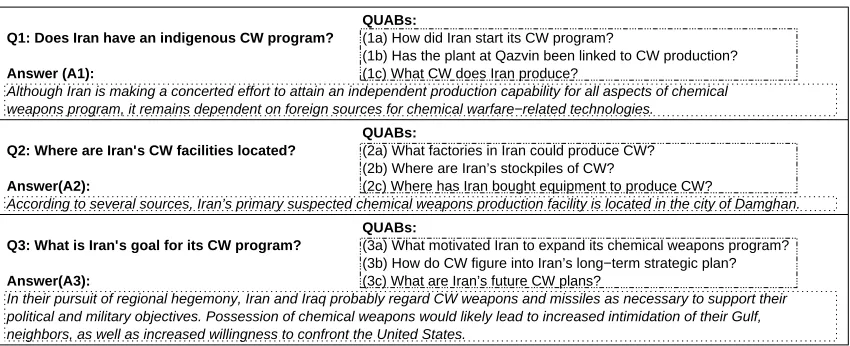
Q1: Does Iran have an indigenous CW program?
(1b) Has the plant at Qazvin been linked to CW production? (1c) What CW does Iran produce?
(1a) How did Iran start its CW program?
Q2: Where are Iran’s CW facilities located? (2a) What factories in Iran could produce CW? (2b) Where are Iran’s stockpiles of CW?
(2c) Where has Iran bought equipment to produce CW?
Q3: What is Iran’s goal for its CW program? (3a) What motivated Iran to expand its chemical weapons program? (3b) How do CW figure into Iran’s long−term strategic plan? (3c) What are Iran’s future CW plans?
QUABs:
QUABs:
QUABs:
Answer(A3): Answer(A2): Answer (A1):
Although Iran is making a concerted effort to attain an independent production capability for all aspects of chemical weapons program, it remains dependent on foreign sources for chemical warfare−related technologies.
According to several sources, Iran’s primary suspected chemical weapons production facility is located in the city of Damghan.
[image:8.612.96.521.52.225.2]In their pursuit of regional hegemony, Iran and Iraq probably regard CW weapons and missiles as necessary to support their political and military objectives. Possession of chemical weapons would likely lead to increased intimidation of their Gulf, neighbors, as well as increased willingness to confront the United States.
Figure 6: A sample interactive Q/A dialogue.
QUAB questions are clustered based on their mapping to a vector of important concepts in the QUAB.The clustering was done using the K-Nearest Neighbor (KNN) method (Dudani, 1976). Instead of measuring the similarity be-tween the user question and each question in the QUAB, similarities are computed only be-tween the user question and the centroid of each cluster.
Similarity Metric 7 was derived from the re-sults of Similarity Metrics 5 and 6 above. In this case, if the QUAB question (T U ) that was
deemed to be most similar to a user question (T
) under Similarity Metric 5 is contained in the cluster of QUAB questions deemed to be most similar to T
under Similarity Metric 6, then TVU receives a cluster adjustment score
in order to boost its ranking within its QUAB cluster. We calculate the cluster adjustment score as)
&B
TYU
)
1 3
99
)
, where
represents the difference
in rank between the centroid of the cluster and the previous rank of the QUAB questionT U .
In the currently-implemented version of FERRET, we used Similarity Metric 5 to automatically iden-tify the set of 10 QUAB questions that were most similar to a user’s question. These question-and-answer pairs were then returned to the user – along with answers from FERRET’s automatic Q/A system – as potential continuations of the Q/A dialogue. We used the remaining 6 similarity metrics described in
this section to manually assess the impact of simi-larity on a Q/A dialogue.
5 Experiments with Interactive Q/A
Dialogues
To date, we have used FERRET to produce over 90 Q/A dialogues with human users. Figure 6 illustrates three turns from a real dialogue from a human user investigating Iran’s chemical weapons prorgram. As it can be seen coherence can be established between the user’s questions and the system’s answers (e.g. Q3 is related to both A1 and A3) as well as between the QUABs and the user’s follow-up questions (e.g. QUAB (1b) is more related to Q2 than either Q1 or A1). Coherence alone is not sufficient to analyze the quality of interactions, however.
research; in E1 and E3, users prepared a short report detailing their findings; in E2, users were given a list of “challenge” questions to answer.
Exp Users QUABs? Scenarios Topics
E1 8 Yes 8 Egypt BW, Russia CW, South
Africa CW, India CW, North Korea CBW, Pakistan CW, Libya CW, Iran CW
E2 24 Yes 2 Egypt BW, Russia CW
E3 4 No 6 Egypt BW, Russia CW, North
[image:9.612.317.533.52.218.2]Korea CBW, Pakistan CW India CW, Libya CW, Iran CW
Table 2: Experiment details
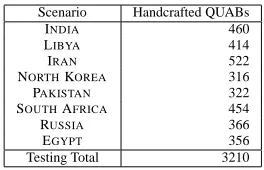
In E1 and E2, users had access to a total of 3210 QUAB questions that had been hand-created by de-velopers for each the 8 dialogue scenarios. (Table 3 provides totals for each scenario.) In E3, users per-formed research with a version of FERRET that in-cluded no QUABs at all.
Scenario Handcrafted QUABs
INDIA 460
LIBYA 414
IRAN 522
NORTHKOREA 316
PAKISTAN 322 SOUTHAFRICA 454
RUSSIA 366
EGYPT 356
[image:9.612.74.301.107.185.2]Testing Total 3210
Table 3: QUAB distribution over scenarios
We have evaluated FERRET by measuring
effi-ciency, effectiveness, and user satisfaction:
Efficiency FERRET’s QUAB collection enabled
users in our experiments to find more relevant infor-mation by asking fewer questions. When manually-created QUABs were available (E1 and E2), users submitted an average of 12.25 questions each ses-sion. When no QUABs were available (E3), users entered a total of 44.5 questions per session. Table 4 lists the number of QUAB question-answer pairs se-lected by users and the number of user questions en-tered by users during the 8 scenarios considered in E1. In E2, freed from the task of writing a research report, users asked significantly (p 0.05) fewer questions and selected fewer QUABs than they did in E1. (See Table 5).
Effectiveness QUAB question-answer pairs also improved the overall accuracy of the answers re-turned by FERRET. To measure the effectiveness of
a Q/A dialogue, human annotators were used to per-form a post-hoc analysis of how relevant the QUAB pairs returned by FERRET were to each question
Country n QUAB User Q Total
(avg.) (avg.) (avg.)
India 2 21.5 13.0 34.5
Libya 2 12.0 9.0 21.0
Iran 2 18.5 11.0 29.5
N.Korea 2 16.5 7.5 34.0
Pakistan 2 29.5 15.5 45.0
S.Africa 2 14.5 6.0 20.5
Russia 2 13.5 15.5 29.0
Egypt 2 15.0 20.5 35.5
TOTAL(E1) 16 17.63 12.25 29.88
Table 4: Efficiency of Dialogues in Experiment 1
Country n QUAB User Q Total
(avg.) (avg.) (avg.)
Russia 24 8.2 5.5 13.7
Egypt 24 10.8 7.6 18.4
TOTAL(E2) 48 9.50 6.55 16.05
Table 5: Efficiency of Dialogues in Experiment 2
entered by a user: each QUAB pair returned was graded as “relevant” or “irrelevant” to a user ques-tion in a forced-choice task. Aggregate relevance scores were used to calculate (1) the percentage of relevant QUAB pairs returned and (2) the mean re-ciprocal rank (MRR) for each user question. MRR is defined as <
+
%
F
<
<
?
, whree is the lowest rank of
any relevant answer for the
user query7. Table 6 describes the performance of FERRETwhen each of the 7 similarity measures presented in Section 4 are used to return QUAB pairs in response to a query. When only answers from FERRET’s automatic Q/A system were available to users, only 15.7% of sys-tem responses were deemed to be relevant to a user’s query. In contrast, when manually-generated QUAB pairs were introduced, as high as 84% of the sys-tem’s responses were deemed to be relevant. The results listed in Table 6 show that the best metric is Similarity Metric 5. Thse results suggest that the selection of relevant questions depends on sophis-ticated similarity measures that rely on conceptual hierarchies and semantic recognizers.
We evaluated the quality of each of the four sets of automatically-generated QUABs in a sim-ilar fashion. For each question submitted by a user in E1, E2, and E3, we collected the top 5 QUAB question-answer pairs (as determined by Similarity Metric 5) that FERRET returned. As with the manually-generated QUABs, the
automatically-7
[image:9.612.119.251.298.383.2]% of Top 5 Responses % of Top 1 Responses MRR Relevant to User Q Relevant to User Q
Without QUAB 15.73% 26.85% 0.325
Similarity 1 82.61% 60.63% 0.703
Similarity 2 79.95% 58.45% 0.681
Similarity 3 79.47% 56.04% 0.664
Similarity 4 78.26% 46.14% 0.592
Similarity 5 84.06% 68.36% 0.753
Similarity 6 81.64% 56.04% 0.671
[image:10.612.71.303.53.140.2]Similarity 7 84.54% 64.01% 0.730
Table 6: Effectiveness of dialogs
generated pairs were submitted to human assessors who annotated each as “relevant” or irrelevant to the user’s query. Aggregate scores are presented in Ta-ble 7.
Egypt Russia
Approach % of Top 5 % of Top 5
Responses Rel. MRR Responses Rel. MRR
to User Q to User Q
Approach 1 40.01% 0.295 60.25% 0.310
Approach 2 36.00% 0.243 72.00% 0.475
Approach 3 44.62% 0.271 60.00% 0.297
[image:10.612.79.293.234.302.2]Approach 4 68.05% 0.510 68.00% 0.406
Table 7: Quality of QUABs acquired automatically
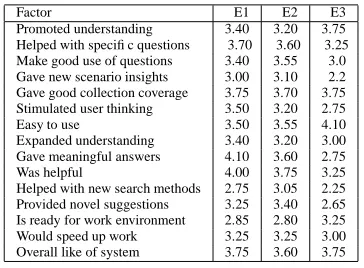
User Satisfaction Users were consistently satis-fied with their interactions with FERRET. In all three experiments, respondents claimed that they found that FERRET(1) gave meaningful answers, (2) pro-vided useful suggestions, (3) helped answer spe-cific questions, and (4) promoted their general un-derstanding of the issues considered in the scenario. Complete results of this study are presented in Ta-ble 88.
Factor E1 E2 E3
Promoted understanding 3.40 3.20 3.75
Helped with specific questions 3.70 3.60 3.25
Make good use of questions 3.40 3.55 3.0
Gave new scenario insights 3.00 3.10 2.2
Gave good collection coverage 3.75 3.70 3.75
Stimulated user thinking 3.50 3.20 2.75
Easy to use 3.50 3.55 4.10
Expanded understanding 3.40 3.20 3.00
Gave meaningful answers 4.10 3.60 2.75
Was helpful 4.00 3.75 3.25
Helped with new search methods 2.75 3.05 2.25
Provided novel suggestions 3.25 3.40 2.65
Is ready for work environment 2.85 2.80 3.25
Would speed up work 3.25 3.25 3.00
Overall like of system 3.75 3.60 3.75
Table 8: User Satisfaction Survey Results
6 Conclusions
We believe that the quality of Q/A interactions de-pends on the modeling of scenario topics. An ideal model is provided by question-answer databases (QUABs) that are created off-line and then used to
8Evaluation scale: 1-does not describe the system,
5-completely describes the system
make suggestions to a user of potential relevant con-tinuations of a discourse. In this paper, we have presented FERRET, an interactive Q/A system which
makes use of a novel Q/A architecture that integrates QUAB question-answer pairs into the processing of questions. Experiments with FERRET have shown
that, in addition to being rapidly adopted by users as valid suggestions, the incorporation of QUABs into Q/A can greatly improve the overall accuracy of an interactive Q/A dialogue.
References
S. Dudani. 1976. The distance-weighted k-nearest-neighbour rule. IEEE Transactions on Systems, Man, and Cybernetics, SMC-6(4):325–327.
S. Harabagiu, D. Moldovan, C. Clark, M. Bowden, J. Williams, and J. Bensley. 2003. Answer Mining by Combining Ex-traction Techniques with Abductive Reasoning. In
Proceed-ings of the Twelfth Text Retrieval Conference (TREC 2003).
Sanda Harabagiu. 2004. Incremental Topic Representations. In Proceedings of the 20th COLING Conference, Geneva, Switzerland.
Marti Hearst. 1994. Multi-Paragraph Segmentation of Exposi-tory Text. In Proceedings of the 32nd Meeting of the
Associ-ation for ComputAssoci-ational Linguistics, pages 9–16.
Megumi Kameyama. 1997. Recognizing Referential Links: An Information Extraction Perspective. In Workshop of
Opera-tional Factors in Practical, Robust Anaphora Resolution for Unrestricted Texts, (ACL-97/EACL-97), pages 46–53.
Chin-Yew Lin and Eduard Hovy. 2000. The Automated Acqui-sition of Topic Signatures for Text Summarization. In
Pro-ceedings of the 18th COLING Conference, pages 495–501.
S. Lytinen and N. Tomuro. 2002. The Use of Question Types to Match Questions in FAQFinder. In Papers from the 2002
AAAI Spring Symposium on Mining Answers from Texts and Knowledge Bases, pages 46–53.
Srini Narayanan and Sanda Harabagiu. 2004. Question An-swering Based on Semantic Structures. In Proceedings of
the 20th COLING Conference, Geneva, Switzerland.
Mihai Surdeanu and Sanda M. Harabagiu. 2002. Infratructure for open-domanin information extraction. In Conference for
Human Language Technology (HLT-2002).
Mihai Surdeanu, Sanda M. Harabagiu, John Williams, and Paul Aarseth. 2003. Using predicate-argument structures for in-formation extraction. In ACL, pages 8–15.
Roman Yangarber, Ralph Grishman, Pasi Tapanainen, and Silja Huttunen. 2000. Automatic Acquisition of Domain Knowl-edge for Information Extraction. In Proceedings of the 18th
COLING Conference, pages 940–946.
Roman Yangarber. 2003. Counter-Training in Discovery of Semantic Patterns. In Proceedings of the 41th Meeting of the
[image:10.612.94.276.444.578.2]