Effect of Modified Whey Proteins on Texture
and Sensory Quality of Processed Cheese
Miroslava MIHULOVÁ
1, Marta VEJLUPKOVÁ
1, Jana HANUŠOVÁ
1,
Jiří ŠTĚTINA
1and Zdeňka PANOVSKÁ
21Department of Dairy, Fat and Cosmetics and 1Department of Food Analysis
and Nutrition, Faculty of Food and Biochemical Technology, Institute of Chemical Technology Prague, Prague, Czech Republic
Abstract
Mihulová M., Vejlupková M., Hanušová J., Štětina J., Panovská Z. (2013): Effect of modified whey proteins on texture and sensory quality of processed cheese. Czech J. Food Sci., 31: 553–558.
One of the possibilities to enhance nutritional benefits of processed cheese is the incorporation of whey proteins. However, it is necessary to characterise the effect of their addition on its texture, rheology, and sensory quality. Pro-cessed cheese was manufactured from Edam cheese, low-fat fresh cheese, emulsifying salts, and water phase (drinking water, non-modified and modified reconstituted whey). Modification of whey was performed by enzymatic protein hydrolysis and additional removal of hydrophobic peptides. The texture of products was characterised by texture profile analysis, rheology by dynamic oscillation rheometry, and sensory quality by descriptive quantitative analysis. The effect of whey protein addition on the texture and rheology of cheese was dependent on protein concentration and modification. Native whey concentration in comparison with water decreased hardness and chewiness and enhanced adhesiveness of samples. Higher concentration increased hardness and chewiness and lowered adhesiveness. Modi-fied whey compared to the native one produced softer and better chewable products. However, the sensory analysis of products did not demonstrate any differences in their hedonic quality.
Keywords: cheesemaking; flavour; rheology; TPA; whey protein hydrolysate
Whey is a by-product from cheese manufacture. It contains nutritionally valuable proteins with es-sential amino acids. Nevertheless, β-lactoglobulin, the main whey protein, is one of the food aller-gens. This problem could be solved by separation of β-lactoglobulin or partial hydrolysis of the pro-tein mixture. The reduction of β-lactoglobulin al-lergenicity by hydrolysis, especially the enzymatic one, in comparison with its separation from the protein mixture provides some advantages. Partial hydrolysis of whey proteins modified their functional properties, nutritional value and sensory parameters (Adler-Nissen 1986; Doyen et al. 2013). Whey protein hydrolysate (WPH) could be better soluble,
thermostable, and resistant to coalescence and they could have better emulsifying and foaming activity (Euston et al. 2001; Perez et al. 2012). Moreover, the enzyme hydrolysis could generate some biologically active peptides, for example with ACE inhibitory, antihypertension or prebiotic function (Sodini et al. 2005; Pan et al. 2012; Wang et al. 2012). For these reasons WPH is a worthwhile functional food ingredient. However, its usability in the food industry is limited by a bitter taste, which is probably linked with the generation of hydrophobic peptides (Cle-mente 2000; Welderufael et al. 2012).
Processed cheese is traditionally made from ren-net cheese, butter, processed cheese, emulsifying
salts, drinking water, and flavouring non-dairy ingredients (dyes, spices, vegetables and meat). Nowadays manufacturers also use other dairy ingredients, such as milk, cream, whey, butter-milk, butterfat, casein, caseinates, whey proteins, and non-dairy hydrocolloids. For the production of processed cheese analogues other non-dairy ingredients could be used as well, for example vegetable oil and non-dairy proteins (Caric & Kaláb 1997). Processed cheeses and their ana-logues have become widely popular because of their easy to use and long-keeping. They are a considerable source of proteins and calcium in Central Europe, especially in the Czech Republic. These products are primarily consumed as a spread in the Czech Republic but they could be also used to prepare pasta sauces, burgers, pizzas, toasts, baguettes and salads (Czech and Moravian Dairy Association 2009; Ministry of Agriculture of the Czech Republic 2009). For these reasons there is an effort to modify and enhance the nutritional value of processed cheese and develop functional food which will comply with current nutritional requirements. The use of WPH in processed cheese manufacture could provide a product with bet-ter functional properties and with the content of biologically active peptides (Adler-Nissen 1986; Doyen et al. 2013). Thus, this work is focused on the application of WPH in the processed cheese manufacture and characterisation of its effect on texture and rheological properties and sensory quality of the products.
MATERIAL AND METHODS
WPH preparation. Whey powder (Moravia Lac-to, a.s., Jihlava, Czech Republic) was reconstituted in demineralised water to obtained dry matter (DM) content of 7, 14, and 21% wt which corresponded to the protein content of 0.93, 1.55, and 2.39% wt, respectively (ISO 8968-3). The hydrolysis of whey proteins was carried out in a batch reactor using a Bacillus licheniformis protease mixture Promod 439L (Biocatalysts Ltd., Parc Nantgarw, UK) with enzyme activity of 161 CU/g. The hydrolysis pro-cess was performed using the following conditions: enzyme/protein ratio 1/100.6, pH 8.0, 40°C, 3 hours. The enzyme mixture was inactivated by heating to 85°C for 15 minutes. The hydrolysis degree (DH) was assessed by OPA method (Adler-Nissen 1986) to 16.7% DH. Bitter taste of WPH was verified by
sensory analysis (unpublished data). For this reason hydrophobic peptides were removed from the half of the product by adsorption on activated carbon Norit CG1 (Norit Activated Carbon, Amersfoort, the Netherland). The adsorption process was per-formed using the following conditions: activated carbon/WPH ratio 1/333.3, 21°C, 90 minutes. The activated carbon was removed by centrifuga-tion (Universal 320R; Andreas Hettich GmbH & Co. KG, Tuttlingen, Germany) at 9000 rpm, 4°C, 30 minutes. The protein content decreased after the removal of hydrophobic peptides by 0.05% wt, the hydrolysis degree by 3.2% DH. The absence of bitterness was confirmed by sensory analysis (unpublished data).
Processed cheese manufacture. Processed cheese [DM 38% wt, fat in dry matter (FDM) 31% wt, pH 5.8] was prepared from Edam cheese (DM 57% wt, FDM 45% wt; Moravia Lacto, a.s., Jihlava, Czech Republic), low-fat fresh cheese (DM 18% wt, FDM 0.5% wt; Laktos, a.s., Czech Republic), emulsifying salts (BK Giulini GmbH, Ladenburg, Germany) and water phase [drinking water (DW), reconstituted whey (W), WPH, debittered WPH (dWPH)]. Emulsifying salts constituted 3% wt of the formula, Joha® S9 spezial (mixture of sodium poly- and pyrophosphates) 2.8% wt and Joha® T-Neu 0.2% wt. The processed cheese manufacture was carried out by batch melting of the starting mixture using a universal cutting machine UM-5 Universal (Stephan & Söhne GmbH & Co., Hameln, Ger-many). The melting process was performed under partial vacuum (20–80 mbar) with indirect heating (to 95°C) and constant stirring (1500 rpm). Holding time was 5 min at 95°C. Obtained products were stored at 5°C. For each water phase were carried out four manufactures. Texture and rheological properties of processed cheese were determined after 7 days of storage. Materials and products were characterised by the content of DM (ISO 5534), FDM (ISO 3433), and proteins (ISO 8968-3).
shear rate dependence on increasing shear stress (100–60 000 Pa at 600 s).
Hardness, adhesiveness and chewiness of samples were characterised by a TA.XT.plus Texture Analyser (Stable Micro Systems Ltd., Survey, UK) according to the method developed by Bourne & Szczesniak (2003). Measurement was performed three times for each manufacture.
Descriptive quantitative analysis. Sensory attributes spreadability, stickiness on the knife and flavour (smell and taste) were characterised by descriptive quantitative analysis with ordi-nal seven-point scale (ISO 11035). The sensory panel consisted of ten professional assessors (aged 25–60). The scales which were used for sensory assessment are displayed in Table 1.
Statistical analysis. Statistical analyses were performed using the Microsoft Excel 2003 software (Microsoft Office Excel 2003; Microsoft Corpora-tion, Redmind, USA). Data obtained from texture and rheological measurements were evaluated by
ANOVA F-test with foregoing removal of outli-ers using Grubbs’ test on the level of significance
P (α) = 0.05. Data from sensory analysis were evaluated using the ANOVA Kruskall-Wallis test on P (α) = 0.05 (Vorlíček et al. 1984).
RESULTS AND DISCUSSION
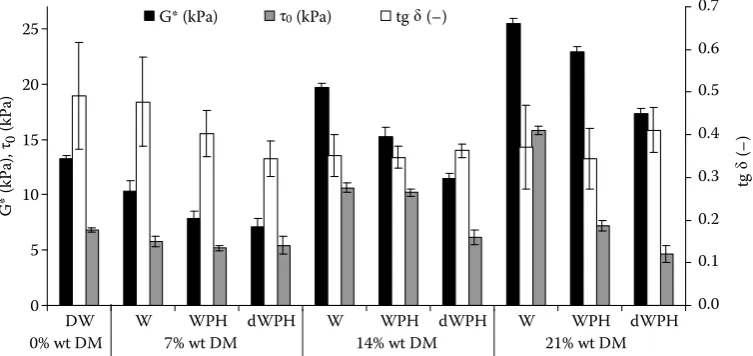
The influence of different water phase addition on rheological and texture properties of processed cheese is shown in Figures 1 and 2.
[image:3.595.63.533.100.217.2]It was observed that the replacement of drinking water with whey at native concentration (DM 7% wt) lowered the shear complex modulus (equiva-lent to texture property hardness), phase shift (P > 0.05) and yield stress of the samples. TPA confirmed the results and recorded a decline in hardness and chewiness and an increase in ad-hesiveness. These changes could be due to the presence of whey proteins and especially lactose Table 1. The ordinal scales for characterisation of processed cheese sensory quality
Point Spreadability Stickiness on the knife Flavour
1 non-spreadable non-sticky extremely dislike
2 practically non-spreadable practically non-sticky very much dislike
3 slightly spreadable tracy sticky slightly dislike
4 easily spreadable slightly sticky like nor dislike
5 slightly runny moderately sticky slightly like
6 very runny very sticky very much like
7 extremely runny extremely sticky extremely like
Figure 1. Rheological properties of processed cheese with different water phases, DW (drinking water), reconstituted whey (W), whey protein hydrolysate (WPH), debittered WPH (dWPH). Results are expressed as the arithmetic mean
of four parallel manufactures. Error bars indicate the confidence interval (P ≤ 0.05)
0 5 10 15 20 25
DW W WPH dWPH W WPH dWPH W WPH dWPH
G
* (
kP
a)
,
τ (k0
Pa
)
0.0 0.1 0.2 0.3 0.4 0.5 0.6 0.7
tg
δ (–
)
G* (kPa) τ0 (kPa) tg δ (–)
[image:3.595.129.506.531.709.2]which disturbed the compact and continuous casein matrix (Caric & Kaláb 1997). On the contrary, an increase of whey DM content had the opposite effect. This could be explained by enhancement of protein content which allowed more protein-protein interactions and formed the firmer protein network (Dimitreli & Thomareis 2007). The addition of WPH in comparison with the addition of whey caused a decrease of the shear complex modulus, phase shift and yield stress of the processed cheese but the decline in yield stress was statistically insignificant (P > 0.05) for whey and modified whey with DM content of
[image:4.595.141.468.86.285.2]7% wt. The lowering of hardness and chewiness was confirmed by recorded rheological results. The observed trend could be due to the degradation of whey proteins during the enzyme hydrolysis and generation of peptides with lower molecular weight which hindered the formation of compact processed cheese matrix, declined its firmness because of weaker protein-protein interactions, or had better emulsifying properties (Euston et al. 2001; Dimitreli & Thomareis 2007). The deepening of this trend by using dWPH could be explained by a decrease of amino compounds and so fewer protein-protein interactions (Dimitreli Figure 2. Texture properties of processed cheese with different water phases, drinking water (DW), reconstituted whey (W), whey protein hydrolysate (WPH), debittered WPH (dWPH). Results are expressed as the arithmetic mean
of four parallel manufactures. Error bars indicate the confidence interval (P ≤ 0.05)
1 – 2 – 3 – 4 – 5 – 6 – 7 –
DW W WPH dWPH W WPH dWPH W WPH dWPH
0% wt DM 7% wt DM 14% wt DM 21% wt DM
extremely
non-sticky practically tracy sticky slightly sticky moderate very sticky
good spreadable extremely runny
very runny
slightly runny
non-spreadable practically non-spreadable slightly spreadable
– 1 – 2 – 3 – 4 – 5 – 6 – 7
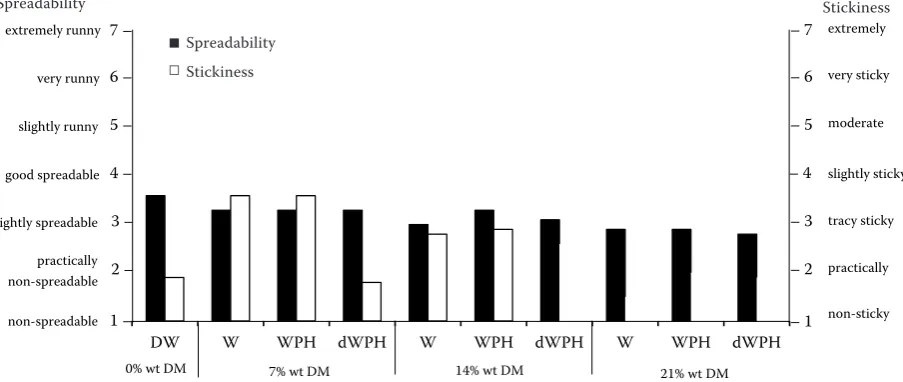
Figure 3. Spreadability and stickiness on the knife of processed cheese with different water phases, drinking water (DW), reconstituted whey (W), whey protein hydrolysate (WPH), and debittered WPH (dWPH). Results are expressed as arith-metic mean of ten assessors
0 10 20 30 40 50 60
DW W WPH dWPH W WPH dWPH W WPH dWPH
Hardness (N) Adhesiveness (N s) Chewiness (–)
0% wt DM 7% wt DM 14% wt DM 21% wt DM
Spreadability Stickiness
□Stickiness
[image:4.595.74.526.524.715.2]& Thomareis 2007). There was not recorded any definite influence of whey protein hydrolysis on the adhesiveness of samples.
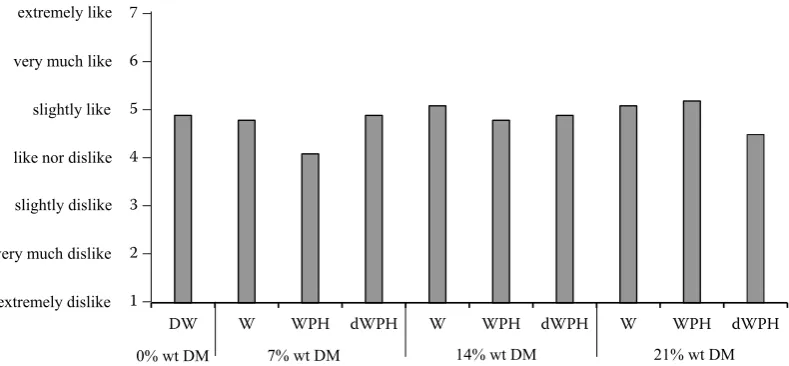
The influence of different water phase addition on evaluated sensory characteristics of processed cheese is shown in Figures 3 and 4.
Samples were rated as slightly spreadable, prac-tically non- to tracy sticky and slightly like. No statistically significant difference (P > 0.05) was recorded between them in spreadability and flavour. Thus, based on the results of flavour assessment, the removal of hydrophobic peptides with bitter taste from WPH could be omitted for the processed cheese manufacture. This would be beneficial not only to the maintenance of the nutritional value (essential amino acids and potentially biologically active peptides) of the material but also from the economic aspect (Clemente 2000; Sodini
et al. 2005; Pan et al. 2012; Wang et al. 2012). Therefore, the following work will be focused on the characterisation of generated peptides and demonstration of their biological activity.
CONCLUSIONS
The effect of whey protein addition and their enzymatic hydrolysis on rheology, texture, and sen-sory quality of processed cheese was investigated. It was observed that whey at native concentration in comparison with drinking water decreased the shear complex modulus, yield stress, phase shift, hardness and chewiness, and increased the
adhesiveness of products. An opposite trend was recorded for the enhancement of whey concen-tration. The replacement of whey with WPH and dWPH lowered the shear complex modulus, yield stress, phase shift, hardness and chewiness of the samples. No difference (P > 0.05) was observed in the flavour of processed cheese, so the removal of bitter peptides with potential biological activity could be omitted for this product.
References
Adler-Nissen J. (1986): Enzymatic Hydrolysis of Food Proteins. Elsevier Applied Science Publishers, London: 116–124.
Bourne M.C., Szczesniak A.S. (2003): Sensory Evalua-tion/Texture in Encyclopedia of Food Sciences and Nu-trition. New York State Agricultural Experiment Station, Cornell University, New York: 5167–5174.
Caric M., Kaláb M. (1997): Processed cheese products. Chemistry, Physics and Microbiology, 2: 467–505. Clemente A. (2000): Enzymatic protein hydrolysate in human
nutrition. Trends Food Science Technology, 11: 254–262. Czech and Moravian Dairy Association (2009): Dairy
Pro-duction in the Czech Republic 2008. Praha. Available at http://www.cmsm.cz/stale_informace.html
Dimitreli G., Thomareis A.S. (2007): Texture evaluation of block-type processed cheese as a function of chemi-cal composition and in relation to its apparent viscosity. Journal of Food Engineering, 79: 1364–1373.
Doyen A., Husson E., Bazinet L. (2013): Use of an elec-trodialytic reactor for the simultaneous β-lactoglobulin 1 –
2 – 3 – 4 – 5 – 6 – 7 –
DW W WPH dWPH W WPH dWPH W WPH dWPH
0% wt DM 7% wt DM 14% wt DM 21% wt DM
like nor dislike extremely like
very much like
slightly like
[image:5.595.98.493.84.267.2]extremely dislike very much dislike slightly dislike
enzymatic hydrolysis and fractionation of generated bio-active peptides. Food Chemistry, 136: 1193–1202. Euston S.R., Finnigan S.R., Hirst R.L. (2001):
Heat-induced destabilization of oil-in-water emulsions formed from hydrolyzed whey protein. Journal of Agricultural and Food Chemistry, 49: 5576–5583.
ISO 11035 (1994): Sensory analysis – Identification and Selection of Descriptors for Establishing a Sensory Profile by a Multidimensional Approach. International Organisa-tion for StandardisaOrganisa-tion, Geneva.
ISO 3433 (2008): Cheese – Determination of fat content – Van Gulik method. International Organisation for Stand-ardisation, Geneva.
ISO 5534 (2004): Cheese and Processed Cheese – Determi-nation of the Total Solids Content (Reference Method). International Organisation for Standardisation, Geneva. ISO 8968-3 (2004): Milk – Determination of Nitrogen
Content – Part 3: Block-digestion Method. International Organisation for Standardisation, Geneva.
Ministry of Agriculture of the Czech Republic (2009): Pano- rama potravinářského průmyslu. Praha. Available at http:// eagri.cz/public/web/mze/ ministerstvo-zemedelstvi/vyroc- ni-a-hodnotici-zpravy/panorama-potravinarskeho-prumys-lu/panorama-potravinarskeho-prumyslu-2009.html Pan D., Cao J., Guo H., Zhao B. (2012): Studies on
pu-rification and the molecular mechanism of a novel ACE
Corresponding author:
Miroslava Mihulová, MSc, Vysoká škola chemicko-technologická v Praze, Fakulta potravinářské a biochemické technologie, Ústav mléka, tuků a kosmetiky, Technická 5, 166 28 Praha 6, Česká republika;
E-mail: [email protected]
inhibitory peptide from whey protein hydrolysate. Food Chemistry, 130: 121–126.
Perez A.A., Carrera Sánchez C., Rodríguez Patino J.M., Rubiolo A.C., Santiago L.G. (2012): Foaming characteristics of β-lactoglobulin as affected by enzymatic hydrolysis and polysaccharide addition: Relationships with the bulk and interfacial properties. Journal of Food Engineering, 113: 53–60.
Sodini I., Lucas A., Tissier J.P., Corrieu G. (2005): Physi-cal properties and microstructure of yoghurts supple-mented with milk protein hydrolysates. International Dairy Journal, 15: 29–35.
Vorlíček M., Holický M., Špačková M. (1984): Pravdě- podobnost a matematická statistika pro inženýry. České vysoké učení technické v Praze, Praha: 195–202, 208–210. Wang X., Wang L., Cheng X., Zhou J., Tang X., Mao
X.-Y. (2012): Hypertension-attenuating effect of whey protein hydrolysate on spontaneously hypertensive rats. Food Chemistry, 134: 122–126.
Welderufael F.T., Gibson T., Methven L., Jauregi P. (2012): Chemical characterisation and determination of sensory attributes of hydrolysates produced by enzymatic hydrolysis of whey proteins following a novel integrative process. Food Chemistry, 134: 1947–1958