Munich Personal RePEc Archive
Credit Growth Volatility
Oduncu, Arif and Ermişoğlu, Ergun and Polat, Tandogan
Central Bank of the Republic of Turkey
August 2013
1
Credit Growth Volatility
Arif Oduncu Ergun Ermişoğlu Tandoğan Polat
Abstract
The Central Bank of the Republic of Turkey has started to implement its new policy mix since late 2010. In this new approach expectations, credit growth and reel exchange rate are monitored closely as key indicators for financial stability on top of price stability. The effect of this new monetary policy framework on the volatility of credit growth is the main theme of this note. To the best of our knowledge, we are the first to analyze the impact of new policy mix on the credit growth volatility. It is shown that there is a significant decrease in the volatility of credit growth after the introduction of new policy framework at late 2010. Therefore, it can be said that this new monetary policy framework contributes to financial stability in Turkey by lessening the credit growth volatility.
Keywords: Volatility, Credit growth, Central banking, CBRT’s new policy mix,
Financial Stability;
JEL classification: C22, E52, E58
2
1
Introduction
Before the 2008 global financial crisis, the inflation targeting (IT) regimes had
become the mainstream approach of central banks across the globe. IT exclusively
focuses on price stability while financial stability is mostly faded into the background,
and sometimes completely ignored. However, the global crisis in 2008-2009 proved
the inefficiency of this approach and signified the need to observe financial stability
along price stability (Borio, 2011). To that extent, it was well understood that a policy
rate that yields price stability may not necessarily provide financial stability.
Therefore, IT has been started to be questioned among academicians and policy
makers.
Accordingly, the Central Bank of the Republic of Turkey (CBRT) has started to
implement its new policy mix since late 2010. This new approach is alternatively
named IT++1 in which credit growth and reel exchange rate are monitored closely as
key indicators for financial stability on top of price stability (First plus stands for
credit growth and the second one stands for reel exchange rate). Governor Başçı
stated the reference point of 120 for real exchange rate and of 15% for annual credit
growth for the year 2013. Moreover, Başçı stated that decreasing credit growth
volatility and FX volatility is important to maintain price and financial stability (Başçı,
2013). In this economic note, we will study the effects of new policy framework on
the volatility of credit growth. To the best of our knowledge, it is the first analytical
paper on investigating the impact of new policy mix on the credit growth volatility.
3
2
Literature about New Policy Mix
After the 2008 global financial crisis, central banks of advanced economies
have created abundant liquidity by monetary expansions in order to lift up the
economy from their ravaged states. This abundant liquidity has increased the
volatility of short-term capital flows that have adverse effects on the credit growth
volatility and FX volatility in emerging markets. In order to reduce the adverse
consequences of excessive capital flow volatility, CBRT has designed and launched its
new monetary policy framework. In this framework, interest rate corridor, liquidity
funding strategy and required reserves are jointly used to maintain price stability and
to contribute to financial stability2. The effects of this new framework have been
examined in a few studies. For example, Alper et al. (2012) show that required
reserves ratio policy of CBRT is an important determinant of bank lending in Turkey.
Akçelik et. al (2012) conclude that additional monetary tightening, a new liquidity
policy tool of CBRT, has a significant role in reducing volatility in the exchange rate. It
is also shown that during the days of additional monetary tightening Turkish Lira (TL)
appreciated against the emerging market currencies. Oduncu et al. (2013) study the
effectiveness of Reserve Options Mechanism (ROM)3, which is the option to hold FX
or gold reserves in increasing tranches in place of Turkish Lira reserve requirements
of Turkish banks, on the volatility of TL. They claim that ROM, the unique tool that is
designed and launched by CBRT, is an effective policy tool in decreasing the volatility
of Turkish lira. Binici et al. (2013) focus on the interaction of asymmetric interest rate
corridor with the credit-deposit spread reflexing banks’ appetite for lending. They
2
For details of this new framework, see Başçı and Kara (2011), Kara (2012) and Akçelik et al. (2013)
3
4
conclude that an asymmetric corridor policy together with an active liquidity
management strategy can be used to affect credit and deposit rates via different
channels. Last but not the least, Değerli and Fendoğlu (2013) examine the potential
effect of ROM on the volatility, skewness and kurtosis of TL. They show that the
USD/TL expectations have exhibited lower levels of volatility, skewness and kurtosis
after controlling for a set of domestic and common external factors.
3
Data
The weekly stock bank credit data is used in this study. Stock of weekly total
credit data includes total banking sector loans and credit cards; excludes
non-performing loans and credits to financial sectors. Total credit can be divided into
business loans and consumer loans. The data set covers the period between January
06, 2006 and June 28, 2013, with 389 total observations.
The GARCH framework is used in order to examine the impact of new policy
framework on the volatility of credit growth. The GARCH model has been developed
by Bollerslev (1986) from the Autoregressive Conditional Heteroskedastic (ARCH)
model previously introduced by Engle (1982). In ARCH, the changing variance is
included into estimation in order to obtain more efficient results. It is assumed that
the error term of the return equation has a normal distribution with zero mean and a
time varying conditional variance, so the forecasted variance of return equation
varies systemically over time. One of the most appealing features of the GARCH
framework, which explains why this model is so widely used in the literature, is that
5
clustering. The weekly credit growth of total, business and consumer loans are
shown below.
The weekly credit growth is obtained as:
⁄ , : Credit stock of week t
Graph 1: The weekly credit growth of total loans
Graph 2: The weekly credit growth of business loans
-3,0 -2,0 -1,0 0,0 1,0 2,0 3,0
6 Graph 3: The weekly credit growth of consumer loans
First, the volatility of credit growth is calculated as using annual standard
deviation of credit growth to examine visually whether there is an impact of new
policy framework on the volatility of credit growth. The annual standard deviation is
used since there is a big seasonality in the credit data. Volatility is calculated as
shown below:
), : Credit growth of week t
Graph 4: The volatility of total loans growth
-1,0 -0,5 0,0 0,5 1,0 1,5 2,0
7 Graph 5: The volatility of business loans growth
Graph 6: The volatility of consumer loans growth
These graphs show that there is a significant decrease in the volatility of credit
growth after late 2010 when CBRT has started to implement its new monetary policy
framework. This volatility decline can be seen in both consumer and business loans
also. 0,00 0,20 0,40 0,60 0,80 1,00 1,20 1,40 1,60
8
Lastly, this finding is examined by the GARCH framework. Therefore,
GARCH(1,1) 4 model shown below is used to estimate the impact of new monetary
policy framework on credit growth volatility. In the model, the credit growth is used
as the dependent variable, while a dummy variable for the introduction of new
monetary policy framework is used as an independent variable5. If the coefficient of
the dummy variable is negative and significant, it implies that credit growth volatility
is lower during when new monetary policy mix is in effect.
Model:
∑ (1.a)
(1.b)
(1.c)
Dummy variable is defined as below:
{
4
Empirical Results
In model, the impact of the introduction of new monetary policy framework
on the credit growth volatility is studied for total, business and consumer loans
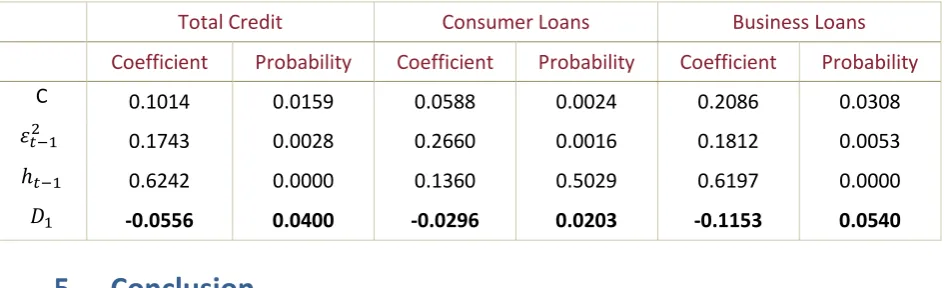
respectively. Estimation results are shown in Table 1. Since the sign of the dummy
variable is negative and statistically significant at 5%, it indicates that there is a
4
GARCH(1,1) is selected over other GARCH specifications according to Akaike Information Criterion (AIC) and Bayesian Information Criterion (BIC).
5
9
decrease in the credit growth volatility after the introduction of new monetary policy
[image:10.595.63.536.186.330.2]framework.
Table 1: Estimation Results of Variance Equations
Total Credit Consumer Loans Business Loans
Coefficient Probability Coefficient Probability Coefficient Probability
C 0.1014 0.0159 0.0588 0.0024 0.2086 0.0308
0.1743 0.0028 0.2660 0.0016 0.1812 0.0053
0.6242 0.0000 0.1360 0.5029 0.6197 0.0000
-0.0556 0.0400 -0.0296 0.0203 -0.1153 0.0540
5
Conclusion
The Central Bank of the Republic of Turkey has started to implement its new
policy mix since late 2010. In this note, this new monetary policy framework on the
volatility of credit growth has been examined. To the best of our knowledge, we are
the first to analyze the impact of new policy mix on the credit growth volatility. It is
shown that there is a significant decrease in the volatility of credit growth after the
introduction of the new monetary policy framework. This is an important finding
since lower volatility of credit growth supports the financial stability. Therefore, it
can be said that new monetary policy framework of CBRT contributes to financial
10
References
Akçelik, Y., Ermişoğlu, E., Oduncu, A. ve Taşkın, T. (2012). “Ek Parasal Sıkılaştırma’nın Döviz Kurları Üzerindeki Etkisi” CBT Research Notes in Economics No. 12/30.
Akçelik, Y., Başçi, E., Ermişoğlu, E. and Oduncu, A. (2013). “The Turkish Approach to Capital Flow Volatility” CBRT Working Paper No. 13/06.
Alper, K., Hülagu, T. and Keleş, G. (2012). “An Empirical Study on Liquidity and Bank Lending” CBRT Working Paper No. 12/04.
Alper, K., Kara, H. and Yörükoğlu, M. (2012). Rezerv Opsiyonu Mekanizması. CBT Research Notes in Economics No. 12/28
Başçı, E. (2013). “Governor Başçı's presentation at the BIS-Bank of Russia Conference (Moscow, July 19, 2013)”.
Başçı, E. (2013). “Governor Başçı's speech at 81. Annual General Meeting of CBRT (Ankara, April 9, 2013)”.
Başçı, E. ve Kara, H. (2011). “Finansal İstikrar ve Para Politikası,” CBRT Working Paper No. 11/08.
Binici, M., Erol, H., Kara, H., Özlü, P. and Ünalmış, E. (2013). “Faiz Koridoru bir Makro İhtiyati Araç Olabilir mi?” CBT Research Notes in Economics No. 13/20.
Bollerslev, T. (1986). Generalized autoregressive conditional heteroscedasticity, Journal of Econometrics, 31, 307–27.
Borio, C. (2011). “Central Banking Post-Crisis: What Compass for Uncharted Waters?”
BIS Working Papers No. 353.
Değerli, A. and Fendoğlu, S. (2013). “Reserve Option Mechanism as a Stabilizing Policy Tool: Evidence from Exchange Rate Expectations,” CBRT Working Paper No. 13/28.
Kara, H. (2012). “Küresel Kriz Sonrası Para Politikası,” CBRT Working Paper No 12/17.