Munich Personal RePEc Archive
Outplacement - Barriers and Challenges
of Implementation by Small and
Medium-Sized Enterprises in Poland
Klimczuk-Kochańska, Magdalena and Klimczuk, Andrzej
Stanislaw Staszic College of Public Administration in Bialystok,
Warsaw School of Economics
2013
Online at
https://mpra.ub.uni-muenchen.de/49336/
1 11th Annual ESPAnet Conference “Social Policy and Economic Development”
September 5-7 , 2013, Poznań University of Economics
Stream: 6. Innovative social and labour-market policies in times of crisis
dr Magdalena Klimczuk-Kochańska
Stanislaw Staszic College of Public Administration in Bialystok
mgr Andrzej Klimczuk
Warsaw School of Economics
Outplacement - Barriers and Challenges of Implementation by Small and Medium-Sized Enterprises in Poland
Introduction
The global financial and economic crisis forces undertaking restructuring actions by
companies. These processes are commonly associated with implementation of solutions for
optimization operating costs in human capital dimension. In former communist states of
Eastern, South-Eastern and Central Europe like Poland these changes are associated with
political, social and economic transformation from late 20th century. The restructuring
processes are perceived here as an activity for layoffs, which consequently leads to increase of
unemployment, including long-term and structural unemployment. Outplacement is relatively
little popular technique oriented on responsible monitored dismissals for a smooth transition
of laid-off workers to new workplaces. In this way, both employees and companies increases
their chances for maintaining competencies and better adaption to market competition
requirements. In this article outplacement will be described as a concept with mechanisms
similar to active labor market policies. However outplacement is aimed at prevention of
unemployment, not on action when it already occurs. Key challenges are cooperation of
enterprises with public and non-public employment services as well as adapting these
programs to the needs and capabilities of small and medium-sized enterprises. Article
includes a critical analysis of the literature as well as selected results of research conducted in
2
Outplacement as a possible response of Polish enterprises to the restructuring during
economic crisis
The competitiveness of the European economy increasingly depends on its ability to
innovate as well as fast and smooth adaptation to the changes of its environment. Enterprises
are constantly forced to adaptation, because in the medium term – due to technological progress and innovation – product life cycle is getting shorter. They must also respond to changes in international division of labor which leads to restructuring actions1. In Poland, in
the public consciousness, these processes are associated with rapid economic change of the
transformation from 20th century 90s or economic downturn of 2002-2004. Present
restructuring concerns the global financial crisis and is negatively associated with
unemployment, mass layoffs and bankruptcies. In the past, many restructuring processes
resulted in undesirable consequences for communities and regions that worsening their
situation2. Success of changes depends on the way of carrying them out, cooperation between
social partners and the mutual trust. The negative consequences of those changes mainly
affects laid off people who become unemployed.
Restructuring of employment is a result of its level mismatch to the organization’s needs. According to K. Sochacka this process is undertaken, as employers need to adapt for
changing economic, technical and organizational conditions3. According to A. Pocztowski
labor surplus can be analyzed further in quantity, quality, temporal, spatial, or cost
dimensions4. This researcher also indicates three groups of factors that cause employment
mismatch: (1) economic like business conditions, irrational use of time, high labor costs and
inadequate remuneration systems; (2) technical like new technologies that modernize
workplaces or changing demand for labor; as well as (3) organizational like changes in
organizational structures, work processes, mergers and acquisitions. Nowadays downsizing is
associated with a tendency to reduce size and cost of business organization. These changes are
universal, applicable to all categories of employees, including managerial staff.
Forced reduction of employment may result in many undesirable effects. Those are for
example: (1) decreased activity of employees remaining in the company and not reaching
expected performance and consequently decrease of their suitability for enterprise; (2)
1
K.-D. Sohn, S. Czuratis, Zielona Księga UE. Restrukturyzacja przedsiębiorstw. Analiza z dnia 14 maja 2012 r.,
Centrum für Europäische Politik, Fundacja FOR, Warszawa 2012, www.for.org.pl/pl/d/3e7bbc0b6276bf19dcf616b5b6e2163b [14.07.2013].
2
M. Korsak, Restrukturyzacja zatrudnienia, FISE, Warszawa 2009, p. 5.
3
K. Sochacka, Skuteczne rozwiązanie stosunku pracy z pracownikiem, C.H. Beck, Warszawa 2012, p. 6.
4
3 workers desire to find a job more suited to their needs; (3) re noticing labor surplus, which
leads to take another job cuts5. A. Downs indicates that the forced dismissal decisions are
often based on calculation of lawsuits brought by laid-off workers risk, while total disregard
for protection morale of persons in the company and its intellectual capital6. Workers reliefs
are affected by, amongst others, risk of previously formed image of the company loss as well
as image of its products, brands and services; loss of confidence from employees, customers,
suppliers and other business partners; sending to the environment signals that company is
experiencing financial, organizational, or technical difficulties; dismissal of staff influence on
the level of sales, credit quality, ability to attract new suppliers, flexibility in defining terms of
cooperation7.
Research of international auditing company KPMG regarding human resources
policies in 303 enterprises operating in Poland show that the majority, 88% of surveyed
companies, said that economic slowdown was the main reason for changes in their policies8.
The main changes that were introduced was the restructuring of employment and
implementation of flexible forms of employment and occupation. Researchers proposed a
three categories of cost optimization by the companies in terms of human capital: (1)
reduction of employment; (2) reduction of workers benefits; (3) optimizing costs of workers
maintenance9. Downsizing allows a reduction of companies operating costs in the short term.
At the end of December 2010 45% companies said they had decided on it in response to the
economic downturn. Intention to continue redundancies declared 1/10 surveyed companies.
For 93% companies using this method it was effective and has proved successful. In addition,
companies reduced recruitment activity, reduced workers benefits, in some cases, have
decided to “forced” unpaid leaves, but these solutions are less effective10. In the long run, these methods are not effective, hence the relatively few companies continue to optimize costs
with their help. Some Polish companies also applied during the economic downturn long-term
cost optimization methods. Mostly they were internal recruitment, flexible forms of
employment and outsourcing. About 70% companies that implement them, do not intend to
5
D. Lewicka, Zarządzanie kapitałem ludzkim w polskich przedsiębiorstwach. Metody, narzędzia, mierniki, PWN, Warszawa 2010, p. 117.
6
A. Downs, Jak ograniczyć zatrudnienie w dobrym stylu?, [in:] K. Szczepaniak (ed.), Biznes. Tom V.
Zarządzanie zasobami ludzkimi, PWN, Warszawa 2007, p. 24.
7
P. Janik, Outplacement jako narzędzie w procesie restrukturyzacji zatrudnienia, „Zeszyty Naukowe
Małopolskiej Wyższej Szkoły Ekonomicznej w Tarnowie” 2/2009, p. 393-394.
8
J. Karasek, A. Emerling, P. Kwiatkowski, Optymalizacja kosztów a utrzymanie pracowników. O reakcjach firm
na trudne warunki rynkowe, KPMG, Warszawa 2011, p. 9.
9
Ibidem, p. 10-11.
10Ibidem
4 abandon these tools. However, with the exception of internal recruitment and additional work
load, these solutions have been used, at least two times less, than the reduction of employment
or reduction of recruitment. In other words, the KPMG study shows that entrepreneurs tend
mainly towards solutions oriented to the benefits in a short rather than a long period of time.
Thus, exposing themselves to risks associated with the negative effects of layoffs. The use of
outplacement in organizations wishing to dismiss workers will therefore allow reduction of
the scope of these negative processes.
Outplacement is a special type of external de-recruitment undertaken at the initiative
of employer. It’s a form beside redundancies undertaken because of negative appraisal and exemptions which are a result of organizational improvements11. Generally outplacement can
be understood as laying off employees, which is accompanied by the organization of actions
to help departing employees with finding new job. This includes activities such as counseling,
retraining and searching for a new job. Such program could also be supplemented by efforts
targeted to other organization stakeholders (contractors, clients, local community).
Outplacement as a specialized field of consulting was born in the United States after World
War II12. First outplacement programs were government projects that were designed to help
former soldiers find a job in times of peace13. In the 60s 20th century it began to be used as a
commercial service when it was noticed that similar problems are encountered by people who
suddenly and unexpectedly are losing their jobs. In Poland, the first outplacement programs
started in the 90s of 20th century.
Individual researchers differently define the essence of outplacement. L. Konarski
emphasizes that the launch of a program prevents or significantly reduce unhealthy
11A. Ludwiczyński, Alokacja zasobów ludzkich w organizacji
, [in:] H. Król, A. Ludwiczyński (eds.),
Zarządzanie zasobami ludzkimi. Tworzenie kapitału ludzkiego organizacji, PWN, Warszawa 2006, p. 222-224.
12
Professional literature contains attempts to modify or replace world outplacement by other concepts like: „job search counseling services”, „career management counseling”, „career transition services”, „career planning”,
„career change coaching”. Synonymous terms are „executive outplacement” and „executive career coaching”
(Podręcznik outplacementu w ramach Programu Operacyjnego Kapitał Ludzki, Ministerstwo Rozwoju Regionalnego, Warszawa 2010, p. 10). In Poland interchangeably are used terms „outplacement” and
„zwolnienia monitorowane” (monitored dismissals). Also used are terms like: „system łagodnych zwolnień”
(system of gentle redundancies), „kompleksowa pomoc udzielana osobom zwalnianym” (comprehensive assistance to dismissed), „wsparcie pracodawcy i pracownika w okresie restrukturyzacji” (support for employers and employees under restructuring), „program adaptacji zawodowej” (retraining program), „program
aktywizacji zawodowej” (vocational activation program), „program kontynuacji kariery” (program of career continuation) (A. Binda, Skąd pochodzi i jak zmienia się pojęcie outplacementu, L.Grant HR Consulting, www.lgrant.com/skad-pochodzi-i-jak-zmienia-sie-pojecie-outplacement- [14.07.2013]).
13
5 competition and conflict among employees threatened with redundancy14. Program allows
monitoring their behavior during notice period, reduces insecurity, frustration, failure. Fired
employee receives support from the current employer in the form of recommendations, further
advice and training. Has the possibility of benefiting from professionals advice, honestly
prepared labor market analysis, evaluations of industries development, economic situation of
country, development trends, demand for certain specialists. The dictionary of “Detailed Description priorities of the Operational Programme Human Capital” defines outplacement by instruments by which it can be carried out: “Labour market services provided to the employee, which is during dismissal or threatened dismissal. Outplacement may include, in
particular, vocational counseling and psychological assistance in finding a new job, funding
training, retraining courses, assistance in resettling, resources to start a business”15. Some of broader definitions are by: M. Armstrong which considering monitored dismissals as
assistance programs for laid-off workers through counseling16; M. Juchnowicz which assumes
that this programs also aim to reduce “the impact of negative effects on the assessment of personnel decisions and the company’s reputation in the business environment”17; as well as by K. Makowski which states that outplacement is: “versatile and comprehensive system of care: managerial, organizational, legal, institutional, psych-sociological, and if necessary – also treatment of redundant people, designed to reduce any kind of distressing redundancies
effects and as much as possible facilitate their future professional activity”18. As noted by A.
Ludwiczyński outplacement should be a social investment that guarantee social consensus19. Such program should mitigate the negative emotions associated with organizational changes,
reduce the risk of open conflict, reduce decrease of productivity and the risk of most valuable
employees departure from the company’s. Similarly, K. Schwan and K.G. Seipel emphasize that outplacement offers “consistent with social contract” dismissal of merit employees which
14
J. Borkowski, M. Dyrda, L. Konarski, B. Rokicki, Człowiek w organizacji. Podręczny słownik psychologii,
zarządzania i dziedzin pokrewnych, Elipsa, Warszawa 2001, p. 90; [cited by:] M. Sidor-Rządkowska, Zwolnienia
pracowników a polityka personalna firmy, Wolters Kluwer, Warszawa 2010, p. 111.
15Szczegółowy opis priorytetów Programu Operacyjnego Kapitał Ludzki
, Ministerstwo Rozwoju Regionalnego, Warszawa 2010, p. 346.
16
M. Armstrong, Zarządzanie zasobami ludzkimi, Oficyna Wolters Kluwer, Kraków 2007, p. 426.
17
M. Juchnowicz, Outplacement kompetencji jako sposób poprawy elastyczności kapitału ludzkiego, [in:] M. Juchnowicz (ed.), Elastyczne zarządzanie kapitałem ludzkim w organizacji wiedzy, Difin, Warszawa 2007, p. 176.
18
K. Makowski (ed.), Zarządzanie pracownikami. Instrumenty polityki personalnej, Poltext, Warszawa 2001, s.167; [cited by:] A. Ludwiczyński, Alokacja zasobów ludzkich w organizacji, op. cit., p. 225.
19Ibidem
6 should consequently lead to dynamic “winding of development” for companies and employees20. It should be situation in which “everybody wins”.
Although outplacement allows limiting the negative effects of employment
restructuring and unemployment rising, however, it does not allow avoid them. A.
Kwiatkiewicz proposed typology of instruments related to restructuring used in Poland21.
Outplacement was classified to management tools connected to already started restructuring
process beside: retirement solutions; benefits for the unemployed; severance payments;
individual compensation packages. On the other hand, points tools for restructuring
anticipation: early warning systems (eg, informing labor offices by employers on projected
redundancies); training and retraining for employees threatened with redundancy; activities
for people aged 50+; monitoring and analysis of surplus and shortage in occupations carried
out by labour offices; active labor market projects financed by the European Social Fund;
investments in research and development22. Employers can therefore apply many instruments
of overtaking short-term restructuring process or mitigate its course.
In conclusion, it is considered that outplacement includes de-recruitment activities,
which includes reducing the negative effects of organizational and employment restructuring.
It has to allow employees to overcome the stress caused by loss or lack of jobs and stimulate
smooth entry into the external labor market. In Poland, outplacement programs are run by
private employment services - commercial and non-governmental entities23.
Outplacement in the context of activation policies
Outplacement have a positive impact on the perception of the company as a socially
responsible and trustworthy. Help for redundant employees should brought such benefits as:
improving the image of organization, a positive climate in organization, protection of key
competencies and reducing the costs of lawsuits24. The reduction in employment should also
be preceded by an analysis on the effects not only for company but also region as well
justifications of redundancy for workers and social environment25. Restructuring requires,
therefore, take into account not only the norms, values, attitudes and goals of companies
20
K. Schwan, K.G. Seipel, Marketing kadrowy, C.H. Beck, Warszawa 1997, p. 239.
21
A. Kwiatkiewicz, Antycypacja i zarządzanie procesami restrukturyzacji w Polsce, BPI Polska, Warszawa 2009, p. 43-49.
22Ibidem
, p. 39-43
23
J. Religa, A. Kicior, Outplacement jako wyspecjalizowana usługa doradcza w kontekście polskich
uwarunkowań prawnych, społecznych i ekonomicznych, „Edukacja Ustawiczna Dorosłych” 2/2010, p. 105.
24
D. Lewicka, Zarządzanie kapitałem ludzkim w polskichprzedsiębiorstwach. Metody, narzędzia, mierniki, op. cit., p. 118.
25
7 owners, but also others involved in its tasks and crisis. Outplacement programs can thus be
analyzed in relation to the corporate social responsibility and social economy concepts. Both
of these approaches are derived from different theoretical traditions, but from the perspective
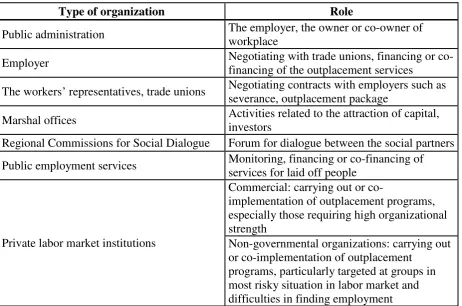
of contemporary social policy they are closely linked. Table 1 contains adapted to Polish
conditions typology of main actors in employment restructuring process as well as roles that
they can play in it26. In alternative proposals it is recommended that in different parts of the
social restructuring plan should be consulted and negotiated with: organizations representing
the employees (eg trade unions), managerial staff, employees themselves and external
organizations incorporated in restructuring (eg, employment agencies, commissions provided
[image:8.595.69.532.317.623.2]in collective labor agreements, government)27.
Table 1. Roles of entities participating in employment restructuring process
Type of organization Role
Public administration The employer, the owner or co-owner of
workplace
Employer Negotiating with trade unions, financing or
co-financing of the outplacement services
The workers’ representatives, trade unions Negotiating contracts with employers such as severance, outplacement package
Marshal offices Activities related to the attraction of capital,
investors
Regional Commissions for Social Dialogue Forum for dialogue between the social partners
Public employment services Monitoring, financing or co-financing of services for laid off people
Private labor market institutions
Commercial: carrying out or
co-implementation of outplacement programs, especially those requiring high organizational strength
Non-governmental organizations: carrying out or co-implementation of outplacement
programs, particularly targeted at groups in most risky situation in labor market and difficulties in finding employment
Source: own analysis based on M. Korsak, Restrukturyzacja zatrudnienia, FISE, Warszawa
2009, p. 7.
26
See: M. Korsak, Restrukturyzacja zatrudnienia, op. cit., p. 5-7; B. Piotrowski, Outplacement – podstawowy pakiet informacji, FISE, Warszawa 2010, p. 18-20.
27A. Ludwiczyński,
Analiza pracy i planowanie zatrudnienia, [in:] H. Król, A. Ludwiczyński (eds.),
8 It should be possible to identify the main benefits of participation in outplacement for
firms external partners28. Local authorities avoid social tensions and keep tax revenues from
the newly employed persons. Public employment services fulfill with the statutory purposes
by working with employers and gain experience in the outplacement implementation.
Employers’ organizations and employers recruit employees and establish business contacts. Private advisory companies, training and employment agencies acquire customers and build
services directory. Non-governmental organizations gain experience in the implementation
actions, reliability, references, financial support and opportunities for development and
acquire or strengthen staff. It should be noted that the Polish employment services so far
mainly been active for the unemployed and does not been partners for companies in dealing
with redundancies resulting from restructuring processes29. People at risk of losing their jobs
are somewhat out of their system, are defined as “work seeking” employees, which does not give them access to most of the public forms of support. There is also a belief that
outplacement is expensive and hard to find programs that are carried out only by consultants
from commercial companies, while they are, and can be carried out also by non-governmental
organizations 30.
It is recommended that outplacement should be implemented in framework of local
partnerships and pacts. Polish and foreign experience in outplacement programs, particularly
for long-term unemployed, indicate a failure of using classical model of outplacement31.
These programs offer only assessment of the potential and motivation of laid off employees.
Basic support and preparation for entering the job market are too short. This support refers to
selective rather than comprehensive preparation of redundancies to the new situation on labor
market and confront them to potential employers or to offer them possibility of independent
start-ups. It is therefore recommended usage of adapted and environmental outplacement
models – methods based on long-help and involving more entities of local and regional labor market. The first model is based on the extended program (the average 1-3 to 9 months) and
adapting it to the needs of affected workers. While environmental concerns also help for
unemployed and young people entering the labor market. That support contains
interconnection of participants in group and usage of individual activation techniques32.
28A. Ledwoń, Outplacement –przewodnik dla organizacji pozarządowych
, FISE, Warszawa 2010, p. 20-21.
29
A. Kwiatkiewicz, Antycypacja i zarządzanie procesami restrukturyzacji w Polsce, op. cit., p. 33.
30A. Ledwoń,
Outplacement –przewodnik dla organizacji pozarządowych, op. cit..
31
J. Tyrowicz, Ewaluacja i efektywność programów społecznych w Polsce, [in:] M. Grewiński, J. Tyrowicz (eds.), Aktywizacja, partnerstwo, partycypacja - o odpowiedzialnej polityce społecznej, Mazowieckie Centrum
Polityki Społecznej, Warszawa 2007, p. 139.
32
9 In conclusion it should be noted that outplacement is based on similar mechanisms to
rebuild employability as active labor market policies. However, in contrast to these programs
is aimed at helping those who are at risk of unemployment rather than those who already are
unemployed. At the same time it is appropriate to supplement outplacement models by
“activating impulses present in a variety of configurations between individuals and groups, and between institutions (social policy actors) understood as producers and service
providers”33. Thus, necessary are outplacement analysis which taking into account the concept of governance and social entrepreneurship. On the one hand is possible networking of actors
that solve the problem of unemployment risk on a horizontal way (including for example,
health, education, regional development) based on dialogue and resources sharing. At the
same time outplacement may include a temporary employment and retraining in third sector
and social enterprises.
Selected results of research conducted in Podlaskie Voivodship
In 2012 in Podlaskie Voivodship as part of “Innowacje na zakręcie - testowanie i
wdrażanie nowych metod outplacementu” (“Innovation on the cusp - testing and implementation of new outplacement methods”) project was conducted research on outplacement. Research included a series of in-depth interviews, focus groups and
quantitative CATI research (Computer Assisted Telephone Interviewing) among
entrepreneurs and employees. CATI interviews were carried out in the period from October to
November 2012. Below are presented some results of a survey conducted among business
leaders.
Podlaskie Voivodeship, with its capital in the city of Białystok is situated in the
eastern part of Poland. It borders with Belarusian Voblasts of Grodno and Brest to the east,
Lithuanian Counties of Alytus and Marijampolė to the northeast and with Kaliningrad Oblast of Russia to the north. Region covers an area of 20.180 km², ie 6,4% of the country. In 2011, the 31,9% region surface were areas for nature conservation34. In the years 1988-2011 there
was a slight increase in the number of residents – from 1188 thousand inhabitants in 1988 year to 1200 thousand in 201135. At the same time there was a decline in population
pre-production age (17 years or less) from 361 thousand (30,3% of entire region’s population) to
33
A. Karwacki, Papierowe skrzydła. Rzecz o spójnej polityce aktywizacji, Wyd. Naukowe Uniwersytetu
Mikołaja Kopernika, Toruń 2010, p. 70
34Bank Danych Lokalnych
, GUS, www.stat.gov.pl/bdl [14.07.2013].
35NPR i PSR 2002. Raport z wyników spisów powszechnych
- Województwo Podlaskie, Urząd Statystyczny w
10 233 thousand (18,5%) as well as increase in the population over production age (60+ for
women’s/65+ for mans) 165 thousand (13,8%) to 212 thousand (17,7%). According to estimates of the Central Statistical Office from 2008 reduce in the number of population of
region is expected36. Until 2035 year, it will be 120 thousand inhabitants less in Podlaskie
Voivodeship. At the same time number of pre-production person will be reduced from 242
thousand (20,3% of entire region’s population) in 2007 year to 165 thousand (15,3%) in 203537. In the forecast period number of people in retirement age will increase from 202
thousand (17,1%) to 303 thousand (28,3%). Unfavorable demographic trends is accompanied
by the lowest average population density in the country, which in 2011 amounted to 59
persons per km² and was significantly lower than the national average 123 persons per km²38. Region is characterized by a negative balance of internal and international migration for
permanent residence. In 2011 year amounted -1,6 per 1000 population and was higher than
the national average equal -0,1. The region is characterized by poor industrialization – there are two important developments directions: agriculture and tourism. The structure of
employment in 2011 year was dominated by services (261 thousand persons). Fewer people
were employed in agriculture, hunting, forestry and fishing (116 thousand persons) as well as
in industry and construction (115 thousand persons). The registered unemployment rate in
2011 year was 14,1% and exceeded the national average 12,5%. Value of GDP per capita in
2010 year was 26985 PLN and it was lower against the national average 37096 PLN.
Selection of research sample included companies divided in the following industries:
crafts industry in Podlaskie Voivodship; industries crucial to region development; public
sector; and starters - future growth industries. The study sample consisted of exactly 200
companies. Among the analyzed dominated small and medium-sized companies, created in
the 1971-2000 years. Companies represented mainly key industries of region and public
sector entities. The largest part of them represented construction industry and foodstuffs. In
more than half of entities within the organizational structures are units or departments
responsible for carrying out activities in the field of personnel policy. Those units employ
mostly 1-2 employees. Respondents, as a specialists in personnel policy in their companies
mainly have positions of owners, managers or human resources specialists. In only few
enterprises monitored or group redundancies were ever conducted.
36Prognoza ludności na lata 2008
-2035, GUS, Warszawa 2009, p. 173.
37Prognoza ludności na lata 2008-2035 - Województwo Podlaskie
, GUS,
www.stat.gov.pl/cps/rde/xbcr/gus/PUBL_prognoza_ludnosci_na_lata_2008_2035_20_podlaskie.xls [14.07.2013].
38Bank Danych Lokalnych
11 Representatives of the selected enterprises from Podlaskie Voivodship quite often
have a general understanding of outplacement concept. Nearly 31% of respondents associate
them with management of human resources and labor market. A similar proportion of
respondents claims it has a theoretical understanding of outplacement (27,5%). However, in
the light of further results should be considered that the knowledge of these programs are very
general and superficial. For 38,5% respondents outplacement is unknown concept.
Results of the study allow to say that entrepreneurs recognize an average usefulness of
individual outplacement forms that were already used in surveyed companies. As particularly
important are considered activities aimed at the severance payments for dismissed persons,
raising their training qualifications and vocational training aimed at career change.
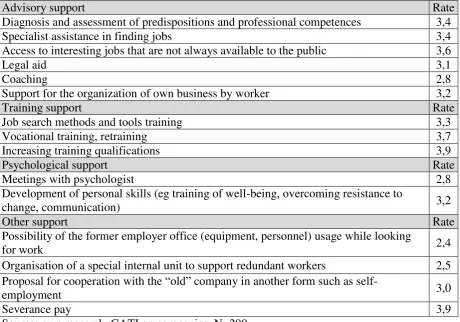
Respondents were asked to rate on a scale from 0 to 5 suitability of various activities to
support redundant workers which were used in their companies. The obtained evaluation are
set on a scale of 2,3 to 3,8, which means average usefulness of individual outplacement
[image:12.595.69.530.402.724.2]instruments.
Table 2. Assessment of suitability for company outplacement actions
Advisory support Rate
Diagnosis and assessment of predispositions and professional competences 3,4
Specialist assistance in finding jobs 3,4
Access to interesting jobs that are not always available to the public 3,6
Legal aid 3,1
Coaching 2,8
Support for the organization of own business by worker 3,2
Training support Rate
Job search methods and tools training 3,3
Vocational training, retraining 3,7
Increasing training qualifications 3,9
Psychological support Rate
Meetings with psychologist 2,8
Development of personal skills (eg training of well-being, overcoming resistance to
change, communication) 3,2
Other support Rate
Possibility of the former employer office (equipment, personnel) usage while looking
for work 2,4
Organisation of a special internal unit to support redundant workers 2,5 Proposal for cooperation with the “old” company in another form such as
self-employment 3,0
Severance pay 3,9
12 As the relatively high usefulness was rated activities involving transmission severance
pay for dismissed persons (average rating 3,8). In second place are increasing professional
training (3,8). As important was considered also professional training aimed at career change
(3,7). Lowest rated were the forms of activities from outplacement process like: the ability to
use offices of former employer (2,4), or holding a special internal unit responsible for dealing
with work promotion of redundant employees (2,5). Quite low were also rated actions in the
field of coaching (2,8), collaboration with psychologist (2,8), and maintain the relationship
with existing employer in other forms (3,0). Activities that would be aimed at further contact
of employer with laid off employee were therefore rated very low.
Such responses may be interpreted as the fact that employers who lay off employees
would rather does not keep further contacts with them. Enterprises are in fact oriented on
activities that will bring them benefits in a short period of time. They recognize that the
easiest way is to provide workers with such support that will definitely cuts assert to other
claims by the dismissed employee against former employer, and such a solution can be
primarily severance payments. It is similar in the case of training, which can also be carried
out after laid off the employee and which are often performed under different labor market
institutions – public, non-governmental and commercial, that offer such instruments. Representatives of companies prefer to cut off themselves from the problem of redundancies
and paradoxically – although generated in this way costs they will even transfer severance pay, than use - perhaps even in whole cheaper - forms of support, that require the maintenance
of contact with redundant worker, support him, or even establish new forms of cooperation in
the vocational field.
Another part of CATI interview questionnaire was related to outplacement
implementation barriers. Respondents were asked an open question, and received responses
can be divided into four groups of barriers: financial, knowledge and skills, psychological and
human. Barriers were dominated by those related to lack of knowledge and organization staff
proper preparation for outplacement implementation (70 respondents). The reduction or even
13 Table 3. Barriers to the outplacement implementation in firm
From employers side Rate
Lack of proper knowledge among managers and HR department on outplacement 3,7
Lack of skills in use outplacement forms and methods 3,7
The high cost of outplacement conducting (such as consultancy, training, etc.) 4,1 Improperly conducted information campaign in the company - lack of information for
workers about outplacement causes and how it will be implemented 3,3 Lack of employee-elected representative of the crew assigned to the contacts with
company’s management 3,0
Insufficient employees inform about available support 3,2
No talks of executives with an employee that will be laid off 3,2
Staff limitations - there is no one to take care of this in company 3,6
No experience in EU funds raising 3,2
Deteriorating condition of the company 3,6
Participation in the outplacement activities interferes with work, because they are
carried out during working hours 3,4
Lack of access to specialists in the field of outplacement 3,4
From employee side Rate
The passive attitude of the laid off workers - low interest of redundant workers in forms
of support that require active participants 3,5
Insufficient awareness of outplacement carrying out benefits 3,8
Low interest of workers in the retraining possibility 3,7
Low potential of adapting of workers threatened with redundancy - much of the
redundancies applies to basic professions 3,5
Labor market institutions side Rate
Little experience of employment agencies and other labor market institutions in
outplacement projects 3,3
Staff restrictions of labor offices and other labor market institutions 3,2
Lack of standards used in the outplacement processes 3,4
Insufficient dissemination of outplacement methodology among Polish companies 3,6
No studies on outplacement good practices 3,5
Lack of cooperation between the various institutions of support for unemployed and
business development 3,5
Other barriers Rate
Laws hinder employment agencies participation in projects funded by the EU in career
counseling subject 3,1
Bad opinion on the use of outplacement 2,9
Low public awareness on outplacement use and its benefits 3,7
Source: own research, CATI on companies, N=200.
The next part of questionnaire was assessment by the enterprise barriers of
outplacement implementation divided into four groups. Namely: barriers on employers side,
employees side, from labor market institutions and from other sources. Specific barriers were
evaluated on a scale from 0 to 5, where 0 meant that a barrier is irrelevant, while 5 that is very
14 which considered as high cost of outplacement conducting (average rating 4,1). Slightly lower
have been evaluated: lack of employers skills in the use of outplacement (3,7) as well as lack
of knowledge on the subject among managers and staff responsible for personnel (3,7).
Enterprises therefore admit to a lack of experience in this field.
The lowest rated barrier is “Lack of employee-elected representative of the crew assigned to the contacts with company’s management” (average rating 3,0). Very small part of entrepreneurs attention is paid to a lack of talks between management and redundant
workers (3,2), as well as lack of experience in raising funds from the European Union (3,2).
In other words, respondents acknowledge authoritarian imposition of redundancies for
workers as granted and don’t have nothing to reproach in the lack of implementation of outplacement.
Regarding the assessment of difficulties in outplacement implementation on the
employees side respondents considers that mainly those are insufficient awareness on its
implementation benefits (3,8). While passive attitude of laid-off persons is not considered as
major problem (3,5) as well as employees low adaptive potential (3,5). The barriers on the
side of labor market institutions were also evaluated at a relatively low level. Particularly
important are the “insufficient dissemination of outplacement methodology among Polish companies” (3,5) and no studies on outplacement good practices (3,5). Thus, some employers shows interest in the subject, or delegates responsibility for outplacement to other entities. At
the same time respondents do not count on labor market institutions support. Employers
acknowledge fact that they do not have enough qualified personnel (3,2) as well as not
conduct cooperation with other actors in outplacement implementation (3,5).
In addition, respondents does not rated highly factor for poor opinion on the use of
outplacement (2,9), because they might just know a little on the subject to date in good and
wrong terms. Companies also do not recognize as a major obstacle the laws concerning
involvement of labor market institutions in financing of outplacement projects by European
Union (3,1). While as quite important was rated low public awareness of outplacement uses
and benefits (3,7).
Conclusions
This article brought closer the conditions for use of outplacement by Polish companies
under the global financial and economic crisis ongoing since 2008. Paper presents outplacement
as a responsible form of layoffs, which should aim to minimize the risk of long-term
15 labor market policies. Outplacement Success depends on the needs of stakeholders of restructured
companies and their commitment in order to create a situation in which “everybody wins”. Article discusses the results of research on companies from Podlaskie Voivodship concerning barriers to
the use of this concept by small and medium-sized enterprises.
Discussed results allow to conclude that the outplacement can be considered as a tool
for restructuring, but does not allow to avoid it. It only allows to mitigate its course. The main
barrier to outplacement development, using its instruments and implementation models based
on the commercial, governmental and public entities collaboration is a very limited
knowledge of outplacement issues among entrepreneurs. Outplacement tools are seen as
expensive and which do not bring immediate optimization of the cost for companies. Firms
prefer a rapid reduction of employment, which not only leads to conflict with redundant
worker, but also aggravated relations with the crew remaining in company. Outplacement
rarely is it seen as part of strategy to increase flexibility of organisation as well as its
adaptation to maintain competitiveness under conditions of risk and uncertainty in
environment. Entrepreneurs using conventional techniques of redundancies often make these
actions in ineffective way so they do not bring positive results and become “new” obstacles for organization development.
In relation to the above conclusions, the following recommendations for the
implementation of outplacement programs in Poland, especially taking into account the
specificities of small and medium-sized enterprises sector was made. Outplacement programs
should take into account best practices in redundancies communicating by the employers. It is
reasonable too early preparation of employees to maintain their employability and to remain
on standby for the possibility of redundancies. Outplacement programs should include
activities not only to affected by redundancies workers, but also to those remaining in the
company. The benefit for laid-off workers may be including in outplacement programs
temporary forms of employment, employment in third sector and social enterprises as well as
coordinate these programs in collaboration with non-employment agencies. It is reasonable to
promote and strengthen local partnerships as entities that can serve adapted and
environmental outplacement, and thus also improve strategic management of labor market
policies at the local and regional level. It is reasonable to break the stereotype of high cost of
outplacement through the promotion of best practice of employment agencies run by
non-governmental organizations. Also important is the promotion of outplacement as part of
corporate social responsibility. Attention should be paid that the use of outplacement by
16 better perceived by customers and partners. Absence of this perspective makes layoffs as an
internal problem of companies, while layoffs also bring negative effects to its environment
and stakeholders. It is necessary to collect and disseminate good practices of outplacement
programs usage for small and medium-sized enterprises. The literature on the subject consists
mainly of studies with programs carried out by consulting firms on behalf of large companies.
References:
Armstrong M., Zarządzanie zasobami ludzkimi, Oficyna Wolters Kluwer, Kraków 2007.
Bank Danych Lokalnych, GUS, www.stat.gov.pl/bdl [14.07.2013].
Binda A., Historia i rozwój outplacementu jako wyspecjalizowanej usługi doradczej, L.Grant
HR consulting,
www.lgrant.com/historia-i-rozwoj-outplacement-u-jako-wyspecjalizowanej-uslugi-doradczej- [14.07.2013].
Binda A., Skąd pochodzi i jak zmienia się pojęcie outplacementu, L.Grant HR Consulting,
www.lgrant.com/skad-pochodzi-i-jak-zmienia-sie-pojecie-outplacement-
[14.07.2013].
Downs A., Jak ograniczyć zatrudnienie w dobrym stylu?, [in:] K. Szczepaniak (ed.), Biznes.
Tom V. Zarządzanie zasobami ludzkimi, PWN, Warszawa 2007.
Grewiński M., Tyrowicz J. (eds.), Aktywizacja, partnerstwo, partycypacja - o odpowiedzialnej
polityce społecznej, Mazowieckie Centrum Polityki Społecznej, Warszawa 2007.
Janik P., Outplacement jako narzędzie w procesie restrukturyzacji zatrudnienia, „Zeszyty
Naukowe Małopolskiej Wyższej Szkoły Ekonomicznej w Tarnowie” 2/2009.
Juchnowicz M. (ed.), Elastyczne zarządzanie kapitałem ludzkim w organizacji wiedzy, Difin,
Warszawa 2007.
Juchnowicz M., Outplacement kompetencji jako sposób poprawy elastyczności kapitału
ludzkiego, [in:] M. Juchnowicz (ed.), Elastyczne zarządzanie kapitałem ludzkim w
organizacji wiedzy, Difin, Warszawa 2007.
Karasek J., Emerling A., Kwiatkowski P., Optymalizacja kosztów a utrzymanie pracowników.
O reakcjach firm na trudne warunki rynkowe, KPMG, Warszawa 2011.
Karwacki A., Papierowe skrzydła. Rzecz o spójnej polityce aktywizacji, Wyd. Naukowe
Uniwersytetu Mikołaja Kopernika, Toruń 2010.
Koral J., Outplacement - sposób na bezrobocie, FISE, Warszawa 2009.
Korsak M., Restrukturyzacja zatrudnienia, FISE, Warszawa 2009.
Król H., Ludwiczyński A. (eds.), Zarządzanie zasobami ludzkimi. Tworzenie kapitału
17 Kwiatkiewicz A., Antycypacja i zarządzanie procesami restrukturyzacji w Polsce, BPI
Polska, Warszawa 2009.
Ledwoń A., Outplacement –przewodnik dla organizacji pozarządowych, FISE, Warszawa 2010.
Lewicka D., Zarządzanie kapitałem ludzkim w polskich przedsiębiorstwach. Metody,
narzędzia, mierniki, PWN, Warszawa 2010.
Ludwiczyński A., Alokacja zasobów ludzkich w organizacji, [in:] H. Król, A. Ludwiczyński (eds.), Zarządzanie zasobami ludzkimi. Tworzenie kapitału ludzkiego organizacji,
PWN, Warszawa 2006.
Ludwiczyński A., Analiza pracy i planowanie zatrudnienia, [in:] H. Król, A. Ludwiczyński (eds.), Zarządzanie zasobami ludzkimi. Tworzenie kapitału ludzkiego organizacji,
PWN, Warszawa 2006.
Makowski K., Outplacement - europejskim standardem w dziedzinie zarządzania zasobami
ludzkimi, [in:] K. Kuciński (ed.), Polskie przedsiębiorstwa wobec standardów
europejskich, SGH, Warszawa 2003.
NPR i PSR 2002. Raport z wyników spisów powszechnych - Województwo Podlaskie, Urząd
Statystyczny w Białymstoku, Białystok 2003.
Piotrowski B., Outplacement - Podstawowy Pakiet Informacji, FISE, Warszawa 2010.
Pocztowski A., Zarządzanie zasobami ludzkimi. Strategie - procesy - metody, PWE,
Warszawa 2007.
Podręcznik outplacementu w ramach Programu Operacyjnego Kapitał Ludzki, Ministerstwo Rozwoju Regionalnego, Warszawa 2010.
Prognoza ludności na lata 2008-2035 - Województwo Podlaskie, GUS, www.stat.gov.pl/ cps/rde/xbcr/gus/PUBL_prognoza_ludnosci_na_lata_2008_2035_20_podlaskie.xls
[14.07.2013].
Prognoza ludności na lata 2008-2035, GUS, Warszawa 2009.
Religa J., Kicior A., Outplacement jako wyspecjalizowana usługa doradcza w kontekście
polskich uwarunkowań prawnych, społecznych i ekonomicznych, „Edukacja Ustawiczna Dorosłych” 2/2010.
Schwan K., Seipel K.G., Marketing kadrowy, C.H. Beck, Warszawa 1997.
Sidor-Rządkowska M., Zwolnienia pracowników a polityka personalna firmy, Wolters Kluwer, Warszawa 2010.
Sochacka K., Skuteczne rozwiązanie stosunku pracy z pracownikiem, C.H. Beck, Warszawa
18 Sohn K.-D., Czuratis S., Zielona Księga UE. Restrukturyzacja przedsiębiorstw. Analiza z dnia
14 maja 2012 r., Centrum für Europäische Politik, Fundacja FOR, Warszawa 2012,
www.for.org.pl/pl/d/3e7bbc0b6276bf19dcf616b5b6e2163b [14.07.2013].
Szczegółowy opis priorytetów Programu Operacyjnego Kapitał Ludzki, Ministerstwo Rozwoju Regionalnego, Warszawa 2010.
Szczepaniak K. (ed.), Biznes. Tom V. Zarządzanie zasobami ludzkimi, PWN, Warszawa 2007.
Tyrowicz J., Ewaluacja i efektywność programów społecznych w Polsce, [in:] M. Grewiński, J. Tyrowicz (eds.), Aktywizacja, partnerstwo, partycypacja - o odpowiedzialnej
polityce społecznej, Mazowieckie Centrum Polityki Społecznej, Warszawa 2007.
Outplacement - bariery i wyzwania wdrażania przez
małe i średnie przedsiębiorstwa w Polsce
Abstrakt:
W warunkach globalnego kryzysu finansowego i gospodarczego podejmowana przez
przedsiębiorstwa restrukturyzacja wiąże się często z optymalizacją kosztów działalności w wymiarze kapitału ludzkiego. Relatywnie mało popularną jest technika odpowiedzialnych
zwolnień monitorowanych, która umożliwia ograniczenie ryzyka długotrwałego bezrobocia
oraz pozwala na zachowanie kompetencji kluczowych tak przez pracowników, jak i organizacje. Jednocześnie publiczne i niepubliczne służby zatrudnienia przeważnie nie mają doświadczenia w realizacji programów outplacement. Programy te są też trudno dostępne dla małych i średnich przedsiębiorstw. Referat opiera się na krytycznej analizie literatury przedmiotu oraz badaniach przeprowadzonych w województwie podlaskim w 2012 roku w
ramach projektu „Innowacje na zakręcie - testowanie i wdrażanie nowych metod outplacementu”. Badania obejmowały serię indywidualnych wywiadów pogłębionych,
zogniskowanych wywiadów grupowych oraz badanie ilościowe CATI wśród przedsiębiorców i pracowników. Główne wnioski prowadzą do twierdzenia, iż outplacement powinien być
upowszechniany jako dobra praktyka społecznej odpowiedzialności biznesu. Realizacja programów może odbywać się poprzez zwiększenie roli podmiotów gospodarki społecznej -
w szczególności organizacji pozarządowych realizujących zadania z zakresu polityki rynku
19
Słowa kluczowe:
polityka aktywizacji, antycypacja restrukturyzacji, bezrobocie, interesariusze outplacementu,
partnerstwa i pakty lokalne, rozwój regionalny i lokalny, współpraca
międzysektorowa, zwolnienia monitorowane.
Outplacement - Barriers and Challenges of Implementation by Small and Medium-Sized Enterprises in Poland
Summary:
Under the conditions of the global financial and economic crisis restructuring
undertaken by companies often is associated with the optimization of operating costs in the
dimension of human capital. Relatively little popular technique is responsible outplacement,
which can reduce the risk of long-term unemployment and maintains the key competencies by
the employees and organizations. At the same time public and private employment services
usually have no experience in implementing outplacement programs. Small and medium-sized
enterprises have difficulties in availability of those services. Paper is based on a critical
analysis of the literature and a study conducted in Podlaskie Voivodship in 2012 in the under
the project „Innovations in the corner - testing and implementation of new methods of outplacement.” Study included a series of in-depth interviews, focus groups and quantitative CATI research among entrepreneurs and employees. Main conclusions lead to claim that
outplacement should be popularized as good practice of corporate social responsibility. The
implementation of such programs can be done by increasing the role of social economy actors
- in particular non-governmental organizations that carry out tasks in the field of labor market
policy.
Key words:
activation policy, restructuring anticipation, unemployment, outplacement stakeholders, local
partnerships and pacts, regional and local development, cross-sectoral cooperation,