Sampling Error Estimation in Stratified Surveys
Ricardo Cao, José A. Vilar, Juan M. Vilar, Ana K. López
Department of Mathematics, Campus de Elviña, University of A Coruña, A Coruña, Spain Email: [email protected]
Received March 7, 2013; revised April 8, 2013; accepted April 15,2013
Copyright © 2013 Ricardo Cao et al. This is an open access article distributed under the Creative Commons Attribution License,
which permits unrestricted use, distribution, and reproduction in any medium, provided the original work is properly cited.
ABSTRACT
Many operations carried out by official statistical institutes use large-scale surveys obtained by stratified random sam-pling without replacement. Variables commonly examined in this type of surveys are binary, categorical and continuous, and hence, the estimates of interest involve estimates of proportions, totals and means. The problem of approximating the sampling relative error of this kind of estimates is studied in this paper. Some new jackknife methods are proposed and compared with plug-in and bootstrap methods. An extensive simulation study is carried out to compare the behavior of all the methods considered in this paper.
Keywords: Variance Estimation; Jackknife; Bootstrap; Stratified Sampling
1. Introduction
Many of the operations carried out by official statistics institutions are based on surveys performed on a finite population using stratified random sampling without replacement. These surveys provide information on three types of variables: binary, categorical with more than two modalities, and continuous quantitative variables. Usual- ly, most of the variables are binary, i.e. they yield two possible responses commonly coded with 1 and 0, and the aim is to estimate pP
1 . A typical example isthe variable indicating the presence or absence of a particular characteristic of interest in the study popu- lation, e.g. if a person is employed or unemployed, a household has Internet access or not, etc. In the case of categorical variables with more than two possible re- sponses, say i , the aim is to estimate
the proportion of each of the answers,
, 1,, ,I I2
A i
piP Ai . For continuous quantitative variables, X, the objective is to estimate the mean of the variable, E X
.Stratified sampling is an appropriate method when several homogeneous and mutually exclusive strata or subpopulations are identified in the population. Stratifi- cation can contribute to improve the representativeness of the sample by reducing sampling error. The bigger the differences between the strata, the greater the gain in accuracy. Moreover, some strata can be occasionally small in size but big in importance in the study. In these cases, an exhaustive sampling is recommended, i.e. all the individuals of these strata will be part of the sample.
These strata are called self-represented.
Once that a population quantity , such as a mean or a proportion, has been estimated, it is important to obtain an accurate estimate of the sampling error to assess the reliability of our estimator ˆ. The sampling error of ˆ can be presented in absolute terms, using the standard deviation of ˆ, namely
ˆ Var
ˆ ,abs
E
or in relative terms, using the variation coefficient of the estimator given by
ˆ Var
ˆ .
ˆ
rel
E
E
About 200 variables are recorded in the Galician ACS, a survey including nearly 4000 companies in a total population of 65,000. The sample is obtained by strati- fied random sampling, with strata having different weights and some of them being self-represented. The strata are constructed by regarding the combination of three variables: the level of research performed in the company, the size of the company, measured in terms of the number of paid employees, and the main activity of the company.
The rest of this work is divided into the following sections. Notation used some basic concepts are intro- duced in Section 2. Section 3 describes the different jackknife procedures used to estimate the relative error of the estimators. The bootstrap methods of the error esti- mation are described in Section 4. Some results from a broad simulation study carried out to compare the be- haviour of all the methods studied are presented in Section 5. Finally, the main conclusions of the work are established in Section 6.
2. Notation and Basic Concepts
From now on, and i will denote the population
size, the number of strata and the population size of the i-th stratum, , respectively. Given a variable of interest,
,
N L N
1, , i L
X , xij is the j-th element of the i-th
population stratum, with i . When
the variable in study is quantitative (continuous or dis- crete), it will make sense to speak about the population mean,
1, ,
, 1, ,
j N i L
1 1 1 Ni
i j 1
, L L i ij i i N x x
N N
(2.1)and the population total,
1 1 i N
L L
ij
i j i1 1
,
L
i i i
i
x N N x x
(2.2)being
1 1 Ni
i i
j i
j
x x
N
1 i N i ij j
and x x
.Let
Xij,j1, , ni,i1, , L
be a stratified ran-dom sample without replacement of X, of size
1 L i i n n
, ni being the sample size within the i-thstratum. Denoting by FiN ni i the elevation factors
of each stratum, the unbiased estimators of the mean and the total are obtained as follows.
1 1 1 ˆ 1 , i n i ij
i i j
L i i i N 1 1 1 L L
i i i i
X F n X
N
N n F X N
(2.3) and1 1 1
ˆ ˆ L i i L i i i L i i,
i i i
N N X F n X F X
(2.4)where
1 1 = ni
i ij j i 1 i n i ij j X X n
and X X
N n
1
F
.
Note that, by definition, i i for the strata self-
represented in the sample, and hence the elevation factor of these strata is i .
ˆ
ˆ
The unbiasedness property of and as esti- mators of and , respectively, follows from its con- struction as convex linear combinations of sample means (see (2.3) and (2.4)). So, from (2.1) and (2.2) follows
1 1 1 1 1 ˆ , L Li i i i i i
i i
L i
i i
E F n E X F n x
N N N x N
and
ˆ
ˆ .E NE N
Some simple calculations, although long (see, for ex- ample, [1]), yield the variance of these estimators. Spe- cifically,
2 2 2
2 1 2 2 1 1 ˆ Var 1 L i i
i i i
i i i
L
i i i
i i i N n F n N n N
N N n
n N
(2.5) and 2 1 ˆ ˆVar Var L i i i ,
i
i i
N N n N n
2 (2.6) i being the variance of the finite population in the i-th stratum, given as
2 2 1 1 . 1 i Ni ij i
j i x x N
2Replacing the population variances i , in (2.5) and
(2.6) by the corresponding sample variances corrected by their degrees of freedom,
2 2 1 1 , 1 i ni ij i
j i
S X X
n
ˆ
we obtain plug-in estimators for the variance of and
ˆ
. Specifically,
22 1
1 ˆ
Var L i i i
PI i
i i
N N n
S n N
21
ˆ
Var L i i i .
PI i
i i
N N n
S n
(2.7)
2 1 ,
1
i i i
i 2 2 1 1 1 i N i i i ij j i i N N
x x p p
N N N
that is estimated using
2 1 ,
1 1
i i
i i i
i
X P P
n p i P 2 2 2 1
1 ni
i ij
j
i i
n n
S X
n N
where i denotes the true proportion of ones in the
-th stratum and i the corresponding sampling pro-
portion. Using the new expressions for i and Si in
(2.6) and (2.7), respectively, we obtain the variance of
2
ˆ
and its plug-in estimator for binary variables, which are reduced to
1 , 1 . i i i i i i n p p n P P ˆ 2 1 1 ˆ Var 1 ˆ Var 1 L i ii i i
L i i PI i i N N n N N N n
Going back to the general case in (2.5), it is deduced that the absolute and relative sampling errors of estimator
take the form
1 2 2
ˆ ˆ ,
i i i
i i rel n E E 1 1 2 2 1 1
ˆ Var ˆ
1 ˆ ,
1 L abs i abs L
i i i
rel i i i N N E N n E N
N N n
n
Hence, the plug-in estimators of these errors are
, 1 , 1 ˆ ˆ1 ˆ ˆ
L abs PI i abs PI N N N n E N
1 2 2 ,i i i
i i
n
E S
(2.8)
, ˆ Eˆrel PI, ˆ ,
1 2 2
1
1
ˆ L i i i
rel PI i
i i
N N n
E S n
(2.9)As N and ˆNˆ, the relative errors of ˆ and ˆ as well as of their estimations are the same. Hence, the rest of the study will focus on the estimation of the relative error of parameter , the population total.
3. Jackknife Estimation
The jackknife method is a general estimation procedure introduced by [2] that has been widely used to estimate the bias and the standard error of a statistic. It is well known that the jackknife technique leads to a reduction in the bias. Furthermore, the jackknife method is basi- cally a resampling procedure, and hence one can estimate the accuracy of an estimator without assuming previous
hypotheses on the distribution of the population.
ˆ
Let be an estimator of a parameter based on the sample X1,X2, , Xn
ˆ , then the jackknife estimator
of the variance of is defined as
2 11
ˆ ˆ ˆ
VarJACK n i ,
i n n
ˆwhere i is the jackknife pseudovalue, that is the estimator calculated using the whole sample except for the i-th observation, X1, , Xi1,Xi1, , Xn, and ˆ is the mean of the jackknife pseudovalues,
1
1
ˆ n ˆ
i i n
.In a stratified sampling, the jackknife pseudovalues can be constructed following one of the two possible criteria: either removing a sample value at each iteration or removing a stratum at each iteration. Application of these criteria leads to two different jackknife estimators for the variance of ˆ and ˆ. Moreover, according to (2.4), ˆ can be expressed as a linear combination of independent statistics
Xi , each one being separatelyconstructed from the subsample of each stratum. Consequently, the variance of ˆ can be calculated as a linear combination of variances of statistics constructed at stratum level. If these variances are previously esti- mated by jackknife in each stratum, then there will be a third way of using the jackknife to approximate the variance of ˆ. Each of the three jackknife proposals are described more in detail below.
3.1. Jackknife Leaving One Sample Value out
Each jackknife pseudovalue is constructed by removing a single data value from the overall sample
Xij,j1, , , n ii 1, , L
rs
. Thus, the pseudovalue ob- tained when eliminating the s-th observation of the r-th stratum, X , takes the form
1
1,
ˆ L s ˆ s ,
i i r r r r r r
rs i i r
F X F X F X F X
1, i n s i ijj j s
where 1 r r r N F n
and X
X
. On the other hand we have that
1, 1 1, 1 1 1 1 1 1 , 1 i i i sr r r r
n n
r r
rj rj
j j s j
r r
n
r r r
rj rs
j j s
r r r
r r
r rs
r r r r
r
r rs
r
F X F X
N N
X X
n n
N N N
X X
n n n
N N
X X
n n n n
and hence
1
XrXrs
. 1ˆ ˆ r
rs r N n
By averaging all the pseudovalues, we obtain
1 1
1 1 1 1
1
1 1
ˆ ˆ ˆ
1 1 ˆ ˆ. 1 r r n n L L r rs
r s r s r
L r
r r r
r r
N
n n
N
n X X n n
r rs X X n
ˆ VarHence, the jackknife estimator of is given by
2 2 2 1 1 r r rs n rs r X X ,1 1 1 2 2 2 2 1 1 ˆ Var 1 1 1 1 1 , 1 r n L r JACKr s r
L r r
r r r s
L r r r r N n n n n N n X X
n n n
N n S n n
and the first variant of the jackknife estimator for the relative error is
2 2 1 2.1 r r r N E S n n r r , ,1 1 1 1 ˆ ˆ ˆ L rel JACK r n
(3.1)3.2. Jackknife Leaving One Stratum out
Here we propose to calculate each pseudovalue removing all the observations of one stratum. Thus, the -th jackknife pseudovalue is based on the original sample without the observations of stratum , i.e.
ˆF Xr r
. 2
ˆ
2
1,
ˆr L i i
i i r
r r
N N
F X
N N N N
Now, two variants of the jackknife estimator are intro- duced by considering different ways of averaging the pseudovalues r . First, we use a weighted mean, where each pseudovalue is weighted by the population size of the stratum removed in the calculation. Thus, we have
2 2
1 1
1 1
ˆ ˆ
L L
A r r
r r r L L r r r r N N ˆ ˆ . r r r r r r r F X N F X N N N N N N N N
ˆ VarThen, the jackknife estimator of takes the form
Note that, in this case, it seems that a more simplified expression cannot be achieved. The jackknife estimator of the relative error is then calculated as
2 2 ˆ . Ai i i
r i
N F X
N N
2 2 ,2 2 1 2 1 1ˆ ˆ ˆ
Var
ˆ
L
r r
JACK A r
r
L L
r r r r
r i
N N N
N
N N N N F X
N N N
1 2 ,2 , ,2 1ˆ ˆ Var ˆ .
ˆ JACK A
rel JACK A
E
(3.2) An alternative variant of the jackknife leaving a stra- tum out is obtained if all the strata contribute with the same weight in the estimation, i.e. the pseudovalues are directly averaged as follows
2 2
1 1
1 1
1 1
ˆ ˆ ˆ
1 ˆ . L L B r r r
r r r
L L
r r
i r r r
N
F X
L L N N
F X N
L N N N N
2
ˆ B Var
ˆUsing , the jackknife estimator of be- comes
,2 2 2 2 1 2 1 1 ˆ Var1 ˆ ˆ
ˆ ˆ 1 , JACK B L B r r L L
r r i i
r r i i
L L
N F X F X
L N
L N N L N N
not admitting a simpler explicit expression either. The jackknife estimator of the relative error with this criterion is
1 2 ,2, ,2
1
ˆ ˆ Var ˆ .
ˆ JACK B
rel JACK B
E
ˆ
(3.3)
3.3. Jackknife within Each Stratum
According to (2.4), the variance of can be expressed as a linear combination of the variances of the sample means within each stratum
2
1
ˆ
Var L i Var i .
i N X
ˆ (3.4) Hence, a new jackknife approximation to the variance of can be obtained by estimating each Var
Xi
with the jackknife method and replacing these estimators in (3.4). For the jackknife estimator of Var
Xi , thepseudovalues are defined as
1,
1 1 ,
1 1
i n
s s s
i i ij i
j j s
i i
u X X X
n n
1, 2, , i
s n
for
, and their mean is given by
1 1 1,
1 1 1 1 1 1 . 1
i i i
i
n n n
s
i i ij
s s j j s
i i i
n
i ij i
j
i i
u u X
n n n
n X X
Then, the jackknife estimator of the variance of the sample mean of the i-th stratum is
2 1 1 1, 1 1 1 1 1 1 Var 1 1 1 1 2 1 1 i i i i i i i i n s iJACK i i i
s i
n n
ij i
s j j s
i i n n ij i s j i i n n ij i s j i i n ij is j
i i i
n
X u u
n X n n X n n n X n n n X X
n n n
2 2 2 2 1 1 1 1 is i i is i i is i i n X n n X n n X n n
2 2 1 2 2 1 2 1 2 2 1 2 1 1 1 2 1 1 1 1 1 1 1 1 1 1 i i i i i n ij j i i n ij j i i n is s i i n ij i j i i n ij i j i i 2 1 2 2 1 2 1 1 , i i n is s i i n ij j i i i i X X n n X n n S n
n n X n n X n n X X n n X X n n
and using these previous jackknife estimations we obtain
2 21
= L i .
i i i N S n
,3 ˆ VarJACK The corresponding jackknife estimation of the relative error is given by
2 2 1 21 . L i i i i N E S n
B B ˆ , ,3 1 ˆ ˆ ˆrel JACK (3.5)
4. Bootstrap Estimation
An alternative resampling method often used to estimate the variance and the relative sampling error of the esti- mators is the bootstrap or self-sufficient estimation me- thod. As any resampling procedure, including jackknife, the bootstrap takes advantage of not requiring hypotheses on the underlying distribution. The bootstrap method was introduced by Efron (see [3-5]) and has been widely treated in the literature. The basic idea of bootstrap con- sists in estimating the underlying population and then drawing out a number of resamples from the estimated population. By extracting a large number of these resamples (in the order of one or several thousand),
bootstrap replications of a particular estimator can be obtained and used to approximate the estimator variance and relative error.
ˆ
According to (2.4), the estimator can be written as the sum of the independent random variables
, 1, ,
i i
F X i L
ˆ
. Hence, the bootstrap can be either applied to the global population, in order to directly estimate the variance of , or to each of the strata, in order to estimate the variance of each statistic F Xi i and
then approximate the variance of ˆ as the sum of the variances of F Xi i . In particular, any bootstrap re-
sampling plan ensuring the independence among diffe- rent strata is valid to be used on the whole sample or stratum by stratum, although the latter is indeed more efficient computationally. Note also that the statistic
i i
F X will have zero variance in self-represented strata,
where the sampling is exhaustive i , and therefore
it is not necessary to draw out bootstrap resamples in these strata.
F 1
i
A detailed description of two bootstrap resampling procedures to approximate the population total in a fixed stratum , with i
1, 2, , L
, is provided below.4.1. Bickel and Freedman Bootstrap Method
The proposal by Bickel and Freedman (see [6]) consists in estimating the underlying population from a mixture of two distinct and equal-sized finite populations.
If Fi is an integer number, then the bootstrap algo-
rithm proceeds as follows.
BF.1 The estimated subpopulation for the i-th stratum is constructed by grouping Fi identical copies of the
sample of the stratum, that is the empirical population is given by
1 2
1 1 1
ˆ , , , , , , , , , .
i
i i i
F
i Xi Xin Xi Xin Xi Xin
i
n
1, ,
i
i in
X X
ˆ
i
BF.2 A bootstrap resample of size , , is selected at random and without replacement from .
BF.3 A bootstrap estimate for the population total in the i-th stratum, Xi
, is calculated from the bootstrap resample derived in the previous step.
BF.4 Steps BF.2 and BF.3 are repeated a large number,
, of times ( or 5000, for example),
thereby obtaining a set of bootstrap replicates of the
B B= 1000, 2000
B
total estimator,
1, , B
i i
X X
Var i
. Then, the bootstrap X
variance of the total,
, is approximated by means of
2 1 1 1 Var , 1 with . B ji i i
j B
j
i i
j
X X X
B X X B
When the elevation factor Fi is not integer, Steps
BF.1 and BF.2 are modified as follows.
BF.1’ Consider FiKiRi, being Ki
Fi
, wherer n
1 ˆ 2 denotes the integer part function. Thus,
, with and 1 .
i i i i i i i i i
Two empirical finite subpopulations i and i
N K n r r R n
ˆ
are now considered for the i-th stratum, which are formed, respectively, by Ki and
identical co-pies of the observed sample, that is
K1
1
1 1
, ,
, , ,
i
i i
i i
in
K K
n i in
X X
X X
1
i
1 2
1
1 1
2
1 2
1 1
ˆ , , , , , , , ,
ˆ
, , , , , , , , ,
i
i i
i i
K
i i in i in i
i
i in i in i i
X X X X
X X X X X X
BF.2’ Define 1 1
1
i i
i i
r r
n N
, , ,
n X X
1
ˆ
i
. A bootstrap
resample of size i i1 ini , is selected randomly and without replacement from i with probability
i
, and from ˆ i2 with probability 1i.
The specific selection of i ensures that the mean
and the variance in the resampling of a bootstrap ob- servation Xij
N
are equal to the expected quantities when the size of the bootstrap population is i. Notice that
the first resampling algorithm is a particular case of the previous one. In fact, if Fi is an integer, i.e. Ri = 0, then
i i i i and both algorithms
become identical.
1
ˆ
ˆ ,
1
ˆ
1
ˆ 0,
r K F, i i 1
4.2. Booth, Butler and Hall Bootstrap Method
The bootstrap procedure proposed by Booth, Butler and Hall (see [7]) is based on completing the population
i estimated in Step BF.1’ by adding a random sub-
sample of the observed sample. In this way, one avoids using the two finite bootstrap populations i and i . More precisely, Steps BF.1’ and BF.2’ of the
Bickel and Freedman algorithm are modified as follows.
2
ˆ
i i i
BBH.1 As in Step BF.1’, consider F K R, where
i i
K F and ri i i, with i i.
The finite subpopulation estimated for the i-th stratum R
n 0 r n
4 ˆ 1 ˆ 3
i i i
ˆ1
i
1
, , , ,
i
i
K
i in
X X
3
ˆ
ri
Xi, ,Xini
1
, , , i
i i in
n X X
4
ˆ
i
is given by ˆ , where is constructed as in Step BF.1’, i.e.
1 1 2
1 1
ˆ , , , , , ,
i i
i Xi Xin Xi Xin
and i is formed by a random subsample of size
generated without replacement from 1 .
BBH.2 A bootstrap resample of size , is selected at random and without replacement from .
The bootstrap estimation of the variance of the statistic ˆ
is now obtained using (2.4) and the bootstrap appro- ximations Var
i
X calculated with one of the algo- rithms previously described. Specifically,
2
1
ˆ
Var L i Var i .
i
F X
1 1
ˆ L i i L i i ˆ,
i i
E F E X F X
Considering that
the bootstrap relative error is given by
1 22
1 1
ˆ ˆ Var .
ˆ
L
rel i i
i
E F X
(4.2)
Note that the bootstrap variance for an exhaustive stratum is equal to zero, and hence the sum in (4.2) can be restricted to the non-exhaustive strata. Thus, we can write
1 22
1, 1
1
ˆ ˆ Var .
ˆ i
L
rel i i
i F
E F X
This clearly reduces the computational effort because no bootstrap resamples are generated from self-repre- sented strata.
5. Simulation Study
An extensive simulation study was performed to compare the estimators of the relative error of the population mean,
ˆ Erel
ˆ
, described in the previous sections. Spe- cifically, the following estimators were computed: the plug-in estimator Eˆrel PI,
ˆ given in (2.9); the
, ,1
ˆ ˆ
rel JACK
E
jackknife estimators (leaving out one value), Eˆrel JACK, ,2A
ˆ and Eˆrel JACK, ,2B
ˆ (both leav-ing out one stratum), and Eˆrel JACK, ,2B
ˆ (jackknife in each stratum) given in (3.1), (3.2), (3.3) and (3.5), respectively; and the bootstrap estimators derived from (4.1) using the resampling algorithms by Bickel and Freedman (BF estimator) and by Booth, Butler and Hall (BBH estimator).As the self-represented strata do not affect to the sam- pling error, corrected versions of the jackknife estimators were also constructed by omitting the pseudovalues associated with these strata. These corrected versions are referred as the original ones but adding the letter “C”. Note that this correction is implicit by construction in the case of the plug-in and bootstrap estimators.
Three different types of response variables were simu- lated in our experiments:
parameter of interest is pP "1"
, ,
, which was chosen to take values close to 0.50, 0.30, 0.15 and 0.05.
Multinomial variables. Variables taking four possible results denoted by A A A1 2 3 and A4 were considered. Here, the parameter of interest is the vector
1, ,2 3,4
i1, 2,3, 4
, with , for .
Specifically, i
iP A
was selected to take the value .
0.58, 0.24,0.12, 0.06
5000
N L10
400 n
0.30P p p
"1 0.5072
400 n ˆ
Continuous variables. Response variables generated from three possible absolutely continuous distributions: uniform, normal and exponential.
Different scenarios of high and low variability be- tween the mean responses of the population strata were simulated. In all our experiments, the population size was data values, classified in strata so that two of these strata were self-represented in the sampling. The first experiments were carried out with a sample size . Thus, the ratio between the sample and population sizes mimics the one in the Galician ACS conducted by IGE and that initially motivated the present work.
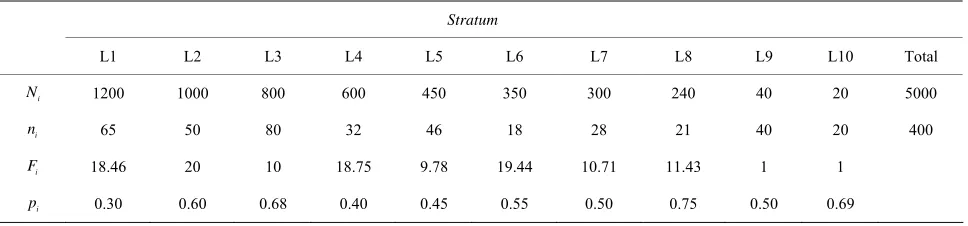
Our first results come from an experiment with binary response. The specific parameter values used to generate the population and the sample are shown in Table 1.
Table 1 summarizes the main features of the experi- ment. Thus, for instance, stratum L1 is formed by 1200 observations taking two possible values, “0” and “1”, that have been randomly generated from Bernoulli trials
with 1 . Note that all the values i
are around 0.5, but there is a high variability between them. The overall population consists of 5000 observa-
tions and satisfies that and
.
"1"
ˆ E
"1000 p P
0.05135
M
rel
Under this population design, samples of size were generated, and hence 1000 estimates
were obtained with each studied method. In the case of the bootstrap procedures, a set of bootstrap replicates was considered to compute each estimator. The behaviour of each estimation procedure was examined by using the following values:
1000 B
1 1
ˆ M ˆr
r
E M
i)
(iv) MSE ˆ = Bias ˆ 2Var ˆii) Bias ˆ E ˆ (v) RMSE ˆ MSE ˆ
iii) sd ˆ Varˆ (vi) Effic ˆ MSE ˆ MSE ˆPI
ˆEffic
The quantity measures the efficiency of each estimator ˆ with respect to the plug-in estimator,
ˆPI Effic ˆ 1
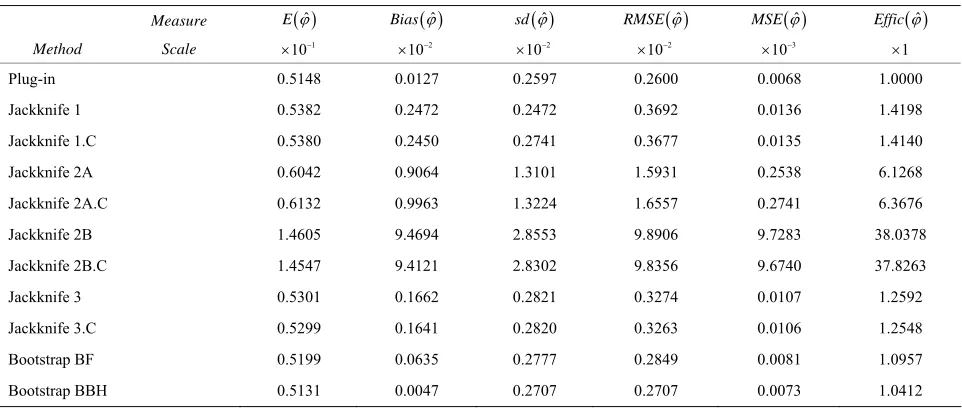
. Thus, means that the considered estimator ˆ presents better behavior than the plug-in estimator in terms of mean squared error. Results from our first experiment are shown in Table 2, where different scales have been used to obtain a more intuitive comparison.
Similar experiments were carried out using different
1 L
i i
n n
, where the new sample size in the sample sizes i-th stratum, i1, , L, was determined by nikni,
with i being the sample size of the first experiment
(see Table 1) and k = 0.25, 0.30, 2, 3 and 4. Excluded from this rule are the two self-represented strata for which obviously
n
i i
n N in all cases. The values of
ˆRMSE and Effic
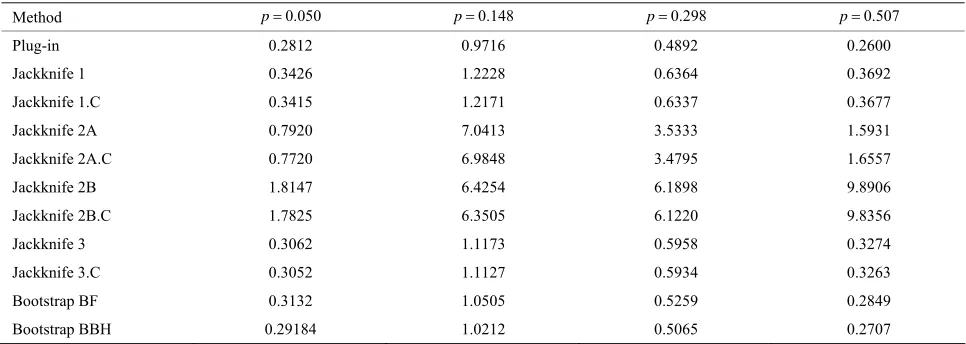
ˆ obtained with these new sample sizes are presented in Tables 3 and 4, respec- tively.New trials of our first experiment were run with diffe- rent values of parameter . Table 5 presents
results of
"1" pP
ˆRMSE obtained for different values of .
p
Tables 2-5 provide a sample of the results obtained in our extensive numerical study with binary response. Some interesting conclusions derived from this study are stated below.
The plug-in method gave good results and was often the most efficient procedure. Moreover, it has the advantage of being computationally fast. It is also observed that its efficiency improves with increasing sample size.
[image:7.595.57.541.622.735.2]
Ni , sample size
n , elevation factor i
Table 1. Parameters in the first experiment with binary response: population size
Fi and piP
"1"
for the i-th stratum
Li i
, 1,,10.Stratum
L1 L2 L3 L4 L5 L6 L7 L8 L9 L10 Total
i
N 1200 1000 800 600 450 350 300 240 40 20 5000
i
n
i
65 50 80 32 46 18 28 21 40 20 400
F 18.46 20 10 18.75 9.78 19.44 10.71 11.43 1 1
i
Table 2. Results for the experiment with binary response conducted under parameters in Table 1. Total population para- meters: pP
"1"
0 5072. and Erel
ˆ
0 05135. . Results based on M1000 trials with sample size n400.Measure E ˆ Bias ˆ sd ˆ RMSE ˆ MSE ˆ Effic ˆ
Method Scale 101 102 102 102 103 1
Plug-in 0.5148 0.0127 0.2597 0.2600 0.0068 1.0000
Jackknife 1 0.5382 0.2472 0.2472 0.3692 0.0136 1.4198
Jackknife 1.C 0.5380 0.2450 0.2741 0.3677 0.0135 1.4140
Jackknife 2A 0.6042 0.9064 1.3101 1.5931 0.2538 6.1268
Jackknife 2A.C 0.6132 0.9963 1.3224 1.6557 0.2741 6.3676
Jackknife 2B 1.4605 9.4694 2.8553 9.8906 9.7283 38.0378
Jackknife 2B.C 1.4547 9.4121 2.8302 9.8356 9.6740 37.8263
Jackknife 3 0.5301 0.1662 0.2821 0.3274 0.0107 1.2592
Jackknife 3.C 0.5299 0.1641 0.2820 0.3263 0.0106 1.2548
Bootstrap BF 0.5199 0.0635 0.2777 0.2849 0.0081 1.0957
Bootstrap BBH 0.5131 0.0047 0.2707 0.2707 0.0073 1.0412
ˆ 210
[image:8.595.57.540.352.522.2]SE RM
Table 3. Values of
n n n
for different sample sizes.
Method 145 230 400 740n 1080n n1420
Plug-in 1.1840 0.5366 0.2600 0.127 0.075 0.0052
Jackknife 1 1.5743 0.7060 0.3692 0.298 0.329 0.0380
Jackknife 1.C 1.5737 0.7051 0.3677 0.296 0.325 0.0376
Jackknife 2A 4.3400 2.0697 1.5931 2.572 3.177 0.3616
Jackknife 2A.C 4.2781 2.0474 1.6557 2.660 3.267 0.3707
Jackknife 2B 8.5497 9.0836 9.8906 10.957 11.401 1.1773
Jackknife 2B.C 8.4640 9.0140 9.8356 10.912 11.359 1.1732
Jackknife 3 1.2161 0.6026 0.3274 0.280 0.318 0.0366
Jackknife 3.C 1.2158 0.6021 0.3263 0.277 0.315 40.0362
Bootstrap BF 1.2351 0.5643 0.2849 0.160 0.171 0.0157
Bootstrap BBH 1.2605 0.5715 0.2707 0.137 0.090 0.0072
ˆEffic
Table 4. Results of for different sample sizes.
Method n145 n230 n400 n740 n1080 n1420
Plug-in 1.0000 1.0000 1.0000 1.0000 1.0000 1.0000
Jackknife 1 1.3296 1.3156 1.4198 2.3526 4.3525 7.3621
Jackknife 1.C 1.3290 1.3141 1.4140 2.3306 4.3041 7.2785
Jackknife 2A 3.6656 3.8572 6.1268 20.2704 42.0836 70.0182
Jackknife 2A.C 3.6133 3.8156 6.3678 20.9679 43.2797 7107821
Jackknife 2B 7.2211 16.9287 38.0378 86.3640 151.0166 227.9469
Jackknife 2B.C 7.1487 16.7990 37.8263 86.0093 150.4603 227.1530
Jackknife 3 1.0271 1.1230 1.2592 2.2079 4.2156 7.0899
Jackknife 3.C 1.0269 1.1220 1.2548 2.1869 4.1686 7.0090
Bootstrap BF 1.0432 1.0516 1.0957 1.2631 2.2631 3.0474
[image:8.595.56.540.557.734.2]
ˆ 2
10
[image:9.595.56.539.106.278.2]SE RM
Table 5. Results of for different values of pP "1"
0.050
p p 0.148
.
Method 0.298p 0.507p
Plug-in 0.2812 0.9716 0.4892 0.2600
Jackknife 1 0.3426 1.2228 0.6364 0.3692
Jackknife 1.C 0.3415 1.2171 0.6337 0.3677
Jackknife 2A 0.7920 7.0413 3.5333 1.5931
Jackknife 2A.C 0.7720 6.9848 3.4795 1.6557
Jackknife 2B 1.8147 6.4254 6.1898 9.8906
Jackknife 2B.C 1.7825 6.3505 6.1220 9.8356
Jackknife 3 0.3062 1.1173 0.5958 0.3274
Jackknife 3.C 0.3052 1.1127 0.5934 0.3263
Bootstrap BF 0.3132 1.0505 0.5259 0.2849
Bootstrap BBH 0.29184 1.0212 0.5065 0.2707
Both bootstrap methods (BF and BBH) yield com- petitive results. The BBH bootstrap presents better behaviour than the BF bootstrap, especially for large sample sizes. For moderate or small sample sizes (less than 10% of the population size), the bootstrap methods behave similarly to the plug-in method in terms of efficiency, although with a higher computa- tional cost (that, in any case, results to be acceptable).
Results in Table 5 allows us to conclude that prior comments are valid for binary variables regardless of the specific value taken by
"1" . In particular, it is observed that RMSE takes the smallest values when p is close to 0 or 0.5.p P
, ,
Next step in our simulation study is addressed to analyze the case of multiple response. Specifically, it is assumed that there are four mutually exclusive and exhaustive results for the response variable, let us say
1 2 3 The jackknife 3 estimator (based on applying jack-
knife to each stratum) behaved similarly to the boot-
strap estimators for small sample sizes
n400
population of A A A and A4. As in the case of binary response, a and worsened with increasing n. Jackknife 1 esti-mator (based on leaving out one sample datum) was competitive although yielded worse results than the jackknife 3 with small sample sizes. Both variants of the jackknife 2 estimator (based on leaving out one stratum) yielded much worse results for all the con- sidered sample sizes. Therefore, it is not advisable to use the jackknife 2 estimators. In general, the worse behaviour of the jackknife-based estimators seems to be mainly due to the bias of the estimation, although for the jackknife 2 estimators poor results are also observed in terms of standard deviation.
5000
N observations divided in L = 10 strata was simulated. Data forming the -th stratum were randomly generated from a multinomial distribution with parameter
j
1, 2, ,3 4
j j j j j j
i
, where de-
notes the probability of event Ai in the -th stratum, j
, 1, 2,3, 4j j
P A i
i i . Different values of
j were selected to set up scenarios with high and low variability of the responses between strata. In all cases, the overall population, which is formed by bringing together all strata, presents the theoretical parameter vector
1, , ,2 3 4
0.58, 0.24, 0.12, 0.06
, where
, 1, 2,3, 4i P Ai i
1000 M
. No substantial differences were observed between
using the jackknife procedures and their corrected versions (.C), based on cancelling the exhaustive strata. Just a slight advantage for the corrected ver- sions is observed.
Similar conclusions are valid for the two scenarios of high and low variability of the response between different strata. In general, the plug-in estimator is the most efficient in both situations, although the diffe- rences between the plug-in and the other methods are smaller in the case of low variability.
For small sample sizes
n145
, both two bootstrap methods and jackknife 3 led to a greater efficiency than the plug-in method.A total of samples of size were randomly selected and each of them was used to con- struct an estimator
400 n
ˆ
of the relative error in the sam-
1 2 3 4
ˆ ˆ ˆ ˆ ˆ, , ,
pling of . Again, two strata were con- sidered to be exhaustive in the sampling. The theoretical error for the simulated population is
0.05,0.09,0.15,0.21
ˆ ,r1, , M
ˆ ,i1, 2,3, 4
ˆ. The set of estimates obtained with each of the studied methods
r
isthen used to calculate the mean squared error and the efficiency of each procedure with respect to the plug-in method. Both quantities were simultaneously obtained for each estimated marginal component i
t ˆ
1 2.r r
1
1
ˆ ˆ M ˆ
r
RMSE MSE
M
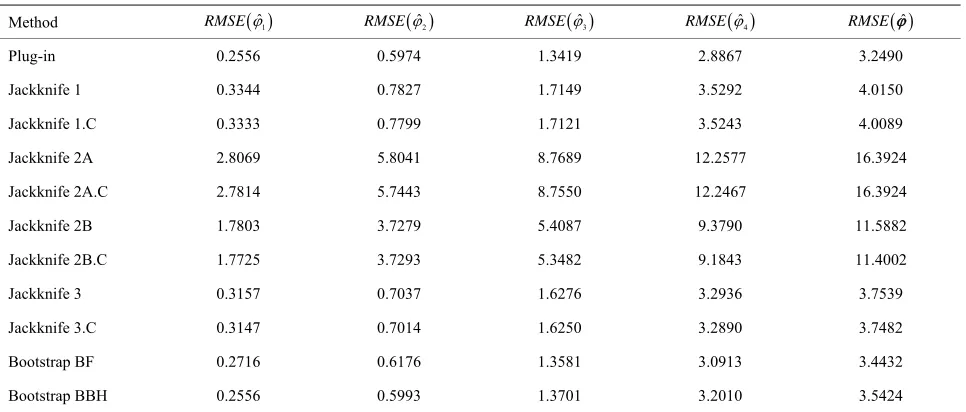
Results from this new simulation are shown in Tables 6 and 7.
Results from Tables 6 and 7 show that the conclusions derived from simulations with binary response are equally valid for the case of multiple response.
Finally, we focus on the case of continuous response variables. Thus, new experiments were carried out to examine the performance of the different estimation pro- cedures with responses generated from uniform, normal and exponential distributions. The simulation plan was
designed by following the same outline as in previous experiments.
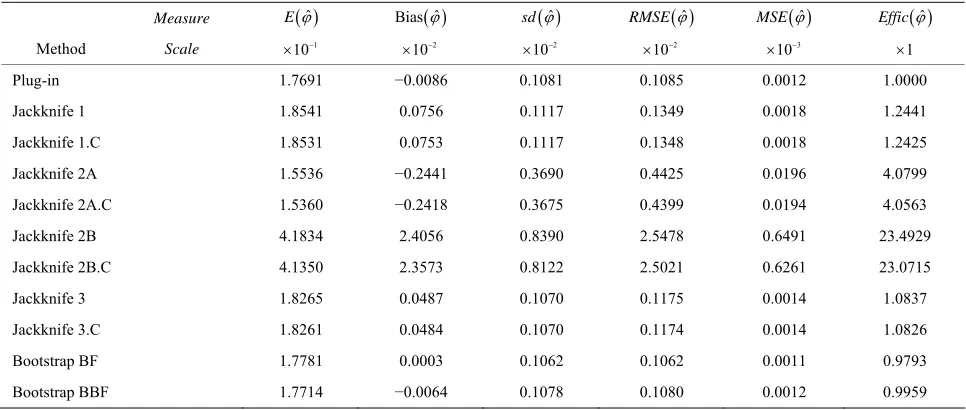
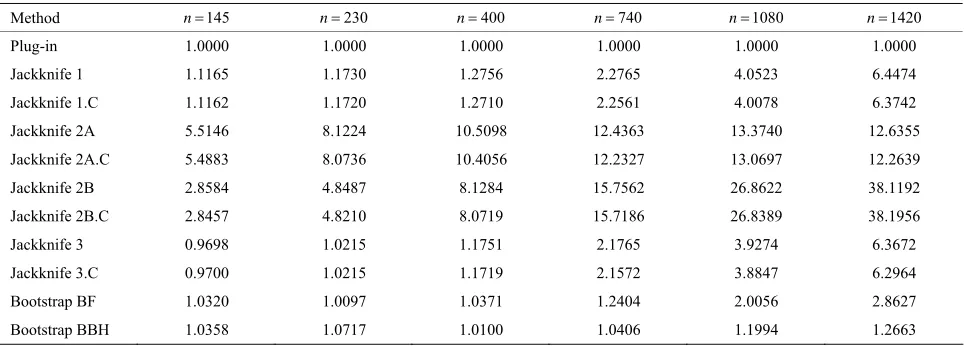
For instance, some experiments with normal and ex- ponential responses were carried out considering the features summarized in Table 8. Note that these para- meters lead to a situation of high variability between data from different strata. Some outcomes derived from these experiments are presented in Tables 9 and 10, for the Gaussian case, and in Tables 11 and 12, for the ex- ponential case. Here, the target parameter in the overall population, Erel
ˆ , took the value 0.01770.05365
for the Gaussian response, and
, for the ex- ponential response.
[image:10.595.58.541.285.491.2]
Table 6. Results of ˆ 2
10
RMSE
1000
M n 400
for the experiment with multiple response and high response variability between strata. Results based on trials with sample size .
ˆ1
RMSE RMSE ˆ2 RMSE ˆ3 RMSE ˆ4 RMSE ˆ
Method
Plug-in 0.2556 0.5974 1.3419 2.8867 3.2490
Jackknife 1 0.3344 0.7827 1.7149 3.5292 4.0150
Jackknife 1.C 0.3333 0.7799 1.7121 3.5243 4.0089
Jackknife 2A 2.8069 5.8041 8.7689 12.2577 16.3924
Jackknife 2A.C 2.7814 5.7443 8.7550 12.2467 16.3924
Jackknife 2B 1.7803 3.7279 5.4087 9.3790 11.5882
Jackknife 2B.C 1.7725 3.7293 5.3482 9.1843 11.4002
Jackknife 3 0.3157 0.7037 1.6276 3.2936 3.7539
Jackknife 3.C 0.3147 0.7014 1.6250 3.2890 3.7482
Bootstrap BF 0.2716 0.6176 1.3581 3.0913 3.4432
Bootstrap BBH 0.2556 0.5993 1.3701 3.2010 3.5424
ˆ [image:10.595.57.540.536.735.2]Effic
Table 7. Results of for the experiment with multiple response and high response variability between strata. Results based on M1000 trials with sample size n400
145
n n230 n 400
.
Method 740n 1080n n1420
Plug-in 1.0000 1.0000 1.0000 1.0000 1.0000 1.0000
Jackknife 1 1.1427 1.1322 1.2358 1.6634 2.4630 3.4143
Jackknife 1.C 1.1523 1.1315 1.2339 1.6572 2.4503 3.3943
Jackknife 2A 2.0393 3.2180 5.0454 6.6219 7.4788 7.1866
Jackknife 2A.C 2.0346 3.2084 5.0327 6.6123 7.4769 7.1893
Jackknife 2B 1.5625 2.1351 3.5667 6.5472 10.5012 13.8590
Jackknife 2B.C 1.5410 2.1142 3.5088 6.3559 10.1349 13.3493
Jackknife 3 0.9652 1.0451 1.1554 1.6130 2.3709 3.3767
Jackknife 3.C 0.9818 1.0442 1.1536 1.6071 2.3587 3.3573
Bootstrap BF 1.0101 0.9744 1.0598 1.1614 1.5541 1.8045
Table 8. Main features for experiments with normal and exponential responses: population size
Ni
, sample size
ni
Liand distribution parameters for the i-th stratum .
Stratum
L1 L2 L3 L4 L5 L6 L7 L8 L9 L10 Total
i
N 1200 1000 800 600 450 350 300 240 40 20 5000
i
n
i
65 50 80 32 46 18 28 21 40 20 400
Normal
50 55 46 45 56 44 57 55 46 50
i
10 22 15 10 9 20 21 19 11 12
Exponential
i
[image:11.595.56.539.303.508.2] 0.10 0.11 0.09 0.10 0.11 0.10 0.11 0.09 0.10 0.08
Table 9. Results from the experiment with Gaussian response conducted according to parameters in Table 8 and based on trials with sample size .
= 1000
M n400
Measure E ˆ Bias ˆ sd ˆ RMSE ˆ MSE ˆ Effic ˆ
Method Scale 101 102 102 102 103 1
Plug-in 1.7691 −0.0086 0.1081 0.1085 0.0012 1.0000
Jackknife 1 1.8541 0.0756 0.1117 0.1349 0.0018 1.2441
Jackknife 1.C 1.8531 0.0753 0.1117 0.1348 0.0018 1.2425
Jackknife 2A 1.5536 −0.2441 0.3690 0.4425 0.0196 4.0799
Jackknife 2A.C 1.5360 −0.2418 0.3675 0.4399 0.0194 4.0563
Jackknife 2B 4.1834 2.4056 0.8390 2.5478 0.6491 23.4929
Jackknife 2B.C 4.1350 2.3573 0.8122 2.5021 0.6261 23.0715
Jackknife 3 1.8265 0.0487 0.1070 0.1175 0.0014 1.0837
Jackknife 3.C 1.8261 0.0484 0.1070 0.1174 0.0014 1.0826
Bootstrap BF 1.7781 0.0003 0.1062 0.1062 0.0011 0.9793
Bootstrap BBF 1.7714 −0.0064 0.1078 0.1080 0.0012 0.9959
ˆ [image:11.595.60.538.539.733.2]Effic
Table 10. Results of for Gaussian response and different sample sizes.
Method n = 145 n = 230 n = 400 n = 740 n = 1080 n = 1420
Plug-in 1.0000 1.0000 1.0000 1.0000 1.0000 1.0000
Jackknife 1 1.2080 1.1241 1.2441 1.9405 3.3611 5.6684
Jackknife 1.C 1.2079 1.2237 1.2425 1.9327 3.3438 5.6372
Jackknife 2A 3.9205 4.5127 4.0799 7.5143 16.6298 31.3715
Jackknife 2A.C 3.9042 4.4950 4.0563 7.5016 16.6140 31.3358
Jackknife 2B 4.4365 10.2989 23.4929 54.3585 93.2693 145.4229
Jackknife 2B.C 4.3642 10.1115 23.0715 53.5200 91.8624 143.3255
Jackknife 3 0.9942 1.0336 1.0837 1.8723 3.2635 5.5708
Jackknife 3.C 0.9943 1.0335 1.0826 1.8648 3.2468 5.5406
Bootstrap BF 1.0140 0.9996 0.9793 1.0183 1.8710 2.0230
Table 11. Results from the experiment with Exponential response conducted according to parameters in Table 8 and based on M = 1000 trials with sample size n = 400.
Measure E ˆ Bias ˆ sd ˆ RMSE ˆ MSE ˆ Effic ˆ
Method Scale 101 102 102 102 103 1
Plug-in 5.3474 −0.0179 0.2894 0.2899 0.08410 1.0000
Jackknife 1 5.5928 0.2275 0.2915 0.3698 0.1368 1.2756
Jackknife 1.C 5.5928 0.2252 0.2917 0.3685 0.1358 1.2710
Jackknife 2A 2.4534 −2.9119 0.8971 3.0470 9.2841 10.5098
Jackknife 2A.C 2.4865 −2.8788 0.9022 3.0168 9.1013 10.40556
Jackknife 2B 6.4268 1.0615 2.1040 2.3566 5.5537 8.1284
Jackknife 2B.C 6.3898 1.0245 2.0803 2.3402 5.4766 8.0719
Jackknife 3 5.5246 0.1593 0.3012 0.3407 0.1161 1.1751
Jackknife 3.C 5.5224 0.1571 0.3013 0.3398 0.1154 1.1719
Bootstrap BF 5.3963 0.0310 0.2991 0.3007 0.0904 1.0371
Bootstrap BBH 5.3442 −0.0211 0.2921 0.2928 0.0857 1.0100
ˆ [image:12.595.57.539.329.502.2]Effic
Table 12. Results of for exponential response and different sample sizes.
Method n145 230n 400n 740n 1080n n1420
Plug-in 1.0000 1.0000 1.0000 1.0000 1.0000 1.0000
Jackknife 1 1.1165 1.1730 1.2756 2.2765 4.0523 6.4474
Jackknife 1.C 1.1162 1.1720 1.2710 2.2561 4.0078 6.3742
Jackknife 2A 5.5146 8.1224 10.5098 12.4363 13.3740 12.6355
Jackknife 2A.C 5.4883 8.0736 10.4056 12.2327 13.0697 12.2639
Jackknife 2B 2.8584 4.8487 8.1284 15.7562 26.8622 38.1192
Jackknife 2B.C 2.8457 4.8210 8.0719 15.7186 26.8389 38.1956
Jackknife 3 0.9698 1.0215 1.1751 2.1765 3.9274 6.3672
Jackknife 3.C 0.9700 1.0215 1.1719 2.1572 3.8847 6.2964
Bootstrap BF 1.0320 1.0097 1.0371 1.2404 2.0056 2.8627
Bootstrap BBH 1.0358 1.0717 1.0100 1.0406 1.1994 1.2663
Results in Tables 9-12 allow us to confirm that the different analyzed estimation procedures behaved as in the previous experiments. Moreover, an analogous beha- viour was also observed with uniform response and with scenarios of low variability between strata. In short, the conclusions derived from our numerical study with bin- ary or multinomial response can be extended to the case of continuous response variables, regardless of the gene- rating probability distribution.
amined in this type of surveys are binary, categorical and continuous, and hence, the estimates of interest involve estimates of proportions, totals and means. In this setting, several procedures to approximate the sampling relative error of this kind of estimates are proposed. Different estimation techniques are considered, including the natu- ral estimation of plug-in type and more sophisticated methods based on jackknife and bootstrap methodologies. The behaviour of the different procedures proposed is examined and compared by means of an extensive simu- lation study. In general, the plug-in method presents good behaviour in all the analyzed situations, with the additional advantage of having a low computational cost. For small sample sizes, the jackknife estimator denoted by “jackknife 3”, which is based on the prior application of the jackknife technique to each stratum, and the two bootstrap methods considered (particularly the bootstrap proposed by Booth, Butler and Hall) yield results similar
6. Final Conclusion
as those obtained with the plug-in estimator, and in some cases, even better. However, the estimators obtained with these methods have a higher (although acceptable) com- putational cost.
7. Acknowledgements
This research was supported by the Galician Official Statistical Institute (IGE) and by Grants 10DPI105003PR and CN2012/130 from Xunta de Galicia (Spain), and by Grant number MTM2011-22392 from Ministerio de Ciencia e Innovación (Spain).
REFERENCES
[1] S. K. Thompson, “Sampling,” Wiley, New York, 1992. [2] M. Quenouille, “Approximate Tests of Correlation in
Time Series,” Journal of the Royal Statistical Society: Se- ries B (Statistical Methodology), Vol. 11, No. 1, 1949, pp.
18-84.
[3] B. Efron, “Bootstrap Methods: Another Look at the Jackknife,” The Annals of Statistics, Vol. 7, No. 1, 1979,
pp. 1-26. doi:10.1214/aos/1176344552
[4] B. Efron, “The Jackknife, the Bootstrap, and Other Re- sampling Plans, Siam Monograph 38,” Society of Indus- trial and Applied Mathematics CBMS-NSF Monographs, 1982.
[5] B. Efron and R. Tibshirani, “An Introduction to the Boot- strap,” Chapman & Hall, New York, 1993.
[6] P. J. Bickel and D. A. Freedman, “Asymptotic Normality and the Bootstrap in Stratified Sampling,” The Annals of Statistics, Vol. 12, No. 2, 1984, pp. 470-482.
doi:10.1214/aos/1176346500
[7] J. G. Booth, R. W. Butler and P. Hall, “Bootstrap Meth- ods for Finite Populations,” Journal of the American Sta- tistical Association, Vol. 89, No. 248, 1994, pp. 1282-