1 Cite as: Wallace G, Bird V, Leamy M, Bacon F, Le Boutillier C, Janosik M, Macpherson R, Williams J, Slade M Service user experiences of REFOCUS: a process evaluation of a pro-recovery complex intervention, Social Psychiatry and Psychiatric Epidemiology, in press.
Title: Service user experiences of REFOCUS: a process evaluation of a pro-recovery complex intervention
Genevieve Wallace*
Research worker, King’s College London, Health Service and Population Research Department, Institute of Psychiatry, Psychology & Neuroscience, De Crespigny Park, London
Victoria Bird*+
Research Fellow, Wolfson Institute of Preventive Medicine, Queen Mary University of London, Newham centre for mental health, London E13 8SP,
* Joint first authors
Mary Leamy
Programme manager and trial coordinator, King’s College London, Health Service and Population Research Department, Institute of Psychiatry, Psychology & Neuroscience, De Crespigny Park, London
Faye Bacon
Research worker, King’s College London, Health Service and Population Research Department, Institute of Psychiatry, Psychology & Neuroscience, De Crespigny Park, London
Clair Le Boutillier
Research worker, King’s College London, Health Service and Population Research Department, Institute of Psychiatry, Psychology & Neuroscience, De Crespigny Park, London
2 Research worker, King’s College London, Health Service and Population Research Department, Institute of Psychiatry, Psychology & Neuroscience, De Crespigny Park, London
Rob Macpherson
Consultant psychiatrist, 22gether NHS Foundation Trust, Gloucestershire Julie Williams
Research worker, King’s College London, Health Service and Population Research Department, Institute of Psychiatry, Psychology & Neuroscience, De Crespigny Park, London
Mike Slade
Professor of Mental Health Recovery and Social Inclusion, Institute of Mental Health, University of Nottingham, Triumph Road, Nottingham NG7 2TU
+Corresponding author [email protected]
Acknowledgments
3 Word count 245 abstract, Overall 4746
Abstract
Purpose: Policy is increasingly focused on implementing a recovery-orientation within mental health services, yet the subjective experience of individuals receiving a pro-recovery intervention is under-studied. The aim of this study was to explore the service user experience of receiving a complex, pro-recovery intervention (REFOCUS), which aimed to encourage the use of pro-recovery-supporting tools and support recovery-promoting relationships.
Methods: Interviews (n=24) and two focus groups (n=13) were conducted as part of a process evaluation and included purposive sample of service users who received the complex, pro-recovery intervention within the REFOCUS randomised controlled trial (ISRCTN02507940). Thematic analysis was used to analyse the data.
Results: Participants reported that the intervention supported the development of an open and collaborative relationship with staff, with new conversations around values, strengths and goals. This was experienced as hope-inspiring and empowering. However, others described how the recovery tools were used without context, meaning participants were unclear of their purpose and did not see their benefit. During the interviews, some individuals struggled to report any new tasks or conversations occurring during the intervention.
Conclusion: Recovery-supporting tools can support the development of a recovery-promoting relationship, which can contribute to positive outcomes for individuals. The tools should be used, in a collaborative and flexible manner. Information exchanged around values, strengths and goals should be used in care-planning. As some service users struggled to report their experience of the intervention, alternative evaluation approaches need to be considered if the service user experience is to be fully captured.
Declarations of conflicting interest: None
4 Introduction
Personal recovery has been defined as “a deeply personal, unique process of changing one’s attitudes, values, feelings, goals, skills, and/or roles. It is a way of living a satisfying, hopeful, and contributing life even within the limitations caused by illness” [1]. A systematic review and narrative synthesis of 97 models of recovery identified five key recovery processes: Connectedness, Hope and optimism, Identity, Meaning and purpose and Empowerment (CHIME)[2].
Personal recovery underpins national mental health policy in many Anglophone countries, and highlights an intention to move away from directive services with a narrow focus of symptom reduction [3,4]. Despite emerging clarity around the meaning of personal recovery [2,5] and the prioritisation of personal recovery in mental health service policy, delivery of a recovery-orientation within routine practice remains a challenge [6,7,8]. Concerns have been raised about the mainstreaming of recovery within services [9], and how services can successfully balance risk management within a recovery-promoting service which aims to minimise coercion [10]. Despite studies focussing on the service user experience of care [11,12], or the overall meaning of recovery [13], less evaluative work has been conducted into the experience of receiving a pro-recovery intervention or service.
The REFOCUS programme was a 5-year programme of research aiming to improve the recovery-orientation of community mental health teams in England through the development and testing of a manualised team-based complex, pro-recovery intervention [14]. The intervention and evaluation was based on best practice in recovery support, and systematic reviews of personal recovery [2], strengths [15], recovery measures [16] and recovery support measures [17]. The REFOCUS intervention was evaluated within a cluster randomised controlled trial [18].
In line with best practice in trial methodology [19] a process evaluation was undertaken as part of the REFOCUS programme, aiming to understand the experience of individuals receiving and delivering the REFOCUS intervention. This paper focuses on the service user experience of receiving the intervention, and aims to provide ecologically valid evidence about the impact of recovery-orientated care on the experience of service users.
5 As part of the REFOCUS process evaluation, semi-structured individual interviews and focus groups were conducted with service users who received care from teams in the intervention arm of the trial.
Refocus intervention and trial
The REFOCUS Trial (ISRCTN02507940) took place across adult community mental health teams in two provider trusts in England: South London and Maudsley NHS Foundation Trust (SLaM) and 2gether NHS Foundation Trust (2gether) in Gloucestershire. The trial evaluated a one year manualised, pro-recovery intervention, delivered to whole community mental health teams. The intervention was intended to be integrated into routine clinical practice, and consisted of two components: pro-recovery Working Practices and Recovery-promoting relationships. The Working Practices (WPs) provided staff with materials and tools they could use to support: Understanding values and treatment preferences (WP1), Assessing strengths (WP2), and Supporting goal-striving (WP3). The WPs were designed to be used collaboratively with service users. Staff were not required to explicitly reference the REFOCUS intervention when using the WPS, but instead integrate them within their routine care. The WPs were provided in the context of Component two: Recovery-promoting relationships. Teams were supported to develop a shared understanding of the meaning of personal recovery, as well as recognise service users as equal partners in their care. Attitude and value change was promoted through personal recovery training and a coaching skills-based training course. Recovery promoting relationships were also promoted through supporting teams to initiate a ‘partnership project’ which encouraged staff and service users to work collaboratively on a shared task or activity of their choosing.
Twenty-seven community mental health teams from SLaM (18 teams) and 2gether (9 teams) participated in the trial. Teams were eligible for inclusion if they provided a care co-ordinating function for service users. Fourteen teams (nine in SLaM, five in 2gether) were allocated to the intervention arm with the remaining teams allocated to standard care. The 14 teams allocated to the intervention comprised recovery (n=9), psychosis (n=2), forensic (n=2) and low support teams (n=1). Although the name and client group of these teams varied somewhat, they all aim to support the recovery of individuals with complex mental health difficulties in the community.
Ethical approval
6 Participants
For the individual interviews a purposive sample of 24 individuals was recruited from 11 of the 14 intervention teams. The purposive sample aimed to maximise variation in trial site, service location, time in mental health services and diagnosis. To be included, service users were required to meet the following criteria a) have received the REFOCUS intervention based on staff or self-report during the previous 12 months, b) were well enough to take part as decided by their care coordinator and c) could speak and understand English.
Focus groups were conducted with a convenience sample of individuals who had taken part in two partnership projects: the ‘Let’s Be Well’ website and ‘Outward Bound’ activity day, in which staff and service users worked together to create a website highlighting local services and resources, and embarked on a range of outdoor adventure activities, respectively. These were chosen as they represented both sites of the trial and were contrasting types of project.
Procedure
A semi-structured interview schedule was developed in collaboration with the REFOCUS Lived Experience Advisory Panel (LEAP) - a group of individuals with personal or family experience of mental health difficulties, who provided Patient Public Involvement to the programme. The interview schedule aimed to gather in-depth data relating to the experience of receiving the REFOCUS intervention and included questions on their experience of services in the last year, recovery promoting relationships and REFOCUS Working Practices. The focus group topic guide covered the experience of participating in a partnership project. Focus groups were used instead of interviews to capture the shared experience of these group-based projects.
7 Prior to the interview and focus groups, participants were provided with information about the study, written informed consent was obtained, and socio-demographic information collected. The researchers conducting the interviews were all from professional research backgrounds, and had in-depth knowledge of the REFOCUS intervention. VB, MJ, ML, EC and GR received training in conducting service user interviews from members of LEAP. Each focus group was facilitated by two researchers. The interviews lasted between 35 and 65 minutes, with both focus groups lasting approximately 90 minutes.
At the end of each interview or focus group, participants were given the opportunity to ask questions and reflect on their experience. All individuals received remuneration for their participation (£20 for focus groups, £10 for interviews). The research was conducted at local community mental health team bases or in the participant’s home. Following data collection, interviewers recorded their initial impressions and identified emergent themes in memos which were used during the data analysis [20].
Data analysis
Interviews and focus groups were recorded, transcribed verbatim and anonymised. Transcripts were coded using NVivo qualitative data analysis software version 8. Thematic analysis was used for the data analysis following the guidance of Braun and Clarke [20]. Initially, the first four interview transcripts were coded inductively by three independent coders (VB, FB and MJ) to identify pertinent codes within the text. The coders met to discuss the codes and develop an initial coding framework. The topic guide was modified to reflect emerging codes with data collection continuing concurrently with the data analysis. Two researchers (VB and GW), including one researcher with a professional/service user background, independently applied the coding framework to the remaining transcripts. Throughout coding the two coders met regularly to iteratively update and modify the coding framework. Any differences in coding were discussed and alternative interpretations of the data recorded as memos. The two researchers then reviewed the codes, seeking to organise them into overarching themes. Candidate themes were reviewed and refined. For each of the themes and sub-themes a definition was created. The language of the original data extracts was used to inform their headings and definitions.
Results
8 who refused were from a range of teams across both sites. One focus group was carried out in each Trust, consisting of 6 and 7 service users respectively. Demographics of the individuals who took part are included in Table 1
INSERT TABLE 1 HERE
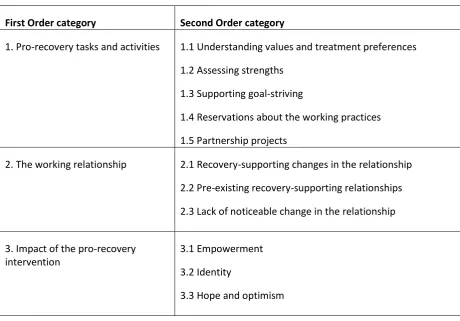
Themes were apparent across the different individual interviews and focus groups, unless otherwise specified. The themes were organised into three superordinate categories: ‘Pro-recovery tasks and activities’, ‘The working relationship’ and the ‘Impact of the recovery intervention’. The first and second order categories are shown in Table 2.
INSERT TABLE 2 HERE
Category 1: Pro-recovery tasks and activities
Participants described their experience of the pro-recovery tasks and activities (Working Practices) implemented during the REFOCUS intervention. These were three specific conversations and behaviours, which staff were encouraged to use with service users.
1.1 Understanding values and treatment preferences
Staff were encouraged to learn about the values and treatment preferences of service users to inform care-planning, through either conversational, narrative or visual mapping approaches. Participants reported new topics of conversation, particularly around sexuality and spirituality, which made participants, feel that staff were ‘genuinely’ interested in them and wanted to get to know them as a person. As a result participants felt better understood, which helped to strengthen the working relationship
‘I just felt she is taking more interest in me, more than just coming and giving me injections, she wanted to know more about how I feel, what I’m doing, what I’m thinking.’ (P3, M, SLaM)
Conversely other participants felt that asking questions about an area of their life implied they had a problem in that area. In some cases, these individuals felt that the questions were intrusive, and reported not wanting to discuss wider aspects of their life with staff.
9 These experiences highlighted the need for any recovery-orientated working practice to be delivered in an individualised way, such as only discussing areas important to the individual and ensuring conversations are service user-led.
1.2 Assessing strengths
The strengths assessment focussed on exploring the internal, external, service-related strengths and resources of individuals. When service users gave examples of their strengths they focused on valued personal qualities such as resilience and kindness, and less on external strengths or resources. Participants reported having a greater awareness of their strengths following these discussions.
‘It was good because it showed I’ve got a lot of courage, that’s one of my strengths’ (P11, M, SLaM)
Where individuals had difficulty identifying their strengths, staff encouragement including highlighting the person’s strengths were helpful strategies. Although only apparent in a few examples, discussions around strengths being taken further to include planning how to utilise those strengths, was seen as particularly useful.
‘It makes me feel like it’s something I can work with, something I can actually put into practice and make part of my routine. If I’m good at it and I want to do it, why shouldn’t it?’ (P2, M, SLaM)
1.3 Supporting goal-striving
Within any recovery-orientated service, staff are encouraged to learn about the personally-valued goals of the people they support, work in partnership to support these goals, and use them to inform care-planning. Service users were more familiar with goal striving than the other pro-recovery tasks in the intervention. Goals gave people a sense of direction and purpose in life, in essence something to ‘aim for’. Many participants gave examples of personal goals, and how these had been shared or discussed with staff members.
‘He’ll ask me what else I want to do with my life, where I see myself in say a couple of years or something like that and in terms of set targets’ (P13, M, SLaM)
10 ‘It makes me realise that I could actually do something, it wasn’t just pie in the sky, it did have a purpose.’ (P23, F, TGT)
1.4 Reservations about the Working Practices
Some individuals could not recall having completed the Working Practices; for these individuals they were not memorable events. For others, the recovery activities and resources were not always positively experienced, particularly where they were delivered in a formulaic and generic way. In these cases, individuals saw them as another form that needed to be completed for the benefit of staff members.
‘That fulfilled something for her more than it did for me y’know being asked “who’s this” and “who’s that”, it didn’t fulfil much for me (…) it was a sort of quick, a sort of bird pecking at the ground.’ (P9, F, SLaM)
Participants highlighted that in order for discussions around strengths, goals and values to be useful, the information they gave should then be acted upon and incorporated into the care plan. Discussing and recording the information without further action did not go far enough to support personal recovery.
‘If you are just asking for asking’s sake then there is nothing but if you use them and ask to see how they can better be suited to your mental your mental wellbeing, your care coordination, then yes.’ (P3, M, SLaM)
1. 5 Partnership project
As with any pro-recovery intervention or service, the aim of the partnership project was for staff members and service users to do something collaboratively and break down any ‘them’ and ‘us’ barriers. Participants from both focus groups described how the partnership projects gave opportunities for social interaction with other service users and staff. This led to new or stronger connections with others. Distinctions between service users and staff faded and relationships were as equals, in genuine partnership.
‘There were times when I can truthfully say I couldn't distinguish between you know who were the punters if you like and who were the staff, and that's a good thing. (…) it was a different approach and probably a very good one.’ (Focus Group, P1, M, TGT)
11 cases. Service users described being ‘invited’ to attend a pre-determined project, describing their involvement as ‘consultation’, and their wish be more comprehensively involved throughout.
‘We are going to an agenda that’s already been set (…) it’s definitely not our project.’ (Focus Group, P3, M, SlaM)
Category 2: The working relationship
The working relationship was central to the intervention. The aim of the Working Practices was to facilitate a more recovery-focused working relationship built on collaboration and strengths-focused approaches.
2.1 Recovery-supporting changes in the relationship
Participants discussed how the REFOCUS intervention changed their relationship with staff by enabling staff to learn more about them. This was particularly linked to the Understanding values and treatment preferences Working Practice, which gave individuals 'permission' to discuss new topics, often neglected within traditional problem-focused conversations. This supported the development of a relationship in which service users felt that staff were genuinely interested in getting to know them as individuals.
‘She's looking at you know empowering me, which shows that she's interested in me as a person, I'm not just a statistic (…) she really cares. It really gives me a strong sense of our relationship; it has like I said improved markedly for that reason.’ (P1, F, SLaM)
Furthermore, this helped to build mutual trust and respect in the relationship, with both parties ‘warming’ to each other. Service users consequently felt more able to be open with staff. An increase in service user-directed conversations was also reported, with individuals feeling able to and wanting to contribute to the agenda of meetings.
‘She’s much more friendly. How can I say this, in a way I’m leading her places rather than she leading me’ (P9, F, SLaM)
2.2 Pre-existing recovery-supporting relationships
Some participants described recovery-oriented features of a working relationship which could not be identified as an intervention-specific change; they predated the intervention. In particular, these relationships were characterised by involvement in decisions, goal setting, feeling listened to and respected as an individual.
12 These relationship qualities were supported by the personality and personal values of staff. In general, participants valued staff being supportive, ‘genuinely’ caring, open and honest in a constructive but not dismissive way. Where relationships were already recovery-supporting, it is likely that any changes brought about by a specific pro-recovery intervention will be less distinct and harder for service users to notice, especially where the intervention was integrated into the routine care already provided.
2.3 Lack of noticeable change in the relationship
There were also a number of participants who stated that their relationships with staff did not become more recovery-orientated during the REFOCUS intervention. They described decision-making power remaining with staff, with differences in opinion seen as evidence of pathology, and medication remaining the focus of conversations. Service users felt that some staff did not want the relationship or this power-dynamic to change.
‘He just wasn’t able to give up that element of control; he felt that if I got to that stage I needed to be in contact with them’ (P22, F, 2gether)
A minority of individuals also reported that they did not want their relationship with staff to change. This was particularly the case where service users sought minimal involvement with services and were not receptive to broadening the role of services beyond risk and medication management. These participants often reported previous negative experiences of services, including forced medication and hospitalisation. In these cases, individuals could not imagine services being different. ‘I don’t think I’ve ever made a decision about my care, I don’t know what kind of decision I would make about my care.’ (P3, M, SLaM)
Category 3: Impact of the pro-recovery intervention
When participants were asked about the impact of REFOCUS, they often focused on specific activities or conversations. However, there was a large amount of overlap in the impact reported.
3.1 Empowerment
Individuals felt empowered by the intervention in relation to both their mental health and other areas of their life. Being given increased independence and choice in their care indicated that staff believed they were capable of managing increased responsibility. This in turn made individuals feel more confident in their ability to cope.
13 Some participants described envisaging a future where they would feel less heavily dependent on staff and services. This was particularly apparent where participants had described working collaboratively with staff to achieve their goals.
‘She’s there for me, but I know in time I won’t have to keep relying on this person.’ (P19, F, 2gether)
3.2 Identity
Service users described how Working Practices used as part of the REFOCUS intervention facilitated greater self-awareness, prompting thoughts about a wide range of life areas that they otherwise rarely focused on, including their goals and values.
‘When they asked these questions it makes you think about yourself in a different light, in a different way, about what you are doing and what you are thinking, how do you see yourself?’ (P3, M, SLaM)
This self-knowledge included greater awareness of their strengths, valued personal qualities and available resources, which encouraged participants to have a more positive self-image. This was seen to be resulting from conducting Strengths assessments, and was further enhanced by increases in the recovery-orientation of the relationship with staff, particularly where staff took an interest in the strengths of the person.
3.3 Hope and optimism
Another important outcome for participants was an increase in hope. Participants across the interviews and focus groups described how this change was due to conversations focusing on strengths and successes both in the Assessing strengths Working Practice and throughout the intervention. Staff members were encouraged to actively communicate their hope and belief in the person.
‘I feel more positive that I can go for what I said I was going to go for, and if someone else believes in me then I more believe in myself.’ (P13, M, SLaM)
Hope was seen by many participants as essential to recovery-promoting efforts, underpinning actions such as goal-striving or building relationships. Therefore increasing hope was felt to be very powerful.
‘If you’ve lost hope then you’ve lost life (…) so it’s good to have someone give you hope (…) that’s the main thing, (…) she just lets me know that there’s reason to have hope.’ (P17, M, SLaM)
Discussion
14 intervention facilitated a mutually open and collaborative relationship between staff and service users. Participants were able to direct conversations and felt that staff got to know them as individuals. The intervention also led to a greater awareness of the person’s strengths and values, leading to a more positive self-image, and increases in hope and empowerment. However, the intervention was not successfully implemented in all cases. In particular, some participants experienced elements of the intervention in the absence of a recovery-promoting relationship. When delivered in this way, these elements were experienced as intrusive and for the benefit of staff. Finally, some individuals struggled to notice changes and could not describe any new tasks or conversations, thus questioning the implementation of the intervention.
The present study was conducted as part of a wider process evaluation nested within the REFOCUS RCT [21]. Within the RCT there were no group differences in recovery scores at the end of the intervention. However, the analysis indicated that where intervention teams had high levels of participation, both staff and service user-rated scores for recovery promotion were significantly greater than controls. The intervention also had positive effects on functioning and levels of unmet need. These findings are consistent with the present study. In particular, the Working Practices were seen as hope-inspiring and empowering, with a shift towards a strengths-focus and goals. Participants discussed how the intervention led to a greater awareness of their own strengths and resources; it is therefore possible that staff also gained more awareness of the strengths of the individual. A number of other quantitative studies have also assessed the effectiveness of recovery-focused interventions including recovery workbooks [22], Wellness Recovery Action Plans (WRAP) [23,24,25,26], peer-led education[27] and strengths-based case management [28] and also demonstrated increases in hope [24,27], empowerment [22].
15 Strengths and Limitations
This is the first study to explore service user experiences of a team-level complex pro-recovery intervention. The use of a qualitative approach across two sites enabled an in-depth and nuanced understanding with increased generalisability. Many mental health services are seeking to become more recovery-focused, and this study provides guidance on what service users do and do not find helpful in recovery-promoting relationships and recovery activities.
Despite this strength, the study had three limitations. Firstly, participants were selected based on self or staff reports of exposure to the REFOCUS intervention, so may not be representative of other service users. Secondly, the main interviewer (VB) helped to develop the intervention and all interviewers were known to be researching recovery, so social desirability bias may have led to over-reporting of change. Furthermore, as interviewers had knowledge of the intervention components, were individuals were prompted by the interviews to aid recall of the different intervention components. Finally, asking participants to characterise interactions over the last 12 months may have led to recall bias.
Implications for practice
Three implications for practice were identified. Firstly, the tools provided to support implementation of the three Working Practices need to be seen as a means not an end. The Working Practices can help to build a recovery-promoting relationship and are of value when implemented within the context of a recovery-orientated relationship. However rigid and formulaic implementation was not found to be helpful. Previous research has indicated that staff tend to focus on particular tasks as evidence of ‘doing’ recovery thus, “omitting the underlying philosophy of recovery-orientated practice” [29,30].
Secondly, recovery-focussed tools should be integrated into care planning. Participants highlighted that conversations around values, strengths and goals needed to result in the information discussed being used to support their recovery. For example, goals need to be broken down into tangible steps, and available resources identified, including opportunities to use the person’s strengths.
16 Research implications
When asked about their experiences, some service users were unable to recall the intervention, despite being identified by staff as individuals who had received it. One explanation may be that participants had little awareness of the REFOCUS intervention. Raising awareness of the intervention may help individuals identify subtle changes in the working relationship, and additionally may increase service user expectations of recovery-promoting practice from staff. One potential strategy for increasing awareness is to provide individuals with signals that the intervention is in use, such as the use of a handbook. This may also facilitate co-ownership of the intervention and promote increased collaboration.
Furthermore the intervention was intended to be integrated into practice and may have resulted in ‘soft’ changes to the working relationship. Where an intervention is integrated within routine care, evaluation from a service user perspective is challenging. Alternative approaches might include ethnographic investigations such as participant observation or the recording of interactions. Although not without their limitations [31,32], these may be more useful in detecting subtle changes.
This study is the first to expand upon the limited knowledge regarding the service user experience of a pro-recovery intervention. The findings highlight that when successfully implemented, the REFOCUS intervention supported the development of recovery-promoting relationships and contributed to recovery outcomes. However, the delivery of the intervention, including ineffective or inadequate implementation, was highlighted as a problem. Finally, if research is to more adequately capture the experience of people using the service, alternative evaluation approaches to evaluation may need to be considered, particularly where interventions are embedded within routine care.
References
1. Anthony WA (1993) Recovery from mental illness: the guiding vision of the mental health system in the 1990s. Psychosocial Rehabilitation Journal 16: 11-23.
2. Leamy M, Bird V, Le Boutillier C, Williams J, Slade M (2011) A conceptual framework for personal recovery in mental health: systematic review and narrative synthesis. British Journal of Psychiatry 199: 445-452.
17 4. Henwood B, Whitley R (2013) Creating a recovery-oriented society: research and action. Aust N Z J
Psychiatry 47: 609-610.
5. Soundy A, Stubbs B, Roskell C, Williams SE, Fox A, et al. (In Press) Identifying the facilitators and processes which influence recovery in individuals with schizophrenia: a systematic review and thematic synthesis. Journal of Mental Health 0: 1-8.
6. Meehan TJ, King RJ, Beavis PH, Robinson JD (2008) Recovery-based practice: do we know what we mean or mean what we know? Australian and New Zealand Journal of Psychiatry 42: 177-182.
7. Oades LG, Anderson J (2012) Recovery in Australia: marshalling strengths and living values. Int Rev Psychiatry 24: 5-10.
8. Felton BJ, Barr A, Clark G, Tsemberis SJ (2006) ACT team members' responses to training in recovery-oriented practices. Psychiatr Rehabil J 30: 112-119.
9. Rose D (2014) The mainstreaming of recovery. Journal of Mental Health 23: 217-218.
10. Sykes MJ, Brabban A, Reilly J (In Press) Balancing harms in support of recovery. Journal of Mental Health 0: 1-5.
11. Tanskanen S, Morant N, Hinton M, Lloyd-Evans B, Crosby M, et al. (2011) Service user and carer experiences of seeking help for a first episode of psychosis: a UK qualitative study. BMC Psychiatry 11: 157.
12. McSherry P, O'Connor C, Hevey D, Gibbons P (2012) Service user experience of adapted
dialectical behaviour therapy in a community adult mental health setting. J Ment Health 21: 539-547.
13. Windell DL, Norman R, Lal S, Malla A (2015) Subjective experiences of illness recovery in individuals treated for first-episode psychosis. Soc Psychiatry Psychiatr Epidemiol 50: 1069-1077.
14. Slade M, Bird V, Le Boutillier C, Williams J, McCrone P, et al. (2011) REFOCUS Trial: protocol for a cluster randomised controlled trial of a pro-recovery intervention within community based mental health teams. BMC Psychiatry 11: 185.
15. Bird VJ, Le Boutillier C, Leamy M, Larsen J, Oades LG, et al. (2012) Assessing the strengths of mental health consumers: a systematic review. Psychol Assess 24: 1024-1033.
16. Shanks V, Williams J, Leamy M, Bird VJ, Le Boutillier C, et al. (2013) Measures of personal recovery: a systematic review. Psychiatr Serv 64: 974-980.
17. Williams J, Leamy M, Bird V, Harding C, Larsen J, et al. (2012) Measures of the recovery orientation of mental health services: systematic review. Social Psychiatry and Psychiatric Epidemiology 47: 1827-1835.
18. Slade M, Bird V, Clarke E, Le Boutillier C, McCrone P, et al. (In Press) Supporting recovery in patients with psychosis using adult mental health teams (REFOCUS): a multi-site cluster randomised controlled trial. Lancet Psychiatry.
19. Grant A, Treweek S, Dreischulte T, Foy R, Guthrie B (2013) Process evaluations for
cluster-randomised trials of complex interventions: a proposed framework for design and reporting. Trials 14: 15.
20. Braun V, Clarke V (2006) Using thematic analysis in psychology. Qualitative research in psychology 3: 77-101.
21. Slade M, Bird V, Clarke E, Le Boutillier C, McCrone P, et al. (2015) Supporting recovery in patients with psychosis through care by community-based adult mental health teams (REFOCUS): a multisite, cluster, randomised, controlled trial. Lancet Psychiatry 2: 503-514.
22. Barbic S, Krupa T, Armstrong I (2009) A randomized controlled trial of the effectiveness of a modified recovery workbook program: preliminary findings. Psychiatr Serv 60: 491-497. 23. Cook JA, Copeland ME, Hamilton MM, Jonikas JA, Razzano LA, et al. (2009) Initial outcomes of a
18 24. Cook JA, Copeland ME, Jonikas JA, Hamilton MM, Razzano LA, et al. (2012) Results of a
Randomized Controlled Trial of Mental Illness Self-management Using Wellness Recovery Action Planning. Schizophrenia Bulletin 38: 881-891.
25. Cook JA, Jonikas JA, Hamilton MM, Goldrick V, Steigman PJ, et al. (2013) Impact of Wellness Recovery Action Planning on service utilization and need in a randomized controlled trial. Psychiatric Rehabilitation Journal 36: 250-257.
26. Fukui S, Starnino VR, Susana M, Davidson LJ, Cook K, et al. (2011) Effect of Wellness Recovery Action Plan (WRAP) participation on psychiatric symptoms, sense of hope, and recovery. Psychiatric Rehabilitation Journal 34: 214.
27. Cook JA, Steigman P, Pickett S, Diehl S, Fox A, et al. (2012) Randomized controlled trial of peer-led recovery education using Building Recovery of Individual Dreams and Goals through Education and Support (BRIDGES). Schizophr Res 136: 36-42.
28. Barry KL, Zeber JE, Blow FC, Valenstein M (2003) Effect of strengths model versus assertive community treatment model on participant outcomes and utilization: Two-year follow-up. Psychiatric Rehabilitation Journal26(3)()(pp 268-277), 2003Date of Publication: Dec 2003 26: 268-277.
29. Leamy M, Clarke E, Le Boutillier C, Bird V, Janosik M, et al. (2014) Implementing a complex intervention to support personal recovery: a qualitative study nested within a cluster randomised controlled trial. PLoS One 9: e97091.
30. Gilburt H, Slade M, Bird V, Oduola S, Craig TK (2013) Promoting recovery-oriented practice in mental health services: a quasi-experimental mixed-methods study. BMC Psychiatry 13: 167. 31. Coulthard K, Patel D, Brizzolara C, Morriss R, Watson S (2013) A feasibility study of expert patient
and community mental health team led bipolar psychoeducation groups: implementing an evidence based practice. BMC Psychiatry 13: 301.
19 Table 1: Socio-demographic characteristics of participants (n=37)
Characteristics Individual Interviews Focus Groups
24 13
Gender (N, %): Female Male 6 (25%) 18 (75%) 8(62%) 5(38%)
Age (Mean, SD) 43.7 (10.3) 42.7(8.9)
Ethnicity (n, %): White British White Other
Black/ Black British - African Black/ Black British - Caribbean Mixed ethnicity
Other
Did not disclose
12 (50%) 1(4%) 4(17%) 3(13%) 2(8%) 1(4%) 1(4%) 9 (69%) 0(0%) 1(8%) 0(0%) 0(0%) 3(23%) 0(0%) Diagnosis (n, %):
Schizophrenia Bipolar Disorder Depression Anxiety Other
Did not want to disclose
6(25%) 5(21%) 2(8%) 0(0%) 2(8%) 9(38%) 1(8%) 3(23%) 4(31%) 1(8%) 2(15%) 2(15%) Intervention wave1
Lewisham (Wave 1) Southwark (Wave 2) Croydon (Wave 3) Gloucester (Wave 1) Gloucester (Wave 2) Mental health team type (n, %):
Support and recovery Early intervention service Forensic Continuing care Other 7(29%) 4(17%) 6(25%) 2(8%) 5(21%) 18(75%) 0(0%) 5(21%) 0(0%) 1(4%) 6(46%) 0(0%) 0(0%) 0(0%) 7(54%) 9(69%) 1(8%) 0(0%) 1(8%) 2(15%) Time in MH services years (mean, SD) 14.3(11.3) 13.0(9.7)
1
20 Table 2: First and Second Order Coding Categories
First Order category Second Order category
1. Pro-recovery tasks and activities 1.1 Understanding values and treatment preferences 1.2 Assessing strengths
1.3 Supporting goal-striving
1.4 Reservations about the working practices 1.5 Partnership projects
2. The working relationship 2.1 Recovery-supporting changes in the relationship 2.2 Pre-existing recovery-supporting relationships 2.3 Lack of noticeable change in the relationship
3. Impact of the pro-recovery intervention
3.1 Empowerment 3.2 Identity