Agent Based Modelling as a Decision Support System
for Shadow Accounting
Decision Support Systems
Thomas Chesneya,∗, Stefan Goldb, Alexander Trautrimsa
aNottingham University Business School, University of Nottingham, UK bFaculty of Economics and Management, University of Kassel, Germany
Abstract
We propose the use of agent based modelling to create a shadow account, that is, a secondary account of a business which is used to audit or verify the primary ac-count. Such a model could be used to test the claims of industries and businesses. For example, the model could determine whether a business is generating enough funds to pay minimum wage. Parameters in the model can be set by observation or a range of values can be tested to determine points at which enough revenue could be generated. We illustrate the potential of agent based modelling as a tool for shadow accounting with a case study of a car wash business.
Keywords: minimum wage, social compliance, auditing, accountability
This paper has been published in Decision Support Systems DOI: 10.1016/j.dss.2017.01.004
Link: http:
//
dx.doi.org/
10.1016/
j.dss.2017.01.0041. Introduction
Stakeholders demand comprehensive and reliable disclosure from businesses on their activities, their performance, and the impacts that they have on society and
☆Authors are listed in alphabetical order.
∗Corresponding author.
the environment. Businesses respond to this pressure by engaging in communica-tion with their stakeholders through annual reports, sustainability statements, so-cial media posts and personal communications (Owen et al., 2001). Such commu-nications are presented as fact but have been found to overemphasise good news and downplay bad news, or to omit negative messages altogether (Guillamon-Saorin et al., 2012; Merkl-Davies et al., 2011; Reimsbach and Hahn, 2015). The discrepancy between these corporate narratives and actual corporate performance has been termed the “reporting-performance portrayal gap” (Adams, 2004, p.731). Despite external assurance issued by commercial auditors (Comyns et al., 2013) this gap has not been substantially reduced (Knebel and Seele, 2015; Junior et al., 2014).
Stakeholders face major difficulties in verifying and evaluating the information provided by businesses yet need high quality information to empower them to act as watchdogs against companies who might jeopardise their interests and the interests of society at large (Heikkurinen and Ketola, 2012; Dingwerth and Eichinger, 2010). This watchdog capacity hinges crucially on access to independent information for complementing, balancing and verifying corporate accounts (O’Sullivan and O’Dwyer, 2009). Sources of independent information have been conceptualized as shadow accounts, sometimes called counter accounts or anti-accounts (Gallhofer et al., 2006; Boiral, 2013; Rodrigue, 2014). Although they can play a decisive role in revealing conflicts and contradictions in corporate communications that may destabilise the status-quo and spur change (Adams and Whelan, 2009), shadow accounts have largely suffered from being unsystematic, partial, selective and unreliable (Gray et al., 2014). One may generally assume a negative correlation between the independence of parties issuing shadow accounts and their access to internal business information and this hampers the validity of their conclusions.
impacts on society with the information released by a company, if they are able to observe at least some of the company’s activities.
The paper is structured as follows. After presenting the background to shadow accounting and the use of decision support systems for challenging corporate dis-closure, we briefly discuss agent based models (ABMs) and then build a model of a manual car wash business to present the features of ABMs that may be useful for shadow accounting. We conclude the paper by discussing our findings and highlighting our contribution to the literature.
2. Background
Businesses are inclined towards narcissism in that they seek “admiration and recognition by highlighting their laudable achievements and camouflaging most of their negative impacts, which are likely to undermine the grandiose image that the reported information promotes” (Boiral, 2013, p.1043). Although these aims are entirely compatible with sustainable business practices (Brown and Fraser, 2006) they are distinctly incompatible with objective standards of reporting qual-ity namely balance, completeness, accuracy and reliabilqual-ity (Boiral, 2013). Gold et al. (2016) conclude from an analysis of corporate reports in the agrifood sector that businesses tend to concentrate reporting on performance dimensions that are difficult to verify by consumers, in particular, sustainability. Similarly, Comyns and Figge (2015) have found through content analysis of greenhouse gas reporting in the oil and gas sector that the ‘experience’ and ‘credence’ information provided in sustainability reports (Comyns et al., 2013) is of low quality even though the percentage of firms reporting increased sharply during the period of the study. This evidence suggests that businesses leverage the elusiveness of many sustain-ability issues and exploit information asymmetries to the detriment of the consumer and stakeholder side.
To mitigate this information asymmetry, it seems important to promote shadow accounting from its niche existence tied to a few beacons such as Traidcraft (Dey, 2007b), Friends of the Earth (Dey, 2007a) and Corporate Watch (Gallhofer et al., 2006) to widespread and dependable alternative sources of information about businesses. However shadow accounting tends to fight an up-hill battle. Especially in areas such as corporate sustainability reporting, companies are trying to appropriate it for its own purpose (Gallhofer et al., 2006). Thus, shadow accounting struggles to serve its democratic function of o
ff
ering alternative perspectives and alternative voices for holding powerful institutions accountable for their actions (Gray et al., 2014). Moerman and van der Laan (2015) suggest that shadow accounting can challenge corporate accounting and communication by addressing 1) the mismatch between policies and actual conduct, 2) the mismatch between disclosures by companies and those by external third parties, 3) deceitfulness and retention of information, and 4) secrecy regarding corporate decisions and their likely future impacts.Despite several attempts in the last fifty years and an array of potential ben-efits, shadow accounting has largely remained “patchy, ad hoc, and unsystematic” (Gray et al., 2014, p.253) largely owing to lack of resources and insu
ffi
cient backing from the scientific community. Early proponents such as the Counter Information Services (CIS) were distinctively radical. CIS were a group of Marx-ist journalMarx-ists that published alternative accounts on a number of corporations including Ford and Unilever that were mainly based on information from main-stream media (Gray et al., 2014; Moerman and van der Laan, 2015). Although there have been a few academically driven shadow accounting projects such as the silent reports from the Centre for Social and Environmental Accounting Research on Tesco (Gibson et al., 2001; Adams, 2004), shadow accounting has not yet received suffi
cient academic support to fully develop its potential for society. Shadow accounting could strongly profit from innovative methods that help make sense of externally accessible information to challenge corporate speech.guistic features of senior managements’ presentations during quarterly earnings conference calls to detect the likelihood of financial statements being manipulated, under the assumption that senior managers have knowledge of such manipulations. Burgoon et al. (2015) confirmed the usefulness of linguistic analysis tools for examining management utterances during earnings conference calls, and specifically underline the importance of unscripted responses. On a slightly dif-ferent but related note, decision support systems based on data mining have been deployed for detecting credit card fraud, a crime which causes huge damage to business and society and which represents a significant concern for consumers (e.g., Ngai et al. (2011); Bhattacharyya et al. (2011); Bahnsen et al. (2016)); it has also been used to uncover instances of money laundering (Gao and Xu, 2009).
While these examples show that there are a variety of decision support systems for scrutinising corporate financial accounts, no decision system for the analysis of social and environmental accounts can be found in the literature. This is not too surprising since financial accounting is in most countries embedded in a strong taxation and legal framework which specifies formal standards for auditing and assurance (Khalil et al., 2015). Failure to operate within this framework leads to litigation and this imposes real monetary costs on misstatements by management (Willekens and Simunic, 2007). In contrast, sustainability reporting remains largely a voluntary activity (Unerman and O’Dwyer, 2007).
Therefore new ways of shadow accounting to narrow the credibility gap should be explored. In particular, the social dimensions of sustainability—working con-ditions, labour rights and community well-being—have been largely neglected in modelling approaches (Seuring, 2013). Agent based modelling has already proved its suitability to investigate the social side of business and technical systems (e.g., Wu et al. (2015)). Agent based modelling is especially suitable as a decision sup-port system for examining the social claims of businesses, thus backing shadow accounting endeavours.
this by proposing ABMs as an innovative and versatile method for facilitating shadow accounting based on externally accessible information that helps stake-holders to challenge business rhetoric and action, and hence create the ‘cognitive dissonance’ (Adams and Whelan, 2009) necessary for change towards business conduct that is better aligned with societal needs and preferences.
3. Agent based modelling
We propose that agent based modelling can be a useful tool for shadow ac-counting. An agent based model is a representation of a phenomenon or system, built from the interactions and behaviour of autonomous units or agents. They are well known (Heath et al., 2009) but in brief: typically an ABM is a computer simulation, a set of duplicate packets of software code that process and respond to signals from other packets of code. The packets are the agents which are in-stantiated to have certain attributes and then allowed to interact with each other in order to study the behavior that emerges. ABMs have successfully been used to study the swarming behaviour of birds and insects, the movements of molecules and other atomic particles under a range of conditions, climate change, the spread of fire, coastal erosion and a broad range of other phenomena. The use of agent based models in the social sciences is not common but is established (Borrill and Tesfatsion, 2011; Van Hemel et al., 2008; Bainbridge, 2006; Gilbert and Troitzsch, 2005) and has been used before in the study of decision support (Chesney, 2014; Lovric et al., 2013; Zaffar et al., 2011; Schramm et al., 2010; Macy and Willer, 2002). A robust philosophy of simulation exists (Winsberg, 2010). Economics in particular has embraced agent based modelling and has described it as a ‘culture-dish approach to the study of economic worlds’ (LeBaron and Tesfatsion, 2008). In a well known exploration of the possibilities, Epstein and Axtell (1996) create an ABM of social structures in society built up from the interactions of individuals to show the emergence of group formation, trade and combat. Van Hemel et al. (2008) review the use of ABMs in military research. A common criticism of ABMs is that they overly simplify a complex situation (Louie and Carley, 2008), although we note that in fact, any social science methodology could be accused of doing the same.
4. Car wash case
4.1. Rationale
consider that 5 people working on washing a car for 20 minutes with a total pay-ment of £5 must involve them being paid less than the minimum wage (of around £7 per hour). An ABM can examine this claim, easily incorporating elements that other approaches such as spreadsheet models and systems dynamics would find challenging. Broadly there are two ways we can use an ABM for shadow accounting in this case and these involve either working forwards or backwards. Working forwards we can set model parameters after having observed the car wash for a time, to determine what revenue it generates. Working backwards we can run the model multiple times, each time varying parameter values to examine the points at which the wash generates enough revenue to pay minimum wage, and then ask whether these values are plausible.
4.2. The model
A real car wash was chosen as the basis for the model. There are two parts to the wash. When a car enters, it joins or forms a queue. After a wash the customer can pay £4 and leave or can opt for a valet service (wax and vacuum for £10). There are n workers at the car wash with typically n
=
[3,5] and this changes throughout the day with n=
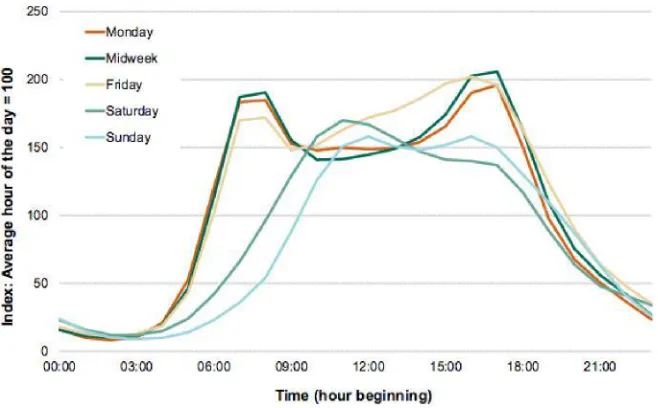
2 when the business opens each day. We assume that there are always enough workers, either through the existing workers being unable to move because of a lack of opportunities, or from a large pool of potential workers who are ready to replace any that move. Each area is worked on by two people if they are available with others choosing (seemingly at random) an activity to contribute to. As it happens, there are two government vehicle count points on the stretch of road where the car wash sits showing an average of nearly 20,000 cars passing each day (Department for Transport, 2014). The Government has also compiled statistics on the flow of traffi
c on the road throughout the day and these are shown in Figure 1.[Figure 1 about here.]
The car wash has fixed costs. We investigated these and estimate that they are between £200 to £500 per week for rent, water fees, electricity and council tax. For our model we take a median figure of £350, but we also look at what would happen using the minimum and maximum figures. The wash opens seven days a week.
for other times pnorm. Figure 1 is roughly bi-modal and roughly uniform between
the two peaks. We used it to estimate that 53% of the daily 20,000 cars passes the car wash during open hours, and 20% of that is rush hour tra
ffi
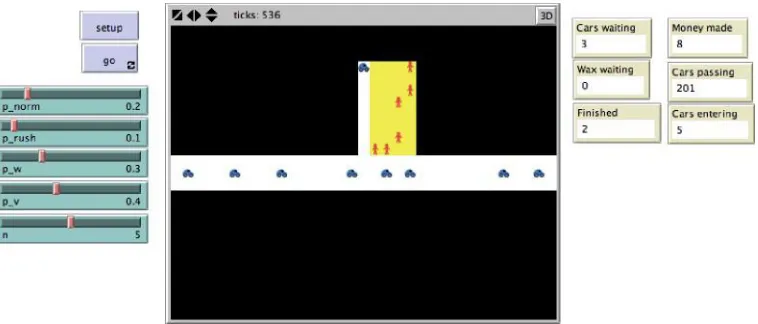
c (note that the car wash opens at 9am and is therefore closed for all but the tail end of the morning rush hour).As each car passes the wash there is a probability pw that it will enter the wash. There is a probability pv that after a quick wash the customer will want a valet. Each car (the cars are the agents in the model) has two variables: w stores how many seconds it will take to wash and v stores how long it will take to valet, and these can vary to capture di
ff
erent sizes of vehicle on the road. Once a car is in a queue, any workers working on it will reduce w or v by 1 for each passing time period. If a driver approaches but sees a queue they may decide not to turn in. In this way, the ABM captures all the salient elements of the wash. A screen shot of the model is shown in Figure 2.From our observations, a wash takes an average of 525 person-seconds1, a valet a further 1,750 person-seconds. The queue never grew longer than five cars with drivers tending to turn away where there are three or more cars ahead of them.
[Figure 2 about here.]
4.3. Analysis
In Section 4.1 we listed two ways of using an ABM as a shadow account for the car wash. Working forwards, we ran the model using the parameter values that we observed along with the publicly available data. This suggests that in a single day the wash would generate about £500 (£494), minus fixed costs giving £444.
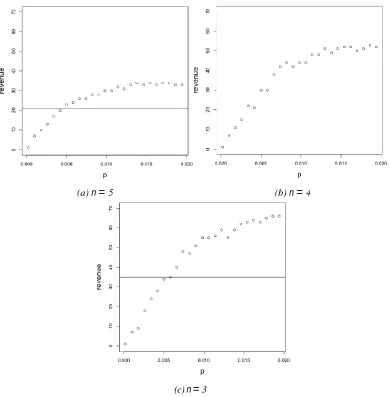
The second approach, working backwards, is to examine a range of values to determine the points at which a minimum level of revenue is generated, and then asking whether these values are realistic. Taking the probability pw, Figure 3 shows the revenue generated when varying pw for three levels of n during one hour in non-rush hour tra
ffi
c. The horizontal line shows the minimum needed to generate suffi
cient earnings for the wash to pay its workers minimum wage. At around p=
0.
005 the car wash becomes profitable. Feeding this figure into the ABM causes just over 40 cars to go to the wash each day which seems realistic.[Figure 3 about here.]
While pw = 0
.
005 seems realistic, we dropped this figure to see how high pv would have to be for the car wash to stay profitable. At pw = 0.
001 the car wash was not profitable with any number of workers. At n = 5 and pw = 0.
002 the wash was not profitable. With n = 5 and pw = 0.
004 the car wash was profitable if pv = 0.
6 (the value we observed was 0.5 so again this seems at least plausible).In terms of the legality of the car wash then, the ABM gives the following results: £444 is enough to pay minimum wage and 40+ cars per day is a figure which certainly intuitively seems possible. Contrary to what the BBC documen-tary suggested, our car wash does appear to be able to produce enough money to operate legally, even if we factor in the highest figure for fixed costs.
(As an aside, we note that by examining the company accounts, we could work backwards to determine whether the firm’s claim that it is paying minimum wage is plausible. This could also potentially be used to detect fraudulent behaviour such as money laundering. The accounts of the car wash will be publicly available but we have not accessed them as in this instance our interest is not in fraud. It is important again to emphasise that our car wash example is illustrative and we do not suspect it of any illegal behaviour.)
5. Discussion
Our ABM suggests that this particular car wash is making enough money to pay its employees a minimum wage. We stress again that our illustration cannot and could not provide a proof of wage abuses in a strict sense: Just because a company earns enough to pay minimum wage does not mean that it does so. Similarly, just because it does not earn enough, does not mean staff aren’t being paid properly:
Some business owners accept operating at a loss, for instance if the business is conceived as a hobby activity. We should also stress that in the case of the car wash, if insufficient revenue was being generated and workers were being paid less than minimum, it does not necessarily mean laws are being broken as is possible to employ workers as contractors working on a commission per vehicle.
conduct. Taken further, ABMs may inform the development of a group of com-putational screening models that go beyond the detection of fraud in financial reporting, towards the detection of fraud and deception in broader social aspects of business.
The car wash ABM was not difficult to create and after observing the operation of the business, it only took an afternoon to implement. Someone with an interest in shadow accounting could learn to produce an ABM using modern tools, facing a learning curve that is perhaps only marginally steeper than that faced when learning to use a traditional accounting package. In fact the actual observation itself might be the most challenging part of shadow accounting and we note that our choice of case is one that is easily observed; this would not be so for many businesses where workers are for example in different countries, enclosed behind factory gates or as domestic workers behind closed doors. In the case of the car wash where it is easy to observe production activities and service delivery but difficult to draw robust conclusions from these observations, the use of ABM can be seen as an important instrument for shadow accounting. One may argue that consumers are increasingly in charge of flagging alleged cases of labour exploitation if production activities and service delivery are clearly visible to them. These suspected cases may then be taken up and scrutinized by actors that are skilled in using ABM modelling.
and ultimately improving social welfare. In the case of the car wash for example, data from satellites could be used for shadow accounting. Satellites tracking the fill rate of parking lots are already used by financial analysts to predict sales and hence create a shadow account of revenues of shopping malls (Balakrishnan, 2016).
Summing up, ABM represents a systematic and reliable procedure for creating robust shadow accounts if labour and other aspects of production and service can be observed by stakeholders but these data cannot be easily evaluated.
6. Conclusions
This paper advocates the use of ABMs as a tool for facilitating and enhancing the impact of shadow accounting. At the same time we acknowledge that our approach, and its presentation in this paper, does not go without limitations. First of all, production activities and service delivery need to be at least partly observ-able to generate sufficient data to base the ABM on. This is often not the case when workers are in remote countries, in private domestic settings, or in fenced-off
factories. Even if some observability is given, there is still the human factor of indifference that hinders endeavours of shadow accounting as by far not all stake-holders are willing to get involved, raise concerns, and share their observations with people skilled in ABM. Furthermore, we have repeatedly emphasized that ABMs and shadow accounting more generally, have to be applied with caution so to make them tools for holding business accountable for their actions, rather than creating a destructive culture of suspicion within society.
may be seen as important tools for generating ‘cognitive dissonance’ (Adams and Whelan, 2009) that makes business strategically and comprehensively incorporate societal needs and preferences. Hence, ABMs could strengthen the so far largely neglected social dimension when modelling sustainability in business. Their use would meet for example the resonating call in Decision Support System by Seur-ing (2013) to increasSeur-ingly base modellSeur-ing approaches in sustainability manage-ment on empirical data. They also represent an opportunity for interdisciplinary research when those with knowledge of agent modelling can partner with those with a desire to investigate practices in different industries.
Agent-based modelling is certainly not the only method of modelling our ex-ample of the car wash, but it comes with particular strengths that make it suitable for wider use in the field of social and financial accounting and accountability. Un-like systems dynamics, ABMs are particularly suited to handling various forms of heterogeneity: different sizes of vehicle, peak days and months through the year and workers of different abilities taking breaks of different length throughout the day. ABMs allow for more dynamic interactions of agents and more complex recursive reasoning processes. Each parameter in a model can be varied and repeated many thousands of times, and scenarios can be compared. All of this can be done from the computer as soon as any observation of the business is complete. ABMs will show at what point enough money is being made by a firm for it to be able to pay the minimum wage and they can verify other aspects of social and financial accounting. We repeat our call that the use of ABMs as a tool for shadow accounting warrants further academic exploration and practical application.
Acknowledgements
References
Adams, C. A., 2004. The ethical, social and environmental reporting-performance portrayal gap. Accounting, Auditing & Accountability Journal 17 (5), 731– 757.
Adams, C. A., Whelan, G., 2009. Conceptualising future change in corporate sus-tainability reporting. Accounting, Auditing & Accountability Journal 22 (1), 118–143.
Akerlof, G., 1970. The market for “lemons”: Quality uncertainty and the market mechanism. Quarterly Journal of Economics 84 (3), 488–500.
Bahnsen, A. C., Aouada, D., Stojanovic, A., Ottersten, B., 2016. Feature engi-neering strategies for credit card fraud detection. Expert Systems with Applications.
Bainbridge, W. S., 2006. God from the machine. AltaMira Press.
Balakrishnan, A., 2016. Fewer cars are parked at malls. here’s what that could mean for apple, analyst says. CNBC.
URL http://www.cnbc.com/2016/12/09/fewer-cars-are-parked-at-malls-heres-what
Balineau, G., Dufeu, I., 2010. Are fair trade goods credence goods? a new pro-posal, with french illustrations. Journal of Business Ethics 92 (2), 331–345.
BBC Media Centre, 2016. Britain’s secret slavery business.
URL http://www.bbc.co.uk/mediacentre/proginfo/2016/10/britains-secret-slaver
Bhattacharyya, S., Jha, S., Tharakunnel, K., Westland, J. C., 2011. Data mining for credit card fraud: A comparative study. Decision Support Systems 50 (3), 602–613.
Boiral, O., 2013. Sustainability reports as simulacra? a counter-account of a and a+ gri reports. Accounting, Auditing & Accountability Journal 26 (7), 1036– 1071.
Brown, J., Fraser, M., 2006. Approaches and perspectives in social and environ-mental accounting: an overview of the conceptual landscape. Business Strategy and the Environment 15 (2), 103–117.
Burgoon, J., Mayew, W. J., Giboney, J. S., Elkins, A. C., Moffitt, K., Dorn, B., Byrd, M., Spitzley, L., 2015. Which spoken language markers identify de-ception in high-stakes settings? evidence from earnings conference calls. Journal of Language and Social Psychology, 0261927X15586792.
Chesney, T., 2014. Networked individuals predict a community wide outcome from their local information. Decision Support Systems 57, 11–21.
Comyns, B., Figge, F., 2015. Greenhouse gas reporting quality in the oil and gas industry: A longitudinal study using the typology of “search”,“experience” and “credence” information. Accounting, Auditing & Accountability Journal 28 (3), 403–433.
Comyns, B., Figge, F., Hahn, T., Barkemeyer, R., 2013. Sustainability reporting: The role of “search”,“experience” and “credence” information. In: Account-ing Forum. Vol. 37. Elsevier, pp. 231–243.
Department for Transport, 2014. Traffic counts.
URL http://www.dft.gov.uk/traffic-counts/
Dey, C., 2007a. Developing silent and shadow accounts. Sustainability accounting and accountability, 307–326.
Dey, C., 2007b. Social accounting at traidcraft plc: A struggle for the meaning of fair trade. Accounting, Auditing & Accountability Journal 20 (3), 423–445.
Dingwerth, K., Eichinger, M., 2010. Tamed transparency: How information dis-closure under the global reporting initiative fails to empower. Global Envi-ronmental Politics 10 (3), 74–96.
Epstein, J., Axtell, R., 1996. Growing artificial societies. Brookings Institution Press.
Gallhofer, S., Haslam, J., Gallhofer, S., Haslam, J., Monk, E., Roberts, C., 2006. The emancipatory potential of online reporting: the case of counter account-ing. Accounting, Auditing & Accountability Journal 19 (5), 681–718.
Gao, S., Xu, D., 2009. Conceptual modeling and development of an intelligent agent-assisted decision support system for anti-money laundering. Expert Systems with Applications 36 (2), 1493–1504.
Gibson, K., Gray, R., Laing, Y., Dey, C., 2001. The silent accounts project: Draft silent and shadow accounts 1999–2000 for tesco plc. Centre for Social & Environmental Accounting Research: Glasgow.
Gilbert, N., Troitzsch, K., 2005. Simulation for the social scientist second edition. Open University Press.
Glancy, F. H., Yadav, S. B., 2011. A computational model for financial reporting fraud detection. Decision Support Systems 50 (3), 595–601.
Gold, S., Kunz, N., Reiner, G., 2016. Sustainable global agrifood supply chains: Exploring the barriers. Journal of Industrial Ecology.
Gold, S., Trautrims, A., Trodd, Z., 2015. Modern slavery challenges to supply chain management. Supply Chain Management: An International Journal 20 (5), 485–494.
Gov.UK, 2014. Traffic flows by time and day.
URL https://www.gov.uk/government/uploads/system/uploads/attachment data/fil
Gray, R., Adams, C., Owen, D., 2014. Accountability, social responsibility and sustainability: Accounting for society and the environment. Pearson Higher Ed.
Guillamon-Saorin, E., Osma, B. G., Jones, M. J., 2012. Opportunistic disclosure in press release headlines. Accounting and Business Research 42 (2), 143– 168.
Guiso, L., Sapienza, P., Zingales, L., 2015. The value of corporate culture. Journal of Financial Economics 117 (1), 60–76.
Heikkurinen, P., Ketola, T., 2012. Corporate responsibility and identity: from a stakeholder to an awareness approach. Business Strategy and the Environ-ment 21 (5), 326–337.
Humpherys, S. L., Moffitt, K. C., Burns, M. B., Burgoon, J. K., Felix, W. F., 2011. Identification of fraudulent financial statements using linguistic credibility analysis. Decision Support Systems 50 (3), 585–594.
Junior, R. M., Best, P. J., Cotter, J., 2014. Sustainability reporting and assurance: a historical analysis on a world-wide phenomenon. Journal of Business Ethics 120 (1), 1–11.
Khalil, S., Saffar, W., Trabelsi, S., 2015. Disclosure standards, auditing infrastruc-ture, and bribery mitigation. Journal of Business Ethics 132 (2), 379–399.
Knebel, S., Seele, P., 2015. Quo vadis gri? a (critical) assessment of gri 3.1 a+ non-financial reports and implications for credibility and standardization. Corporate Communications: An International Journal 20 (2), 196–212.
Larcker, D. F., Zakolyukina, A. A., 2012. Detecting deceptive discussions in conference calls. Journal of Accounting Research 50 (2), 495–540.
LeBaron, B., Tesfatsion, L., 2008. Modeling macroeconomies as open-ended dynamic systems of interacting agents. The American Economic Review 98 (2), 246–250.
Louie, M. A., Carley, K. M., 2008. Balancing the criticisms: Validating multi-agent models of social systems. Simulation Modelling Practice and Theory 16 (2), 242–256.
Lovric, M., Li, T., Vervest, P., 2013. Sustainable revenue management: A smart card enabled agent-based modeling approach. Decision Support Systems 54 (4), 1587–1601.
Macy, M. W., Willer, R., 2002. From factors to actors: Computational sociology and agent-based modeling. Annual review of sociology, 143–166.
Michelon, G., Pilonato, S., Ricceri, F., 2015. CSR reporting practices and the quality of disclosure: An empirical analysis. Critical Perspectives on Accounting 33, 59–78.
URL http://www.sciencedirect.com/science/article/pii/S1045235414001051
Moerman, L., van der Laan, S., 2015. Exploring shadow accountability: The case of james hardie and asbestos. Social and Environmental Accountability Journal 35 (1), 32–48.
Ngai, E., Hu, Y., Wong, Y., Chen, Y., Sun, X., 2011. The application of data mining techniques in financial fraud detection: A classification framework and an academic review of literature. Decision Support Systems 50 (3), 559– 569.
O’Sullivan, N., O’Dwyer, B., 2009. Stakeholder perspectives on a financial sector legitimation process: The case of ngos and the equator principles. Accounting, Auditing & Accountability Journal 22 (4), 553–587.
Owen, D. L., Swift, T., Hunt, K., 2001. Questioning the role of stakeholder engagement in social and ethical accounting, auditing and reporting. In: Accounting forum. Vol. 25. Wiley Online Library, pp. 264–282.
Reimsbach, D., Hahn, R., 2015. The effects of negative incidents in sustainability
reporting on investors’ judgments–an experimental study of third-party ver-sus self-disclosure in the realm of ver-sustainable development. Business Strat-egy and the Environment 24 (4), 217–235.
Rodrigue, M., 2014. Contrasting realities: corporate environmental disclosure and stakeholder-released information. Accounting, Auditing & Accountability Journal 27 (1), 119–149.
Schramm, M. E., Trainor, K. J., Shanker, M., Hu, M. Y., 2010. An agent-based diffusion model with consumer and brand agents. Decision Support
Systems 50 (1), 234–242.
Seuring, S., 2013. A review of modeling approaches for sustainable supply chain management. Decision Support Systems 54 (4), 1513–1520.
Throckmorton, C. S., Mayew, W. J., Venkatachalam, M., Collins, L. M., 2015. Financial fraud detection using vocal, linguistic and financial cues. Decision Support Systems 74, 78–87.
Unerman, J., O’Dwyer, B., 2007. The business case for regulation of corporate social responsibility and accountability. In: Accounting Forum. Vol. 31. Elsevier, pp. 332–353.
Van Hemel, S. B., MacMillan, J., Zacharias, G. L., et al., 2008. Behavioral Modeling and Simulation:: From Individuals to Societies. National Academies Press.
Willekens, M., Simunic, D. A., 2007. Precision in auditing standards: Effects
on auditor and director liability and the supply and demand for audit services. Accounting and Business research 37 (3), 217–232.
Winsberg, E., 2010. Science in the age of computer simulation. University of Chicago Press.
Wu, P. P.-Y., Fookes, C., Pitchforth, J., Mengersen, K., 2015. A framework for model integration and holistic modelling of socio-technical systems. Decision Support Systems 71, 14–27.
Zaffar, M. A., Kumar, R. L., Zhao, K., 2011. Diffusion dynamics of open source
(a) n = 5 (b) n = 4
(c) n = 3
[image:21.612.112.501.170.567.2]