Developing a stepwise approach towards designing a web- based knowledge
platform for multidisciplinary communication (research)
Table of content
Abstract 4
Introduction 5
1. A narrative approach 6
2. Web- based knowledge platforms 8
3. Research questions 9
4. The two exemplary multidisciplinary cases 11
4.1. The River Care research programme 11
4.2. Infection (zoonoses) prevention and control 13
Method 14
1. The RiverCare project 15
1.1. Interview analysis and coding in RiverCare 15 1.2. Analysis and coding of RiverCare evaluation workshop
16
2. Infection prevention and control 16
2.1. Analysis and coding of interviews for Infection Prevention and Control 16
2.2.. Analysis and coding of the focus group for Infection Prevention and control 17
Results 19
1.1. Contextual inquiry 19
1.2. Value specification 20
2. Analysis of the interviews, the RiverCare workshop and the Infection Prevention and
Control focus group 22
2.1. Content and information related categories 23
2.2. User related categories (skills and goals) 33
2.3. User interface (capabilities) 39
2.4. Management of the platform 44
2.5. Multidisciplinary related categories 46
2.6. Implementation 49
Discussion 53
1. Research questions 53
2. Stepwise approach 54
3. The model of Murray and Sools (2014) 56
4. Linking and comparing the two cases 58
5. Suggestions for future research 60
6. Using the findings 61
References 62
1. Appendix A: Coding scheme 66
2. Appendix B: An example of storyline visualization 68
Abstract
Multidisciplinary research and communication offers many advantages and has become essential in modern research settings. Still it faces various problems that it must overcome in order to reach its full potential. These problems often lie in the communication between the various disciplines involved in e.g. a project. A web-based knowledge platform could offer a solution to these problems in communication. The question of how such a platform could be created was answered through the analyses of interviews from two different cases that are multidisciplinary in nature. Furthermore a workshop and a focus group were held as an iteration and these results were translated into a seven step approach towards developing a web-based knowledge platform.
Introduction
As science is continuously progressing and developing, the need for multidisciplinary research increases. This is due to the fact that science, society and management are becoming more dynamic and interdependent than they have ever been(Naiman, 1999).
Multidisciplinarity is defined as a process where scientists and other stakeholders from different disciplines of research, society or management work together, addressing a common goal and/ or problem from their individual viewpoints or expertise (Stokols et al.,2003).
Because of this science can no longer be discipline driven (researched from the perspective of one particular discipline). In order to be more more comprehensive of the complexity of the systems that are being researched, it must move towards multidisciplinarity (Kates et al., 2001). According to literature science in general benefits greatly from multidisciplinary research (Kates et al.,2001). Scientific problems can be viewed from a variety of different perspectives, this is of great importance, because many problems of today’s science have become too complex to be resolved by a single discipline (Naiman, 1999).
this can lead to misconceptions and confusion about what is being said (Wear,1999). Wear compares these dialects to constitutive metaphors, which frame the way we see the world around us. He says that the greater the divergence between these worldviews, the more difficult effective communication becomes.This barrier in communication therefore does not only exist between scientists of different disciplines, but also between scientists and other stakeholders involved in the process, which can be e.g. companies, governmental agents etc. Learning the language of a particular discipline (the jargon) is a time consuming process, but it is crucial to effective communication (Naiman,1999).
Wear provides an example of the use of these metaphors and the confusion which it can bring in his paper “Challenges to interdisciplinary discourse”. He states that the word “competition” for example has an entirely different meaning to an ecologist, for whom this brings to mind the concept of survival of the fittest species, as to an economist, who links this concept the
operational processes of the economy (Wear,1999).
This paper addresses two examples of projects that are faced with the purpose of multidisciplinary communication barriers.
1. A Narrative approach
A possible solution can be found in narrative psychology. Narrative psychology has proven to be an effective tool in increasing (scientific) knowledge and effective comprehension of this
knowledge. Narrative approaches to science communication have been widely used in
healthcare, but are applicable to other fields of science (Fix et al.,2012). Narrative psychology addresses how people make sense of their surroundings, the people around them and the information presented to them. It states that human beings live in a storied world, and that through stories they make sense of it (Murray & Sools,2014). This can be used in any context and with any type of content. By linking events or ideas narrative shaping creates a meaningful pattern between chunks of information that would otherwise be random and disconnected and therefore more difficult to understand (Riessman,2008). By using narratives, holistic knowledge is promoted. By putting previous misunderstood or unknown words or actions into a story, these are understood and acknowledged better (Murray & Sools,2014). Research shows that using narratives in science communication also increases the engagement of audiences and allows more effective comprehension of the information at hand (Dahlstrom,2014).
For science communication this means that information is presented to the audiences in a storied form. The representation of information in such a way are called “storylines”. The target
colleagues (2016) and this proved to be an effective method for conveying scientific information to scientists from other disciplines and non-scientists involved. However they stated that it is of great importance that not only a static view of the information must be given, but an
understanding of the sequence of events must be guaranteed in order for the scientists from other disciplines and the other stakeholders involved to effectively comprehend the relevant
information. This must be taken into consideration whilst framing the information in the most effective possible way (De Bruijn et al., 2016).
2. Web based knowledge platforms
The question remains how the target audiences will gain access to the relevant information in the form of storylines. Creating a web based platform could offer fast and easy access to all people involved. This includes researchers from different scientific backgrounds as well as the general population interested in the topic at hand. A knowledge based platform can be understood as a “combination of persons (or organizations), usually dispersed over a number of geographically separate sites, with appropriate communications technology” (Creech & Willard, 2001, p. 5). To secure more effective communication and reduce the general problem of communication in multidisciplinary research a web based knowledge platform which contains narrative elements in the form of storylines could offer a solution. It addresses the problems in communication
between researchers of different backgrounds and the general population, with no specific scientific background.
people together from all kinds of different backgrounds, disciplines and parts of the world (Choi & Pak, 2006). By using an online platform much time can be saved, for there would be less need for face to face meetings, because communication can occur from all geographical locations thinkable.
Creating a web based knowledge platform does not only diminish the need for additional meetings and grant fast and easy access to the relevant information. It also stresses the
importance of joint value creation between all members/ users of the network, strengthens the capacity for communication and research, makes individual parts stronger through the
participation of others and secures a higher level of engagement (Creech & Willard, 2001). By adding elements that allow a certain degree of interactivity through e.g. different online navigational options, visual and written aspects of the information can be combined to increase the level of user adherence also known as the “stickiness of the platform” (Bush & Tiwana, 2005) even further (Segel & Heer, 2010; Stephens et al.,2014).
Multidisciplinary cases will benefit from using web- based platforms in practice. The two
exemplary cases, that are multidisciplinary in nature, that are addressed in this thesis, River Care and the Zoonoses prevention and control case, aim at creating such a web based knowledge platform. And both theses platforms could benefit from incorporating storyline elements on to these platforms to increase effective communication and comprehension of relevant information.
3. Research Questions
that need to be taken in order to secure a fitting framework for the narrative presentation of the relevant information on the web-based platform. It takes a close look at the requirements, which the platform must fulfill in order to allow the best possible comprehension of information for all parties (disciplines) involved. It focuses on how the content/ information should be presented and therefore be perceived, the users/ stakeholders that are involved, the interface design of the platform and it’s capabilities, the management of the platform and how the platform aids
multidisciplinary research and communication. These requirements should all be met, before the narrative part can be included.
Thus, the main research question of this thesis is:
● Which requirements should a web-based knowledge platform meet, in order for the narrative presentation of information to be optimally included?
This main research question consists out of five sub- research questions:
● How should the content/ information be presented on the web-based knowledge platform?
● Which features should the platform contain in order to fit the stakeholder/ user’s needs? ● What should the interface of the platform look like and what are its capabilities?
● In which way should the platform be managed?
● How can the aid multidisciplinary research/ communication?
4. The two exemplary multidisciplinary cases
These two cases were chosen because they are multidisciplinary in nature and deal with the issues related to multidisciplinarity, like e.g. problems in communication between the several disciplines involved in the projects. Furthermore they both address complex problems and have multiple different stakeholders involved. Because of these characteristics the two chosen cases represent multidisciplinary settings accurately.
4.1. The RiverCare research programme
River research aims at the achievement of a more sustainable and safe future and does this through developing different environmental policies. The development of the human population has a great impact on local, regional and global ecosystems like rivers. Therefore it is of
2004). These sectors include limnology, fisheries and fish research, hydrology and water research and geomorphology (Vugteveen et al., 2014).
Experts have agreed that it is a necessity to bring in actors from all involved disciplines to guarantee effective comprehension and management of the complex environmental issues
(Mainstone and Brierly, 2009; Thorp et al., 2007; Wear, 1999; Naiman, 1999; Benda et al., 2002; Palmer and Bernhardt, 2006; McCulloch,2007). By all disciplines they do not only mean the direct contributing fields like ecology, geomorphology and hydrology, but also fields such as social sciences, engineering and economics (Vaughan et al.,2009; Hannah et al., 2004; Bond,2003; Thoms & Parssons, 2002).
The problem however is that river research is not an exception and it is faced with the same problems of multidisciplinary communication that other disciplines face. The integration of the various sectors is still considered uncommon and comes with difficulties in communication, comprehension of information etc. which in turn takes a toll on the effectiveness of working together and creating good results (Hillman,2009). These problems can be attributed to different factors. Some experts claim that there are still extensive boundaries between the disciplines, which can not be overcome so quickly. These boundaries lie in the problems of communication between the actors in the different fields of expertise. Boulton and colleges (2008) refer to mutual misunderstandings between disciplinary cultures and the lack of effective
The RiverCare research programme is involved with various projects and focuses on the long term effects of certain measures that are taken to e.g. decrease the risk of floods in the
Netherlands. Additional examples of projects in which RiverCare is involved are the
construction of side channels, the removal of obstacles, the lowering of groynes, the replacement of groynes by longitudinal dams, the lowering of floodplains, the relocation of levees etc. It is a six year programme (2014-2019), which was called to life by the Netherlands Centre for River Studies (NCR) and the University of Twente.
4.2. Infection (zoonoses) prevention and control
Infection prevention and control addresses the distorted ecological balance due to human associated behaviors. The greater part (60.3%) of infectious diseases are zoonotic (Jones et al., 2008). Zoonotic infections are infections that can be transferred from animals to humans (Pappas,2011). Infection prevention and its control can be characterized as a “wicked public health problem”. It is called a wicked problem because there is no general unanimity regarding the problem definition and solution, because there are multiple independent stakeholders from different levels (e.g. political, societal and economical agents) involved and because there is no clear goal set in the problem solving process (Van Woezik et al.,2016). A multidisciplinary approach is essential when addressing these “wicked problems”, and solutions depend greatly on the collaboration of all parties involved (Van Woezik et al., 2016).
contribute by elaborating on the problem and its solution from their specific, individual point of view.
The World Health Organization (WHO) stresses the importance of a multidisciplinary approach when addressing this problem. A partnership between the different sectors involved is essential in the problem solving problem according to the WHO (Rabozzi et al.,2012). They call this multidisciplinary approach: “ One health approach”. This one health approach focuses on
interdisciplinary communication and collaboration in order to prevent and control zoonoses (Van Woezik et al.,2016). This multidisciplinary approach has many advantages and has proven to be of great value in the problem solving process, but there are still many problems in reality. These problems originate in uncertainties between the stakeholders involved e.g. problems in
communication, and also arise due to insufficient knowledge of the general public about zoonoses (Van Woezik et al.,2016).
Van Woezik and colleagues offer a solution to this problem in the form of an online platform designed in co- creation with the different stakeholders involved. They involved the stakeholders not only in the implementation phase, but also in the design phase to increase commitment and ownership of the project (Goodyear-Smith,2015). The goals of the platform are to increase the knowledge about zoonoses in the general public and to aid the communication between the different stakeholders involved.
For the RiverCare project interviews were analysed and an evaluation workshop was held, for the Infection Prevention and Control project there were also interviews analysed and a focus group was held .
For the RiverCare project 20 semi-structured interviews were recorded, transcribed and then analysed. The evaluation workshop took place on the 22.6.2017. The audio of this workshop was recorded, transcribed and then analysed.
For Infection Prevention and Control at first 19 transcripts were coded and analysed and then the transcripts of a focus group that was held on the 14.11.2017 were coded and analysed.
The coding scheme was developed through open coding. This means that the scheme was created through the assessment of the values discussed by the people that were interviewed, that
participated in the evaluation workshop for the RiverCare project or that were part of the focus group for Infection Prevention and Control. This information served as basis for answering the main research question as well as the sub- research questions.
1. River Care project
1.1. Interview analysis and coding in RiverCare
In the case of river management 20 semi structured interviews were conducted in May and June of 2016. The participants were all involved in the River Care project, but originated from different disciplines. The participants either worked in government organizations involved with the project (N=4), were members of research/ academic institutions (N=7), worked for
The interviews that were conducted lasted approximately two hours and consisted of three different parts. Of these three parts only the second part, which addressed the topic of storylines in a knowledge based platform and the potential usefulness of these storylines in this setting, is of interest to this research paper. The other two parts focussed mainly on the context of
multidisciplinary work in general and the experiences that the participants have in this domain. One interview was conducted with two participants simultaneously and one recording
malfunctioned, so it could not be used for analysis. This means that a total of 19 interviews was analysed.
The interviews were transcribed verbatim and analysed using a coding scheme. The first round of analysis was conducted by a first analyser, who developed a draft coding scheme. The
transcripts then were read, reviewed and codes were assigned by a second analyser. The third step of the analysis was to compare the two coding schemes and based on this comparison the original scheme was adapted (Appendix A).
The codes were analysed in both a quantitative and qualitative manner, meaning that the content of the codes, the quotes of the participants, were analysed and the frequency of the codes was measured. High frequency of occurrence of certain codes however does not mean that these codes are of greater importance than codes which do not get named so often. This means that they just may be more obvious to the participants. Therefore the focus of this paper remained on the qualitative analysis of the transcripts.
After this first round of analysis an example storyline was created using a fast prototyping software called articulate studio 360. This example was presented to a group of participants during an evaluation workshop. These participants stemmed from the multiple disciplines (Government representatives, researchers, consultants and other stakeholders) mentioned above, that are involved in the River Care project. The participants were asked to reflect on the storyline example in anonymous feedback forms and through means of group discussion, which was recorded and then transcribed verbatim for analysis.
2. Infection prevention and control
2.1. Analysis and coding of interviews for Infection Prevention and Control
19 transcripts (n=19) were coded and then analysed according to the following coding scheme (Appendix A), which was developed for both the interviews from the RiverCare project and the interviews from the infection prevention and control interviews, to identify the key elements that added significant information to the development of the stepwise approach of designing a web based knowledge platform with narrative elements.
Because of the multidisciplinary nature of the zoonoses prevention problem, stakeholders from multiple disciplines involved were interviewed.
In sum, 13 women and 11 men were interviewed. One interview was conducted with three people, and two interviews were conducted with two different stakeholders simultaneously. The stakeholders were veterinarians, human medicine practitioners, members of the LTO (Land- en Tuinbouworganisatie Nederland), Faculteit Dierengeneeskunde, Inspectie voor de
(Landelijke Coördinatie Infectieziektenbestrijding), IGZ (Inspectie voor de Gezondheidszorg), Q- Support, RIVM (Rijksinstituut voor volksgezondheid en milieu), CVI (Centraal vet.
Instituut), KNMvD (Kon. Nederlandse maatschappij voor dierengeneeskunde) and the LIGC (Landelijke informatiecentrum gezelschapsdieren).
These stakeholders are all involved in the problem of zoonoses prevention and control on federal, provincial and municipal levels.
2.2. Analysis and coding of focus group for Infection Prevention and Control
In addition to the interviews a focus group was held on the 14.11.2017. This focus group consisted out of five expert participants from the human, veterinary and government sectors of health care. Goal of this focus group was to gain input on how the platform for the Infection Prevention and Control project could be improved. These suggestions that the participants made on improvement of the platform could also be used for answering the research questions posed in this thesis.
Results
1.1 Background of the the cases (Rivercare and Infection prevention and control)
The two research papers: “User’s perspectives about the potential usefulness of online storylines to communicate river research to a multidisciplinary audience” by Cortez Arevalo (2016, work in progress)and “Tackling wicked problems in infection prevention and control: a guideline for co- creation with stakeholders” by Woezik et al. (2016), offer valuable insights into which stakeholders and users will be invested in the platform or will be using the platform and the requirements that they have towards the platform.
papers the contextual inquiry and the value specification were aimed at identifying the stakeholders and their requirements towards the platform.
1.2. Contextual inquiry
Through the review of the articles, potential users and stakeholders for the web based knowledge platform were identified. The next step was to generalize these users and
stakeholders, so they were not specific to the cases anymore. Five different prospective user groups were identified:
1. Users from research and academic backgrounds (multidisciplinary) 2. Government organizations involved
3. Laypeople interested in the topic 4. Investing companies
5. Consultancies
The prospective users of the platform are all involved one way or another through their line of work, with the exception of the “laypeople”, who are users that are not necessarily involved in any way, but only desire to acquire certain knowledge or understanding of the topic.
1.3. Value specification
Next the values of the potential users were assessed in two steps. The articles were analysed to gain insight in the values that were identified through the research done in these papers.
The eight values that were identified in the study of Cortez Arevalo (2016, work in progress) for
1. Users need a clear view on what the benefits of using the storyline component are and on how it is useful for the users ( in the form of a concrete/ generalizable example )
2. Using visual aids in the form of multimedia interactive elements to aid effective comprehension
3. Interface design: Easy to follow navigation and search options, fast access, availability of contact details and related external links to other platforms and they called for a project overview, timeline and overview of the user’s involvement
4. The need for tailored information
5. The presentation of results in a simple and clear context 6. The engagement of stakeholders in general
7. The possibility to access additional information if required
8. The applicability to other research topics (generalizable example)
The five values that were identified in the study by Woezik and colleges (2016) for Infection Prevention and control were:
1. Information must come from a trustworthy source.
2. Websites must be connected with already existent zoonoses initiatives. 3. The website must contain external links to other relevant sites.
4. It must provide only relevant information.
Through analysis of the results of the articlessome important values could be assessed.
Distinctive similarities in both cases have come to the fore related to the way the information and the content is to be presented on the platform. Like e.g. the presentation of the information (relevance and up to date) and the possibility to access (external) additional information. These values were taken into account in developing the stepwise approach to develop the web based platform.
In addition to these values found in the two respective cases, the analysis of the interviews brought some new insights in what features an effective knowledge based platform should provide its users. Like e.g. providing the users with the possibility of personalization, how interactivity can be ensured, which information should be selected under consideration of the target groups etc.
2. Analysis of the interviews, the RiverCare workshop and the Infection Prevention and Control
focus group
The results that were found in the interviews, the evaluation workshop and the focus group
interface design and capabilities of the platform and how the platform aids multidisciplinary research and communication.
These sub questions consist out of multiple facets, of which a short overview will be given.
2.1. Content and Information related categories
Table 1
Overview of content related/ information category
Category Examples
1. Provide external links to related online sources (other platforms, research papers etc.)
-Additional information -Links to metadata
-External sources -easy access
2.Ensure the credibility of the presented information on the platform
- Perceive as credible
3.Update information regularly - Usefulness -Management -Central Database
4.Information availability -Different levels of entrance - External
links
5.Presentation of the information on the platform - User group appropriate
-Visualisations - Language - Context
6.Selection of appropriate information under consideration of the target groups
- User appropriate - Levels of entrance - Link to confidentiality,
personalization and management
7.Provide procedural knowledge on how the information is gathered
- Link to external links
8.Confidentiality of information/ Possible intellectual property constraints
- Legal policy issues
- Link to information availability and selection of information
*Category: Required aspects of the online platform that are content/ information related
2.1.1. Provide external links to related online sources (other platforms, research papers etc.)
Throughout the interviews it became very clear that the participants valued the availability of
external links to additional information, external related platforms and actors very high.
“Be able to link to in-depth information.” ( Focus group Infection Prevention and Control )
“Link the platforms together. As a central thread throughout the platform, there is a lack of this
at the moment. OneHealth is everything and OneHealth is nothing. Zoonosis are complex
problems. You cannot just rely on the humanitarians or veterinarians. “ (Focus Group Infection
If there would be any questions that were left unanswered by the information presented on the
platform the users could diverge to other sources of information (through external links on the
platform) to look for the answers.
“If you as the GGD want to place something on your website, so you can answer specific
questions, then you can refer to other sources. The RIVM for example and then combine it with
in-depth information.” (Focus group Infection Prevention and Control)
“And maybe it is possible to have some link to questions and answers when you don’t know
them.” ( River Care project )
Another interviewee pointed out the importance of having links to the metadata of the project
that is presented on the platform:
“And it is in a technical way and also in a way of metadata, but on the other hand, you need to
put the metadata there, because otherwise no one knows what (example) means.” ( River Care
project )
In other words: Additional data surrounding the topic must be made available (through external
links) so that e.g. researchers who want to look deeper into the context of the research can if they
desire to do so.
“But it’s not the idea that for instance some storylines may connect. I think. So is it also possible
to make one together?” (RiverCare Workshop)
The participants also stressed the importance of not having to explicitly look for these links, but
that they would be easy to find and the access to the required information would also be easy.
This could be done through adding external links on the platform that connect to e.g. other
2.1.2.Ensure the credibility of the presented information on the platform
The participants also addressed the topic of credibility of the information on the platform. As
already mentioned in the section about the perceived barriers, the participants expressed the
concern of who will be able to upload information onto the platform and the type of information
that they upload. This concern became even more clear whilst addressing the credibility of
information.
One participant said:
“ Yeah, that is very difficult, because you must also have quality. So if everybody is going to put
information on your website. It can be anything, you must look who is putting (more) in your website.” ( River Care project )
If the user of the platform does not perceive the information that is being given as credible then
he or she will not continue to use the platform.
“And also, well let’s say, the management of it. And with management I also mean(..) If it is total chaos and if all data, different standards and different metadata (..). Well, if that’s all messy,
then the people, well then they start to distrust the information and then it will not be useful
anyway.” ( River Care project )
Information becomes credible if the user is under the impression and/ or has proof of the fact
that experts are involved in giving the information (uploading it to the platform).
“You should put together a group of experts, who are familiar with the problem and that are
A link between the credibility of information and the provision of external links could be found
in the interviews. By providing links to e.g. external expertise metadata (scientific based
metadata) the research will be conceived as more credible and therefore more useful.
“It would be so great if the platform would be able to find and provide the right expertise. And if
it could attract new experts. That would be really great.” (Focus Group Infection Prevention and
Control)
2.1.3. Update information regularly
Another aspect of the content and information related findings was “up to date information”.
Throughout the interviews it became clear that the content of the platform would only be
perceived as useful if the information is kept up to date/ actual.
“I think, yeah, the time barrier of putting all the information, and also keeping it actual. You
should update frequently, because I think for all data or all information, keeping it up to date is
important.” ( River Care project )
Participants furthermore suggested that not only one person should be in charge of keeping the
platform up to date, but that more people should watch over this process in order to keep the
information more up to date, faster to access and through this encourage more people to use the
platform.
An interviewee of the infection prevention and control case talked about the platform needing
to be the only central database where the relevant updated information can be found. The need
for a single central platform is high and based on updated information presented in this
“Our need for a central place where decisions about communications and further actions can be
made, is very high.” (Infection Prevention and Control) 2.1.4. Information availability
On the topic of information availability participants had two suggestions. The first one was to
incorporate a feature that would shield of certain information to certain users. This would mean
that not all information would be available to all types of users (link to personalization).
“Meaning that you have some kind of rights management on top of the page that you can shield
of certain content for certain users etc.” ( River care project )
The second suggestion is related to “external links”. Through the platform users should be able
to access even more information and this information should be made available to them.
2.1.5. Presentation of information on the platform
Another important feature that must be guaranteed on the platform according to the interviewees
is the understandable presentation of information. To secure this feature they suggest different
approaches.
“Yesterday I asked a citizen to join our knowledge platform and give input. In this way we try to
bring the knowledge, mails, information and scientific articles closer to the people.” (Infection
To ensure that “lay people” can understand the information presented to them on the platform,
the information must be presented in an understandable way. Meaning appropriate language
and visualisations must be used.
“ So then I guess that I will have a page like this with one storyline, which is like the threat in my
PhD, so let’s expect it will be my PhD thesis in common language. Right? And then we have
contributors and users, which is my user committee, research programme I did it in and I saw a few other things. And then the resources and publications and everything that I have produced in
those four or five weeks.” (RiverCare workshop)
One participant stressed the importance of using visual aids to secure a more understandable
presentation of the information at hand:
“ I think it would be very easy to have a platform, which encloses information in a visual way,
without lots of texts. Keep the layout simple.” ( RiverCare project )
Through the use of visualisation of information on the platform participants expected facilitation
of better understanding.
Furthermore the participants were in favour of presenting the information appropriate to the
target group of users. By this they meant a presentation in a not too scientific and technical way,
so that users not from the explicit scientific research field would be able to understand the
information presented to them more effectively. Furthermore the layout was addressed. A clear
and well designed, easy to follow layout would also benefit the ease of understanding of the
Another important feature that was mentioned by an interviewee of the River Care project
was in relation to the use of storylines on the platform. The interviewee expected the use of
storylines to facilitate better understanding of the presented information:
“Under the storylines, I like them, so I can really easily share with other people outside of River
Care what specific things River Care is about.” ( RiverCare project )
The use of storylines would improve the ease of understanding by explaining the information in
a more simple way, giving users insight into the background and context of the project.
Participants expressed the need for a balance between complexity and simplicity for researchers
and non- researchers. By this they mean that the information must be presented and written
appealing enough for the researchers to feel like they gain something by using the platform, but
must also be presented in such a way for the non- researchers that they are able to understand and
follow the information presented to them.
“Well for me when sharing my information , well, it might not match the level that the scientists
are used to.” ( RiverCare project )
This participant expressed his/ her concern that if information is presented in a too simplistic
manner, that researchers might lose interest and turn to other sources of information.
2.1.6. Selection of information under consideration of the target groups
The next content and information related factor that arose from the analysis of the interviews was
the “selection of (appropriate) information. Participants stated that not all information of
“ There is less need to access than to share. If you need more kinds of data there is more
pressure to get it. Than if you have data, you know. And it is also related to the questions whether your data is useful to others.” ( River Care project)
The underlying thought of this quote is that some information that might be useful to e.g.
researchers will be of less use for other stakeholders, like members of government branches
involved in the project. They should have the possibility of selecting the parts of information by
clicking on them in an overview on the platform that are useful to them, without having to look
through all the other information. Because as one interviewee stated:
“ The volume of data, it can be overwhelming.” ( River Care project )
The selection of information is closely related to other factors found during the analysis of the
interviews. The first being the issue of “confidentiality”. Not all information from certain
project can be shared with the general public, because of confidentiality. This must be
considered, whilst designing the platform.
One participant suggested the use of different levels of entrance, which in turn is closely
related to the factor of “personalization”:
“ Perhaps it is possible to make different levels of entrance. ( River Care project )
The third factor related to the “selection of information” is “management of the platform”. The
managers of the platform, which consists out of involved stakeholders of the project, must select
the appropriate information in relation to the project and guarantee the quality of the information,
which in turn is related to the issue of “credibility”.
For a better understanding of the information presented in the storylines, participants suggested
to give more insight into the way that the information was gathered.
“It is not only the data, but also the way the data is collected.” ( River Care project )
This statement can also be linked to the feature of “external links”. The desire to have access to
additional information and to gain insight into the process of how this was gathered appears of
great importance to the interviewees.
“Then you wonder, where does the information come from” (Infection prevention and control)
Another interviewee of the River Care project said:
“I hope to have access also to the history of the information. So, then I also know a little bit what
was the process that it came through.” ( River Care project )
2.1.8.Confidentiality of information/ possible intellectual property constraints
This feature, discovered through analysis of the interviews, appears in many ways and is linked
to other elements of the content and information related feature of the stepwise approach to
developing the platform, like e.g. “information availability” and “selection of information”.
The confidentiality issue is mainly perceived as a barrier by the interviewees (see “barriers/
disadvantages”), because of this sometimes it is not possible to share all relevant information.
For certain projects it is not always possible to share all data researchers explain in the
interviews. One researcher gave an example for this:
“Also if the government gives us subsidy, they ask us to share often the information. Only for
For such “sensitive” projects the design of a web- based knowledge platform accessible to
different kinds of users would not be ideal. Here the issue of “selection of information” becomes
apparent again.
Furthermore they speak of other projects where certain information can not be shared for
other reasons, such as legal policy issues.
“ Going back, sometimes there are security concerns and legal policy issues with sharing data.” (River Care project)
2.2. User related category
Table 2
Overview of user related category
1. Interactivity/ contact other actors involved - Contact other actors involved - Communication
- Feedback - Contact details
2. Time and effort to use the platform - Minimal time and effort - Visualizations -Software -Language -Age issues
3. Personalization of the platform - Profile - Interactivity - Difference in profiles
4. Notifications provided to the users - Emails -Newsletters -Small news or stories -Link to personalization
5. Downloading of data -Using the data - Increase adherence
- Link to confidentiality and personalization *Category: Required aspects of the online platform that are user related
2.2.1. Interactivity/ contact other actors involved
Throughout the interviews it became apparent that there is a great desire to make the platform
interactive. The participants listed several different aspects of what this interactivity should look
like. One suggested that the platform should provide the possibility of contacting other actors
involved in the project or involved in similar projects throughout the country or in other
countries even.
“Again, if you will use the platform just to find people which you can find the information with,
but you can not share it on the platform itself.” ( River Care project )
“Who can I contact to get the information I would like to have. Because I am somebody who is
going to call somebody or going to send somebody an email.” ( River Care project ) If the platform was to provide contact details, then possible sharing of other data, input or ideas
They also suggested giving the details of the authors of the data that is presented on the
platform, so they can be contacted if any other questions, issues or the desire to co-operate etc.
with these authors should arise.
Another aspect of interactivity would provide users with the possibility of giving feedback to
and receiving feedback from others.
“If you make a nice dataset or collect it. This is a good place to share it. They have the opportunity to get reflexion of people from the field. They are also the people that will be
working in companies and universities.” ( River Care project )
Not only the possibility of giving and receiving feedback would present itself, but also decisions
on what to share and which information is deemed useful by the users could be made through
communicating with each other.
Another statement that was given related to the fact that through using the platform to
contact other actors, new alliances could be made and experts from various different fields could
more easily get in touch with each other.
“So that’s something and I know how to find people to cooperate with or to gain information
from or gain experience from.” ( River Care project )
2.2.2. Time and effort to use the platform
The time and effort spent on learning how to use the platform should be as little as possible
according to the interviewees. This is closely related to all content and information codes
appropriate visualisations are used, the right information is selected etc. then the time and effort
spent on learning how to use the platform will be minimized.
Furthermore this factor is dependent on how the user interface is designed (see section
below). If e.g. the interface design of the platform is easy to follow, easy understandable and
usable software is used, the platform can be navigated easily, relevant information can be
accessed fast and the choice of language is appropriate to the target audience then this will also
affect the time and effort spent on learning how to use the web based knowledge platform.
Another factor that is pointed out by one of the interviewees for the River Care project is the
fact that time and effort are also linked to the age of the users in question. Users of a certain age
might have more difficulties getting acquainted with the software. This must be taken into
consideration, whilst designing the platform. Concerning the use of software one interviewee
stated:
“ You should do it, in this time in the world, you should learn it. Not everybody knows it, not
everybody uses it, because it is related to age.” ( River Care project )
2.2.3.Personalization of the platform
The possibility of being able to install a profile on the platform was mentioned many times
First of all they saw benefit in setting up personals profiles on the platform in relation to
contacting other actors involved and giving and receiving feedback. Personal profiles would
improve the level of interactivity on the platform.
Profiles would need to be updated regularly. If not this could damage the impression of
credibility on the platform.
“ I only view profiles that are recently well maintained. I feel the obligation to make sure that at least the vision of a profile that is on the internet should reflect who I am. So that I am at least
aware how I am visible in the outside world.” ( River Care project )
Another interviewee stressed the importance of making the setup of the profile no too
complicated, because otherwise people/ potential users might not join at all.
“ So, if it is a simple one , then it is ok, but if you ask a lot of things before I can access the the
website, i guess that a lot of people don’t even start it.” ( River Care project )
One researcher mentioned the creation of different levels of entrance, meaning a difference in
profiles. These different levels would allow different things, like restricted access to information
or contact details, the ability to upload data, give feedback or receive feedback.
2.2.4. Notifications provided to the users
“ So if you get too much information, you need a proper way for me to say what kind of
information do I get from this. I need announcements, but not too often. I need to define that for myself.” ( River Care project )
This means that users want to be updated about changes to the platform or addition of
information on e.g. projects, but want to define how much and what type of information they
receive. This is closely linked to the code of “personalization”.
Notifications could be given through emails, newsletters, small news or stories related to
the information presented.
“You should try to get, if your platform is there and the results are there, then you should have
small news, stories, water board related, emails, newsletters.” ( River Care project) It is not only of the essence that notifications are given but also that they reach the desired
audience as fast as possible.
“It would be ideal if people would receive notifications on their phones or computers if
something is up. We have arranged that if some type of signal reaches someone within our organization that this gets to the right people as fast as possible.” (Infection Prevention and
Control)
The last user related code found throughout the interviews is being able to download certain data
(sets). By allowing users to download certain data(sets) the interviewees expect higher
adherence to the use of the platform. They repeatedly speak of “using the data and results”
and voice a clear preference on using the data themselves after downloading it on their own
computer to working with the data on the online platform.
“And also I, you have really found the information, for instance if you have found data and you can use the data. Is it for me possible to download the data and work with it in my own system?
Or do I have to work with the data on the river care site?” ( River Care project )
This code is related to “confidentiality” and “personalization of the platform”. If some
information for example is only available to certain users, because of different levels of entrance
on the platform then only these users can actually access and download the information.
“And then I can even download the data and do my own stuff that is nice.” ( River Care project)
Table 3
Overview of user interface related category
Category Examples
1. Easy to follow interface design -Visualizations
- Understandable navigation
2. Use common and easy to use software - Familiar software
3. Fast and easy access to information through fast and easy navigation of platform
- Link to overview -Visualizations
4. Choice of language - Consider user groups
- Dutch or English - Personalization
5. Provide an overview of the data and all actors involved
- External links - Contact information
6. Use platform on multiple devices - Smartphones - Tablets etc.
8. Ensure the generalizability of the platform - For other projects
*Category: Required aspects of the online platform that are (user) interface related
This section explains all codes found in relation to the interface design of the platform. The
interviewees described how the interface should ideally be designed to satisfy their demands.
The interface design of the platform should be easy to follow. This could be achieved by using
appropriate visualisations of the information presented on the platform and by allowing the
navigation design to be simplistic.
“ By all means there should be no manual to use it. It should be so easy that even my grandma
could use it” ( River Care project )
“Professionals conduct their search through keywords. So let the platform appear through this. Selective keywords are really important.” ( Focus group Infection Prevention and Control )
They also stress the importance of making the platform easy to find on the web for the general
population.
“It should be easy for the general population to find it. “ ( Focus group Infection Prevention and Control )
2.3.2. Use common and easy to use software
The interface design of the platform should be easy to follow. This could be achieved by using
common and easy to use software, which provides fast and easy access to the required
information and through easy navigation of the platform in general, by using e.g. keyword
search. Interviewees suggested the use of common software, that almost everybody already is
familiar with.
“ Yeah, and use common programs like, I should not download first the program, because it will give problems with our IT staff. Use common programs like Microsoft programs.” ( River Care
project )
“You need a platform that is very recognizable.” (Infection Prevention and Control)
Not only should the use platform be easy to understand, but also the navigation to relevant parts
of the platform should be designed in such a way that information can be access fast and without
any trouble for all different types of user groups.
“But just the ease of navigation through the application is important and being able to query and
find the data. That is relevant to what is your interest.” ( River Care project )
2.3.4. Choice of language
Furthermore interviewees stressed the importance of the appropriate choice of language of the
platform.
“And what I think that a really big choice you have to make is the language of the platform. If you make it, I think from the traditional point of view or scientific point of view, you, the main
language should be English. But I think if you want to share also the platform with other people
(like e.g.) RWS (Rijkswaterstaat), the waterboards or just local communities, then English will
be a disadvantage, or will make it difficult for them to be part of the platform.” ( River Care project)
Before randomly selecting a language for the platform the target audience should be considered
first. The advantage of using an online knowledge based platform is that fact that it can be in
different languages, which the users can e.g. select on the main/ starter page of the platform. For
the two exemplary cases the user could e.g. choose between Dutch and English. This code is
2.3.5. Overview of all data and actors involved
Further capabilities that the platform should provide to its users according to the interviewees
were an overview of all the data and all the actors involved, to ensure an even more simplistic
navigation of the platform.
“ To access, I think would be easier, that you have a quick overview of what data there is and
where.” ( River Care project ) and “ Now, I do not have an idea about who is involved in the entire River Care project, for instance. Who is dealing with what kind of subject, on what, that
would be nice.” ( River Care project )
“A ‘what are their names’ would be helpful.” (Focus Group Infection Prevention and control)
This overview can e.g. be linked to external sources of information about the content or the
authors and could provide the possibility of contacting these authors.
2.3.6. Use platform on multiple devices
They also discussed the possibility of being able to use the platform on multiple devices such
as smartphones and tablets etc.
“ Maybe you can, have an app for example for it. To use it on a smartphone.” ( River Care
2.3.7. Ensure the generalizability of the platform
The last aspect in relation to the capabilities that the platform should provide was the capability
to be generalizable.
“And suppose that you build your platform using open source technology like the GIS tools open
source and the web page is open source, the content management system is open source. Then I have this framework that I can easily deploy for a different project.” ( River Care project)
The framework of the platform should be easily applicable to other projects according to the
interviewees. By doing this the use and navigation of the platform will roughly be the same and
then can be used in a similar way for other projects or platforms.
“Not to be overwhelmed if you visit the website, the platform as a new user, in a minute you
should oversee the structure of the site, the way you can use it. I think it is important not to have
2.4. Management of the platform Table 4
Overview of management of the platform related codes
Category Examples
1. Issues regarding the maintenance of the platform
- Link to credibility
2. Ensure quality of the information and data provided through monitoring
- Responsibility questions
3.Management by multiple experts - Link to credibility
- Avoid double posting e.g. - Expert in charge
4. Issues regarding the decision making process
- Management team - Timing questions
*Category: Required aspects of the online platform that are management related
2.4.1. Issues regarding the maintenance of the platform
The interviewees expressed certain concerns related to the management and maintenance of the
platform. These concerns related strongly to the issue of how credibility could be ensured
through management.
“Who is going to tell what the quality of the data is. And who, what are you going to do if
somebody is putting a giant amount of terabytes of information on your platform. All kinds of
get information from the provinces. But then we must check the quality of information from the
provinces.” ( River Care project )
2.4.2. Ensure quality of the information and data provided through monitoring
The main concern in relation to credibility is the monitoring of the data that can be uploaded on
the platform. The interviewees were mainly concerned with the responsibility issues. They
asked questions like:
“ Who will be able to upload data?” and “who will ensure the quality of the data.” ( River Care
project )
“Talking about communication, sometimes I wonder who is in charge and how.” (Infection
Prevention and Control)
“Who owns the help-desk. Who is in charge of maintenance and updates on the platform. This is
relevant. Who is responsible.” ( Focus group Infection Prevention and Control )
2.4.3. Management by multiple experts
Interviewees suggested multiple (expert) actors involved in the project should manage the
sharing of the data to ensure the credibility of the information. They should decide what is
relevant and what is not and prevent things like e.g. “double- posting”.
“If the information is very poor I will not come a second time to get information. It should be fast, actual information, I guess it should be one or two persons who are updating all the time. It
is quite a job.” ( River Care project )
“ I think if you get an abundance of information it is difficult to keep track (...) to make a good
2.4.4. Issues regarding the decision making process
This “management- team” should also make decisions concerning when certain updates should
be made or when additional information relevant to the program should be added to the platform.
“But I think the main drawback would be, that there is no pressure, no one is asking for your data. When will you put it there.” ( River Care project )
2.5. Multidisciplinary related categories
Table 5
Overview of the multidisciplinary related category
Category Examples
1. Connection of multiple disciplines - Better relationships - Central database
2. Prohibit misunderstandings in communication
- Tackle previous multidisciplinary related problems
- Decision making process
3. Connect various sources from abroad - Increase knowledge flow
4. Increase effectivity and quality of the platform and information through multidisciplinarity
- Likelihood of gathering more knowledge will increase through connection of
disciplines
2.5.1. Connection of multiple disciplines
The aim of using a web based knowledge platform is to connect multiple disciplines and ensure
that information can be exchanged fast and without misunderstandings in communication. This
in turn was expected to result in better relationships between all parties involved. Regarding
this multidisciplinary feature of the platform interviewees suggested that the platform should
function as a central database of sorts.
“Working together will build a better relation and possible more willingness to help us with our interest.” ( River Care project )
2.5.2. Prohibit misunderstandings in communication
Through the connection of disciplines and actors involved previous multidisciplinary problems
are tackled. These were mainly problems in communication. Effective communication is crucial
in decision making processes and necessary in order for the actors in charge to make good
choices.
“We want to be a reliable advisor to the government. In order for them to make good choices and secure that the Netherlands becomes healthier.” (Infection Prevention and Control)
2.5.3. Connect various sources from abroad
According to the interviewees all parties/ actors involved in the platform could benefit from it.
government and lay people interested in the topic presented on the platform not only in the
Netherlands, but also abroad. By doing this not only will more people have access to the
information on the platform, but the likelihood of gathering information from other sources ( e.g.
abroad ) will increase and the interviewees expect the platform and the knowledge flow through
the platform to benefit greatly from this.
“Access for research institutes or universities abroad. That will be interesting.” ( River Care project)
2.5.4. Increase effectivity and quality of the platform and information through multidisciplinarity
Through the connection of the multiple disciplines the likelihood of gathering additional
information will increase. This could benefit problematic situations as well. For example when
certain actors involved feel like they do not have enough information about the topic. In
situations like this the platform can offer guidance and support.
“The mayor has been assigned with tasks concerning the zoonosis, but does not know much
about the topic. They are in need of support.” ( Focus group Infection Prevention and control )
2.6. Implementation
Throughout the interviews it became apparent that the interviewees also had a lot to contribute
concerning the future implementation of the knowledge based platform. The statements made in
the interviews gave valuable insights into the expected benefits and barriers of such an
implementation and should be taken into consideration in the development process of the
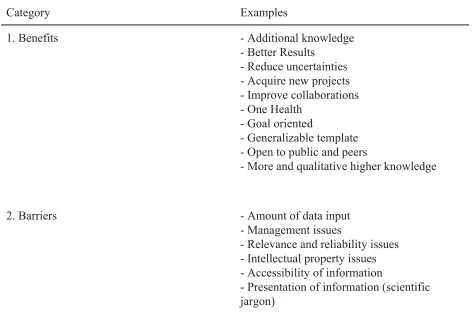
Table 6
Overview of the Implementation related category
Category Examples
1. Benefits - Additional knowledge
- Better Results - Reduce uncertainties - Acquire new projects - Improve collaborations - One Health
- Goal oriented
- Generalizable template - Open to public and peers
- More and qualitative higher knowledge
2. Barriers - Amount of data input
- Management issues
- Relevance and reliability issues - Intellectual property issues - Accessibility of information
- Presentation of information (scientific jargon)
*Category: Required aspects of the online platform that are implementation related
Participants mainly talked about the different benefits they expected the web based knowledge
platform to have. These anticipated benefits gave insight in what they believe the platform
should contain to assure the most effectivity.
“Should this extra knowledge become available. Based under decisions to modify, the landscape
becomes richer, and decisions ultimately will be wiser, because (they) will be based on
knowledge not only of (e.g.) hydraulic effects, but also on (e.g.) ecological effects. More knowledge.” ( River Care Project )
Through the participation of various different users and stakeholders of the project, more
knowledge will become available and the participants expect the platform to benefit from this.
They also expected better results from this and believe that this assimilation of knowledge will
additionally reduce uncertainties and increase the possibility of acquiring new projects.
“Doing a project better, getting better results out of the project. Reduce uncertainties and
acquire more projects.” ( River Care Project )
Using a platform in such a way, to connect multiple disciplines and to improve the
collaborations of these disciplines is described by some interviewees of the infection prevention
and control case as the “one- health” approach.
“We can state in general that the communication between human and veterinary medicine and
it’s practitioners is not entirely ideal, that is why these platforms are founded so that the thought of “One Health” can prevail.” (Infection Prevention and Control)
Uniting multiple disciplines to work towards a common, general goal is perceived as a great