UNIVERSITY OF TWENTE
The validity of the Forms of
Self-Criticizing/Attacking & Self-reassuring
Scale in comparison to the
Self-compassion Scale
In Partial Fulfillment of the Requirement
for the Degree of the Master of Science
by Markus Fabian Fritzsche
Supervisors:
Dr. Peter ten Klooster
Dr. Hester Trompetter
Psychology
Table of Contents
Abstract(...(3
!
Introduction(...(5
!
(((Self6criticism(...(5
!
(((Self6compassion(...(6
!
(((Affect(...(7
!
(((Stress(...(7
!
(((Anxiety(&(Depression(...(8
!
(((Well6being(...(8
!
(((Gender(&(Age(...(9
!
(((Dimensionality(of(self6criticism(and(self6compassion(...(9
!
Method(...(13
!
(((Participants(...(13
!
(((Procedure(...(13
!
(((Measurement(...(13
!
(((Data(Analysis(...(15
!
Results(...(17
!
(((Descriptive(statistics(...(17
!
(((Concurrent(&(Convergent(validity(...(19
!
(((Known(groups(validity(...(20
!
(((Incremental(validity(...(20
!
Discussion(...(23
!
Abstract
Objective: There has been a lot of separated research on self-criticism and self-compassion. Unfortunately research is still limited with regards to the relation between these constructs. Therefore the aim of this study was to investigate the relation between criticism and self-compassion and their predictive value for well-being and psychopathology. To measure the constructs of interest, the Forms of Self-Criticizing/ Attacking & Self-reassuring Scale (FSCRS) and the Self-compassion Scale-Short form (SCS-SF) were used. It was hypothesized that self-criticism and self-compassion are strongly related but that their relation to other variables such as positive affect, stress, anxiety, depression, well-being, gender and age were different in strength and pattern.
Design: For the analysis, data of an online cross-sectional survey conducted by the University of Twente was used.
Subjects: The convenience sample consisted of 397 subjects, of whom 329 were included in the analysis with a mean age of 30.94 years.
Method: Besides the FSCRS and the SCS-SF, data was collected on other variables with the modified Differential Emotions Scale (mDES), the Perceived Stress Scale (PSS), the Hospital Anxiety and Depression Scale (HADS) and the Mental Health Continuum- Short form (MHC-SF). Analysis included correlations, t-test for independent samples and a stepwise hierarchical regression analysis. Besides the mDES, the internal consistency was good for the investigated constructs and variables.
Results: As expected a significant and strong correlation was found between the FSCRS and SCS-SF. In addition, the SCS-SF tended to relate stronger with positive variables, whereas the FSCRS related stronger with negative variables. Concerning the subscale correlations, high ranges were observed between the subscales reassured self/ inadequate self from the FSCRS and the subscales over-identification/ mindfulness from the SCS-SF. Concerning the incremental validity, subscales of the FSCRS and the SCS-SF explain the most unique variance, whereas the SCS-SF is the strongest predictor for well-being. With regards to psychopathology the SCS-SF could not explain unique variance beyond the FSCRS.
Abstract
Thema: Deze studie bekijkt hoe zelfkritiek en zelf-compassie in verhouding tot elkaar relateren en onderzoekt de voorspellende waarde voor welzijn en psychopathologie. Naar beiden constructen is tot nu toe vooral los van elkaar onderzoek gedaan. Om de constructen te meten werd de “Forms of Self-Criticizing/ Attacking & Self-reassuring Scale” (FSCRS) en de “Self-compassion-Scale-Short form” (SCS-SF) gebruikt. Het werd veronderstelt dat zelfkritiek en zelf-compassie sterk gerelateerd zijn maar dat hun relatie tot andere variabelen zoals positieve affect, stress, angst, depressie, welzijn, geslacht en leeftijd in sterkte en patroon verschillen.
Onderzoeksopzet: In deze studie is gebruik gemaakt van een online enquête welke van de Universiteit van Twente verzameld werd.
Proefpersonen: De gemak steekproef bestond uit 397 proefpersonen, waarvan 329 in de analyse includeert werden. De gemiddelde leeftijd van de proefpersonen was 30.94 jaren.
Methode: Naast the FSCRS en de SCS-SF, werd data van andere variabelen met de “modified Differential Emotions Scale” (mDES), de “Perceived Stress Scale” (PSS), de “Hospital Anxiety and Depression Scale” (HADS) en de “Mental Health Continuum- Short form” (MHC-SF) verzameld. Voor de analyse werden correlaties berekent, t-test voor onafhankelijke steekproeven en een stapsgewijze hiërarchische regressie analyse doorgevoerd. Met uitzondering van de mDES, was de interne consistentie voor de onderzochte constructen en variabelen goed.
Resultaten: Er was een significante en sterke correlatie tussen de FSCRS en de SCS-SF. Daarenboven werd duidelijk dat de SCS-SF sterker met de positieve variabelen correleerde, waarbij de FSCRS sterker met de negatieve variabelen correleerde. Verder werd geobserveerd dat de reikwijdte van correlaties tussen de subschalen geruststellend zelf / ontoereikend zelf van de FSCRS en de subschalen over-identificatie/ mindfulness van de SCS-SF erg hoog waren. De subschalen van de FSCRS en de SCS-SF verklaren het meest unieke variantie, waarbij de SCS-SF de sterkste voorspeller voor welzijn is. Met betrekking tot psychopathologie was de SCS-SF niet in staat unieke variantie boven de FSCRS te verklaren.
Introduction
Self-criticismIndividuals are often assumed to be primarily self-interested, having more concern for themselves than for others, but common experience suggests that people are often much harsher and unkind toward themselves than they ever would be to others they care about (Neff, 2003a). Furthermore self-criticism has been linked to a number of psychological disorders, depression being the most important (Zuroff, Sadikaj, Kelly & Leybmann, 2016). Moreover research has found that self-critical psychiatric clients often experience psychological difficulties such as anxiety, eating disorders, substance abuse, personality disorders and suicide. When faced with stress, failure and negative emotion, self-critical clients are more likely to experience a sense of defeat, inferiority and self-blame (Kannan & Levitt, 2013). Therefore it is not surprising that highly self-critical people who experienced an extremely stressful event are more likely to develop symptoms of post-traumatic stress disorder (Harman & Lee 2010). A study from Lassri & Shahar (2012) found that people have more trouble in romantic relationships when they criticize themselves and are more likely to become lonely. In addition, self-criticism has also been linked to binge eating, especially if self-critical people grew up in critical or emotionally abusive families (Dunkley, Masheb & Grilo 2010).
Concerning self-criticism, there is no consensus on whether it is a trait or a state characteristic. According to Blatt, Quinlan, Chevron, McDonald & Zuroff (1982), self-criticism is the sensation, and therefore a state, that one must struggle to compensate for having failed and to live up to standards. Others define self-criticism more as a trait like Zuroff et. al. (2016), who describe self-criticism as a the tendency to make strict evaluations of the self which is often accompanied by feelings of guilt, unworthiness and self-recrimination. This corresponds with the view of Abi-Habib & Luyten (2013), who define self-criticism as a strong emphasis on control and autonomy, which are accompanied by fears of disapproval and loss of autonomy and control.
had higher levels of self-critical perfectionism described themselves as having feelings of guilt, sadness, hopelessness, loneliness and low positive emotions (Kannan & Levitt, 2013).
Self-compassion
Contrary to self-criticism, the concept of self-compassion originates in the Buddhist tradition and describes the ability to be empathic towards pain and sorrow of oneself and others, accompanied by the desire to relieve these unpleasant mental states (Bohlmeijer, Bolier, Westerhof & Walburg, 2015). According to Neff (2003a, p. 85) “self-compassion is an emotionally positive self-attitude that should protect against the negative consequences of judgment, isolation, and rumination”. When one is experiencing personal failure, self-compassion has three components. Self-kindness involves extended kindness and understanding to oneself rather than harsh judgment and self-criticism. Common humanity includes that one appreciates experiences as part of the larger human experience rather than seeing them as separating and isolating. The third component, Mindfulness, is characterized by a balanced awareness of one’s painful thoughts and feelings rather than over-identifying with them. For self-compassion, it is necessary that individuals do not over-identify with their emotions to be able to recognize the broader human context of one’s experience (Neff, 2003a).
Several studies have established positive outcomes of self-compassion. Individuals who were higher in self-compassion demonstrated less extreme reactions, less negative emotions, more accepting thoughts and a greater tendency to put their problems into perspective (Yarnell, Stafford, Neff, Reilly, Knox & Mullarkey, 2015). In addition, interventions based on mindfulness, loving kindness and compassion showed promising results in alleviating distress and promoting well-being, reflected in decreased negative affect and increased positive affect in patients with compassion. Concerning the relationship between compassion and psychopathology, higher levels of compassion were associated with lower levels of mental health symptoms developing well-being, reducing depression and anxiety and increasing resilience to stress (MacBeth & Gumley, 2012). A study from Gilbert & Procter (2006) used self-compassion in a therapeutic approach called Compassionate Mind Training in order to treat habitually self-critical individuals, showing highly promising results in significantly decreasing inadequacy/ self-hatred and increasing self-reassurance.
Gibbons, Chotai, Duarte & Matos, 2012). Regarding self-compassion, it is unclear whether high positive self-compassion, or instead low levels of self-judgment and self-isolation are the best predictor for well-being. This relates to an important question of whether self-compassion and self-criticism measure the same construct or are they different in predicting well-being. Research on self-criticism and self-compassion has been investigated independently from each other most of the time, therefore this study investigates the relation between self-criticism and self-compassion and their already known relation to other variables such as affect, stress, anxiety & depression, well-being, gender & age.
Affect
Several studies have demonstrated clear links between self-criticism and emotion (Zuroff et. al., 2016). Dunkley et. al. (2003) found that self-critical components of perfectionism significantly predicted daily stress, avoidant coping mechanisms, low-perceived social support, negative affect and low positive affect. According to Zuroff et. al. (2016) participants who scored at high average levels of self-criticism also reported high negative affect and high overt self-criticism. Furthermore, according to research from Dunkley et. al. (2003) self-criticism has been associated with high daily negative affect and low daily positive affect over periods of one week or more.
Concerning self-compassion, research has shown that compassion training elicit activity in brain regions previously associated with positive affect and affiliation suggesting that compassion training leads to beneficial effects on enhancing positive affect in response to adverse situations (Klimecki, Leiberg, Lamm & Singer, 2012). Gilbert et. al. (2012) found that compassion from self or others can help regulate distress and coping with negative emotions. Moreover Gilbert et. al. (2012, p. 375) argued “Positive emotions created within purely social contexts have long been associated with affiliation, kindness, and warmth and seen as emotional textures for compassion”. In addition, a study about emotional processes found that self-compassion was negatively related to negative emotion, anxiety, sadness and feelings of guilt (Kannan & Levitt, 2013).
Stress
(fight), self-isolation (flight) and over-identification (freeze). Therefore it seems that the basic components of self-compassion are able to counter the psychological stress reactions (Gilbert, 2005; Neff, 2003a, 2003b).
Anxiety & Depression
Self-criticism, rumination and feelings of separation have been shown to be strongly associated with maladaptive outcomes such as depression (Neff, 2003a). This is in accordance with Lassri & Shahar (2012) who have found that people who criticize themselves are more likely to become depressed, anxious and lonely. Moreover they are also more likely to have trouble in their romantic relationships.
Concerning depression, research has shown that there are two distinct psychological dimensions of depression. The first dimension is dependency, which is characterized by feelings of helplessness and weakness, including fears of being abandoned and by wishes to be cared for. The second type is self-critical, which is characterized by feelings of inferiority, guilt and worthlessness (Blatt et. al. 1982). Dependency may be externally directed vulnerability concerning interpersonal relatedness, whereas self-criticism involves an internally directed vulnerability concerning self-definition (Chui, Zilcha-Mano, Dinger, Barrett & Barber, 2016). According to Gilbert & Procter (2006), who investigated self-criticism and self-reassurance in relation to depression in an imagery study, self-self-criticism can be experienced as powerful, angry and discouraging. Those high in trait self-reassurance, however, do not have such an intense or clear internal critical relationship, their critical images are less powerful and easier to dismiss. Self-criticism may also result in self-centeredness and not being able to evaluate one’s own behavior from a neutral position like one would do when being self-compassionate. Therefore the chance to suffer from depression due to over-identification in regard with negative thoughts might increase (Neff, 2003a).
Self-reassurance and self-compassion seem to have similar effects concerning depression. In addition, research on self-reassurance showed that it is negatively related to depression symptoms (Irons, Gilbert, Baldwin, Baccus & Palmer, 2006), which is consistent with the findings from Neff (2003b) that self-compassion seems to protect against depression. Research has also shown that compassion for the self is linked to self-esteem and negatively related to depression and anxiety (Gilbert & Procter, 2006).
Well-being
discrepancy between performance and expectations. Self-critical perfectionism is therefore sometimes described as the opposite of well-being(Stoeber & Rambow, 2007).
Self-compassion, however, benefits well-being by “giving up harmful behaviors to which one is attached, and encouraging oneself to take whatever actions are needed - even if painful or difficult - in order to further one’s well-being.” (Neff, 2003a, p. 88). According to Neff, Rude & Kirkpatrick (2007) self-compassion is a powerful predictor of mental health and increased self-compassion has been found to predict enhanced psychological health over time. Moreover a meta-analysis about the relation between self-compassion and well-being found that self-compassion is even stronger correlated with cognitive and psychological well-being than with affective well-well-being (Zessin, Dickhäuser & Garbade, 2015). According to Neff (2009) enhanced self-compassion has been associated with greater life satisfaction, emotional intelligence, social connectedness, learning goals, wisdom, personal initiative, curiosity, happiness, optimism and positive affect. Moreover, self-compassion is associated with less self-criticism, depression, anxiety, fear of failure, thought suppression, perfectionism, performance goals and disordered eating behaviors (Neff, 2009).
Gender & Age
Associations of self-criticism and self-compassion with socio-demographic factors like gender differences and age are not yet well established. Concerning gender differences, women are traditionally known for their sacrifice, prioritizing the needs of others over their own, which might enhance self-compassion (Yarnell et. al., 2015). Nevertheless women have also been found to be more critical of themselves, using more negative self-talk than males. Several studies (Yarnell et. al., 2015) have shown that women have lower levels of self-esteem compared to men, which may influence women to judge themselves negatively inhibiting their ability to be self-compassionate. For instance, self-compassion involves actively soothing and comforting one when suffering is experienced. These qualities are emphasized for women but not men. In fact, research indicates that adherence to masculine gender norms is associated with lower levels of self-compassion. Male socialization patterns emphasizing emotional restrictiveness may also mean that self-compassion is less accessible to men than women. In addition to this gender role, self-criticism tends to become less extreme over life and an understanding of common humanity increases with age, which means that self-criticism could decrease, whereas self-compassion could increase over the years (Yarnell et. al., 2015).
Dimensionality of self-criticism and self-compassion
to the lack of empirical research in a similar vein it is unknown whether self-criticism and self-compassion are the endpoints of one single continuum or if they exist on distinct dimensions. Knowing the definition of self-criticism, what if someone is judgmental and punishing towards the self; who sees the human experience as separated and isolated; who over-identifies with painful thoughts and feelings? This perspective should illustrate someone who is the opposite of the given three basic components of self-compassion. Given the fact that self-compassion counteracts the negative consequences of self-criticism, one might assume that both constructs are rather opposed positions than two distinct dimensions.
Moreover this is interesting, because criticism is a type of depression and self-compassion seems to protect against depression (Neff, 2003a). Furthermore self-self-compassion has been negatively associated with self-criticism, depression, anxiety, rumination, while
being positively associated with life satisfaction and social connectedness (Neff et. al., 2007).
Still it is unknown how self-compassion and self-criticism relate to each other and if they explain unique variance for well-being or psychopathology. This is the first study that investigates self-criticism and self-compassion in a sample from the general population and focuses on the relation between self-criticism and self-compassion and their relation to affect, stress, anxiety & depression, well-being, gender & age.
Furthermore this study aims at measuring the incremental validity in predicting well-being or psychopathology. In order to examine the relationship between criticism/ self-compassion and the variables mentioned earlier, this study explores different possibilities of how the two concepts could relate to these variables.
1.“What is the direct relation between self-criticism and self-compassion?” - Concurrent validity
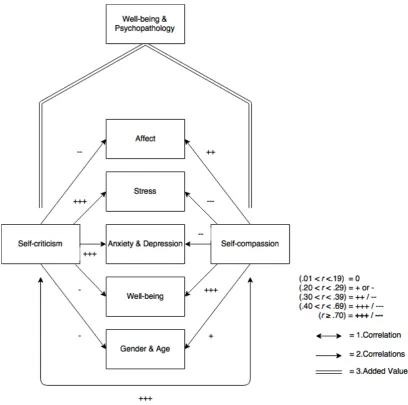
The first research question explores to what extent aspects of criticism and self-compassion are related to each other. This approach is the first step in order to investigate whether these constructs are distinct from each other. It is expected that self-criticism negatively and strongly relates to compassion, implying that a lower score on self-criticism is associated with a higher score on self-compassion. This corresponds with previous finding that self-compassion decreases self-criticism (Neff et. al., 2007). Constructs can be considered as strongly related to each other if the correlation is high (.40 < r < .69).
2.”To what extent do self-criticism and self-compassion differ in their relationships to other variables?”- Construct validity
self-criticism and self-compassion are measuring one construct. But if these correlations differ, this would suggest that self-criticism and self-compassion are measuring to different constructs. To investigate this issue correlations are measured per variable in order to search for divergent correlations.
A moderate (.30 < r < .39) negative correlation between self-criticism and positive affect is expected based on the findings from Dunkley et. al., (2003) which revealed that self-criticism was associated with high daily negative affect and low daily positive affect. Compassion in turn, can help to regulate distress and to cope with negative emotions (Gilbert et. al., 2012), which leads to the assumption that self-compassion and positive affect are moderately positive related. Concerning stress, a strong (.40 < r < .69) positive correlation with self-criticism and a strong negative correlation with self-compassion are expected. This corresponds with the findings from Gilbert (2005) that self-criticism undermines efforts at problem-focused coping, whereas compassion works as a buffer to stress. Moreover self-criticism has been shown to be strongly associated with depression (Neff, 2003a) and it might also reduce well-being (Dunkley et. al., 2006). These findings consequently leads to the assumption that self-criticism is strongly positive related to anxiety & depression, whereas well-being is weakly (.20 < r < .29) negatively associated with self-criticism. In comparison, self-compassion is known for its benefits for well-being (Neff, 2003b) and to be a powerful predictor of mental health (Neff et. al., 2007). Therefore it is assumed that self-compassion and anxiety & depression are moderately negatively associated, whereas the relation to well-being is expected to be strong.
Figure 1. Self-criticism and self-compassion in hypothesized relation to each other and to affect, stress, anxiety & depression, well-being, gender & age.
3. “To what extend do self-criticism and self-compassion explain unique variance in well-being and psychopathology?”
Method
Participants
A total number of 397 subjects participated in the current study. Due to missing data on the survey, especially the self-criticism and self-compassion questionnaires, 68 subjects were removed from the data pool, leaving a total number of 329 subjects, of which 65.7% were female. The youngest participant was 15 years old and the oldest was 79 (Mage= 30,84; SD=
13,23). The level of education was represented by seven ordinal categories, with “1” being primary school and “7” being university. The majority of subjects had a relatively medium level of education, with the biggest group in level four (40.7%). Concerning their life situation, most of the participants were working (40.7%) or studying (47.7%). While 70.8% of the participants indicated having no religious views, 29.2% had differing religious views.
Procedure
The current study utilizes data of an online cross-sectional survey that was conducted by the University of Twente. For this study, various students recruited participants that filled in the questionnaires offered by the university. Participants completed eight self-report questionnaires that contained a total of 148 questions and answered additional demographic questions about for example gender, education and current life situation. Participants completed the Forms of Self-Criticising/ Attacking & Self-reassuring Scale (FSCRS; Gilbert, Clarke, Hempel, Miles & Irons, 2004), the Survey of Recent Life Experiences (SRLE;Kohn & Macdonald, 1992), the Self-compassion Scale-Short form (SCS-SF; Raes, Pommier, Neff & Van Gucht, 2011), the modified Differential Emotions Scale (mDES; Fredrickson, Tugade, Waugh & Larkin, 2003), the Perceived Stress Scale (PSS; Cohen, Kamarck & Mermelstein, 1983), the Hospital Anxiety and Depression Scale (HADS; Zigmond & Snaith, 1983) and the Mental Health Continuum-Short form (MHC-SF; Lamers, Westerhof, Bohlmeijer, ten Klooster & Keyes, 2011). In this study, Dutch versions of the scales were used therefore language proficiency in Dutch was an inclusion criterion. Participation in the survey took approximately 30 minutes.
Measurement Self-criticism
were translated into Dutch. The items are rated on a 5-point Likert scale ranging from 0 (“Not at all like me”) to 4 (“Extremely like me”) (Baião et. al., 2015). The internal consistency of the total FSCRS was excellent with α = 0.90. The analysis of the subscales revealed values of 0.82 (Reassured self), 0.86 (Inadequate self) and 0.80 (Hated self). In this study the negatively worded items from reassured-self were mirrored in order to compute a total score, where a higher score indicates more self-criticism (range 0-88). The norms from Baião et. al. (2015) can be used to interpret the descriptive statistics from the FSCRS.
Self-compassion
The SCS-SF was originally developed by Neff (2003b), and measures an individual’s ability to be self-compassionate. The instrument consists of 26 items that represents the components of self-compassion in six subscales: self-kindness, self-judgment, common humanity, isolation, over-identification and mindfulness. This study utilizes a Dutch short form of the original version developed by Raes et. al. (2011) that consists of 12 items. The items are rated on a 7-point Likert scale ranging from 1 (“Almost never”) to 7 (“Almost always”). The items on the scales self-judgment, isolation and over-identification are reversed coded in order to compute a total self-compassion score. The SCS-SF has been approved to be valid and reliable in measuring self-compassion (Raes et. al., 2011). The internal consistency of the total SCS-SF was good with α = 0.85. The coefficients of the subscales were good (Self-judgment= .83, Isolation= .65, Over-identification= .73 and Mindfulness= .72), with exception of the subscales Common humanity with an acceptable value (.60) and Self-kindness with a poor value (.52). In this study the negatively worded items are transformed into recoded scores in order to compute a total self-compassion score, which indicates more self-compassion with higher scores (range 12-84).
Affect
Stress
The PSS developed by Cohen et. al. (1983) measures the degree to which situations in one’s live are perceived as stressful. The scale consists of 10 items. Participants answered on a 5-point Likert scale ranging from 0 (“Never”) to 4 (“Very often”). In this study the total score indicates more perceived stress (range 0-40). The PSS has been approved to be reliable and valid (Cohen et. al. 1983). The internal consistency of the PSS was good with α = 0.83.
Anxiety & depression
The HADS developed by Zigmond & Snaith (1983) is a reliable and valid self-report measuring anxiety and depression. The two subscales anxiety and depression consists of 14 items in total that are rated on a 4-point Likert scale ranging from 0 (“Almost always”) to 3 (“Almost never”). There is strong evidence for a strong single dimension of general psychopathology in the HADS (Spinhoven, Ormel, Sloekers, Kempen, Speckens & Van Hemert, 1997). In this study the total HADS was used with higher scores indicating higher more psychopathology (range 0-42). The Chronbach’s alpha of the total HADS was almost excellent with α = 0.89. The internal consistency of the subscales anxiety and depression (HADS) were good with α = 0.85 and α = 0.78 respectively.
Well-being
The MHC-SF is a reliable and valid self-report developed by Lamers et. al. (2011). The MHC-SF includes emotional, psychological and social well-being taken as a whole giving an indication about one’s well-being. It consists 14 items that are rated on a 6-point Likert scale ranging from 1 (“Never”) to 6 (“Always”). In this study the total score of the MHC-SF was used with higher scores indicating better positive mental health (range 14-84). The internal consistency of the MHC-SF was excellent with α = 0.91. The coefficients of the subscales were good for emotional- (.87), social- (.77) and psychological (.85) well-being.
Data Analysis
In order to test the research hypotheses, the data of the FSCSR, the SCS-SF, the mDES, the PSS, the HADS and the MHC-SF were analyzed with the Statistical Program for Social Sciences (SPSS, version 21). First participants with missing data were excluded from further analyses by deleting all unfinished cases. After that the reliability of the questionnaires was measured by determining a coefficient of internal consistency, the Cronbach’s alpha, for the six instruments and their subscales.
and negative affect, the PSS, the HADS and the MHC-SF. In addition correlations were examined between these constructs and gender & age. Following Pearson’s interpretation, strengths of a positive correlation were defined as negligible (.01 < r < .19), weak (.20 < r < .29), moderate (.30 < r < .39), strong (.40 < r < .69) or very strong (r ≥ .70). In order to examine the known groups validity, a t-test for independent samples was examined to distinguish differences in self-criticism and self-compassion by gender. The t-test with independent samples revealed that the equality of variances was met for the SCS-SF (F=1.81; p=.179) but not for the FSCRS (F=4.27; p=0.04. If unequal variance is assumed, the assumption of homogeneity has been violated and it might affect the Type 1 error rate.
Results
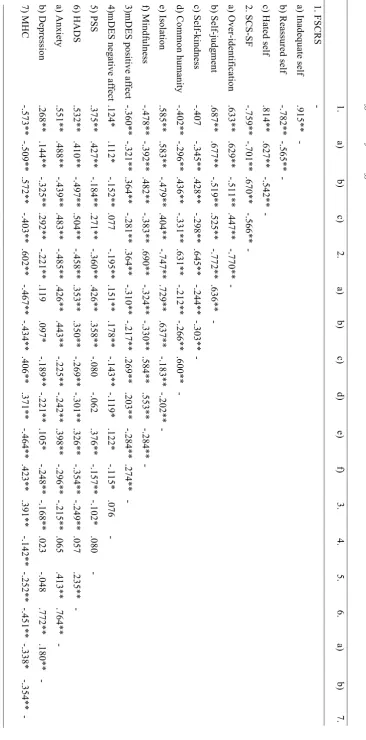
Descriptive statistics [image:17.595.95.502.220.640.2]Table 1 gives an overview of how the subjects scored on the diagnostic instruments employed in the current study. The outcomes of the correlation analysis between all relevant diagnostic instruments are depicted in Table 2.
Table 1. Descriptive statistics of the Diagnostic instruments
___________________________________________________________________________________
Range Mean SD Min. Max.
___________________________________________________________________________________
FSCSR (0-88) 39.00 7.73 12 68
Inadequate self (0-36) 14.66 7.17 0 35
Reassured self (0-32) 21.50 5.47 2 32
Hated self (0-20) 2.83 3.47 0 20
SCS-SF (12-84) 52.71 12.44 18 83
Over-identification (2-14) 7.74 3.17 2 14
Self-judgment (2-14) 6.73 3.19 2 14
Self-kindness (2-14) 8.55 2.56 2 14
Common humanity (2-14) 8.79 2.70 2 14
Isolation (2-14) 7.77 3.19 2 14
Mindfulness (2-14) 9.61 2.60 2 14
mDES positive affect (7-56) 33.46 5.54 19 50
mDES negative affect (7-56) 29.26 8.72 8 56
PSS (0-40) 19.06 4.30 0 30
HADS (0-42) 20.92 2.83 11 29
Anxiety (0-21) 12.12 2.34 5 16
Depression (0-21) 8.80 1.66 2 15
MHC-SF (14-84) 57.09 12.79 22 84
Emotional (3-18) 13.54 3.10 4 18
Social (5-30) 17.70 5.49 5 30
Psychological (6-36) 25.85 5.88 8 36
Concurrent & Convergent validity
The direction of the correlations of the FSCRS and the SCS-SF were always contrary to the investigated variables. As expected a significant and strong correlation was found between the FSCRS and SCS-SF (r=-.76), which means that people who are more self-compassionate are likely to be less self-critical. Concerning the subscales of the FSCRS, reassured self was strongly associated with inadequate self (r=-.57) and hated self (r=-.54), whereas hated self and inadequate self were strongly related (r=.63). Based on the subscales of the FSCRS and SCS-SF, the strongest correlation was found between self-judgment and inadequate self (r=.68), whereas self-judgment is slightly higher correlated with self-criticism (r=.69). The lowest correlation of the subscales between FSCRS and the SCS-SF was found between self-kindness and hated self (r=-.30). Furthermore common humanity was weakly correlated as well with the FSCRS as with the subscales of the SCS-SF, especially with over-identification (r=-.21), suggesting relatively unique concepts.
As can be seen from highlighted correlations in table 2, the SCS-SF tended to relate stronger with positive variables, whereas the FSCRS related stronger with negative variables. As expected a significant moderate correlation was found between the FSCRS and the mDES
of positive affect (r=-.36), which indicates that people who are more critical to themselves, are
more likely to experience less positive affect. Surprisingly there was only a weak correlation between the mDES of negative affect and the FSCRS (r=.12) and a weak correlation to the SCS-SF (r=-.20). Furthermore there is a moderate correlation between the SCS-SF and the mDES of positive affect (r=.36). As can be seen in table 2, a moderate correlation was found between the FSCRS and the PSS (r=.38), which indicates that people who are more self-critical are inclined to perceive more stress, compared to the SCS-SF (r=-.36). Concerning the HADS, a significant and strong correlation was found with the FSCRS (r=.53), whereas the SCS-SF was strongly correlated (r=-.46), indicating that one with more self-compassion is likely to experience less psychopathology or vice versa. Moreover the FSCRS and the MHC-SF have been strongly associated (r=-.57), compared to the SCS-MHC-SF (r=.60), which implies that people who are more self-critical are more likely to have less well-being.
As expected, a weak but significant correlation was found between the FSCRS and age (r=-.23, p <.001), which indicates that people tend to become less self-critical over the years. A very comparable weak correlation was found between the SCS-SF and age (r=.28, p <.001), which implies that people become more self-compassionate as they grew up. According to these findings, the pattern of the correlations corresponds with the expectations of this study but half of the correlations differed in their expected strength.
Known groups validity
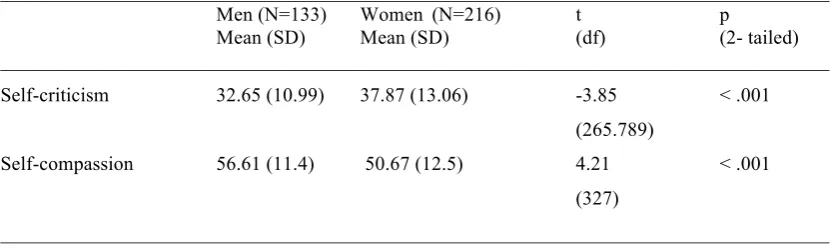
In order to examine significant differences between gender and the scales of FSCRS and SCS-SF, a t-test with independent samples was conducted. As can be seen from table 4, a difference in the FSCRS of T (265.78) =-3.85, p < .001 was found, which differ significantly by gender. Furthermore a difference in the SCS-SF of T (327) =4.34; p< .001, which also differ significantly by gender. Results indicated that men scored significantly lower on criticism compared to woman. Furthermore men scored significantly higher on self-compassion compared to woman. Therefore, as expected, the results revealed that both, the FSCRS and the SCS-SF are able to discriminate and show differences between men and
[image:20.595.90.507.461.585.2]women.
Table 4. Means and standard deviations of self-criticism and self-compassion by gender and
the assigned condition including the T-Test of independent samples
___________________________________________________________________________________
Men (N=133) Women (N=216) t p
Mean (SD) Mean (SD) (df) (2- tailed)
___________________________________________________________________________________
Self-criticism 32.65 (10.99) 37.87 (13.06) -3.85 < .001
(265.789)
Self-compassion 56.61 (11.4) 50.67 (12.5) 4.21 < .001
(327)
___________________________________________________________________________________
Incremental validity
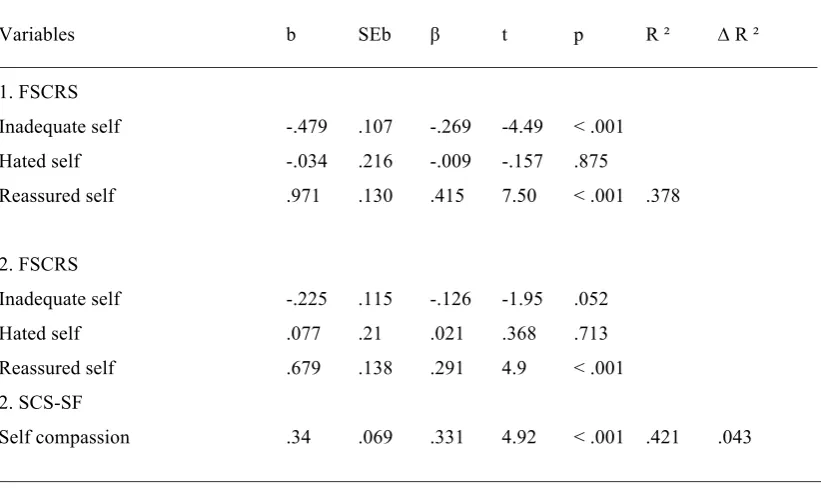
To examine the validity of the SCS-SF over and beyond the FSCRS in predicting well-being and psychopathology a regression analyses was conducted. The total FSCRS explained a significant proportion of variance in well-being scores, R²= .33, F (1, 327) = 159.82, p < .001. Together, the total FSCRS and the SCS-SF accounted for 39% of the variance of the well-being scores, R²= .39, F (2, 326) = 106.127, p < .001.
variance in well-being scores, R²= .38, F (3, 325) = 65.87, p < .001. Therefore the subscales of the FSCRS and the SCS-SF accounted for 42% of the variance of the well-being scores, R² = .42, F (4, 324) = 58.97, p < .001. In the first model of the stepwise regression analysis the subscales reassured self (b = .97, SEb = .13, β = .42, p < .001) and inadequate self (b = -.48,
SEb = .11, β = -.27, p < .001) explained significant variance in well-being scores. Only the
subscale hated self of the FSCRS was not significant (b = -.03, SEb = .22, β = -.01, p =.875). By adding the SCS-SF, as can be seen from the final model in table 5, inadequate self is not significant. Only reassured self of the FSCRS remains a significant predictor, while the
[image:21.595.91.502.290.534.2]SCS-SF is significant in explaining unique variance in well-being.
Table 5. Regression analyses with well-being as dependent variable
___________________________________________________________________________________
Variables b SEb β t p R ² ∆ R ²
__________________________________________________________________________________ 1. FSCRS
Inadequate self -.479 .107 -.269 -4.49 < .001
Hated self -.034 .216 -.009 -.157 .875
Reassured self .971 .130 .415 7.50 < .001 .378
2. FSCRS
Inadequate self -.225 .115 -.126 -1.95 .052
Hated self .077 .21 .021 .368 .713
Reassured self .679 .138 .291 4.9 < .001
2. SCS-SF
Self compassion .34 .069 .331 4.92 < .001 .421 .043
___________________________________________________________________________________
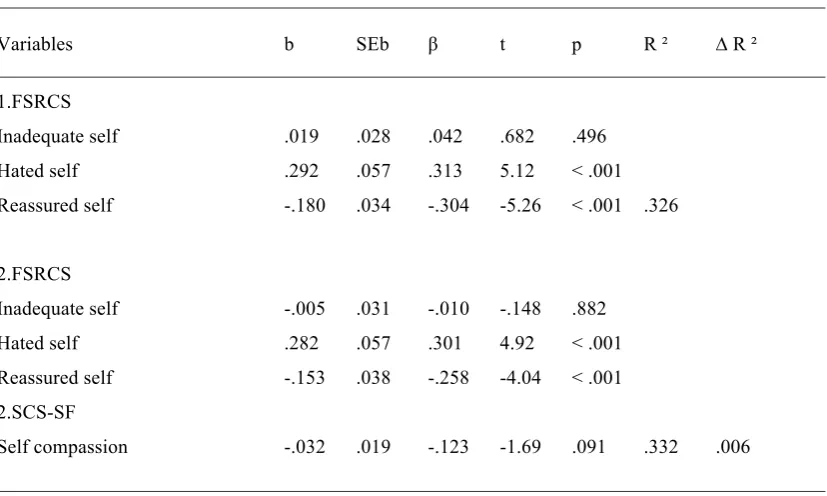
A second regression analyses was performed in order to examine the incremental validity of the FSCRS and the SCS-SF in predicting psychopathology. The total FSCRS explained a
significant proportion of variance in psychopathology scores, R²= .28, F (1, 327) = 128.94, p
< .001. The FSCRS accounted for 28% of the variance of the psychopathology scores but the
SCS-SF was not significant in explaining unique variance, R²= .29, F (2, 326) = 66.53 , p
=.073. Performing another regression analyses with the subscales reassured self, inadequate self and hated self, the FSCRS explained a significant proportion of variance in
psychopathology scores, R²= .33, F(3, 325) = 52.37, p < .001. The subscales of the FSCRS
accounted for 33% of the variance of the psychopathology scores but the SCS-SF was not
significant in explaining unique variance, R²= .33, F(4, 324) = 40.21, p = .091. In the first
= -.30, p < .001) and hated self (b = .29, SEb = .06, β = .31, p < .001) explained significant variance in psychopathology scores. Only the subscale inadequate self of the FSCRS was not significant (b = .02, SEb = .03, β = .04, p = .496). In table 6 findings of the final model from the regression analyses are shown, revealing that inadequate self of the FSCRS is no significant predictor for psychopathology.
[image:22.595.92.506.211.459.2]
Table 6. Regression analyses with psychopathology as dependent variable
___________________________________________________________________________________
Variables b SEb β t p R ² ∆ R ²
___________________________________________________________________________________ 1.FSRCS
Inadequate self .019 .028 .042 .682 .496
Hated self .292 .057 .313 5.12 < .001
Reassured self -.180 .034 -.304 -5.26 < .001 .326
2.FSRCS
Inadequate self -.005 .031 -.010 -.148 .882
Hated self .282 .057 .301 4.92 < .001
Reassured self -.153 .038 -.258 -4.04 < .001
2.SCS-SF
Self compassion -.032 .019 -.123 -1.69 .091 .332 .006
Discussion
The main purpose of this research was to investigate the relation between self-criticism and self-compassion and their predictive value for well-being and psychopathology. It was hypothesized that self-criticism and self-compassion were strongly related but that their relation to other variables such as positive affect, stress, anxiety, depression, well-being, gender and age were different in strength and pattern. The results support the presented hypotheses and suggest that self-criticism and self-compassion are similar but unique constructs, indicating evidence for a two continua model.
Concerning the descriptive statistics, the subscales of the FSCRS correspond closely with previous findings from a non-clinical population. The scores on the subscales are on average given the median of the subscales from Baião et. al. (2015). The average scores of the SCS-SF and the subscales are comparable with results from a Dutch sample (Raes et. al., 2011). Concerning the PSS, the average scores of this study are high compared to the study from Cohen (1988), where the average scores decreased with age. By comparing the scores of the HADS with a study sample of a general population, the participants of the current study scored surprisingly high on the anxiety and depression scale (Spinhoven et. al., 1997). Furthermore Lamers et. al. (2011) measured well-being with the MHC-SF in a Dutch sample and surprisingly, the scores on the sub- and total score are much higher in the current study compared tot the previous one. Nevertheless, results from a study from Trompetter, Kleine & Bohlmeijer (2016) corresponds with the current findings of this study regarding the MHC-SF, but with regard to the negative affect of the mDES, the average score is much higher.
Moreover the observed relationships between self-criticism and the negative variables
correspond with previous research (Dunkley et. al., 2003; Zuroff et. al., 2016; Neff, 2003a).
According to Zuroff et. al. (2016) self-criticism is related to high negative and low positive affect. Surprisingly, there was no strong relation between self-criticism and negative affect. Instead findings of this study indicated that self-criticism has a much more important role influencing positive affect. Research on self-compassion (Gilbert et. al., 2012; Klimecki et. al., 2012; MacBeth & Gumley, 2012) indicated positive outcomes like alleviating distress, increasing positive affect and promoting well-being, which is in line with the findings of this study. Therefore it seems that self-compassion works as a buffer for psychopathology like anxiety and depression, by promoting positive affect and well-being (Gilbert, 2005; Gilbert et. al., 2012; Neff, 2003b; Neff, et. al, 2007). These findings are in line with previous research, which indicated that self-criticism and self-compassion can be distinguished into
their resilient and vulnerable influences respectively (López, Sanderman, Smink, Zhang, van
Sonderen, Ranchor & Schroevers, 2015). Concerning age, findings suggest that self-criticism
assumption that men are less self-critical and more self-compassionate compared to women (Yarnell et. al., 2015).
According to the convergent validity of the total FSCRS and the SCS-SF it seems that both scales are measuring the same construct given their strong relation, which confirms the
idea that self-critical people actually have a fear of being kind to themselves (Gilbert et. al.,
2012). Taking the subscales into account, however, the findings of this study suggest that the
constructs are more unique given the weak relations between the subscales of common humanity/ self-kindness from the SCS-SF and inadequate-self/ reassured-self from the FSCRS respectively. From this point of view, it seems recommendable to use both, the FSCRS and the SCS-SF, in order to measure well-being and psychopathology. Concerning the convergent validity, results further indicated that self-criticism and self-compassion have the same pattern in relation to other variables, which was not expected. Nevertheless the pattern of the findings revealed that self-criticism tended to be stronger associated with negative variables like stress, anxiety and depression and that self-compassion is stronger related to positive variables such as positive affect and well-being. In addition, research about the factor structure of the SCS supports the idea of the distinction between self-compassion and self-criticism with resilient and vulnerable factors respectively, which provides evidence
that these constructs are rather independent (López et. al., 2015). The high range of
correlations between the subscales reassured self/ inadequate from the FSCRS and over-identification/ mindfulness from the SCS-SF, further supports this point of view, indicating unique constructs.
Concerning the incremental validity of the FSCRS and the SCS-SF in predicting well-being and psychopathology interesting findings were observed. The FSCRS explains unique variance for well-being and psychopathology. The subscales of the FSCRS show more unique variance than the total FSCRS for well-being and psychopathology, which can be explained by the comparable pattern of a stronger correlation of the total FSCRS compared to the subscales. For clarification, weaker correlations indicate more unique variance, whereas
stronger correlations imply less. Concerning well-being, together with the SCS-SF, only the
subscale reassured self added significant unique variance. These findings might be explained by the fact, that literature agrees that self-reassurance and self-compassion are strongly related constructs (Irons et. al., 2006) and therefore significant in predicting well-being. In addition, this corresponds with previous research from Gilbert & Procter (2006) who used self-compassion in a therapeutic approach to treat self-critical. In addition, self-reassurance and self-soothing capabilities are often used in clinical interventions in order to reduce one’s
self-criticism (Shahar, Carlin, Engle, Hegde, Szepsenwol & Arkowitz, 2012). Moreover,
variance, whereas the SCS-SF is the strongest predictor for well-being. Concerning psychopathology, the subscales reassured self and hated self explained unique variance, whereas inadequate self did not. Together with the SCS-SF, this pattern remained the same. Therefore the SCS-SF did not appear to explain unique variance for psychopathology.
The results further indicate that some hypothesized relations were different than assumed. Concerning the PSS, it was expected that the relation would be strong but there was only a moderate negative relation to the FSCRS, whereas the SCS-SF was moderately positively associated. A possible explanation might be that not enough evidence from literature was assembled consequently expecting a stronger association. In terms of the HADS in relation to the SCS-SF, an even stronger association was observed. In addition, the relation between the MHC-SF and the FSCRS was different than expected, given the strong negative correlation.
It can be concluded that the FSCRS and the SCS-SF are useful when measuring
positive outcomes like well-being but this is not the case regarding psychopathology. The results further emphasize that the SCS-SF does not add value over the FSCRS in explaining unique variance in measuring negative outcomes like psychopathology. This can be supported
by the fact that, the FSCRS explains unique variance over and beyond the SCS-SF for
well-being and psychopathology (a reversed regression analyses). Therefore when measuring
psychopathology, the FSCRS has more predictive value than the SCS-SF. The most notable
difference lies in the influence of self-criticism and self-compassion on positive and negative variables, which corresponds with previous findings, emphasizing that the FSCRS and the SCS-SF are not measuring the same construct (e.g., Gilbert et. al., 2012; Gilbert, 2005; Neff,
2003b). Therefore it can be stated that self-criticism and self-compassion are strongly related
but unique constructs. Concerning the dimensionality of the investigated constructs, the
results indicate that one can extend the understanding of the self contemporary being self-critical or that one can appreciate some experiences as part of the human experience and some as separated. Therefore this study indicates that self-criticism and self-compassion are rather two dimensions, meaning that one can be self-critical and self-compassionate and not one or the other.
representativeness of the sample. In addition, the gender distribution was not equally distributed which also constrain the opportunity to generalize the findings of this study. Furthermore the internal consistency of the mDES was low, which might effect the reliability of the findings.
For future research in the fields of positive psychology, it is necessary to further investigate why self-criticism and self-compassion are both significant in predicting being but not psychopathology. Concerning the SCS-SF as the strongest predictor for well-being, future research should focus whether this could be associated with the number of items of the scale. Moreover it is recommended to investigate the relation between self-criticism
and self-compassion within a clinical sample. This is necessary in order to gain more insight
for the use of the FSCRS and the SCS-SF and to obtain more evidence that the investigated constructs are unique. Concerning the stronger association between self-criticism to negative variables and self-compassion to positive variables it is unknown whether these results are a consequence of a method effect. According to López et. al. (2015) a method effect occurs when “two factors are solely composed by positively and negatively formulated items “ (p. 8), like self-compassion and self-criticism respectively. Therefore future research should focus on balancing scales with positive and negative formulated items to prevent bias. Based on the findings of this study, future research should use the FSCRS for interventions that focus on negative outcomes. But with regards to interventions that focus on positive outcomes the
FSCRS as well as the SCS-SF should be considered. The findings of the study further
References
Abi-Habib, R., & Luyten, P. (2013). The role of dependency and self-criticism in the
relationship between anger and depression. Personality and Individual Differences,
55(8), 921-925.
Baião, R., Gilbert, P., McEwan, K., & Carvalho, S. (2015). Forms of
Self‐Criticising/Attacking & Self‐Reassuring Scale: Psychometric properties and
normative study. Psychology and Psychotherapy: Theory, Research and Practice,
88(4), 438-452.
Blatt, S. J., Quinlan, D. M., Chevron, E. S., McDonald, C., & Zuroff, D. (1982). Dependency
and self-criticism: psychological dimensions of depression. Journal of consulting and
clinical psychology, 50(1), 113.
Bohlmeijer, E., Bolier, L., Westerhof, G., & Walburg, J. A. (2015). Handboek positieve
psychologie. Theorie* Onderzoek* Toepassingen. Tijdschrift voor Psychiatrie, 57(3),
226-227.
Chui, H., Zilcha-Mano, S., Dinger, U., Barrett, M. S., & Barber, J. P. (2016). Dependency and Self-Criticism in Treatments for Depression.
Cohen, S., Kamarck, T., & Mermelstein, R. (1983). A global measure of perceived stress.
Journal of health and social behavior, 385-396.
Cohen, S. (1988). Perceived stress in a probability sample of the United States.
Dunkley, D. M., Masheb, R. M., & Grilo, C. M. (2010). Childhood maltreatment, depressive symptoms, and body dissatisfaction in patients with binge eating disorder: The mediating role of self‐criticism. International Journal of Eating Disorders, 43(3), 274-281.
Dunkley, D. M., Zuroff, D. C., & Blankstein, K. R. (2003). Self-critical perfectionism and
daily affect: dispositional and situational influences on stress and coping. Journal of
personality and social psychology, 84(1), 234.
Fredrickson, B. L., Tugade, M. M., Waugh, C. E., & Larkin, G. R. (2003). What good are positive emotions in crisis? A prospective study of resilience and emotions following
the terrorist attacks on the United States on September 11th, 2001. Journal of
personality and social psychology, 84(2), 365.
Galanakis, M., Stalikas, A., Pezirkianidis, C., & Karakasidou, I. (2016). Reliability and Validity of the Modified Differential Emotions Scale (mDES) in a Greek Sample.
Psychology, 7, 101-113.
Gilbert, P. (2005). Compassion and cruelty: A biopsychological approach. In P. Gilbert (Ed.),
Compassion: Conceptualisations, research and use in psychotherapy (pp. 9-74)
British Journal of Clinical Psychology, 43(1), 31-50.
Gilbert, P., McEwan, K., Matos, M., & Rivis, A. (2011). Fears of compassion: Development
of three self‐report measures. Psychology and Psychotherapy: Theory, Research and
Practice, 84(3), 239-255.
Gilbert, P., & Procter, S. (2006). Compassionate mind training for people with high shame
and self‐criticism: Overview and pilot study of a group therapy approach. Clinical
Psychology & Psychotherapy, 13(6), 353-379.
Gilbert, P., McEwan, K., Gibbons, L., Chotai, S., Duarte, J., & Matos, M. (2012). Fears of compassion and happiness in relation to alexithymia, mindfulness, and self‐criticism.
Psychology and Psychotherapy: Theory, Research and Practice, 85(4), 374-390.
Harman, R., & Lee, D. (2010). The role of shame and self‐critical thinking in the development and maintenance of current threat in post‐traumatic stress disorder. Clinical psychology & psychotherapy, 17(1), 13-24.
Irons, C., Gilbert, P., Baldwin, M. W., Baccus, J. R., & Palmer, M. (2006). Parental recall, attachment relating and self‐attacking/self‐reassurance: Their relationship with
depression. British Journal of Clinical Psychology, 45(3), 297-308.
Kannan, D., & Levitt, H. M. (2013). A review of client self-criticism in psychotherapy.
Journal of Psychotherapy Integration, 23(2), 166.
Klimecki, O. M., Leiberg, S., Lamm, C., & Singer, T. (2012). Functional neural plasticity and
associated changes in positive affect after compassion training. Cerebral Cortex,
bhs142.
Kohn, P. M., & Macdonald, J. E. (1992). The Survey of Recent Life Experiences: A
decontaminated hassles scale for adults. Journal of behavioral medicine, 15(2),
221-236.
Lamers, S., Westerhof, G. J., Bohlmeijer, E. T., ten Klooster, P. M., & Keyes, C. L. (2011). Evaluating the psychometric properties of the mental health continuum‐short form
(MHC‐SF). Journal of clinical psychology, 67(1), 99-110.
Lassri, D., & Shahar, G. (2012). Self-criticism mediates the link between childhood emotional
maltreatment and young adults' romantic relationships. Journal of Social and Clinical
Psychology, 31(3), 289.
López, A., Sanderman, R., Smink, A., Zhang, Y., van Sonderen, E., Ranchor, A., & Schroevers, M. J. (2015). A reconsideration of the Self-Compassion Scale’s total
score: self-compassion versus self-criticism. PloS one, 10(7), e0132940.
MacBeth, A., & Gumley, A. (2012). Exploring compassion: A meta-analysis of the
association between self-compassion and psychopathology. Clinical Psychology
Neff, K. D. (2003a). Self-compassion: An alternative conceptualization of a healthy attitude toward oneself. Self and identity, 2(2), 85-101.
Neff, K. D. (2003b). The development and validation of a scale to measure self-compassion. Self and identity, 2(3), 223-250.
Neff, K. D. "Self-compassion." Handbook of individual differences in social behavior (2009). Neff, K. D., Rude, S. S., & Kirkpatrick, K. L. (2007). An examination of self-compassion in
relation to positive psychological functioning and personality traits. Journal of
Research inPersonality, 41(4), 908-916.
Raes, F., Pommier, E., Neff, K. D., & Van Gucht, D. (2011). Construction and factorial
validation of a short form of the self‐compassion scale. Clinical psychology &
psychotherapy, 18(3), 250-255.
Shahar, B., Carlin, E. R., Engle, D. E., Hegde, J., Szepsenwol, O., & Arkowitz, H. (2012). A pilot investigation of emotion‐focused two‐chair dialogue intervention for
self‐criticism. Clinical Psychology & Psychotherapy, 19(6), 496-507.
Sherry, S. B., Stoeber, J., & Ramasubbu, C. (2016). Perfectionism explains variance in self- defeating behaviors beyond self-criticism: Evidence from a cross-national sample.
Personality and Individual Differences, 95, 196-199.
Spinhoven, P. H., Ormel, J., Sloekers, P. P. A., Kempen, G. I. J. M., Speckens, A. E. M., & Van Hemert, A. M. (1997). A validation study of the Hospital Anxiety and
Depression Scale (HADS) in different groups of Dutch subjects. Psychological
medicine, 27(02), 363-370.
Spss, I. (2012). IBM SPSS statistics version 21. Boston, Mass: International Business
Machines Corp.
Stoeber, J., & Rambow, A. (2007). Perfectionism in adolescent school students: Relations
with motivation, achievement, and well-being. Personality and Individual
Differences, 42(7), 1379-1389.
Trompetter, H. R., Kleine, E., & Bohlmeijer, E. T. (2016). Why Does Positive Mental Health Buffer Against Psychopathology? An Exploratory Study on Self-Compassion as a
Resilience Mechanism and Adaptive Emotion Regulation Strategy. Cognitive therapy
and research, 1-10.
Westerhof, G. J., & Keyes, C. L. (2010). Mental illness and mental health: The two continua
model across the lifespan. Journal of adult development, 17(2), 110-119.
Yarnell, L. M., Stafford, R. E., Neff, K. D., Reilly, E. D., Knox, M. C., & Mullarkey, M.
(2015). Meta-analysis of gender differences in self-compassion. Self and Identity,
14(5), 499-520.
Zigmond, A. S., & Snaith, R. P. (1983). The hospital anxiety and depression scale. Acta
Zuroff, D. C., Sadikaj, G., Kelly, A. C., & Leybman, M. J. (2016). Conceptualizing and
measuring self-criticism as both a personality trait and a personality state. Journal of