Review Article
Best strategy of thromboembolic prophylaxis after
knee arthroscopy: a systematic review and
meta-analysis of 9 randomized trials
Zhen Lyu1*, Bing Li1*, Xiaofei Zhang1, Bo Li1, Xinglong Ma2, Jinxing Ma2, Jun Liu1
1Department of Joint Surgery, Tianjin Hospital, Tianjin, China; 2Orthopedic Institute of Tianjin, Tianjin, China. *Equal contributors.
Received March 6, 2018; Accepted October 9, 2018; Epub January 15, 2019; Published January 30, 2019
Abstract: Introduction: Currently, prevention of deep vein thrombosis after arthroscopic knee surgery is in dispute. The aim of this study was to conduct a meta-analysis of all randomized controlled trials published, determining whether anticoagulation should be performed after knee arthroscopies (KA). Materials and methods: A compre- hensive literature search was conducted through October 24, 2017. PubMed, Embase, Web of Science, Cochrane Library, CISCOM, CINAHL, and Google Scholar databases were searched. The aim was to determine the relationship between the use of different chemical anticoagulation strategies and the risk of deep venous thrombosis after knee
arthroscopies. A meta-analysis of pooled and stratified data was performed and assessed using Mantel-Haenszel fixed effects models. Results: A total of nine randomized clinical trials met the eligibility criteria and were included
for quantitative analysis. Thromboprophylaxis was shown to significantly decrease the risk of symptomatic DVT (P =
0.914, 95% CI = 0.10-0.22) and asymptomatic distal DVT (P = 0.107 95% CI = 0.18--0.45) after KA. There was no
significant association between anticoagulation drugs and risk of bleeding events (P = 0.092, 95% CI = 0.56-1.06).
Use of LMWH after KA may significantly reduce the risk of distal asymptomatic DVT. Three kinds of chemical preven
-tion measures can reduce incidence of symptomatic DVT, without increasing the risk of bleeding events. Conclusion:
The present study confirms that thromboprophylaxis after arthroscopic surgery is significant, without increasing the
risk of bleeding events. Oral antithrombotic drugs are a better prophylactic strategy than subcutaneous injections of LMWH.
Keywords: Thromboprophylaxis, LMWH, rivaroxaban, aspirin, knee arthroscopy, meta-analysis
Introduction
Knee arthroscopy (KA) is the most common orthopedic procedure performed on a day-care setting, with more than 5 million procedures per year in Western countries [1, 2]. Venous thromboembolism (VTE) is a common and clini -cally relevant complication to major orthopedic surgery. However, it has been considered rare in the setting of elective knee arthroscopy based on reported retrospective articles [3-5]. Some reports have reported that incidence of objectively proven deep-vein thrombosis (DVT) after KA ranges from 0.6% to 18% (symptom-atic DVT 0% to 1%) [6-8], without thrombus pro- phylaxis [9-12]. Recently, a large population case-control study reported a 18-fold increased risk of DVT in the first three months following KA [13]. Common clinical symptoms of DVT
include unilateral leg swelling, skin temperature rise, or positive Homan examination. The most serious clinical manifestation is the emergence of fatal pulmonary embolism (PE), which is dif-ficult to diagnostic.
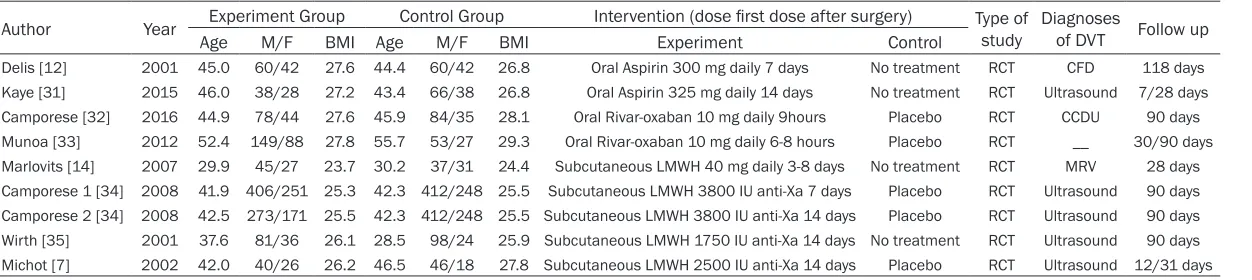
Table 1. Characteristics of included studies in this meta-analysis
Author Year Experiment Group Control Group Intervention (dose first dose after surgery) Type of study Diagnoses of DVT Follow up
Age M/F BMI Age M/F BMI Experiment Control
Delis [12] 2001 45.0 60/42 27.6 44.4 60/42 26.8 Oral Aspirin 300 mg daily 7 days No treatment RCT CFD 118 days Kaye [31] 2015 46.0 38/28 27.2 43.4 66/38 26.8 Oral Aspirin 325 mg daily 14 days No treatment RCT Ultrasound 7/28 days
Camporese [32] 2016 44.9 78/44 27.6 45.9 84/35 28.1 Oral Rivar-oxaban 10 mg daily 9hours Placebo RCT CCDU 90 days
Munoa [33] 2012 52.4 149/88 27.8 55.7 53/27 29.3 Oral Rivar-oxaban 10 mg daily 6-8 hours Placebo RCT __ 30/90 days
Marlovits [14] 2007 29.9 45/27 23.7 30.2 37/31 24.4 Subcutaneous LMWH 40 mg daily 3-8 days No treatment RCT MRV 28 days Camporese 1 [34] 2008 41.9 406/251 25.3 42.3 412/248 25.5 Subcutaneous LMWH 3800 IU anti-Xa 7 days Placebo RCT Ultrasound 90 days Camporese 2 [34] 2008 42.5 273/171 25.5 42.3 412/248 25.5 Subcutaneous LMWH 3800 IU anti-Xa 14 days Placebo RCT Ultrasound 90 days Wirth [35] 2001 37.6 81/36 26.1 28.5 98/24 25.9 Subcutaneous LMWH 1750 IU anti-Xa 14 days No treatment RCT Ultrasound 90 days Michot [7] 2002 42.0 40/26 26.2 46.5 46/18 27.8 Subcutaneous LMWH 2500 IU anti-Xa 14 days Placebo RCT Ultrasound 12/31 days
decreased costs, and decreased risk of bleed-ing. It has good preventive effects, having been successfully used in orthopedic surgery VTE prophylaxis [15, 16]. The American Academy of Orthopedic Surgeons and the American College of Chest Physicians have included aspirin as an acceptable form of chemoprophylaxis against VTE following hip and knee arthroplasty. An RCT by Kaye found that the use of aspirin in a low-risk population undergoing arthroscopic knee surgery was not warranted [17]. Rivaroxaban is a highly selective direct factor-Xa inhibitor. It has been approved for VTE prevention after orthopedic operations. It has been used in non valvular atrial fibrillation patients to treat and prevent strokes [18-20]. Recently, new oral drugs, such as rivaroxaban, have been shown to improve results from thromboprophylaxis in patients undergoing knee arthroscopy surgery [21-24].
dence for the development of clinical standard guidelines.
Methods
Data sources and searches
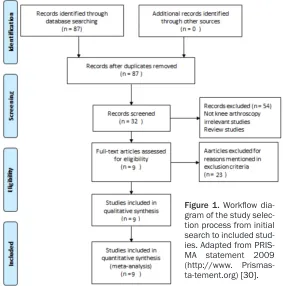
A comprehensive literature search was con-ducted up through October 24, 2017 using PubMed, Embase, Web of Science, Cochrane Library, CISCOM, CINAHL, and Google Scholar databases. Previous meta-analyses and ab- stracts/presentations from annual meetings about antithrombotic therapy and prevention of thrombosis (American College of Chest Physicians Evidence-Based Clinical Practice Guidelines) were also screened. All research articles published with a combination of the fol-lowing search terms were matched: “Aspirin”, “Factor Xa inhibitors”, “Low molecular weight Figure 1. Workflow dia
-gram of the study selec-tion process from initial search to included stud-ies. Adapted from PRIS-MA statement 2009 (http://www. Prismas-ta-tement.org) [30].
Although the risk of deep venous thrombosis (DVT) after knee arthroscopy is a real problem, some studies have suggested that chemical pro-phylaxis could reduce the risk of VTE. Some articles have recommended the use of antithrombotic drugs [25] after arthroscopic knee sur-gery to prevent thrombosis, because of a lack of medic- ine-based evidence. Several countries and international organizations, including the American College of Chest Physicians, recommend that young low-risk patients after knee arthroscopic surgery do not use anticoagulant drugs. Similarly, the Americ- an Association of Orthopedic Surgeons has not objected to the use of preventative drugs after knee arthroscopies. The present meta-analysis ana-lyzed the incidence of DVT, bleeding events, and other aspects, comparing a variety of anticoagulant drugs on the prevention of deep vein throm-bosis. The aim was to provide evidence-based medical
evi-Table 2. Results of anticoagulation VS. control groups
P value RR 95% CI
Symptomatic DVT 0.914 0.14 (0.10--0.22)
Asymptomatic Distal DVT 0.107 0.28 (0.18--0.45)
heparin”, “thrombosis”, “knee arthroscopy”, and “Randomized trials”. No language, date, or other publication restrictions were imposed. The most updated/inclusive data on each study was used for abstraction. Reference lists of rel-evant studies were also scanned.
Selection criteria and quality assessment
Inclusion criteria were: 1) Human studies; 2) RCTs comparing the effect and safety of a sin-gle anticoagulant drug to a control group with a placebo or no treatment; 3) Studies reporting re-specified outcomes of interest; and 4) RCTs concerning post-knee arthroscopic surgery.
[image:4.612.90.522.73.484.2]Exclusion criteria were: 1) Non-randomized reg-istries; 2) Several anticoagulants were used in combination of the experimental group; 3) The control group used anticoagulants; 4) Upstream administration by study design of another anti-coagulant prior to randomization; and 5) Follow-up was not relevant to the meta-analysis. The present study used the Grading of Re- commendations Assessment, Development, and Evaluation (GRADE) system to evaluate the quality of included studies. Details of evidence profiles for outcomes are presented in Table 2. GRADE level of evidence was high for symptom -atic deep vein thrombosis and asymptom-atic Figure 2. Quality assessment of included studies using QUADAS-2 tool criteria. A. Each risk of bias item is presented
distal symptomatic thrombosis. Scores were mid-level for clinically relevant non-major bleed-ing events.
Quality assessment of studies was conducted using QUADAS-2 tool criteria. One study was considered to be at high risk of bias. Eight stud-ies had an unclear risk of bias. High risk of bias was based on the use of blinding of participants and personal reasons (performance bias). Details of the risk of bias for each study are pre -sented in Figure 2.
Statistical analysis
To examine the strength of anticoagulant drugs preventing thrombosis after knee arthroscopy surgery, pooled odds ratios (ORs) and their cor-responding 95% confidential intervals (CIs) were estimated for each study. Subgroup analy-sis was also performed by drug (defined as aspirin, rivaroxaban, and LMWH) and by the method (defined as oral and subcutaneous) for thrombosis with anticoagulant drugs.
Departure of frequencies of thrombosis with anticoagulant drugs after knee arthroscopy surgery was calculated by Chi-squared tests for the controls. Forest plots were created to visu-ally assess major contributors to heterogeneity. Possible publication bias was tested using Begg’s [26] funnel plot and Egger’s [27] regres-sion test (P < 0.5 indicates statistically signifi-cant publication bias). Sensitivity analysis was
performed to examine the impact on individual studies. Odds ratios (ORs) and a 95% confi -dence intervals (95% CIs) were used to deter-mine whether a fixed or random-effects model [28] would be applied. For p values of 0.05 and 50%, between-study heterogeneity was consid-ered to be significant and a random-effects model was used to calculate the OR. If no sig-nificant heterogeneity was observed, a fixed-effects model was used (DerSimonian-Laird method). I2 statistics was employed to quantify
inter-study variability, with larger values sug-gesting an increased degree of heterogeneity [29].
All statistical analyses in this study were per-formed using the statistical software package Stata (Stata Statistical Software: release 11.0 College Station, TX, StataCorp. LP).
Results
Study search
Figure 1 presents a detailed summary of the study selection process. Of the 87 articles screened, 79 were excluded according to exclu-sion criteria. A total of 9 randomized clinical tri-als met the eligibility criteria and were included for quantitative analysis.
Study characteristics
Study characteristics of included studies are presented in Table 1. Of the randomized con-trolled trials, two used aspirin, two used rivar-oxaban, and five used LMWH. Each randomized controlled trial was reviewed. Data was extract -ed for the following elements: author, year, age, gender, BMI, intervention (dose first dose after surgery), type of study, diagnoses as DVT, and follow up. Prophylactic agents were as follows: 1) Aspirin (oral aspirin 300 mg daily); 2) Rivaroxaban (oral rivaroxaban 10 mg daily); and 3) Low molecular-weight heparin (LMWH) (1. Subcutaneous LMWH 3000-3800 IU anti-Xa 7 days, 2. Subcutaneous LMWH 1750-2500 IU anti-Xa14 days).
Symptomatic DVT
Nine randomized controlled trials, including 2,931 participants, compared anticoagulation drugs with placebo or no treatment. Anticoa- gulation drugs were associated with a signifi
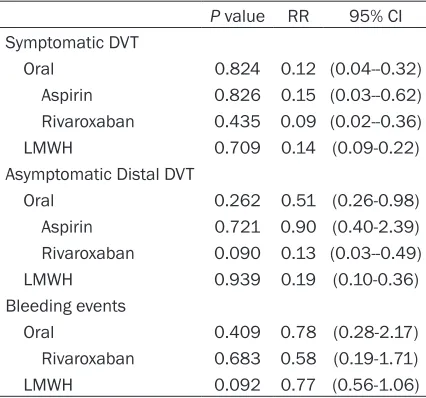
-Table 3. Subgroup analysis results of anticoagu-lation VS. control groups
P value RR 95% CI
Symptomatic DVT
Oral 0.824 0.12 (0.04--0.32) Aspirin 0.826 0.15 (0.03--0.62) Rivaroxaban 0.435 0.09 (0.02--0.36) LMWH 0.709 0.14 (0.09-0.22)
Asymptomatic Distal DVT
Oral 0.262 0.51 (0.26-0.98) Aspirin 0.721 0.90 (0.40-2.39) Rivaroxaban 0.090 0.13 (0.03--0.49) LMWH 0.939 0.19 (0.10-0.36) Bleeding events
[image:5.612.90.303.96.295.2]cant decrease in risk of Symptomatic DVT (rela -tive risk (RR) = 0.14, 95% CI 0.10 to 0.20, P = 0.914; I2 = 0%; Table 2; Figure 2).
Asymptomatic distal DVT
In nine randomized controlled trials, including 3,023 participants, anticoagulation drugs were
Heterogeneity in terms of ORs of rivaroxaban was found in asymptomatic distal DVT sub -group analysis. Since P values were < 0.5, a fixed effects model was used.
Publication bias causes a disproportionate number of studies with positive results, reduc-ing accuracy and reliability of meta-analyses. Figure 3. Odds ratio of primary analysis associated with anticoagulation
vs. control therapy. (A) Symptomatic DVT, (B) Asymptomatic Distal DVT (C)
Bleeding events.
associated with a significant decrease in the risk of asymp-tomatic distal DVT (RR = 0.28, 95% CI 0.18 to 0.45 P = 0.107; I2 = 39.1%; Table 2; Figure 2). Bleeding events
Since an aspirin experiment did not report a bleeding event, a total of eight studies were included in this meta-analysis. There was no significant asso -ciation with anticoagulation drugs and risk of bleeding events (RR = 0.77, 95% CI 0.56 to 1.06, P = 0.092; I2 = 42.9%
Table 2; Figure 2). Subgroup analysis
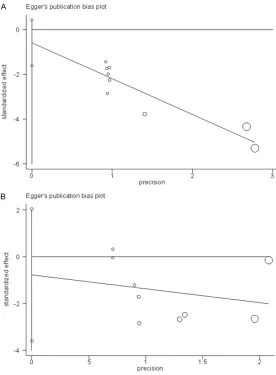
There was no evidence of publication bias found in the present meta-analysis (Figure 4). Sensitivity analyses for pooled studies
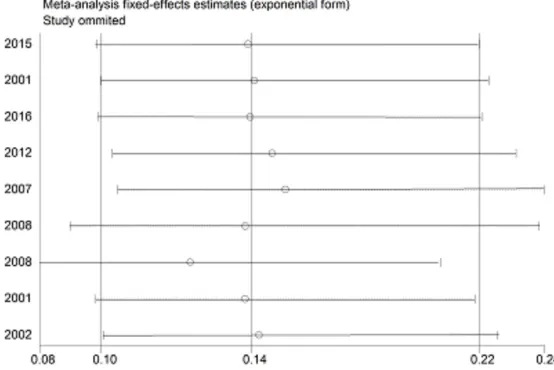
Sensitivity analysis concerning the association of anticoagulation drugs and thrombosis risk was performed to assess the impact of each study on pooled ORs. Results suggest that pooled ORs were not altered by the omission of any individual study (Figure 5).
Discussion
According to pooled statistical analysis, inci-dence of symptomatic deep venous thrombosis (DVT) in patients receiving a knee arthroscopy
trials to support this conclusion. In general, symptomatic DVT after knee arthroscopy is rare [7, 14, 32-35]. To the best of our knowl-edge, all current publications confirm that LMWH can prevent thrombosis. There are no reports on thromboprophylaxis of oral antico-agulants. Low-cost LMWH not only reduces thromboembolic events during knee arthro-plasty but also during knee arthroscopy. However, LMWH requires subcutaneous injec-tions and is, therefore, only cost-effective if the patient or caregiver can inject the drug at home [37, 38]. Oral anticoagulants could be used as an alternative.
Clinical manifestations of asymptomatic distal DVT include unilateral leg swelling, skin tem -Figure 4. Egger’s funnel plot of symptomatic DVT (A) and asymptomatic dis
-tal DVT (B) and anticoagulation drugs after KA in the dominant model. Each
circle represents an individual study, while the circle size is proportional to the study weight. Logger natural logarithm of odds ratio.
[image:7.612.91.367.70.445.2]perature rise, redness, and a positive Homan examination, which can be checked and con-firmed by color ultrasonography [32]. Incidence of asymptomatic DVT in the anticoagulant-treated group was 1.2%, 3.8% lower than the control group of patients that did not receive treatment (Table 2). Williams reported a higher detection rate of 3.5% for asymptomatic distal DVT within two weeks after knee arthroscopy without anticoagulant therapy [8]. The discrep-ancy between these studies is likely due to dif-ferences in follow-up times, as the average fol-low-up time in the literature is 30 days. Compared to the control group, LMWH had a significant eightfold lower incidence of asymp -tomatic distal DVT in patients that received anticoagulant therapy (0.9%) (P = 0.939, 95% CI 0.10 to 0.36). Results remained ambiguous on whether the two oral anticoagulants, aspirin and rivaroxaban, can reduce incidence of asymptomatic distal DVT since no significant differences were observed between control and treatment groups.
Minor complications caused by antithrombotic drugs, such as minor bleeding, wound hemato-ma, and even re-operation due to bleeding [39], are unpredictable [31]. Wirth [35] reported a higher incidence of bleeding events in the experimental group, compared to the control group. The present study, however, found no statistically significant correlation between the use of anticoagulant prophylactic treatment and bleeding incidence.
ferent. For LMWH and rivaroxaban, the dura-tions were the same but they were significantly different from the two studies using aspirin. Fortunately, the results of all included studies agreed.
Conclusion
In conclusion, this is the first meta-analysis examining the use of anticoagulants to prevent DVT after knee arthroscopies. The use of anti -coagulants must balance the prevention of thrombosis with the potential for complica-tions. The present study confirmed that antico -agulant treatment after arthroscopic surgery significantly contributes to the prevention of thrombosis without increasing the risk of bleed-ing events. Current adopted prevention strate-gies require daily subcutaneous injections of LMWH. However, Munoa [33] reported that, post-surgery, patients often did not receive their anticoagulant treatment before the pre-scribed LMWH date. Several studies have reported [40-43] a lower risk and better safety performance associated with the use of aspi-rin, compared to other traditional antithrombot-ic agents after knee and hip replacement sur-gery. The same conclusions were drawn using a randomized controlled trial with aspirin for the prevention of thrombus after knee arthroscopy. Furthermore, a rigorous double-blind and ran-domized controlled study showed that the use of rivaroxaban after knee arthroscopies signifi -cantly reduced the risk of DVT, without increas -Figure 5. Sensitivity analysis of summary odds ratio coefficients on inci
-dence of DVT after KA and anticoagulant prophylaxis with susceptibility to
osteoarthritis under the dominant mode.
Limitation
[image:8.612.90.367.75.260.2]dif-ing the risk of bleeddif-ing [44]. It was believed that oral administration is more appropriate than subcutaneous administration because it allows for self-management of the drug, ensuring the safety of the prescription. In general, symptom-atic DVT after knee arthroscopies is rare and there is no requirement to use anticoagulant therapy for low-risk patients. However, it is rec-ommended that oral anticoagulation is used for high-risk patients to prevent DVT.
Acknowledgements
This research supported by grants from the Health Bureau Science and Technology Fund of Tianjin (No. 2013KZ063) and Health and Family Planning Fund of Tianjin (No. 14KG123).
Disclosure of conflict of interest
None.
Address correspondence to: Dr. Jun Liu,
Depart-ment of Joint Surgery, Tianjin Hospital, 406 Jiefang
Street, Hexi District, Tianjin, China. Tel: +86 15602176472; E-mail: [email protected]
References
[1] Hoppener MR, Ettema HB, Henny CP, Verheyen
CC, Büller HR. Low incidence of deep vein thrombosis after knee arthroscopy without thromboprophylaxis a prospective cohortstudy of 335 patients. Acta Orthop Scand 2006; 77: 767-771.
[2] Graham WC, Flanigan DC. Venous thromboem -bolism following arthroscopic knee surgery: a current concepts review of incidence, prophy-laxis and preoperative risk assessment. Sports Med 2014; 44: 331-43.
[3] Bohensky MA, Dsteiger R, Kondogiannis C, Sundararajan V, Andrianopoulos N, Bucknill A,
McColl G, Brand CA. Adverse outcomes associ-ated with elective knee arthroscopy: a popula-tion-based cohort study. Arthroscopy 2013; 29: 716-25.
[4] Hetsroni I, Lyman S, Do H, Mann G, Marx RG.
Symptomatic pulmonary embolism after out-patient arthroscopic procedures of the knee: the incidence and risk factors in 418,323 ar-throscopies. J Bone Joint Surg Br 2011; 93: 253-7.
[5] Maletis GB, Inacio MD, Reynolds S, Funahashi
TT. Incidence of symptomatic venous thrombo-embolism after elective knee arthroscopy. J Bone J Surg Am 2012; 94: 714-20.
[6] Williams JS Jr, Hulstyn MJ, Fadale PD, Lindy PB, Ehrlich MG, Cronan J, Dorfman G. Incidence
of deep vein thrombosis after arthroscopic kn- ee surgery. Thromb Haemost 1997; 79: 183. [7] Michot M, Conen D, Holtz D, Erni D, Zumstein
MD, Ruflin GB, Renner N. Prevention of deep
vein thrombosis in ambulatory arthroscopic knee surgery: a randomized trial of prophylaxis with low-molecular weight heparin. Arthroscopy 2002; 18: 257-263.
[8] Williams JS, Hulstyn M, Fadale PD, Lindy PB, Ehrlich MG, Cronan J, Dorfman G. Incidence
of deep vein thrombosis after arthroscopic knee surgery; a prospective study. Arthroscopy 1995; 11: 701-5.
[9] Demers C, Marcoux S, Ginsberg JS, Laroche F,
Cloutier R, Poulin J. Incidence of venographi-cally proved deep vein thrombosis after knee arthroscopy. Arch Intern Med 1998; 158: 47-50.
[10] Dahl OE, Gudmundsen TE, Haukeland L. Late
occurring clinical deep vein thrombosis in joint operated patients. Acta Orthop Scand 2000; 71: 47-50.
[11] Jareguito JW, Greenwald AE, Wilcox JF, Paulos
LE, Rosenberg TD. The incidence of deep ve -nous thrombosis after arthroscopic knee sur-gery. Am J Sports Med 1999; 27: 707-10. [12] Delis KT, Hunt N, Strachan RK, Nicolaides
AN. Incidence, natural history and risk factors of deep vein thrombosis in elective knee ar-throscopy. Thromb Haemost 2001; 86: 817-21.
[13] van Adrichem RA, Nelissen RG, Schipper IB, Rosendaal FR, Cannegieter SC. Risk of venous thrombosis after arthroscopy of the knee: re-sults from a large population based case-con-trol study. J Thromb Haemost 2015; 13: 1441-8.
[14] Marlovits, Striessnig G, Schuster R, Luxl M,
Trattnig S, Vécsei V. Extended duration throm -boprophylaxis with enoxaparin after arthros- copic surgery of the anterior cruciate ligament: a prospective,randomized, placebo-controlled study. Arthroscopy 2007; 23: 696-702. [15] Collaboration AT. Collaborative overview of
ran-domized trials of antiplatelet therapy-III: reduc-tion in venous thrombosis and pulmonary em-bolism by antiplatelet prophylaxis among surgi-cal and medisurgi-cal patients. BMJ 1994; 308: 235-46.
[16] Pulmonary Embolism Prevention (PEP) Trial Collaborative Group. Prevention of pulmonary embolism and deep vein thrombosis with low dose aspirin: pulmonary embolism prevention trial. Lancet 2000; 355: 1295-302.
[17] Kaye ID, Patel DN, Strauss EJ, Alaia MJ,
Garofolo G, Martinez A, Jazrawi LM. Prevention of venous thromboembolism after arthroscop-ic knee surgery in a low-risk population with the use of aspirin. A randomized trial. Bull
[18] Turpie AG, Lassen MR, Eriksson BI, Gent M,
Berkowitz SD, Misselwitz F, Bandel TJ,
Home-ring M, Westermeier T, Kakkar AK. Rivaroxaban for the prevention of venous thromboembo-lism after hip or knee arthroplasty. Pooled analysis of four studies. Thromb Haemost 2011; 105: 444-53.
[19] Prins MH, Lensing AW, Brighton TA, Lyons RM,
Rehm J, Trajanovic M, Davidson BL, Beyer-Westendorf J, Pap ÁF, Berkowitz SD, Cohen AT,
Kovacs MJ, Wells PS, Prandoni P. Oral rivaroxa-ban versus standard therapy for the treatment of symptomatic venous thromboembolism: a
pooled analysis of the EINSTEIN-DVT and PE
randomised studies. Lancet Haematol 2014; 1: e37-46.
[20] Prins MH, Lensing AW, Bauersachs R, et al. ROCKET AF Investigators. N Engl J Med 2011; 365: 883-91.
[21] Eriksson BI, Borris LC, Friedman RJ, Haas S,
Huisman MV, Kakkar AK, Bandel TJ, Beckmann
H, Muehlhofer E, Misselwitz F, Geerts W;
RECORD1 Study Group. Rivaroxaban versus
enoxaparin for thromboprophylaxis after hip arthroplasty. N Engl J Med 2008; 358: 2765-75.
[22] Kakkar AK, Brenner B, Dahl OE, Eriksson BI,
Mouret P, Muntz J, Soglian AG, Pap AF,
Misselwitz F, Haas S; RECORD2 Investigators.
Extended duration rivaroxaban versus short-therm enoxaparin for the prevention of venous thromboembolism after total hip arthroplasty: a double blind, randomised controlled trial. Lancet 2008; 372: 31-3.
[23] Lassen MR, Ageno W, Borris LC, Lieberman JR, Rosencher N, Bandel TJ, Misselwitz F, Turpie
AG; RECORD3 Investigators. Rivaroxaban ver -sus enoxaparin for thromboprophylaxis after total knee arthroplasty. N Eng J Med 2008; 358: 2776-86.
[24] Lassen MR, Borris LC, Christiansen HM, Boll KL, Eiskjaer SP, Nielsen BW, Schøtt P, Olsen
AD, Rodenberg JC, Lucht U. Prevention of
thromboembolism in 190 hip arthroplasties: comparison of LMW heparin and placebo. Acta Orthop Scand 1991; 62: 33-8.
[25] Falck-Ytter Y, Francis CW, Johanson NA, Curley
C, Dahl OE, Schulman S, Ortel TL, Pauker SG, Colwell CW Jr. Prevention of VTE in orthopedic
surgery patients: antithrombotic therapy and prevention of thrombosis, 9th ed: american college of chest physicians evidence-based clinical practice guidelines. Chest 2012; 141 Suppl: e278S-e325S.
[26] Begg CB, Mazumdar M. Operating characteris-tics of a rank correlation test for publication bias. Biometrics 1994; 50: 1088-101.
[27] Egger M, Davey Smith G, Schneider M, Minder
C. Bias in meta-analysis detected by a simple, graphical test. BMJ 1997; 315: 629-34.
[28] DerSimonian R, Laird N. Meta-analysis in clini -cal trials revisited. Contemp Clin Trials 2015; 45: 139-45.
[29] Hildebrand KA, Frank CB, Hart DA. Gene inter -vention in ligament and tendon: current status, challenges, future directions. Gene Ther 2004; 11: 368-78.
[30] Moher D, Liberati A, Tetzlaff J, Altman DG; The
PRISMA Group. Preferred reporting items for systematic reviews and meta-analyses: the PRISMA statement. PLoS Med 2009; 6: e1000097.
[31] Kaye ID, Patel DN, Strauss EJ, Alaia MJ,
Garofolo G, Martinez A, Jazrawi LM. Prevention of venous thromboembolism after arthroscop-ic knee surgery in a low-risk population with the use of aspirin. A Randomized Trial. Bull
Hosp Jt Dis 2015; 73: 243-8.
[32] Camporese G, Bernardi E, Noventa F, Bosco M, Monteleone G, Santoro L, Bortoluzzi C, Freguja S, Nardin M, Marullo M, Zanon G, Mazzola C,
Damiani G, Maniscalco P, Imberti D, Lodigiani
C, Becattini C, Tonello C, Agnelli G; ERIKA Study
Group. Efficacy of rivaroxaban for thrombopro -phylaxis after knee arthroscopy (ERIKA). A phase II, multicentre, double-blind, placebo-controlled randomised study. Thromb Haemost 2016; 116: 349-55.
[33] Muñoa L, González AB, Díaz de Rada P, Valentí A. Rivaroxaban is as efficient and safe as bemi -parin as thromboprophylaxis in knee arthros-copy. Musculoskelet Surg 2014; 98: 21-5. [34] Camporese G, Bernardi E, Prandoni P, Noventa
F, Verlato F, Simioni P, Ntita K, Salmistraro G,
Frangos C, Rossi F, Cordova R, Franz F,
Zucchetta P, Kontothanassis D, Andreozzi GM;
KANT (Knee Arthroscopy Nadroparin Throm- boprophylaxis) Study Group. Low-molecular-weight heparin versus compression stockings for thromboprophylaxis after knee arthrosco-py: a randomized trial. Ann Intern Med 2008; 149: 73-82.
[35] Wirth T, Schneider B, Misselwitz F, Lomb M, Tüylü H, Egbring R, Griss P. Prevention of ve-nous thromboembolism after knee arthrosco-py with low-molecular weight heparin (revipa-rin): results of a randomized controlled trial. Arthroscopy 2001; 17: 393-9.
[36] Adala R, Anand A, Kodikal G. Deep vein throm -bosis and thromboprophylaxis in arthroscopic anterior cruciate ligament reconstruction. Indian J Orthop 2011; 45: 450-3.
[37] Dahl OE, Pleil AM. Investment in prolonged
thromboprophylaxis with dalteparin improves clinical outcomes after hip replacement. J Thromb Haemost 2003; 2: 896-906.
[38] Davies LM, Richardson GA, Cohen AT. Economic
elec-tive hip surgery. Value Health 2000; 3:
397-406.
[39] Marlovits S, Striessnig G. Extended-duration thromboprophylaxis with enoxaparin after ar-throscopic surgery of the anterior cruciate liga-ment: a prospective, randomized, placebo-controlled study. Arthroscopy 2007; 23: 696-702.
[40] Bozic KJ, Vail TP, Pekow PS, Maselli JH, Lin-denauer PK, Auerbach AD. Does aspirin have a
role in venous thromboembolism prophylaxis in total knee arthroplasty patients? J Arthro- plasty 2010; 25: 1053-60.
[41] Brown GA. Venous thromboembolism prophy -laxis after major orthopaedic surgery: a pooled analysis of randomized controlled trials. J Arthroplasty 2009; 24 Suppl: 77-83.
[42] Powers PJ, Gent M, Jay RM, Julian DH, Turpie
AG, Levine M, Hirsh J. A randomized trial of less intense postoperative warfarin or aspirin therapy in the prevention of venous thrombo-embolism after surgery for fracturedhip. Arch Intern Med 1989; 149: 771-4.
[43] Dorr LD, Gendelman V, Maheshwari AV,
Bou-tary M, Wan Z, Long WT. Multimodal thrombo-prophylaxis for total hip and knee arthroplasty based on risk assessment. J Bone Joint Surg Am 2007; 89: 2648-57.