ISSN Print: 2327-5219
DOI: 10.4236/jcc.2018.611002 Nov. 13, 2018 12 Journal of Computer and Communications
A New Efficient Obstacle Avoidance Control
Method for Cars Based on Big Data and
Just-in-Time Modeling
Tatsuya Kai
Department of Applied Electronics, Faculty of Industrial Science and Technology, Tokyo University of Science, Tokyo, Japan
Abstract
This paper provides a new obstacle avoidance control method for cars based on big data and just-in-time modeling. Just-in-time modeling is a new kind of data-driven control technique in the age of big data and is used in various real systems. The main property of the proposed method is that a gain and a con-trol time which are parameters in the concon-trol input to avoid an encountered obstacle are computed from a database which includes a lot of driving data in various situations. Especially, the important advantage of the method is small computation time, and hence it realizes real-time obstacle avoidance control for cars. From some numerical simulations, it is showed that the new control method can make the car avoid various obstacles efficiently in comparison with the previous method.
Keywords
Big Data, Just-in-Time Modeling, Cars, Obstacle Avoidance Control
1. Introduction
A lot of studies on automatic operation for cars have been actively done by var-ious companies and research groups [1] [2] [3]. Automatic operation technique includes automatic obstacle avoidance, automatic braking, automatic parking, automatic driving, automatic tracking, and so on. On the other hand, the word “big data” is spreading rapidly and it is utilized in various research fields [4] [5] [6]. It is expected that the big data technique can be applied to automatic opera-tion problems of cars. However, the number of the researches on automatic op-eration techniques from the viewpoint of big data is small, and we can say that these techniques are strongly needed in terms of actual utilization of self-driving
How to cite this paper: Kai, T. (2018) A New Efficient Obstacle Avoidance Control Method for Cars Based on Big Data and Just-in-Time Modeling. Journal of Com-puter and Communications, 6, 12-22.
https://doi.org/10.4236/jcc.2018.611002 Received: September 10, 2018
Accepted: November 10, 2018 Published: November 13, 2018 Copyright © 2018 by author and Scientific Research Publishing Inc. This work is licensed under the Creative Commons Attribution International License (CC BY 4.0).
http://creativecommons.org/licenses/by/4.0/
DOI: 10.4236/jcc.2018.611002 13 Journal of Computer and Communications
cars.
The purpose of this research is to develop a new efficient avoidance control method of encountered moving obstacles for cars based on big data and just-in-time modeling. In the just-in-time modeling technique, we regard a da-tabase which includes a lot of input and output data for a system as a mathemat-ical model of the system, and we compute a control input by using some ex-tracted data from the database [7] [8] [9] [10]. That is to say, just-in-time mod-eling is one of the applications of big data. In [11] [12], the authors have pro-posed a obstacle avoidance control method for cars based on big data and just-in-time modeling, and have shown that the proposed method can compute a control input that can make a car avoid an encountered obstacle. However, in some situations, the car moves with waste motions, and hence there is a room for improvement in the control method.
The contents of this paper are as follows. First, in Section 2, the problem for-mulation on the obstacle avoidance control problem for a car is stated. Next, Section 3 gives a brief summary of just-in-time modeling and develops a new ef-ficient control method for obstacle avoidance control of the car. Then, in Section 4, some numerical simulations are demonstrated in order to check the effective-ness of the new method.
2. Problem Formulation
In this section, the problem formulation on the obstacle avoidance control problem for cars shall be presented. This study considers the next nonholonomic car model on the 2-dimensional plane as a mathematical model of a car:
1 1 2 cos , sin , , x u y u u θ θ θ = ⋅ = ⋅ =
(1)
where
( )
x y, is the center point of the car,θ
is the heading angle of the car. In addition, u u1, 2 are the control inputs as shown in Figure 1, where u1 is the velocity to the heading angle direction and u2 is the angular velocity.Next, the problem setting of an obstacle is shown. We assume that the shape of the obstacle is circular with the radius of the obstacle is Ro>0, and the cen-ter of the obstacle is located on the x-axis at the point
(
Xo,0 ,)
Xo >0 asillu-strated in Figure 2.
Now, it is assumed that the control inputs u u1, 2 are represented in the form:
(
)
1 2
, 2π
cos 0 ,
c
c c
u V t
u A t T
T = = ≤ ≤ (2)
DOI: 10.4236/jcc.2018.611002 14 Journal of Computer and Communications
In this research, we consider the following problem on obstacle avoidance control of the car.
Problem [Obstacle Avoidance Control Problem] For a set of given data: a velocity of the car *
c
V and a circular obstacle *, *
o o
X R , find a gain A* and an control time *
c
T of the control input u2 in (2) which can avoid collision with the obstacle for the car (1).
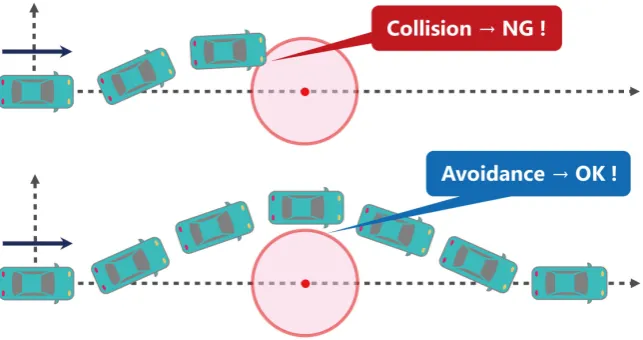
[image:3.595.223.526.218.713.2]As illustrated in Figure 4, if the values of the gain A and the control time Tc are not suitable, the car collides with the obstacle. In the next section, we will consider a new method based on just-in-time modeling as a solution of the above obstacle avoidance problem.
Figure 1. The setting of a car.
Figure 2. A car and an obstacle.
DOI: 10.4236/jcc.2018.611002 15 Journal of Computer and Communications Figure 4. Collision and avoidance.
3. Just-in-Time Modeling Approach to Obstacle Avoidance
Control
3.1. Summary of JIT Modeling
In this section, a new method of obstacle avoidance control of a car based on the just-in-time modeling (JIT modeling) approach will be developed. First, a brief summary on just-in-time modeling is shown. A general algorithm on just-in-time modeling is carried out in accordance with the following procedure.
1) Construct a database that contains input-output data of the system.
2) In order to compute an output for a query data, extract some neighborhood data of the query data.
3) Derive a local linear model at the query data from the obtained neighbor-hood data.
4) Using the local linear model, compute the output for the query data.
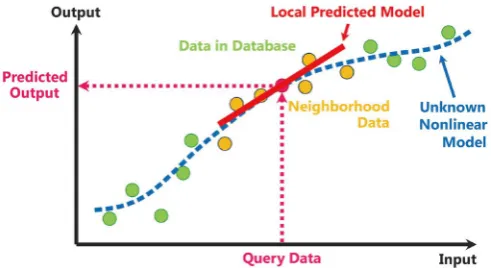
Figure 5 shows an illustration of just-in-time modeling. The advantages of just-in-time modeling are as follows; we do not derive a mathematical model of the system for control, it is available for not only linear systems but also nonli-near ones. Computation of an output for a query data needs low calculation amount, however, we have some options such as definition of neighborhood, the total number of data in the database, the number of neighborhood data, deriva-tion of local linear model, and so on.
3.2. Construction of Database
We here consider how to construct a database on obstacle avoidance of the car. At first, we have to decide the range of database. For example, for the velocity of the car Vc, we denote the minimum and maximum values by Vcmin and Vcmax,
respectively. In addition, we also denote the interval of data for Vc by hVc
Then, the number of Vc can be calculated by max min 1
: .
c
c
c c
V
V
V V
N
h
− +
DOI: 10.4236/jcc.2018.611002 16 Journal of Computer and Communications Figure 5. An illustration on just-in-time modeling.
We have to note that min, max
c c
V V , and hVc have to be determined so that NVc
is an integer. In a similar way, we can define the number of Xo and Ro as
o
X
N and NRo:
max min max min 1 : , 1 : , o o o o o o X X o o R R X X N h R R N h − + = − + = (4) respectively.
Next, a computation method of gains and control times which can avoid colli-sion with obstacles is derived. For the range of the gain A and the control time
c
T in the control input u2, we denote their maximum and minimum values by max, min
A A and max, min
c c
T T , respectively. For a data
(
V X Rc, o, o)
, we perform anumerical simulation of the car with the gain A. It is noted that we change the values of A and Tc from Amin and Tcmin to Amax and Tcmax with the
inter-vals hA and hTc in ascending order, respectively. For the simplicity, it is
as-sumed that the shape of the car is approximated by a circle with a radius Rc. Then, the condition such that the car does not collide with the obstacle can be represented by
( )
(
)
2( )
2 ,o c o off
x t −X +y t >R R R+ + (5)
where Roff is an offset distance between the car and the obstacle for safety. If
the inequality holds while the simulation, obstacle avoidance control is achieved and save the gain A* and the control time *
c
T in the database. According to circumstances, the gain and the control time which avoid collision cannot be obtained because of the setting of Amax, that is to say, the car may not avoid an obstacle in spite of the maximum values of the gain Amax and the control time
max
c
T . Hence, the number of data in the database N satisfies
,
c o o
V X R fail
N N N N= −N (6)
where Nfail is the number of data for which obstacle avoidance control is not
DOI: 10.4236/jcc.2018.611002 17 Journal of Computer and Communications
3.3. Computation of Gain and Control Time
Then, a computation method of a gain for a query data is shown. First, we have to extract some neighborhood data of the query data. We denote the number of data in the database by N and the index of the data by i i
(
=1, , N)
. In the simplest way, we use Euclidian distance and define the distance between a data(
i, ,i i)
c o o
V X R and the query data
(
*, ,* *)
c o o V X R as(
*) (
2 *) (
2 *)
2: .
i i i i
c c o o o o
d = V V− + X −X + R R− (7)
The distance di is also saved in the database. Next, we sort all the data in ascending order with respect to the distance di:
(
i, i, , , ,i i i i)(
1, ,)
c o o c
V X R A T d i = N , and extract K
(
<N)
data from the sorteddatabase (the tilde ~ over variables means sorted data). Finally, by using the K
extracted data
(
i, i, , , ,i i i i)(
1, ,)
c o o c
V X R A T d i = K , we calculate the gain A* and
the control time *
c
T of the query data
(
*, ,* *)
c o oV X R as weighted means:
1 1
1 1
: 1 , : 1
i i K K c i i i i c K K i i i i T A d d A T d d ∗ = ∗ = = = =
∑
=∑
∑
∑
(8)where the inverse numbers of the distances 1 di are utilized as weights.
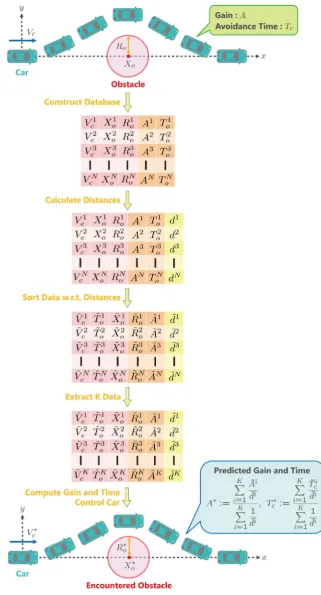
The procedure of obstacle avoidance control of the car based on just-in-time modeling is summarized as the next algorithm and Figure 6.
Algorithm [Obstacle Avoidance Control via JIT Modeling]
Step 1 For various data
(
V X Rc, o, o)
, compute a gain A and a control time Tc which can avoid an obstacle. Then, construct the database which contains the inputs(
i, ,i i)
(
1, ,)
c o o
V X R i= N and the outputs
(
i, i)
(
1, ,)
cA T i= N . Step 2 For a query data
(
*, ,* *)
c o o
V X R , calculate distances d ii
(
=1, , N)
forall the data
(
i, ,i i)
(
1, ,)
c o oV X R i= N in the database with (7), add the distances to the database.
Step 3 Sort all the data in the database in ascending order with respect to the distance:
(
i, i, , , ,i i i i)
(
1, ,)
c o o c
V X R A T d i = N and extract K
(
<N)
data fromthe sorted database
(
i, i, , , ,i i i i)
(
1, ,)
c o o c
V X R A T d i = K .
Step 4 By using the gains and the distances in the extract K data
(
i, ,i i)
(
1, ,)
c
A T d i = K , compute the gain A* and the control time *
c T from (8).
Step 5 By using the control inputs (2) with the computed gain A* and the computed control time *
c
T , control the car.
DOI: 10.4236/jcc.2018.611002 18 Journal of Computer and Communications Figure 6. Obstacle avoidance control of a car via just-in-time modeling.
4. Numerical Simulations
effec-DOI: 10.4236/jcc.2018.611002 19 Journal of Computer and Communications
tiveness of the proposed method. First, a database on obstacle avoidance of the car for just-in-time modeling is constructed. For construction of a database, we set the ranges of input data as Table 1.
The parameters of the car are set as Rc=2 m,Roff =0.5 m. For construction
of a database, the range of the gain A is set as min 0.01, max 1.0, 0.01
A
A = A = h = ,
and the range of the control time Tc is also set as Tcmin =1,Tcmax=20,hTc =1. A
part of the obtained database is shown in Table 2. The number of data in the database is N=2255, which is equal to N N NTc Xo Ro = × × × =11 41 5 5 2255,
hence this implies Nfail =0.
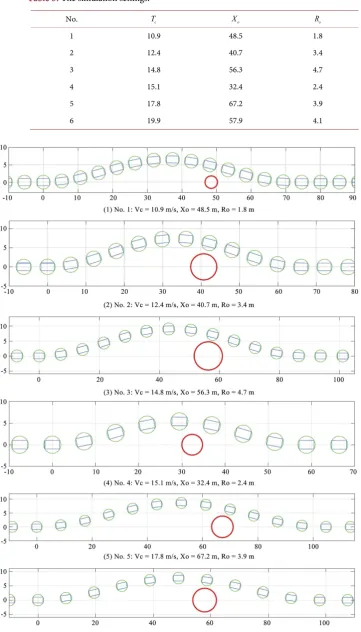
By the database and the proposed algorithm, six cases of numerical simula-tions (from No. 1 to 6) are carried out and the simulation settings are shown in
Table 3. The simulations results are illustrated in Figure 7. Figure 7 shows the trajectories of the car on the xy-plane. From these simulation results, it turns out that the car can avoid the obstacles for various situations. Moreover, it is also confirmed that the proposed control method requires small computation time. We next compare the proposed method to the previous one [11] [12] in terms of efficiency of the movement of the car. In the previous method, the control time
c
T is treated as one of the inputs, and the output is only the gain A. Figure 8
depicts simulation results with the previous method with the three problem set-tings (from No. 1 to 3) in Table 3. In comparison with Figures 1-3 in Figure 8, we can see that the car moves effectively and has less waste from Figures 1-3 in
Figure 7. Consequently, the results indicate the effectiveness of the proposed method.
Table 1. The parameter settings for construction of a database.
Parameter Value Parameter Value Parameter Value
min
c
V 10 m/s max
c
T 20 m/s hc 1 m/s
min
o
X 30 m/s max
o
X 70 m hXo 1 m
min
o
R 1 m max
o
R 5 m hRo 1 m
Table 2. A part of the obtained database.
No. Tc Xo Ro A Tc
1 10 30 1 0.08 5 2 10 30 2 0.43 5 3 10 30 3 0.56 5 4 10 30 4 0.37 6 5 10 30 5 0.43 6 6 10 31 1 0.34 5
DOI: 10.4236/jcc.2018.611002 20 Journal of Computer and Communications Table 3. The simulation settings.
No. Tc Xo Ro
1 10.9 48.5 1.8 2 12.4 40.7 3.4 3 14.8 56.3 4.7 4 15.1 32.4 2.4 5 17.8 67.2 3.9 6 19.9 57.9 4.1
DOI: 10.4236/jcc.2018.611002 21 Journal of Computer and Communications Figure 8. Numerical simulation results by the previous method.
5. Conclusion
In this paper, a new obstacle avoidance control method of a car has been devel-oped via just-in-time modeling. The new control method can compute a gain and a control time of the control inputs to avoid encountered obstacles with small computation time. From some numerical simulations, it is showed that the car can avoid various obstacles, and hence the effectiveness of the proposed me-thod can be checked. In addition, the movement of the car generated by the proposed new method is more efficient in comparison with one generated by the previous method. Future work on automatic driving of cars includes the next topics: an extension to avoidance control for moving obstacles, automatic park-ing and automatic drivpark-ing based on just-in-time modelpark-ing.
Conflicts of Interest
The author declares no conflicts of interest regarding the publication of this pa-per.
References
[1] Navet, N. and Simonot-Lion, F., Eds. (2013) Automotive Embedded Systems Handbook (Industrial Information Technology).CRC Press, USA.
[2] Jurgen, R.K. (2013) Autonomous Vehicles for Safer Driving. Society of Automotive Engineers Inc., USA.
[3] Reif, K., Ed. (2014) Automotive Mechatronics: Automotive Networking, Driving Stability Systems, Electronics. Bosch Professional Automotive Information, Sprin-ger Vieweg, Braunschweig.
[4] Kitchin, R. (2014) The Data Revolution: Big Data, Open Data, Data Infrastructures and Their Consequences. SAGE Publications Ltd., London.
[5] Marz, N. and Warren, J. (2015) Big Data: Principles and Best Practices of Scalable Real-Time Data Systems. Manning Pubns Co., New York.
Para-DOI: 10.4236/jcc.2018.611002 22 Journal of Computer and Communications digms. Morgan Kaufmann, Burlington, Massachusetts.
[7] Stenman, A., Gustafsson, F. and Ljung, L. (1996) Just in Time Models for Dynami-cal Systems. Proceedings of 35th IEEE Conference on Decision and Control, Kobe, 13 December 1996, 1115-1120. https://doi.org/10.1109/CDC.1996.574658
[8] Zheng, Q. and Kimura, H. (2001) Just-in-Time Modeling for Function Prediction and Its Applications. Asian Journal of Control, 3, 35-44,
https://doi.org/10.1111/j.1934-6093.2001.tb00040.x
[9] Wakao, S., Hosogoshi, D. and Yamamura, T. (2006) Fundamental Study on the Ap-plication of Just-in-Time Modeling to Wind Power Estimation. Proceeding of Eu-ropean Wind Energy Conference and Exhibition 2006, Athens, 27 February-2 March 2006, 412-416.
[10] Ge, Z. and Song, Z. (2010) A Comparative Study of Just-in-Time-Learning Based Methods for Online Soft Sensor Modeling. Chemometrics and Intelligent Labora-tory Systems, 104, 306-317.https://doi.org/10.1016/j.chemolab.2010.09.008
[11] Kai, T. and Miyashita, S. (2016) A Just-in-Time Modeling Approach to Obstacle Avoidance Control of a Car. International Journal of Advances in Mechanical & Automobile Engineering, 3, 110-113.