Neural Sequence-to-sequence Learning of Internal Word Structure
Tatyana Ruzsics Tanja Samardˇzi´c
CorpusLab, URPP Language and Space, University of Zurich, Switzerland {tatiana.ruzsics, tanja.samardzic}@uzh.ch
Abstract
Learning internal word structure has re-cently been recognized as an important step in various multilingual processing tasks and in theoretical language com-parison. In this paper, we present a neural encoder-decoder model for learn-ing canonical morphological segmenta-tion. Our model combines character-level sequence-to-sequence transformation with a language model over canonical seg-ments. We obtain up to 4% improvement over a strong character-level encoder-decoder baseline for three languages. Our model outperforms the previous state-of-the-art for two languages, while eliminat-ing the need for external resources such as large dictionaries. Finally, by compar-ing the performance of encoder-decoder and classical statistical machine transla-tion systems trained with and without cor-pus counts, we show that including corcor-pus counts is beneficial to both approaches.
1 Introduction
One of the most obvious structural differences be-tween languages is the variation in the complex-ity of internal word structure. In some languages, such as English, words are relatively short and morphologically less complex. In other languages, such as Chintang in Example 11, words tend to
be long and encapsulate rather rich structure. The Chintang verbthaptakhain Example 1 consists of a number of morphemes expressing the impera-tive mode, aspect and deixis. The information ex-pressed by a single Chintang verb requires several
1The example is adapted from (Stoll et al.,In press)
words in English, as it can be seen in the glosses.2
and in the translation. Example 1
a. cuwa thaptakha
b. cuwa thapt -a -khag -a c. water move -IMP -see -IMP
across [2sS]
d. Bring some water over here! The variation in word structure is observed even in common categories such as plural, which is typ-ically part of a word, but expressed using different structures. The items in Example 23 show three
different structural types associated with express-ing plural across languages.
Example 2
Type Sg. Pl.
Suffix Turkish ev ev-ler
‘house’ ‘houses’ Prefix Swahili m-toto wa-toto
‘child’ ‘children’ Redupli- Malay anak anak-anak
cation ‘child’ ‘children’ With the spread of natural language process-ing to a wider range of languages, learnprocess-ing in-ternal word structure becomes increasingly impor-tant for developing practical applications. Analy-sis of internal word structure, usually termed mor-phological segmentation, has been shown helpful in tasks such as machine translation (Dyer et al., 2008;Narasimhan et al., 2014), speech process-ing (Creutz et al., 2007) and parsing (Seeker and C¸etinoglu, 2015). Additionally, there is a grow-ing interest in automatic learngrow-ing of morphologi-cal segmentation for the purpose of theoretimorphologi-cal
lan-2Cf. Leipzig Glossing Rules athttps://www.eva.
mpg.de/lingua/resources/glossing-rules. php
3The examples are adapted from (Eifring and Theil,2005)
guage comparison (Bentz et al.,2017). In this con-text, it becomes particularly important to be able to process a wide variety of languages, for which the available data sets consist of small, annotated corpora.
In the present work, we cast the task of morphological segmentation as supervised neu-ral sequence-to-sequence learning over characters. Our goal is to define a method for automatic seg-mentation that can be easily ported across lan-guages, taking advantage of the relatively small, manually analyzed corpora increasingly available in the linguistic community. Our approach there-fore needs to rely only on the data available in an annotated corpus.
We follow the line of research based on the soft-attention encoder-decoder paradigm (Bahdanau et al.,2014). This paradigm was recently applied to the task of canonical segmentation by Kann et al.(2016). It was shown to achieve the state-of-the-art performance when combined with a neural re-ranker method that employs additional external dictionary information (Kann et al., 2016). Our approach improves the results achieved by Kann et al. (2016) in case of Indonesian and German languages eliminating at the same time the need for resources outside of annotated corpora. 2 Related Work
The task of the morphological segmentation can be defined in two ways, illustrated with the Chin-tang verb from Example 1:
a. Surface segmentation: thaptakha→thapt-a-kh-a b. Canonical segmentation:
thaptakha→thapt-a-khag-a
The termsurfaceorallomorphsegmentation is used byCreutz and Linden(2004) to refer to the analysis where the input word is segmented into substrings without any further string transforma-tion. This definition is most widely applied in computational processing; it is, however, too sim-plistic for the majority of languages. It does not allow, for instance, to identify-esinbus-esand-s
incar-sas two variants of the same English plural marker.
More recently, the termcanonical segmentation
was used by Cotterell et al.(2016) to refer to the same definition that was termed morpheme seg-mentation by Creutz and Linden (2004). In this
case, a more abstract internal word structure is learned by transforming the resulting substrings into their canonical forms.
While a great variety of methods has been pro-posed for surface segmentation, canonical seg-mentation, which is address in our work, has started being addressed only recently.
The task of surface morphological segmentation is traditionally approached using finite-state tech-nology, such as OpenFst library (Allauzen and Ri-ley, 2012) and OpenGrm Thrax Grammar Com-piler library (Roark et al., 2012), with sequence modeling used to disambiguate the finite-state out-put (Heintz,2008).
Another line of research has addressed sur-face segmentation with unsupervised algorithms (MORFESSOR (Creutz and Lagus,2002), MOR-FESSOR CAT-MAP (Creutz and Lagus, 2005)), and, more recently, with semi-supervised ap-proaches (Poon et al., 2009; Kohonen et al., 2010)). Narasimhan et al.(2015) include seman-tic information in the unsupervised learning, stay-ing at the level of surface segmentation. Their approach is extended byBergmanis and Goldwa-ter (2017), who make a step towards canonical segmentation, proposing a method to generalize over spelling variants of functionally similar mor-phemes.
Supervised approaches to learning morpholog-ical structure are rather rare. Ruokolainen et al. (2013) apply conditional random fields algorithm, used for different sequence classification tasks, to the task of surface segmentation. Their CRF-MORPH system tags each character of a morpho-logically complex word with one of the tags ‘B’ for the beginning, ‘M’ middle, and ‘E’ end of a segment, and ‘S’ for a single character segment. The CHIPMUNK model ofCotterell et al.(2015) based on a semi-Markov model extends the CRF-MORPH approach by adding features from stand-alone dictionaries and affix lists.
Canonical segmentation is tackled by Cotterell et al. (2016), who develop a log-linear model on conjunction of a finite-state transduction model for modeling orthographic changes and a semi-Markov segmentation model.
et al.(2016) on canonical segmentation by apply-ing the encoder-decoder RNN framework. Kann et al.(2016) achieve the current state-of-the-art for canonical segmentation by re-ranking the output of the encoder-decoder system. The re-ranking component is a multilayer perception run on the morphemes embeddings (Kann et al.,2016). The morphemes embedding used for this re-ranking model are calculated using additional information from the Aspell dictionaries. We follow Kann et al. (2016) in using the encoder-decoder RNN framework, but we do not use any external re-sources. Instead of that, we extract and exploit more information from the training corpus.
Our approach is in the spirit of the “shallow fu-sion” approach to machine translation ofGulcehre et al.(2017). LikeGulcehre et al.(2017), we in-tegrate a language model into an encoder-decoder framework. There are, however, several important differences.
First of all, the role of the language model is dif-ferent. Integrating a language model allows Gul-cehre et al. (2017) to augment the parallel train-ing data with additional monoltrain-ingual corpora on the target side. In this way, they add new infor-mation about sequencing, not captured in training on parallel data alone. Both components of their system are trained on the same kind of units — characters. As opposed to this, we use a language model to extract more information from the paral-lel data. We add new information by training the system at two levels: the basic encoder-decoder component is trained on character sequences and the language model component is trained on the sequences of morphemes. In the case ofGulcehre et al.(2017), the use of a language model is moti-vated by the fact that external monolingual target-side data is almost always universally available. The situation is reversed for the task of morpho-logical segmentation: morphomorpho-logically segmented corpora are produced manually by experts in the process of linguistic analysis and they tend to be small and expensive. Our approach is motivated by the need to extract as much information as pos-sible from relatively small target-side data sets.
Second, we add a third component to our model which controls for the difference in characters length between the input word string and the out-put segmentation string. This helps overcome lan-guage model preference for a short output.
Last, while Gulcehre et al. (2017) use a
lan-guage model implemented with recurrent neural networks, we employ a statistical language model, which is better adapted to our settings with small data sets.
Finally, we note that corpus frequencies are not used in previous supervised approaches, but that systems are trained on word types (training data consist of a list of word types and a segmentation for each type). In the present work, we study token versus types training set up and how this difference affects the performance of statistical models.
3 Model Description
Given an input sequence, such as the Chintang sentence in Example 1 (line a.), we produce a canonical segmentation (line b.), where we recog-nize that the sequencekhin the surface form is an instance of the light verbkhag.
We follow the notations of Kann et al. (2016) in the formalization of the task of canonical seg-mentation. First, we define two discrete alphabets,
Σof the surface symbols andΣcan of the
canon-ical symbols. For many languages these two al-phabets coincide, for example in the case of En-glish they consist of 26 letters of the Latin alpha-bet. In the case of Chintang, these alphabets are different: the surface symbols express more spe-cific pronunciation features. Our task is to learn a mapping from a surface word form w ∈ Σ∗ (e.g., w=‘thaptakha’), to its canonical segmenta-tionc∈ Ω∗ (e.g., c=thapt|-a|-khag|-a). We define
Ω = Σcan∪ {|}, where the symbol ‘|’ marks
seg-mentation boundaries.4
To learn the mappings, we combine the general sequence transformation framework — known as the encoder-decoder RNN — trained on a charac-ter level with a language model trained on mor-phemes. Note that a kind of a language model over characters is implicitly included as a part of the decoder in the character-based encoder-decoder RNN. The language model in our ap-proach is trained over higher level units, provid-ing additional information about the sequences. This, however, poses a challenge for its integration in the general framework. We tackle this prob-lem with our “synchronization” method applied at the decoding stage: the segmentation hypotheses
are expanded and scored using a log-linear com-bination of (a) scores from a lower-level encoder-decoder model and (b) higher-level scores of the language model. The fusion of the scores is trig-gered only at the segmentation boundaries.
In this section, we first review the encoder-decoder RNN framework. Then, we present our fusion approach for integrating a language model into the encoder-decoder system.
3.1 Background: Standard Encoder-Decoder Set-up (cED)
The canonical segmentation problem fits the general sequence-to-sequence framework, that is mapping a variable-length sequence to another variable-length sequence. In machine translation, a relatively standard way to perform this task is using encoder-decoder RNN (Cho et al., 2014; Sutskever et al., 2014), extended with a bidirec-tional encoder and attention mechanism of Bah-danau et al.(2014). For the task of canonical seg-mentation, the input and the output to the encoder-decoder model is represented as a sequence of characters separated by spaces. Formally, we use the following set up.
The encoder RNN processes the input sequence of vectors,X = (x1, . . . , xnx), into a sequence of vectors representing hidden states:
ht=f(ht−1, xt), t= 1, . . . , nx (1)
where f stands for gated recurrent units (Cho et al., 2014). The decoder RNN is conditioned on the information produced by the encoder to generate the output sequenceY = (y1, . . . , yny). Specifically, the decoder RNN models a condi-tional probability at each step as a function of pre-vious output, current decoder hidden state and cur-rent context vector:
p(yt|y1, . . . , yt−1, X) =g(yt−1, st, ct), (2)
st=f(st−1, yt−1, ct), t= 1, . . . , ny (3)
The context vectorctis computed at each step as
a weighted sum of the hidden states:
ct= nx
X
k=1
αtkhk, (4)
where the weights are calculated by an alignment model which scores how well the inputs around
the position k and the output at the position t
match. Intuitively, the decoder produces an output element one at a time, each time focusing (putting attention) on a different part of the input sequence in order to gather the details that are required to produce the next output element.
We use the bidirectional setting of the encoder model (Bahdanau et al., 2014): the hidden state
ht for each time step is obtained by
concatenat-ing a forward and backward stateht = [−→ht;←h−t].
This means that the hidden state contains the sum-maries of both the preceding elements and the fol-lowing elements. We refer to this standard frame-work as cED.
3.2 Integrating a Morpheme Language Model (LM) into cED
Before the integration, we assume that cED sys-tem and language model LM have been trained separately. The cED system is trained on charac-ter sequences in a parallel corpus where the source side consists of unsegmented words and the target side consist of the aligned canonically segmented words. During the training the cED model learns conditional probability distribution over the char-acter sequences (2). The LM is trained over mor-pheme sequences on the target side of the corpus and scores how likely a given sequence is in a given language.
We can find the most probable segmentation us-ing a beam search algorithm guided by “synchro-nized” character-level cED and morpheme-level LM scores. At each time step t, the cED system computes a score for each possible next charac-terytin the vocabularyΩas a continuation of the
segmentation hypothesis from the previous step {(y1y2. . . yt−1)i}, i = 1, . . . , K where K is the beam size (how many best scored segmentation hypothesis we keep from each step). This score is a logarithm of the probability (2). Then, each pos-sible continuation {(y1y2. . . yt−1)iyt}, yt ∈ Ω,
i= 1, . . . , K gets a score which is a sum of cED scores for each character, that is, a sum of the scores for a hypothesis from a previous time step
(y1y2. . . yt−1)i and a score for the next character
yt. Thus we get a set of|Ω|×Knew hypothesis of
length|t|together with their respective scores. All these new hypotheses at the steptare then sorted according to their respective scores, and the topK
In order to guide the described beam decod-ing with the LM scores we perform a “synchro-nization”. Specifically, we continue the beam search based on the character cED scores till the step s1 where all the segmentation hypothesis {(y1y2. . . ys1)i}i= 1, . . . , K end with a bound-ary symbol. The boundbound-ary symbol can be either end of word symbol ‘< /w >’ or a segmentation boundary symbol ‘|’. At this step, we re-score the segmentation hypotheses with a weighted sum of the cED score and the LM score:
logp(ys1|y1, . . . , ys1−1, X)
= logpcED(ys1|y1, . . . , ys1−1, X)
+αLMlogpLM(y1, . . . , ys1−1) (5) At this step, y1, . . . , ys1 is considered a se-quence of s1 characters by the cED system and
y1, . . . , ys1−1 (without the last boundary symbol) is considered one morpheme by the LM.
From this synchronization point s1 we continue to expand the re-scored hypothesis {(y1y2. . . ys1)i} i = 1, . . . , K at the next time step using again only cED scores. We continue this process until we get to the next synchronization point s2 where all the hypoth-esis {(y1y2. . . ys2)i} i = 1, . . . , K end with a boundary symbol. After rescoring them with a weighted sum of cED and LM we continue this process again till the next synchronization point. The decoding process ends at a synchronization point where the last symbol of the best scored hypothesis (using the combined cED and LM score) is an end-of-word symbol.
The described decoding process therefore scores the segmentation hypotheses at two levels: normally working at the character level with cED scores and adding the LM scores only when it hits a boundary symbol. In this way, the LM score helps to evaluate how probable the last generated morpheme is based on the morpheme history, that is the sequence of morphemes generated at the previous synchronization time steps.
3.3 The Length Constraint
It is well known that language models give higher preference to shorter sequences. This becomes an issue in the proposed fused model described above: at the synchronization points high LM scores tend to stop further hypothesis expansion. For example, only the first segment can be gen-erated as a model output if it happens to be a
fre-quent standalone word. This leads to favoring seg-mentation predictions where the output is shorter than the input, which is rarely plausible in segmen-tation. Our early experiments confirmed this intu-ition, therefore we consider the length constraint component to be an integral part of the language model inclusion and we do not report experiments without this component.
To deal with the length issue, we add a “length constraint” component LC. The LC score is based on the difference in character length between the input word and its segmentation hypothesis. To synchronize the LC score with LM scoring process described before we assign it only at the synchro-nization time steps and attach it to the boundary symbol. Therefore, the LC score, combined with the LM score, helps to evaluate how probable is the last generated morpheme given the sequence of morphemes generated at the previous steps.
Assume that the input word is X = x1. . . xn
and the produced segmentation hypothesis at the first synchronization step s1 is y1. . . ys1 where
ys1 is a boundary symbol. Then the LC score as-signed to the morphemey1. . . ys1−1 and attached to the boundary symbol ys1 is calculated as the negative value of the absolute difference between the morpheme length and input word length di-vided by the the input length:LC(y1. . . ys1−1) = −(|y1. . . ys1−1| − |X|)/|X| = −|s1 − 1 −
n|/n. At the next synchronization point s2 the LC score is calculated using the length of the next produced segment: LC(ys1+1. . . ys2−1) = −(|ys1+1. . . ys2−1|−|X|)/|X|. In a general case, the LC score for the last generated segmentσican
be expressed as
LC(σi) =−(|σi| − |X|)/|X| (6)
Note that boundary symbols are excluded for the segments length calculation.
The intuition behind the LC score is that it gives a contribution to the total score of a segmenta-tion hypothesis showing how different the length of the so far produced hypothesis is compared to the length of the input word. The characters in the canonical segments tend to be either inserted or deleted compared to their surface form equiv-alents, therefore we measure LC score using an absolute difference in the length. The higher the absolute value of the difference between the input and the hypothesis, the higher the penalty.
control the total score of our fusion model be-comes:
logp(ys1|y1, . . . , ys1−1, X)
= logpcED(ys1|y1, . . . , ys1−1, X)
+αLMlogpLM(y1, . . . , ys1−1)
+αLCLC(y1, . . . , ys1−1) (7)
where the weightsαLMandαLCare optimized on
a development set.
4 Data and Experiments
In this section, we first give a description of the corpora that we employ for the experiments. Then, we discuss the experimental setup for our model. Finally, we discuss the different configurations of the corpus we employ to explore encoder-decoder model behavior with and without corpus frequen-cies.
4.1 Corpora
We run our experiments on the datasets for En-glish, German and Indonesian released by Cot-terell et al.(2016).5 The corpus for each language
is constructed based on the 10,000 forms selected at random from a uniform distribution over types. This data is further used to sample 5 splits into 8000 training forms, 1000 development forms and 1000 test forms. FollowingCotterell et al.(2016) and Kann et al. (2016), we report the results on each of the 5 splits for all three languages.
In addition to these sets, we use a manually seg-mented and glossed corpus of Chintang (Bickel et al., 2004-2015), a language that features a high degree of synthesis and free prefix ordering (Bickel et al., 2007). The total corpus size of 955,025 word tokens makes the Chintang corpus an exceptional resource for the task of morpholog-ical segmentation. As discussed in Section2, the target segmented data is not easily available and corpora of this size are not likely to be developed for many langauges. We are interested in exper-imenting with a realistic setup, therefore we use around 150,000 tokens out of the total corpus size. This set is divided into the training set (around 100,000 word tokens) and development and test set (around 25,000 word tokens each).
5ryancotterell.github.io/
canonical-segmentation
The data set taken from Cotterell et al. (2016) allows us a comparison of our system with the pre-vious state-of-the-art. The Chintang set allows us to run the segmentation models in different train-ing regimes, with and without corpus frequencies, and therefore to assess the influence of the corpus counts on the performance.
4.2 Tools
We combine the three different components, cED, LM and LC, into a single fused model using the SGNMT (syntactically guided neural machine translation) framework ofStahlberg et al.(2016).6
This framework provides an elegant solution to de-composing an encoder-decoder system into three components: training, decoding and scoring.
The training module implements the encoder-decoder model with attention mechanism using the Blocks framework built on top of Theano.7.
We employ this implementation for the cED model.
The scoring component of SGNMT consists of predictor modules, which define scores over the target vocabulary given the current internal pre-dictor state, the history, the source sentence, and external side information. Predictors can be com-bined with other predictors to form complex de-coding tasks. In the case of our model, we use three predictors: cED, LM and LC.
The decoding component is represented by the decoder modules which are search strategies that traverse the space spanned by the predictors. We use a beam search module.
We train the language model LM over mor-pheme sequences using SRILM toolkit.8. The
model is trained on the target side of the parallel corpus, i.e. the canonical segmentations.
The weights of the predictors are optimized us-ing MERT (Och, 2003). This is a standard opti-mization routine in statistical machine translation which searches for the weights of the model com-ponents by directly maximizing the performance of the system on a development set. We use the Z-MERT tool9in our implementation. The code is
available on our GitHub account.10 6http://ucam-smt.github.io/sgnmt 7https://github.com/mila-udem/blocks 8http://www.speech.sri.com/projects/
srilm/
9http://www.cs.jhu.edu/˜ozaidan/zmert/ 10https://github.com/tatyana-ruzsics/
4.3 Experimental Setup
Baseline and comparison As a baseline, we use the basic component of our model (cED), an ensemble of 5 character-level attention encoder-decoder models with the hyperparameters de-scribed below.
We also compare the encoder-decoder model to the character-level statistical machine transla-tion (cSMT). This approach is a natural choice in machine translation with small training sets, but no results have been reported so far for the task of canonical segmentation. We used the Moses toolkit with the following settings: distortion is disallowed and build-in MERT optimization is used to optimize the translation model and lan-guage model.
As a reference, we compare our results to the state-of-the-art neural re-ranker model of Kann et al. (2016) Note, however, that the results can-not be directly compared since Kann et al.(2016) use extra training material in the form of external dictionaries.
Evaluation Since our method is intended to be used for processing corpora, the evaluation is per-formed at the level of word tokens using accuracy of the full segmentation. In addition, we evaluate the performance on subsets of test words. Besides the seen words, we distinguish between two kinds of test words that are not seen in the training cor-pus: a) new combinations of morphemes already seen during training and b) words that contain un-seen morphemes.
Hyperparameters The bidirectional encoder consists of a forward and a backward recurrent RNN each having 100 hidden units. The decoder also has 100 hidden units. The dimensionality of the character embedding is 300. We use a mini-batch stochastic gradient descent (SGD) algorithm together with Adadelta to train each model. Each update direction is computed using a minibatch of 20 training examples. At decoding, we use a beam search with a beam size of 12 to find the segmenta-tion that approximately maximizes the condisegmenta-tional probability. All the described hyperparameters are the same as in the work ofKann et al.(2016).
Initialization of all weights (encoder, decoder, embeddings) to the identity matrix and the biases to zero (Le et al., 2015) results in a very fast convergence rate compared to other initializations. We train a single model for 20 epochs with an
early stopping based on the development set per-formance. We also shuffle the training data be-tween the epochs.
Finally, we use an ensemble of five encoder-decoder models with different random initializa-tions. We shuffle the training data for each of the model using different seed value. The ensemble model is based on a combined score from all 5 models and is used to guide the decoding process. Following earlier experiments, we use mor-pheme 3-gram language model and apply Kneser-Ney smoothing.
As the objective for the MERT weight optimiza-tion we use accuracy on the development set. Tokens vs Types The Chintang corpus allows us to assess the influence of the corpus counts on the performance of the models used for canonical segmentation. In these experiments, we run only the two baseline models, cSMT and cED (without our language model component), in order to eval-uate directly the relevance of such corpus signal to these two training paradigms.11
We run each model, cSMT and cED, in two regimes. In the first, type regime, we train the models using a parallel corpus which consists of word types, i.e. unique pairs of surface form and its canonical segmentation. The size of such type corpus is around 21,000 word forms. In the second regime, we train the models using a parallel corpus where each pair of surface form and its canonical segmentation appears as many time as the corre-sponding word appears in the corpus. The size of the token-based corpus is then 100,000 tokens.
In the type regime, the amount of training ex-amples is substantially smaller than in the token regime. In order to make the comparison between the token regime and the type regime more fair in terms of the amount of training and testing data, we add one more experiment. Specifically, we train the cED model in the type regime using the same number of iterations as in the token regime: 100,000 iterations. In this way, each word type is seen multiple times both in the type and the to-ken regime. The difference is that all the types are equally frequent in the type regime, while we observe their natural text frequency in the token
regime.
5 Results and Discussion
The performance of our fused model cED+LM to-gether with the two baseline models is reported for English, German, Indonesian in Table1.12 We
show the average results over five splits for each language along with the standard deviation (in brackets). Additionally, we present the results on the words not seen in the training which make up for 99% of the test sets in this corpora.
Our fused approach gives an improvement from 1% to 4% over the stronger cED baseline. The bigger improvement for Indonesian could be at-tributed to the regular patterns of orthographic changes which appear on the segmentation bound-aries. In the category of unseen data, the LM com-ponent helps to correct errors for the words con-sisting of new combinations of seen morphemes. In case of Indonesian, around 80% of new words (an average over five splits) belongs to this cate-gory, while its share is only around 25% for Ger-man and English. The overall lower perforGer-mance for English and German thus might be due to the less regular patterns and more unseen roots in the training data.
We observe that out of the two baseline models, cED and cSMT, cED performs on average better although their behavior is very similar with a dif-ference of only 1% in accuracy in the case of Ger-man and Indonesian.
For reference, we also show the results of the joint model ofCotterell et al.(2016) and the state-of-the-art neural reranker model of Kann et al. (2016) which are available for these data sets. We can see that our approach (cED+LM) gives an im-provement of 1% for German and 2% for Indone-sian over the state-of-the-art performance while we do not employ extra information from external dictionaries. Note that the languages for which we improve the state of the art are morphologically richer than English.
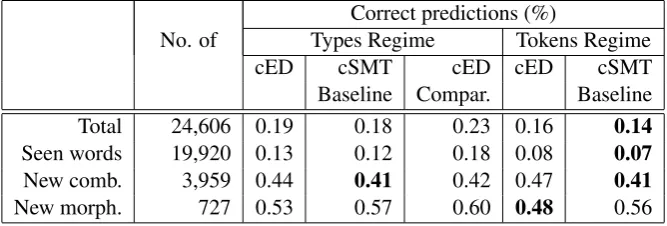
Table 2 shows the cED and cSMT model on Chintang in two training regimes, word types and word tokens. We also report the results for com-parative setting of the type-based regime.
12We obtained significantly better results for cED model than those reported inKann et al.(2016). We speculate that the difference might be due to the shuffling of the data be-tween the training epochs and early stopping based on the validation set performance.
We observe that the corpus-wide training based on word tokens increases the overall performance for both, the cED and cSMT models. The ob-served improvement can be partially explained by the fact that our evaluation is token based: we count the same result as many times as it appears in the test set. Nevertheless, the score is infor-mative because it shows the coverage over the whole corpus. Additionally, our comparable set-ting shows that seeing a segmentation for a word type multiple times is not what helps learning. What is beneficial is knowing the actual distribu-tion in the corpus.
It can be seen in Table 2 that cSMT outper-forms cED in the token regime. One possible ex-planation for this outcome is that the inclusion of the word counts helps to learn the character align-ments better. This explanation would be in line with the results ofAharoni and Goldberg(2017), who showed that using pretrained character-level statistical alignments to guide the encoder-decoder network in training time can help to improve over the end-to-end soft attention approach for morpho-logical inflection generation task, which also falls into the category of a more general sequence trans-duction task.
Regarding the different subsets of the test data, the highest improvement on unseen words with new morphemes is achieved by the cED model, while the cSMT model generalizes better in the category of unseen words that consist of new com-bination of seen morphemes. Both models be-have similarly on seen words with the cSMT being slightly better. This leads to an overall best perfor-mance of the cSMT model, since the category of seen words has the largest weight among all the word tokens in the test data.
6 Conclusion and Future Work
We presented a neural model based on charac-ter level encoder-decoder framework for morpho-logical canonical segmentation in a low-resource setting. The model is fused with a language model over morpheme segments and length con-trol model. Our approach gives higher results than the state-of-the-art approach to canonical segmen-tation for languages with more morphology, In-donesian and German, while using only the infor-mation contained in the training corpus.
Error Rate (%) Types Regime
cED+LM cED cSMT Joint* cED+RR*
Baseline Baseline
English Total 0.21(.01) 0.22 (.01) 0.27 (.02) 0.27 (.02) 0.19 (.01)
New comb. 0.15 (.03) 0.24 (.01) - -
-New morph. 0.23 (.01) 0.20 (.01) - -
-German Total 0.19(.00) 0.23 (.02) 0.24 (.02) 0.41 (.03) 0.20 (.01)
New comb. 0.11 (.02) 0.33 (.03) - -
-New morph. 0.21 (.01) 0.20 (.01) - -
-Indonesian Total 0.03(.02) 0.07 (.01) 0.06 (.01) 0.10 (.01) 0.05 (.01)
New comb. 0.02 (.03) 0.06 (.01) - -
-New morph. 0.09 (.03) 0.09 (.03) - -
-Table 1: Performance on the task of canonical segmentation for English, German and Indonesian. Type-based regime. cED+LM - character Type-based encoder-decoder model fused with morpheme Type-based language model. Baseline models: cED - character based encoder-decoder model, cSMT - character based statis-tical machine translation model. For reference only: Joint* - model ofCotterell et al.(2016), cED+RR* - model ofKann et al.(2016), not directly comparable since based on external dictionary information)
Correct predictions (%)
No. of Types Regime Tokens Regime
cED cSMT cED cED cSMT
[image:9.595.100.501.61.242.2]Baseline Compar. Baseline Total 24,606 0.19 0.18 0.23 0.16 0.14 Seen words 19,920 0.13 0.12 0.18 0.08 0.07 New comb. 3,959 0.44 0.41 0.42 0.47 0.41 New morph. 727 0.53 0.57 0.60 0.48 0.56
Table 2: Performance on the task of canonical segmentation for Chintang. Type-based vs token-based training regime. cED - character based encoder-decoder model, cSMT - character based statistical ma-chine translation model. Comparative setting for cED: training in types regime for the same number of iterations as in the individual setting of token regime.
optimization of model components is performed using neural approaches.
Another idea relevant to explore in future work is to consider the networks that are designed to be strong at character copying which is the most com-mon operation in string transduction tasks such as morphological segmentation, morphological rein-flection and normalization (Gu et al., 2016; See et al.,2017;Makarov et al.,2017).
We also analyzed the effect of incorporating corpus counts for the purpose of training statis-tical and neural models for canonical segmenta-tion. The results show that incorporating counts as they are seen in the corpora is beneficial for such task for both types of models. Our findings sug-gest that training sets including real word counts should be further developed for this and similar
tasks and would be beneficial for development of future models.
References
Roee Aharoni and Yoav Goldberg. 2017. Morphologi-cal inflection generation with hard monotonic atten-tion. InACL.
Cyril Allauzen and Michael Riley. 2012. A pushdown transducer extension for the openfst library. In Im-plementation and Application of Automata - 17th In-ternational Conference, CIAA 2012, Porto, Portu-gal, July 17-20, 2012. Proceedings. pages 66–77.
Dzmitry Bahdanau, Kyunghyun Cho, and Yoshua Bengio. 2014. Neural machine translation by jointly learning to align and translate. CoRR
abs/1409.0473.
[image:9.595.132.466.329.442.2]and Paula Buttery. 2017. Variation in word fre-quency distributions: Definitions, measures and im-plications for a corpus-based language typology.
Journal of Quantitative Linguisticspages 128–162. https://doi.org/10.1080/09296174.2016.1265792.
Toms Bergmanis and Sharon Goldwater. 2017. From segmentation to analyses: a probabilistic model for unsupervised morphology induction. In Proceed-ings of the 15th Conference of the European Chap-ter of the Association for Computational Linguistics. Valencia, Spain.
Balthasar Bickel, Goma Banjade, Martin Gaen-szle, Elena Lieven, Netra Prasad Paudyal, Ichchha Purna Rai, Manoj Rai, Novel Kishore Rai, and Sabine Stoll. 2007. Free prefix or-dering in chintang. Language 83(1):43–73. https://muse.jhu.edu/article/214599.
Balthasar Bickel, Sabine Stoll, Martin Gaenszle, Novel Kishor Rai, Elena Lieven, Goma Banjade, Toya Nath Bhatta, Netra Paudyal, Judith Pettigrew, Ichchha P. Rai, and Manoj Rai. 2004-2015. Audio-visual corpus of the chintang language, including a longitudinal corpus of language acquisition by six children.http://www.mpi. nl/DOBES.
Kyunghyun Cho, Bart van Merrienboer, Dzmitry Bah-danau, and Yoshua Bengio. 2014. On the properties of neural machine translation: Encoder-decoder ap-proaches. InProceedings of SSST@EMNLP 2014, Eighth Workshop on Syntax, Semantics and Struc-ture in Statistical Translation, Doha, Qatar, 25 Oc-tober 2014. pages 103–111.
Ryan Cotterell, Thomas M¨uller, Alexander Fraser, and Hinrich Sch¨utze. 2015. Labeled morphological seg-mentation with semi-markov models. In Proceed-ings of the Nineteenth Conference on Computational Natural Language Learning. Association for Com-putational Linguistics, pages 164–174.
Ryan Cotterell, Tim Vieira, and Hinrich Sch¨utze. 2016. A joint model of orthography and morphological segmentation. InNAACL HLT 2016, The 2016 Con-ference of the North American Chapter of the Asso-ciation for Computational Linguistics: Human Lan-guage Technologies, San Diego California, USA, June 12-17, 2016. pages 664–669.
Mathias Creutz, Teemu Hirsim¨aki, Mikko Kurimo, Antti Puurula, Janne Pylkk¨onen, Vesa Siivola, Matti Varjokallio, Ebru Arisoy, Murat Sarac¸lar, and An-dreas Stolcke. 2007. Morph-based speech recog-nition and modeling of out-of-vocabulary words across languages. ACM Trans. Speech Lang. Pro-cess.5(1):3:1–3:29.
Mathias Creutz and Krista Lagus. 2002. Unsupervised discovery of morphemes. In Proceedings of the ACL-02 Workshop on Morphological and Phonolog-ical Learning. Association for Computational Lin-guistics, pages 21–30.
Mathias Creutz and Krista Lagus. 2005. Inducing the morphological lexicon of a natural language from unannotated text. In Proc. International and In-terdisciplinary Conference on Adaptive Knowledge Representation and Reasoning (AKRR-05). Espoo, Finland, pages 106–113.
Mathias Creutz and Krister Linden. 2004. Morpheme segmentation gold standards for finnish and english. Christopher Dyer, A Muresan, and Philip Resnik. 2008. Generalizing word lattice translation. In In ACL-HLT.
H. Eifring and R. Theil. 2005. Linguistics for Students of Asian and African Languages. [available at
http://www.uio.no/studier/emner/ hf/ikos/EXFAC03-AAS/h05/larestoff/ linguistics/], Universitetet i Oslo.
Jiatao Gu, Zhengdong Lu, Hang Li, and Victor O. K. Li. 2016. Incorporating copying mech-anism in sequence-to-sequence learning. CoRR
http://arxiv.org/abs/1603.06393.
Caglar Gulcehre, Orhan Firat, Kelvin Xu, Kyunghyun Cho, and Yoshua Bengio. 2017. On integrat-ing a language model into neural machine translation. Computer Speech and Language
https://doi.org/http://doi.org/10.1016/j.csl.2017.01.014. Ilana Heintz. 2008. Arabic language modeling with
fi-nite state transducers. InACL 2008, Proceedings of the 46th Annual Meeting of the Association for Com-putational Linguistics, June 15-20, 2008, Columbus, Ohio, USA, Student Research Workshop. pages 37– 42.
Katharina Kann, Ryan Cotterell, and Hinrich Sch¨utze. 2016. Neural morphological analysis: Encoding-decoding canonical segments. InProceedings of the 2016 Conference on Empirical Methods in Natural Language Processing, EMNLP 2016, Austin, Texas, USA, November 1-4, 2016. pages 961–967.
Oskar Kohonen, Sami Virpioja, and Krista Lagus. 2010. Semi-supervised learning of concatenative morphology. InProceedings of the 11th Meeting of the ACL Special Interest Group on Computational Morphology and Phonology. Association for Com-putational Linguistics, pages 78–86.
Quoc V. Le, Navdeep Jaitly, and Geoffrey E. Hinton. 2015. A simple way to initialize recurrent networks of rectified linear units. CoRRabs/1504.00941. Peter Makarov, Tatyana Ruzsics, and Simon
Clematide. 2017. Align and copy: Uzh at sig-morphon 2017 shared task for morphological reinflection. In Proceedings of the CoNLL-SIGMORPHON 2017 Shared Task: Universal Morphological Reinflection. Vancouver, Canada. Karthik Narasimhan, Regina Barzilay, and Tommi
Karthik Narasimhan, Damianos Karakos, Richard Schwartz, Stavros Tsakalidis, and Regina Barzilay. 2014. Morphological segmentation for keyword spotting. EMNLP.
Franz Josef Och. 2003. Minimum error rate training in statistical machine translation. InProceedings of the 41st Annual Meeting of the Association for Compu-tational Linguistics, 7-12 July 2003, Sapporo Con-vention Center, Sapporo, Japan.. pages 160–167.
Hoifung Poon, Colin Cherry, and Kristina Toutanova. 2009. Unsupervised morphological segmentation with log-linear models. In Proceedings of Human Language Technologies: The 2009 Annual Confer-ence of the North American Chapter of the Associa-tion for ComputaAssocia-tional Linguistics. Association for Computational Linguistics, pages 209–217.
Brian Roark, Richard Sproat, Cyril Allauzen, Michael Riley, Jeffrey Sorensen, and Terry Tai. 2012. The opengrm open-source finite-state grammar software libraries. In Proceedings of the ACL 2012 Sys-tem Demonstrations. Association for Computational Linguistics, ACL ’12, pages 61–66.
Teemu Ruokolainen, Oskar Kohonen, Sami Virpioja, and Mikko Kurimo. 2013. Supervised morphologi-cal segmentation in a low-resource learning setting using conditional random fields. InProceedings of the Seventeenth Conference on Computational Nat-ural Language Learning. Association for Computa-tional Linguistics, pages 29–37.
Abigail See, Peter J Liu, and Christopher D Man-ning. 2017. Get To The Point: Summarization with Pointer-Generator Networks. InACL.
Wolfgang Seeker and ¨Ozlem C¸etinoglu. 2015. A graph-based lattice dependency parser for joint morphological segmentation and syntactic analysis.
TACL3:359–373.
Felix Stahlberg, Eva Hasler, Aurelien Waite, and Bill Byrne. 2016. Syntactically guided neural machine translation. InProceedings of the 54th Annual Meet-ing of the Association for Computational LMeet-inguis- Linguis-tics, ACL 2016, August 7-12, 2016, Berlin, Ger-many, Volume 2: Short Papers.
Sabine Stoll, Jekaterina Mazara, and Balthasar Bickel. In press. The acquisition of polysynthetic verb forms in chintang. In Michael Fortescue, Marianne Mithun, and Nicholas Evans, editors, Handbook of Polysynthesis, Oxford University Press, Oxford.
Ilya Sutskever, Oriol Vinyals, and Quoc V. Le. 2014. Sequence to sequence learning with neural net-works. InAdvances in Neural Information Process-ing Systems 27: Annual Conference on Neural In-formation Processing Systems 2014, December 8-13 2014, Montreal, Quebec, Canada. pages 3104– 3112.