
Protocol-Specific Intrusion Detection System using
KNN Classifier
N. Sameera1, Prof. M. Shashi 2
1Research Scholar, 2Professor Dept of CSSE, Andhra University, Visakhapatnam, INDIA
Abstract: Information Security Analytics is evolving as a big trend in recent years. Lots of existing knowledge is not enough to understand it completely. In order to explore it more and to sharpen research work on it, first of all, user has to understand the importance of security. The target is on analytics which is the process of taking raw data and by processing the data and produces meaningful information through which one can derive patterns. Information security requires enthusiastic people who are interested in taking security challenges against continually evolving attacks, as opportunities to excel in the field of security. In this digital world, attacker’s strategy keeps changing. They even can make use of defenders actions as a step to build a new attack. This paper proposes a new approach of applying called “protocol-specific Intrusion Detection System Using KNN Classifier” for identifying an abnormal/anomalous transaction, which leads to an attack. This can be done by submitting each observation to the model, which is already trained with some training data based on the protocol of the transaction.
Key Words: KNN, training data, validation data, testing data, confusion matrix
I. INTRODUCTION
Internet dependency has increased gradually in such a way that it has become part of our lives. Rapid growth in the process of digitization of data leads to the problem of maintaining large volumes of generated data. Because of un-patched vulnerabilities in the security mechanisms, there are chances that our data can be attacked by intruders [1]. This indicates a big threat to the confidentiality, availability and integrity of the user’s information. Attacker enters the system pretending like a normal user to launch an attack by different ways, which is called as a cyber-attack or intrusion. The process of firing an attack always involves some prior task of observing victims environment to identify vulnerabilities and breach through to capture various components of the target system [2]. In order to protect the system from cyber-attacks or intrusions which may happen at any time, anywhere, intensive monitoring of the system activity is essential to prevent or detect and recover from such attacks. BInformation security analytics involves development of automated methods and tools for defending a system from attackers and are referred to as intrusion detection systems [3]. Intrusion detection systems often borrow extensive data analysis and mining techniques for classification, clustering etc. security related data [14]. Data in the real world is very tough and complex and requires strategic procedures to draw conclusions. Data Analytics supports the process of examining complex structured data and its behavior there by extracting patterns useful for decision making. Behavior of the data and patterns are extracted and analyzed step by step. Data analytics involves the process of collecting, preprocessing and transforming the data to extract patterns from it either through supervised or unsupervised learning depending on the availability of class label for known set of examples [4]. Intrusion detection systems apply supervised learning methods for detecting known attacks based on their signatures while they apply unsupervised learning methods for identifying unknown or zero-day attacks due to unavailability of signatures as they aim to exploit zero-day vulnerabilities [15]. This paper focuses on analyzing the traffic packets of NSL_KDD dataset described in terms of numeric attributes to classify them in to a set of known attacks. Since most of the attributes are numeric, K-nearest neighbor classifier is found to be suitable [5]. Though it is one of the most popular algorithms for performing classification on data sets with numeric attributes, the authors propose a variant named “Protocol-Specific Intrusion Detection System Using KNN Classifier” for appropriately handling an important attribute named “protocol type” which is a multi-valued categorical attribute. The rest of the paper is organized as follows. Section 2 gives the motivation of authors towards this approach. Session 3 presents the KNN classification. Section 4 describes about data set used. Section 5 tells about feature selection and preprocessing. Session 6 presents the approach of protocol specific KNN classifier. Section 7 describes about results and Session 8 presents conclusions.
II. MOTIVATION
distributions of classes and uneven distribution of feature values motivates authors to move towards Protocol-Specific Intrusion Detection System which partitions the data according to the protocol of the data and perform classification by only considering informative features and significant classes.
48%
35%
2% 2% 2% 0% 0% 0% 0% 14%
0% 0% 0% 0%
38%
32%
0% 0% 78%
0% 0%
10%
0% 0% 0%
4% 4% 0% 10% 20% 30% 40% 50% 60% 70% 80% 90% p e rc e n ta ge classes
protocol_specific classes distribution
tcp
icmp
[image:2.612.99.517.116.432.2]udp
Fig. 1: Class-wise distribution of instances belonging to different protocols
III. K-NEAREST NEIGHBOR CLASSIFICATION MODEL
Supervised learning is defined in general as the process of learning about the data under the guidance of a supervisor. During the process of learning, labeled train data which consisting of set of training examples is observed and analyzed. This approach finally produces an inferred function which can be used for mapping new examples. KNN is an algorithm for classification of data under supervised learning approach [7]. Classification is the process of identifying and classifying the data in to corresponding classes. KNN classifies the things by performing analytics on past/historical data available. It uses different distance metrics like Euclidian, Manhattans, Murkowski. These metrics are described in Fig.2. Having a set of known class labels, for each new data item X, this algorithm takes its nearest K data items and estimate the closeness by using distance metrics. Finally assigns item X to the class of its closest neighbor [8]. This algorithm increases its efficiency by increasing the value of K. Overall, the K-nearest neighbor is a very effective classifier. Within R the “class” package offers support for K-nearest neighbor.
[image:2.612.205.409.603.714.2]The only input that can be supplied to the K-nearest neighbor is K, which indicates the number of closest training observations. The required class of the observation can be decided based on the majority of the votes gives by its K neighbors. Consider the Fig.3. for getting clear view of the K-nearest neighbor functionality [7].
Fig.3: scenario1
Here, in this sample training data only two groups are there one is represented by circle and other is represented by square. Observation marked as star is the new incoming one, which needs to be classified in to the either of the groups. Considering K value is very important in KNN classification and it is better to consider an odd K value. For suppose take k=3,that means we need to consider 3 neighbors and finally consider majority class label as shown in the Fig.4 . Since in this case all the three nearest neighbors to the star are belongs to the circle only. So from this it can be clearly concluded that the class of star is circle.
Fig.4: senario2
IV. DATA SET
Fig.5: distribution of classes in nsl_kdd data set.
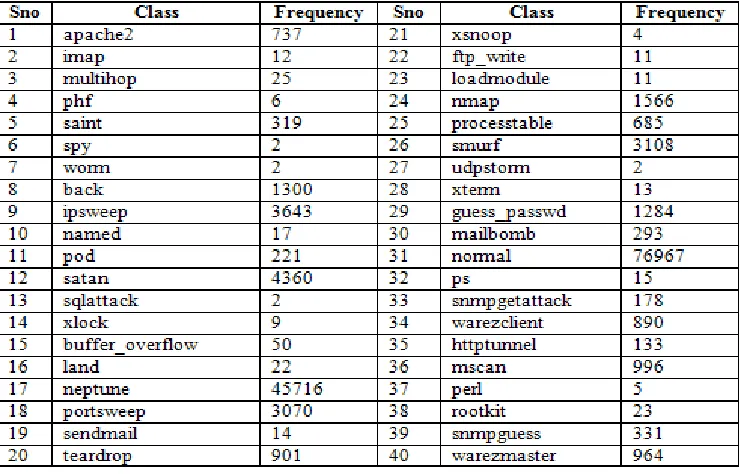
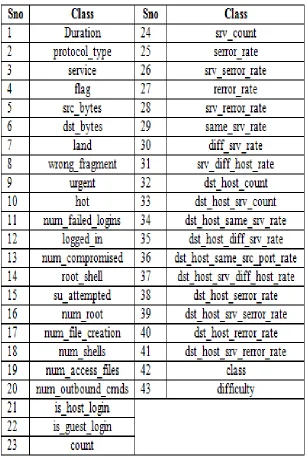
From the pie chart it is observed that almost half observations are labeled as normal class. After that next majority class is Neptune. All the remaining classes are very less in number. This unequal distribution may affect the predictions. In order avoid this we have taken stratified sampling from the data and considered this sampled data as the data given to the model.Table.2 gives the list of features present in the dataset.
V. FEATURE SELECTION AND PREPROCESSING
Variables describing the data set are called features. Features of dataset plays an active part in identifying the class label. After choosing the dataset, the next important step one has to take is selecting significant features which contribute much to the dataset. This process is called “feature selection”. Based on the domain expertise one has carefully decided which feature is significant and which is not.Feature selection is an iterativeprocess [6]. If the constructed model is not doing good with the selected features we can backtrack to the feature selection process. Out of 43 features, as a step of preprocessing the data, we have eliminated some of the features which are having all zeros, as zero valued fields contribute nothing. Those eliminated fields are 7,9,14,15,18,20 and 21.And features numbered 3, 4 are also eliminated as they are non- numeric fields having more levels. Later we have divided the pre-processed data in to modules with respect to the prototype, in which each module data is again pre-processed if necessary and partitioned for training and testing purposes [16]. From training data set we have considered only the observations with respect to the significant classes. Before going to build the model, this preprocessed data should be normalized.
[image:4.612.141.511.479.716.2]Table 2: Attributes in NSL-KDD dataset
VI. PROTOCOL SPECIFIC INTRUSION DETECTION SYSTEM USING KNN CLASSIFIER:
Table 3: protocol specific Intrusion Detection System Using KNN classifier
Algorithm:
Step 1: Remove non-numeric features having more levels and also remove features with null information.
Step 2: Convert all features with 2 distinct values into binary.
Step 3: Partition the dataset into two parts in 80:20 ratio and use 80% data (part1) for building and validating the
models and use 20% (part2) data for testing the performance of the approach.
Step 4: Partition the total data (part1) into 3 modules based on the protocol.
Step 5: On each protocol based partition, define a model in terms of relevant features, plausible class labels and the
Best_K by repeating the following steps
(a) Divide the partition into 60:40 ratios to generate training set and validation set.
(b) Identify significantly frequent classes from the training set as plausible class labels and screen the
remaining instances.
(c) Generate a training set sample with almost equal representation from each of the plausible classes either by over sampling or by under sampling the training instances.
(d) Remove features with null information and normalize the relevant features of training and validation data by fitting into the scale of [0, 1] .
(e) Record the class labels of training and validation data separately.
(f)Apply KNN by supplying normalized training and validation data sets along with the class labels of the training data as detailed below for each K:
(i) For each instance of the validation data find its distance to all instances of the training set sample and identify closest K training examples referred to as its neighbors.
(ii) Label the validation instance with the majority class label among its neighbors and record it as the predicted class label for the validation instance.
(iii) Find the classification accuracy by comparing predicted class labels with the actual class labels of the validation set for a given K value.
(g) Repeat the steps (i) to (iii) for different K values within the plausible range and find the K that results in the maximum accuracy as the Best_K.
Step 6: Integration of protocol-specific models to classify test cases/unseen cases :
(a)For each instance of the test data, based on the type of the protocol, invoke corresponding model along with its Best_K to predict class label of the test instance.
(b)To estimate the performance of the protocol specific KNN classifier model compare the predicted labels with the actual labels of the test cases and count the number of true-positives true-negatives, false positives and false negatives.
VII.EVALUATION METHODS
[image:7.612.178.427.297.716.2]Several techniques have been developed to evaluate the model with in supervised algorithms. Based on results obtained by running the approach on the test data one can have some predictions about the results [11]. To determine how well the approach did, one need to look at the proportion of correctly predicted results on the test data. We can calculate the accuracy of the result by considering number of correct predictions means true positives and true negatives and then dividing that by the total number of predictions. For this we need to construct the confusion matrix by using cross table. Accuracy = (TP+TN) / (Total-Predictions) Loss estimation can be obtained by considering cost of ignoring the intrusion, cost of miss-classification and cost of false intrusion by assigning proper weightage. "Cost of ignoring the intrusion" can be obtained by adding all false positives and high weightage is given to it as it leads to the dangerous step if the actual intrusion is ignored. Next high weightage is given to the cost of misclassification which indicates false positives and false negatives. And no weightage is assigned to the cost of false intrusion which indicates false negatives.Results are ultimate output of the approach which decides the importance of using that particular approach. By applying the KNN classifier to the nsl_kdd data set we will get the validation results at different K values shown in fig. 6,7,8. By observing validation results for each protocol-module the best K-value for each module is decided [12]. By using this best K-value testing is done on the test set of NSL-KDD data which results in best accuracy. Coincidentally, here the best K-Value for the three protocol modules is seems to be 3 as observed from bellow graphs. By submitting this best K-value to the protocol-specific KNN classifier, testing accuracy is as good as 96% and the loss is as low as 0.4
[image:7.612.200.428.305.536.2].
Fig 6: Validation results of TCP module
Fig 7: Validation results of ICMP module
[image:7.612.183.411.596.709.2]VIII. CONCLUSION
In this paper, authors propose a novel approach for detecting intrusions by protocol specific KNN classifier. Since most of the attacks are significant with respect to protocol, the focus of this approach is in considering the important categorical attribute called protocol. Data is partitioned according to its protocol. Separate model is built on the protocol specific data by only considering the predominant class labels from each partition and by ignoring the null informative features. The testing data can be supplied to this intrusion detection system which invokes the corresponding models to generate class labels of instances. Results show that our approach is good at detecting existence of the attacks and is feasible in improving the performance of attack detection process. The accuracy is as good as 96%. In this way, the proposed “Protocol-specific intrusion detection system using KNN classifier” gives best results for detection of intrusions.
REFERENCES
[1] George. S. Oreku, Fredrick J.Mtenzi “Cybercrime: Concerns, Challenges and Opportunities” "Information Fusion for Cyber-Security Analytics", Studies in Computational Intelligence 691, Springer International Publishing, 2017.
[2] Jay Jacobs, Bob Rudis , “Data-Driven Security: Analysis, Visualization and Dashboards”
[3] Leandros A. Maglaras,, Ki-Hyung Kim, Helge Janicke, Mohamed Amine Ferrag, Stylianos Rallis, Pavlina Fragkou, Athanasios Maglarasf, Tiago J. Cruz, “Cyber security of critical infrastructures ” Available online at www.sciencedirect.com, ICT Express 4 (2018) 42–45.
[4] Setiawan*, Supeno Djanali, Tohari Ahmad, “A Study on Intrusion Detection Using Centroid-Based Classification” 4th Information Systems International Conference 2017, ISICO 2017, 6-8 November 2017, Bali, Indonesia
[5] Buczak, Member, IEEE, and Erhan Guven, Member, IEEE, “A Survey of Data Mining and Machine Learning Methods for Cyber Security Intrusion Detection” IEEE COMMUNICATIONS SURVEYS & TUTORIALS, VOL. 18, NO. 2, SECOND QUARTER 2016.
[6] Frans Hendrik Botes, Louise Leenen and Retha De La Harpe, ”Ant Colony Induced Decision Trees for Intrusion Detection” conference paper june 2017. Available:
[7] Ahmed I. Saleh1 · FatmaM. Talaat1 · LabibM. Labib, ’’A hybrid intrusion detection system (HIDS) based on prioritized k-nearest neighbors and optimized SVM classifiers’’ © Springer Science+Business Media B.V. 2017
[8] https://www.analyticsvidhya.com/blog/2014/10/introduction-k-neighbours-algorithm-clustering [Last accessed on April 27,2018
[9] Amar Meryem, Douzi Samira, El Ouahidi Bouabid, Lemoudden Mouad, “A novel approach in detecting intrusions using NSLKDD database and MapReduce programming” . The 14th International Conference on Mobile Systems and Pervasive Computing (MobiSPC 2017). Available online at www.sciencedirect.com , Procedia Computer Science 110 (2017) 230–235 .
[10] HONGXING MA, JIANPING GOU, (Member, IEEE), XILI WANG1, JIA KE, & SHAONING ZENG, “Sparse Coefficient-Based k-Nearest Neighbor Classification” September 6, 2017.
[11] Shichao Zhang, Senior Member, IEEE, Xuelong Li, Fellow, IEEE, Ming Zong, Xiaofeng Zhu, and Ruili Wang, “Efficient kNN Classification With Different Numbers of Nearest Neighbors” ,IEEE TRANSACTIONS ON NEURAL NETWORKS AND LEARNING SYSTEMS, VOL. 29, NO. 5, MAY 2018.
[12] Camille Cobb, Samuel Sudar, Nicholas Reiter, Richard Anderson, Franziska Roesner, Tadayoshi Kohno, “Computer security for data collection technologies”, ICTD Lab and Computer Security & Privacy Research Lab Computer Science & Engineering, University of Washington, USA. Contents lists available at ScienceDirect Development Engineering.
[13] F. C. Freiling, T. Holz, and G. Wicherski, ``Botnet tracking: Exploring a root-cause methodology to prevent distributed denial-of-service attacks,'' Lect. Notes Comput. Sci., vol. 10, no. 2, pp. 319_335, 2005.
[14] WEIZHI MENG, (Member, IEEE), ELMAR WOLFGANG TISCHHAUSER, QINGJU WANG, YU WANG, & JINGUANG HAN, (Member, IEEE), “When Intrusion Detection Meets Blockchain Technology: A Review” March 15, 201
[15] Lee, W., Stolfo, S. J., Chan, P. K., Eskin, E., Fan, W., Miller, M., ... & Zhang, J. (2001). Real time data mining-based intrusion detection. In DARPA Information Survivability Conference & Exposition II, 2001. DISCEX'01. Proceedings (Vol. 1, pp. 89-100). IEEE.
[16] Muttaqien, I. Z., & Ahmad, T. (2016, December). Increasing performance of IDS by selecting and transforming features. In Communication, Networks, and Satellite (COMNETSAT), 2016 IEEE International Conference on (pp. 85-90). IEEE.

![fig. 6,7,8. By observing validation results for each protocol-module the best K-value for each module is decided [12]](https://thumb-us.123doks.com/thumbv2/123dok_us/1258966.653396/7.612.183.411.596.709/observing-validation-results-protocol-module-value-module-decided.webp)
