Pronunciation by Parametric Speech
Synthesizer
T o n y Vitale"
Digital Equipment Corporation
Automatic and accurate pronunciation of personal names by parametric speech synthesizer has become a crucial limitation for applications within the telecommunications industry, since the technology is needed to provide new automated services such as reverse directory assistance (number to name).
Within text-to-speech technology, however, it was not possible to offer such functionality. This was due to the inability of a text-to-speech device optimized for a specific language (e.g., American English) to accurately pronounce names that originate from very different language families. That is, a telephone book from virtually any section of the country will contain names from scores of languages as diverse as English and Mandarin, French and Japanese, Irish and Polish. All such non-Anglo-Saxon names have traditionally been mispronounced by a speech synthesizer resulting in gross errors and unintelligible speech.
This paper describes how an algorithm for high accuracy name pronunciation was imple- mented in software based on a combination of cryptanalysis, statistics, and linguistics. The algorithm behind the utility is a two-stage procedure: (1) the decoding of the name to determine its etymological grouping; and (2) specific letter-to-sound rules (both segmental rules as well as stress-assignment rules) that provide the synthesizer parameters with sufficient additional information to accurately pronounce the name as would a typical speaker of American En- glish. Default language and thresholds are settable parameters and are also described. While the complexity of the software is invisible to applications writers as well as users, this function- ality now makes possible the automation of highly accurate name pronunciation by parametric speech synthesizer.
1. Background
There has been a great deal of interest recently in the generation of accurate phonetic equivalences for proper names. New and enhanced services in the telecommunica- tions industry as well as the increasing interest in speech I / O for the workstation has renewed interest in applications such as the automation of name pronunciation by speech synthesizer in reverse directory assistance (number to name) applications (Karhan et al. 1986). In addition, speech recognition research can benefit by automatic lexicon construction to be ultimately used in such applications as directory assistance (name to number) and a variety of workstation applications (Cole et al. 1989).
Computational Linguistics Volume 17, Number 3
The inaccuracy of name pronunciation by parametric speech synthesizer has been a problem often addressed in the literature (Church 1986; Golding and Rosenbloom 1991; Liu and Haas 1988; Macchi and Spiegel 1990; Spiegel 1985, 1990; Spiegel and Macchi 1990; Vitale 1987, 1989a, 1989b, and others). The difficulty stemmed from the fact that high-quality speech synthesizers were so optimized for a particular language (e.g., American English), that a non-English form such as an unassimilated or partially assimilated loanword would be processed according to English letter-to-sound rules only) Since non-Anglo-Saxon personal names fall into the category of loanwords, the pronunciation of these forms ranged from slightly inaccurate to grossly unintelligible.
1.1 General Letter-to-Sound Rules
Letter-to-sound rules are a requirement in any text-to-speech architecture and take slightly different forms from system to system; however, they typically follow a stan- dard linguistic format such as x - . y/z, where x is some grapheme sequence, y some phoneme sequence, and z the environment, usually graphemic. The following is a typical example of a set of letter to sound rules:
C ~ I s /
/-{Eft,Y}
C --* / k /This set would handle all such forms as CELLAR, CILIA, CY, CAT, COD, etc., but clearly not loanwords such as CELLO for exactly the same reasons that make the pro- nunciation of last names so difficult for a synthesizer having only English letter-to- sound rules. A number of letter-to-sound rule sets are in the public domain, (e.g., Hunnicutt 1976; Divay 1984, 1990). However, m a n y rule sets that are currently in use in commercial speech synthesizers remain confidential. Venezky (1970) contains an extensive discussion of issues involving phoneme-grapheme correspondence.
The accuracy of pronunciation of normal text in high-quality speech synthesizers using exclusively or primarily letter-to-sound processing can now range as high as 9 5 + % . 2 In tests we ran, however, this accuracy (without dictionary lookup), was de- graded by as much as 30% or more when the corpus changed to high-frequency proper names. The degradation was even higher when the names were chosen at random and could be from any language group. Spiegel (1985) cites the average error rate for the pronunciation of names over four synthesizers as 28.7%, which was consistent with our results.
The reason for this degradation is due to the fact that the phonological intelligence of a speech synthesizer for a given language cannot discriminate among loanwords that are not contained in its memory (i.e., dictionary). In the Case of names, these are really loanwords ranging from the commonly found Indo-European languages such as French, Italian, Polish, Spanish, German, Irish, etc. to the more "exotic" ones such as Japanese, Armenian, Chinese, Latvian, Arabic, Hungarian, and Vietnamese. Clearly, the pronunciation of these names from the m a n y ethnic groups does not conform to the phonological pattern of English. For example, as pronounced by the average English speaker, most German names have syllable-initial stress, Japanese and Spanish names tend to have penultimate stress, and some French names have word-final stress.
1 That is, phonemic rules. Obviously, the phonetics output by a synthesizer would not be sufficient for multiple languages.
Chinese names tend to be monosyllabic and consequently stress is a non-issue; in Italian names, stress may be penultimate or antepenultimate as is the case with Slavic languages and certain other groups.
But while stress patterns are relatively few in number, the letter-to-sound corre- spondences are extremely varied. For example, the orthographic sequence CH is pro- nounced [~] in English names e.g., CHILDERS,
[~]
in French names e.g., CHARPENTIER, and [k] in Italian names e.g. BRONCHETTI or the anglicized version of some German names e.g., BACH. This means that letter-to-sound must account for a potentially large number of diverse languages in order to output the correct phonetics.Most researchers understand that in order to process the name accurately, at least two parameters must be known: (1) that the string is a name and thus needs to be processed by a special algorithm; and (2) that the string must be identified with a particular set of languages or language groups such that the specifics of the pronunci- ation (i.e., the letter-to-sound rules) can be formally described (Church 1986; Liu and Haas 1988; and others). While there has been some interest in attempting to identify a word as a name from random text, this present work assumes a database in which name fields are indexed as such (e.g., a machine-readable telephone directory) and no further mention of this will be made. This paper simply describes an implementation of this two-stage process, and details the first stage - - the correct identification of a name as belonging to a certain language group. It should be stressed that there have been other attempts to implement similar algorithms, although few descriptions of such implementations are available.
1.2 Language Groups
For purposes of identification, sets of similar languages are more efficiently grouped together. However, the language groups used in this study may not always corre- spond to the set of language families familiar to most linguists. For example, while Japanese or Greek may be in groups by themselves, languages such as Spanish and Portuguese may be grouped together into a So. Romance group and this set m a y be different from, Say, Italian, which may be grouped with Rumanian, or French, which m a y be grouped by itself. This is done to reduce the complexity of letter-to-sound (Sec- tion 4.1). However, the software is set up such that groupings can be moved around to accommodate different letter-to-sound rule sets. In addition, the number of groups is a variable parameter and could be modified as would the inclusion of any new rule sets in the letter-to-sound subsystem. Thus, for n language groups, the probability P of some language group L i being the correct etymology is P ( L i ) - - - ~ . 1
1.3 Etymology
Identification of a particular language group in the United States and m a n y countries of Western Europe is not an easy task. According to the United States Social Security files (Smith 1969), there are approximately 1.5 million different last names in the United States, with about one-third of these being unique in that they occur only once in the register. 3 Furthermore, the etymologies of the names span the entire range of the world's languages, although the spread of these groupings is obviously related to geopolitical units and historical patterns of immigration and is different in the United States than it is, say, in Iceland, Ireland, or Italy.
Computational Linguistics Volume 17, Number 3
2. Role of the Dictionary
The first step in the process w a s the construction of a dictionary that c o n t a i n e d b o t h c o m m o n a n d u n u s u a l n a m e s in their o r t h o g r a p h i c r e p r e s e n t a t i o n a n d p h o n e t i c equiv- alent. All sophisticated s p e e c h s y n t h e s i z e r s t o d a y use: a lexical d a t a b a s e for d i c t i o n a r y l o o k u p to p r o c e s s w o r d s that are, for one r e a s o n oi" another, exceptions to the rule. In generic synthesizers, these are typically functors that u n d e r g o v o w e l or stress re- duction, partially a s s i m i l a t e d or u n a s s i m i l a t e d l o a n w o r d s that c a n n o t be p r o c e s s e d b y language-specific letter-to-sound rules, a b b r e v i a t i o n s that are b o t h generic a n d domain-specific, h o m o g r a p h s that n e e d to be d i s t i n g u i s h e d phonetically, a n d selected p r o p e r n o u n s , such as g e o g r a p h i c a l place n a m e s or c o m p a n y n a m e s .
In the case of p r o p e r s u r n a m e s , h o w e v e r , d i c t i o n a r y l o o k u p s , while necessary, are of limited use. T h e r e are a n u m b e r of r e a s o n s for this. First, w h i l e the m o s t c o m m o n n a m e s w o u l d h a v e an e x t r e m e l y h i g h hit rate ( m u c h like functors in a generic sys- tem), the c u r v e quickly b e c o m e s a s y m p t o t i c . C h u r c h (1986) h a s s h o w n that w h i l e the m o s t c o m m o n 2,000 n a m e s can a c c o u n t for 46% of the K a n s a s City t e l e p h o n e b o o k , it w o u l d take 40,000 entries to obtain a 93% a c c u r a c y rate. F u r t h e r m o r e , a c c u r a c y w o u l d decrease if o n e considers that g e o g r a p h i c area has a p r o f o u n d influence on n a m e g r o u p i n g , a n d thus the figures for a large East or West C o a s t m e t r o p o l i t a n area w o u l d certainly b e significantly lower. It can be easily s h o w n that the functional l o a d of each n a m e c h a n g e s w i t h the g e o g r a p h i c a l location. 4 T h e n a m e SCHMIDT, for e x a m p l e , is n o t in the list of the m o s t f r e q u e n t 2,000 n a m e s , yet it a p p e a r s in the Social Security files as the m o s t c o m m o n n a m e in M i l w a u k e e (Spiegel 1985). Liu a n d H a a s (1988) c o n d u c t e d a similar e x p e r i m e n t that i n c l u d e d 75 million h o u s e h o l d s in the U.S. The first f e w t h o u s a n d n a m e s a c c o u n t for 60% of the database, b u t the c u r v e flattens o u t after 50,000 n a m e s a n d it w o u l d take 175,000 n a m e s in a d i c t i o n a r y to c o v e r 88.7% of the p o p u l a t i o n . This w o u l d m e a n that e v e n w i t h a n e x t r e m e l y large d i c t i o n a r y (each e n t r y of w h i c h w o u l d h a v e to be phoneticized), there w o u l d still be an error rate of o v e r 11%.
E v e n w i t h these limitations, dictionary l o o k u p s are still quite i m p o r t a n t . Fre- q u e n t l y occurring n a m e s , like functors, h a v e a h i g h functional load (above). Spiegel (1985) claims that if the m o s t c o m m o n 5,000 n a m e s are u s e d in a d i c t i o n a r y for a p o p u l a t i o n of 10 million p e o p l e , e v e n if letter-to-sound h a d a n a c c u r a c y of o n l y 75% (which is e x t r e m e l y l o w for a h i g h - q u a l i t y s p e e c h synthesizer), the error rate w o u l d be < 2.5%. M o s t other r e s e a r c h e r s h a v e also a s s u m e d a d i c t i o n a r y l o o k u p as p a r t of a n y p r o c e d u r e to increase the a c c u r a c y of n a m e p r o n u n c i a t i o n . Therefore the general flow of text f r o m the g r a p h e m e s p a c e to the p h o n e t i c realization m u s t p r o c e e d first t h r o u g h a dictionary. C o m m o n last n a m e s s u c h as SMITH, JOHNSON, WILLIAMS, BROWN, JONES, MILLER, DAVIS, WILSON, ANDERSON, TAYLOR, etc. a n d c o m m o n n a m e s (both first a n d last n a m e s ) f r o m a v a r i e t y of other l a n g u a g e s s h o u l d be included. T h e size of this d i c t i o n a r y is u p to its creator. The d i c t i o n a r y u s e d in this s o f t w a r e c o n t a i n e d a b o u t 4,000 lexical entries that w e r e p r o p e r n a m e s , s There is, h o w e v e r , n o r e a s o n to exclude
4 Functional load here is used in a slightly different sense than in linguistics. The functional load of a grapheme is its frequency of occurrence, in relation to other graphemes in the language, weighted equally, as measured over a sizable corpus of orthographic data.
very large dictionaries (e.g., > 50,000 words) although the choice of a search algorithm then becomes more important in real-time implementations.
When a dictionary lookup is used and a match occurs, the result is simply a translation from graphemes to phonemes, and the phoneme string (along with m a n y other acoustic parameters picked up along the way) is output to the synthesizer. 6 When there is no match, (i.e., most cases), however, some algorithm is needed to increase pronunciation accuracy.
3. Identification Pass
It is assumed that certain textual elements are identified as names and are intentionally processed as such. This algorithm does not address the identification of proper names in random text, although there has been some activity in this area in recent years with the increased attention to voice prosthesis, remote access to electronic mail, and other applications. In database retrieval applications this is not usually a problem, since names fields in a database are typically marked by some field identifier. Similarly, the syntax of electronic mail message headers can often be used to mark a personal name. The first stage in the identification procedure is the analysis of the sequence of graphemes that makes up the name, and its indexing as belonging to some language group. The concept of identification by orthographic trigram is by no means new and has been discussed in the literature (e.g., Church 1986; Liu and Haas 1988; and others). In our implementation, the identification is a complex procedure that includes filter rules for identification or elimination, graphemic (non-trigram) and morphological analysis, as well as trigram analysis. While this scheme m a y seem complex, it will run in real time, and thus the complexity is invisible to the user.
3.1 Filter R u l e s
It is well known in both linguistics and cryptanalysis that a text string from a lan- guage
Li
will have unique sequence characteristics that distinguishLi
from all other languages in the set{Li, Lj,...
Ln }. All alphabetic languages (as opposed to syllabaries or ideographic systems) have a quantifiable functional load of graphemes as well as phonemes, and this functional load will differ greatly from language to language. We have therefore created a set of rules that we call filter rules. Filter rules are rules that may positively identify a name or positively eliminate a name from further consider- ation. The use of nonoccurrence is not new but is refined to include a more elaborate filter mechanism for variable length grapheme sequences. When scanning the name to determine etymology, if the name cannot be positively identified, it is more efficient to eliminate some groups from consideration, thereby increasing the speed of the search (below).There are some unique identification characteristics of grapheme strings from cer- tain languages. In these cases, a grapheme G m a y help identify a string as being from
Li.
For example, the grapheme E in English is well known as the most common letter, and has a functional load of 12.4% (Daly 1987). Scrabble and similar games are interest- ing indicators of this and mark functional load of graphemes by values of individual letters; the lower the value, the higher the functional load. Naturally, quantitative dif- ferences occur from language to language. While z has an extremely low functional load in English, it is one of the most common letters in Polish. As an example of thiswell as the average length of each field of an entry.
Computational Linguistics Volume 17, Number 3
metric, if we take 1+ occurrences of the letter K in a n a m e o v e r the total n u m b e r of u n i q u e n a m e s in a corpus, in Japanese, the f r e q u e n c y of this letter is 40.1%, in Ger- m a n it is o n l y 18.9% a n d in Italian, the letter does :not occur. Since the distribution of letters in p r o p e r n a m e s will differ from that of the general lexicon, statistics on letter f r e q u e n c y in n a m e s s h o u l d be compiled i n d e p e n d e n t l y b u t could be used for d e t e r m i n i n g probabilities. Similarly, the o r t h o g r a p h i c length of a name, like the length of a c o m m o n n o u n , could, in a m o r e elaborate scheme, be also u s e d as a factor in d e t e r m i n i n g probabilities. In the dictionary u s e d in this study, b o t h n a m e s a n d non- n a m e s together h a d an average length of slightly u n d e r 7.5 g r a p h e m e s . This coincides w i t h the findings of Daly (1987), in w h i c h n o r m a l w o r d s h a d an a v e r a g e length of 7.35 g r a p h e m e s . 7 N e i t h e r of these were u s e d as factors in d e t e r m i n i n g probabilities in this i m p l e m e n t a t i o n .
Sequences of g r a p h e m e s are m u c h m o r e useful in d e t e r m i n i n g the identification of a language group. Sequences of 2 or m o r e letters including larger m o r p h o l o g i c a l el- e m e n t s w i t h i n a n a m e m a y be c o n s i d e r e d characteristic of a language g r o u p a l t h o u g h each of these m a y also effectively exclude a set of o t h e r language groups. For exam- ple, sequences such as c z , PF, SH, EE (or longer ones) u n a m b i g u o u s l y define certain l a n g u a g e groups. A trivial example of this w o u l d be the sequence #MC (where # is a w o r d - b o u n d a r y ) , w h i c h u n a m b i g u o u s l y identifies the w o r d as Irish resulting in a probability of 1 for the identification of the c o r r e s p o n d i n g l a n g u a g e group.
H o w e v e r , e v e n if a sequence c a n n o t identify a language g r o u p u n a m b i g u o u s l y , the filter rules often eliminate one or m o r e g r o u p s f r o m consideration, t h e r e b y drastically altering the statistical chances of an incorrect guess. As m i g h t be expected, the longer the (legal) sequence in
Li,
the less likely it is to occur in a n o t h e r l a n g u a g e group. In some languages, either alphabetic ones or those that are transliterated into alphabetic systems (e.g., Japanese), certain letters d o not occur. For example, the letter L does not occur in Japanese, x does not occur in Polish, J does not occur in Italian, a n d so on. The occurrence of a n y of these g r a p h e m e s in a n a m e string w o u l d t h e n i m m e d i a t e l y eliminate that language f r o m consideration. Thus, if m l a n g u a g e g r o u p s h a v e b e e n eliminated, the probability of some l a n g u a g e g r o u pLi
being the correct e t y m o l o g y is n o wP(Li)
= ~_-~. Analysis has s h o w n that the filter rules eliminate an a v e r a g e of 54% of all possible language groups, sFilter rules, therefore, consist of (a) identification rules a n d (b) elimination rules. Identification rules m a t c h a g r a p h e m e sequence against an identical sequence in the name. A m a t c h is a positive identification a n d the filter routines stop. Elimination rules also m a t c h a g r a p h e m e sequence against an identical g r a p h e m e sequence in the name. A m a t c h eliminates that l a n g u a g e g r o u p f r o m consideration. There are a n u m b e r of different w a y s these rules could be applied. One of the m o r e efficient m e t h o d s is to create a hash table of g r a p h e m e strings a n d search for substrings for identification a n d elimination at the same time. W h i c h e v e r w a y a compiler for these rules is written, it is clear that the routines stop after a positive identification occurs. The benefit of using filter rules p r i o r to the t r i g r a m analysis (below) is one of speed.
O n e m i n o r p r o b l e m that h a d to be e x a m i n e d was the fact that m a n y n a m e s have b e e n anglicized from their original form, resulting in v a r i e d a n d disparate p r o n u n c i a -
7 The average length of an English word is 3.98 letters when the words are weighted by frequency of appearance (Daly 1987) clearly due to the shorter length of commonly occurring forms such as function words. While no similar statistics have been compiled for names, it is doubtful whether the
discrepancy in length between weighted and unweighted would be as large.
tions (not to mention some rather strange spellings, including graphemes that do not exist in the source language). For example, a Polish name such as ALEXANDROWICZ contains the grapheme x, although x does not occur in Polish (i.e. KS --* X). The ortho- graphic sequence scI (= [~]) in Italian is occasionally anglicized as SH even through the sequence StI does not occur in the language. Therefore, the elimination rules have to be carefully tailored to take such phenomena into consideration. Sequences that positively identify a language must also be carefully screened for the same reason. Names like O'SHINSKI are not uncommon. 9 In this case, whether the name is consid- ered Irish or Polish may not matter in terms of the phonemic output, but there are cases where it would make enough of a difference to cause intelligibility problems in the final output.
3.2 Trigram Analysis 1°
The job of the filter is to positively identify a language or to effectively eliminate one or more groups within the set of possible language groups when positive identification is not possible. Elimination obviously reduces the complexity of the task of the remaining analysis of the input name. Assuming that no language group is positively identified as the language group of origin by the filter, some further analysis is needed. This further analysis is performed by a trigram analyzer, which receives the input name string and a vector of uneliminated language groups. The trigram analyzer parses the string into trigrams. If word boundary symbols are included as part of the string, then the number of trigrams in the string will always be equal to the number of elements (graphemes). Thus, the name SMITH ==~ #SMITH# will contain five trigrams: #SM, SMI,
MIT, ITH, a n d TH#.
A trigram table is a four-dimensional array of trigram elements and language group. This array contains numbers that are probabilities (generated from a large reference corpus of names labeled as belonging to a particular language group) that the trigram is a member of that language group. Probabilities are taken only to four decimal places, although there is no empirical reason for this.
3.2.1 Creation of Trigram Databases. The creation of a trigram database would be an extensive and time-consuming task if it were to be done manually. Nevertheless, it was initially necessary to hand-label a large list of names with language group tags associated with each name. Fortunately, this was expedited with country-specific per- sonnel lists from a large company. 11 Once these lists were completed, computational analysis was performed on the list, decomposing each name into grapheme sequences of varying lengths, including trigrams, and searching for recurring morphological ele- ments as well. This analysis, in turn, created a set of tables (language-specific n-grams, trigrams, etc.), which was then used for further analysis. The language identifier itself can be utilized as a tool to pre-filter a new database in order to refine the probability table. This is illustrated in Figure 1. The name, language group tag, and statistics from the language identifier are received as input. This analysis block takes this information and outputs the name and language group tag to a master language file and produces rules to a filter rule-set. In this way, the database of the system is expanded as new
9 Murray Spiegel (personal communication) has pointed out that there are 79 households in the U.S. that have this name.
10 For our purposes here, trigram will be used synonymously with the term trigraph. Trigram analysis is by no means new and has been discussed often in the literature (e.g., Church 1986).
Computational Linguistics Volume 17, Number 3
Figure 1
I
!
n a m e I Language Id & J Phonetic - Realization
rules
name/Lang, tag/phonemics
'[' trigram
probabilitiesCompute
Probabilities
name Lang.
tag
stats
AnalysisMaster Language File
Elimination & [ Identification
Rules [
name Lang. ta!
input names are processed so that new names can be more accurately recognized. The filter rule store provides the filter rules to the filter module for identification or elimination.
3.2.2 Trigram Array and Statistical Analysis. The final trigram table itself then has four dimensions: one for each grapheme of the trigram and one for the language group. The trigram probabilities are sent to the language group blocks, phonetic realization block, and to the trigram analysis, which produces a vector of probabilities that the grapheme string belongs to the various language groups.
The master file contains all grapheme strings and their language group tag. The trigram probabilities are arranged in a data structure designed for ease of searching a given input trigram. For example, if we use an n-deep three-dimensional matrix where n is the number of language groups, then trigram probabilities can be computed from the master file using the following algorithm:
c o m p u t e t o t a l n u m b e r of o c c u r r e n c e s of e a c h t r i g r a m f o r all l a n g u a g e g r o u p s L (l-n)
for all g r a p h e m e s t r i n g s S in L for all t r i g r a m s T in S
if (count [T] [L] = O) u n i q [L] + = 1 count [T] [L] + = i
for all p o s s i b l e t r i g r a m s T in m a s t e r s u m = 0
for all l a n g u a g e g r o u p s L
s u m + = count [T] [L] / u n i q [L] for all l a n g u a g e g r o u p s L
[image:8.468.111.379.55.282.2]Table 1
Sample matrix of probabilities.
Trigram Li
L i
...
Ln
#VI .0679 . 4 6 5 9 . . . . 2093
VIT .0263 . 4 1 4 5 . . . . 0000
ITA .0490 . 7 8 5 1 . . . . 0564
TAL .1013 . 4 4 2 2 . . . . 2384
ALE .0867 . 2 6 0 2 . . . . 2892
LE# .1884 . 3 1 8 1 . . . . 0688
AV. .0866 . 4 4 7 7 . . . . 1437
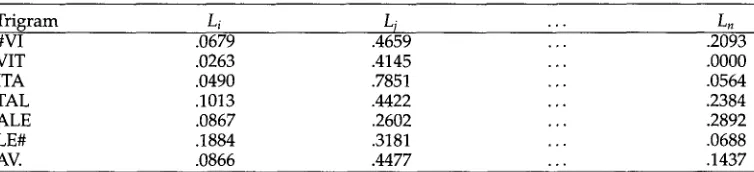
In any case, the result of the trigram analysis is a vector of probabilities for a given trigraph over the number of language groups. Table 1 shows an example of what the probability matrix would look like for the name string VITALE.
In the matrix shown in Table 1, L is a language group, and n is the number of language groups not eliminated by the filter rules. The probability that the grapheme string #VITALE# belongs to a particular language group is actually produced as a vector of probabilities from the total probability line. In this case, the trigram #vI has a probability of .0679 of being from language group
Li
.4659 of being from the language groupLj
and only .2093 of being from the language group Ln. The average of the probability table entries identifiesLj
as being the most probable language group. In this case,Lj
was Italian.The probability of a trigram being a member of a particular language group can be derived by a number of different methods. For example, one could use a standard Bayesian formula that would derive the probability of a language group, given a trigraph T, as
P(LilT)
whereP(TILi)P(Li)
P(Li)IT) = Y~,k P(TILk)P(Lk)
Furthermore, where x is the number of times the token T occurred in the language group
Li
and y is the number of uniquely occurring tokens in the language groupLi,
always, where n is the number of language groups (nonoverlapping). Therefore,
P(Li]T) -
P(TILi)
P(TfLi)
~k=l P(~
~Lk) Ek=l
P(TILk)
While this is not the most mathematically optimal or elegant method (since averag- ing tends to favor a noneven distribution of trigram probabilities) and is certainly a simplistic method of performing such calculations, it works reasonably well and is computationally inexpensive. It should be noted, however, that multiplying proba- bilities, calculating and adding log probabilities, or even averaging the two highest probabilities, may all work, but each of these approaches assumes that trigrams are independent of one another. It is beyond the scope of this paper to discuss the elegance of one mathematical solution over another but it would be interesting to examine other options, such as higher order conditional probabilities, e.g.,
P(LiIT1, T2,
T3) =P(TIlT2, T3, Li)P(T21T3, Li)P(T3 Li)P(Li)
P(T1, T2,
T3) [image:9.468.34.411.86.172.2]Computational Linguistics Volume 17, Number 3
Table 2
Name pronunciation statistics.
Name Identified Language Highest Probability
Partington English .4527
Bischeltsrieder German 1.000
Villalobos Spanish .4377
Kuchenreuther German .6973
O'Banion Irish 1.000
Zecchitella Italian 1.000
Pederson English .3258
Hashiguchi Japanese 1.000
Machiorlatti Italian 1.000
Andruszkiewicz Polish 1.000
Fujishima Japanese 1.000
Macutkiewicz Polish .6153
Fauquembergue French .4619
Zwischenberger German 1.000
Youngblood English .8685
Laracuente Italian .2675
Laframboise French .3778
McAllister Irish 1.000
Abbruzzese Italian .5113
Rodriguez Spanish .6262
Yanagisako Japanese .7074
Migneault French 1.000
Znamierowski Polish 1.000
Shaughnessy Irish .6239
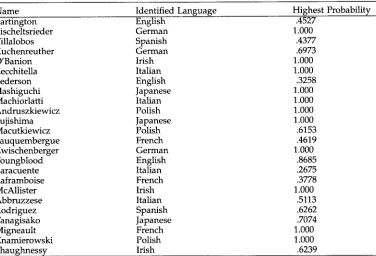
Table 2 is an e x a m p l e of the o u t p u t of the language g r o u p identification m o d u l e . The table consists of t w e n t y - f o u r p r o p e r n a m e s r a n d o m l y b u t equally selected f r o m the eight separate language groups. 12 Twenty-three out of t w e n t y - f o u r were correctly identified. The o n l y error is on the n a m e LARACUENTE, w h i c h is the lowest score a n d is identified as Italian instead of Spanish.
N o t e also that .2675 is the lowest score in the list. In practice, this w o u l d not h a v e p r e s e n t e d a problem, since the letter-to-sound rules for language g r o u p s such as Italian a n d Spanish are v e r y similar (e.g., the stress p a t t e r n w o u l d be penultimate, etc.) a n d thus the p h o n e t i c realization w o u l d be almost identical. W h e n p r o n u n c i a t i o n is i n c l u d e d in the evaluation, the scores w o u l d be slightly h i g h e r in certain cases, since an incorrect identification does not always result in an incorrect pronunciation.
3.3 Thresholding
Since the o u t p u t of the e t y m o l o g y analyzer is a vector of probabilities and o n l y the highest score is chosen (i.e., a best guess), a n u m b e r of different situations can arise regarding the total spread a m o n g the n u m b e r s , the difference in s p r e a d b e t w e e n a n y t w o n u m b e r s , or the s p r e a d b e t w e e n some n u m b e r a n d 0 (i.e. an absolute comparison). For this reason, a n d to m a k e use of this information, t h r e s h o l d i n g has b e e n applied.
Essentially, thresholding allows for analysis to be m a d e o v e r the vector of proba- bilities such that statistical i n f o r m a t i o n can be u s e d to help d e t e r m i n e the confidence level for the language g r o u p w i t h the highest score (i.e., the best guess). Two types of threshold criteria h a v e b e e n applied: absolute and relative.
[image:10.468.58.434.86.342.2]3.3.1
Absolute Thresholding.
Absolute thresholding can apply when the highest prob- ability determined by the trigram analyzer is less than a predetermined threshold that is variable or can be set programmatically. This would mean that the trigram analyzer could not determine, from among the language groups, a single language group with a specified degree of confidence. For example, if empirical evidence (i.e., over a given corpus) suggests that P < n (where P is the highest probability and n is some number predetermined to be too low for an adequate confidence level), then some other action should be taken, n should be set by analysis of data. While this "other action" is vari- able, one approach would be to choose a default language that m a y or may not be the same as the language group identified by the highest probability. Evidence suggests that typically it is not.As an example, if the absolute threshold were set at P < .1000 and the highest score were .0882 for some language
Li,
then the default language is chosen whether or not this is the same asLi.
There may be circumstances where the accuracy might be able to be tuned by adjusting the absolute threshold. 13 However, this parameter should be construed more as a partial filter which, if set to some reasonable value, will filter out only scores showing a very low confidence level, and thus it would rarely affect the result.3.3.2
Relative Thresholding.
Another type of thresholding scheme that was imple- mented is a relative thresholding. In this case, A spans a number of probabilities provided that the distance between the highest score and the default language is < n. Therefore, ifPj
was the probability assigned to the default language group, no matter where this occurred relative to the best guessPi, if A(Pi, Pj) < n,
the default language is chosen. (Typically, n is a smaller number than it was for absolute thresholding.) This is, of course, empirical and should be judged according to an analysis of the database used. It is our impression that if the default language group falls within the A, the algorithm should force a choice of the default language.It should be noted, however, that there are other ways in which relative threshold- ing could have been implemented, e.g., when the distance in probabilities between the language group identified as having the highest probability and that identified as hav- ing the second highest probability is < n, where again n is some number determined by analysis of the data. Thus where
Pi
is the highest probability andPj
the second highest, then, ifA(Pi, Pj), < n,
the default language is chosen. The problem with this approach is that it would result in two close scores (i.e. between similar languages), forcing a default to a third and possibly structurally dissimilar language. For example, a name for which the scores for Italian or Spanish fell within the A might then be forced into the default language, say English. This is clearly not optimal for a generic use of the algorithm, although it might be useful under certain application-specific circumstances.3.4 Default Language
To solve practical application problems of name pronunciation, it was necessary to define a default language group. The concept of using a default language proves to be useful for several reasons: (1) it is consistent with the philosophy that where
Computational Linguistics Volume 17, Number 3
mistakes are made, they will reflect human errors in pronunciation; 14 (2) the software underlying this algorithm is designed to be used in speech communities anywhere in the world; and (3) the default language could be adjusted for communities in the U.S. or elsewhere where one language group predominates.
If
Pi
orA(Pi~Pj)
falls within some range, it signals, for whatever reason, a low confidence level. Humans, when faced with a decision in these circumstances, often opt for the "familiar," in this case, some predefined default pronunciation. This would almost always be the language of the speech community in which the application is running. In other words, if the confidence level is measured as low via some thresh- olding mechanism, then a conservative approach would be to default to some "safe" language group, even if this might result in an error in the correct pronunciation (see fn. 14).Secondly, whether an application is running in Berlin, Paris, Dublin, or Milan, the default language setting could be changed to reflect the predominant language group. In Germany, for example, in cases where threshold confidence level scores are too low for the language group identifier, the default (presumably German) would reflect a reasonable guess.
The default language parameter could also be used in other cases where the pre- dominant linguistic base of an area is known to be different from that of the wider speech community. In telecommunications applications, for example, telephone num- ber prefixes are unambiguous indicators of geographical areas, some of which are relatively homogeneous in ethnic makeup. In cases like these, an application might make use of an automatic default language change for calls pertaining to these areas. Thus, in a Hispanic neighborhood, the default would be to Spanish. This could also be used for homographic first and last names in an elaboration of this system such that ambiguities like JULIO, JESUS, and the like could be resolved. The default lan- guage setting is certainly the most important of any of the settable parameters, since it determines the base language that is used in all cases of low confidence.
4. Letter-to-Sound Rules
Much of the discussion of this paper has been devoted to an explanation of the identifi- cation of the etymology of the name. While this is certainly the more difficult problem to solve, there is a great deal more that needs to be done to arrive at some reasonable approximation of a phonetic realization. The identifier merely takes an orthographic sequence and adds a tag that marks it as a member of a particular language group. The output remains a graphemic sequence. It is the tag, however, that forces the name through one of a special set of letter-to-sound rules optimized for the languages of that particular group. Therefore, the sole difference between a name run through the identifier and a word from generic English text is that the name is tagged as a special case and undergoes different letter-to-sound rules.
4.1 Optimization of Rule Sets
The letter-to-sound module is a knowledge-rich complex subsystem that takes a graph- eme input and converts it into its appropriate phonemic equivalent. In normal letter- to-sound systems that apply to generic text (see Klatt 1987 p. 767ff), an orthographic se- quence is, according to some rule set, converted into symbols that typically correspond
1
Dictionary ]
,L
Elimination &
Identification
Rules
Tagnm
Analysis
C
Let~er-to-soun
Language Group 1
Letter-to-sound Language
Group 2 ~ p ~ p n
Figure 2
to segmental phonemes and stress patterns for that form. In this case, however, the task becomes much more complex because of the many language groups involved (Section 1.1).
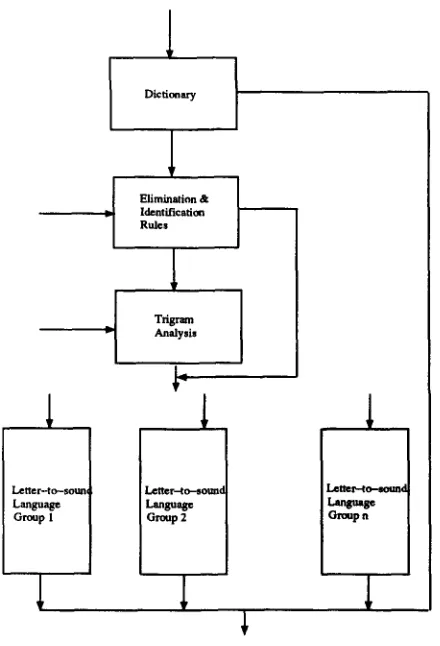
When the tag (above) is attached to some name thereby identifying it as belonging
to some language group
Li,
the orthographic sequence is funneled through a specialset of letter-to-sound rules for
Li,
and similarly forLj,..., Ln.
Figure 2 is a block di-agram of the entire flow of the procedure with the letter-to-sound modules (slightly oversimplified) occurring after identification has been completed.
While the concept of separate rule sets is a valid one, in practice this would be an unnecessarily complex system since it is obvious that there would be a great deal of redundancy and overlapping of rules from one rule set to the other. For example,
the simple rule (K ~ / k / might be valid for many of the language groups. This
would fail to capture the generalization that this rule can be shared by a subset of the total number of language groups, would therefore waste computing resources, and consequently is architecturally suboptimal.
[image:13.468.120.340.52.375.2]Computational Linguistics Volume 17, Number 3
5. Some Further Issues
5.1 First Names
Historically, s u r n a m e s in m a n y p a r t s of the w o r l d are s i m p l y extensions of the first n a m e to distinguish different o w n e r s of the s a m e first n a m e . As a c o n s e q u e n c e of this, first n a m e s h a v e a h i g h e r f r e q u e n c y of occurrence t h a n s u r n a m e s since the list of first n a m e s is a smaller set for m o s t languages. ~s Therefore, m a n y of these are a p p r o p r i a t e l y i n c l u d e d in the lexicon or dictionary. In addition, the s a m e first n a m e m a y s p a n a w i d e v a r i e t y of languages. C o m m o n E u r o p e a n first n a m e s are f o u n d in d i s p a r a t e regions of the w o r l d , d u e to extralinguistic factors s u c h as the g e o g r a p h y of f o r m e r colonial p o w e r s . P u t a n o t h e r way, m o r e p e o p l e in a n g l o p h o n e countries h a v e the first n a m e
JOHN t h a n h a v e the last n a m e SMITH. 16 For this reason, the m o s t c o m m o n first n a m e s in each l a n g u a g e g r o u p are i n c l u d e d in the dictionary. H o w e v e r , in the e v e n t that there is no d i c t i o n a r y m a t c h o n first n a m e s , t h e y s h o u l d still be processed, like the s u r n a m e , b y the l a n g u a g e identification m o d u l e (below).
Processing the first n a m e can b e d o n e i n d e p e n d e n t l y or, in a n e l a b o r a t i o n of the a l g o r i t h m , m a y be d o n e in conjunction w i t h the s u r n a m e . For e x a m p l e , if the n a m e YUKIO KOBAYASHI w e r e p r o c e s s e d a n d o n e n a m e w a s f o u n d b y a d i c t i o n a r y l o o k u p , that identification could assist in the identification of the other. If the p r o b a b i l i t y of b o t h n a m e s w e r e l o w b u t the best guess s h o w e d the s a m e l a n g u a g e g r o u p identified for both, this could also b e u s e d as a factor in the d e t e r m i n a t i o n of the correct ety- mology. In this s c h e m e , c a u t i o n m u s t be u s e d especially w i t h f e m a l e n a m e s in m a n y countries w i t h a h e t e r o g e n e o u s ethnic m a k e u p (e.g. the U n i t e d States) since a s u r n a m e (taken f r o m a h u s b a n d ) a n d f e m a l e first n a m e will often b e f r o m different l a n g u a g e g r o u p s . This, of course, can b e o v e r c o m e b y m a r k i n g s u c h n a m e s in the lexicon as female. H o w e v e r , it w a s f o u n d that s u c h additional l o a d i n g is n o t n e c e s s a r y since the e t y m o l o g y of n a m e s c a n be a c c u r a t e l y a s c e r t a i n e d w i t h o u t utilizing i n f o r m a t i o n o u t s i d e of the n a m e itself.
5.2 Hyphenated Surnames
H y p h e n a t e d n a m e s w o u l d be p r o c e s s e d as if t h e y w e r e t w o s e p a r a t e n a m e s . Again, this is b e c a u s e of the p o t e n t i a l c o n f u s i o n that c o u l d occur w h e r e p a r t of the h y p h e n a t e d n a m e is a m a r r i e d n a m e a n d the other a birth n a m e . Thus, s u r n a m e s s u c h as ARRO¥O-
PETERSEN, MAHONEY-RIZZO, KILBURY-MEISNER, a n d the like s h o u l d b e t r e a t e d as if the h y p h e n w e r e a l a n g u a g e separator. F u r t h e r m o r e , in s u c h c o m b i n a t i o n s , the s e q u e n c e is often u n p r e d i c t a b l e . S o m e cultures a d o p t the c o n v e n t i o n (for w o m e n ) of b i r t h n a m e - m a r r i e d n a m e (e.g., English, Polish), while others h a v e the o p p o s i t e o r d e r of m a r r i e d n a m e - b i r t h n a m e (e.g., G e r m a n ) . 17
5.3 Homographs
A classic p r o b l e m that faces l e t t e r - t o - s o u n d a l g o r i t h m s is the existence of h o m o g r a p h s . These are w o r d s that are spelled the s a m e b u t h a v e t w o different p r o n u n c i a t i o n s , u s u - ally signaling a difference in f o r m class. English contains, in its general vocabulary,
15 Certain languages, however, have a more open-ended system than those of the familiar Indo-European languages. In Chinese languages, for example, individuals have a wide variety of names which derive from the general lexicon. A female name might be WANG MEI HWA where WANG is the surname, MEI "beautiful' and HWA 'flower'. Her sister might be WANG MEI YEH "beautiful leaves.'
16 Liu and Haas (1988) point out that the name SMITH occurs 676,080 times for a database of 75 million households in the U.S. representing 1% of the total.
over 300 of these, some of which are high frequency forms. Examples of this are DE- LIBERATE, ARITHMETIC, REFUSEr PRODUCE, COORDINATE, SOW, BASS, and many others. Modern-day text-to-speech systems do not yet process these automatically. An even more difficult problem faces a proper name pronunciation algorithm. Whereas one could, in principle, devise a method for generic text using form class or part of speech to distinguish pairs such as those just mentioned, it is not always possible to predict
which variant will occur in a proper name. TM
5.4 Free Variation and Cross-Language Variation
5.4.1 Homographic Variation and Cross-Language Variation. Different pronuncia-
tions may occur in either free variation or in cross-language variation, with the two occasionally overlapping. Free variation occurs when the same last name occurs with two or more different pronunciations but these are from the same language group.
One person with the name BERNSTEIN may pronounce it
[br'nstaYn],
whereas a secondperson may pronounce it
[br.'nstl~n].
This is true free variation where typically one pro-nunciation represents something closer to the source language. In a slightly different type of variation, one name may indeed be from a different language group or else the alternation reflects a radical anglicization of the name, e.g., PACE may be pronounced
either
[pds]
or[pd~i].
Stress patterns also vary greatly depending upon the degree ofassimilation into English. For example, Slavic names show a great deal of variation from penultimate stress (which is the canonical stress pattern) to antepenultimate (the
assimilated pattern). E.g., ANDRUSZKIEWICZ could be [andru~kY6vi~] or [andrt~kYevi~].
Often, cues such as orthography may give a hint as to the degree of assimilation. If the native Slavic phoneme Iv] is written orthographically as W, for example, it has a higher chance of retaining the source (i.e. penultimate) stress pattern than if the same phoneme were written orthographically as V.
Cross-language variation causes greater problems in this regard, since names are listed in the dictionary in only one way. However, this algorithm is not language- specific but can be used anywhere in the world. While the entry could be modified, no procedure that would allow for different lexical entries for the same spelling has
been implemented. In any case, names like ROBERT could be
[rdbrt]
or[rob&]
depend-ing upon whether the name is English or French. Similarly, names like JULIO, PETER, WALTER, GILES, BERNARD, GUY, RICHARD, JAN, CLAUDE, and hundreds of others have different segmental forms or stress patterns depending upon where they originate from and whether the name has been assimilated into English. One w a y in which this could be handled is by marking these in a dictionary and then using the 'loading" strategy of last name etymology as discussed above (Section 5.1). Another method is simply to adopt one variant as the default with the others also listed as homographs and marked for language type with the corresponding phonetic equivalents. Since the default language is a settable parameter (Section 3.4), multiple phonetic entries could, in principle, be used.
5.5 Loanword Assimilation and Segmental Modification
It is obvious that the segmental phonetic output of letter-to-sound rules is restricted to the inventory of allophones of the synthesizer. That is, an English-based speech synthesizer should not be expected to make a French uvular [R] or a German velar fricative. Moreover, it would be counterproductive to even attempt to approximate
Computational Linguistics Volume 17, Number 3
these sounds, since the listener would not be expecting this and intelligibility of the name would certainly decrease. For this same reason, even the segmental phonemes of the source language can distract the listener's attention and reduce intelligibility. For example, while the name CARBONE must have penultimate stress to be considered correct, it would be inappropriate to phonemicize the final orthographic vowel as a mid front / e / , as would be the case in the target language (i.e., Italian). This is because the assimilation of this and other similar names into English has raised the vowel phonemically t o / i / (and diphthongized it phonetically to [iy]. Thus, while CARBONE would b e / k a r b 6 n e / i n Italian, it would be / k a r b 6 n i / i n anglophone countries such as the United States.
Furthermore, the different degrees of assimilation can be formally described in an elaboration of the algorithm presented here. For example, assuming allophones as produced by a speech synthesizer are optimized to American English, one could apply a number of rules to the name CARBONE as follows:
1. Orthography --* (CARBONE) 2. Phonemicization ~ / k a r b 6 n e / 3. Assimilation Rule 1 --+ / k a r b 6 n i /
4. Assimilation Rule 2 (optional) ~ / k a r b 6 n /
Thus, we can place different degrees of assimilation on the target language (i.e. English) using formal (ordered) rules. This would allow a generic synthesizer's letter to sound (and allophonic) rules the ability to change degree of assimilation in much the same way that we will eventually be able to specify shifts in style and register within text-to-speech systems.
6. Testing and Evaluation
6.1 Performance
The performance goal of the software developed around this algorithm was real-time processing. We benchmarked the performance on a Digital Equipment Corporation Vax 8800 running VMS V5.1. A total of 34,337 names were processed in 25 minutes and 27 seconds, or equivalently 22.65 names per second. After some code optimization and streamlining of the filter rules, we later ran similar tests using the same databases on an 33 MHz PC running MS-DOS V5.0. While these tests were run on the iden- tification portion only, we were able to process several thousand names per second. Large commercial applications will have similar compute power, and thus real-time processing is not a problem. It should be noted that many applications do not require real-time processing since the processed name and address can be simply stored in a separate field in the database. The routines can thus be used to create a database of phonemicized names by preprocessing the name, storing the phonemic equivalent of the name in some field, and sending that field to the synthesizer at some later time. 6.2 Pronunciation Accuracy
Table 3
Names vs. generic lexical items.
Lexical type % Error before % Error after Dictionary
All function words 2000 common surnames Complex poly test
828 Single L-group surnames
0 0 +
31.9 0 +
5.1 5.1 -
92 6.3 -
O u r reasoning was that the o u t p u t should minimally m o d e l h u m a n behavior. H o w - ever, because the algorithm contains m o r e linguistic i n f o r m a t i o n than is k n o w n b y the average person, the software has the potential to be m o r e accurate than a p e r s o n (i.e., m a k e f e w e r gross p r o n u n c i a t i o n errors). Testing of h u m a n vs. c o m p u t e r p r o n u n c i a t i o n of n a m e s from a test database is being c o n d u c t e d i n d e p e n d e n t l y at the present time within the artificial intelligence c o m m u n i t y (Golding and R o s e n b l o o m 1991) as well as within the t e l e p h o n e industry.
One of the problems w e faced is a definition of w h a t constitutes correctness. Very often, m o r e than one p r o n u n c i a t i o n is acceptable and m a n y readers of this p a p e r h a v e h a d their o w n n a m e s p r o n o u n c e d differently b y other individuals. Even profes- sional linguists faced with n a m e s such as MOUDRY, FUCHS, SOUTO, D'ANGELO, BADKE, DUJMUCH, SMYTHE, and others cannot say definitively w h e t h e r one p r o n u n c i a t i o n is correct or not (Hochberg et al. 1990). For the p u r p o s e s of o u r evaluation, in cases like these, a p r o n u n c i a t i o n was accepted if linguists felt that the segmental p h o n e m i c o u t p u t and stress p l a c e m e n t were reasonable. Again, a n o t h e r a n d possibly m o r e re- alistic a p p r o a c h m i g h t be to p h o n e m i c i z e a set of n a m e s f r o m the p r o n u n c i a t i o n of a g r o u p of individuals w h o are not o w n e r s of the name. These p r o n u n c i a t i o n s could then be p h o n e m i c i z e d b y a linguist a n d correctness could then be evaluated b y a simple matching of the majority pronunciation. In a n y case, b o t h [fyuks] and [fu6] were considered correct for FUCHS b u t [ffi~iz] and [f^ks] were not; [smaYO] a n d [smIO] for SMYTHE b u t not [smIOiI; [diY~njelo] and [degnjelo] for D'ANGELO but not [daenj61o] and so on. Similarly, because of h o m o g r a p h i c variation (Section 5.4.1) and the a t t e m p t to m a k e errors replicate w h a t h u m a n s m i g h t say, w e w o u l d accept certain p r o n u n c i - ations for n a m e s that w e k n e w came from two v e r y different sources as long as one w e r e reasonable. For example, [p6s] w o u l d be an acceptable p r o n u n c i a t i o n for PACE e v e n if the first n a m e were Antonio. In fact, often one cannot say definitively that one p r o n u n c i a t i o n or the other is the one used w i t h o u t asking the p e r s o n w h o o w n s the name. Again, with the loading strategy factoring in first n a m e (above), one m i g h t increase the probability of a reasonable pronunciation.
Testing was d o n e with several databases that w e r e not used to compile the tri- grams. Some d e g r a d a t i o n was expected w h e n using a n e w (test) database. H o w e v e r , as s h o w n in Figure 1, after testing, a n e w database could be m e r g e d with the reference database, and n e w and m o r e complete trigram statistics calculated.
[image:17.468.31.415.88.143.2]Computational Linguistics Volume 17, Number 3
Table 4
Database tests - - no dictionary.
Database % Error no ident. % Error with ident.
Reference - set 1 18% 8%
Reference - set 2 24% 8%
Test - hardcopy 32% 15%
Test - softcopy 22% 12%
Table 5
First, last, and street names.
Word type No dictionary Dictionary
Last names 12% 7%
Street names 24% 7%
First names 23% 1%
In a s e c o n d test, w e h a d a subject r a n d o m l y choose t w o sets of 100 n a m e s f r o m o u r reference d a t a b a s e a n d t w o f u r t h e r sets of 100 n a m e s f r o m each of t w o t e l e p h o n e books. O n e t e l e p h o n e b o o k w a s h a r d c o p y f r o m a large region in the East a n d the second w a s a n on-line d i r e c t o r y f r o m a large region in the mid-West. In the case of the h a r d c o p y listings, the d a t a w e r e p u t o n line to b e analyzed. The s o f t c o p y w a s edited to r e m o v e u n w a n t e d m a t e r i a U 9 We i n c l u d e d the s o f t c o p y d a t a b a s e to m i n i m i z e a n y bias, conscious or otherwise, t h a t the subject m a y h a v e h a d a n d these n a m e s w e r e c h o s e n w i t h a s i m p l e p r o g r a m that p u l l e d o u t the r e q u i r e d n u m b e r of n a m e s f r o m the n a m e field. In spite of the fact that t r i g r a m s t e n d to be r e p e a t e d o v e r a d a t a b a s e (above), w e n e v e r t h e l e s s e x p e c t e d s o m e d e g r a d a t i o n going to n e w test lists, as the d a t a in Table 4 illustrate. The error rate w a s calculated w i t h a n d w i t h o u t the identification a l g o r i t h m o n f o u r d a t a b a s e s of 100 n a m e s each u s i n g no dictionary lookup.
Because of the h i g h functional l o a d of d i c t i o n a r y entries (see Section 2), scores w e r e e x p e c t e d to be c o n s i d e r a b l y h i g h e r w h e n the d i c t i o n a r y l o o k u p m o d u l e w a s included. We tested this h y p o t h e s i s a n d f o u n d that w h e n the d i c t i o n a r y w a s i n c l u d e d in the s o f t c o p y t e s t - d a t a b a s e analysis (above), the error rate w a s r e d u c e d f r o m 12% to 7%. O t h e r tests also indicated that the u s e of a d i c t i o n a r y cuts the error rate a p p r o x i m a t e l y in half.
D u e to the fact that m a n y a p p l i c a t i o n s w r i t t e n a r o u n d this s o f t w a r e will require the accurate p r o n u n c i a t i o n s of first n a m e a n d street n a m e as well as last n a m e , w e d e c i d e d to e x a m i n e the a c c u r a c y for e a c h of these categories as well. T h e anticipation w a s that the a c c u r a c y rate for first n a m e s (using a dictionary) w o u l d be slightly higher t h a n t h a t of last n a m e s a n d that the a c c u r a c y rate for street n a m e s w o u l d be slightly lower. This is b e c a u s e of the higher f r e q u e n c y of occurrence of first n a m e s (above) as well as the fact that the p r o n u n c i a t i o n of street n a m e s t e n d s to be e x t r e m e l y v a r i a b l e a n d , like place n a m e s , h a s b e e n o b s e r v e d to v a r y b e t w e e n local a n d non-local p o p u l a t i o n g r o u p s . Table 5 indicates the error rates of the first n a m e a n d street n a m e tests c o m p a r e d w i t h the last n a m e tests m e n t i o n e d above, r u n o v e r the test d a t a b a s e w i t h a n d w i t h o u t a dictionary.
[image:18.468.50.439.73.237.2]N o t e that both street n a m e s a n d first n a m e s h a v e m u c h l o w e r accuracy than last n a m e s w i t h o u t the use of a dictionary. First names, like functors and irregular verb forms, exhibit u n u s u a l b e h a v i o r in terms of the canonical segmental p h o n o l o g y of the language, e.g., THOMAS, w h e r e the first s e g m e n t is / t / r a t h e r than / ( 9 / , MICHAEL, w h e r e o r t h o g r a p h i c CH, is / k / and not / ~ / , and so on. In the case of street names, m a n y are the same as place n a m e s (OTTAWA BLVD), first n a m e s (JOYCE ST.), or last n a m e s (EISENHOWER AVE). In a n y event, note that the use of the dictionary with these n a m e fields is crucial to the success of the algorithm, m u c h m o r e so than in the case of surnames. In fact, the n o n - A n g l o - S a x o n s u r n a m e s (LUELLA, LEONARDO, etc.) are h a n d l e d quite a d e q u a t e l y w i t h o u t use of a dictionary lookup. In the case of first names, the error rate is e x t r e m e l y low since the vast majority of these w o u l d be f o u n d in the dictionary.
Naturally, the final and m o s t crucial test of accuracy is the overall intelligibility of the name, that is, w h e t h e r an individual on the receiving e n d of a t e l e p h o n e line (with its r e d u c e d b a n d w i d t h ) can hear, repeat, and correctly transcribe (in n o r m a l orthogra- phy) a p e r s o n ' s n a m e and address. These tests and others r e m a i n for future research. We set out s i m p l y to a t t e m p t to i m p r o v e p r o n u n c i a t i o n accuracy of p r o p e r n a m e s b y creating a m o r e intelligent front-end processor and a m o r e complex letter-to-sound rule set that w o u l d take into account the variability of the text to be processed. Tests indicate that an algorithm can be successfully i m p l e m e n t e d to significantly increase accuracy of n a m e pronunciation. This helps m a k e possible applications in which p r o p e r n a m e s are o u t p u t intelligibly using a speech synthesizer, as well as text-processing functions such as the construction of a n a m e dictionary for automatic speech recognition. The algorithm has, in fact, been i m p l e m e n t e d for speech synthesis a n d is c u r r e n t l y being used in a commercially available p r o d u c t within the telecommunications industry.
Acknowledgments
I would like to thank Patrick Gili, Dave Conroy, Bob Curtis, and Tom Levergood of Digital Equipment Corporation for their many ideas and their programming expertise, which allowed for the
development of tools that helped determine the initial feasibility of the algorithm and later helped improve accuracy of the identification pass; and Murray Spiegel of Bell Communications Research for numerous discussions and a profitable exchange of ideas. I also thank Janine Haley of CONTEL and Bob Weide of Carnegie Mellon University who shared databases which allowed me to test and refine the identification portion of the algorithm. References
Church, K. W. (1986). "Stress assignment in letter to sound rules for speech
synthesis." In Proceedings, IEEE
International Conference on Acoustics Speech and Signal Processing 4, pp. 2423-2426. Cole, R. A.; Inouye, J. W. T,; Muthasamy,
Y. K.; and Gopalakrishnan, M. (1989). "Language identification with neural networks: A feasibility study." In
Proceedings, IEEE Pacific Rim Conference on Communications, Computers and Signal Processing.
Daly, N. A. (1987). Recognition of Words from Their Spellings: Integration of Multiple Knowledge Sources. M.Sc. Thesis, Massachusetts Institute of Technology. Divay, Michel (1990). "A written text
processing expert system for text to phoneme conversion." In Proceedings, International Conference on Spoken Language Processing (ICSLP). Kobe, Japan.
pp. 853-856.
Divay, Michel (1984). "De l'6crit vers l'oral ou contribution a l'6tude des traiternents des textes 6crits en vue de leur
prononciation sur synth6tiseur de parole." Thbse d'Etat, Universit6 de Rennes. Golding, A. R.; and Rosenbloom, P. S.
(1991). "A comparison of anapron with seven other name pronunciation
systems." Knowledge Systems Laboratory Report No. KSL 91-26. Stanford
University.
Computational Linguistics Volume 17, Number 3
Hochberg, J.; Mniszewski, S. M.; Calleja, %; and Papcun, G. J. (1990). "What's in a Name?: Last Names as a Computational Problem." Unpublished paper, Los Alamos National Laboratory, Los Alamos, NM.
Hunnicutt, S. (1976). "Phonological rules for a text-to-speech system." American Journal of Computational Linguistics Microfiche 57. Karhan, C.; Hardzinski, M.; Holinka, V.; and
Viets, M. (1986). "Text-to-speech synthesis for pronouncing names and addresses in a telecommunications service: designing the user interface." In Proceedings, Voice I/0 Systems Applications Conference "85. pp. 51-57.
Klatt, D. H. (1987). "Review of
text-to-speech conversion for English." Journal of the Acoustical Society of America 82/3. pp. 737-793.
Liu, F. C.; and Haas, L. J. (1988). "Synthetic speech technology for enhancement of voice-store-and-forward systems." In Proceedings, American Voice Input/Output Society.
Macchi, M.; and Spiegel, M. (1990). "Using a demisyllable inventory to synthesize names." In Proceedings, Speech Tech '90. pp. 208-212.
Smith, E. C. (1969). American Surnames. Rednor, PA: Chilton.
Spiegel, M. (1990). "Speech synthesis for network applications." In Proceedings, Speech Tech '90. pp. 347-355.
Spiegel, M. (1985). "Pronouncing surnames automatically." In Proceedings, American Voice Input~Output Society. pp. 109-132. Spiegel, M.; and Macchi, M. (1990).
"Synthesis of names by a
demisyllable-based speech synthesizer." Journal of the American Voice Input/Output Society 7, pp. 1-10.
Venezky, R. L. (1970). The Structure of English Orthography. The Hague: Mouton. Vitale, A. J. (1989a). "Application-driven
technology: automated customer name and address." In Proceedings, American Voice Input/Output Society. Newport Beach, CA.
Vitale, A. J. (1989b). "The automation of name and address output as a utility for the telecommunications industry." In Proceedings, National Communications Forum 43(2), pp. 1109-1113.