A Study on Supply Chain Management in
Construction Projects
Sneha. P1, Dr. S. Kanchana2, M.E., Ph.D
Abstract: The construction industry in general is characterized with high fragmentation, low productivity, cost and time overruns, and conflicts compared with other manufacturing industries. Supply chain management as an innovative management mode provides a new solution for resolving these problems from systems perspective.
The main objective of this study is to find critical factors affecting supply chain management in construction industries. Focusing on the questionnaire survey, factors are collected and using fuzzy logic based assessment ranking is to be done. Selection of supplier is a complicated decision involving many criteria is taken into consideration. Analysis and Ranking is done using SPSS software and risk severity is to be carried out using fuzzy logic toolbox of MATLAB software rank. Questionnaire survey of supply chain management is carried out in several construction industries randomly selected among Kerala’s construction industries. It is said that the ultimate goal of any effective supply chain management system is to reduce inventory.
I. INTRODUCTION
Supply chain management (SCM) has been widely regarded as an effective and efficient management measure and strategy to improve the performance of the construction industry, which has suffered from high fragmentation, large waste, poor productivity, cost and time overruns, and conflicts and disputes for many years. It has become a major subject of management research and manufacturing theory recently. Currently supply chain management is in its developing stage. The construction sector players including engineers, contractors, suppliers and clients. Every product that reaches an end user represents a cumulative effort of multiple organizations. These organizations refer collectively as a supply chain.
Supply chain management deals with the flow of goods and services and includes all processes that transform raw materials into final products. The major characteristic of the construction supply chain is that each client represents a unique customer with unique requirements. The construction supply chain have to adjust to that in order to become more effective and more efficient. Construction Project Management is defined as the direction, regulation and supervision of a project from early development to completion. The ultimate goal of construction project management is the full satisfaction of client’s demands both in terms of functionality and budget.
II. METHODOLOGY
“Supply Chain Management System” SCMS is an important step adopted to improve the quality in their productivity, early supply of materials, reduce inventory etc. Several literature reviews and factors related to the supply chain systems were studied. Each studies concentrate on different factors. Using the available details from the literatures, a questionnaire is prepared using likert scale method. The questionnaire provides the details regarding the critical factors affecting the supply chain system. From the questionnaire survey information’s can be gathered and factors can be identified. Ranking can be done using SPSS software & analysis using fuzzy logic toolbox of MATLAB software. This study details the results of the questionnaire survey of supply chain management that are to be conducted in several construction industries randomly selected in kerala. A questionnaire is simply a tool for collecting and recording information about a particular issue of interest. It addresses a large number of issues and questions of concern in a relatively efficient way with the possibility of a high response rate. The success of a questionnaire is based upon the skills and insights with which the lists of questions are formulated along with the type of questions used.
III. ANALYSIS
The collected data were analysed and ranked using the SPSS software and the risk severity were analysed through fuzzy logic toolbox of MATLAB software.
A. Data Collection
B. Demographical Analysis
[image:2.612.157.450.129.248.2]1) Designation of the Respondents: From different companies a total of 29 Engineers, 21 Contractors, 25 Suppliers and 19 Clients had answered to the questionnaire. Figure 4.1 represents the designation of respondents.
Figure 3.1 Designation of the Respondents
Among 94 people, 14 people from small industries, 42 from medium and 38 people from large industries were answered to the questionnaire survey.
C. Analysis Of Results
The main objective of conducting this project is to identify the factors that affect Supply Chain Management. The factors were identified from the literature review, these were analysed and ranked according to their significant influence towards construction projects in Supply Chain Management system.
IV. RESULTS AND DISCUSSION
A. Factors For Engineers
[image:2.612.93.519.430.518.2]1) Factors Affecting the Efficiency of SCMS for Engineers
Table 4.1 Factors Affecting the Efficiency of SCMS for Engineers
SL No. Factors Mean Rank
1 Production Planning 4.5862 3
2 Transportation 4.0345 5
3 Inventory 4.7586 1
4 Lead Time 4.4483 4
5 Purchasing 4.7241 2
The major factors that affect the efficiency of SCM are Inventory, Transportation, Lead Time, Purchasing and Production Planning. Engineers were asked to scale the functions which were expected to influence their relationship with their suppliers.
2) Factors that are Barrier to Supply Chain Organization for Engineers
Table 4.2 Factors that are Barrier to Supply Chain Organization for Engineers
SL No. Factors Mean Rank
1 Late and incorrect payments 4.5862 1
2 Retention / holding 4.3103 5
3 Bidding process 4.4483 3
4 Impractical program discussion 4.4138 4
5 Traditional contracts do not promote good working relationships
3.1724 8
6 Estimators are too demanding on small organizations 4.2069 6 7 Companies do not understand other business within
supply chain
3.9310 7
8 Quality less products purchasing and production 4.5517 2
29
21 25
19
Designation of the Respondents
Engineer
Contractor
Supplier
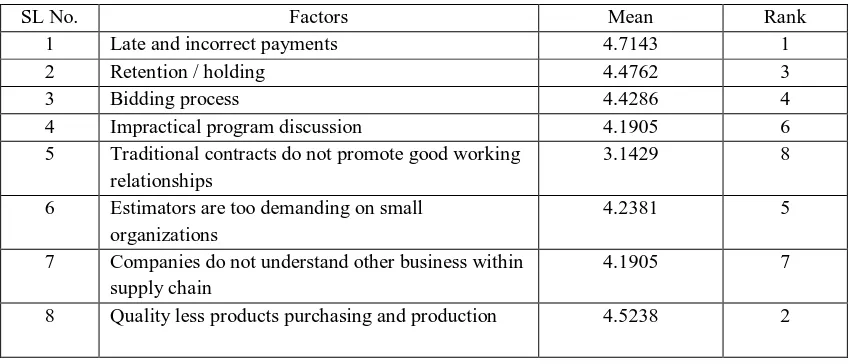
[image:2.612.78.521.599.744.2]Late and incorrect payment, quality less products purchasing and production, estimators are too demanding on small organizations, companies do not understand other business within supply chain, and traditional contracts do not promote good working relationships are the main barriers to Engineers.
[image:3.612.92.524.160.302.2]3) Factors Considering Supply Chain Participation for Engineers
Table 4.3 Factors Considering Supply Chain Participation for Engineers
SL NO. FACTORS MEAN RANK
1 Improved customer service 5.0000 1
2 Overall supply chain reduction 4.6552 3
3 Increased profitability 4.6207 5
4 Reducing paperwork 4.3793 7
5 Increased market competitiveness 4.3103 8
6 Cost reductions within your organization 4.5172 6
7 Benefits to the client 4.6552 4
8 Benefits to your supplier 4.2759 9
9 Improved quality assurance 4.9655 2
Contractors should analyse their partners’ demand logically during the project which is essential for a successful collaboration between a contractor and its partners leading to a well-established and developed SCM organization. Mainly Increased profitability, Increased market competitiveness, improved customer service, Benefits to the suppliers, improved quality assurance are the main factors.
B. Factors For Contractors
[image:3.612.92.523.424.510.2]1) Factors Affecting the Efficiency of SCMS for Contractors
Table 4.4 Factors Affecting the Efficiency of SCMS for Contractors
SL No. Factors Mean Rank
1 Production Planning 4.4286 4
2 Transportation 3.7143 5
3 Inventory 4.7143 1
4 Lead Time 4.5238 3
5 Purchasing 4.6190 2
2) Factors that are Barrier to Supply Chain Organization for Contractors
Table 4.5 Factors that are Barrier to Supply Chain Organization for Contractors
SL No. Factors Mean Rank
1 Late and incorrect payments 4.7143 1
2 Retention / holding 4.4762 3
3 Bidding process 4.4286 4
4 Impractical program discussion 4.1905 6
5 Traditional contracts do not promote good working relationships
3.1429 8
6 Estimators are too demanding on small organizations
4.2381 5
7 Companies do not understand other business within supply chain
4.1905 7
[image:3.612.94.520.557.739.2]3) Factors Considering Supply Chain Participation for Contractors
Table 4.6 Factors Considering Supply Chain Participation for Contractors
SL NO. FACTORS MEAN RANK
1 Improved customer service 5.0000 1
2 Overall supply chain reduction 4.5238 5
3 Increased profitability 4.4762 6
4 Reducing paperwork 4.4286 8
5 Increased market competitiveness 4.1905 9
6 Cost reductions within your organization 4.6667 3
7 Benefits to the client 4.6667 4
8 Benefits to your supplier 4.3810 7
9 Improved quality assurance 5.0000 2
C. Factors For Suppliers
[image:4.612.93.521.311.529.2]1) Factors which Develop Successful Supply Chain Relationship with clients
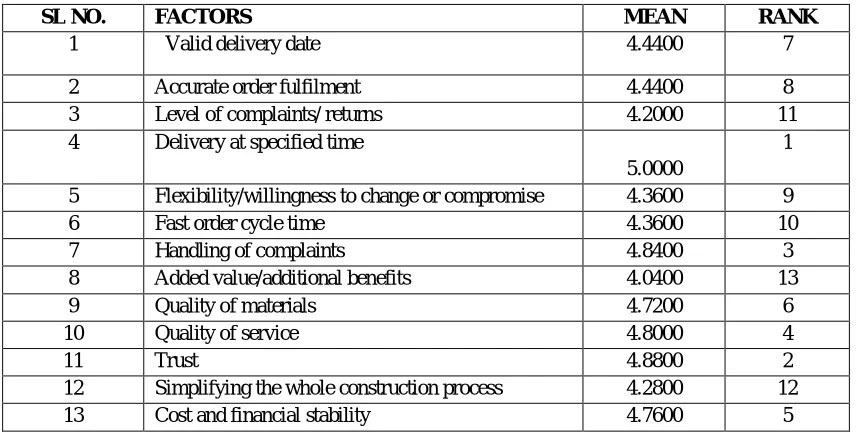
Table 4.7 Factors which Develop Successful Supply Chain Relationship with clients
SL NO. FACTORS MEAN RANK
1 Valid delivery date 4.4400 7
2 Accurate order fulfilment 4.4400 8
3 Level of complaints/ returns 4.2000 11
4 Delivery at specified time
5.0000
1
5 Flexibility/willingness to change or compromise 4.3600 9
6 Fast order cycle time 4.3600 10
7 Handling of complaints 4.8400 3
8 Added value/additional benefits 4.0400 13
9 Quality of materials 4.7200 6
10 Quality of service 4.8000 4
11 Trust 4.8800 2
12 Simplifying the whole construction process 4.2800 12
13 Cost and financial stability 4.7600 5
It was analysed that suppliers were aware of importance of clients for developing a successful supply chain relationship. The questionnaire were provided to reveal the degree of importance of which factors were more important for them. Factors were listed as valid delivery date, delivery at specified time, quality of materials, simplifying the construction process, handling of complaints.
2) Factors Considered While Taking Decision with Clients
Table 4.8 Factors Considered While Taking Decision with Clients
SL NO. FACTORS MEAN RANK
1 Being consulted in deciding the production Schedule
4.6400 3
2 Being consulted in deciding which new products to develop
4.5600 5
3 Being consulted regarding new technological Innovations
[image:4.612.87.523.614.726.2]4 Delivery risk factors 4.2000 7
5 Market competitors 4.4800 6
6 Production factors (Quality, Quantity, standards) 4.6400 4
7 Financial status 4.6800 2
Delivery risk factors, being consulted in deciding which new product to develop, Market competitors, being consulted in deciding the production schedule, being consulted in deciding which new product to develop are the selected main five factors.
[image:5.612.94.520.218.347.2]3) Factors Considered When Sharing Information with Clients
Table 4.9 Factors Considered When Sharing Information with Clients
SL NO. FACTORS MEAN RANK
1 Competitive advantage is sought by production planning or inventory decisions
4.3200 2
2 Competitive advantage is sought by sharing information with suppliers or customers
4.2800 3
3 Competitive advantage is sought by performing some of your suppliers or customers work for them
4.4400 1
4 Proportion of overall production process subcontracted to outside firms
4.2400 4
Competitive advantage is sought by sharing information with suppliers or customers, Competitive advantage is sought by production planning or inventory decision, Proportion of overall production process subcontracted to outside firms, Competitive advantage is sought by performing some of the supplier or customers work for them thus all factors are considered and ranked accordingly.
D. Factors For Clients
[image:5.612.95.518.466.692.2]1) Factors in Relationship between Clients & Organization
Table 4.10 Factors in Relationship between Clients & Organization
SL NO. FACTORS MEAN RANK
1 Reliability of supply 4.6316 5
2 Top management support 4.5789 8
3 Trust 4.8947 1
4 Mutual interest 4.7895 2
5 Manpower development 4.3158 11
6 Closer links between demand/ supply 4.4737 9
7 Free flow of information 4.6842 3
8 Integrated information systems 4.2632 12
9 More frequent meetings 4.3684 10
10 Joint business planning 4.1053 13
11 Simplifying the whole construction process 4.6842 4
12 Creating standardization of processes 4.6316 6
13 Simplifying the bidding process 4.6316 7
2) Factors Considered while Taking Decision with Suppliers
Table 4.11 Factors Considered while Taking Decision with Suppliers
SL NO. FACTORS MEAN RANK
1 Being consulted in deciding the production Schedule
4.5789 3
2 Being consulted in deciding which new products to develop
4.5789 4
3 Being consulted regarding new technological Innovations
4.5263 5
4 Financial status 4.6316 2
5 Market competitors 4.4737 6
6 Quality standards 4.7895 1
7 Inbound transportation 4.4211 7
Quality standards, Financial status, Being consulted in deciding the production Schedule, Being consulted in deciding which new products to develop, Being consulted regarding new technological Innovations are the major five ranked factors considered while taking decision with suppliers.
3) Factors Considered When Sharing Information with Suppliers
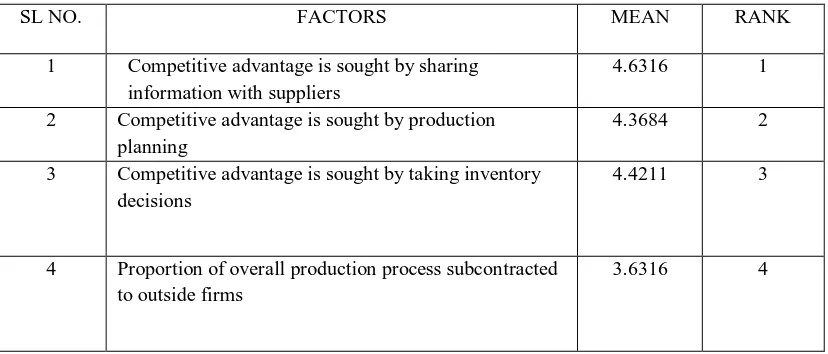
Table 4.12 Factors Considered When Sharing Information with Suppliers
SL NO. FACTORS MEAN RANK
1 Competitive advantage is sought by sharing information with suppliers
4.6316 1
2 Competitive advantage is sought by production planning
4.3684 2
3 Competitive advantage is sought by taking inventory decisions
4.4211 3
4 Proportion of overall production process subcontracted to outside firms
3.6316 4
Competitive advantage is sought by sharing information with suppliers, Competitive advantage is sought by production planning, Competitive advantage is sought by taking inventory decisions, Proportion of overall production process subcontracted to outside firms are the critical factors when sharing information with suppliers.
E. Analysis Using Fuzzy
Fuzzy logic is an approach to computing based on "degrees of truth" rather than the usual "true or false" (1 or 0) Boolean logic on which the modern computer is based. Fuzzy logic includes 0 and 1 as extreme cases of truth (or "the state of matters" or "fact") but also includes the various states of truth.
There are basically three steps for analysing data in Fuzzy logic tool,
1) Fuzzification
2) Fuzzy Inference
[image:6.612.101.515.379.556.2]a) Fuzzy Output
Table 4.13 Fuzzy output factors for Engineers
SL NO. FACTORS RANK FUZZY OUTPUT
SEVERITY
1 Production Planning 8 MODERATE
2 Transportation 20 MINIMAL
3 Inventory 3 CRITICAL
4 Lead Time 13 MINIMAL
5 Purchasing 4 CRITICAL
6 Late and incorrect payments 9 MODERATE
7 Retention / holding 16 MINIMAL
8 Bidding process 12 MINIMAL
9 Impractical program discussion 14 MINIMAL
10 Traditional contracts do not promote good working relationships
22 MINIMAL
11 Estimators are too demanding on small organizations 19 MINIMAL
12 Companies do not understand other business within supply chain
21 MINIMAL
13 Quality less products purchasing and production 10 MODERATE
14 Improved customer service 1 CRITICAL
15 Overall supply chain reduction 5 CRITICAL
16 Increased profitability 7 MODERATE
17 Reducing paperwork 15 MINIMAL
18 Increased market competitiveness 17 MINIMAL
19 Cost reductions within your organization 11 MODERATE
20 Benefits to the client 6 MODERATE
21 Benefits to your supplier 18 MINIMAL
22 Improved quality assurance 2 CRITICAL
Table 4.14 Fuzzy output factors for Contractors
SL NO. FACTORS RANK FUZZY OUTPUT
SEVERITY
1 Production Planning 15 MINIMAL
2 Transportation 21 MINIMAL
3 Inventory 3 CRITICAL
4 Lead Time 10 MODERATE
5 Purchasing 7 MODERATE
6 Late and incorrect payments 4 CRITICAL
7 Retention / holding 11 MODERATE
8 Bidding process 13 MINIMAL
9 Impractical program discussion 18 MINIMAL
10 Traditional contracts do not promote good working relationships
22 MINIMAL
11 Estimators are too demanding on small organizations 17 MINIMAL 12 Companies do not understand other business within
supply chain
19 MINIMAL
13 Quality less products purchasing and production 9 MODERATE
14 Improved customer service 1 CRITICAL
15 Overall supply chain reduction 8 MODERATE
16 Increased profitability 12 MINIMAL
17 Reducing paperwork 14 MINIMAL
18 Increased market competitiveness 20 MINIMAL
19 Cost reductions within your organization 5 CRITICAL
20 Benefits to the client 6 MODERATE
21 Benefits to your supplier 16 MINIMAL
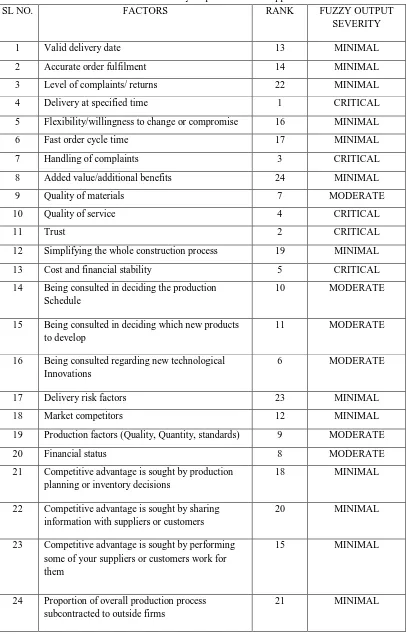
Table 4.15 Fuzzy output factors for Suppliers
SL NO. FACTORS RANK FUZZY OUTPUT
SEVERITY
1 Valid delivery date 13 MINIMAL
2 Accurate order fulfilment 14 MINIMAL
3 Level of complaints/ returns 22 MINIMAL
4 Delivery at specified time 1 CRITICAL
5 Flexibility/willingness to change or compromise 16 MINIMAL
6 Fast order cycle time 17 MINIMAL
7 Handling of complaints 3 CRITICAL
8 Added value/additional benefits 24 MINIMAL
9 Quality of materials 7 MODERATE
10 Quality of service 4 CRITICAL
11 Trust 2 CRITICAL
12 Simplifying the whole construction process 19 MINIMAL
13 Cost and financial stability 5 CRITICAL
14 Being consulted in deciding the production Schedule
10 MODERATE
15 Being consulted in deciding which new products to develop
11 MODERATE
16 Being consulted regarding new technological Innovations
6 MODERATE
17 Delivery risk factors 23 MINIMAL
18 Market competitors 12 MINIMAL
19 Production factors (Quality, Quantity, standards) 9 MODERATE
20 Financial status 8 MODERATE
21 Competitive advantage is sought by production planning or inventory decisions
18 MINIMAL
22 Competitive advantage is sought by sharing information with suppliers or customers
20 MINIMAL
23 Competitive advantage is sought by performing some of your suppliers or customers work for them
15 MINIMAL
24 Proportion of overall production process subcontracted to outside firms
Table 4.16 Fuzzy output factors for Clients
SL NO. FACTORS RANK FUZZY OUTPUT SEVERITY
1 Reliability of supply 6 MODERATE
2 Top management support 11 MODERATE
3 Trust 1 CRITICAL
4 Mutual interest 2 CRITICAL
5 Manpower development 21 MINIMAL
6 Closer links between demand/ supply 15 MINIMAL
7 Free flow of information 4 CRITICAL
8 Integrated information systems 22 MINIMAL
9 More frequent meetings 19 MINIMAL
10 Joint business planning 23 MINIMAL
11 Simplifying the whole construction process 5 CRITICAL
12 Creating standardization of processes 7 MODERATE
13 Simplifying the bidding process 8 MODERATE
14 Being consulted in deciding the production Schedule
12 MINIMAL
15 Being consulted in deciding which new products to develop
13 MINIMAL
16 Being consulted regarding new technological Innovations
14 MINIMAL
17 Financial status 9 MODERATE
18 Market competitors 16 MINIMAL
19 Quality standards 3 CRITICAL
20 Inbound transportation 17 MINIMAL
21 Competitive advantage is sought by sharing information with suppliers
10 MODERATE
22 Competitive advantage is sought by production planning
20 MINIMAL
23 Competitive advantage is sought by taking inventory decisions
18 MINIMAL
24 Proportion of overall production process subcontracted to outside firms
24 MINIMAL
V. CONCLUSION
Studies and discussions were done on supply chain management at various fields based on the journals collected. Supply chain management is a challenging task in the construction industry and are complex in their structure. Different factors affecting supply chain in construction fields are identified and the conceptual remedial measures for each study are suggested according to its convenience. The details regarding the topic is collected by questionnaire survey with the help of internal and external personalities involved in the system. By conducting questionnaire survey more knowledge regarding the SCMS was obtained. Even if major steps are taken to improve the efficiency and productivity of construction industry, for the last decades on the performance of construction industry in terms of the budget, quality of service, quality of materials and time of delivery, there is still room for the improvements of supply chain management tools.
RECOMMENDATIONS
As a recommendation for the critical risk severity problem following are as follows
A. Inventory control
B. Better purchasing management
C. Improvisation in customer service for better customer satisfaction.
D. Quality control management
E. Total quality management
F. Timely payments
G. Cost control techniques
H. Trust between actors
I. Information sharing between actors
J. Simplifying construction activity
REFERENCES
[1] Ana Beatriz Lopes de Sousa Jabbour , Alceu Gomes Alves Filho ,Adriana Backx Noronha Viana , Charbel Jos Chiappetta Jabbour, (2011), ‘Factors affecting the adoption of supply chain management practices: Evidence from the Brazilian electro-electronic sector’, IIMB Management Review 23, pp.208 -222. [2] Anders Segerstedt, Thomas Olofsson, (2010), ‘Supply chains in the construction industry’, Supply Chain Management: An International Journal, Vol. 15, Issue
5, pp. 347 – 353.
[3] Elbaz.M, (2011), ‘Fuzzy performance measurement of supply chain in manufacturing companies, Expert Systems with Applications’, Expert Systems with Applications, Vol 38, Issue 6, (June 2011), PP.6681-6688.
[4] M.Agung Wibowo, Moh Nur Sholeh, (2015), ‘The analysis of supply chain performance measurement at construction project’ Procedia Engineering 125, PP. 25 – 31.
[5] Manoj Hudnurkar, Suresh Jakhar, Urvashi Rathod, (2014), ‘Factors affecting collaboration in supply chain: A literature Review’, Procedia - Social and Behavioral Sciences 133, pp 189 – 202.
[6] Rajen B. Mistry, Vishal R Gajera, Hiren A. Rathod, ’Evaluation of factor affecting for supply chain in construction project’,International Journals of Advanced Research in Engineering Science &Management. ISSN : 2394-1766.
[7] Rajesh K. Singh, (2011), ‘Developing the framework for coordination in supply chain of SMEs’, Business Process Management Journal Vol. 17 issue. 4. [8] S.Mukesh Balwani, S.A. Hussain, Aquib Ansari, Naseeruddin Haris, (2010) , ‘Supply Chain Management in Construction’, International Journal on Recent and
Innovation Trends in Computing and Communication pp Volume: 3, Issue: 2.
[9] Se-Hak Chun, Ho Joong Hwang and Yong-Hwan Byun, (2015), ‘Green Supply Chain Management in the Construction Industry: Case of Korean Construction Companies’ Procedia - Social and Behavioral Sciences 186, pp. 507 – 512.
[10] Shahram Gilaninia, Hossein Ganjinia, Omidreza Alihosseini, 2013, ‘Studying the Factors Affecting Supply Chain Management and Provide proper Strategies for Improving it (Case Study Poultry Farming Industry)’, International Journal of Innovative Research in Science, Engineering and Technology, Vol. 2, Issue 11.