Abstract— A ubiquity system has pervasive features with certain intelligence level. On the other hand, ubiquity means the existence or apparent existence, everywhere or at the same time. In nowadays, ubiquity is becoming the most import features for web developments, especially in education area. In this paper, a Ubiquity Collaborative Architecture (UCAT) for graduate thesis development is presented. UCAT is based on systems engineering and supports different learning methodologies, advisory styles, and resources applied. Besides, a Methodology for Graduate Thesis process (MGT) is presented. MGT is based on the classical research process. However, most common instructional models can be applied in seminars or courses associated to MGT. These methodologies are concisely revised in the paper. In addition, a template describing the contents of the thesis document is presented. Finally, future works are briefly discussed.
Index Terms—Computational Education, Educational Systems, Graduate Thesis Development, Instructional Methodologies, Ubiquity Architecture.
I. INTRODUCTION
he terminal efficiency in graduate programs is an important issue in all universities around the world. There are many reasons, which explain why students abandon their studies. For instance, students frequently unfinished their graduate programs for an inadequate technical support or lack of motivation. In this context, the responsibility is shared by students and supervisors. Even though, students have the main charge for their theses development; supervisors have a very important role in this process.
In 1929, Piaget proposed the collaborative learning [1] and the seed of new instructional area was born. In 1978, Vygotsky’s research was about social interactions and individual learning topics [2]. Next, Bruner sustained that learning is an active process where students build new knowledge pieces based on previous learning [3]. In 1987, Stefik et al [4] proposed collaboration systems for training. On the other hand, the importance of physical and social environments in the collaborative learning process has been
Manuscript received August 06, 2013.
R. E. Álvarez, Pilar H. Limonchi, J. Paulo Sánchez-Hernández, Juan Frausto-Solís and Juan Segura-Salazar are with Universidad Politécnica del Estado de Morelos, México.
(E-mail: [email protected], [email protected], [email protected], [email protected] and [email protected])
emphasized since the 1990s [5]. Besides, cooperative learning approach was also proposed many years ago by H.R. Pfister [6]. Then, works related to achieve more friendly computational educative methods were published. The main features searched by the new works were to build more ubiquity systems [7]. However, the design of a new architecture requires the adequate use of TICS, which integrate different instructional models in a synchronous and asynchronous way. Ubiquity scholar systems allow essentially creating computational educative scenarios such that different devices can be used for communication tasks between students, professors, and supervisors. However, in nowadays almost everything is possible through technology; a big challenge is, undeniably, to make a ubiquity system; another but not less important is to define a suitable architecture. In this paper, an architecture named Ubiquity Collaborative Architecture for Thesis development (UCAT) is proposed. UCAT is designed for assisting the thesis process and effective communication between students and supervisors.
The paper is organized as follows. Section two, presents research works related to architectures oriented to assist students in their academic tasks. In section three, some researches dealing with instructional models are presented; then in section four, a methodology for the thesis process is explained. In section five, a new architecture and its ubiquity features are shown. Finally, the conclusions are shown at the end of the paper.
II. RELATEDWORKS
Stefik et al, discussed a collaborative environment (Colab) for being used on meetings; the main idea was to use it by a group of professionals, working together in the solution of a problem. Colab, allowed computing assistance for preparing presentations, chats and papers [4]. Further works were developed and applied in several areas. Subsequently, academic works emerged; for instance CoCoDoc, a framework for editing documents were published in 1997 [8]. CoCoDoc, was one of the first academic environments based on Corba [9]. Later, educational systems evolved to support the entire learning process by automatic software based on the collaborative approach [10]. Recently, a collaborative authoring system (SAC) was proposed for academic domain, in order to be used in any academic institution adopting the regime known as LMD (From French, Licence-Master-Doctorate). LMD supports several teacher tasks, as courses on line, download lessons, and self –assess [11].
UCAT: A Ubiquity Collaborative Architecture
for Developing Thesis Degree
R. E. Álvarez, Pilar H. Limonchi, J. Paulo Sánchez-Hernández, Juan Frausto-Solís, Juan
Segura-Salazar
Even though theses are very important for improving the terminal efficiency, a few computer systems are focused on the thesis development process. One of the first educational technologies is THEOL [12]. This system supports the entire thesis development process and allows communication between supervisors and master students. The main functions of THEOL are:
Research process, which the natural steps used are: Thesis topic selection, thesis proposal, supervision, thesis writing, oral examination, and thesis assessment.
Instructional model. This function uses three approaches: Problem Based-Learning (PBL), cognitive apprenticeship, and collaborative learning.
Tools for communication and collaboration, such as discussion forum, and knowledge sharing.
III. INSTRUCTIONALMETHODOLOGIES An instructional-design theory offers explicit surveillance. This approach assists students to develop their learning skills, behaviors, and values. The main instructional methods are:
Problem Based Learning (PBL)
Project Oriented Learning (POL)
Collaborative Learning (CL)
Competency Based Education (CBE)
Even though PBL was developed in the 1950s for medical education applications [13] [14], it is used for all the academic areas, mainly in engineering and social sciences. PBL provides a clear link between theory and practice; the learners are actively working in different tasks for solving a problem of their area. Project Oriented Learning (POL) is natural for engineering, economical, financial, and computational academic areas. POL works as follows [15]:
a) A project is proposed to the students, and a plan is defined by them. This plan includes objectives, roles, responsibilities, and scheduling.
b) The project is usually accompanied by a set of courses such as mathematics, physics, financial engineering, and informatics.
c) A due date is assigned and general resources are provided.
As a consequence, students develop competencies to solve problems, become autonomous, research, and inquiry skills.
The instructional method CL is in fact, a set of learning strategies; students work by teams, helping each other to solve academic tasks. There are many CL strategies used in every academic level. In other words, instructional models such as PBL, POL, and CBE usually use cooperative learning.
More recently CBE has dominated the educational field. While PBL and POL develop skills for elaborate projects and solve problems as the main abilities. In addition, CBE prepares professionals with general and specific competencies in their area. For instance, the future graduated
professional not only should learn how to build a dam with the higher security standards and the lower cost, but also they should take care of the ecological environments. Besides, ethical aspects should be learned for all of them (engineers, architectures, lawyers, and graduated students). They should learn to work together for making sustainable solutions. In order to do that, some criteria are established for any instructional design when CBE is implemented. These criteria depend on every institutional context. For obtaining more effective results, hierarchical network of competencies can be defined for different graduated studies in every institution. Furthermore, CBE considers that every student usually needs a different coaching style [16]. In other words, the same supervisor should assume different roles with different students.
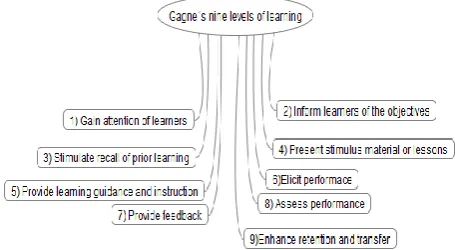
For any methodology, differentiated instruction strategy is a powerful approach [17]; different didactic techniques are involved for the students in the learning process [18]. Another important contribution was introduced by Robert Gagne, who proposed an instructional model of two learning levels [19]. The first level is related to categorize outcomes from five types: verbal information, intellectual skills, cognitive strategies, attitudes, and motor skills. The second step is related to organize instructional events. In this step, Gagne proposes the levels shown on Figure 1.
In this paper CBE and the Gagne’s approach are applied in an instructional model for graduate thesis development, which is explained in section four.
IV. INSTRUCTIONAL MODEL APPLIED
For obtaining a master's degree usually a thesis is required. The Methodology for Graduate Thesis process (MGT) used in this paper is shown on Figure 2, which consists of eight phases. This methodology is based on the Gagne’s levels and CBE. For the following description, when a Gagne’s level is involved in a phase of MGT, its number is parenthesized using LN (L=level, N=number’s level). Next, only some levels are presented for simplicity.
[image:2.595.316.544.367.492.2]The methodology starts with the proposal thesis. In phase two, students should know the thesis goal (L2), and guidance should be done during the process (L5). In fact, L5 is involved in any MGT phase. In addition, every phase should be assessed (L8). An important aspect is to provide a correct feedback (L7) to the thesis; this is done during and at the end of phases two and three. Besides, supervisors and students
should have adequate tools, and both of them require some competency for this process. Students enhance their competencies while problem object of their theses are solved. On the other hand, seminars are convenient for the thesis development; on them the Gagne’s level are applied. All of them should be formally evaluated. This evaluation must be officially registered by the academic and administrative office in order to increase the elicit performance (L6). In any phase, CBE is adequate and any instructional methodology can be implemented. Moreover, differentiation may be used; different methodologies are acceptable to different subsets of students in the same thesis seminar. Phases two and four are related to committee evaluations. Students who overcome this stage, can continue with the other steps until the thesis be finished; then a dissertation can be prepared.
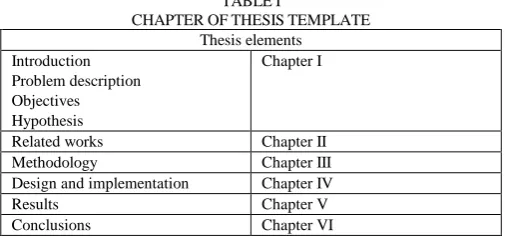
In order to make the process more efficient, some templates are usually designed for the thesis document. A particular template contains the outline of a thesis, where some hints for every section is given. For instance, Table 1 shows the outline of one template.
TABLEI
CHAPTEROFTHESISTEMPLATE Thesis elements
Introduction Problem description Objectives Hypothesis
Chapter I
Related works Chapter II Methodology Chapter III Design and implementation Chapter IV Results Chapter V Conclusions Chapter VI
V. UBIQUITYARCHITECTURE
[image:3.595.41.294.672.791.2]Graduate studies are important for professional education and Research and Development (R&D). Companies require well-trained personal to solve diverse problems. However, in this age, TICs are revolutionizing the way how to communicate between people. Thus, many institutions have been benefited, such as educational institutions which improve the communication among researchers in the learning process. Although, learning has been gradually evolving with distance education, TICs are not fully exploited. Consequently, mobility architectures [20] provide ubiquitous environments to be applied in education. Moreover, a ubiquity system has ubiquitous features with certain intelligence level. On the other hand, ubiquity literally means the capacity of being everywhere, especially at the same time. Furthermore, Weiser introduced in 1991, the area of ubiquitous computing [21] which is also known as ubicomp. Weiser proposed a paradigm which look upon vision of people and environments augmented with computational resources that provide information and services when and where desired [22]. In other words, more technologies, environments, and persistent time features, more ubiquitous is the system. For instance an intelligent TV set allowing to watch the news (of Fridays at 7:00 P.M) on any schedule of the week is more ubiquitous than the traditional TV set.
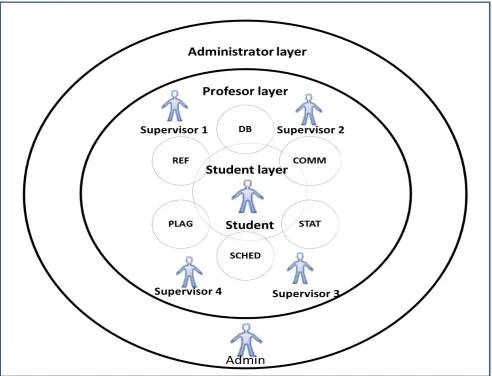
In this work, UCAT provides a collaborative environment for developing (Figure 3) thesis degree. The system UCAT is an environment where actors (students and supervisors) interact for developing students’ theses. The architecture is composed by three layers. The first layer is the collaborative working system where students work on their thesis documents. The second layer is the computer environment where professors supervise students. Finally, in the third layer, the administrator generates profiles, manages and authorizes access to the system, generates statistical reports, and updates the system and other administrative tasks.
The components of the UCAT are shown on Figure 4: REF, PLAG, SCHED, STAT, and COMM. These components access the Data Base (DB) and are described as follows:
i. Database academic reports (DB). This function has options to load proposal and thesis documents. Besides, new versions are generated by agents. It is possible to have a log for every session work. ii. Communication environment (COMM). This
component is a communication platform where students and supervisors can discuss progress and improvements of proposal and thesis. The principal feature of this component is the communication with different intelligent devices (Tablets, cellphones, and laptops). Additionally, modes synchronous and asynchronous are supported.
iii. Statistical assessment (STAT) generates student’s reports of proposal and thesis progress, and statistical reports as well.
iv. Schedule system (SCHED). Design a scheduling of all activities to be carried out is vital to the success of thesis development. SCHED helps agents to plan different activities at different levels.
[image:4.595.57.550.53.429.2]v. Plagiarism system (PLAG). PLAG’s function is in charge of checking plagiarism in different graduate thesis documents, such as: proposals, middle term
[image:4.595.317.548.583.775.2]reports, final thesis documents, research projects, and working papers.
vi. Reference system (REF) is a function which helps agents to prepare reports with different reference styles.
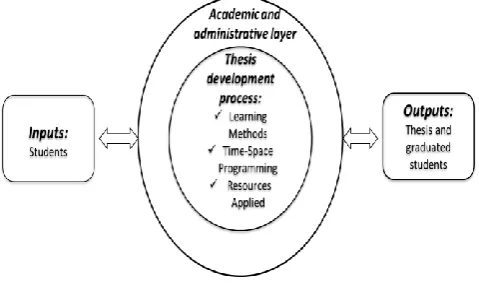
Now we come back to ubiquitous concept. In fact, Weisser wanted to describe new computer systems which computers and program seem to be absent [21]. For instance, in a ubiquity computing, people can interact naturally with their refrigerator or TV any time and from every place, through a ubiquity system which never is achieved. Notice that one hundred percent of ubiquity is never achieved. In the case of UCAT, a ubiquity architecture has been conceived by an engineering systems approach. Thus, a model of inputs, process and outputs is designed as follows:
Inputs: Students.
Process: Learning methods, time-space programming, and resources.
Outputs: Theses and graduate students.
The systemic UCAT approach is shown on Figure 5. The inputs of this system are students which are starting their graduate studies. Generally, sooner or later, they should start a subject thesis and a supervisor is needed; usually an R&D experimented professor takes this role. Students and supervisors are the main actors on thesis development process. Both of them are essential in this process. Thus, their tasks and iteration should be supported with a ubiquity approach: anytime, any technological media, and any methodology. Students have the bigger challenge. That implies several issues such as: a) to define and implement the best strategy for their research; b) to implement, test, and to document every part of their thesis work, and c) to prepare and present their thesis dissertations. On the other hand, professors guide students and motivate them for achieving a success in their thesis project. On Figure 5, the thesis development process is shown. The input includes students, and then the thesis development process is started. The previous process is supported with academic and administrative layer regulations (format, thesis guidelines for thesis documentation, and oral examinations).
Finally, the outputs are: finished theses, graduated students, and research reports. The mentioned UCAT features are organized as follows:
A. Learning Methods
Instructional methods: PBL, POL, and CBE.
Learning style: Collaborative, individual, differentiation, feedback, and many others.
Assessment style: Check point evaluation and feedback.
Committee activities: Advisory styles and academic work.
Research style: Qualitative, quantitative, basic, technological development, study cases, comparative studies, and state of the art.
B. Time-Space Programming
Synchronization Style: Synchronous/asynchronous.
Learning environment: Full attendance (face to face), semi attendance (mix or blend mode), and distance education.
Time schedule: Daily, weekly, and monthly C. Resources Applied
Technological devices: Tablets, cellular phones, cloud space, and other desktops.
Tools: Reference styles, graphical results, tabular results, and virtual libraries.
D. Academic and administrative layer
Graduate studies: Computer science, financial engineering, education, management science.
Graduate level: Specialization, master, and Ph.D.
Regulations.
Administrative support.
The UCAT architecture is not completely implemented. However, some preliminary results regarding MGT were obtained. In two universities and four graduate programs MGT was implemented: Finance, information technology, biotechnology, and education. The instructional methodologies implemented were PBL and POL into a CBE framework. A satisfaction survey shows promised results for the final implementation. Furthermore, in three of the four programs, one hundred percent of students accepted the methodology enthusiastically which contributed to increment the terminal efficiency.
VI. CONCLUSIONS
In this paper, instructional methodologies are revised. Collaborative work is barely analyzed in different instructional learning styles. Searching to contribute with terminal efficiency in graduate programs the ubiquitous architecture UCAT is proposed. This architecture is thought for support the whole thesis development process. The ubiquity features where structured with an engineering system approach. The proposal architecture is presented and organized in four groups: this organization can be useful, in principle, for any university. MGT instructional methodology for thesis development was presented. Preliminary results show promissory final results.
[image:5.595.47.287.612.756.2]Future works are related to test UCAT and to obtain
statistical results. The integration of UCAT components should be done. Besides, is suggested to develop intelligent systems with a higher ubiquity level to support activities of students with certain physical limitations. More robust architecture for supporting emergent technologies from artificial intelligence and different communication media are required as well.
REFERENCES
[1] J. Piaget, The Child’s Conception of the World. New York, USA: Brace Jovanovich, 1929.
[2] L.S. Vygotsky, Mind in Society: The Development of Higher
Psychological Processes. Cambridge, UK: Harvard University Press,
1978.
[3] J.S. Bruner, Acts of Meaning. Cambridge, MA: Harvard University Press, 1986.
[4] M. Stefik, G. Foster, D.G. Borrow, K. Kahn, S. Lanning, and L. Suchman. Beyond the Chalkboard: Computer Support for Collaboration and Problem Solving in Meetings, Computing Practices, Communications of the ACM, Vol. 30, Number 1, 1987, pp. 32-47.
[5] J. Lave, E. Wenger, Situated Learning. Cambridge, UK: Cambridge University Press, 1991.
[6] H.R. Pfister, Evaluating Distributed Computer-Supported Cooperative Learning (D-CSCL): A Framework and Some Data, in Conf.Rec, Proceedings of the 2nd international conference on New Learning Technologies, Berne, Switzerland, 1999.
[7] V. Serrano, T. Fishter. Collaborative Innovation in Ubiquitous Systems, Science and Business Media, Springer. July 2007. [8] G.H. ter Hofte, H.J. vand der Lught, CoCoDoc: A Framework for
Collaborative compound document editing based on OpenDoc and Corba, Open Distributed Processing and Distributed Platforms, Proceedings of the IFIP/IEEE, Toronto Canada, May. 1997, pp.15-33. [9] S. Vinosky, CORBA: Integrating diverse applications within distributed heterogeneous environments, Communications Magazine, IEEE, Vol. 35, Issue 2, Feb. 1997, pp. 46-55.
[10] C.A. Collazos, L.A. Guerrero, J.A. Pino, and S. F. Ochoa, Evaluating Collaborative Learning Processes, CRIWG 2002, LNCS 2440, Springer Verlag, 2002, pp. 203-221.
[11] Y. Lafifi, and G. Touil, Study of the Impact of Collaboration among Teachers in a Collaborative Authoring System, Journal of Information Technology Education: Innovations in Practice, Information Science Institute, Vol. 9, 2010, pp. 113-132.
[12] Y. Yang, X. Han, J. Yang, Q. Zhou, On the Desing of an Advanced, Web-Based System for Supporting Thesis Research Process and Knowledge Sharing, in Journal of Educational Technology Development and Exchange, Vol 5, Number 2, 2012, pp. 111-124. [13] D. Zheng, M.F. Young, Comparing instructional methods for
teaching technology in education to preservice teachers using logistic regression, Proceedings of the 7th International Conference on the Learning Sciences. Bloomington, Indiana, USA, 2006, pp. 873-879. [14] J.R. Savery, T.M. Duffy, Problem Based Learning: An instructional
model and its constructivism framework, Educational Technology, Vol. 35 (5), 1995, pp. 31-38.
[15] J. E. Mills, D.F. Treagus, Engineering Education –is problem-based or Project-Based Learning the Answer?, Australasian Journal of Engineering Education, ISSN 1324-5821, 2003, pp. 2-16.
[16] R.E. Slavin, Cooperative Learning, Learning and Cognition in Education, Elsevier, 2010, pp.160-166.
[17] P. Subban, Differentiated instruction: A research basis, International Education Journal, Vol 7, Number 7,ISSN: 1443-1475, 2006, pp 935-947.
[18] H.W.M. Hoogveld, The Teacher as Designer of Competency-Based Education, Open Universiteit Nederland, Otec, ISBN:90-9016816-8, 2003, pp 1-113.
[19] K. Khadjooi, K. Rostami, S. Ishaq, How to use Gagne’s model of instructional design in teaching psychomotor skills, Medical Education, Vol. 4 Number 3, 2011, pp. 116-119.
[20] N. Banerjee, S.K. Das, A. Acharya, SIP-Based Architecture for next generation Wireless Networks, Proceeding IEEE, International Conference on Pervasive Computing and Communications (PermCom 2005), 2005.
[21] M. Weiser, The computer for the 21st century. Sci. Am. 265, 3 (Sept.), , 1991, 94–104.