1
Abstract—MARTI (Módulo de Ajedrez Robótico con Tablero Interactivo) was proposed to be a virtual chess player/tutor which consists of a Cartesian robotic arm controlled by a chess engine, and a multi - touch screen based on diffuse infrared illumination technology. MARTI is able to play chess against any human opponent manipulating physical pieces with his robotic arm, while showing the movements available that the player has on his screen. The chess pieces and tactile gestures are sensed in real time through artificial vision. The system provides feedback on the screen about the status of the game through dialog boxes, sounds and light sets. The module is conceived with two purposes: a) To investigate the possibilities of interconnecting advanced technologies in a single autonomous module that emulates the properties of a human chess tutor / player, and b) how to improve the chess learning experience (in novices) improvement of technic (in casual and/or professional players) making chess more enjoyable and attractive. This document shows the mechanical, electronic, and control software design for the system. It also presents the interaction of people with MARTI and their satisfaction based on playful teaching.
Index Terms — Computer vision, chess robot, chess engine, human-machine interaction, multi-touch interface.
I. INTRODUCTION
OBOTICS, game algorithms, and virtual teaching have been studied and researched with the intention of improving our link with technology so we can take the best advantage of it.
A. Background
The project was born when analyzing the lack of interest and widespread dissemination of chess considering its cognitive benefits. While chess has been developed in its software version, as well as there are advances in the predictive algorithm of the game, a playful interactive module has not been developed yet which combines technologies to enrich the gaming experience and attract new people to the game.
The objective of this research is to achieve an improvement in the learning experience of chess through technology. While Manuscript recieved July 26, 2017; revised August 3, 2017. This work was supported in part by Universidad de las Fuerzas Armadas – ESPE, Sangolquí, Ecuador.
Carrera L. is with the Universidad de las Fuerzas Armadas – ESPE, Departamento de Ciencias de la Energía y Mecánica, Av. General Enriquez S/N and Paseo Escénico Santa Clara (phone: 593992784824, e-mail: [email protected]).
it can be enjoyed in a casual way, the opportunity to have a tutor and/or player able to provide a feedback of the game, is low. Not to mention that there are breaches in the level of the players, which provokes a situation of competition and frustration. This prevents the inexperienced player to enjoy chess or learn something from it. This could be solved by the robotic chess tutor we are proposing.
The study by Gliga and Flesner (2011) about chess training in children shows an improvement in resistance to monotony and a prolonged attention to a specific task. This improves the absorption of knowledge imparted in school [1]. The Effectiveness of Chess Training in the Treatment of ADHD (Attention Deficit Disorder and Hyperactivity) studied by Blasco Fontecilla (2016) shows excellent results in reducing the severity of the disease in people who were subjected to chess training in a period of time [2].
The TURK - 2 study by Sajó et al show this technological aid to chess by implementing a multimodal chess player with a robotic arm and a talking human head on a screen; In this investigation is studied how the module improves the experience of the game of chess by simulating a real player who interacts actively with the user [3].
As for learning chess software, Picussa et al (2004) designed a server for enhancing the experience of chess in children implementing an educational and playful software [4]. This and other studies allow us to focus this project in a playful - educational way.
There are studies carried out on some relevant aspects related to this project. The problem of sensing the chess pieces simultaneously and detecting their state is one of them. This case is studied in the industrial robot ABB IRB 1400 modified to play chess, which uses dynamic artificial vision for sensing [5]. A similar case is studied in GAMBIT, which is an experimental robotic arm capable of recognizing the board and the pieces by computer vision [6]. These investigations also analyze the current ability for moving chess pieces on a board with precision using robotic manipulators.
Many researchers have made in-depth studies on chessman manipulation techniques. This is the case of the MARINE
Morales F. is with the Universidad de las Fuerzas Armadas – ESPE, Departamento de Ciencias de la Energía y Mecánica, Av. General Enriquez S/N and Paseo Escénico Santa Clara (e-mail: [email protected]).
Tobar J. is with the Universidad de las Fuerzas Armadas – ESPE, Departamento de Ciencias de la Energía y Mecánica, Av. General Enriquez S/N and Paseo Escénico Santa Clara (e-mail: [email protected]).
Loza D. is with the Universidad de las Fuerzas Armadas – ESPE, Departamento de Ciencias de la Energía y Mecánica, Av. General Enriquez S/N and Paseo Escénico Santa Clara (e-mail: [email protected]).
Leonardo Carrera, Fabricio Morales, Johanna Tobar, and David Loza.
MARTI: A Robotic Chess Module with
Interactive Table, for Learning Purposes
BLUE robot designed by Urting and Berbers where they analyze the types of movements that must be carried out by the manipulator, and the recommended forms of the clamps obtaining the least interference in the board [7]. An additional study is GAMBIT again, where the type of clamp is analyzed according to its subjection and/or apprehension in pieces of chess [6].
Studies show that people respond to machines in a better way when they allow an intuitive communication close to the human experience, by using human senses. They make them attractive and more usable as shown in several studies of human – machine interaction.
The project is necessary for its investigation because it includes two problems: 1) how to make technologies interact harmoniously in a complex system and 2) how to achieve a system for teaching the user how to play chess and/or be a chess opponent. The research focuses on finding the most appropriate combination of technologies from a mechatronic design that solves the above issues.
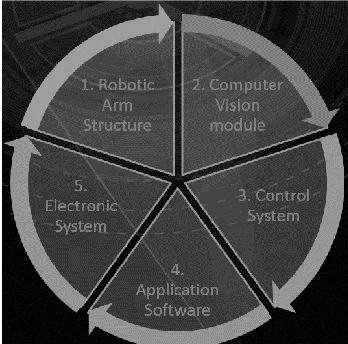
This research focuses in the design of a modular system for a playful chess teaching using a multi-touch board capable of projecting animated plays in real time, an autonomous robotic manipulator to position pieces and a chess engine. The proposed system is detailed in Fig. 1.
II. PROBLEM STATEMENT
The project focuses on three main aspects: the type of artificial vision and the interface projection, the robotic manipulator system of the chess pieces, and the design of the application software as a chess board. Therefore, the study of the QFD matrix of requirements against metrics resulted in 5 interconnected modules and their specific function, see Fig. 2. The following stages explain the hardware and software design process of the modules of MARTI.
III. HARDWARE DESIGN A. Robotic Manipulator
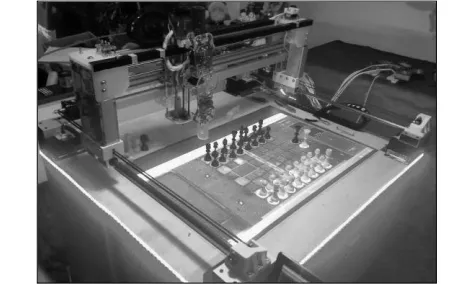
The robotic manipulator purpose is to perform chess plays by moving the pieces to their destination on the projected board using its end effector or clamp. See Fig. 3.
[image:2.612.318.564.246.386.2]The robotic configuration of MARTI is Cartesian due to fine spatial resolution and a predominantly planar work volume, stability with low vibration in motion and good repeatability. Fig. 4 and Fig. 5 shows the design of the robotic manipulator and the arrangement of the axes.
Regarding the structural design of the manipulator, the size of the workload shown in Fig. 5 was considered, and it was necessary to apply safety factors using the ultimate effort over the permissible stress in the material for all the designed pieces. The maximum factor was 1607,293 and the lowest was 4,786. The structural design process of each axis was made by calculations of embedded and undetermined beams and the effects of the supports of the transverse axis with the column theory were also analyzed. All calculations were made theoretically and with CAE software.
Fig. 2. MARTI design modules obtained from user needs analysis against available technical specifications.
Fig. 1. Systems that make up MARTI. The figure shows the structural modules as well as electronic and software sub-modules.
[image:2.612.49.296.345.483.2]
Fig. 3. Robotic arm of MARTI moving the piece.
[image:2.612.314.565.473.586.2] [image:2.612.84.258.523.695.2]The mechanisms for transmission of movement used in this project are of two types: cogwheel/toothed belt GT2 (for the transverse and longitudinal axes) and nut/endless screw (for the vertical axis) of bronze and stainless steel respectively. All were selected according to design criteria and calculation standards. The sizing of each actuator was performed, with maximum torques of 99 mN.m for each motor of the longitudinal axis, 31 mN.m for the transverse axis motor, and 3 mN.m for the vertical axis also provided with a motor. The motors of the axes are NEMA 23 and NEMA 17.
The robot has features: a spatial resolution of 1.1 mm, a payload capacity of 2 kg, motor runs at 5 steps per mm in the timing belts and 40 steps per mm running on the worm.
The Denavit - Hartenberg relations for the kinematics of the robot are given in (1) following the parameters seen in Fig. 4.
[ 𝑥 𝑦 𝑧
] = [
𝑑1 ∗ 𝑑2 ∗ 𝑑3 ∗ +13 + 34
] = [
𝑑1 ∗ 𝑑2 ∗ 𝑑3 ∗ + 47 𝑚𝑚.
] (1)
B. Final Effector (gripper)
The end effector was designed to catch the piece without causing it to fall without any displacement or rotation.
This end effector has a double linear clamp opened by parallel bars. The double mechanism showed in Fig. 6 has been incorporated in order to save time to the system while capturing an enemy piece and moving it. The mechanism can take and transfer up to 2 pieces at the same time, making it more dynamic with the player.
The fingers of the end effector open in parallel and achieve a cylindrical opening avoiding interferences when it take a piece over the board. Thus, the piece is completely enclosed, and
thanks to its contact surfaces by clamping in 2 parts (see Fig. 7) the piece locks and prevents sliding. The parts are shown in Fig. 8.
B. Retroprojection System
The RDI (Rear Diffused Illumination) method was chosen as a rear projection system because of its excellent reflection, multi-gestures, no occlusion, does not depend on pressure, does not require special materials for projection, and has a robust and
[image:3.612.320.560.86.178.2]simple implementation other infrared technologies. Fig. 5. Robotic manipulator assembled with the end effector. The prism shows
the volume available for the robot movement.
Fig. 9. Rear-projection system hardware. Note the arrangement of the robot on the box housing the rear projection system.
[image:3.612.50.297.173.294.2][image:3.612.315.564.212.322.2]
Fig. 6. Double end clamp with 180° central rotary mechanism.
Fig. 8. Parts and properties of the end effector clamp.
Fig. 7. Clamps that hold the chess piece from the top of the body the base of the body.
[image:3.612.315.564.220.451.2][image:3.612.52.262.557.683.2] [image:3.612.317.565.596.695.2]
The RDI method used in this project has a device configuration as shown in Fig. 9 where there are 4 infrared reflectors of 850 nm each, a modified infrared camera, the material overhead projector and the mirror. The camera filter is modified to detect the infrared wavelength of the reflectors.
Fig. 10 shows the location of the camera with its angle of view of 56° ideal for addressing the entire area of the screen. The height that the projector must reach to project the area of the screen is 116 cm to 157 cm. In the practice, a height of 130,816 cm was reached.
C. Chess Pieces
The design of the chess pieces are based on FIDE (World Chess Federation) rules which indicate that pieces should not exceed 10 cm in height and should occupy approximate 44% of the square, and the colors must be easily differentiable between players. Modifications were made for the final effector.
IV. ELECTRONIC AND SOFTWARE DESIGN A. System Architecture
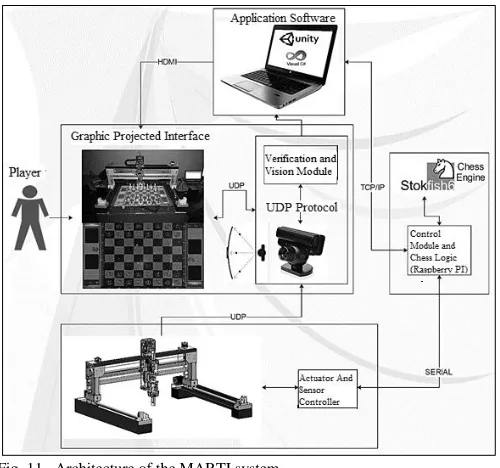
The objective of this stage is to include each technology in a single process scheme and to know the evolution of the system as a function of the user's action as shown in Figure 11.
All the programming is high leveled, sending only strings of characters in chess notation to avoid ambiguities between software modules. The application software, artificial vision module, chess engine and the robot control system are independent of each other allowing them to detect interruptions asynchronously from an external event, gaining flexibility and modularity.
B. Software modules
The software modules refer to the programming blocks implemented in the different platforms and processors, see Fig. 12.
C. Computer Vision
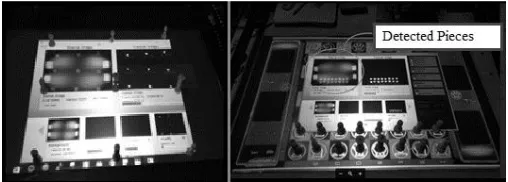
Fig. 13 shows a schematic of the operation of the vision, where the image is processed by threshold filters, Gaussians etc. and a solid image is obtained in 2 dimensions with a relative position and an identifier, sent by TUIO protocol in UDP.
D. Application Software Module
The program was developed in UNITY 5 which is a platform to develop video games assisted with C# Visual Studio from Microsoft. This one is in charge of processing the relative positions coming from the module of artificial vision, to show the plays in the screen and to communicate with the engine of chess. See flow chart of Fig. 14.
E. Electrical and Electronic Module
[image:4.612.317.562.52.197.2]The scheme of the electronic and electrical system for the Fig. 11. Architecture of the MARTI system.
[image:4.612.315.562.289.469.2]
Fig. 12. Programming blocks in their different modules within MARTI.
[image:4.612.49.299.324.558.2]Fig. 13. Image Processing Schematic
[image:4.612.313.565.570.687.2]robot control is shown in Fig. 15.
V. OPERATION AND GAME DESIGN The operation is carried out as follows:
The robot starts moving to the position of HOME, delimited by end-of-run sensors, and the interface showing the menu to the player, which in turn allows tactile gestures (connecting via UDP to infrared camera and CCV artificial vision software, See Fig. 18) to interact with the screen. In it are projected (one by one), 4
windows of selection as shown in Fig. 16.
When you click New Game in the main menu, it opens a previous menu where you can select the gender, (which activates the cyan lights in children and pink in girls), type of game (versus human, versus robot, or tutorials) and the options Start or Return. By default, it is found as Girl and versus Robot. Internally, the application software is linked to the chess engine via TCP with fixed IP, see Fig. 11. The Options menu allows you to change the TCP port
settings or vary the difficulty of the game. The application software also attempts to bind to the chess engine in order to change the TCP configuration if necessary. The Exit Game menu allows you to close the program.
When you press Start Game, the system changes animation and displays a chessboard with 6.7 cm boxes each, projected pieces, and their name and color. It should be emphasized that the design of the interface was done with the help of the standards of colors and position of
elements of GEDIS standard and recommendations of investigations on interfaces for chess, combined as shown in Fig. 16 y Fig. 17.
The game starts with the user placing the 32 pieces on the board until the message disappears, the parts being detected and saved by the CCV artificial vision module, see Fig. 18.
The user starts the game (by default the player has the white ones) taking the piece. The vision is activated by detecting that the piece is raised and disappears. Then the application software and the chess engine execute the algorithm to check the relative position in 2 dimensions of the image obtained by the artificial vision module, then the movements are projected on the screen of that piece, see Fig. 17. It should be noted that the application software sends the information to the chess engine via TCP.
Afterwards, the user must make the wrong move or not. If it is wrong, an error message will appear, a set of lights (red and purple) and sounds (high) will indicate the invalidity of your movement. If it is correct the system will indicate you (with the same audiovisual methods) that the movement is correct (blue and green colors, victory sounds and motors) and you should expect the movement of the robot as in Fig. 20. Internally, the chess engine in the Raspberry PI sends the play to the controller of the robot through serial communication that translates it into movements of the motor by moving the robot to the position and take the piece. If it is wrong, the chess engine sends the corresponding error message. The user returns the piece to the original position executes the movement until it is valid.
Fig. 17. Main game screen. This capture shows the pieces placed and the way to indicate the available positions of each piece when being lifted. You can also notice the dialog boxes, buttons and times.
Fig. 16. Game Menu windows. Left upper: Start window. Inf. Left: level options and TCP (advanced). Right upper: previous menu of selection of gender and game mode. Inf. right: close menu.
[image:5.612.53.294.59.220.2][image:5.612.71.274.327.479.2]
Fig. 15. Schematic diagram of the system circuit.
[image:5.612.315.569.408.499.2]VI. TESTS AND RESULTS
Mechanical, electronic, software and interaction tests were made with people.
In the robot positioning tests, a maximum error of 0.66% accuracy and repeatability of movements was observed.
In the tests of the projector a reflection angle was determined with the mirror from 5° to 10° to have an offset of 2.8 cm up and down the screen and a wasting of 2 cm in the width of the screen with 95% of the total screen, being suitable for projection.
The instruments such as the camera, the projector and the infrared lights were calibrated according to their factory configurable parameters and according to the laboratory environment where the system is adapted very well to these changes.
The most important test was interaction with people. For this, a target population of 9 people was defined, 3 of which were chess professionals, 3 sporadic players and 3 inexperienced players. All included in the range of 15 to 30 years. They were asked to test the module in some games, and to evaluate the performance of MARTI according to 2 aspects: entertainment and learning / consolidation of rules of chess. All inexperienced players showed a 90% learning of the chess rules by counting the times MARTI taught them a new rule and a 10% consolidation of chess rules with the same counting method. Sporadic players reported having learned 20% of new rules and 30% consolidation of knowledge. Finally, experienced players showed a 0% learning of new rules and a 10% consolidation. The last group was the most interesting because they gave recommendations of dynamic gameplay for the system. In all
groups, the degree of satisfaction was high, measured qualitatively by their opinion and by the time they spent playing against MARTI. See Fig. 19.
VII. CONCLUTION
The MARTI module is, therefore, an autonomous chess module, with the ability to detect the movements of chess pieces and hand commands through artificial vision. The module has a Cartesian robotic manipulator to enrich the experience with the player, moving according to the moves made by an installed chess engine. The design is focused on teaching and maximum interactivity with the person emulating a real game of chess. It proved to be a feasible solution for interconnecting technological modules and also resulted in a solution that improves the chess-playing experience.
REFERENCES
[1] F. Gliga and P. I. Flesner, “Cognitive Benefits of Chess Training in Novice Children,” Procedia -Social Behav. Sci., vol. 116, pp. 962–967, 2014.
[2] H. Blasco-Fontecilla et al., “Efficacy of chess training for
the treatment of ADHD: A prospective, open label study,”
Rev Psiquiatr Salud Ment, vol. 9, no. 1, pp. 13–21, 2016. [3] L. Sajó, Z. Ruttkay, and A. Fazekas, “Turk-2, a multi-modal
chess player,” Int. J. Hum. Comput. Stud., 2011.
[4] J. Picussa et al., “a User-Interface Environment Solution As
an Educational Tool for an Online Chess Server on the Web,” pp. 262–267, 2004.
[5] Goncalves José and Leitao Paulo, “CHESS ROBOT SYSTEM,” 2004.
[6] C. Matuszek and B. Mayton, “Gambit: A Robust Chess-Playing Robotic System,” … Robot. …, 2011.
[7] D. Urting and Y. Berbers, “MarineBlue: A Low-cost Chess Robot.,” Robot. Appl., 2003.
[8] G. Du, S. Bi, Y. Xiao, and W. Li, “The compliance control study of Chinese chess robot in Cartesian coordinate system,” Int. Conf. Adv. Mechatron. Syst. ICAMechS, pp. 31–35, 2013.
[9] H. M. Luqman and M. Zaffar, “Chess Brain and Autonomous Chess Playing Robotic System,” Int. Conf. Autonous Robot Syst. Compet., 2016.
[10] A. T. Y. Chen and K. I. K. Wang, “Computer vision based chess playing capabilities for the Baxter humanoid robot,”
Proc. - 2016 2nd Int. Conf. Control. Autom. Robot. ICCAR 2016, pp. 11–14, 2016.
[11] R. G. Budynas and J. Keith Nisbett, Diseño en ingeniería mecánica de Shigley, Octava. McGraw-Hill Latinoamérica, 2008.
[image:6.612.56.287.406.548.2]