A Type Inference Algorithm for
Secure Ambients
Franco Barbanera,
aMariangiola Dezani-Ciancaglini,
bIvano Salvo
band Vladimiro Sassone
ca Dip. di Matematica e Informatica, Univ. di Catania
e-mail: [email protected] b Dip. di Informatica, Univ. di Torino
e-mail: {dezani, salvo}@di.unito.it c COGS, University of Sussex
e-mail: [email protected]
Abstract
We consider a type discipline for the Ambient Calculus that associates ambients with security levels and constrains them to be traversed by or opened in ambients of higher security clearance only. We present a bottom-up algorithm that, given an untyped process P, computes a minimal set of constraints on security levels such that all actions during runs of P are performed without violating the security level priorities. Such an algorithm appears to be a prerequisite to use type systems to ensure security properties in the web scenario.
1
Introduction
The Ambient Calculus [CG98] has recently been successfully proposed was a model for the Internet and the sort of (mobile) computations that can take place on it. Ambients provide the abstraction for named locations: they may contain processes and sub-ambients, whileπ-calculus-like processes inside ambients are a natural representation of (concurrent) computations. A process may:
• communicate asynchronously with processes in the same ambient;
• cause the enclosing ambient to move inside or outside other ambients;
• destroy the boundary of a ambient, causing the contents of the
sub-ambient to be released into the parent sub-ambient.
In order to enrich the algebraic theory of ambients, [LS00] introduced the Safe Ambient Calculus, where process activities are more finely controlled by
means of coactions. The basic idea here is that an ambient can be traversed or opened if a process inside it agrees.
A standard way of forbidding unwanted behaviours is to impose a type discipline. Different type disciplines have been proposed for the Ambient Cal-culus: types in [CG99] assure the correctness of communications, while the type system of [CGG99] in addition guarantees that only ambients declared as ‘mobile’ actually move and only ambients declared as ‘openable’ are opened. Adding subtyping as in [Zim00b] allows us to obtain a more flexible type dis-cipline. Finally, using ‘group names’, [CGG00] allows the type of an ambient
n to control the set of ambients n may cross and the set of ambients it may open. Moreover, dynamic private group names creation provides a flexible way of preventing unwanted names propagation.
A powerful type discipline for the Safe Ambient Calculus has been devised in [LS00] whose main features are the control of ambient mobility and the removing of grave interferences, i.e. of all non-deterministic choices between logically incompatible interactions. This is achieved using types which can be derived only for single-threaded ambients, i.e. ambients which at every step offer at most one interaction with external or internal ambients. The Secure Safe Ambient Calculus of [BC01] is a typed variant of Safe Ambients in which ambient types are protection domains expressing behavioural invariants.
Security plays a crucial role in the theory and practice of distributed sys-tems. In [DCS00] a type discipline is proposed for safe mobile ambients that is motivated essentially by its ensuring security properties. The type of an ambient name specifies a security level s and type correctness requires that an ambient at security level s can only be traversed or opened by ambients at security levels at least s. Two independent partial orders are defined on security levels to control respectively opening and movement rights. A gen-eral analysis of how to encode mandatory security policies inside the Ambient Calculus is carried out in [BCC01b]. Difficulties therein in finding a natural interpretation of basic notions like read and write access led the authors to introduce a variant of the Ambient Calculus, the Boxed Ambients [BCC01a]. Mobile ambients have been analysed also using proof systems [CG00], ab-stract interpretations [HJNN99], and flow analysis [DLB00].
In order to simplify the definition of the algorithm and its analysis, we ignore coactions, distinctions between movement and opening rights, and re-strict communication to names only (rather than capabilities). Correctness, completeness and minimality are proved with respect to a simplified version of the type system in [DCS00].
Except for the distributed system calculus defined in [BC01], type systems for ambients consider the network as a whole, globally typed entity. This is an unrealistic model for the web, where agents typically interact with only partial knowledge of each other. And it is even more unrealistic when we try to model security properties, because attackers need not obey the rules of our type system. Algorithms such as ours move a step towards an effective use of type systems to ensure security properties in the global computing scenario, as they can infer useful information even when partial or no type assumptions are available. More precisely, ambients can derive a minimal set of constraints on security levels necessary for an untyped process to be well-typed, and on the basis of such information, they can then decide whether or not to allow the process in, and with what privileges.
2
Calculus and Types
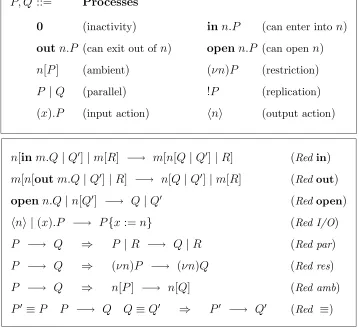
We focus on a version of the Ambient Calculus where only names can be communicated. Under this hypothesis the syntactic distinction between ex-pressions and processes becomes redundant, and the syntax can be given as in Fig. 1, where n ranges over the set N of ambient names. It is worth remark-ing that our removremark-ing capability passremark-ing does not affect the expressiveness of the Ambient Calculus, as shown in [Zim00a] for even more severe restrictions. Reduction is the binary relation on terms generated by the rules in Fig. 1. We use (m open n) (resp. (m in n) and (m out n)) to indicate reductions involving a (Redopen)-reduction (resp. (Redin) and (Redout)) that targets ambient n and happens inside ambient m.
The structural congruence≡ is defined as the least congruence such that:
• | and 0 form a commutative monoid up to ≡;
• !P ≡ !P | P; (νn)0 ≡ 0; (νn)(P | Q) ≡ (νn)P | Q (for n not free in Q);
and (νn)(νm)P ≡(νm)(νn)P.
Although it is possible to consider refined notions of structural congruence, as e.g. in [CG00], their adoption here is orthogonal to our development.
As mentioned earlier, we shall present a type assignment system that en-ables to infer judgements on processes expressing their abiding to constraints on permissions to open or cross boundaries. Then we shall present an algo-rithm to compute the minimal set of constraints.
We consider a set of type-level names, the security levels, U, and a set of type variables VarT, ranged over by α, α0, . . ., together with the constant
P, Q::= Processes
0 (inactivity) inn.P (can enter inton)
outn.P (can exit out of n) openn.P (can openn)
n[P] (ambient) (νn)P (restriction)
P |Q (parallel) !P (replication)
(x).P (input action) hni (output action)
n[inm.Q|Q0]|m[R] −→ m[n[Q|Q0]|R] (Red in)
m[n[outm.Q|Q0]|R] −→ n[Q|Q0]|m[R] (Red out)
openn.Q|n[Q0] −→ Q|Q0 (Red open)
hni |(x).P −→ P{x:=n} (Red I/O)
P −→ Q ⇒ P |R −→ Q|R (Red par)
P −→ Q ⇒ (νn)P −→ (νn)Q (Red res)
P −→ Q ⇒ n[P] −→ n[Q] (Red amb)
[image:4.612.137.496.39.369.2]P0 ≡P P −→ Q Q≡Q0 ⇒ P0 −→ Q0 (Red ≡)
Fig. 1. Processes and Reduction
metavariables S, O, and O to denote, respectively, subsets, preorders and partial orders on U, and write s≤O s0 for (s, s0)∈O.
Definition 2.1 (Ambient Types and Schemes) Types are generated by
T::=δ |s[T],
where δ ranges over VarT ∪ {Shh}, and s over U. Generic types will be indicated by T,T0, . . . and Υ will denote the set of types.
Ambient types, denoted by T, T0, . . ., are types that contain no elements of
VarT. The set of ambient types will be indicated by T.
Ambient type schemes, denoted by τ, σ, . . ., are types in which Shh does not occur. The set of ambient type schemes will be indicated by T S.
We formalise typing environments as partial functions from names to types. Reflecting the classification of types introduced above, we use E,E, and E to denote elements of, respectively, Ξ = N *Υ, N *T, and N *T S. Also, if E(n) = s[T], then nE will denote s; and if E and E0 have disjoint domains,
then E·E0 stands for partial function formed as their union. In particular, we
We start by lifting functions from sets to ambient type schemes and to environments.
Definition 2.2 A mapϕ: (dom(O)→dom(O0))∪(VarT →Υ) defines maps
xϕy: Υ→Υ and pϕq: Ξ→Ξ as follows
xϕy(α) = ϕ(α); xϕy(s[T]) =ϕ(s)[xϕy(T)]
pϕq(E) =xϕy◦E.
In the following we regularly omit explicit mention of x y and p q.
These elements will be employed in tuples either of the form hE,O, S, Ti
(for the type assignment system) or hE, O, S, τi (for the type inference algo-rithm). For the time being, we give the definition below using generic types so to capture all cases of interest at once.
Definition 2.3 (Relation/) The binary relation / on tuples of the shape
hE, O, S,Ti, with S⊆dom(O) is defined by
hE, O, S,Ti / hE0, O0, S0,T0i
if there exists ϕ: (dom(O)→dom(O0))∪(VarT →Υ) such that
• ϕ(E)⊆E0;
• ϕ is monotone as a preorder map O →O0;
• ∀s∈S ∃s0 ∈S0.ϕ(s)≤O0 s0;
• ϕ(T) = T0.
3
An assignment system for security level constraints
Our aim is to infer judgements on security policies expressed by permissions to cross boundaries and granted according to security levels associated with ambients. We use a mappingE to describe the type associated to each ambient
n. Ambient types describe the security level of ambients and, recursively, the security levels of the names that can be exchanged inside n. The information provided by E is complemented by a partial order O that describes the pri-ority relations between security levels that the given security policy dictates. The central judgement in our assignment system sounds as ‘P abides by the constraints E and O’, whose meaning can be informally explained as: if, in any possible reduction sequence of a process abiding by E and O, a reduction makes an ambient n (resp. a process inside n) enter or exit (resp. open) an ambient m, then the security level associated to n is not less than the one associated to m, that is nE ≥O mE.
Definition 3.1 Process P abides by the constraintsE,O, writtenE,O `ok P,
if for all sequences of reductionsP −→∗ terminating with (ninm), (noutm),
or (nopenm) reductions, wherem, nare free names inP, we havenE ≥O mE.
exchanging. We thus derive more informative judgements, viz.E,O `P :S, T
where S ⊆dom(O) and S, T is a process type as defined below.
Definition 3.2 (Process Types) A process typeF is a pair (S, T), with S ⊆ U and T ∈ T.
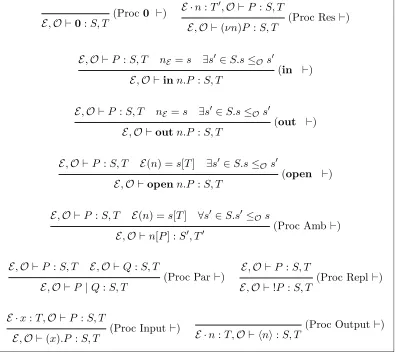
The first component of a process type contains the security levels of the ambient names involved in capabilities possibly performed by the process; the second is the ambient type of the names it exchanges. Concerning the rules, (in `), (out `) and (open `) verify that the security level sof the target ambient name n is bounded by at least one security level in S. Further to that, (open `) checks that the type T of the ambient names exchanged by
P and inside n coincide. Rule (Proc Amb `), instead, verifies that:
• all security levels inS(which are those of the capabilities possibly performed
byP) are bounded by the security levels of the ambientn;
• the type T of the ambient names exchanged by P and inside n coincide.
3.1 Properties
To relate the type assignment system to a type inference algorithm, we find it useful to derive a weakening lemma that uses the relation / introduced in Definition 2.3.
Lemma 3.3 (Weakening) If hE,O, S, Ti/hE0,O0, S0, T0i, then
E,O `P :S, T ⇒ E0
,O0 `
P :S0, T0.
Proof. We proceed by induction on the derivation of E,O ` P : S, T. We consider only one paradigmatic case.
If the last rule applied is (in `) we have:
E,O `P :S, T nE =s0 ∃s1 ∈S.s0 ≤O s1
(in `)
E,O `inn.P :S, T
By the induction hypothesis, we have E0,O0 ` P : S0, T0. Let ϕ be the map
which shows hE,O, S, Ti / hE0,O0, S0, T0i. If n
E0 = s00, we get ϕ(s0) = s00.
Since ∀s∈S ∃s0 ∈S0.ϕ(s)≤
O0 s0, we can find s2 ∈S0 such that ϕ(s1)≤O0 s2.
Being ϕ monotone as a preorder map O → O0 we get s0
0 ≤O0 s2. Therefore,
we can infer, by rule (in `),E0,O0 `inn.P :S0, T0 as follows:
E0,O0 `P :S0, T0 nE0 =s0
0 ∃s2 ∈S0.s00 ≤O0 s2
(in `)
E0
,O0 `
inn.P :S0, T0
2
(Proc0 `) E,O `0:S, T
E ·n:T0,O `P :S, T
(Proc Res`) E,O `(νn)P :S, T
E,O `P :S, T nE =s ∃s0 ∈S.s≤O s0
(in `) E,O `inn.P :S, T
E,O `P :S, T nE =s ∃s0∈S.s≤O s0
(out `) E,O `outn.P :S, T
E,O `P :S, T E(n) =s[T] ∃s0 ∈S.s≤O s0
(open `) E,O `openn.P :S, T
E,O `P :S, T E(n) =s[T] ∀s0∈S.s0 ≤Os
(Proc Amb`) E,O `n[P] :S0, T0
E,O `P :S, T E,O `Q:S, T
(Proc Par `) E,O `P |Q:S, T
E,O `P :S, T
(Proc Repl `) E,O `!P :S, T
E ·x:T,O `P :S, T
(Proc Input`) E,O `(x).P :S, T
[image:7.612.106.502.28.385.2](Proc Output `) E ·n:T,O ` hni:S, T
Fig. 2. Type Assignment System
Theorem 3.4 (Subject Congruence of `) If P ≡Q and E,O `P :F, then
E,O `Q:F.
Theorem 3.5 (Subject Reduction of`) If E,O ` P : S, T and P −→ Q, then E,O `Q:S, T.
Proof. The proof proceeds by induction on the derivation of P −→ Q. We present the cases for (Red in) and (Red open) in the details.
(Red in)n[inm.P |Q]|m[R]−→m[n[P |Q]|R].
It is easy to check that a derivation forE,O `n[inm.P |Q]|m[R] :S, T
must be of the shape
(D1)
...
E,O `R:S00, T00 E(m) = s00[T00] ∀s0 ∈S00.s0 ≤O s00
E,O `m[R] :S, T
E,O `n[inm.P |Q]|m[R] :S, T
...
E,O `P :S0, T0 m
E =s00 ∃s0 ∈S0.s00≤O s0
E,O `inm.P :S0, T0
...
E,O `Q:S0, T0
E,O `inm.P |Q:S0, T0 E(n) =s[T0] ∀s0 ∈S0.s0 ≤ O s
(D1) E,O `n[inm.P |Q] :S, T
We can now build a derivation for the judgementE,O `m[n[P |Q]|R] :
S, T as follows. ...
E,O `P :S0, T0
...
E,O `Q:S0, T0
E,O `P |Q:S0, T0 E(n) =s[T0] ∀s0 ∈S0.s0 ≤O s
(D2) E,O `n[P |Q] :S00, T00
(D2)
...
E,O `R:S00, T00
E,O `n[P |Q]|R:S00, T00 E(m) =s00[T00] ∀s0 ∈S00.s0 ≤O s00
E,O `m[n[P |Q]|R] :S, T
(Red open) openn.P |n[Q]−→P |Q.
It is easy to check that a derivation for open n.P | n[Q] must be of the shape:
(D3)
...
E,O `Q:S0, T E(n) = s[T] ∀s00 ∈S0.s00 ≤O s
E,O `n[Q] :S, T
E,O `openn.P |n[Q] :S, T
with ...
E,O `P :S, T E(n) = s[T] ∃s0 ∈S.s≤ O s0
(D3) E,O `open n.P :S, T
Conditions ∃s0 ∈ S.s ≤
O s0 and ∀s00 ∈ S0.s00 ≤O s imply that ∀s00 ∈ S0 ∃s0 ∈
S.s00 ≤
O s0. So we get hE,O, S0, Ti / hE,O, S, Ti by choosing as ϕ the
identity map. Then we can apply the Weakening Lemma (Lemma 3.3) in order to obtain E,O `Q : S, T. Finally we can build a derivation for P | Q
in the following way.
...
E,O `P :S, T
...
E,O `Q:S, T
E,O `P |Q:S, T
We close this section by stating formally that our type assignment system can type a process P with respect to a given environment and partial order only if P abides by them (according to Definition 3.1).
Theorem 3.6 (Soundness of`) If E,O `P :S, T then E,O `ok P.
Proof. Let E,O ` P : S, T and P −→∗ Q −→ R where the last reduction
step is (n openm) and m, nare free names inP. Then there isQ0 ≡Qsuch
that Q0 has a subterm of the shape n[open m.S | m[U] | V]. By Subject
Reduction Theorem (Theorem 3.5) we get E,O ` Q : S, T, which implies
E0,O ` n[open m.S | m[U] | V] : S0, T0 for some E0 ⊇ E, S0, T0. Looking
at the typing rules (open `) and (Proc Amb `), we get nE0 ≥O mE0. We
conclude nE ≥O mE since by hypothesis m, n are free.
The proofs for the other cases are similar. 2
4
A minimal constraints algorithm
In this section, we address the problem of finding, for a given untyped process
P, a ‘minimal’ set of constraints that P abides by.
Definition 4.1 (Minimal Effects) A minimal effect F is a tuple hE, O, S, τi
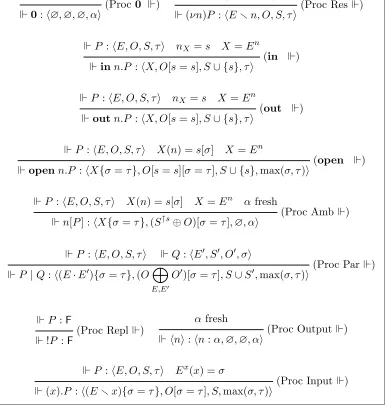
whose components are as described in the notational conventions of Section 2. The bottom-up algorithm described in Fig. 3 enables to infer judgements of the shape
°P :F
where P is a process, and F is a minimal effect. If the algorithm computes a minimal effect hE, O, S, τi for a processP, this will be such that:
• E contains the inferred type assumptions about free names ofP;
• Sincludes security levels associated to the names involved in the capabilities
possibly performed by P;
• O represents the minimal order relation on security levels forP to be
well-typed; and
• τ represents the ambient type scheme of the names exchanged by P.
Before discussing the rules in the details, let us observe that, although we finally want to express the constraints onP as a partial order of security levels, we find it convenient to work with preorders, as they simplify considerably the rules of Fig. 3. In particular, they allow us to define the following operations on effects independently of their environments.
Definition 4.2 (Operations on Preorders) LetO, O0 ⊆ U × U be preorders
of security levels.
We define O⊕O0 to be the preorder induced by the union of O and O0, i.e.
α fresh
(Proc0 °)
°0:h∅,∅,∅, αi
°P :hE, O, S, τi
(Proc Res°)
°(νn)P :hErn, O, S, τi
°P :hE, O, S, τi nX =s X=En
(in °)
°inn.P :hX, O[s=s], S∪ {s}, τi
°P :hE, O, S, τi nX =s X=En
(out °)
°outn.P :hX, O[s=s], S∪ {s}, τi
°P :hE, O, S, τi X(n) =s[σ] X=En
(open °)
°openn.P :hX{σ =τ}, O[s=s][σ=τ], S∪ {s},max(σ, τ)i
°P :hE, O, S, τi X(n) =s[σ] X =En α fresh
(Proc Amb°)
°n[P] :hX{σ=τ},(S↑s⊕O)[σ =τ],∅, αi
°P :hE, O, S, τi °Q:hE0, S0, O0, σi
(Proc Par °)
°P |Q:h(E·E0){σ=τ},(OM E,E0
O0)[σ =τ], S∪S0,max(σ, τ)i
°P :F
(Proc Repl°)
°!P :F
α fresh
(Proc Output °)
°hni:hn:α,∅,∅, αi
°P :hE, O, S, τi Ex(x) =σ
(Proc Input °)
[image:10.612.110.496.40.445.2]°(x).P :h(Erx){σ=τ}, O[σ=τ], S,max(σ, τ)i
Fig. 3. Minimal Constraints Algorithm
For S a set of security levels, and s a security level, S↑s is the preorder where s is added to S as the top element. Formally:
S↑s={(s, s)} ∪ {(s0, s) | s0 ∈S} ∪ {(s0, s0) | s0 ∈S}
We use O[s≤s0] for O⊕ {(s, s0)} and O[s=s0] for O[s ≤s0][s0 ≤s].
Letσ =s1[. . . sn[α]. . .] and τ =s01[. . . s0m[γ]. . .] be ambient type schemes.
We define
max(σ, τ) =
σ if n≥m
τ if n < m
Definition 4.3 (Unification of Ambient Type Schemes) For α 6= γ, let σ = s1[. . . sn[α]. . .] and τ =s01[. . . s0m[γ]. . .] be ambient type schemes, and assume
si =s0i, (1 ≤i≤ n), and the substitution {α← s0n+1[. . . s0m[γ]. . .]}. We shall
use:
• E{σ = τ} to denote the environment obtained from E, by replacing all
occurrences of α with s0
n+1[. . . s0m[γ]. . .];
• O[σ=τ] to denote the preorder O[s1 =s0
1]· · ·[sn=s0n].
The unification of ambient type schemes is central in our construction to express the constraints involved in parallel composition of processes – rule (Proc Par) in Fig. 3 – where we need to compose preorders equating the security levels associated to the same ambient names. This is formalised as:
OM E,E0
O0 = (O⊕O0)[E(n) = E0(n)]n∈dom(E)∩dom(E0)
Finally, we will be building environments by means of the operations below.
En=
E if n∈dom(E)
E, n :s[α] if n 6∈dom(E) with s, α fresh
Ern=
E\ {n :E(n)} if n ∈dom(E)
E if n 6∈dom(E)
Moreover, we extend the notationE·E0 to non necessarily disjointE and
E0 by defining (E·E0)(n) = max(E(n), E0(n)) ifn ∈dom(E)∩dom(E0).
Getting back to Fig. 3, we can now discuss the details of the formal defini-tion of the algorithm. At the beginning, as formalised in the (Proc 0) rule, no relation among security levels exists. The environment is empty and there is no information about names exchanged or involved in capabilities potentially performed by the processes. Capabilities inn andout ncause the name n to be inserted in the environment, if not already present, and the security level associated ton to be inserted in the set of effectsS(notice the use of X in the rules to indicate that the same level is associated ton both in premises and in the conclusions). In the typing of a process of the shapeopenn.P, we have to take care that, after the opening of the ambient n, processes running insiden
will run in parallel withP, and hence we have to unify the type exchanged by
°0:h∅,∅,∅, α0i
(D1)
°openm.0:h{m:s2[α2]},{(s2, s2)},{s2}, α0i
°0:h∅,∅,∅, α4i
°outn.0:h{n:s1[α1]},{(s1, s1)},{s1}, α4i
(D2)
°m[outn.0] :h{n:s1[α1], m:s3[α3]},{(s1, s1),(s3, s3),(s1, s3)},∅, α5i
(D1) (D2)
°P |Q:h{n:s1[α1], m:s2[α2]},{(s1, s1),(s2, s2),(s1, s2)},{s2}, α0i
[image:12.612.106.498.27.238.2]°n[P |Q] :h{n:s1[α1], m:s2[α2]},{(s1, s1),(s2, s2),(s1, s2),(s2, s1)},∅, α6i
Fig. 4. Example of type inference (P ≡openm.0 and Q≡m[outn.0])
At the end, we obtain associations between free ambient names and type schemes in the environment and a preorder relation among security levels. Fig. 4 gives an example of derivation.
4.1 Properties
As for the type assignment system, our algorithm enjoys the expected proper-ties: it infers isomorphic effects for structural congruent processes and com-putes looser effects after reductions. Reduction in fact loosens the minimal constraints on a process, because these depend on the potential execution of capabilities that disappear under reduction. In the following definitions, we formalise the notions of isomorphic effects and loosened constraints.
Definition 4.4 (Partial Order Collapse) For F =hE, O, S, τi an effect, its partial order collapse is the effect F≡ = hE/≡, O/≡, S/≡, τ /≡i where /≡ is
a quotient map1 for the equivalence relation ≡ =
def ≤O ∩ ≥O. To improve
proof readability, we occasionally denote the tuple hE/≡, O/≡, S/≡, τ /≡i as
hE, O, S, τi.
Note that partial order collapses are a special kind of effects, since their preorder component is actually a partial order. We call them ordered effects. Ordered effects are relevant to our development because, as it will be evident shortly, they represent the essence of effects and provide a bridge to ambient types. In particular, if our rules allow to infer ° P : F, then the essential information given by our algorithm is contained in F≡.
1 We convene that /
≡chooses a canonical representative for each class and maps security
levels accordingly, as the canonical quotient map x7→ [x]/≡ would not yield an effect for
Definition 4.5 (The Relation./ on Ordered Effects) Let F = hE, O, S, τi
and F0 = hE0, O0, S0, τ0i be ordered effects. We say that F ./ F0 if F / F0 (as
defined in Definition 2.3) via a map ϕ which is an isomorphism between S
and S0 and between O and O0.
Definition 4.6 (Effects Inequalities and Isomorphism) EffectFisrefinedby effect F0, notation F ≺ F0, if F
≡ / F0≡. Effect F is isomorphic to effect F0,
notation F∼=F0, ifF
≡ ./F0≡.
We can prove that ∼= is a congruence with respect to all the effect trans-formations used to define our minimal constraints algorithm.
Lemma 4.7 Let F ∼= F0, ° P : F and ° P : F0. If ° P : F is a premise and °Q:F00 is the conclusion of an arbitrary rule of the minimal constraints
algorithm, then if we apply the same rule using as premise °P :F0 instead of
°P :F, we get as conclusion °Q:F000 with F00∼=F000.
As formally stated by the lemma below, the system ° infers an effect for each well-formed process: at worst, all security levels will be equated, making our security policy void. The proof by structural induction on processes using previous lemma is standard.
Lemma 4.8 (Termination) For every P there exists F, unique up to ∼=, such that °P :F.
In analogy to Theorems 3.4 and 3.5 and we get:
Theorem 4.9 (Subject Congruence of °) If P ≡Q, °P :F and °Q :F0,
then F∼=F0.
Proof. The proof by induction on≡ using Lemmas 4.7 and 4.8 is easy. 2
Theorem 4.10 (Loosening by reduction) If ° P : F, and P −→ Q, and °Q:F0, then F0 ≺F.
Proof. We give a concise proof which stems from relationships between sys-tems ` and °, discussed in the next section (Theorems 5.2 and 5.3). Let (·)∗ be the map replacing Shh to type variables defined in Definition 5.1.
LetF=hE, O, S, τiand F0 =hE0, O0, S0, τ0i. We have that
°P:hE, O, S, τi
(by Th. 5.2)
®

°Q:hE0, O0, S0, τ0i
E∗, O`P :S, τ∗
(by Th. 3.5) +3E
∗
, O `Q:S, τ∗
(by Th. 5.3)
K
S
where, according to Theorem 5.3, hE0, O0, S0, τ0i / hE∗, O, S, τ∗i. It easily
follows that hE0, O0, S0, τ0i ≺ hE, O, S, τi. 2
impossible, again because by performing a reduction we make the number of capabilities in a process decrease. Certainly, the fewer the capabilities in a process, the fewer the pairs in the preorder inferred by our algorithm. However, as the quotient-order construction is non monotone, a smaller preorder does not imply a smaller corresponding partial order. This is well illustrated by process P below, where reduction gets us a smaller preorder, but a bigger partial order.
P =n[openm.0|m[out n.outm.0]]
The partial order of constraints for P is simply {(s, s)}, with nE = s and
mE = s, whereas the algorithm computes {(s1, s1),(s2, s2),(s1, s2),(s2, s1)},
with nE = s1 and mE = s2 (see Fig. 4). If we reduce P via a (Red open)
reduction, we get
n[outn.outm.0].
It is not difficult to see that the partial order of constraints is bigger for this process than forP. In fact it is{(s1, s1),(s2, s2),(s2, s1)}, i.e. it coincides with
the preorder computed by the algorithm.
5
Correctness and Minimality
In this section, we show that the algorithm is correct and complete with respect to the type assignment system. Moreover, Theorem 5.3 asserts that the effect computed by the algorithmrefines(in the sense of Definition 4.6) any possible typing in the type assignment system. To connect the the algorithm with the type assignment system we need to replace type variables by Shh.
Definition 5.1 Let (·)∗:VarT → T be the map such that α∗ =Shh, for all
α ∈VarT. We lift (·)∗ to type schemes and environments in the obvious way.
Theorem 5.2 (Correctness) Let P be a process. IF °P : hE, O, S, τi then
E∗, O `P :S, τ∗.
Proof. The proof is by induction on derivations. The details for rule (Proc Par °) are as follows.
°P :E, O, S, τ °Q:E0, O0, S0, σ
(Proc Par°)
°P |Q: (E·E0){σ =τ},(OM E,E0
O0)[σ=τ], S∪S0, max(σ, τ)
By induction hypothesis, we have E∗, O `P : S, τ∗ and E0∗, O0 ` Q : S0, σ∗.
By weakening (Lemma 3.3), we have:
((E·E0){σ=τ})∗,(OM
E,E0
O0)[σ =τ]`P :S∪S0, max(σ, τ)∗
and
((E·E0){σ =τ})∗,(OM
E,E0
The statement is proved just by applying the (Proc Par `) rule. 2
The order ‘computed’ by the algorithm is minimal in the following sense.
Theorem 5.3 (Minimality) Let ° P : hE, O, S, τi and E,O ` P : S0, T.
Then hE, O, S, τi/hE,O, S0, Ti.
Proof. By induction on derivations. All cases are quite simple, apart from those of rules (Proc Par) and (Proc Amb), which require some technical inge-nuity. We first consider the (Proc Par) rules.
°P :hE, O, S, τi °Q:hE0, O0, S0, σi
(Proc Par°)
°P |Q:h(E·E0){σ =τ},(OM E,E0
O0)[σ =τ], S∪S0, max(σ, τ)i
E,O `P :S00, T E,O `Q:S00, T
(Proc Par `)
E,O `P |Q:S00, T
Notice that by construction S ∩S0 = ∅ and FV(E, τ)∩ FV(E0, σ) = ∅,
where FV gives the set of (free) type variables in ambient type schemes and environments. Therefore alsoS∩S0 =∅and FV(E, τ)∩FV(E0, σ) = ∅. By
induction there are ϕP and ϕQ such that:
• ϕP(E)⊆ E, ϕQ(E0)⊆ E;
• ∀s∈S ∃s0 ∈S00.ϕP(s)≤O s0;
• ∀s∈S0 ∃s0 ∈S00.ϕQ(s)≤O s0;
• ϕP is monotone as a preorder map O → O;
• ϕQ is monotone as a preorder map O0 → O;
• ϕP(τ) = ϕQ(σ) =T.
We define a map ϕ as follows:
ϕ(s) =
ϕP(s) if s∈S
ϕQ(s) if s∈S0
ϕ(α) =
ϕP(α) if α∈FV(E, τ)
ϕQ(α) if α∈FV(E0, σ)
Then
• ϕ((E·E0){σ =τ})⊆ E;
• ∀s∈S∪S0 ∃s0 ∈S00.ϕ(s)≤O s0;
• ϕ is monotone as a preorder map (OL
E,E0O0)[σ =τ]→ O;
For the (Proc Amb) rules, we proceed as follows
°P :hE, O, S, τi X(n) = s[σ] X =En α fresh
(Proc Amb °)
°n[P] :hX{σ=τ},(S↑s⊕O)[σ =τ],∅, αi
E,O `P :S00, T E(n) =s00[T] ∀s0 ∈S00.s0 ≤O s00
(Proc Amb`)
E,O `n[P] :S0, T0
By induction hypothesis, there is ϕP such that:
• ϕP(E)⊆ E;
• ∀s∈S ∃s000 ∈S00.ϕP(s)≤O00 s000;
• ϕP is monotone as a preorder map O → O;
• ϕP(τ) = T.
We define
ϕ(s0) =
ϕP(s0) if s0 ∈S
s00 otherwise
ϕ(β) =
ϕP(β) ifβ ∈FV(E, τ)
T0 if β ≡α
T otherwise
If n ∈ dom(E), from ϕP(E) ⊆ E and ϕP(τ) = T, we get ϕP(s) = s00, and ϕP(σ) =T. Otherwise, s6∈S implies ϕ(s) =s00 and σ is a type variable that
does not belong toFV(E, τ)∪ {α}and hence, by definition ofϕ, we have that
ϕ(σ) = T. In both cases we obtain:
• ϕ(X{σ =τ})⊆ E;
• ϕ is monotone as a preorder map (S↑s⊕O)[σ =τ]→ O;
• ϕ(α) = T0.
This concludes our proof, being the remaining clause trivially satisfied for the
empty set. 2
6
Relations with group types
In this section, we draft a relationship between types as considered here and the group types of [CGG00]. We consider security levels as group names, and do not distinguish between groups for opening and for moving ambients. The syntax of group types is then
(Proc0 `G) Γ`G0:S, T
Γ·n:T0 `P :S, T
(Proc Res`G) Γ`G(νn)P :S, T
Γ`GP :S, T nΓ=s s∈S
(in `G) Γ`Ginn.P :S, T
Γ`GP :S, T nΓ=s s∈S
(out `G) Γ`G outn.P :S, T
Γ`G P :S, T Γ(n) =s[S, T] s∈S
(open `G) Γ`Gopenn.P :S, T
Γ`G P :S, T Γ(n) =s[S, T]
(Proc Amb`G) Γ`Gn[P] :S0, T0
Γ`GP :S, T Γ`GQ:S, T
(Proc Par `G) Γ`GP |Q:S, T
Γ`G P :S, T
(Proc Repl `G) Γ`G!P :S, T
Γ·x:T `GP :S, T
(Proc Input`G) Γ`G(x).P :S, T
[image:17.612.105.502.27.380.2](Proc Output `G) Γ·n:T `Ghni:S, T
Fig. 5. Type Assignment System for Group Types
Let GT stand for the set of group types. The typing rules of [CGG00] with the types in GT are given in Fig. 5 using the current notational conventions. There is no surprise here, and the rules are as expected. We denote by `G the type system so obtained.
Definition 6.1 Given a partial order O we define its downward closure as
SO(s) ={s0 |s0 ≤O s}, SO(S) =
[
s∈S SO(s)
and the mapping µO: Υ→ GT such that
µO(α) = µO(Shh) = Shh, µO(s[T]) =s[SO(s), µO(T)].
We lift µO to environments as usual.
We can prove that ° P : hE, O, S, τi implies µO(E) `G P : SO(S), µO(τ)
where O is the partial order induced by the preorder O.
Lemma 6.2 E,O `P :S, T implies µO(E)`GP :SO(S), µO(T).
be the conclusion. This means that, for some S and T, we have derived the judgement E,O ` P : S, T and that E(n) = s[T], with s greater than every security level in S. Under such conditions and by definition of SO, we have
that S ⊆ SO(S) ⊆ SO(s). By the Weakening Lemma (Lemma 3.3), we can
derive the judgement E,O ` P : SO(s), T. Applying the induction
hypothe-sis, the judgement µO(E) `G P : SO(s), µO(T) is derivable and µO(E)(n) =
s[SO(s), µO(T)]. We can concludeµO(E)`G n[P] :SO(S0), µO(T0). 2
Theorem 6.3 °P :hE, O, S, Ti implies µO(E)`G P :SO(S), µO(T), where
O is the partial order induced by the preorder O.
Proof. Simply by the correctness of the type inference algorithm with respect to the type assignment system (Theorem 5.2) using the previous lemma. 2
7
Conclusions and Future Works
In the scenario we considered an ambient can enter another when the former has a greater priority. Although this is quite a reasonable assumption, one has to be aware that once the ambient has entered its greater security clearance enables it to do, so to speak, whatever it likes. This is to be avoided if we are to yield a safer, a more realistic, and thoroughly desirable situation in which an ambient successfully controls what happens inside itself.
Reflecting on this, we are naturally led to consider the possibility for an ambient to assign a safe security level to ambients crossing its boundaries and, in general, to all its sub-ambients. Moreover the security level of an ambient can increase when it received an ‘audit’ certificate or decrease when it crosses an unsafe ambient. A distributed version of our type assignment and algorithm can provide the right framework to address an extension of the Ambient Calculus with capabilities allowing security levels modifications as the ones suggested above.
References
[BC01] Michele Bugliesi and Giuseppe Castagna. Secure safe ambients. In POPL’01, pages 222–235. ACM Press, 2001.
[BCC01a] Michele Bugliesi, Giuseppe Castagna, and Silvia Crafa. Boxed ambients. In TACS’01, volume 2215 of Lecture Notes in Computer Science, pages 38–63. Springer-Verlag, 2001.
[BCC01b] Michele Bugliesi, Giuseppe Castagna, and Silvia Crafa. Reasoning about security in mobile ambients. In CONCUR’01, volume 2154 of Lecture Notes in Computer Science, pages 102–120. Springer-Verlag, 2001.
[CG99] Luca Cardelli and Andrew D. Gordon. Types for mobile ambients. In POPL’99, pages 79–92. ACM Press, 1999.
[CG00] Luca Cardelli and Andrew D. Gordon. Anytime, anywhere. modal logics for mobile ambients. In POPL’00, pages 365–377. ACM Press, 2000.
[CGG99] Luca Cardelli, Giorgio Ghelli, and Andrew D. Gordon. Mobility types for mobile ambients. In ICALP’99, volume 1644 of Lecture Notes in Computer Science, pages 230–239. Springer-Verlag, 1999.
[CGG00] Luca Cardelli, Giorgio Ghelli, and Andrew D. Gordon. Ambient groups and mobility types. In TCS’00, volume 1872 of Lecture Notes in Computer Science, pages 333–347. Springer-Verlag, 2000.
[DCS00] Mariangiola Dezani-Ciancaglini and Ivano Salvo. Security types for safe mobile ambients. In ASIAN’00, volume 1961 of Lecture Notes in Computer Science, pages 215–236. Springer-Verlag, 2000.
[DLB00] Pierpaolo Degano, Francesca Levi, and Chiara Bodei. Safe ambients: Control flow analysis and security. In ASIAN’00, volume 1961 ofLecture Notes in Computer Science, pages 199–214. Springer-Verlag, 2000.
[HJNN99] R. R. Hansen, J. G. Jensen, F. Nielson, and H. Riis Nielson. Abstract interpretation of mobile ambients. In SAS’99, volume 1694 of LNCS, pages 134–148. Springer-Verlag, 1999.
[LS00] Francesca Levi and Davide Sangiorgi. Controlling interference in ambients. In POPL’00, pages 352–364. ACM Press, 2000.
[Zim00a] Pascal Zimmer. On the expressiveness of pure mobile ambients. In EXPRESS’00, volume 39 of Electronic Notes in Theoretical Computer Science. Elsevier, 2000.
![Fig. 4. Example of type inference (P ≡ open m.0 and Q ≡ m[out n.0])](https://thumb-us.123doks.com/thumbv2/123dok_us/1029794.618330/12.612.106.498.27.238/fig-example-type-inference-p-open-m-q.webp)