
arXiv:1212.5197v1 [math.CO] 20 Dec 2012
GAVIN BROWN AND ALEXANDER M. KASPRZYK
Abstract. We exhibit seven linear codes exceeding the current best known minimum distance d for their dimension k and block length n. Each code is defined over F8, and their invari-ants [n, k, d] are given by [49,13,27], [49,14,26], [49,16,24], [49,17,23], [49,19,21], [49,25,16] and [49,26,15]. Our method includes an exhaustive search of all monomial evaluation codes generated by points in the [0,5]×[0,5] lattice square.
1. Introduction
The basic invariants of a linear codeCover the finite fieldFq are itsdimension kand itsblock length n. The code is the image in Fnq of a k×n matrix M over Fq. The minimum distance d of C is the smallest Hamming weight of any nonzero linear combination of the rows of M. These invariants are conventionally recorded as a triple [n, k, d]. One usually seeks codes with minimum distance das large as possible for a given block lengthnand dimensionk. There are theoretical upper bounds for the minimum distance, although in many cases the largest known example falls short of these bounds. Grassl [Gra] catalogues the best known linear codes in this sense, and we refer to any code with larger minimum distance as achampion code1.
In this paper we find seven new champion codes defined over F8 by considering the class of generalised toric codes introduced by Little [Lit11] (see§2).
Theorem 1.1. There are precisely five[n, k, d]profiles of champion generalised toric codes over F8 generated by collections of points in a [0,5]×[0,5] square. There are (at least) another two champion codes arising from a [0,6]×[0,6] square. These profiles are listed in Table 1.
The codes we consider correspond to subsets of lattice points in the [0, m]×[0, m] square for small values of m. In principle, our approach is to enumerate all such sets of points, construct the corresponding code over various small fields and then compute its invariants. In §3 we describe an algorithm to enumerate all such sets of points up to affine equivalence. To prove the theorem, we implement and run this algorithm to completion for m = 5, and a partial search when m= 6. Since our algorithm is exhaustive, we can say more:
Theorem 1.2. There are no champion generalised toric codes overFq when q≤7.
It is worth noting that the new Bound A of [GBS12] does not improve the existing theoretical upper bounds for minimum distance in the range of the champion codes we discover, so we cannot say that the codes of Theorem 1.1 are the best possible amongst all linear codes.
2010Mathematics Subject Classification: 14G50 (Primary); 52B20, 14M25 (Secondary).
1The profile [36,19,12] overF
7 discovered in [BK12] is not currently recorded in [Gra], but we willnot regard any code matching these invariants as a champion.
n k d Minm Example points
49 13 27 4 (0,2), (0,3), (0,4), (1,0), (1,2), (2,1), (2,2), (2,4), (3,0), (3,2), (4,1),
(4,3),(4,4)
49 14 26 5 (0,1) (0,4), (1,3), (2,3), (2,4), (3,1), (3,3), (3,5), (4,0), (4,2), (4,4),
(4,5),(5,2), (5,5)
49 16 24 5 (0,1), (0,2), (0,4), (0,5), (1,1), (1,4), (1,5), (2,0), (2,1), (2,4), (3,2),
(3,3),(3,5), (4,2),(5,0),(5,5)
49 17 23 5 (0,1), (0,3), (0,5), (1,1), (1,2), (1,4), (2,2), (2,3), (2,4), (3,0), (3,1),
(3,4),(3,5), (4,0),(4,2),(5,1),(5,5)
49 19 21 5 (0,0), (0,2), (0,4), (0,5), (1,0), (1,1), (1,5), (2,1), (2,2), (2,5), (3,1),
(3,3),(3,4), (4,0),(4,5),(5,0),(5,2),(5,4),(5,5)
49 25 16 6 (0,4), (0,5), (0,6), (1,2), (1,3), (1,4), (1,5), (1,6), (2,1), (2,2), (2,3),
(2,5), (2,6), (3,0), (3,2), (3,4), (3,6), (4,2), (4,3), (4,4), (4,5), (5,1),
(5,5),(6,2), (6,3)
49 26 15 6 (0,2), (0,4), (0,5), (1,1), (1,2), (1,3), (1,4), (1,6), (2,2), (2,3), (2,5),
(3,0), (3,1), (3,3), (3,5), (3,6), (4,3), (4,4), (5,0), (5,2), (5,3), (5,4),
[image:2.595.83.510.114.384.2](5,5),(6,1), (6,2),(6,4)
Table 1. The [n, k, d] invariants of new champion generalised toric codes over F8. In each case a single example is given, contained in the smallest possible [0, m]×[0, m] square, and illustrated in Figure 1.
2. Generalised toric codes
Recall from [Han00] that a toric code C, over a sufficiently large field Fq, is determined by a convex lattice polygon P ⊂Z2⊗Q as follows. Suppose that P lies in a [0, m]×[0, m] square, whereq ≥m+ 2. ThenC is given by the image of ak×nmatrixM whose rows are generated by evaluating each lattice point (a, b) ∈ P∩Z2 (regarded as a monomial xayb) at each vector of the torus (F∗
q)2. The dimension of C is the number of rowsk=
P ∩Z2
of M and the block
length is the number of columns n= (q−1)2.
Ageneralised toric codeis constructed in the same way as a toric code but with the possibility of omitting one or more of the lattice points of P; equivalently, one may remove rows from the generating matrix M. Conceptually this allows one to delete any particularly short vectors in
Figure 1. Example point configurations for the new champion generalised codes over F8 listed in Table 1.
Small polygons. In [BK12] we assembled a comprehensive database of lattice polygons that are contained, up to lattice automorphism and translation, in a [0, m]×[0, m] square, form≤7. This database can be interrogated online via the Graded Ring Database [BKa], or from within the computational algebra software Magma [BCP97]. In [BK12] we checked the toric code corresponding to each such polygon, over all prime-powered fields Fq for m+ 2 ≤ q ≤ 9, and found a single new champion code, defined over F7 with invariants [36,19,12]. In this paper we consider allgeneralised toric codes associated with polygons that lie in a [0, m]×[0, m] square, for m ≤ 5 and m+ 2 ≤ q ≤ 9. We also present partial results when m = 6; in this case the number of possible generalised toric codes is too large to be searched systematically using current techniques. The invariants listed in Table 1 are those of the champion codes we found with this search.
(a) (b)
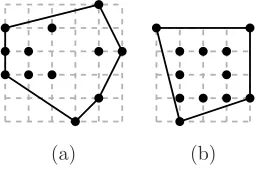
Figure 2. (a) The [49,12,28] code over F8 described by Little [Lit11]; (b) One of 448 non-equivalent ways of generating a [49,12,28] code over F8 from points in a [0,4]×[0,4] square.
[image:3.595.235.363.559.644.2]a [0,4]×[0,4] square, distinct up to lattice automorphism and translation; see Figure 3. Little’s champion [49,12,28] code is more striking still: we have 448 non-equivalent generalised codes in a [0,4]×[0,4] square that yield these invariants. An example is illustrated in Figure 2(b).
Figure 3. The possible choices of points in a [0,4]× [0,4] square giving a [49,13,27] code over F8.
Toric codes often achieve best known minimum distance. We extracted the [n, k, d] profiles of all generalised toric codes that matched, or exceeded, the largest minimum distances available in Grassl’s catalogue over Fq forq≤7. All such codes are contained in a [0,5]×[0,5] square, and so our results are complete. The bounds attained are recorded in Appendix A; generalised toric codes achieve (or exceed) the current best known minimum distance in 28 of the 57 cases.
3. The algorithm
The proof of Theorems 1.1 and 1.2 is by a systematic computer search. The hurdle to overcome is the sheer number of codes and the complexity of computing their minimum distances (often these calculations would take millions of years if the code achieved its apparent minimum distance). We describe an algorithm that carries out the enumeration of subsets of lattice points of a lattice square up to affine equivalence. We have implemented this in Magma exactly as described here, making use of the convex polytopes package [BBK11]. Our code is available to download from [BKb].
Let S ⊂ Z2 be a collection of points contained in a [0, m]×[0, m] square generating the generalised toric code CS over Fq. For any lattice translation S′ = S −u of the points S, or more generally for any affine linear transformation s 7→ (s−u)M of S, where u ∈ Z2 and M ∈ GL2(Z), the toric codes CS and CS′ are monomially equivalent [LS07, Theorem 4].
Therefore it is enough to consider pointsSup to lattice translation and change of basis. Consider now the lattice polygon P := conv(S) ⊂ Z2⊗Q. Up to equivalence, P can be assumed to be one of the polygons constructed in [BK12]. This motivates our approach: For each polygon P
contained in a [0, m]×[0, m] square we will generate, up to equivalence, all possible subsets S
of pointsP ∩Z2 such thatS contains the vertices vert(P) ofP. Insisting that vert(P)⊆S is a natural restriction; if this were not so, Q:= conv(S) is a lattice polygon distinct from P in the same [0, m]×[0, m] square, and, up to equivalence, that polygon will be considered separately.
lattice Z3 =Z2×Z; for example, simply append a coordinate 1 to each vertex of P. We refer to this embedded image of P also as P. Form the cone σ with vertex the origin generated by the points of the embedded image of P. Let Aut(σ) be the linear automorphism group of σ. The action of this group onσ restricts to a faithful action onP, realising the full group of affine lattice automorphisms ofP.
Step 2: Extend the action to subsets of points of P. Clearly v·G ⊆ vert(P) for any
v∈vert(P). LetP :=P ∩Z2\vert(P) be the set of non-vertex lattice points in P. We fix an order of the points of P ={v1, . . . , vk}, where k:=|P|; G acts on P via permutation. Choose a largest orbitO1 of this action on P. Without loss of generality we assume thatO1 permutes the firstk1 ≤k elements.
Step 3: Enumerate subsets of a largest orbit up to the action. From now onwards we regard G as acting on {0,1}k, where an element s ∈ {0,1}k corresponds to a choice of points
S⊆P∩Z2 via the obvious map
s= (b1, . . . , bk)7→S = vert(P)∪ {vi ∈ P |1≤i≤k, bi = 1}.
Let S1 be the set of all sequences in {0,1}k1, up to this action. Enumerating S1 for small polygons is straightforward: in particular, S1 contains a unique sequence of zeros and also a unique sequence containing a single 1. Larger numbers h≥2 of nonzero coefficients depend on theh-transitivity of the action: the number is determined by the orbit–stabiliser theorem, but even without applying that the numbers are small enough simply to run through all possibilities rejecting those already seen (up to the action). We only compute the results for at most⌊k1/2⌋ nonzero coefficients, since the remaining possibilities are obtained via symmetry by exchanging 0 and 1.
Step 4: Extend subsets to all of P. For each s∈ S1 we extend s to an element of {0,1}k as follows. LetGs:={g∈G|s·g=s} ≤G, and let Ps:={vi ∈ P |k1 < i≤k}. By induction we can construct the set of possible {0,1}k−k1
-sequences Ss, up to the action ofGs. Let s⊔s′
denote the concatenation ofs∈ {0,1}k1 with an elements′ ∈ {0,1}k−k1, so thats⊔s′ ∈ {0,1}k.
Then
S={s⊔s′ |s∈ S
1, s′∈ Ss}
corresponds to the set of all points inP ∩Z2\vert(P), up to the action of G.
Example 3.1. Consider the polygonBequal to the [0,2]×[0,2] square. This contains 32points, and hence there exist 232
subsets of points in B. If one insists that vert(B)⊆S for any subset
S of points, then this is reduced to 232−4 = 32 possibilities. Considering subsets S only up to equivalence, we obtain the twelve equivalence classes illustrated in Figure 4.
Figure 4. The twelve equivalence classes of points S in the [0,2]×[0,2] square
B such that vert(B)⊆S.
Step 5: Run a trial minimum distance algorithm to exclude most cases. Fix a prime power q and an integer 0< m < q−1. Given a set of pointsS ⊂[0, m]×[0, m], compute the generalised toric code C=CS(Fq). (In our case, S is one of the subsets of points of a polygon enumerated in Step 4.) Let M = MC be the generator matrix of C. Compute the Hamming length of the shortest nonzero vector that is a linear combination over Fq of up to four rows of
M – this is q4−1 vectors, which is manageable for the small values of q we consider. If this length is strictly greater than the best known minimum distance for codes of dimension|S|and block lengthq−1, then keep the pair S, q for consideration at the next step; otherwise discard the pair S, q, since the corresponding code cannot be a new champion.
Step 6: Compute the minimum distance of successful trial candidates. In principle this is now the hard part. We employ Magma’s MinimumDistancefunction; at heart, it must
simply check the Hamming weight of all words in the code, and so can easily be expected to take too long for our purposes. In practice whenm≤5, for the hundreds of thousands of codes that pass our four-line trial in Step 5, we can always calculate the minimum distance within a few hours, and there are several hundred cases realising champion invariants. So for m ≤5 there are no numerical profiles [n, d, k] other than the five listed in Table 1 that admit champion generalised codes.
Remark 3.2. To get an idea of the effect of symmetries, Table 2 lists the number of subsets of points 2(m+1)2
−4 of the [0, m]×[0, m] square (excluding the vertices, since we handled vertices of polygons separately) and the number of such subsets up to equivalence. Of course there are eight symmetries of the square, and 8×265488 = 2123904; the full group of symmetries of P
has been exploited.
m 1 2 3 4
# subsets of points 1 32 4096 2097152 # up to symmetries 1 12 570 265488
It is conceivable that there are other ‘hidden’ symmetries that preserve the invariants of the toric code, even if they do not preserve the lattice subset, and the multiplicity of champions may be hinting at this.
Acknowledgments. Our thanks to Tom Coates for several helpful ideas, to John Cannon for providing Magma for use on the Imperial College mathematics cluster, and to Andy Thomas for technical assistance. The second author is supported by EPSRC grant EP/I008128/1.
References
[AHV09] James E. Amaya, April J. Harry, and Brian M. Vega, A systematic census of generalized
toric codes over F4, F5 and F16, Tech. report, MSRI-UP, July 2009, available online at
http://www.msri.org/web/msri/scientific/workshops/show/-/event/Wm491.
[BBK11] Gavin Brown, Jaros law Buczy´nski, and Alexander M. Kasprzyk,Convex polytopes and polyhedra,
Hand-book of Magma Functions, Edition 2.17, 2011, available online athttp://magma.maths.usyd.edu.au/.
[BCP97] Wieb Bosma, John Cannon, and Catherine Playoust,The Magma algebra system. I. The user language,
J. Symbolic Comput.24(1997), no. 3-4, 235–265, Computational algebra and number theory (London,
1993).
[BKa] Gavin Brown and Alexander M. Kasprzyk, The Graded Ring Database, online, access via
http://grdb.lboro.ac.uk/.
[BKb] ,Magma routines for computing sets of lattice points up to affine equivalence, online, access via
http://grdb.lboro.ac.uk/files/toriccodes/distinctpoints.tar.gz.
[BK12] , Small polygons and toric codes, J. Symbolic Comput. (2012), 9pp.,
http://dx.doi.org/10.1016/j.jsc.2012.07.001.
[CMO09] Alejandro Carbonara, Juan Pablo Murillo, and Abner Ortiz, A census of two dimensional toric
codes over Galois fields of sizes 7, 8 and 9, Tech. report, MSRI-UP, July 2009, available online at
http://www.msri.org/web/msri/scientific/workshops/show/-/event/Wm491.
[GBS12] Eleonora Guerrini, Emanuele Bellini, and Massimiliano Sala,A bound on the size of linear codes and
systematic codes,arXiv:1206.6006v1 [cs.IT], June 2012.
[Gra] Markus Grassl,Bounds on the minimum distance of linear codes and quantum codes, online, accessed
on 14th October 2012,http://www.codetables.de/.
[Han00] Johan P. Hansen,Toric surfaces and error-correcting codes, Coding theory, cryptography and related
areas (Guanajuato, 1998), Springer, Berlin, 2000, pp. 132–142.
[Lit11] John B. Little,Remarks on generalized toric codes,arXiv:1107.4530v2 [cs.IT], September 2011.
[LS07] John Little and Ryan Schwarz,On toric codes and multivariate Vandermonde matrices, Appl. Algebra
Engrg. Comm. Comput.18(2007), no. 4, 349–367.
[Rua09] Diego Ruano,On the structure of generalized toric codes, J. Symbolic Comput.44(2009), no. 5, 499–
506.
Appendix A. Generalised toric codes overFq, q≤7
q n k dt dg Best Example points
3 4 3 2 2 y (0,1), (1,0),(1,1)
3 4 4 1 1 y (0,0), (0,1),(1,0),(1,1)
4 9 3 6 6 y (0,1), (1,0),(1,1)
4 9 4 4 5 n (0,0), (0,1),(1,0),(1,1)
4 9 5 3 4 n (0,1), (0,2),(1,1),(1,2),(2,0)
4 9 6 3 3 y (0,1), (0,2),(1,1),(1,2),(2,0),(2,1)
4 9 7 2 2 y (0,1), (0,2),(1,1),(1,2),(2,0),(2,1),(2,2)
4 9 8 2 2 y (0,1), (0,2),(1,0),(1,1),(1,2),(2,0),(2,1),(2,2)
4 9 9 1 1 y (0,0), (0,1),(0,2),(1,0),(1,1),(1,2),(2,0),(2,1),(2,2)
5 16 3 12 12 y (0,1), (1,0),(1,1)
5 16 4 10 11 n (0,1), (1,1),(1,2),(2,0)
5 16 5 8 9 n (0,1), (0,2),(1,1),(1,2),(2,0)
5 16 6 8 8 y (0,1), (0,2),(1,1),(1,2),(2,0),(2,1)
5 16 7 7 7 y (0,3), (1,2),(1,3),(2,0),(2,1),(2,2),(3,2)
5 16 8 6 7 n (0,1), (0,2),(1,0),(1,1),(1,2),(2,0),(2,1),(2,2)
5 16 9 6 6 y (0,3), (1,1),(1,2),(1,3),(2,0),(2,1),(2,2),(3,1),(3,2)
5 16 10 4 5 n (0,3), (1,0),(1,1),(1,2),(1,3),(2,1),(2,2),(2,3),(3,1),(3,2)
5 16 11 4 4 y (0,3), (1,0),(1,1),(1,2),(1,3),(2,1),(2,2),(2,3),(3,1),(3,2), (3,3)
5 16 12 4 4 y (0,2),(0,3),(1,1),(1,2),(1,3),(2,0),(2,1),(2,2),(2,3),(3,0),(3,1),
(3,2)
5 16 13 3 3 y (0,1),(0,2),(1,0),(1,1),(1,2),(1,3),(2,0),(2,1),(2,2),(2,3),(3,0),
(3,1), (3,2)
5 16 14 2 2 y (0,1),(0,2),(1,0),(1,1),(1,2),(1,3),(2,0),(2,1),(2,2),(2,3),(3,0),
(3,1), (3,2),(3,3)
5 16 15 2 2 y (0,1),(0,2),(0,3),(1,0),(1,1),(1,2),(1,3),(2,0),(2,1),(2,2),(2,3),
(3,0), (3,1),(3,2),(3,3)
5 16 16 1 1 y (0,0),(0,1),(0,2),(0,3),(1,0),(1,1),(1,2),(1,3),(2,0),(2,1),(2,2),
(2,3), (3,0),(3,1),(3,2),(3,3)
7 36 3 30 30 y (0,1), (1,0),(1,1)
7 36 4 27 28 n (0,1), (1,1),(1,2),(2,0)
7 36 5 24 27 n (0,1), (0,2),(1,1),(1,2),(2,0)
7 36 6 24 25 n (0,1), (0,2),(1,1),(1,2),(2,0),(2,1)
7 36 7 23 24 n (0,3), (1,2),(1,3),(2,0),(2,2),(3,1),(3,2)
7 36 8 20 22 n (0,1), (0,2),(1,0),(1,1),(1,2),(2,0),(2,1),(2,2)
7 36 9 20 21 n (0,3), (1,1),(1,2),(1,3),(2,0),(2,1),(2,2),(3,1),(3,2)
7 36 10 18 20 n (0,3), (1,0),(1,1),(1,2),(1,3),(2,1),(2,2),(2,3),(3,1),(3,2)
7 36 11 18 19 n (0,4), (1,3),(1,4),(2,1),(2,2),(2,3),(3,0),(3,1),(3,2),(3,3), (4,3)
continued from previous page
q n k dt dg Best Example points
7 36 12 17 18 n (0,4),(1,3),(1,4),(2,1),(2,2),(2,3),(3,0),(3,1),(3,2),(3,3),(4,2),
(4,3)
7 36 13 15 17 n (0,1),(0,2),(1,0),(1,1),(1,2),(1,3),(2,0),(2,1),(2,2),(2,3),(3,0),
(3,1), (3,2)
7 36 14 15 16 n (1,1),(1,2),(1,3),(1,4),(2,1),(2,2),(2,3),(2,4),(3,1),(3,2),(3,3),
(4,0), (4,1),(4,2)
7 36 15 14 15 n (0,4),(1,2),(1,3),(1,4),(2,1),(2,2),(2,3),(2,4),(3,0),(3,1),(3,2),
(3,3), (4,1),(4,2),(4,3)
7 36 16 12 14 n (0,3),(1,0),(1,1),(1,2),(1,3),(2,1),(2,2),(2,3),(3,1),(3,2),(3,3),
(3,4), (4,1),(4,2),(4,3),(4,4)
7 36 17 12 13 n (0,3),(1,0),(1,1),(1,2),(1,3),(1,4),(2,1),(2,2),(2,3),(2,4),(3,1),
(3,2), (3,3),(3,4),(4,2),(4,3),(4,4)
7 36 18 12 13 n (0,3),(0,4),(1,2),(1,3),(1,4),(2,0),(2,1),(2,2),(2,3),(2,4),(3,0),
(3,1), (3,2),(3,3),(4,0),(4,1),(4,2),(4,3)
7 36 19 12 11 y (0,4),(1,3),(1,4),(2,2),(2,3),(2,4),(2,5),(3,2),(3,3),(3,4),(3,5),
(4,1), (4,2),(4,3),(4,4),(4,5),(5,0),(5,1),(5,2)
7 36 20 10 11 n (0,3),(1,2),(1,3),(2,1),(2,2),(2,3),(2,4),(3,1),(3,2),(3,3),(3,4),
(3,5), (4,1),(4,2),(4,3),(4,4),(4,5),(5,0),(5,1),(5,2)
7 36 21 10 10 y (0,1),(0,2),(0,3),(0,4),(1,1),(1,2),(1,3),(1,4),(1,5),(2,1),(2,2),
(2,3), (2,4),(2,5),(3,1),(3,2),(3,3),(4,0),(4,1),(4,2),(5,0)
7 36 22 9 10 n (0,3),(0,4),(1,2),(1,3),(1,4),(2,1),(2,2),(2,3),(2,4),(2,5),(3,1),
(3,2), (3,3),(3,4),(3,5),(4,0),(4,1),(4,2),(4,3),(5,0),(5,1), (5,2)
7 36 23 8 9 n (1,2),(1,3),(1,4),(1,5),(2,1),(2,2),(2,3),(2,4),(2,5),(3,1),(3,2),
(3,3),(3,4),(3,5),(4,0),(4,1),(4,2),(4,3),(4,4),(5,1),(5,2),(5,3),
(5,4)
7 36 24 8 8 y (0,3),(0,4),(1,2),(1,3),(1,4),(1,5),(2,1),(2,2),(2,3),(2,4),(2,5),
(3,1),(3,2),(3,3),(3,4),(3,5),(4,0),(4,1),(4,2),(4,3),(4,4),(5,0),
(5,1), (5,2)
7 36 25 6 7 n (0,1),(0,2),(0,3),(1,1),(1,2),(1,3),(1,4),(1,5),(2,1),(2,2),(2,3),
(2,4),(2,5),(3,1),(3,2),(3,3),(3,4),(3,5),(4,0),(4,1),(4,2),(4,3),
(4,4), (4,5),(5,4)
7 36 26 6 7 n (0,1),(0,2),(0,3),(0,4),(1,1),(1,2),(1,3),(1,4),(1,5),(2,1),(2,2),
(2,3),(2,4),(2,5),(3,1),(3,2),(3,3),(3,4),(3,5),(4,0),(4,1),(4,2),
(4,3), (4,4),(4,5),(5,4)
7 36 27 6 6 y (0,3),(0,4),(0,5),(1,2),(1,3),(1,4),(1,5),(2,1),(2,2),(2,3),(2,4),
(2,5),(3,0),(3,1),(3,2),(3,3),(3,4),(3,5),(4,0),(4,1),(4,2),(4,3),
(4,4), (5,0),(5,1),(5,2),(5,3)
continued from previous page
q n k dt dg Best Example points
7 36 28 6 6 y (0,3),(0,4),(0,5),(1,1),(1,2),(1,3),(1,4),(1,5),(2,1),(2,2),(2,3),
(2,4),(2,5),(3,0),(3,1),(3,2),(3,3),(3,4),(3,5),(4,0),(4,1),(4,2),
(4,3), (4,4),(5,0),(5,1),(5,2),(5,3)
7 36 29 5 6 n (0,2),(0,3),(0,4),(0,5),(1,2),(1,3),(1,4),(1,5),(2,1),(2,2),(2,3),
(2,4),(2,5),(3,0),(3,1),(3,2),(3,3),(3,4),(3,5),(4,0),(4,1),(4,2),
(4,3), (4,4),(4,5),(5,0),(5,1),(5,2),(5,3)
7 36 30 4 5 n (0,1),(0,2),(0,3),(0,4),(0,5),(1,1),(1,2),(1,3),(1,4),(1,5),(2,0),
(2,1),(2,2),(2,3),(2,4),(2,5),(3,0),(3,1),(3,2),(3,3),(3,4),(3,5),
(4,1), (4,2),(4,3),(4,4),(4,5),(5,2),(5,3),(5,4)
7 36 31 4 4 y (0,1),(0,2),(0,3),(0,4),(0,5),(1,1),(1,2),(1,3),(1,4),(1,5),(2,1),
(2,2),(2,3),(2,4),(2,5),(3,0),(3,1),(3,2),(3,3),(3,4),(3,5),(4,0),
(4,1), (4,2),(4,3),(4,4),(4,5),(5,0),(5,1),(5,2),(5,3)
7 36 32 3 4 n (0,1),(0,2),(0,3),(0,4),(0,5),(1,1),(1,2),(1,3),(1,4),(1,5),(2,0),
(2,1),(2,2),(2,3),(2,4),(2,5),(3,0),(3,1),(3,2),(3,3),(3,4),(3,5),
(4,0), (4,1),(4,2),(4,3),(4,4),(4,5),(5,1),(5,2),(5,3),(5,4)
7 36 33 3 3 y (0,1),(0,2),(0,3),(0,4),(0,5),(1,1),(1,2),(1,3),(1,4),(1,5),(2,0),
(2,1),(2,2),(2,3),(2,4),(2,5),(3,0),(3,1),(3,2),(3,3),(3,4),(3,5),
(4,0), (4,1),(4,2),(4,3),(4,4),(4,5),(5,0),(5,1),(5,2),(5,3), (5,4)
7 36 34 2 2 y (0,1),(0,2),(0,3),(0,4),(0,5),(1,0),(1,1),(1,2),(1,3),(1,4),(1,5),
(2,0),(2,1),(2,2),(2,3),(2,4),(2,5),(3,0),(3,1),(3,2),(3,3),(3,4),
(3,5),(4,0),(4,1),(4,2),(4,3),(4,4),(4,5),(5,1),(5,2),(5,3),(5,4),
(5,5)
7 36 35 2 2 y (0,1),(0,2),(0,3),(0,4),(0,5),(1,0),(1,1),(1,2),(1,3),(1,4),(1,5),
(2,0),(2,1),(2,2),(2,3),(2,4),(2,5),(3,0),(3,1),(3,2),(3,3),(3,4),
(3,5),(4,0),(4,1),(4,2),(4,3),(4,4),(4,5),(5,0),(5,1),(5,2),(5,3),
(5,4), (5,5)
7 36 36 1 1 y (0,0),(0,1),(0,2),(0,3),(0,4),(0,5),(1,0),(1,1),(1,2),(1,3),(1,4),
(1,5),(2,0),(2,1),(2,2),(2,3),(2,4),(2,5),(3,0),(3,1),(3,2),(3,3),
(3,4),(3,5),(4,0),(4,1),(4,2),(4,3),(4,4),(4,5),(5,0),(5,1),(5,2),
(5,3), (5,4),(5,5)
Department of Mathematical Sciences, Loughborough University, Loughborough, LE11 3TU, United Kingdom
E-mail address: [email protected]
Department of Mathematics, Imperial College London, London, SW7 2AZ, United Kingdom
![Table 1. The [n, k, d] invariants of new champion generalised toric codes overF8. In each case a single example is given, contained in the smallest possible[0, m] × [0, m] square, and illustrated in Figure 1.](https://thumb-us.123doks.com/thumbv2/123dok_us/8701422.381544/2.595.83.510.114.384/invariants-champion-generalised-example-contained-smallest-possible-illustrated.webp)
![Figure 3. The possible choices of points in a [0, 4] × [0, 4] square giving a[49, 13, 27] code over F8.](https://thumb-us.123doks.com/thumbv2/123dok_us/8701422.381544/4.595.172.423.173.232/figure-possible-choices-points-square-giving-code-f.webp)
![Figure 4. The twelve equivalence classes of pointsB S in the [0, 2] × [0, 2] square such that vert(B) ⊆ S.](https://thumb-us.123doks.com/thumbv2/123dok_us/8701422.381544/6.595.179.417.115.187/figure-equivalence-classes-pointsb-s-square-vert-b.webp)
