Measuring Dynamic Interaction in Movement Data
Jed A. Long1*, Trisalyn A. Nelson1 1
Spatial Pattern Analysis & Research (SPAR) Laboratory Department of Geography, University of Victoria
*Corresponding author email & address:
Department of Geography, University of Victoria PO Box 3060 STN CSC
Victoria, BC V8W 3R4, Canada
Running Head: Measuring Dynamic Interaction
Keywords: dynamic interaction, movement data, correlation, GPS, space-time, local statistics, spatial analysis
Pre-print of published version.
Reference:
Long, JA and TA Nelson. 2013. Measuring dynamic interaction in movement data. Transactions in GIS. 17(1). 62-77.
DOI:
http://dx.doi.org/10.1111/j.1467-9671.2012.01353.x
Disclaimer:
ABSTRACT:
1
The emergence of technologies capable of storing detailed records of object locations has 2
presented scientists and researchers with a wealth of data on object movement. Yet 3
analytical methods for investigating more advanced research questions from such detailed 4
movement datasets remain limited in scope and sophistication. Recent advances in the 5
study of movement data has focused on characterizing types of dynamic interactions, 6
such as single-file motion, while little progress has been made on quantifying the degree 7
of such interactions. In this article, we introduce a new method for measuring dynamic 8
interactions (termed DI) between pairs of moving objects. Simulated movement datasets 9
are used to compare DI with an existing correlation statistic. Two applied examples, team 10
sports and wildlife, are used to further demonstrate the value of the DI approach. The DI
11
method is advantageous in that it measures interaction in both movement direction 12
(termed azimuth) and displacement. As well, the DI approach can be applied at local, 13
interval, episodal, and global levels of analysis. However the DI method is limited to 14
situations where movements of two objects are recorded at simultaneous points in time. 15
In conclusion, DI quantifies the level of dynamic interaction between two moving 16
objects, allowing for more thorough investigation of processes affecting interactive 17
moving objects. 18
1 Introduction
20
The study of individual movement has entered a new era whereby researchers 21
from various fields can benefit from fine resolution object movement data. Technical 22
developments associated with location aware technologies, such as GPS, are transforming 23
representations of movement. Despite improvements in spatially explicit movement 24
datasets, the scope and sophistication of research questions are limited by a lack of 25
methods and analysis (Wolfer et al. 2001). Laube et al. (2007) suggest that within 26
geography, reliance of geographic information systems (GIS) and spatial statistics on 2-27
dimensional representations may be limiting the development of more complex analyses 28
of movement, while disciplines outside of geography may be unaware of the power of 29
spatial (and space-time) analysis. To optimally utilize new movement datasets, analytical 30
techniques capable of addressing more advanced research questions are required. 31
Recently, the identification and measurement of dynamic interactions between 32
moving objects has become an active area of research, likely owing to readily available 33
fine granularity movement data. Dynamic interaction, a term from the wildlife ecology 34
literature, can be defined as the way the movements of two individuals are related 35
(Macdonald et al. 1980) or as inter-dependency in the movements of two individuals 36
(Doncaster 1990). Alternatively, the terms association (Stenhouse et al. 2005), relative 37
motion (Laube et al. 2005), and correlation (Shirabe 2006) have been used to refer to 38
dynamic interactions between moving objects in other examples. All of these terms refer 39
to the same general idea: identifying of how the movements of one individual are related 40
to another. Recent work on dynamic interactions has focused on methods for identifying 41
al. 2010; or chasing behavior, de Lucca Siqueira and Bogorny 2011). However limited 43
work exists on quantifying the strength of dynamic interactions present in movement 44
data. With this in mind we are motivated to investigate methods for measuring the 45
strength of dynamic interactions when there is an expectation that such behavior occurs. 46
This approach differs from recent developments in movement analysis which focus on 47
identifying patterns, defined a priori, from large movement databases. 48
The objective of this work is to extend a previously developed statistic (Shirabe 49
2006) to a measure capable of quantifying the degree of dynamic interaction between 50
moving objects. The new method (termed DI) measures dynamic interaction in 51
coincidental movement segments, that is, it requires movement data of two individuals 52
recorded simultaneously. The DI method is separable into components measuring 53
dynamic interaction in movement direction (azimuth) and movement distance 54
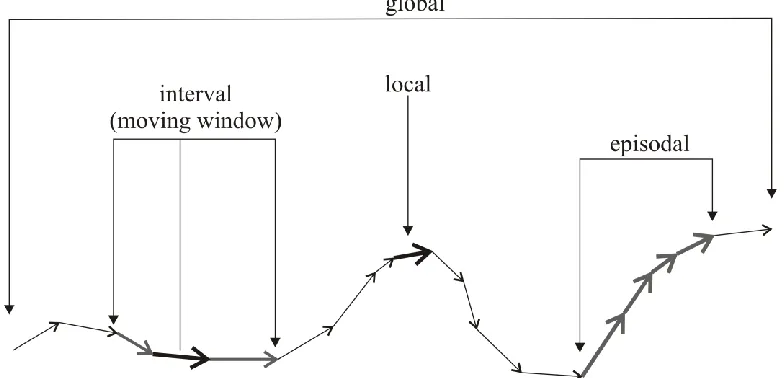
(displacement), termed DIθ and DId respectively. Further, DI is appropriate with the four 55
analysis levels (local, interval, episodal, and global – see Figure 1) identified by Laube et 56
al. (2007) with the beneficial property of local values (denoted here using lower-case – 57
di) that aggregate to the interval, episodal and global values. Lastly, DI is derived in a 58
way to allow for a time-lagged approach, but also extensions including time- and 59
distance-based weighting schemes. 60
< Approximate location Figure 1 > 61
2 Related Work
62
This research is motivated by an existing technique (Shirabe 2006) for measuring 63
the strength of dynamic interactions (termed correlations) present in movement data. The 64
of a Pearson product-moment correlation coefficient. Consider two moving objects Ma 66
and Mb, whose spatial coordinates (x, y) are recorded coincidentally at discrete times t = 1 67
… n, termed fixes. Now consider for any M with t = 2…n, V = [Mt – Mt-1] = [vt], is a
68
vector time series of M with n-1 vector segments. A correlation statistic for movement 69
data defined this way takes the form (Shirabe 2006): 70
1 1 2 1 1 2 1 1 n t b b t n t a a t b b t n t a a t b a , v v v v v v v v V Vr (1)
71
Where
1 1 1 1 n t t n v
v are mean coordinate vectors of V. The correlation statistic (r)
72
is defined over the interval [-1, 1] with a score of 1 being perfect positive correlation and 73
a score of -1 perfect negative correlation, with 0 denoting no correlation. 74
The statistic – r, could be advanced in three ways. First, it is dependant on the 75
mean vector of each path, and thus measures correlations in movement deviations from 76
their respective means. The statistic, r, cannot be used for testing direct interactions 77
between two moving objects unless their corresponding mean vectors are identical or 78
near identical. An improved statistic would not rely on this overall mean value. Second, r
79
is unable to disentangle the effects of correlations in movement azimuth and distance, 80
while being sensitive to both. Decomposing such a statistic into components based on 81
movement direction (termed azimuth) and distance (displacement) would be beneficial, 82
as it would allow interactions in these two independent components of movement to be 83
analyzed separately. A third improvement would be a statistic that measures the 84
interaction of each individual movement segment (i.e., local level - Laube et al. 2007). 85
Laube et al. 2007). When movement patterns are characterized by periods of interactive 87
and non-interactive behavior, or varying levels of interactive behavior, a local level 88
statistic will allow a finer treatment of dynamic interactions. 89
Measurements of dynamic interaction in movement data have also been 90
developed by wildlife researchers interested in a finer understanding of wildlife 91
movement processes. The types of interactions studied in wildlife are classified as either 92
static or dynamic interactions (Doncaster 1990; Macdonald et al. 1980). Static interaction 93
relates to how two individuals use space coincidentally, while dynamic interaction 94
reflects how the movements of two individuals are related, for example attraction 95
(Macdonald et al. 1980). Typically, measures of dynamic interaction summarize the 96
proximity of simultaneous movement points. Doncaster (1990) introduced one such 97
measure of dynamic interaction based on the variance/covariance matrix of the spatial 98
coordinates of simultaneous wildlife telemetry fixes; others have used Euclidean distance 99
as an indicator of interaction (Bandeira de Melo et al. 2007; Stenhouse et al. 2005). 100
Stenhouse et al. (2005) further investigated dynamic interaction in grizzly bears (termed 101
associations) by measuring dynamic interaction in movement direction (azimuth – θ) 102
defined as: 103
180 180
b
t a
t b
t a t
t ,
f
(2)
104
Equation (2) ranges from 0 –1, with values of 1 when direction of movements is identical 105
and zero when completely opposite (i.e., at 180°). 106
Measuring dynamic interactions in moving object databases is also directly 107
related to a larger body of literature on identifying similar movement trajectories (Sinha 108
commonly employed as a first-step for identifying broader patterns or for detecting 110
clusters in larger movement databases (Benkert et al. 2008; Gao et al. 2010). Moving 111
object pairs that are highly interactive could also be said to follow a similar trajectory in 112
many of these applications, and the methods for detecting dynamic interactions in 113
movement data could be useful for detecting similar movement trajectories. 114
Recently, many new techniques have been developed for categorizing various 115
dynamic interaction patterns commonly found in movement data. Laube et al. (2005) 116
developed a method for detecting RElative MOtion (REMO) classes based upon 117
interpreting patterns of movement direction in groups of moving objects. For example, 118
trend-setting, when one object moves with anticipation of the movement of others, is 119
identifiable using the REMO approach. Noyon et al. (2007) use changes in inter-object 120
distance and velocity to identify relative behavior such as collision avoidance. Benkert et 121
al. (2008) present an algorithm for finding flock patterns in movement databases; which 122
tests whether a group of moving objects are contained in a circle radius r over a given 123
time interval. The study of flocking behavior is useful in the study of wildlife and crowd 124
dynamics (Batty et al. 2003). Buchin et al. (2010) have developed a method for 125
identifying single-file motion in groups of moving objects. Single-file motion is detected 126
using free-space diagrams, derived from the Fréchet distance metric for comparing 127
polygonal curves (Alt and Godau 1995). Related to single-file motion is the detection of 128
chasing behavior, identifiable using the algorithm proposed by de Lucca Siqueira and 129
Bogorny (2011). The methods mentioned above are capable of identifying specific types 130
are unable to quantify the strength of dynamic interactions present, thus motivating the 132
development of quantitative measures of dynamic interaction. 133
3 Derivation
134
In developing a measure of dynamic interaction we consider the rather optimal 135
data situation (as in Shirabe 2006) where two moving objects’ (Ma
and Mb) spatial 136
coordinates (x, y) are recorded coincidentally at discrete times t = 1 … n, termed fixes. 137
For any M with t = 2…n, V = [Mt – Mt-1] = [vt], is a vector time series of M with n-1
138
vector segments. For each movement segment define two fundamental properties: 139
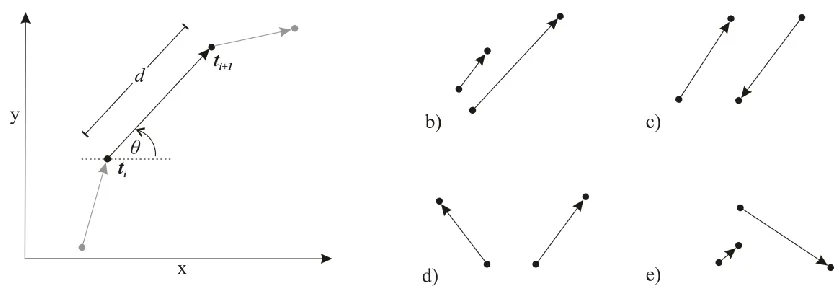
direction (θ), termed azimuth, and length (d), termed displacement. Azimuth (θ) is the 140
angle between a movement segment and a constant axis, most commonly the horizontal 141
axis (Figure 2a). Displacement (d) is the Euclidean distance between two consecutive 142
fixes in a movement segment (Figure 2a). We are interested in deriving a measure of 143
dynamic interaction that separately quantifies interactions in azimuth and displacement 144
(Figure 2b-e). 145
< Approximate location of Figure 2 > 146
3.1 Azimuth – θ 147
To investigate the interaction in movement azimuths we take the cosine of the 148
angle between them. This is simply calculated as: 149
b
t a t b
t a t
t , cos
f
θ
di (3)
150
where θt is the angle of movement at time-step t. Here ft has a range of [-1, 1] as desired.
151
The function
b
t at
cos is 1 when movement segments have the same orientation, 0 152
when movement segments are perpendicular, and -1 when in complete opposing 153
directions. In practice if either object (or both) do not move (3) is undefined, because θt is
undefined. Thus, we must consider two alternative scenarios; first if one object moves 155
and one remains stationary, and second if both objects remain stationary. Here we make 156
the assumption that if one moves and the other remains stationary the two objects exhibit 157
no directional interaction, and if both are stationary they are positively interactive. 158
Considering these two alternative scenarios, a complete definition for (3) is: 159
otherwise cos undefined and both 1 undefined or of one 0 , , , , f b t a t b t a t b t a t b t a t t (4)
160
3.2 Displacement – d 161
Interaction in movement displacement could be measured using a variety of 162
functions. However, it is desirable to have the function (gt) fall in the range of 0 – 1,
163
where a value of 0 represents no interaction and 1 positive interaction. Note there is no 164
consideration of negative interaction in displacement. Using this definition gt can be
165
thought of as a scaling function to ft, and maintains the statistic on the range [-1, 1]. We
166
propose the following function for gt:
167
b t a t b t a t b t a t t d d d d d , d g 1 ddi (5)
168
Where |·| is the absolute value operator, and α is a scaling parameter defaulting to 1. The 169
function
b
t a tt d d
g , approaches zero when dta >>> dtb or vice-versa, and is 1 when dta =
170
b
t
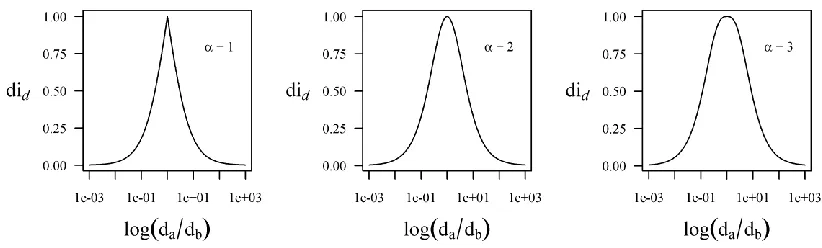
d . The effect of the scaling parameter (α) on the function gt
dta,dtb
is demonstrated in 171Figure 3. Parameter α can be adjusted to place stricter or looser requirements on 172
similarity in displacement denoting interaction. As α is increased larger differences in 173
reveals that it is undefined when b t a
t d
d = 0, (i.e., both objects are stationary). If we
175
consider both objects remaining stationary as positive interaction, a more robust 176
definition of (5) is: 177
0 1 0 1 b t a t b t a t b t a t b t a t b t a t t d d , d d d d d d , d , d g (6) 178< Approximate location of Figure 3 > 179
Thus, for two corresponding movement segments, a measure of dynamic 180
interaction is the product between the azimuthal term (ft) and displacement term (gt):
181
b
t a t t b t a t t b t a
t ,v f , g d ,d
v θ d
t di di
di (7)
182
We are motivated to use the functions ft and gt to provide a statistic that covers the range
183
[-1, 1] as was done in Shirabe (2006). Positive values of dit correspond to cohesive or 184
positively interactive movements, while negative values can be interpreted as repulsion or 185
opposing movements. Values near zero should be interpreted as having no interaction. 186
The di statistics measure dynamic interaction based on similarity in azimuth (θ)
187
and displacement (d) of simultaneous movement segments but do not account for the 188
proximity of moving objects. Thus, di represents a similarity index taken in a normalized 189
plane (i.e., the distance between the two objects has no impact on the resulting value). 190
We are motivated to use this type of formulation as the spatial proximity required for 191
dynamic interaction to occur is application specific. It is up to the analyst to decide if two 192
moving objects maintain a requisite proximity for dynamic interaction to occur, then such 193
example when identifying points-of-interest in large movement databases (e.g., Benkert 195
et al. 2007), the di methodshould not be employed. 196
We have made assumptions in the equations for diθ and did regarding how to 197
analyze dynamic interactions when objects do not move (i.e., θ is undefined and d = 0). 198
In certain cases interpretation of these situations will be clear, for example, if one object 199
stops moving, does the other? However in practice, many applications may not facilitate 200
such straight-forward interpretation. For example, when studying urban travelers does 201
stopping at a red-light signify a change to dynamic interaction even if they will 202
eventually go straight? In light of these concerns, these assumptions can be modified to 203
accommodate different situations that may arise in various movement scenarios to fit a 204
given application. 205
3.3 Global analysis 206
A global version of the di statistic can be used to measure the overall interaction 207
in a set of movement segments. First, it is useful to recognize that we can identify global 208
interaction in azimuth or displacement individually by summing the interaction values for 209
each individual segment and dividing by the number of segments. This form of a global 210
DI gives equal weight to each segment. . 211
1 1 1 1 n t b a n , θθ V V di
DI (8)
212
1 1 1 1 n t b a n , dd V V di
DI (9)
213
A global measure of overall dynamic interaction DI can also be derived. 214
1 1 1 1 1 1 1 1 n t n t b a n n, di di di
DI V V θ d (10)
It is important to note that in the local version di = diθ × did, but with the global statistic, 216
due to summation rules, DI ≠ DIθ × DId. This can make interpretation of global values of
217
DI less straightforward than with local values. However, if we were to alternatively 218
define the global version as DI = DIθ × DId, then the equation defined by (10) would no
219
longer hold. Thus, interpretation of DI values is best done separately for each component 220
(i.e., DI, DIθ, and DId). 221
The global formulation is also appropriate for interval and episodal levels of 222
analysis. Here we simply replace n with some interval or episode length n’, where n’ < n. 223
This type of analysis can be illuminating when analyzing interactions in larger movement 224
datasets, where varying levels of dynamic interaction may occur at different points in the 225
movement paths. 226
3.4 Time- and Distance-based Weighting 227
In instances where the sampling interval of the n fixes is unequal it is desirable to 228
scale the statistic based on the temporal duration of each movement segment. In practice, 229
this would give more weight to segments of longer duration and less weight to shorter 230
segments. Temporal weighting may also be used to account for missing fixes, common to 231
GPS-based tracking data. Let Δt correspond to the temporal duration of segment t, where
232
1
1 n
t
t T is the total duration of the entire movement path. Then a time weighted
233
version of (10) is defined as: 234
1
1 n
t t b
a
T
,V θ d
V di di
DI (11)
235
Viewed in light of the uncertainty associated with movement data, this form of temporal 236
proportional to the duration between fixes; lower weights to segments with higher 238
uncertainty (i.e., more time between fixes) and higher weights to segments with higher 239
certainty or finer space-time resolution. 240
Similarly, we can define a distance-based weighting scheme for (10) where 241
movements with larger displacement have increased weight in calculation of the statistic. 242
Varying distance-based weights could be used when dynamic interactions of a specific 243
movement behavior are of interest. For example in the study of wildlife long directed 244
movements are often interspersed with shorter random movements distinguishing 245
migratory and foraging behavior (Turchin 1998). Distance weighting could be used to 246
tailor the measurement of dynamic interactions to either of migratory or foraging 247
behaviors in this case. A possible distance-based weighting scheme would be the average 248
displacement of two segments: dtavg
dta dtb
/2, and
1
1 n
t avg
t D
d . Based on the
249
average displacement a distance-weighted version of (10) is defined as: 250
1
1 n
t avg t b
a
D d
,V θ d
V di di
DI (12)
251
However, the average displacement of two objects movement segments is misleading 252
when one object has a large displacement and the other has a small displacement. Thus, 253
other distance measures are worth investigating for alternative distance-based weighting 254
schemes, keeping in mind that the sum of the weights should equal one. The equations 255
(11) and (12) can be combined to provide a time- and distance-based weighting scheme. 256
It is important to note that time- and distance-based weighting is really only useful when 257
interpreting global results when there is benefit to assigning segments weights based on 258
Another interesting extension to studying correlations in movement paths is when 260
movements interact with a temporal lag, for example when trend-setting occurs, as 261
described by Laube et al. (2005). The DI statistic can be modified to evaluate dynamic 262
interactions at a temporal lag. To measure dynamic interactions at a temporal lag, select a 263
time lag – k, where k is generally taken to be a multiple of the fix interval (i.e., if fixes are 264
taken at even intervals the time between consecutive fixes). Then we can, alternatively 265
define diθ and did as:
266
b
k t a t
t ,
f
θ
di (13)
267
b
k t a t t d ,d
g
d
di (14)
268
The global statistics (DI, DIθ, DId) can be computed as before, using the time lagged
269
versions of diθ(13) and did (14).
270
4 Data
271
4.1 Simulated Data 272
Six simulated data sets are used to highlight the utility of the DI statistic and the 273
benefit of extensions it makes to r (Shirabe 2006). A single random walk (n = 10) is used 274
to generate a movement path that is the bases for the simulation examples. We used 275
manual permutations to the spatial coordinates of the original random walk to produce 5 276
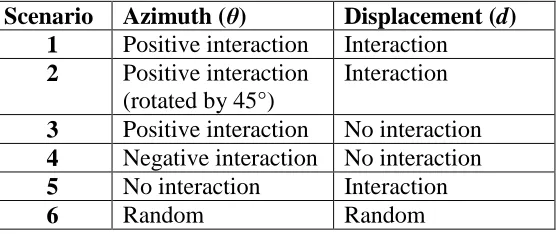
new movement paths that represent 5 unique dynamic interaction scenarios (Table 1). 277
The first scenario simulates two objects moving with strong-positive dynamic interaction. 278
The second scenario uses the same two paths as the first scenario, but one is rotated at 279
45°, simulating strong interaction in displacement, and low interaction in azimuth. The 280
third scenario simulates positive interaction in azimuth and no interaction in 281
interaction in displacement. The fifth scenario simulates no interaction in azimuth and 283
strong interaction in displacement. The sixth scenario uses a second independent random 284
walk to simulate random interactions between two moving objects. 285
< Approximate location of Table 1 > 286
4.2 Athletes – Ultimate Frisbee 287
In team sports players (objects) movements are expected to be highly interactive. 288
Often a defending player is tasked with “covering” an offensive player, and their 289
movements are in reaction to that offensive player. In the sport of ultimate frisbee, 290
offensive players move about the field in an attempt to get open for a pass from their 291
teammates. Defending players cover them, in an attempt to intercept or dissuade passes 292
from being completed. As such, in ultimate frisbee the movements of an offensive player 293
and their defender are highly interactive. We used 5 Hz sports-specific GPS devices 294
(GPSports, Fyshwick, Australia) to monitor the movements of two ultimate frisbee 295
players over a one minute segment during a training game. In this example, the two 296
players cover each other for the entirety of the one minute period. A total of n = 276 GPS 297
locations (out of a possible 300) were simultaneously recorded. Most of the missing 298
locations occur when the players are relatively stationary. At 5 GPS locations per second 299
this represents an extremely detailed movement dataset, appropriate for investigating the 300
intricate movements of athletes. 301
4.3 Grizzly Bears in Alberta, Canada 302
To further demonstrate DI, we investigate a previously published dataset 303
containing GPS telemetry locations of a number of grizzly bears in Alberta, Canada 304
showed evidence of dynamic interaction during different seasons, in particular male-306
female interactions were strongest during spring when mating activity occurs. To 307
demonstrate DI, we examine one specific male-female bear combination that exhibited a 308
relatively strong association during the mating season (male (G006) and female (G010) - 309
see Fig. 4 in Stenhouse et al. 2005). Grizzly bear GPS collars were programmed to obtain 310
a location fix every four hours, however missing entries are frequent. As a result, only 311
112 simultaneous GPS fixes were obtained for the two bears during period from May 28, 312
2000 to July 08, 2000. In this example, we incorporate time-based weighting in order to 313
account for unevenness in fix intervals (ranging from 4 hours to over 6 days). 314
5 Results
315
5.1 Simulated Data 316
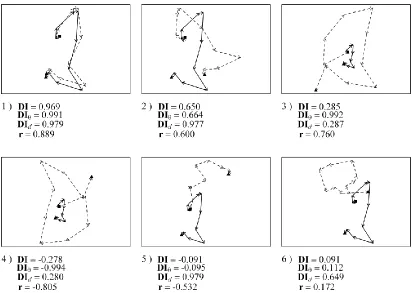
Using the six simulated datasets we compared global values for DI, DIθ, and DId
317
with Shirabe’s (2006) r statistic (Figure 4) to reveal both the similarities and differences 318
between these two methods. In scenario 1, where both movements are highly interactive 319
in both displacement and azimuth, DI and r are very similar. In scenario 2 DI and r are 320
similar, however using the DI method we can identify that interaction is higher in 321
displacement (DId = 0.977), and lower in azimuth (DIθ = 0.664). In contrast, scenario 3
322
reveals a situation where DI and r exhibit substantially different results. Using DIθ and 323
DId we can further examine the nature of the interaction in both azimuth and
324
displacement, in this case DId = 0.287 and DIθ = 0.992. High DIθ independent of DId
325
could be useful in measuring interactive movement patterns via different modes of 326
transportation (e.g., walking vs. biking), or scale independent movement behavior in 327
present (i.e., repulsion). In this case, DI is small and negative (DI = -0.278) due to low 329
interaction in displacement (DId = 0.280), while rxy is large and negative (r = -0.805).
330
Scenario 5, shows the case where low DI is a function of low interaction in azimuth (DIθ
331
= -0.095), despite having a strong level of interaction in movement displacement (DId =
332
0.979), while rxy = -0.532. Measurement of high vs. low DId independent of DIθ could be
333
used in behavior analysis to identify objects with similar diurnal activity patterns (i.e., 334
temporal patterns of long and short movements). In Scenario 6, both DI and r show 335
values near 0, as would be expected from two independent random motions. It is 336
interesting to note that DId = 0.649 is relatively high in this example, as the random
337
walks used identical parameters for their displacement distributions. 338
< Approximate location of Figure 4 > 339
5.2 Athletes – Ultimate Frisbee 340
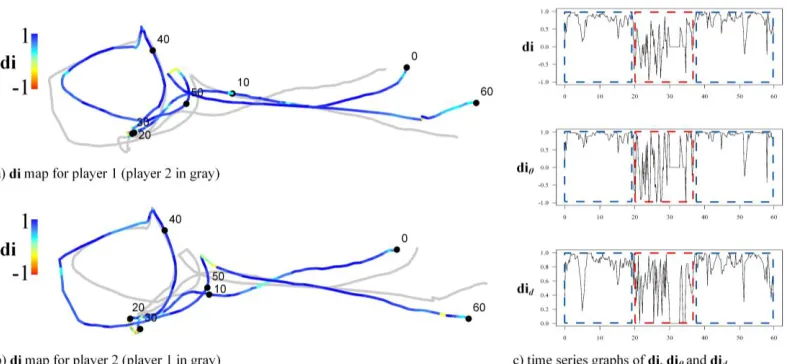
In the Ultimate Frisbee example, the two players positively interact in movement 341
azimuth (DIθ = 0.682) and movement displacement (DId = 0.730). The global statistic
342
shows that a substantial level of interaction exists between the two athletes (DI = 0.572). 343
Local analysis enables the identification of times/locations where the athletes exhibit 344
more or less interactive movements (Figure 5). In the ultimate frisbee example, local 345
analysis is more informative than the global measure, as the movement path consists of 346
many (shorter) movement segments. Maps of local di can be combined with a time-series 347
graph of di, diθ, and did related to times/locations during the game where the defending 348
player did a poor job covering the offensive player. We use episodal level analysis to 349
segregate the movement paths into episodes of high vs. low interaction in order to further 350
- 40 seconds (highlighted in blue in Figure 5), high and positive di values suggest the 352
defending player is providing good defensive coverage (for these two episodes DI = 353
0.757). While from 20 - 38 seconds (highlighted in red in Figure 5) di values are much 354
lower, an indication of less interactive movement and poor defensive coverage (for this 355
episode DI = 0.122). 356
< Approximate location of Figure 5 > 357
5.3 Grizzly Bears in Alberta, Canada 358
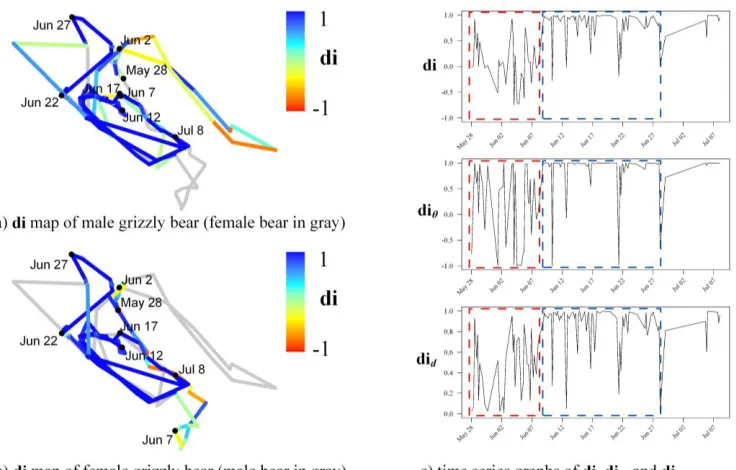
In the grizzly bear example it was revealed that the male and female bears showed 359
substantial interaction (DI = 0.578) over the 42 day period from May 28, 2000 to July 8, 360
2000, using time-based weighting (see equation (11)) to account for missing fixes. 361
Similarly, time weighted results for azimuth (DIθ = 0.663) and displacement (DId = 362
0.731) reveal that both azimuth and displacement were strongly related during this 363
period. Local analysis revealed that the strong interaction seen with the global results was 364
a function of highly cohesive movements during the middle of June, while at the 365
beginning of June the two animals show little interaction (see Figure 6). Again we 366
perform analysis at the episodal level for separate periods identified visually from the 367
local analysis as having low and high dynamic interaction (low interaction: May 28 – 368
June 09; high interaction: June 09 – 29). The period of high interactions has a time-369
weighted DI = 0.492, while the period of low interaction has a time-weighted DI = 0.029. 370
Highly interactive behavior by mating grizzly bears is common in this region, as males 371
will attempt to confine female movements to a ‘mating area’ (Hamer and Herrero 1990). 372
Interpretation of maps and graphs of di facilitates the identification of where and when 373
< Approximate location of Figure 6 > 375
6 Discussion
376
DI has three fundamental advantages over an existing method (Shirabe 2006) for 377
measuring interactions (termed correlations) in movement data. First, the existing method 378
follows a traditional correlation coefficient structure and is thus dependent on the mean 379
vector of a movement vector time series. In most cases, this mean movement vector will 380
have little relevance in the context of the analysis. However, in cases where interactions 381
are expected to occur relative to some mean movement trajectory, the method from 382
Shirabe (2006) is still advantageous. For instance, two objects moving radially from a 383
point (at some acute angle) may exhibit dynamic interaction (e.g., Fig. 4a in Shirabe 384
2006). Second, DI is explicitly decomposed into components measuring interaction in 385
movement azimuth and displacement. This property enables analysts to identify 386
situations where movements are related in one component but not the other. For example, 387
in scenario 3, DId is low, however strong interaction is present in DIθ, indicating that the
388
objects move with similar azimuths but not displacements, a conclusion not discernable 389
from the rxy statistic. Lastly, the di statistics we have developed are calculated
390
independently for each simultaneous movement segment. The di values can be mapped 391
and analyzed in a time-series fashion providing a local level analysis. Local analysis 392
reveals spatial-temporal information about locations of increased or decreased interaction 393
along the movement trajectory. Furthermore, the local level statistics (di, diθ, and did) are 394
easily aggregated to coarser levels of analysis (interval, episodal, and global). 395
Other research areas where measuring movement interactions could provide new 396
examples. In transportation applications measuring interactions in large movement 398
databases could be used for generating information on commuter behavior. Examples 399
from human-activity research where interactions are important include tourist behavior 400
(e.g., Shoval and Isaacson 2007) or crowd dynamics (Batty et al. 2003). With wildlife 401
movement data, the detection of interactions is important in the study of resource 402
selection (Millspaugh et al. 1998) and social behavior (Bandeira de Melo et al. 2007; 403
Kenward et al. 1993), but also for examining offspring dependency, and inter-/intra-404
species behavior. Finally, a number of sporting examples exist where measuring 405
movement interactions could provide new and unique insight including soccer, American 406
football, and ice hockey. 407
We use simulated movement data to highlight the advantages of DI over an 408
existing method in a small set of specific scenarios designed to show the range of 409
dynamic interactions present in movement data. When two movements are highly 410
interactive (e.g., scenario 1) both methods successfully identify the high level of dynamic 411
interaction. Also, when two movements show opposing or repulsive movements (e.g., 412
scenario 4) both methods are able to identify this behavior. The value of the DI method is 413
demonstrated in scenarios 3, 4, and 5, where interactions in either azimuth or 414
displacement are coupled with no interaction in the other component. This type of 415
analysis may be useful, for example, when object movement is dependent on a temporal 416
factor. For instance, many wildlife species are active only at specific times of the day and 417
remain dormant during other periods. Measuring positive dynamic interactions in 418
different species or individuals operate with similar circadian cycles (Merrill and Mech 420
2003). 421
The example from athletes playing ultimate frisbee demonstrates the value of 422
measuring dynamic interactions at the local and episodal levels of analysis. Local and 423
episodal analysis revealed periods of varying degrees of dynamic interaction, which can 424
be related to player performance (i.e., how well the defensive player was able to cover the 425
offensive player). In many team sports, player evaluation has traditionally been 426
conducted by human observers. More recently, data driven analyses have become 427
common in the evaluation of players in team sports (e.g., Fearnhead and Taylor 2011). 428
When a player’s movement can be directly related to specific abilities, for instance the 429
soccer example in Laube et al. (2005), the measurement of dynamic interactions, using 430
the DI method can enhance player evaluation using novel sport-specific movement 431
datasets. 432
The DI method we have developed requires that movement locations be recorded 433
simultaneously. Such a tidy form of movement data (i.e., where objects locations are 434
recorded simultaneously) may not always be available, limiting the ability to implement 435
this method. In such cases, path interpolation methods (e.g., Tremblay et al. 2006) could 436
be used to estimate the locations of one object at coinciding times. Similarly, in many 437
applications the assumption that movement data are collected at a regular interval is not 438
satisfied (e.g., with movement data collected using cell-phone records). This is also the 439
case in many wildlife telemetry studies where missing fixes are common. In the grizzly 440
bear example, we demonstrate the value of temporal weighting the DI statistic to account 441
can provide unique and valuable insights into the nature of dynamic interactions present 443
in movement datasets. Local analysis reveals the times and locations of dynamic 444
interactions not discernable from global level statistics. When comparing male and 445
female grizzly bears, the dynamic interactions were likely due to mating behavior. This 446
example demonstrates the value of quantifying dynamic interactions in wildlife 447
movement datasets, as they can be related directly to specific social activities. 448
When movement data are collected at too fine a granularity, the movement 449
process (e.g., dynamic interaction) can be masked by data noise (termed over-sampling, 450
Turchin 1998). In these cases, down-sampling can be used to reduce data redundancy in 451
the movement path and improve the process signal to noise ratio. The DI statistics can 452
then be computed on the re-sampled movement dataset, as another form of interval and/or 453
episodal analysis (e.g., Laube et al. 2007). Variations of this procedure at different 454
interval and episodal scales can lead to increasingly complex and cross-scale 455
investigations of dynamic interactions in moving object datasets. Recently, Laube and 456
Purves (2011) have discussed the impact that movement data granularity (i.e., sampling 457
resolution) has on metrics used to quantify and describe movement trajectories (e.g., 458
mean speed). The DI method is similarly impacted by the granularity at which 459
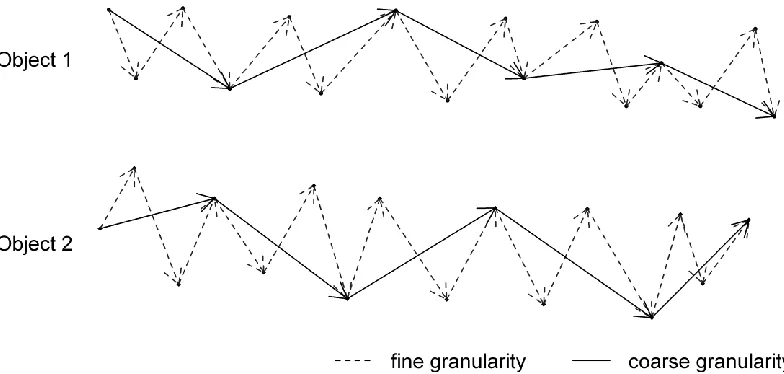
movement data are represented. For example, at a coarse granularity objects may exhibit 460
positive dynamic interactions, while at a fine granularity their movements may show 461
negative dynamic interaction (see Figure 7). Both the granularity at which the data are 462
represented and analysis level selected will impact the results and subsequent 463
movement data analysis be conducted across a range of scales (granularities and analysis 465
levels) to correctly understand observed patterns. 466
< Approximate location of Figure 7 > 467
6 Conclusions
468
Movement data are being collected for a variety of research agendas involving the 469
study of humans, their vehicles, and wildlife. Central to analyzing movement data is the 470
measurement of dynamic interactions between pairs of moving objects. We have 471
developed a new statistic (DI) for measuring dynamic interactions in discrete movement 472
data (e.g., with a GPS). The basic properties of movement segments – azimuth and 473
displacement, are used to detect dynamic interactions in azimuth, displacement, and 474
overall movement. The DI method can be applied at four analysis levels (local, interval, 475
episodal, and global - Laube et al. 2007) associated with movement data, and results can 476
be aggregated across analysis levels. We introduce both time- and distance-based 477
weighting schemes that can be useful in specific situations. The measurement of dynamic 478
interactions at a temporal-lag, an example of trend-setting (Laube et al. 2005), can be 479
easily incorporated. Like many spatial analysis techniques the DI method is impacted by 480
the granularity at which movement data is represented. A detailed investigation of cross-481
scale effects is warranted to provide a better understanding of how the measurement of 482
dynamic interaction is impacted by changing data granularities. 483
In some situations the nature of movement interactions will not simply involve 484
two moving objects, but rather involve two moving objects impacted by a third. Consider 485
the grizzly bear example; the bears exhibit varying levels of dynamic interaction over the 486
relative to the location of other objects, including other bears, roads, or sources of 488
attraction or repulsion (i.e., food or danger). Future research will develop approaches for 489
measuring third-party interactions, whereby pairs of moving objects interact with respect 490
to a third stationary or moving object. 491
To those wishing to measure dynamic interactions with their own applications we 492
have developed code for implementing DI in the statistical software package R (R 493
Development Core Team 2011), for more information please visit: 494
<insert link to website here> 495
Acknowledgements
496
Funding for this work was provided by Canada’s Natural Science and 497
Engineering Research Council (NSERC) and GEOIDE through the Government of 498
Canada’s Networks for Centres of Excellence program. A special thanks to G. Stenhouse 499
and the Foothills Research Institute for access to the grizzly bear data used in the case 500
study. Also, thanks go out to the University of Victoria Ultimate Frisbee Club for their 501
participation in ongoing data collection endeavors. The constructive comments we 502
received from three anonymous reviewers greatly improved the presentation of this 503
article. 504
References
506 507
Alt H and Godau M 1995 Computing the Fréchet distance between two polygonal curves. 508
International Journal of Computational Geometry & Applications 5 (1-2): 75-91 509
Bandeira de Melo L F, Lima Sabato M A, Vaz Magni E M, Young R J and Coelho C M 510
2007 Secret lives of maned wolves (Chrysocyon brachyurus Illiger 1815): as 511
revealed by GPS tracking collars. Journal of Zoology 271 27-36 512
Batty M, Desyllas J and Duxbury E 2003 The discrete dynamics of small-scale events: 513
agent-based models of mobility in carnivals and street parades. International 514
Journal of Geographical Information Science 17 (7): 673-97 515
Benkert M, Djordjevic B, Gudmundsson J and Wolle T 2007 Finding popular places. In 516
Tokuyama T (eds) Proceedings of the ISAAC 2007, LNCS 4835: 776-87 517
Benkert M, Gudmundsson J, Hubner F and Wolle T 2008 Reporting flock patterns. 518
Computational Geometry 41 111-25 519
Buchin K, Buchin M and Gudmundsson J 2010 Constrained free space diagrams: a tool 520
for trajectory analysis. International Journal of Geographical Information 521
Science 24 (7): 1101-25 522
de Lucca Siqueira F and Bogorny V 2011 Discovering chasing behavior in moving object 523
trajectories. Transactions in GIS 15 (5): 667-88 524
Doncaster C P 1990 Non-parametric estimates of interactions from radio-tracking data. 525
Journal of Theoretical Biology 143 431-43 526
Fearnhead P and Taylor B M 2011 On estimating the ability of NBA players. Journal of 527
Quantitative Analysis in Sports 7 (3): Article 11 528
Gao Y, Zheng B, Chen G and Li Q 2010 Algorithms for constrained k-nearest neighbor 529
queries over moving object trajectories. Geoinformatica 14 241-76 530
Hamer D and Herrero S 1990 Courtship and use of mating areas by grizzly bears in the 531
front ranges of Banff National Park, Alberta. Canadian Journal of Zoology 68 532
2695-97 533
Kenward R E, Marcstrom V and Karlbom M 1993 Post-nestling behaviour in goshawks, 534
Accipiter gentilis: II. Sex differences in sociality and nest-switching. Animal 535
Behaviour 46 371-78 536
Laube P, Imfeld S and Weibel R 2005 Discovering relative motion patterns in groups of 537
moving point objects. International Journal of Geographical Information Science 538
19 (6): 639-68 539
Laube P, Dennis T, Forer P and Walker M 2007 Movement beyond the snapshot - 540
Dynamic analysis of geospatial lifelines. Computers, Environment and Urban 541
Systems 31 481-501 542
Laube P and Purves R S 2011 How fast is a cow? Cross-scale analysis of movement data. 543
Transactions in GIS 15 (3): 401-18 544
Macdonald D W, Ball F G and Hough N G 1980 The evaluation of home range size and 545
configuration using radio tracking data. In Amlaner C J and Macdonald D W 546
(eds) A Handbook on Biotelemetry and Radio Tracking. Oxford, Pergamon Press: 547
405-24 548
Merrill S B and Mech L D 2003 The usefulness of GPS telemetry to study wolf circadian 549
Millspaugh J J, Skalski J R, Kernohan B J, Raedeke K J, Brundige G C and Cooper A B 551
1998 Some comments on spatial independence in studies of resource selection. 552
Wildlife Society Bulletin 26 (2): 232-36 553
Noyon V, Claramunt C and Devogele T 2007 A relative representation of trajectories in 554
geographical spaces. Geoinformatica 11 479-96 555
R Development Core Team 2011 R: A language and environment for statistical 556
computing. R Foundation for Statistical Computing. ISBN 3-900051-07-0, URL 557
http://www.R-project.org Vienna, Austria
558
Shirabe T 2006 Correlation analysis of discrete motions. In Raubal M, Miller H J, Frank 559
A U and Goodchild M F (eds) GIScience 2006. LNCS, vol. 4197. Berlin, 560
Springer-Verlag: 370-82 561
Shoval N and Isaacson M 2007 Sequence alignment as a method for human activity 562
analysis in space and time. Annals of the Association of American Geographers 563
97 (2): 282-97 564
Sinha G and Mark D M 2005 Measuring similarity between geospatial lifelines in studies 565
of environmental health. Journal of Geographical Systems 7 115-36 566
Stenhouse G B, Boulanger J, Lee J, Graham K, Duval J and Cranston J 2005 Grizzly bear 567
associations along the eastern slopes of Alberta. Ursus 16 (1): 31-40 568
Tremblay Y, Shaffer S A, Fowler S L, Kuhn C E, McDonald B I, Weise M J, Bost C A, 569
Weimerskirch H, Crocker D E, Goebel M E and Costa D P 2006 Interpolation of 570
animal tracking data in a fluid environment. The Journal of Experimental Biology 571
209 128-40 572
Turchin P 1998 Quantitative Analysis of Movement: Measuring and Modelling 573
Population Redistribution in Animals and Plants. Sunderland, MA, Sinauer 574
Vlachos M, Gunopulos D and Kollios G 2002 Robust similarity measures for mobile 575
object trajectories. In (eds) Proceedings of the 5th International Workshop on 576
Mobility in Databases and Distributed Systems (MDDS), Aix-en-Provence, 577
France: 721-26 578
Wolfer D P, Madani R, Valenti P and Lipp H-P 2001 Extended analysis of path data from 579
mutant mice using the public domain software Wintrack. Physiology & Behavior 580
73 745-53 581
Yanagisawa Y, Akahani J I and Satoh T 2003 Shape-based similarity query for trajectory 582
of mobile objects. In Chen M-S, Chysanthis P K, Sloman M and Zaslavsky A 583
(eds) Mobile Data Management, LNCS 2574. Berlin, Springer-Verlag: 63-77 584
Table 1: Simulated movement scenarios, depicting different types of dynamic
interactions, used to examine the differences between the new interaction statistic (DI) and an existing method (r).
Scenario Azimuth (θ) Displacement (d) 1 Positive interaction Interaction
2 Positive interaction (rotated by 45°)
Interaction
3 Positive interaction No interaction
4 Negative interaction No interaction
5 No interaction Interaction
6 Random Random
Figure 6: Local analysis showing maps of di values for a) the male grizzly bear (G006), and b) the female grizzly bear (G010), from the grizzly bear example. c) time series graphs of di, diθ, and did can be used to identify periods of high and low dynamic