L.H. Lee, M.E. Kuhl, J.W. Fowler, and S. Robinson, eds.
ABSTRACT
In this paper, we investigate output accuracy for a Discrete Event Simulation (DES) model and Agent Based Simula-tion (ABS) model. The purpose of this investigaSimula-tion is to find out which of these simulation techniques is the best one for modelling human reactive behaviour in the retail sector. In order to study the output accuracy in both mod-els, we have carried out a validation experiment in which we compared the results from our simulation models to the performance of a real system. Our experiment was carried out using a large UK department store as a case study. We had to determine an efficient implementation of manage-ment policy in the store’s fitting room using DES and ABS. Overall, we have found that both simulation models were a good representation of the real system when model-ling human reactive behaviour.
1 INTRODUCTION
Simulation has become a preferred tool in Operation Re-search (OR) for modelling complex systems. Studies in human behaviour modelling have received increased focus and attention from simulation research in the UK (Robin-son 2004). The research in human behaviour modelling has been applied to various application areas such as manufac-turing, health care, military and many more. As found in the literature, researchers choose either Discrete Event Simulation (DES) or Agent Based Simulation (ABS) as tools to investigate human behaviour problems. The choice of which simulation technique to be used relies on the in-dividual judgment of the simulation model characteristics and their experience with the model. The representation of human behaviour contains complexity and variability; therefore when investigating such systems it is very impor-tant to choose a suitable modelling and simulation tech-nique.
In this research, we aim to provide an empirical study in order to find out which simulation modelling technique
is a good representation of a real system in our validation experiment. In the validation experiment we have com-pared the results from traditional DES and ABS models to the performance of the real system. The main difference between traditional DES and ABS is that in the first one the modelling focuses on the process flow, while in the ABS the modelling focus is on the individual entities in the system and their interactions.
Human reactive behaviour means “how a certain indi-vidual responds to a certain request. For example, sales staff provides help when needed. In this work, we investi-gate the output accuracy of DES and ABS models when modelling human reactive behaviour in a department store. Statistical tests were used to compare the models.
The content of the report is as follows: a background section which gives a taxonomy of simulation techniques and a discussion of previous related work. Background in Section 2 explores the theory and characteristics of three major OR simulation methods, i.e. DES, ABS and System Dynamics (SD). In Section 3, we define our case study and the model design. Validation experimentation is presented in Section 4, where we also compare our simulation mod-els’ output against the real world output by using quantita-tive methods. In addition results from the experiment are also discussed. Finally in Section 5 we draw our conclu-sions and summarize the current progress of our research.
2 BACKGROUND
There are several tools and techniques that can be used to model a system. Modelling is a process of abstracting a real world problem into modelling tools. Over the last three decades, simulation has become a frequently used model-ling tool in OR (Kelton 2007).
A simulation can be defined as a process of executing a model over time. Its ability to model complex systems has made simulation the preferred user choice when com-pared to mathematical models. Simulation can be classified INVESTIGATING OUTPUT ACCURACY FOR A DISCRETE EVENT SIMULATION MODEL
AND AN AGENT BASED SIMULATION MODEL Mazlina Abdul Majid
School of Computer Science Nottingham University Nottingham, NG8 1BB, U.K.
Uwe Aickelin
School of Computer Science Nottingham University Nottingham, NG8 1BB, U.K.
Peer-Olaf Siebers
Majid, Aickelin and Siebers into three types; Discrete Event Simulation (DES), System
Dynamics (SD) and Agent Based Simulation (ABS). DES models represent a system based on a series of chronological sequencing of events where each event changes state in discrete time. Meanwhile, SD models rep-resent real world phenomenon using stock and flow dia-grams, causal loop diagrams (to represent a number of in-teracting feedback loops) and differential equations. In contrast to the DES and SD models, ABS models comprise of a number of autonomous, responsive and interactive agents that will interact with each other in order to achieve their objectives. We can summarise the three simulation techniques as follows: the DES and ABS models are suit-able to work with discrete event. They both model changes in discrete time from one event to another. On the other hand, SD models are suitable for modelling a system with continuous state changes.
We have found literature performing comparisons be-tween the DES and ABS models together with SD models in terms of model characteristics; however, none of them are currently focusing on modelling human behaviour. One of the relevant papers comparing simulation technique with regards to model characteristics is (Wakeland et al. 2005), where they have compared SD and ABS in field of Bio-medical. The authors found that the understanding of the aggregate behaviour in SD models and state changes in in-dividual entities in ABS models is relevant in the study. SD and DES comparisons in the field of Fisheries were de-scribed by (Morecroft and Robinson 2006). They found that SD and DES are different approaches but both are suitable for modelling systems over time. Existing com-parisons between DES and ABS were described by (Becker et al. 2006) in the field of transportation where they found that DES is less flexible than ABS, i.e. it is dif-ficult to model different behaviours of shippers in DES. In addition to the existing comparison between DES and ABS, (Yu et al. 2007) performed a quantitative comparison on the DES and ABS models outputs in the field of trans-portation. We found just one work that describes the three techniques discussed in this study. (Owen et al 2008) tried to establishing a framework for comparing the different modelling techniques.
We have also found a disparity in the quantity of work comparing SD and ABS or SD and DES contrasted to the amount of work comparing DES and ABS. Specifically, this disparity can be outstanded when referring to model-ling human behavioural and where the focus is output ac-curacy. Therefore, in this research we choose to study the differences between DES and ABS in this regard.
To study the differences in both models, we choose to focus on management practices in retail with regards to worker behaviour. Research in retail previously focused on consumer behaviour (i.e. Schenk et al. 2007). However, research in management practices has started to evolve as described by (Siebers et al. 2007, 2008). As discussed in
the existing comparison of simulation techniques above, a lot of work has been done to compare simulation tech-niques in transportation and supply chain management. These studies have focused on modelling characteristics. On the other hand, we have decided to compare the accu-racy of output in the DES and ABS models on manage-ment practices, as it is currently a developing area of study in the retail domain.
3 CASE STUDY FIELDWORK
In order to achieve our aim, we have used a case study ap-proach. The research has focused on the operation of the main fitting room in the womenswear department of one of the top ten retailers in the UK (see Figure 1). We wanted to identify the potential impact for fitting room performance when having different numbers of sales staff permanently present.
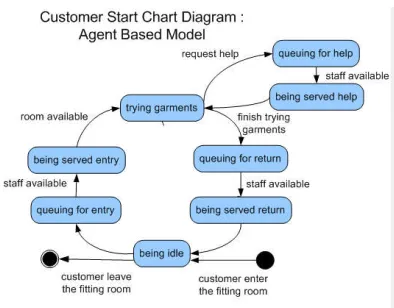
We have investigated the staff behaviour on human re-active behaviour, which relates to staff responding to the customer when being available and requested. From the case study exploration, we have produced a flow chart dia-gram for DES conceptual models (see Figure 2) as in DES we focus on process flow. Our ABS conceptual models (see Figure 3 for an example) are state chart diagrams for the different types of people we had to represent (in our case customers and staff) as in ABS we focus on the indi-vidual ‘actors’ and their interactions.
In the fitting room operation, the staff reactive behav-iours can be seen in three jobs. Job 1 is about counting the number of garments and giving the green card, job 2 is about providing help and lastly job 3 is about receiving the green card and unwanted garments from the customers. The case study data has been transformed into the simula-tion inputs for the experimentasimula-tion.
4 EXPERIMENTATION
L.H. Lee, M.E. Kuhl, J.W. Fowler, and S. Robinson, eds.
Figure 1: An illustration of the main fitting room operation
we describe how we have performed our validation ex-periment.
4.1 Validation Experiment
We have used black box validation to compare the simula-tion outputs from DES and ABS with the real system out-put using quantitative method. By using statistical methods for this comparison, we are able to find out which simula-tion model is a good representasimula-tion of a real system. We compared output data observed in the department store to the distribution of the predicted output generated by each model. By assuming the alternative hypothesis is the oppo-site of null hypothesis in all tests, thus in the paper we will only state the null hypothesis. The main hypothesis for the validation test was constructed as following:
Ho= DES model is a good representation of a real system Ho= ABS model is a good representation of a real system
We have used mean waiting time from the three queues as our performance measurement in the experiment. This was the only performance data we were able to collect from the real system. Two tests have been setup in answer-ing the hypothesis. These tests are described in the follow-ing sub-section.
4.1.1 Test 1: Comparing Medians Using a Non Parametric Test
In Normal distributed data, the observed mean, median and mode will have similar values because they are identical in the population. Since waiting time data are not normally distrib-uted, we have chosen to compare medians as a more robust measure of central tendency rather than means and have cho-sen a Non Parametric statistical test known as Mann-Whitney to avoid assuming Normality. We have constructed the fol-lowing hypothesis for the test:
[image:3.612.317.514.267.421.2] [image:3.612.83.290.273.427.2]Majid, Aickelin and Siebers Ho= DES models are not significantly different with real
system in mean customer waiting time
Ho= ABS models are not significantly different with real sys-tem in mean customer waiting time
In performing the Mann-Whitney test, we have used the open source statistical software, R. The median of wait-ing time from DES and ABS models and real system were used for the comparison purpose. We have chosen 0.05 as the level of significance. If the probability of seeing data as or more different than expected under the model is smaller than 0.05, we reject the null hypothesis. If it is not then we fail to reject the null hypothesis. Put some simply we can conclude that the data we observed are consistent with the model’s predictions (without assuming that the model must itself therefore be correct). In the statistic test for DES model against real system, p-value is 0.3269.Since the p-value is not less than the chosen sigma p-value of 0.05; there is insufficient evidence to reject our hypothesis. The statis-tic test for ABS model against real system showed similar results when it had a p-value of 0.2958, and it was larger than the chosen level of 0.05.Therefore, we fail to reject our hypothesis for both simulation models. We find the distribution of median waiting times is consistent with both models. Next we look at the variability of waiting time to see if the one we get from our simulation models matches the variability we can observe in the real system.
4.1.2 Test 2: Measuring Variability
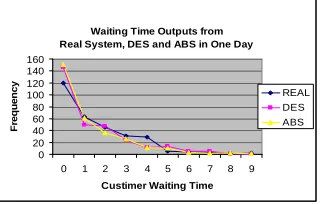
[image:4.612.336.554.294.358.2]In finding out which DES and ABS models are having more variation against real system we have plotted a fre-quency distribution of customer waiting time for a single day (represents one replication) from both simulation mod-els and real system (Figure 4).
Figure 4: Waiting time outputs for one day in real system, DES and ABS models.
Next, we calculate the variance (a measure of disper-sion) of customer waiting times. This allows us to compare the variability of the simulation outputs data against real system on a statistical basis by study the spread of fre-quency distribution of customer waiting time from both
simulation models and real system. To execute the test, we have produced the following hypothesis:
Ho= DES model shows similar variability compare to the real system
Ho= ABS model shows similar variability compare to the real system
[image:4.612.97.258.498.600.2]The spread of frequency distribution for DES and ABS models (as shown in Figure 4) seem slightly different and to look into their differences, we have compared the variances of the outputs. The variance shows how close the simulation outputs i.e. waiting time, in the distribution are to the middle of the distribution.
Table 1: Waiting time outputs for DES, ABS and real sys-tem in one day with standard deviation and variance.
Models
Mean waiting time (minutes)
Standard
deviation Variance
Real system 1.68 1.73 3.01
DES 1.69 1.59 1.96
ABS 1.61 1.70 2.89
By looking at the result in Table 1 above, the variance between DES model and the real system is significantly different with 35% difference and ABS model is similar with real system with 4% difference. The reason for the differences in variance for both simulation models may be due to the different operation structure in DES and ABS mod-els. The entities in DES model are having a strong order and they are depending to each other to change their state. Mean-while agents in ABS model are in decentralised order and they change their state independently. For this test we fail to reject our hypothesis for ABS model where the model has produced similar variability with the real system. However, we have to reject the hypothesis for DES model where the model has shown dissimilarity in variability when compared to the real system.
4.1.3 Validation Experiment Conclusion
In conclusion we find on statistically significant differ-ences between the DES and ABS models when compared to the real system in Test 1. However in Test 2 we found DES model produced different variability then the real sys-tem and ABS produced the similar variability with the real system. Therefore based on Test 2 result, we suggest that the ABS model is more suitable in representing the behav-iour of the real system where the operation involving hu-man is the main focus of the system. Nevertheless based on the validation experiment both simulation models are good in representing the real system and ABS shows better rep-resentation of the real system when passed the Test 2.
Waiting Time Outputs from Real System, DES and ABS in One Day
0 20 40 60 80 100 120 140 160
0 1 2 3 4 5 6 7 8 9 Custimer Waiting Time
F
re
q
u
e
n
c
y
5 CONCLUSION AND FUTURE WORK
In the validation experiments between DES and ABS mod-els, we are able to demonstrate which simulation models is a good representation of real system when modelling hu-man reactive behaviour. To achieve that, we compared the output accuracy of the simulation outputs with the real sys-tem in mean customer waiting time. Statistical methods to analyse the outputs have helped us to identify the statistical significance of the similarity and difference of the simula-tion models to one another. The testing suggested that even though both DES and ABS models produce similar outputs in Test 1, when we compared their medians to the real sys-tem, they showed different variation in their model outputs in Test 2. ABS models reflect the real system behaviour much better than DES model in terms of their predicted variability in waiting times. The system that we modelled in DES and ABS is a typical queuing system with no extra features of complex human behaviour. Moreover, based on the validation results we have concluded that both DES and ABS models are a good representation of the real sys-tem that contains human reactive behaviour. Investigating the outputs’ behaviour using different sample data and dif-ferent scenarios will be carried out as part of our future work. We also want to evolve our experiment by modelling human proactive behaviour in ABS only and look into the benefit of modelling such behaviour in a queuing system for the OR simulation study.
REFERENCES
Becker, M. 2006. Agent-based and Discrete Event Simula-tion of Autonomous Logistic Processes for the Pro-ceedings of: Borutzky, W.; Orsoni, A.; Zobel, R. (eds.): 20thEuropean Conference on Modelling and Simula-tion. pp. 566-571.
Kelton, W.D. et al. 2007. Simulation with ARENA: Fourth Edition. New York: McGraw-Hill. ISBN 0-07-110685-5.
Morecroft. J., and S. Robinson. 2006. Comparing Discrete-Event Simulation And System Dynamics: Modelling A Fishery for theProceedings of the 2006 OR Society Simulation Workshop S. Robinson, S. Taylor, S. Brailsford and J.Garnett, eds.
Owen, C. , D. D. Love, and P. Albores.2008.Selection of Simulation Tools for Improving Supply Chain Per-formance for theProceedings of the 2008 OR Society Simulation Workshop.
Robinson, S. 2004.Discrete-event simulation: from the pioneers to the present, what next? Journal of the Op-erational Research Society. 56, 619–629.
Schenk, et al. 2007. Agent-based simulation of consumer behavior in grocery shopping on a regional level. Journal of Business Research60. 894–903
Siebers, P.O. et al. 2007. “Using Intelligent Agents to Un-derstand Management Practices and Retail Productiv-ity.” In Proceedings of the Winter Simulation Confer-ence, (Dec 9-12 2007).Washington DC, USA, 2212-2220
Siebers, P.O. et al, 2008. “An Agent-Based Simulation of In-Store Customer Experiences.” for theProceedings of the 2008 Operational Research Society Simulation Workshop,(April 1-2). Worcestershire, UK.
Yu, T. T, J. P. Scanlan., and G. B. Wills. 2007. Agent-Based and Discrete-Event Modelling: A quantitative approach. 7thAIAA Aviation Technology, Integration and Operation Conference (ATIO).
Wakeland, et al. 2005. “A Tale of Two Methods—Agent-Based Simulation and System Dynamics—Applied in a Biomedical Context: Acute Inflammatory Re-sponse,” 6th European Congress of Systems Science.
AUTHORS BIOGRAPHIES
MAZLINA ABDUL MAJID is a PhD student in the School of Computer Science, University of Nottingham. Her interest is in discrete event simulation and agent based simulation. Her email is<[email protected]>.
Prof. UWE AICKELIN is a Professor in the School of Computer Science, University of Nottingham. His interests include agent-based simulation, heuristic optimization and artificial immune system His email is<[email protected]>.