warwick.ac.uk/lib-publications
A Thesis Submitted for the Degree of PhD at the University of Warwick
Permanent WRAP URL:
http://wrap.warwick.ac.uk/88811
Copyright and reuse:
This thesis is made available online and is protected by original copyright.
Please scroll down to view the document itself.
Please refer to the repository record for this item for information to help you to cite it.
Our policy information is available from the repository home page.
Chin~s~ Wo~~n i n Whit~
A Study of Nurses in Taiwan
A thesis
by
Liu, Chung-tung
of
Department of Sociology
Presented far the degree of Doctor of Philosophy
at the University of Warwick
FO!- my ch i Idren:
The ;.·,rock desc)-ibed in this thesis was ca)Tied out betweell r.:..;ril 1'~35
and Januacy 1989 under the dicection oi Professor M. Stacev in the
Depal-tment of Sociology of Warwick University. The I-.IO)-k is ociginal and no
P r e r a . c : e
The work started when I fil-sf. r-egistered CiS a part time Postgr-aduate
student at Warwick, after- finishing my MSc degr-ee in medical sociology at
Bedford College, London University in October 1982. Some preliminary
investment had been done and a few essays written while I was in Taiwan
teaching in a medical school. But i t was unly after April 1985, when
secured a gr-an t from the Ch inese Cen tra 1 Governmen t in Ta iwan to come over
England again and switched to full time study, that the real work could
really st.art. Since then, many parts of the work have been changed, such as
the target problems and the methodology to lackle them. The whole war-king
process was dynamic. Ideas exchanged, t loating to and fro between my
supervisor, Professor Margaret Stacey and me over years to find out
results, as well as problems and methods. Only the original purpose of the
study (Chinese women) and the sample group (nurses) have remained the same
and still fascinate me.
The prob lems were focussed gradua lly. The process of emergence of the
problems and the conceptual framework used in the study will be described in
part 1: introduction.
The methodology changed in response to the focusing of the problems.
So th the orig ina I p Ian and the eva 1 v ing curren t des ign will be presen ted in
Par t 2: the ,-esearch process. The fie ld wor k and da ta ana I ys is w 111 be a Iso
deaH with in the same part. Some fut-ther but small alterations away from
the reseal' ch p Ian were made to adjust to the s i tua t ion of the fie ld work as
it happened in practice.
Part 3 will be the results of the historical and literature review. The
their background of Chinese women's life in the past (chapter 8) and at the
present day in Taiwan (chapter 10). A Iso. traditional Ch inese women healers
and carers and the modern nursing history (chapter g) were brought to light
to elucidate the problems in nursing today.
Part 4 will be the emergent themes which were attained t.hrough analysis
of the fie ld work. From these themes, a genera I prof! Ie 0 f the 1 if e of these
women in our sample in present day Taiwan gradually emerged.
In part 5 conclusions are drawn concerning 'the new patriarchy', in which
our respondents' lives are formed, as always around their menfolk - father.
husband and son - although with cer ta in differences from the s i tua t ion in
the past.
My special thanks are due to my supervisor for her encouragement,
support, challenge and inspiration in the past years. also owe a
particular debt to my respondents in this study, especially those who
accepted my interview, for their trust and allowing me insight into their
lives. I a Iso wan t to thank my fr lend Dr. M ichae 1 Rand Hoare who took grea t
pains over the correction of my English throughout and provided invaluable
Ca:n. -te::n. t s
Preface
Glossary
Part 1: Introduction
Chapter 1. Aim 01 the research
Chapter 2. The emergence of problems 9
Chapter 3. The conceptual framework 15
Part 2: The research process
ChapteI' 4-. El'eaking out of the 0.-18 inal plan
Chapter 5. The evolving research design
chapter 6. The field work 50
Part 3: The backgroWld review
Chapter g. The Ch~lese woman 87
Chaptel- 9. From 'San gu tiu po' to the 'Cadng scholar' 101
Chaptel- 10. The Taiwan case 116
Part 4: The emergent themes
chapter 11 . The filial daughter and the I-ebel 137
Chapt.er 12. The legend and truth 162
Chap tel- 13. The forbidden 8ame 191
Chapter 14. A woman's life ?lR
Chapter 15. Nursing - a profession in dilemma 246
Part 5: The Conclusion
Epilogue
Appendix
Schedule of work
Glossary
AH Army Hospital
FMC Female Military College (3 pseudonym for one college)
INC Junior Nursing College (one trainin8 program in Taipei, part elf
TPCN>
NAC Nurses' Association of China
NAROC: Nurses' Assoc ia t ion of Repub 1 ic of Ch ina
NOMe National Defence Medica 1 Cenb-e
OBS
OPD
PUMC
ROC
TPCN
TSGH
TUMC
Obstetr ic
Out patient department
Peiping Union Medical School
Republic of China
Taipei Provincial College of Nursing
Trl-service General Hospital, part of NDMe
Note on the romanization or' Chinese
As dll-h'IVS, there are problems ill 8iving a consistent romanization ot
Chinese terms. Where authors' names are concerneu, J have preserved their
own spell ins, i f given, whether in the older Wade-(riles s.vs tem or the mOl e
modern 'pin-yin'. When transliterating, the pin-vin system has been used as
far as possible. with the usual exceptiolls ,::,- very ,-ommon place-names.
List of non-pinyin terms
Names:
Chiang. Lan-hung Nora Chiao, Chien
Chin, C. H. Chou, Bih-el Chow, Mei-yu Chow, Tse-tsung Hsia, C.T.
Hsu. Fr-ancis L.K. Hsu, Mei-Chlh Lin, Tsalr-yuan
La Lee, Mei-li Lu, Yu-hsia Pao, Chia-lin Shih, Y.r.
Tsai. S.L. Tu, Tsung-ming Wang, Mamie Kwoh Yen, Ching-ping Yu, T.C.
Caveat
Places:
Damshui Fukien Kaohsiung Kinmen Nanking Taipei
It has not been possible in every instance to distinguish between
references to modern Chinese women in Taiwan and those to the totality of
women in the Chinese homeland. When it is not otherwise clear from the
con text, references to 'Chinese women' in the present tense should be assumed
Part 1: Introduction
Chapter 1. Aim of research
Chapier 2. The emel~ence 0i problems
Chapter I. Aim of research
Chinese women in Taiwan
The nurses
Cha.p tEar 1 . Ai-In OT r e s E a s r c h
The a im of th is study is to examine nurses 35 Chinese women as a step
towards understanding ~~hinese women in pr-esent-day Taiwan. Hv hope is t,hat
its r-esults may help in the understanding of woman's role and position in a
changing oriental society, while also exposing at the same time other
incompatability phenomena in the society due t:o culture implantation and
con fl ic t from the wes t.
To be more specific, the research is an attempt to examine the middle
class women's I ife both ,9t home as daughters, wives and mothers, 3nd ;:lIso in
public as professional workers; to see whether the persistence of the
tradi-tional expeclation (,I women influences or- interferes with women's life toda"
in genera 1 and tha t of nurses in particu lar. The hope is tha t i t ':an exp la in
some of the problems and dilemmas that the nursing profession faces today in
Taiwan. Thus there are two aspects t.o this work: Chinese women and nurses.
1. Chinese women in Taiwan
For thousands of yeaes, Chinese women were confined at home, deprived
and persecuted, notwithstanding r-epeated waves of feminist effected
movement, in particular t.hose associated with the Tai-ping Rebellion
<1851-1864-), the Republican Revolution (1911), the May Fourth Movement ,1919), the
promulgaion of the Civil Code (1931> (Davin 1978:15), and the revival of a
neo Confucian during the New Llfe Movement (1934) (Norma Diamond 1975:3-45).
To what extent have women in present-day Taiwan inherited this tradition?
In Taiwan recently, women's appeal-ance and behav1our- have changed
conSider-ably. For example they dress in the latest fashion, walking in the
street and sitting in cafes; some of them work at least for a few years of
their- life before man-iage: t1iey go to school to pursue higher and
-education. In consequence quite a few of them believe that they :u-e even
more privileged and freer than their western sisters, to the point where
some men complain that things have gone too far. Arguments like this could
go on IOl-evel-. But ·,.,Ihat is the tcuth? Apart fl-om their :lppearance, deep
inside their mind, we may wonder whether the traditional Chineseness still
"'arks in a complicated way 10 influellce lheic life.
Many works aboul CldllE:SE: ,oJornen have beE:n publishE:d, but lJecy few 3re
from the sociological point of view or using the empirical st.udy melhod.
Most of these works al-e on histocical issues; some have been concerned with
Ch inese women in the pas t (Chen 1965, Guo 1983, Pao 1979, L i & Zhang 1981) j
some concentrated on I.he 1I)0dein history of feminist movement (Li and Zhang
1976) and development. of female education <Liao 1983); some upon special
aspects of woman's life, such as law (Zhao 1977)j some upon successful or
distinguished women in history as women wdtecs CLi 1980). Factory workers
and the peasant women both in China and Taiwan attracted several western
writers (Kristeva 1986, Davin 1978, Wolf 1972, Kung 1976). Women in Chinese
Society (Wolf and Wltke,1979) included broader categories of the past and
presen t, Ii tel- acy and peasan t. iAlomen.
A few st.udies of Women in Taiwan have been done by A.merican
:mlhropolo-gists before mainland China was opened up (Wolf 1972, Kung 1976). In regard
to the middle class, Norma Diamond said that the woman's status tn Taiwan is
a case of "one step i"orwal-d and two steps back" <Dlamond,1973), whereas IIl0St
Ch inese 5cho lal-s ,.,IOIJ ld disagree with her. Even the leader sol IIlellY wOlllell's
organizations and groups would disagree, however unsatisfied they might be
"'ith their situation.
In add i t ion to a 11 the above, given a strong I y ma Ie dam ina ted aeadem ie
a tmosphel-e, it happens as Weber po in ted au t. abou t Can f LIe ian ism's laek a I"
esteem fOI- women <1951:162). Weber said: 'Confucius viewed woman as a
thOl-oughly irrational ct-eature often as difficult to deal with as servants.
condescension makes both women and servants forget theh- distance,
S tr ie tness in turn makes them ill-humored <1951: 161)'. Matters of women !we
trivial, therefore in Taiwan apart from a newly established women's study
to be closed in the near futur-e if no more financial aid is found), matters
of women and children have had and still have very little attraction for the
academic.
Apar t I, am shor tage of proper studies, there are I wo reasons which make
Taiwan a special candidate tor the study of the IJfe ot loodenl Illiddle class
Chinese women. It is a small changing society and it is culturally eccentric.
A sma 11 chang ing soc ie I.y
Taiwan has changed so much dut illg lLs industrialization and Ilrbanization
in the last. Ihh-ty 1,0 torty years, that many Chinese in Taiwan as well as
wesler-ners believe I,hat it is ,ather Amedcanised than Chinese. ;.. small
coun try chang ing f,-om
tradition to a modern
:in old agr iClJll.u,-al society
indus tr ia I ized one in a very
'N i th long s land ing
short period is of
particular interest. This lapid change of life style and impacts from Europe
and America challenge its total attitudes and values. Hence faiwan provides
an unusually good example 01 a ,apidly industr-ializing society within which
to view the effects of modernization on women's "ole. It. is a 1so tor such
reasons tha t stud ies from the emp laymen t po licy v iewpo in t (deve lopmen t and
women 'Norkel s elc) and of chinese women and social change are desirable
(Ban eLL t 987, Chou t 987).
Culturally eccentric
Some Chitlese scholar's believe t.hat., Tahran is the 'I,'essure pot· or
Chinese culture (Chen 1966), which survived the Japanese occupation
<1895-1945). The isolation Japan imposed on her own people from Ihe Tai·."anese :md
on hel- colony IIOhi China, protected the Chinese traditional culture in Taiwan
both (rOlti Ihe Japanese and the westel-n influences that provoked so much of
the social upheaval in Mainland China durillg t.he 1920s, 1930s and a 150 at ler
1949.
Some anthr-opologists such as Norma Diamond (1973) have taken the
attitude t.hat there is no feminist atmosphere at all in Taiwan. She seems
to believe that the Americans were very isolated in Taiwan and did not leave
much influence. Indkecl. impact Uwough the media from A.medca and Japan
could, however-, has been very significant in the recent years.
-2. The lIurses
The nurs ing pI-of ess ion was chosen CIS an examp Ie of m idd Ie and
lowel-middle class women in Taiwan ~l this study tor three reasons. First. because
it stands Zit the illtel-section 01 west :md east <a Chinese woman wOl-king in a
impor ted ',-Jestel-n institution). Second. because it is an old occupation but a
new profession. Third. because of its popularity in recent vears as one oi
the most favourite and suitable occupations tor young middle:md
lower-middle class women in Taiwan <Lu 1980), although signif icantlv. i t involves
close contact with men (doctors and patients) and the male bodv. It is
assumed in lhis study t.bat the problems laced by I,urses plobably represent a
key instance 01 women's expel ience between her work and family life in
present-day Taiwan. The problems encountered by the nursing profession
cou Id be exp la ined by the pl-ob lerns of it be ing a woman's job in a chang ing
Ch inese soc le ty he 19h tened by the par' t leu la,- char ac tel' at the wor k. The
following aspects are noteworthy in this respect.
The nurs in8 image
It is supposed by some oi the general public in Tal .... JaIl Ih8l I,ursin~ is a
fashionable 10b for young ~ornen. and that nurses are Jenerally more
VJes tern ized and have moce chance to ge t to knmoJ the oppos 1 te sex than women
in other occupations. Lhat they I.end t.o mar,'y doctors. and they have more
choices and fl-eedom in social activity and meeting lheir spouses. :\s to the
nursing leader-so they insist on the pure and innocent image of their nurses.
When a doc tor or a pa t ien t boas ts abou t It is experience with nurses, some
nurses, I-ather than t i~.ht tor Lheir sisters, admit and attack the 'corruption'
and 'casual (Le. pl-omiscuous) behaviour' of the black sheep among themselves.
What is the real life 01 nurses actually like? Do the dual images - of
'angel' and the 'easy' woman - have something to do with the persistence of
the traditional value ie. that of the carers in the past:' or with what a
'good' Ch inese woman shou ld be.
This might be true both for nurses as individual women and nursing as a
nur'ses are seen ne i the)' as tves ter'n, as some of the genera 1 pub 1 ic th ink. nor
sociali::ed into women \.Jho were [universal in sense ot belll~J like :':Ill uther
nurses. believing themselves totally universal, obiecti'le and detached trom
ChinesE: cultuce. ,,5 most Ilurses and nUI'sing leaders believe, Ra ther. they
are 'Sood Chinese \'Iomell' just like Gamarnikol.-I notes .:1bout nurses in the
western world that "the moral tr'aits of the 'good nurse' were evidently seen
within the profession itself .00S identical with the characteristics desirable
in a 'sood woman III (1978 :98). Ch inese nur'ses belIave 1 ike good Ch inese ',;omen,
with all the good nature and char-actedstics of an ideal Chinese woman in
modern Taiwan. or are expected to behave in this way.
For Chinese. 'wester'n' ~enerally indicates concepts and pr-actice \,jhich
wer'e brought to China bv the '...Jesterners. for- i.nstance the 'Xi '{i' (western
med ic ine). The ideas of sc ience. democracy, ind iv idua 1 ism, independence. open
socia 1 ac ti vi t Y '.v i th bo th sexes, coue tsh ip, mar r iage based on love. were a 11
I,lestern inputs. 'Western' or 'l)cean style' as used in everyday language to
describe a woman Chinese means simply more individual, more independent,
freer in social relations with the roale, in other words, 'wild'. By contrast
'Chinese' means mOl-e obedient to the parents. shy and introvert. The
trad it iona I Ch inese \-Joman w i l l be de ta i led in chap tel" 7.
Nursing shot-tage? and the dichotomy of its r-easons
As ear 1 y as 1967 Bakel- and Per lrnan announced tha t compar'ed \oJ i th 0 ther
southeast Asian countdes. Taiwan had the least number of nurses both in
relation to population size dnd to the number- oi doctors (1967:77>' A series
of studies followed this dl-gument then, including the public health policy
studies concerned with the early retirement of nurses supposedly the
reason for nursing shOl-tage (Shih 1978) - snd prediction of future nur-sing
manpower according the nurses' tr-ain ing programs ins ti tu ted tor catch ing up
to the in terna tiona 1 standard at hea lth and deve lopmen t (Lin & Chen i 975).
Whether thel-e was Ot- is a nur sing shortage is, however, debatable - siven
tha t there are unemp loyed nur-ses end a t the same time the nurs ing
profession is talking about cutting down some training progl-ams to pursue
nursing quality. The nurSing pr-ofession also paid attention to the short
careers of their nurses, but attributed it to nurses' 'female character'
-lack of loyalty towards their protession.
-This cesearchel' did not accept allot these phenomena in Lhe simple
manner they were s ta ted in the examp les above. They In iSh t on ly be the ',ip
of the iceberg of the who Ie prob lem 0 f women wor k in~ as nUl ses 3nd C 3r- mg
tor patients in the Chinese culture.
A number- of stUdies see nursing as .3 t·loman's iob 3.r,d the divisior, of
labour in the clinic coincides with the gender division ot labour at home.
Some writers see nursing hist.ory as an example of the sex stru~gle between
men and women (Abe I-Sm i th 1960, S Impson ~lId Simpson 1969. Scown 1975.
Ehrenreich and English 1974, Carpentel' 1977, Gaman1ikow 1978). Some other
wOI'ks txy to connect the car'e work (the unpa id and pa id) with women's
ascribed role by the SOCiety (Stacey 1982, Finch 1983, Ungerson 1983).
Gaman1ikow ioc example pointed out that 'the sexual di'lision 01 labour b a
pa tr iarcha I ideo log ica I s true ture in tha t i t reproduces pa tr iarcha I r ~ la t ions
in extrafamilial labour' process .... Any analysis seeking an explanation for ~he
fact that women's work under capitalism is different fl'om men's both
within marT iage or the domes t. ic mode 01 pl-oduc t lOn and lr' i.~a5e labour in the
capitalisl mode of production - must address itself to the pervasiveness of
patriarchal celation' (1978:121), In the view of Ehrenreich and English:
'Nursing, our predominant r'oLe in the heaLth system, is simply a workplace
extension of our roles as wife and mother', while Hearn <1985:1134) lakes
professionalization as a patriarchal process. Whether this is also true in
another patriarchal society, for' instanc.e in a Chinese society. is really
worth iI"les'-igation.
Nurses ,·11 e be !.I.er I udlJt~d in the sk ills
research, consequently the few nurs ing 5 tud ies
of practical ~ork ~han in
t.here are in Taiwan LE:nd to
be more concentl-ated on the clinical and practical side ot Jllilsing. As tor
Chinese historians, in terms of Chinese history nursing histOl'y is too short
and poor Lo be considered worthy of study by them, while tor many
SOCiologists, nursing and medicine is simply another wOl'ld too far away from
the ir ma in fie ld of in teres t.
agt'ee '...I i th Dora thy Ha 11 tha t nur-s ing is par· t 0 I the bas ic f abr ie '.J t
the society, hence nursing can only be undel'stood and interpreted in terms
of its position within the situation existing at any particular time in
Anticipated contribution
This is a piece ot ,-Jock both to look <:It "UI-sas alld Ule nursing
peofession through Chinese women and to study Chinese women theough nurses.
with the hope that its I-esult may help in the under-standing at women's r-ole
in a changing society. If possible. the result ot this study may ;~lso
reflect part of tile difficulties of a society changing trom an ancient toward
a new co un tr-y. bu t a Iso undel- pr-essure to preserve some th ing at its own
culture 110m the lneSClp3.ble impact at the west.
-Chapter ~. The emergence of problem
Personal interest
Chapt~r 2 . Th~ e~ergence o r proble~
Personal interest
This '.-101 k callie 110111 'wo IlIol.ll)es: Ihe compelling intention to know myself
as a woman and Chinese and to study nurses as a profession. In olher words,
it was a parallel process of self-discol)el-Y and explot-:lUon in '-he Chinese
culture on the one hand, and a piece of academic work on I.he other. :..t the
starting point these two aspects seemed so fal' apart from each other Ihat
even I.he .-esearcher did not l-eally appreciate the connection between them.
FrOI.1 sell', CI.iI.ese women t.o Chinese
Being one member of Chinese women I can not help being enchanted by
lheir life and fate. A.s a citizen of one of the oldest and most mysterious
coun tr ies in th is world, to unders tand Ch ina Slid , he Ch inese ·.jas 31so always
my ambition. After contact with the knowledge fr 0111 Lhe west alld
laLel-staying a few years in England, the desire to know myself as a Chinese and
'-.loman I.as never diminished. but on the contrary increased,
From Chinese, Chinese wOlllen to f1llfSeS
The original ambition of studying the Chinese was gl-adually localized 10
the st.udy of Chinese women in the setting of I.he family which 'Alas, and still
is, s basic and important inst.illJl.loll in Chinese society. The role of men
and women in the fanlily would be cenh-al 1.0 family life, ,,,h11e , . ..,omen could
be said to be mOI-e intel-est.1ng than men. Even though the stereotype is of
I.he conforming Chinese woman, because v)omen are not as privileged as Chinese
men, 11 Is IIlllch easier tor loen 1.0 conform 1.0 Ihe pllvlleged siLualion while
women have to either accept and bear fatalistically or 1.0 r'ebel against their
underpJ"ivileged situation. This can be seen in that the most popular novels
f llms snd star les are more abou t 'bad women' I a l.her than good men. A 1 though
-the ambition of 'mderstanding Ihe Chinese, Chinese women :md IHyself was
always Iher'e, I saw II. 3S 9 life-long job. 'n-Ierefor-e '..}hen I star-ted my ,,.}ork
at Warwick University, I could hardly dream of completing it.
The in it ia 1 proposa 1 wh fch I wro te f or my app 1 ica tion to Warw ick was
confined to Ilurses and drew upon IHy own field (tnedical sociology), my
inter-est in nurses ::md Itiy exper- ience as 91'1 ex-nurse, head II1Irse, :md now 3
teachel- of sociology in a medical school. While I was working in the nursing
profession 3nd teaching nursing students, I was inter-ested in and still am
concerned deeply with the problems of nurses 95 individual women 3nd nursing
as a woman's profession. For instance, from the viewpoint of nursing policy
and nursing 3S 3 profession nursing leader-s cd ticised their nurses for lack
of loyalty and devotion t.o t.he profession, while at the same time, nurses
complained about I.heir being abused by hospitals :md doctor-s and lhat the
nursing association not only did nothing Lo help but even blamed Ihem. What
was wrong with all of this? The Il1edical staff silnply assumed all I:his to be
due to Ihe fac t Iha t nurses are women, and women are pe t ty and cou ld .,ever
get along well ·"}ith each other, and always seem to have t.roubles.
In terms of the long history of China, the idea of women working out of
home in paid work is j'elatively new. Women working as nurses, a profession
which was bl'ought to China by the missionaries ,.Jith western tfledicine, 'Nas
unthinkable a hundred years ago, but has become 'Ie)-y popular nowadays. What
sort of causes have brought about this change? Is there any relation to the
over-all social change in Taiwan in the .-ecent years? Where did those people
come from and what brought them t.o nursing'? There were very few nurses
when the Cen tra 1 Government rega ined Ta iwan in 194-5 (Baker and Per Iman
1967), and a number of Mainlander' nurses moved to Taiwan with Ihe
government. Is lhere any dHfer'ence between the mainlander and Taiwanese in
joining nursing and in the olher sides r')t "'E:h liter' ElJen ,.dtholJl. enough
data to give a clear idea about the nurses' social class in Taiwan, it is
clear that the genel-al feature was that most of them came from middle and
lower middle classes. I\re nurses mor'e conservative and Chinese like the
typical middle class or rather more 'western' <ie. more daring in behaviour),
as gossip suggests, because of their being h-ained 3.nd having worked in a
western system? There are 3.1so fantasies about nurses' life, could it be as
the Chinese?
Gradually all of those ideas focused and settled on my current work
-the Chinese woman in a western profession - the Chinese nurse.
The loss and reappearance of problems
The key question to start
Initially, I too followed Baker and Perlman's finding of the shortage of
nurses in Taiwan (1967), and also others such as Shih (1978:712), who
attributes nur-ses' early 'reth-ement' 9.S one of t.he main causes of nursing
shor-tage in Taiwan. Moreover I presumed that nurses leave their job easily
on the one hand because after a few years work, it ... Jould be 9.bout time for
them to get married, and after marriage their married family would not be
happy with their working as a nurse, and on the other because the working
condition in the clinic is not satisfactory enough to keep them going.
General lileratur-e on nur-sing and nur-ses both in Taiwan and the western
societies was reviewed and summary papers of nursing in a changing Chinese
society wel-e \'Jritten. A.fter- t.his preliminary inquir-y, suddenly the problems
raised by 11ursing in Taiwan 9.S peculiar ly Chinese seemed lost, when it
appeared tha t t.hey con formed 101 ith nurs ing as a woman's job in 0 ther places
as well. In many societies nUl-Sing Shortage seems t.o appear e.g. England.
Corwin and Taves <1963:187) also point out that nurses' commitment to the
field of nursing goes with a transitory investment in the career. Other
problems, slIch as low morale, low status, and low pay in the nursing
profession, when they are looked at from the angle of nursing as a woman's
pro f ess ion seem at the firs t sigh t t.o be jus t the same in the wes t as
I'eported by Simpson 9.nd Simpson (1969), Gamarnikow (1978), and Brown (1975).
Besides, when I worked with pr-oblems of high nursing turnover and short
career, 1 found tha t there was ne ither a scheme 1.0 I-e-It- a in ex-nur-ses Lo go
back to the clinic, nor any sign of lack of nurses ie. advertized vacancies.
On I.he contral-y ther-e were many nurSing school graduates who could not find
-:i job. Il could be well possible that nUI'ses simply do not ·.-Iant =s life time
career', and the nursing profession (or the patient ai' the doctor) does not
want older nurses.
r
struggled for 3 long time to determine whether lhe ploblem in nursingprofession is more serious in :1 Chinese society. If it is so, then how could
r
prove it? What Inight this l13ve 1.0 do wit.h Chinese culture even if couldprove it? and wha t i.Jould be ~ he mean ing e'len i
r
I could prove it:' I mus tadm it I kit I seemed to h.J.'.'e 1')5 ~ my '·Iay.
Re-s tar ting was encouraged by my super v isor who sugges ted wr it ing an
autobiography. Even then I was still rejecting the idea of being my own
gu inea- p ig. I sa id to her:
'r
am no t 3. good mode I of a Ch inese woman'. Shesaid: 'Noting t.he deviations is one way of establishing the norm'. did the
autobiography with a certain reluctance, but obeyed Iny I.eacher 3S a good
Ch inese s lLlden t, ',Iondering :l t the same time wh ich par ts cou ld be COl-re la ted
to my future work, and which could not. From then on essays on other sides
of Chinese woman's life, such as t.heil' marriage, love, sex, vJOl'k were traced
out in succession. A.t the same time study and writing on the development
and current situation of nUl'sing in Taiwan continued. By Chen the two parts
of my ~lterest began gradually to fuse together.
In lh is way the amb i tion to study a who Ie perspec t i ve 0 f Ch inese women's
life in present-day Taiwan was l'ebullt. The methodology changed accordingly,
and will be dealt in part 2: the research design.
The current problem:
The odginal problem was 1.00 IIIllch 3. IllJrsing poliCY study ,'ather than a
study of nurses, who were supposed to be my main interest. Having once been
a nurse, personally I was always and still am sympathetic to nurses, although
not standing on the nurses' side to blame the leaders or the profession,
because I believe that there must be some 'invisible' deeper 3nd broader
reasons wh ich made both the leaders and nUl'ses behave in I he par t lcu lar
ways t hey do. In other ,vords,
r
was intel'ested in cedaln problems whichwere ,e levan t Lo nurses 3S women in Ch inese cu 1 ture ra ther than to the
poll..:.'!.
problem
fillallv
although both after "II could be Jealt. with 50ciologlcally. The
was t.hen switched fr-om a question at 'why nursing ·..Jasta~e~' to
\J1~dIILjn8 my research round the Pl-oposition t.hat 'inside ~'lery
'",estern nurse's uniform there is ~ Chinese ';,"oman k,okinl<, out'. r-1'l I eS3ercr.
set out to explore in what way that w~s true in T3iwan in 1~2~ ~nd what it
meant tor the nurses involved.
As (hinese '."omen wOI-kel-s, the f:uoily side ot [lUI ses' life could not be
ne)2;lected. Thus the focus 'J! my l-eseal'ch \.Jas e:<panded from Jlurses' iob
decisions to widel- 3spects ot t.heir lives focussing specil iC;llly on man-iage.
job and pal-en ta I can tro 1.
There is a Ch inese say ins: 'The man worr ies .3bou t choos In'!. i:I VJror&l!. job.
I.he \..;uman won- ies about malTY ing a wI'ong lOan'. No doubt. job~nd man- iage
are the most important things in human life. Hence I started my work from
the nurses' job and marriage decision, for example: How did they make such
decisions? Who influenced them? Many studies of nUI'sing recruitment have
been Jane in Amer iea (see Cow in and Taves 196J: 193, 5 Impson .ollid Simpson
1969:200), but only looking at them as indlviduals, not from t.he angle of
nurses seell dS members of the family. Some studies in Taiwan examined
issues such as pel-sonal motives (Yen 1972:11>, ,:md nUI'ses' tathers'
occupations (Koo 1967:75), but only simplistically.
Through the decision process of the two big life events (job and
JIl.:JITI",>:;E::l. II.S ',It'=LlLlllislII Jlld 111(:' people involveJ. 03150 tE.'elings "lnci II"IE:E1l1ings
01 nurses t.owards them and the sequences oj !I,enl, 'we hope to be, aole to see
more clearly into some examples ot a Chinese ,,,oman's life. The methodology
and (eSedl ch t.echniques used will be detailed in part two: IIIE:: I esearch
process.
-Chapter 3. The Conceptual Framework
':uLt,lI.r': implantation arid socid1 change
Nurses ~s wom~n workers
C h a p t e r 3 . T h e Concept~a1 Fra~e~ork
The lheoretical rramework I.lsed \-Ias based on the assumptions that: 1,
Mode.-n 111.I.-sillg js part. of Ihe '.-JE:stel'n implantation into Ihe Chinese culture,
as are ideas of the nuclear family centred on the married couple based on
their .-omantic love, and I.he working woman. 2. Implantation and implanted
\olomen :md Ilurs ing j s a woman's job.
working in a westen-, style institution
4. Ch inese nurses are Ch inese women
(Itledicine), 3S slJch they -iould be
influenced by Chinese culture,lalues, tradition ;md t.he social sltuation
today.
Culture implantation and social change
Nursing as a western cultural transplantation
Since the Opium War of 1839-42 China has been exposed to the challenge
of western cultuI'e 3S ne'ler before. fls responses 10 this have illcluded
successively: Ihe 'military .-efOl-m' of Li (Hong-zhang) and Zeng (Guo-fan)
(1861-72), the constitutionalism of Kang (You-wei) :md Liang (Qi-chao)
(1898), the Boxer Rebellion (1900) etc. Reactions varying from complete
rejection to partial absorption to absolute westernization were advocated by
different intellectuals. In reality, China accepts western culture, digests it
and takes it over gradually from the material technical level, ego military
and indus tr ia 1 s ides to the non-rna ter ia 1 (ins t 1 tu t 10na land behev ioura 1 leve 1)
ego democracy and SCience, but it 1s still rather easy to feel t.he
incompatibility of and even conflict between the old :md Ihe new, Ihe ',Iest
and I.he eas t. eh ina's modern iza lion process has a lways been a troub led one.
Nursing was accepted in its western and modern form along with medicine
as par t 0 I' Ch ina's modern lza t 10n. Wes tern med lc ine was one 0 f I he ear lies t
-and most well-accepted aspects of western culture by the Chinese because of
its efficacy in dealing with infectious and acute diseases (Wong arid Wu
1932). and its philanthl-opic basis which lessened opposition from both the
government and the people (Ehrem-eich 1978:259), The state needs the
medical profession to satisfy the increasing health demands of its population
and the political pressure which this generates, There is competition and
conflict among western medicine, traditional Chinese medicine and other folk
medicine in Taiwan <Unschuld 1976), The popularity of Chinese and folk
medicine alongside western medicine in Taiwan accounts in part for the
complexity in the cultural implantation.
As to nursing. looking after the sick is one of the basic functions of
any society, Women have always been the main healers in history <Versluysen
1980:175), and often the only healers for women and the poor (Ehrenreich and
English 1974:2). Yet aside from moder-n nurses, the vast range of woman's
past healing work is vh-tually absent from the annals of written history. In
Chinese society I want to ask the same questions in particular: Who played
this function in the past in China, and what sort of work did they do? What
was their status and reward?
the ir disappearance and how?
profession?
Where are those women now? What caused
How did the modern nurses build up their
A scru tiny of the nurS ing his tory in Ch ina shows tha t imperia !ism from
the west was skilfully used to displace the traditional carers in Chinese
history by the early nUl-sing leaders. The beautiful image of the western
high class woman who sacrificed marriage and dignity to ser-ve the poor and
wounded was interpreted in the Chinese way as meaning that women should
always sacdfice themselves for others, Le. men, the senior members in the
family, and children. The strategy of the nineteenth century reformers and
later nursing leaders from England and America was copied. And in its turn
the patriotism against imperialism from the west and during the
sino-Japanese war benefited the growth of nursing. It was in this way that the
traditional Chinese lower class women healers were totally wiped out of the
modern nursing history. More detail will come in chapter- 9: hom 'San Gu Ltu
The family and the woman in change
In the private domain, the I-evolution in the Chinese family, the
emancipation of women, 'free love' and marriage (that is, free from parents
or other 3uthority) was also triggered by lhe wesl. It was brought to China
by the s tl..\den ts and scho lars who stud ied abr-oad and were in fluenced either
directly by the west or hldirectly through Japan.
Society and culture were complex phenomena, subject to varied pressures
to change, bo th It I Lerna 1 and ex terna I, over Lime, and at d if fer en t e a tes.
Parts of the social system might change relatively little; others overnight.
(Worsley 1987:69). 'The values and beliefs of people in a given community
are not separate but elements of a cultul-al system. The elements are not
all equa 11y integrated. However, some 9.re central to the system, others
per iphera I. t\ny attempt to change attitudes and beliefs will produce
anxiety. To some extent this is true even for areas of apparently minor
impor lance. Bu t th is phenomenon becomes increas ing ly ev iden t as one beg ins
to deal with beliefs and attitudes closer to the core of a people's cultur-e'
(Cumming and Cumming 1955:67>. The pattern of beliefs surrounding women's
('ole playing is certainly close to this core because it touches the very
networ-k of interpersonal r-elations that binds Chinese society together. Any
attempts to change existing attitudes in so vital an area must encounter
great resistance.
In the doctrine of the 'Mean' (Zhong-yung
'flit )
(fifth century BO,there are five universally applicable principles (Wu-Iun
:i.1t- ),
governingrespectively: the relationship between the ruler :md minister. that of father
and son. of husband and wife. of elder and younger brother. and of friend and
friend, by which important I-elationships in man's life should be or-dered
<Baker-. 1979:10-11>, For Chinese, these five principles are the most basic
and central to Chinese society.
Accor-ding to Chiao <1971 :205). Lwo Largets which both the new movement
and the conservatives fought for since the new cultul-e movement in China
were filial piety and female chastity. The conservatives believed that these
two aspects were the keys of the old order, to revive and promote them were
therefore necessary to r-evive the traditional Chinese culture. The reformers
believed that female chastity and filial piety were symbols of the inhuman
and uncivilized face of traditional Chinese society, and should be destroyed
-before Ilew c.u ltUl"a I .:lement could be introduced into China. ';ctually these
two are at the centre core of Chinese culture - Lhe hierarchy among the old
and the young, the male and female (Zhang You You Xu, Nan Nu You Bie.Jz
~-f]
1ft
I~' t!jr~..s;11
),
which cemented the social stability forthousands 0 f years. 'Each one has one's pas i tion' was the ma in ph 1l0sophy 0 f
Confucius and the basic idea of Chinese Camily and society. Democracy and
equality have been accepted as the better way for politics, but being equal
with one's father, and Ie t t ing women behave 1 ike men ar"e s till un th inkab Ie,
espec ially sexually. Equa Ii ty of man and woman in both the public and
private domains is still far" off.
Nurses as woman workers
In the western world, 'caring for the sick' has moved from the private
domain to the public domain as part of what functionalists see as 'stripping
the family of its functions' (Stacey 1981:174-175). In both domains, no
daub t, nur ses are s till expec ted to p lay the woman's r a Ie and under take the
same tasks (Hearn, 1985:193). It could be true that nurses were accepted by
the society because they ,.Jere playing a female (0 Ie (Graham, 1983).
Carpenter <l977:165} pointed out that Nightingale's nursing reform was really
a compromise with the pr"evailing male definllions of womanhood.
Nurses as women have characteristics that match the features of the
'secondary labour-market I <Barron and Non- is 1976, quo ted Wars ley 1987: 139).
They tend to change jobs InOI"e often and l-eadily accept the loss of a job;
they are a socially distinct category, which appears to legitimate different
treatment (low status, low pay>: they display little interest in acquiring
rewards for their workj and they are less effectively organized into trade
unions.
In this situation, if a woman wants to run 3way from family
responslblilty or the authority of the senior or male dominance by working
as a nurse, soon she will find herself in another not much different
stal-ted \.Jith lI1iddle class ' . .Jomen :ieeking work just as I.he reformers in
England in the nineteenth century did, but was gradually abandoned by modern
women 3S other bettel' possibilities or more 'masculine' ·,..,ork became
:Iva ilab Ie. The eh inese nurses' wi thdrawa 1 from the job mar ke t may a Iso
reflect this pattern. This remains to be discovered.
Nurses as Chinese women
In Chinese society in the past, '·mmen were confined at horne 3S daughters
:lnd wives to a private sphere where they were subordinated to their fathers,
'meles, brothers emd even sons. Only the very pOOl' would work as sel'vants
or In 'indecent' iobs <e.g. as prostitutes). The two sexes were strictly
segregated.
Car ing was done by the lower s ta tus young women as fam ily members
-wife, daughters, daughter-In-law, and concubines, or the poor old widows in
the neighbourhood. In caring, which was not distinguished fl-om serving, two
principles had to be strictly followed: status and sex segregation. Only
the lowel- s ta tus ones cou ld look after the 0 lder ones, never the 0 ther way
round. Hen cou ld on ly be cared for by women who had a sexua I re la tionsh ip
with them, 3S ·,..,ife or concubine. The traditional Chinese family and its
status st.ructure will be dealt in chaptel- 8.
Women I raditionally worked outside only during a family criSiS, for
example if their man <lathel-, husband) were either dead or incapable of
suppod ing them, a mattel- of grea t shame for the loan concerned. working
women without family crises and difficulty would be women who did not
submit to Fu-dao
<;lp,
~
woman's discipline). Husbands of these womenwou ld be taken to be useless and not strong enough to control their wives,
therefore any man who felt like doing so loight leach them 3 lesson, by
sexua 1 har assmen t or hum ilia t ion, to fr igh ten them back. These kinds 0 f
women were cheapel' snd worse than prostitutes, because prostitutes could be
f11ial daughtel"s working for their poor family, while these women would be
seen to be on I y seek ing oppor t.un 1 ties for sexue I lie ison and exc itemen t.
-In t.heory in the past a middle class woman looking after a man who was
not her husband was impossible. Here we shall want to see whether that kind
of t.aboo is still present in the clinic today. We shall want 1.0 see the
eh inese husbands I al t itude :md (esponse t.owards the h- wives work in8 3S
nurses, and whether the people of higher social class show this response
Part ~: Tile Reseill-ch Pl"OCeSS
Chap tel" ,1. Break ing Oll t ot U-le uri~, illts I P lar.
Chapter- 5, The evolving research design
Chapter 6. The field work
Chapter 4. Breaking out of the original design
The original hypotheses
Attempt at a model
The preliminary approach
Ch~pter 4 . Bre~k~ng ~~t ~£
~r~g~n~1 des~gn
t h e
In response to the original problem - shortage of nurses in Taiwan (see
chapter 2) - first ,-aised up by Baker and Perlman (1967), a preliminary
research design was made to lead the examination of two aspects of nursing
manpower: 1. En try in to nurs ing, and 2. W ithdrawa I from the job.
The original hypotheses
The or ig ina 1 hypotheses inc luded e lemen ts about motiva tion for enter ing
nursing, reasons for leaving, the part played by the woman's personality and
by her families of origin and marriage.
1. Motivation for entering nUl-sing,
My hypotheses, ror the Chinese woman in a changing society which was
once totally patriarchal, gerontocratic, male dominated and family centred,
had been that for many women both marriage and job decisions would be
highly influenced, if not tot.ally decided 01- OlTanged, by the parents (mostly
the father) since women are more submissive and obedient to their parents
than menj that in choosing the job parents would take account of the
r
0 110w ing goa Is: 1. ge t t ing the ir daugh ter marr ied to a doc tor, 2. tr a in ingher so she could Lake care of the family in the future, and 3. be self
s uppor t lng if lhe marr lage wen t wrong. Osugh ters who were more tr ad 1 tiona 1
2. Reasons for withdrawal from the job.
The prospect and fact of marriage conditions most nurses' "iew of their
career ::tr,d prevents them trom committing themselves to nursing as a primary
identity. For most Chinese women, a career is probably in any case still a
second choice. Therefore, she may give up nUI'sing tor any domestic reasons,
such as her husband or parent-in-law's ob.jection.
This part of the study was then to have been divided into two parts: <.1)
for the nurses at work, why do they stay? and (2) for the nurses who are
going to leave, why do they leave?
My hypotheses fo,' the f iI'S t 5"ouP had been either that they were ~ ing Ie
and there were chances for them to marry someone in their working
environment, e.g. male doctOl's or patients, tX rhey I.;e,'e ma,-ned 3nd the
family needed their support economically. For the group leaving, expected
they wou ld be leav ing nurs ing because they were go ing to marry, or because
of the t ami ly's objection to their working if they we,'e marr ied, or because
of the lack of chance to marry wh ile they worked in the hosp i ta I if they
were sing Ie .
A fter man iag8 I :3 woman wou Id be con tro lied by the kin grou p she
married into, mainly by the husband and the mother-in-law, who would, for
instance, decide whethel' she should leave 01' continue working as a nurse.
Most often she would have children and ostenSibly stay at home to raise
them up, but actually do so for the sake of (the face of) the man and his
f am il y . I f she were to wo,' k, i t m igh t be beea use t.he f am i 1 Y needed her to.
Further hypotheses were that mig,'ation fl'om the homeland made the
Ma in lander s more insecw'e and inc lined them to encou)'age the ir daugh ters to
pursue practical work such as nursing; also that the attitude of the
Taiwanese - who were once thought to be more docile and to prefer marrying
doctors - towards nurses and marriage has changed dur'ing recenl years sud,
tha t they s tal' t to be 1 ieve tha t marr iage cou Id happen on the bas is of love
developed from relationships with men met in the clinic.
-The attempt at a model
I spent some time working on a model which would ~lcorporate my
propos it ions and hypo theses. Ma in var tab les and ind ices in the mode 1 1-7el-e:
1. Decision making and motivation
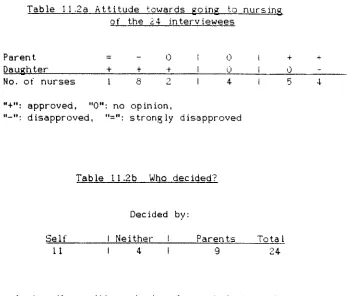
Decision making was classified and scored by the combination of parents'
and daugh ter '5 at ti tude.
Parent 0 + + +
Self + + + 0
Mot ivation 5 4 3 2
+: Approved
Disapproved
0: No opinion
2. Chlneseness and type 'T' women
I recognized that the nUl-se's own personality might also have an
Influence both in their work and private life. As to the soc ia 1 aspec ts
the ir background Inc Iud ing such fac tors as the r-e la t lonsh ips and au thor i ty at
work and home, education and geographical origins were also taken into
accoun t.
Starting from the perspectives of Chinese women (see chapter 2),
expec ted that the nurses' 'Ch Ineseness' wou Id tend to make them follow the
parents' ordel-s, and also push them out of the job market. For as Chinese
women, they would put their family first and follow their husband and
Thus I started from trying to find 'Chineseness' in 1U0del-n nurses in
Taiwan. First, a l-eview of studies of 'the Chinese chal'acter' was done. The
results were quite inconsistent in many ways, probably due to the different
angles of t.he l-esearchers from the early missionary to the modern
anthropologists (Smith 1892, Hsu 1963, Xiang 1960, Lin 1938, Lee and Young
1981, Sun 1983), in addition to which the Chinese have changed appreciably in
the las teen t ury and al'e still chang ing now. A lthough the charac ter of the
Chinese woman has not been studied specifically, female 'Chineseness' was
characterised in response to the general (mainly male) Chinese character, and
according lo the traditional ideal woman of the books of female discipline.
Other studies about Chinese women and their life (Chen 1965, Ayscough 1937),
and women in classical novels and fictions befol'e the western influence, were
examined. A scale to lIleaSUl'e the 'T' (traditional> type personality was
built, and ways of testing its validity and reliability were also considered.
In this phase the 'T' type women were chal-acterised as:
Dependent, passive
Accepting rank and status, submissive
Family (marriage) oriented
Self-sacrificing
Competing with the same sex
Frame of reference local
My hypotheses were that thel'e would be quite a number of 'T' type women
among nurses, and because of the ir 'Ch ineseness' as women, the ir en ter ing and
leav ing nurs ing wou ld have 11 t t Ie to do with the ir own in teres t. Tha t is to
say, they went into nursing schools mainly in consequence of their fathers'
decision whose aim was to marry them to a doctor (especially among the
Taiwanese). Even though a well known matter, this motive would never be
admitted by the nurses and their family.
3. The Paren t
Other variables in the model included: parents' education, occupation
<medical personal or not), and native language (representing their
-geographical or-igins, ie. faiwanese or Mandarin}. Parents' education ~as
planned Lo be measur-ed by the score of the sum of mothel-'s and father's
schooling. Because of the difficulty of its determination, :md also because
of its pass ib Ie over lapp ing with occupa tion and educa tion, no a t temp t was to
be made to measure social status. This did not mean it would not influence
the decision-making of sending daughters to nursing school. In general the
Ma in lander-s were though t to be more independen t than the Ta iwanese g ir Is In
making decisions about theil- own lives.
~. Marriage status
In addition, if they were married the attitude of their family of
man-iage to theil- working as a nurse ie. attitude of lhe husband and his
parents, and nurses' own feeling at work were planned to be examined.
5. Educational background of nurses <type of nurses)
As explained in chapter 10, there are several different kinds of
nurse-training in Taiwan.
into four levels:
The training of registered nurses can be categorised
Practical nursing school: J or 4 year b-aining after middle school
Junior nurSing college 5 year- training after middle school
Senior nursing college 3 year training after high school
Un i ver sit y nurs ing depar tmen t: 4 year tr a in ing after high schoo 1
However it was intended that <in this study), graduates of the two
previous nurSing schools should be categorised into the occupational level,
because of their same opportunity for promotion to head nur-ses. Graduates
of the last one were called degree nurses. The ~hit-d kind was to be
excluded in this study, because of their rare existence in the military
The preliminary approach
A questionnaire including questions 3boul Ch~lese character, personal 3nd
family inCormation was designed. A, I-andom sample of nurses and student
nurses at different levels of education and different wards (male ward or
maternity and pediatric ward) was planned to be investigated. Students of
one normal school were considered as a comparison group, because teaching is
one of the other favourite jobs chosen by young women in Taiwan,
notwithstanding the fact that its graduates mostly work till their- normal
retiring age.
soon realised some difficulties in my method. Problems arose quickly
with Lhe second aspect, the intention to study ex-nurses (withdrawal)
because of the difficulty of dt-awing a sample. They would not turn up in
the NAROC (or union) meeting or records, and there is no other way to trace
them. In any case nurses were not at all enthusiastic about the union, let
alone those who left. The Ministry of Inter-ior Affairs keeps original
information and the address of nurses when they fh-st I-egistel-ed as nurses,
but without follow-up corr-ections this information can be very unreliable,
s inee mos t marr iages and Changes of address happen in a few years after
their graduation.
For these I-easons it began to seem adv isab Ie to coneen tr-a te the study
on such questions as those nurses actually at work, asking them: 'Why they
keep working as nUI-ses?' and 'How does their family I-espond?' 'Do they have
any children·?' if they do, 'Howald were they?' 'Who is looking after the
children?' 'Do the families need t.heir salary?'
As to Lhe ward a nurse works in, if she is man ied, is the 11usband lIlor-e
reluctant if she works in a male ward I-athe Lhan a female or children'S
ward? All nUi ses complain auout night duties, but how does the husband
react if she works in lhe operating theatre which has less night duty, less
con tae t with the pa tien t I bu t more with the young ma Ie doc tors?
If she is not married, questions arise as to whether thel-e is a chance
to find a mate in the working environment or not, whether the work place
would benefit or hinder her future if man-iage were to be taken in account.
-If she is ambitious in wock, will there be opportunity to leal-n and to gain
promotion. All these factors would need to be considered and controlled.
Even with nurses at wOI-k, I also had problems of access. As early as in
1984 before I came over to England. several attempts were made to try to
get access to the sample and for preliminary participant observation and
interview. As I had feared. there was great resistance from the nursing
department in the clinic, even with the formal document of support which
they required from the medical school where I work and to which they also
belong. One vice-head [IUI-Se who had been interested in working with me, was
preven ted by her own head nurse, probab I y through pressure from the nurs ing
depar tmen t.
Testing a hypothesis in the positivistic mode needs a representative
sample and one sufficiently large enough to take ~ccount ot all the
variables of interest. Accessing such a sample, from my own long experience
in nursing studies, would be difficult. There was a further problem. Even
though we might overcome all of the reluctance, suspicion and resistance
from the bUI-eaucracy and nursing departments and schools, and take a random
sample among the hospital nurses and nursing students, respondents might
still only tell us what they thought the nursing department would want them
to say.
Without a representative sample and reliable data, hypotheses testing
and validation of causal relationship would not be possible as a whole. To
build up a whole model and validate it was, further·more pl-obably beyond my
resources, at least in the time available. if not virtually impossible. It
would be extr-emely difficult to verify the causal relationships among the
variables in the model, and even more difficult to verify the model itself.
As to variables. the concept of 'tradition' vs. 'modernity', from which
problems about the 'traditional' type of personality flowed, was challenged by
Professor Stacey. She pointed out that tradition is changing all the time.
roday's so-called 'modern' would become the tradition for the forthcoming
era. It is difficult and also a waste of energy to define what tradition is
here and now, and then to measure it and find its assoc ia t ion with 0 ther
the current situation of ~,he women I,han 1,0 ::It t.empt IneaSUI-es 10 show how
much lhe 'traditional' still persists in them.
Since the eadiest \.Jestern impact, there have been immumerable 'debates
on westecn snd eastel'n cultul-e'. Intellectuals have dr-gued interminably over
ways China should go. The reformists :md J-evolutionsists prefel-ed
wes tern iz it ion \-Jh ile the consel-va t i ves t.e lieved in the rev iva 1 of eh inese
tradition. Between these two Lhere were various intermediates - selective
absol-ption snd complex synthesis.
In real life, culture diffuses by its appr-opriateness. People pick up
the pall.s ·,,,'dch sui I. IIlem and benefit their life and abandon the parts that
aloe unrewarding. The above dr-gurnents were primarily among intellectuals who
wanted to 'l-escue' China, most of whom had studied .abroad. China became the
experimental battlefield of their intellectual autonomy and power. Whatever
the precise influence of such elitists, China, at times slowly, at times
rapidly, unconsciously or consciously, for better or worse, has changed.
The at ti tudes a f in te llec tua Is towards women were var ied. Some ear lier
~~ }L...:f:~
writers, notably Liang Qi-chao
(;r.
tx..~,),
felt that women should beeducated in order to 'raise the healthy next generation'. La ter the more
humanistically minded, e.g. Lll Xun, argued that they should be liberated and
tecollle :;D c~lled 'rlew womerl' Dllring I:he Sino-Japanese 9nd civil-war
periods the government would uphold the responsibility of women for the
counLI-y, but in peacelilne would Ilrge ',Iomen Iiol Lo forget their role 3l home.
Mo therhood then became the ir rna in con tribu tion to the coun try. The argumen t
ovel- female chastity and filial piety continued. Many Ch inese scho lars in
Taiwan still cannot imagine a society that can work without the 'Wu lun' or
'five disciplines' ( see Chapter 3 ) , When 'European customs and American
language' (Ou Feng Mei Yu
::;~
,_" :!!",\.., ...
1;1
.:t~:2.
)
penetrate China, women too '? 0change inevitably in the resulting upheaval. Externally, they can be seen to
dress in the western way, walk in the street and, in some cases, go ou t to
work. But what precisely is their situation now and what does it mean to
them? All these questions are especially 5 19n if ican t for nurses, who are
young women working in a new popular profession coming fr-om the west; who
-come in contact with the male body at wOI-k in a '~ay totally against the
Chinese idea of segregation of the two sexes before marriage.
A new research plan round the proposition - inside every western nurse's
uniform, there is a Chinese woman - was sequentially set out. This current
research plan will be detailed in the next chapter.
It should be stressed, however that when hypothesis testing in a random
sample and model was abandoned finally, it was only partly because of
d if f icu I ties inheren t in th is me thod. The ma in reason f or me thodo logy change
was due to the switch of the focus of the pl-oblem - fl-om 'nursing wastage'
to 'n urses as eh inese women'.
On the whole, although had given up the attempt to measure
'Chineseness' and to verify the causal l-elationships between 'Chineseness' and
the problems of the nursing pr-ofession, I still hoped, through looking at
nurses as women and Chinese, to see what relationships there might be among
Chapter 5. The evolving research design
Historical and literature review
The fie Id study
The research method
Da ta co llect ion Interview
Other modes of data collection
Story hTiting
Group discussion
Data analysis