
Policy instruments to support the diffusion of near zero energy housing in Overijssel Research on the near zero energy housing policy in multiple EU member states and the application of a decision making technique on Overijssel
143
0
0
Full text
(2) Policy instruments to support the diffusion of near zero-energy housing in Overijssel Research on the near zero-energy housing policy in multiple EU member states and the application of a decision-making technique on Overijssel. Author:. Stephan Kuiper s0198498 [email protected]. Graduation committee. 1st supervisor Dr. Joy Clancy [email protected] 2nd supervisor Dr. Thomas Hoppe [email protected]. External reader:. Province of Overijssel Freek Kranen [email protected]. Place & Date. Enschede, October 29, 2014. Institute Faculty Program. University of Twente Management & Governance Public Administration – Policy & Governance. Johan Dolstra [email protected]. Frontpage image source: EcoTerraInvest (2012). Page | ii.
(3) Preface In front of you lies my graduation paper, written in fulfilment of my master’s degree in Public Administration at the University of Twente in Enschede. In this paper I assess possible policy instruments the province of Overijssel can use to promote energy efficient measures for private households within the province boundaries. In order to assess their options a comparative analysis of instruments used in a selection of EU countries is made and presented to a sample of involved stakeholders within the province of Overijssel to grasp the bottom up view on these instruments and their possible effect in the province of Overijssel. The paper therein gives clear recommendations to policy makers on which instruments / instrument mixes are deemed as effective based upon stakeholder opinions. The execution of the project was made possible through the guidance of both my two supervisors from the University of Twente and my supervisor from the province of Overijssel. First of all then I would like to thank Joy Clancy, who took the role of first supervisor and guided me very well in initial design stage of the study and assisted in getting the British translations correct. Secondly I would like to thank my second supervisor Thomas Hoppe, who made sure the methodology used is at a master’s level and assisted a lot in increasing the focus of the research. I also would like to thank Johan Dolstra and Freek Kranen of the province of Overijssel; Johan first for bringing this topic to my attention and helped guiding the province’s part of this paper, Freek secondly for assisting in getting a sufficient sample for use in the survey. Finally I would like to thank my girlfriend Makien Verkroost for reviewing my work and helping me keep on track.. Enschede, October 29, 2014. Page | iii.
(4) Abstract This research resolves around the question “Which (packages/mixes of) policy instruments from five selected Western European countries have proven to be effective in improving energy efficiency standards in private housing”. The research question is formed in collaboration with the province of Overijssel and assessed thee goals the province of Overijssel wants to meet with their energy efficiency policy mix: increasing energy efficiency for private households, strengthening the construction sector, and decreasing dependence on fossil fuels. The province saw interesting policy instruments being used in other EU countries and wanted to know whether those instruments would work in the province of Overijssel. The research commences with identifying instruments used in the selected EU countries: Austria, Belgium, Germany, Sweden, and the United Kingdom. This identification process is guided by the policy instrument classifications by Jordan et al (2010) and assesses the effectivity of found instruments using perceived barriers to adoption of energy efficient improvements, efficiency, and stakeholder involvement. An instrument is then deemed effective when it provides the ability for stakeholders to participate in a bi-directional relationship and when it tries to diminish or overcome a barrier perceived by private house owners. A total of seven instruments were selected based upon effectiveness criteria to use for a second part of this study in an application of these instruments to the province of Overijssel, which all have shown to have a positive impact on energy efficient improvements for private dwellings. The instruments are: -. -. -. -. Financial incentives BAFA on-site consultation -40% Club Green Deal. -. -. -. Code for Sustainable homes Informational instruments Low-energy buildings in the building stock. Financial incentives are found to be able to overcome the financial barrier perceived by house owners as argued by Walls (2012. Financial incentives aim to make the initial purchase price barrier negligible by providing low-cost loans and subsidies for (part of) the purchasing price. The incentive can be paid in the form of loans, grants and/or allowances. BAFA on-site consultation is directly aimed at overcoming multiple barriers perceived by house owners. It provides direct consultation in order to increase knowledge of house owners concerning the energy efficiency of their dwellings by providing detailed reports on the actual savings attainable by their dwelling, which also reduces uncertainty perceived by house owners. Other informational instruments are directly aimed to reduce the lack of knowledge holding house owners back in purchasing energy efficient improvements for their dwellings. Informational instruments can range from free council to low-income households to the pre-emptive working of product labels and construction guidelines. The minus 40-Percent Club is a special informational instrument, in that it serves an exemplary role for the whole of society, showing that it is possible to reduce a household's carbon emission by 40 %. The 100.000 households are followed over multiple years with extensive media coverage. Page | iv.
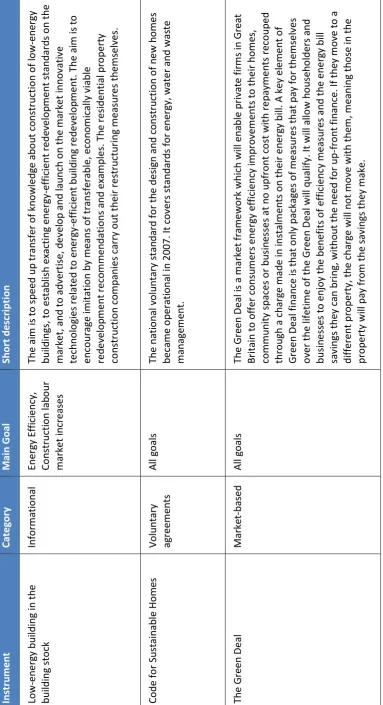
(5) The Request project of the EU program 'Intelligent Energy Europe' aims with the low energy in the building stock project to the development of quality construction standards, enabling a speed-up of knowledge and the establishment of higher building standards. The Code for sustainable homes then is trying to overcome not only the informational barrier, but also tries to reduce uncertainty and address the bounded rationality house owners perceive. The instruments functions by simplifying the building process and increasing awareness. The Green Deal finally is an instrument targeted to negate the financial barrier entirely by enabling energy suppliers to improve dwellings and paying for them through the energy bill. It does so by first improving information available, second by reducing uncertainty about actual savings and thirdly by letting energy suppliers pay for the improvements in the form of a property-linked loan (not personal). The instruments were used as input in the multi-criteria decision-making tool Analytical Hierarchy. process. Via a survey companies and governments within the province of Overijssel were asked on their opinion of the feasibility of found policy instruments when applied to the province of Overijssel.. For all three goals, BAFA on-site consultation is prioritized the most. The problem with this instrument however is the required linkage to financial incentives for house owners. Results from this instrument’s usage are concerned by interactions with financial measures. Informing citizens on their own energy use has been proven the most effective, making the instrument a good candidate for adoption. The second overall prioritized instrument is subsidy usage. In general, subsidies have been used for a long time and have proven their effectiveness. An instrument which would best enable the province of Overijssel to pursue their stated goals then would be comprised of several instruments which work in tandem. First of all, on-site consultation should be used with contracted advisors to show house owners that their residence can be more energy efficient and that it can be beneficial to them by calculating and presenting projected costs and benefits. Second, financial incentives like the sustainability loan should complement this advice in order to increase the chances of adoption of the efficiency measures. Thirdly, people who are willing to make their house more energy efficient should be asked to be documenting their approach and the process of creating their energy efficient houses. These documentaries should then be promoted and advertised actively in order to reach the wider public; making certain that everyone knows what the costs and benefits really are.. Page | 5.
(6) Index Preface. iii. Abstract. iv. Index. 6. List of figures and tables. 9. Chapter I - Introduction. 10. 1.1. Background. 10. 1.1.1. European Union level. 10. 1.1.2. Private housing sector. 10. 1.1.3. Member state level. 11. 1.1.4. Focussing in: Dutch Member state level. 12. 1.1.5. Regional level. 13. 1.1.6. Focussing in on the Dutch region of Overijssel. 13. 1.2. Previous research. 14. 1.3. Motivation. 15. 1.4. Research Objectives. 15. 1.5. Research Questions. 15. 1.6. Chapter overview. 16. Chapter II – Theories and Concepts used 2.1. 17. Concepts used. 17. 2.1.1. Energy efficiency in the residential sector. 17. 2.1.2. Near-zero energy housing. 17. 2.1.3. Regional governments in selected countries. 18. 2.2. Types of policy problems. 18. 2.3. Stages of the policy process. 19. 2.4. Stakeholders participation in the policy process. 20. 2.5. Perceived barriers to adoption of energy efficiency improvements in private dwellings. 21. 2.5.1. Financial barriers. 22. 2.5.2. Informational barriers. 22. 2.5.3. Uncertainty. 23. 2.5.4. Bounded rationality. 23. 2.6. Policy instrument classification. 23. 2.7. This research. 25 Page | 6.
(7) Chapter III - Methodology. 26. 3.1. Research outline. 26. 3.2. Part 1: Cross-national study on policy instruments review in five EU MS. 26. 3.2.1. Research design. 26. 3.2.2. Case selection. 26. 3.2.3. Data collection. 27. 3.2.4. Data analysis. 27. 3.3. Part 2: Stakeholders’ survey on perceived appropriateness of policy instruments. 29. 3.3.1. Research design. 29. 3.3.2. Sample / stakeholder selection. 29. 3.3.3. Data collection. 30. 3.3.4. Data analysis (AHP). 31. 3.3.5. Validity & reliability. 34. Chapter IV – Results of the exploratory international study on policy instruments 4.1. Policy Instrument overview. 35 35. 4.1.1. Austria. 35. 4.1.2. Belgium. 37. 4.1.3. Germany. 39. 4.1.4. United Kingdom. 41. 4.1.5. Sweden. 43. 4.2. Eligible instruments for survey - conclusion on sub question 1. 46. 4.3. Policy instrument effectiveness. 49. 4.3.1. Financial incentives. 50. 4.3.2. BAFA on-site consultation. 51. 4.3.3. Information Schemes. 52. 4.3.4. Minus 40-Percent Club. 53. 4.3.5. Low-Energy Building in the building stock. 54. 4.3.6. Code for Sustainable Homes. 55. 4.3.7. The Green Deal. 56. 4.4. Conclusion - answer to sub question 2. Chapter V – Results from the AHP 5.1. Most preferred instrument overall - answer to sub question 3. 57 60 60. 5.1.1. Survey statistics. 60. 5.1.2. Overall results. 60 Page | 7.
(8) 5.1.3 5.2. Overall ranking of instruments Most preferred instrument by stakeholder group. 62 64. 5.2.1. Category 1: municipalities. 64. 5.2.2. Category 2: companies. 66. Chapter VI – Conclusions 6.1. Sub conclusions. 69 69. 6.1.1. Sub conclusion one: used policy instruments or packages. 69. 6.1.2. Sub conclusion two: policy instruments / packages effectiveness. 70. 6.1.3. Sub conclusion three: instruments prioritized. 71. 6.1.4. Sub conclusion four: best fitting instruments. 72. 6.2. Main conclusion. 72. 6.3. Recommendations. 73. 6.4. Discussion. 73. References. 75. Appendices. 85. Appendix A – Context and policy goals of used EU countries. 86. Appendix B.1 - Policy instruments classification according to Jordan, Wurzel & Zito (2010). 93. Appendix B.2 - policy instrument classifications. 94. Appendix C - Participation Typologies. 95. Appendix D - perceived barriers to energy efficiency purchases by consumers. 96. Appendix E – Instrument selection criteria. 97. Appendix F - Survey. 99. Appendix G – Policy Instruments categorized by country. 106. Page | 8.
(9) List of figures and tables Figures Figure 2.6-1 Figure 2.6-2 Figure 3.2-1: Figure 3.3-3 Figure 4.7-1. Basic and Improved Policy Packages and their Elements. (EUFORES, 2009) Jordan et al. (2003) classification applied to Eufores (2009) classifications Tenure split in the 27 EU member states as a percentage of the total housing stock Overview of criteria and alternatives used in AHP Eligible instruments to use in the main phase. 24 25 27 32 59. Tables Table 3.2-1 Table 4.1-1 Table 4.2-1 Table 4.3-1 Table 4.4-1 Table 4.5-1 Table 4.6-1 Table 5.1-2 Table 5.1-3 Table 5.1-4 Table 5.1-5 Table 5.1-6 Table 5.1-6 Table 5.1-7 Table 5.2-7 Table 5.2-2 Table 5.2-3 Table 5.2-4 Table 5.2-5 Table 5.2-6 Table 5.2-7 Table 5.2-8 Table 5.2-9 Table 5.2-10 Table 5.2-11 Table 6.1.3-1. Criteria used for policy instrument comparison Policy instruments used in Austria Policy instruments used in Belgium Policy instruments used in Germany Policy instruments used in the United Kingdom Policy instruments used in Sweden Policy instruments eligible in this thesis Overall goal ratio Overall best instrument ratio Instrument ratio for the goal Energy Efficiency Instrument ratio for the goal strengthening the construction sector Instrument ratio for the goal less dependence on fossil fuels Instrument ratio’s overall Top three ranked instruments Overall goal ratio for category municipalities Instrument ratio for the goal Energy Efficiency for category municipalities Instrument ratio for the goal strengthening the construction sector for category municipalities Instrument ratio for the goal independence of fossil fuels for category municipalities Instrument ratio overall for category companies top three ranked instruments for category companies Overall goal ratio for category companies Instrument ratio for the goal Energy Efficiency for category companies Instrument ratio for the goal strengthening the construction sector for category companies Instrument ratio for the goal independence of fossil fuels for category companies Instrument ratio overall for category companies Overall best instrument ratio. 28 36 38 40 42 44 47 60 61 61 62 62 63 63 64 65 65 65 66 66 66 67 67 67 68 71. Page | 9.
(10) Chapter I - Introduction There are two key issues related to energy that are exercising policy makers globally: energy prices (and in its extent energy security) and climate change. These issues can be simultaneously addressed through the promotion of energy efficiency. As the second largest consuming sector, energy efficiency measures in the residential sector can have a potential large impact on reducing climate change. Within the European Union, there is synchronisation of policies to addresses these issues and the Commission sees energy efficiency as one of the key mechanisms for addressing energy security and climate change. This policy synchronization has an impact in national legislation of the EU member states, and in the case of the Netherlands works down to municipal level government. To this end energy efficiency in the residential sector can be researched on the sub-national level. This chapter will begin with a brief overview of existing research on the Dutch housing sector, following by the context of this research and the elaboration of the structure of this research paper.. 1.1. Background. 1.1.1 European Union level In light of a few decades of developments concerning global warming, the European Union (EU) under the Kyoto protocol (UNFCCC, 2013a) and its later Doha amendment (UNFCCC, 2013b) has set energy target commitments: all member states have to comply with the following energy targets by the year 2020 (European Commission, 2013): -. -. Reduce the emission of greenhouse gases by 20%; Increase the use of renewable energy sources by 20%; Reduce overall energy consumption by 20%.. These targets are set at a supranational level, and due to the structure of the EU have mostly direct impact on national regulations and legislation, although this differs among member states). The energy consumption by its member states then is segmented by the following end uses in 2010 (Bertoldi et al., 2012): -. -. -. Transport. 31.67 %. Households. 26.65 %. Industry. 25.29 %. -. -. Services. 13.21 %. Agriculture. 2.17 %. Other. 1.01 %. The housing sector then is the second largest energy user in the EU. Improving energy efficiency in this sector then are often considered as one of the most cost-effective ways of cutting carbon emissions (Ashford, 1999, p. 20).. 1.1.2 Private housing sector In the EU the housing market is segmented into two distinct submarkets: private households (owner occupied dwellings) and housing corporations. This distinction is made due to both demanding a different approach; housing corporations operate generally on a macro-level, investing in hundreds Page | 10.
(11) of houses at once, while private house owners engage in micro-transactions, as they only invest in their own properties. The submarket of private households accounts for 71 % of the housing market in the EU on average, making this the most interesting submarket and potentially having the largest impact in reducing energy consumption in the residential sector (CECODHAS, 2012). In 2009, European households were also responsible for 68% of the total final energy use in buildings (Buildings Performance Institute Europe, 2011). In order to meet the energy targets of 2020, the EU has initiated a variety of directives in the residential sector in order to meet the 20-20-20 goals (EUFORES, 2009): -. -. -. -. -. Directive on energy performance of buildings (EPBD) (2002/91/EC) Directive on the promotion of co-generation (CHP-Directive) (2004/8/EC) Directive on eco-design requirements for energy using products (EuP-Directive) (2005/32/EC) Directive on energy end-use efficiency and energy services (ESD) (2006/32/EC) Directive for the taxation of energy products and electricity (2003/96/EC). -. Directive on energy efficiency requirements for boilers, refrigerators and ballasts for fluorescent lighting (2000/55/EC). -. Directives for labelling of electric ovens, air-conditioners, refrigerators and other appliances (2003/66/EC). -. Regulation of Energy Star labelling for office equipment (2006/1005/EC). The directives can be broadly separated into two groups: directives to improve the energy performance of buildings (focus on more technical measures), and directives to reduce electricity use by households (focus on more behavioural measures). These directives are all obligatory for implementation by EU member states. The member states have outlined their energy reduction targets for the year 2020 based upon the EU directives and have implemented additional instruments in order to meet their targets (European Commission, 2008).. 1.1.3 Member state level All countries selected are Member States of the European Union. This means that all countries are subject to European laws and regulations. The European Union has agreed to the Kyoto Protocol and its later Doha amendment, which sets ambitious goals to be reached before 2020, the 20-20-20 goals (European Commission, 2008): -. -. -. A 20% reduction in EU greenhouse gas emissions from 1990 levels; Raising the share of EU energy consumption produced from renewable resources to 20%; A 20% improvement in the EU's energy efficiency. In 2007 the EU rephrased and updated these goals, to achieve 20% reduction in both energy use and CO2 emissions, and a 20% increase in both energy efficiency and a 20% share of renewable energy (Power & Zulauf, 2011). Each member state has incorporated these goals (at least to some extent) in their own national policies, and have added to some extent goals of their own, some more ambitious than others. In order to monitor progress of the member states, they are required to first of all create National Energy Efficiency Action Programmes (NEEAP), laying out their status quo and the coming plans, and after that produce National Communications (NC's) "in order to communicate their activities undertaken with a view to meeting commitments under the Convention" (Austrian Page | 11.
(12) Federal Ministry of AFEW, 2010). These NC's consist of: greenhouse gas inventory information; measures to mitigate greenhouse gas emissions; measures to counteract adverse effects of climate change; measures to promote research and systematic observation; financial support for developing countries; initiatives to enhance the transfer of technology between Parties; and measures to foster education and public awareness with respect to climate change" (Austrian Federal Ministry of AFEW, 2010). In appendix A the selected countries are assessed on the basis of their national context and goals. The areas of interest are population, government structure, average temperature, Gross Domestic Product (GDP), Total Primary Energy Supply (TPES) and percentage house owners vs. house renters. The input for the countries background is provided by the Energy Efficiency Watch, an initiative of members of the European Parliament concerned with the energy efficiency of its member states (EUFORES, 2006). This initiative has produced country reports in which their energy efficiency action plans and policies are assessed for the year 2013.. 1.1.4 Focussing in: Dutch Member state level In the Netherlands EU measures have direct influence on legislation, and EU laws and directives are directly implemented. Efforts to gain these energy savings are led at national government level by multiple policy instruments such as the Energy Performance Certificate, covenants, economic and information tools (Murphy et al, 2012). However, as Murphy et al (2012) concluded in their study on policy instruments used to improve energy performance of existing private dwellings in the Netherlands, current instruments are poorly equipped to forge a long-term energy saving strategy for existing dwellings due to low integration of instruments implemented. Also, the objectives of instruments used are lost during implementation or are unsubstantiated (Murphy et al, 2012, p. 465). Current instruments used by the Dutch Government are combined into the “Energieakkoord”, which sets out the energy future of the Netherlands. In this document the Dutch governments has written its goal of a 100% sustainable energy supply in the year 2050 (Rijksoverheid, 2013). It is a covenant containing multiple goals and agreements which facilitate the sustainable energy supply. The most important goals of the covenant are (Sociaal-Economische Raad, 2013): -. -. -. -. A reduction of the final energy consumption with at least an average of 1.5 percent per year; 100 PetaJoule of energy saving on the final energy consumption in the Netherlands by 2020; An increase in the share of renewable energy sources to 14 percent in 2020; A further increase in this share to 16 percent by 2023; At least 15.000 full-time jobs, created in majority over the next few years.. For private house owners, these goals take the shape of several policy instruments to be used. The following is based upon the statements of foundation “Eigen Huis”, which has aligned all instruments mentioned in the energy covenant relevant to house owners (Eigen Huis, 2014). First of all, an indicative energy label will be handed out for houses which are not already labeled. Second, house owners should be better informed concerning energy efficiency measures, which is why an energy performance guarantee is given. This guarantee should be able to provide an ex-ante set required level of energy savings with normal use. In combination with these measures the financing possibilities are being broadened to include loans payable via the energy bill of households and a fund will be initiated containing 600 million euro for energy efficiency improvements for private households. The last measure mentioned in the energy covenant is a tax reduction on electricity when house owners are locally generating energy or in collaboration with other house owners. Page | 12.
(13) 1.1.5 Regional level 1 “In many ways it is the local and regional actors who have the task of realizing the transition to an energy efficient and sustainable society. The planning and development of a regional strategic energy and climate program is therefore an important tool for the implementation of the national policy “(Swedish Parliament, 2011). However, not all policy instruments can be effectively used on the Dutch regional level. Taxation for instance is excluded for the province; they can only levy provincial surcharges, which are part of the road tax and therefore only apply to owners of motor vehicles (Provinciewet, 1992). Other regulatory instruments (laws) are implemented nation-wide; provinces are obligated to carry out national policies.. 1.1.6 Focussing in on the Dutch region of Overijssel Overijssel provides a range of financial incentives for the purchase of energy saving investments like solar panels. These come in two forms: as a subsidy and as a loan. The subsidy is offering up to €1050 cash back for made energy efficient investments for both your own house and the neighbour’s house. The sustainability loan offers up to €20.000 with an interest rate lower than market rates for usage for energy efficient investments. (Province of Overijssel, 2011). Next to these direct incentives for house owners the province is offering free 48 hours of marketing help for construction companies and has made agreements with housing corporations to make their housing supply more energy efficient (Provincie Overijssel, 2014). An experimental setup is also initiated in 6 municipalities to make 50 private households energy neutral; house owners can apply for this project and receive up to €8000 back on made efficiency investments (Provincie Overijssel, 2014). The province of Overijssel also engages in a variety of policy networks with among others energy suppliers and umbrella organizations in construction and project management in order to share knowledge and experience and collaborate on projects (Province of Overijssel, 2013). The collaboration in these policy networks could have the potential to reduce transaction costs for the province and assist in sharing information with market parties. The policy instruments / mixes that are employed by the province of Overijssel, however practical and attractive they seem, are only sparsely used by private house owners in the Dutch province of Overijssel. There seems to be a “deadlock in supply and demand in the Dutch construction sector; a practical realization requires a transition in the status quo” according to Murphy et al (2012, p. 2). A shift from new-build to renovation will have potentially considerable effects on employment in the construction industry (Meijer et al, 2012). The province of Overijssel can see the market has the capability and potential to support a shift towards near-zero energy housing. Hanson & Laitner (2004) argue that efficiency investments have the potential to “both reduce energy costs and reduce needed investments in power generation” (p. 740), which makes promoting these investments interesting for both consumers (lower energy bill) as energy producers (less investment capital needed).. The regional level is defined as the NUTS-1 region within a member state of the EU, see chapter 2.1.3 for more information 1. Page | 13.
(14) Therefore the province wants an instrument (or combination of instruments) to create the conditions for a competitive energy services market to deliver measures that will meet three goals linked to energy efficiency set by the province: -. -. -. Improved energy efficiency Make consumers less dependent on fossil fuels. Increase employment in the construction sector. Improving energy efficiency standards in privately owned dwellings is possible in at least two ways: either by increasing the efficiency of insulation/appliances etc (technical measures), or decreasing energy usage (behavioural measures). The problem then is, from a regional perspective, what policy instruments can be implemented to improve the energy efficiency standards in the residential private housing sector? This thesis will focus on a comparison of policy instruments in five selected EU countries that are used to improve the energy efficiency standards in private housing.. 1.2. Previous research. Priemus (2005) argued that sustainable housing in the Netherlands is a badly defined concept due to the definition being extended to include social and ecological dimensions (Priemus, 2005, p. 6). Hoppe et al. (2013) argue that recent developments concerning energy efficiency in the Dutch residential sector had not been sufficient to attain the pre-set goals; “progress had not been substantial” (Hoppe et al., 2013, p. 14). This progress suffered from (Hoppe et al., 2013, p. 14): -. -. -. -. Too ambitious goals; The failure to (adequately) involve key target groups in policymaking processes; The predominance of ‘soft’ policy instruments and the lack of legislation; Innovation programmes which favour relatively un-innovative technologies and practices; Target group members' mistrust of the energy labels and energy performance standards Few incentives to encourage target group members to start radical innovative demonstration projects beyond the state-of-the-art of technology.. Research by Beerepoot (2007) indicates that a broad scale adoption of energy efficiency measures fails to occur in the existing Dutch residential sector. In his study on innovative energy systems (IES) in social housing Hoppe concludes that “little has been achieved in the Netherlands” concerning the implementation of innovative renewable energy and energy efficiency technologies (Hoppe T. , 2012, p. 799). This research will assess this apparent gap in adoption by analysing policy instruments used in a selection of EU member states 2 and do a case study on the application of these policy instruments in the Dutch province of Overijssel.. 2. See chapter 4.2.3 Page | 14.
(15) 1.3. Motivation. This research will assess the feasibility of policy instruments to improve energy efficiency on the Dutch regional housing market, as local and regional governments have a “powerful planning role in terms of developing urban areas and authorizing building projects” (Han et al., 2011, p. 2). Also Hoppe (2012) argues that the adoption of innovative energy systems in existing housing in the Netherlands face many barriers, while ambitions were lowered in studied projects. Other EU countries seem to do a better job; it could therefore be beneficial to look across the border in order to identify (better) working policy instruments.. 1.4. Research Objectives. The current state of the Dutch energy efficiency for private households market gives lead to this thesis’ research goal. The first objective will be to create an overview of policy instruments used in five 3 EU member states. The second and main objective of this research will be the application of policy instruments found in five EU member states on the province of Overijssel and assess the effectiveness of those instruments according to local involved stakeholders.. 1.5. Research Questions. In order to assess the problem stated, this research will address the following research question: Which (packages/mixes of) policy instruments from five selected Western European countries have proven to be effective in improving energy efficiency standards in private housing?. This research question has a distinction into two phases. A first part will try to produce an overview of policy instruments from five selected EU member states. To this end the following sub question is given: 1. Which policy instruments or packages were used in five selected Western European countries between 2000 and 2013? The second step is to assess the goal attainment and relative success of these instruments found. It can also prove valuable to assess what the success factor was in the instrument. The second sub question follows this line of thought: 2. To what extent were selected policy instruments (packages) effective in achieving the policy goals they were expected to achieve? The first part of this research is finished after this sub question is answered. This will now form the input for the second part of this research, the application of the data found in the regional setting of the province of Overijssel. To this end a variety of stakeholders are asked to fill in a questionnaire in order to assess their opinions on the likelihood of successful implementation in Overijssel. This third. 3. See chapter 4.2.2 Page | 15.
(16) question then will provide a ranking of policy instruments and their probable success when implementing in Overijssel: 3. How are selected policy instruments prioritized by involved stakeholders for fulfilling the energy efficiency objectives for private housing in Overijssel using the analytical hierarchy process? The final step then is to link this ranking to the theory used: Does the ranking match the effectiveness criteria used in the second sub question? 4. Which instruments are perceived best fitting for implementation by the province of Overijssel taking into account the effectiveness criteria used?. 1.6. Chapter overview. In the second chapter the core concepts and the theoretical framework will be presented. The third chapter then will present the research objectives, questions used in this thesis and the relevance of the study. In chapter four an extensive explanation of the methodology used in this research project is covered. Results of the exploratory research in the first phase of this study will then be presented in chapter five, after which the sixth chapter will address results of the second phase of this study. The final chapter will provide answers to the main research questions, give recommendations (to policymakers) and discusses the limitations of the research.. Page | 16.
(17) Chapter II – Theories and Concepts used In this thesis several concepts are used which are elaborated here. These concepts define the problem on a core level and will be elaborated in this chapter. As this thesis also focuses on a comparison of policy instruments usable on a regional level, but takes the information from multiple EU member states, the concept of regional government in these countries needs to be explored. The theory implicated in this research focuses on policy instrument classification, goal attainment of policies, policy network types and stakeholder involvement. In the first part of the research an overview will be produced of policy instruments used in selected EU countries, which will be structured by instrument categories. Authors on policy instrument categorization are however not unanimous; most distinguish three or four categories, ranging to more than seven categories. In the second part of this thesis the application of found instruments on the province of Overijssel is applied, in which stakeholder participation is an important factor for achieving the goals set out by the province. Stakeholder participation then has the potential to enhance the use and success of policy instruments used.. 2.1. Concepts used. 2.1.1 Energy efficiency in the residential sector Energy efficiency in the residential sector is according to Haas (1997) relatively easier to gain then for example in the industrial sector, as the residential sector is based on a large number of consumers with similar equipment and dwellings, which makes for a fairly homogeneous sample compared to for example manufacturing and service sectors (Haas, 1997) However, the vastness of the sample makes it also more difficult to change and monitor. An understanding of the components of change in household energy use makes it possible to separate factors that may increase with increased incomes or falling energy prices. However, it is impossible to link each of these factors of household energy use to the aggregate energy use; therefore it is more important to reflect on which aspects influence energy consumption by end use (Haas, 1997, p. 790). A common expression of energy efficiency follows the simple ratio (Patterson, 1996): 𝑈𝑈𝑈𝑈𝑈𝑈𝑈𝑈𝑈𝑈𝑈𝑈𝑈𝑈 𝐸𝐸𝐸𝐸𝐸𝐸𝐸𝐸𝐸𝐸𝐸𝐸 𝑜𝑜𝑜𝑜𝑜𝑜𝑜𝑜𝑜𝑜𝑜𝑜 𝑜𝑜𝑜𝑜 𝑎𝑎 𝑝𝑝𝑝𝑝𝑝𝑝𝑝𝑝𝑝𝑝𝑝𝑝𝑝𝑝 𝐸𝐸𝐸𝐸𝐸𝐸𝐸𝐸𝐸𝐸𝐸𝐸 𝑖𝑖𝑖𝑖𝑖𝑖𝑖𝑖𝑖𝑖 𝑖𝑖𝑖𝑖 𝑎𝑎 𝑝𝑝𝑝𝑝𝑝𝑝𝑝𝑝𝑝𝑝𝑝𝑝𝑝𝑝. Energy efficiency then is defined as reducing the difference between the amount of energy going into dwellings and the effective energy consumption by heating and appliances. Energy efficiency then does not automatically reduce energy use. What has to be taken into account is a possible ‘rebound effect’; occurring because improvements in energy efficiency could potentially increase use of the services, thereby possibly backfiring the policy and increasing energy use (UK Energy Research Centre, 2007).. 2.1.2 Near-zero energy housing Near-zero energy housing can be defined in multiple ways. The most encompassing term first, zero energy housing can be defined as "a net zero energy building where, as a result of the very high level Page | 17.
(18) of energy efficiency of the building, the overall annual primary energy consumption is equal to or less than the energy production from renewable energy sources on site" (ECEEE, 2009). According to Hernandez & Kenny (2010), most definitions of near-zero energy housing refer only to “the energy that is used in the operation of the building, ignoring the aspects of energy use related to the construction and delivery of the building and its components” (Hernandez & Kenny, 2010, p. 815). Marszal et al. (2011) also recognize the complexity of the concept due to lack of agreement on the components and calculative methods used (Marszal, et al., 2011, p. 977). The near-zero energy definition however is always deducted from the superlative, meaning a near-zero energy building where, as a result of a high level of energy efficiency of the building, the overall annual primary energy consumption is near equal to the energy production from renewable sources on site. A second definition is set apart from this first one: “near–zero energy housing is when the primary power input in the house (whether conventional power of energy sources on site) equals the total energy consumption of the house. This second definition is used by the province of Overijssel. In this thesis the definition used by the province will most likely be too narrow as I will also consider energy efficient measures which will bring a dwelling to near-zero energy. The net zero energy definition then aims at a higher level than energy efficiency, by reducing energy spills to (near) zero. This thesis will therefore use the definition deduced from the superlative by the ECEEE (2009).. 2.1.3 Regional governments in selected countries As the administrative division among the countries differs, a selection for which level of governance must be made that enables a comparison among them. In this thesis the regional government will be chosen using the Nomenclature of Territorial Units for Statistics (NUTS) (Eurostat, 2012). In this the NUTS-1 level will be chosen for all countries except Austria, Netherlands and Sweden, as these three countries have no ‘real’ NUTS-1 level (NUTS-1 in these countries are comprised of groups of NUTS-2 regions). For the United Kingdom the NUTS-1 level is comprised of 12 statistical regions of England, Wales, Scotland and Northern Ireland. All regional governments chosen at the NUTS-1 level have relative autonomy on the energy efficiency policy field and can be compared with Dutch provinces. Below the regional governments are listed for the countries selected: Austria: States (Länder). The Netherlands: Provinces. Belgium: Regions. The United Kingdom: Statistical regions. Germany: States (Bundesländer). Sweden: National areas (Riksområden). 2.2. Types of policy problems. A problem occurs when a factual situation is in discrepancy with a desired situation (Hommes et al, 2009). This implies that a problem always consists of normative and factual / empirical elements. Problems then should be recognized as subjective social constructs. Due to this subjectivity policy problems are defined by two dimensions, a consensus dimension and a knowledge dimension. In this study these two dimensions are shaped by stakeholder perceptions (consensus dimension) and the use of knowledge (knowledge dimension). (1) Well-structured problems exist where consensus is reached and a shared knowledge base exists (Hoppe, 2011). Moderately structured problems exist when (2) there is either a disagreement on the values and norms underlying the policy problem or (3) Page | 18.
(19) there is disagreement on the knowledge base. (4) Unstructured or ‘wicked’ problems lastly exists where there is disagreement on both underlying values and norms and the knowledge base (Rittel & Webber, 1973). Hoppe acknowledges however, that these four types are, however consistent with Weberian ideal types, not inherently dichotomous; hybrid types are also possible in practice (Hoppe, 2011, p. 75). Also, the problem classification can change over time; for example when new knowledge is being introduced, the amount of certainty can increase, structuring the problem in some degree (Hoppe, 2011). When consensus is reached the problem can also be more structured.. 2.3. Stages of the policy process. The policy process can be divided in roughly eight stages according to Corkery et al (1995, p. 20). The stages distinguished in the policy making process are consecutively problem recognition, agenda setting, problem formulation, formulation of evaluating criteria, create alternatives, policy forming, policy implementation and policy evaluation (Corkery et al., 1995). Although Clay and Schaffer argue there is a notion of a “divided, dichotomous and linear sequence from policy to implementation” (Clay & Schaffer, 1986, p. 4), “the implementation of policy is a vital part of the policy making process, as “implementation always makes or changes policy to some degree” (Lindblom & Woodhouse, 1993, p. 11). Rein & Schön contribute to this theory by naming “the interactions of individuals, interest groups, social movements, and institutions through which problematic situations are converted to policy problems, agendas are set, decisions are made, and actions are taken.” In equality of each other (Rein & Schön, 1993, p. 145). Also, Rein & Schön share the same notion for the first two stages of the policy process, named ‘Naming’ and ‘Framing’ of the problem (Rein & Schön, 1993, p. 153). Problem recognition is the first stage of the policy process. This stage resolves around the introduction of a policy problem, and how it manifests itself or is manifested by stakeholders. This is the nature of the policy issue; is it a chosen problem, has it arisen through ‘normal’ monitoring or has it come by means of a crisis. According to Grindle & Thomas (1991), the process of policy formulation tends to unfold differently depending on whether policy elites perceive they are dealing with a crisis situation or with orderly progress of a political agenda. As Rein & Schön argue, “In each case, the name given to the problematic situation selects different, at best overlapping, phenomena for attention and organizes them differently“ (Rein & Schön, 1993, p. 154). The second stage is agenda setting; which opens the debate on the policy problem. When a policy problem gets in the agenda, only then will attention go to the debate and the policy process starts. However, politicians can choose to keeping attention from certain issues, effectively ensuring the policy process will not begin in order to suffocate them before they are spoken, or to keep them invisible (Corkery et al, 1995, p. 21). After a problem has been set on the agenda, the third stage commences, namely the problem formulation; what is the problem and when is the problem solved? An initial statement of the issue and of the objective will help to determine the nature of the information required and the actors and stakeholders who need to be brought into the process (Corkery et al, 1995, p. 22). After the problem has been formulated, the fourth stage commences: the formulation of evaluating criteria. The policy problem has to be solved, but when is the problem solved, and how can we measure this. There should be a general idea of a destination. It will almost certainly be modified Page | 19.
(20) along the way because of new information or a new form of consensus, but it will help to determine the nature of the information required and the actors and stakeholders who need to be brought into the process (Corkery et al, 1995, p. 22). When the evaluation criteria are clear, the fifth stage begins. This is the time for the creation of alternatives. The debate is opened up to generate options that fulfil one, most or even all objectives created before. It would set out, for instance, who would gain and who would lose from each option. When this stage is completed, a choice must be made for an alternative; the policy is formed. This stage resolves around the actual decision-making process and therefore is the most important stage of the entire policy making process. Important factors in this stage are power relations and the values of stakeholders in order to make a decision. When the decision has been made, it is time for the implementation of the policy, stage six. As the implementation always “makes or changes policy to some degree” (Lindblom & Woodhouse, 1993, p. 11), this stage in the policy process defines the actual outcome of the policy. After implementation there is only one stage left; the final evaluation of the policy to compare the results with the predetermined goals. One should however not think of the policy process as a linear process; it is a much more muddy process and cylindrical in nature.. 2.4. Stakeholders participation in the policy process. These stakeholders (project developers, energy consultants) can participate in the policy development process in a number of different ways, which can vary on (1) the stage of the policy process; (2) the type of policy problem at hand; and (3) the type of policy network. As Papadopoulos & Warin (2007) acknowledge: “Their decisions – when any are taken – can be binding or merely consultative, and they can emerge at different territorial levels or different stages of the policy cycle” (p. 448). Reed (2008) recognizes multiple typologies, as shown in Appendix C. The concept of a hierarchy of participation, conceived of a ‘ladder’, has emerged within stakeholder theory. One of the former leading proponents of ‘ladders’ of stakeholder participation is Arnstein (1969, p. 8), who describes a total of 8 ranks on his ladder of participation. However, as Fung (2006, p. 67) notes, the ladder determined by Arnstein has become obsolete. Authors like Fung (2006, pp. 68-69), Health Canada (2000, p. 12) and Smith (2003, p. 36) argue there are ‘only’ five ways 4 stakeholders can be included in the policy making process, which also, like Arnstein (1969, p. 8), form a continuum based on the extent of involvement and role in decision making. These different processes are not separated by boundaries but naturally flow into each other, building on their predecessors. From low involvement to highest involvement, Smith (2003) distinguishes (1) information exchange, (2) consultation, (3) engagement / dialogue, (4) shared decisions and (5) shared jurisdiction. Culyer & Lomans (2006, p. 363) also acknowledge there are different levels which have an increasing level of participation, forming a continuum.. (Fung uses six ways; Fung distinguishes Deliberate & Negotiate and Deploy Technique & Expertise while the other authors aggregate these) 4. Page | 20.
(21) Papadopoulos & Warin (2007, p. 445) also recognize different levels of participation which coincide with the levels mentioned by Smith (2003): -. According to Smith (2003), information exchange occurs when a decision has already been made, or there is need for acceptance of a proposal or decision before a decision may be made.. -. Consultation occurs when policy decisions are still being shaped and discretion is required, and the purpose is primarily to listen and gather information.. -. Engagement occurs when there is a need for a two-way exchange of information or when individuals and groups take an interest in the issue who will likely be affected by the outcome of the policy.. -. Shared decisions are made when there is opportunity for shared agenda setting and open time frames for deliberation on issues, and when there is a decentralized open debate on the community level.. -. Shared jurisdiction is used when policy makers recognize, respect and reflect community values in governance decisions, and there is room to make difficult allocation choices in a decentralized political context (Health Canada, 2000).. However, stakeholder participation can and should be included in different ways, according to the type of policy problem at hand and the type of policy network stakeholders are engaged in. In this thesis the application of a policy instrument is studied within a regional area, concerning a regional government. The instruments found are assessed based upon the stakeholder participation they allow, as participation is argued to increase the effectiveness of a policy (Reed, 2008). However, policy makers ought not to rush into the highest form of participation; when speed is of interest for example; shared decision-making can slow the process down as far as to halt; decreasing participation effectiveness. When linking stakeholder participation to stages in the policy process of energy efficiency improving policy instruments, Reed argues that “participation should be considered right from the outset, from concept development and planning, through implementation, to monitoring and evaluation of outcomes” (Reed, 2008, p. 2423). Multiple authors argue that including stakeholders as early as possible in decision making can lead to better quality and durable decisions (Mazmanian and Nienaber, 1979; Stewart et al., 1984; Blahna and Yonts-Shepard, 1989; Gariepy, 1991; Beltson, 1995; Chess and Purcell, 1999; Reed et al., 2006).. 2.5 Perceived barriers to adoption of energy efficiency improvements in private dwellings Consumers perceive some barriers with regard to making energy efficiency purchases for their dwelling. Lorenzoni et al. (2007) found a 14 barriers or constraints that consumers perceive to engaging with climate change and energy efficiency more fully 5. Schleich & Gruber (2008) found five categories of perceived barriers in the commerce and services sector, while Brown (2001) found only. 5. See appendix D Page | 21.
(22) three barriers, but also identified five market imperfections 6. Golove & Eto (1996) then identified six market barriers to energy efficiency purchases for consumers' dwellings, while Howarth & Andresson (1993) found at least four market barriers in the consumer appliance market 7. Sunikka & Boon (2003) argue for three dimensions (costs, capacity and knowledge) for which eleven barriers are found. In general, consumers are argued to "lack full information regarding available energy-efficient technologies" (Howarth & Andersson, 1993, p. 263), while "energy efficiency is not a major concern for most consumers because energy costs are not high relative to the cost of many other goods and services" (Brown, 2001, p. 1202). Most authors find the capital market to be a barrier for consumers. Also, most authors argue that a lack of information or knowledge can be a barrier on energy efficiency purchases. Uncertainty then can also act as a barrier, caused by stochastic future energy prices (Schleich & Gruber, 2008, p. 454) or uncertainty concerning benefits of improved energy efficiency (Howarth & Andersson, 1993, p. 265). Lastly, a bounded rationality has been argued by multiple authors by stating consumers are perceived to have a low priority of energy issues, and that climate change is a distant threat. Lorenzoni et al. (2007) have done a great deal of research in order to specify the barriers, but the resulting overview they use is due to this specification also not workable in this thesis. The studies by Howarth & Andersson (1993) and Schleich & Gruber (2008) show the most usability for this thesis, as both studies define these barriers quite extensively. Both studies also identify principal-agent problems as a barrier to energy efficiency purchases for residences. This barrier is however only perceived in the rental residential sector, and therefore falls outside of the scope of this research. The barriers most authors agree on and are used in this thesis then are: -. -. -. -. Financial barriers; Informational barriers; Uncertainty; Bounded rationality.. These barriers are distilled from the collection of barriers listed in Appendix D.. 2.5.1 Financial barriers The financial barrier mostly reflects the often large initial investment costs associated with energy efficiency purchases like solar panels and earth heat pumps. Although the benefits outweigh the costs on a long time period, this initial investment still makes consumers hesitant to purchase them. The long term benefits are not incentivizing enough to become attractive. Golove & Eto argue also that in practice, "potential borrowers, for example low-income individuals and small business owners, are frequently unable to borrow at any price as the result of their economic status or creditworthiness" (Golove & Eto, 1996, p. 10).. 2.5.2 Informational barriers One of the key barriers identified is an informational or knowledge barrier. This barrier is based upon a lack of knowledge concerning the causes, consequences and potential solutions to their energy. 6 7. See appendix D See appendix D Page | 22.
(23) efficiency problem. This includes a lack of experience, understanding and awareness and an overall lack of information (Lorenzoni et al., 2007, p/ 450). Most governments now use energy labels as a means for providing information, Howarth & Andersson argue however that "Empirical work has found that performance labelling has ambiguous effects on consumer decisions" (Howarth & Andersson, 1993, p. 263).. 2.5.3 Uncertainty Uncertainty is perceived as a barrier when trying to assess the returns from energy efficiency investments. Due to consumer's uncertainty about benefits of improved energy efficiency, rational consumers can act as if using high implicit discount rates for the purchase of energy efficient technologies (Howarth & Andersson, 1993, p. 265). This uncertainty can be the result of high costs associated with the gathering of precise estimates of energy prices and equipment performance.. 2.5.4 Bounded rationality As Golove & Eto argue, "individuals and firms are limited in their ability to use - store, retrieve, and analyze - information" (Golove & Eto, 1996, p. 20). They suffer from a ‘bounded rationality’: people are limited by their ability to process information and their finite amount of time available (Rubinstein, 1998). Schleich & Gruber argue that "when making decisions about investment priorities, firms are likely to focus on the core production process rather than on ways to save energy costs" (Schleich & Gruber, 2008, p. 453). Also, consumers still perceive energy efficiency improvements as something in the future; they perceive climate change as a distant threat and as such do not 'need' energy efficiency improvements (Lorenzoni, et al., 2007). Their bounded rationality does not allow them to incorporate future benefits into their current calculation and thoughts pattern, making them oblivious to potential long-term benefits.. 2.6. Policy instrument classification. In Europe are various local governments engaged in energy efficiency policies for the residential sector. These instruments can be classified according to their manner of work and nature. Measures to improve private household energy efficiency can be named as a type of environmental policy, as the main goals of policies in this field are to reduce (carbon) emissions, (more) efficient energy usage and less dependence on fossil fuels. Environmental policy literature distinguishes between traditional regulatory instruments and ‘newer’ instruments or New Environmental Policy Instruments (NEPI’s) (Knill & Lenschow, 2000; Jordan et al., 2003). Traditionally, instruments were mostly subject to a command-and-control strategy, but later use has been made of voluntary measures strategy (VM) and economic instruments (EI) (Bressers & Lulofs, 2004). Many authors use a narrow categorization of policy instruments, broadly known as 'the carrot, the stick and the sermon' (Bressers, 1994; Bemelmans-Videc et al, 1998) The carrot refers to economic incentives, more abstract ‘rewarding’ good behaviour, the stick is the abstract ‘penalty’ for bad behaviour and the sermon is the communicative instrument. Other authors like McDonnell & Elmore (1987), Stavins (2001) and Murphy et al. (2012) use approximately four categories: (1) charge systems, (2) tradable permits, (3) market friction reductions and (4) government subsidy reductions. In the broad sense these different categorizations match the threefold distinction used by Bressers (1994) and Bemelmans-Vedic et al (1998). As this threefold distinction is too narrow in my opinion, in this thesis the four distinct Page | 23.
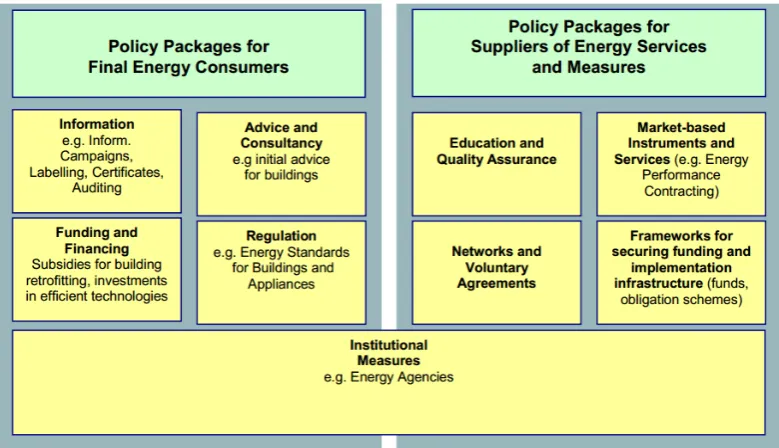
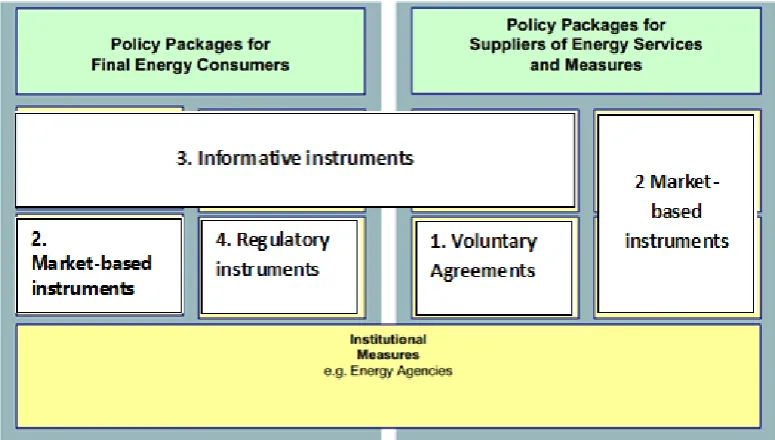
(24) categories as used by Jordan et al. (2010) are used: (1) regulatory instruments; (2) market-based instruments, (3) voluntary agreements; and (4) informational instruments. Jordan et al. (2010) classify these policy instruments according to how the ends and means of management are defined (Appendix B.1). In Appendix B.2 a matrix of different classifications of authors is included. In practice, the European Commission has sanctioned the Energy Efficiency Watch (EEW) to assess the National Energy Efficiency Action Plans (NEEAPs) of the EU member states, in which the energy efficient plans of the member states are discussed under the EU Directive 2006/32/EC. The EEW identifies and categorize multiple policy instrument types in this assessment; the classification of the EEW is provided in figure 2.6-1.. Figure 2.6-1: Basic and Improved Policy Packages and their Elements Source: (EUFORES, 2009). In this figure the classification by Jordan et al. (2005) can be distinguished. Jordan et al. (2005) however do not account for different instrument types for final energy consumers and for suppliers. In figure 2.6-2 the classification by Jordan et al. (2005) is laid on top of the framework used by the EEW.. Page | 24.
(25) Figure 2.6-2: Jordan et al. (2003) classification applied to Eufores (2009) classifications. The bottom instrument category, institutional measures, tries to deliver an integrated package, dealing with both the final energy consumer side and the supplier side. However, due to the fact that only two EU member states mention these institutional measures in their own National Energy Efficiency Action Plan’s (Denmark and the UK) (EUFORES, 2009, p. 69), these instruments will not be used as a separate category as such but as one of the four categories provided by Jordan et al (2003).. 2.7. This research. This research will resolve around the fifth stage of the policy process: the creation of alternative instruments on the policy field of near energy-zero private housing. The problem has already been recognized and is on the policy agenda. Also, the problem has been formulated and evaluation criteria have been formed. This stage now resolves around the formulation of (sets of) alternative policy instruments which can be used to address the problem. Since the problem then can be defined as a moderately structured problem, stakeholder participation will likely be successful if stakeholders are included in the decision-making process extensively. As all barriers and issues resolve around the take-up of energy efficiency improvements rather than the development of these improvements, technical expertise is not deemed as a problem in this debate. Stakeholders should then likely be involved on the basis of creating consensus – i.e. engaging them in order to create a two-way flow of information, where it is more likely stakeholders will expand their own view and incorporate views from others – thus creating consensus. Lorenzoni et al. (2006) also argue that for a policy instrument to be deemed as successful it should (1) provide the ability for stakeholders to participate in a bidirectional relationship with all stakeholders involved and (2) engages perceived barrier by private house owners to not engage in energy efficiency purchases for their dwelling. Schleich & Gruber (2008) complement this by adding that "due to multiple types of barriers being significant, a mix of policies appears to be more appropriate than single policy instruments" (Schleich & Gruber, 2008, p. 461).. Page | 25.
(26) Chapter III - Methodology In this chapter the methodology is presented which is used to answer the previous stated research questions. The methodology is divided into two distinct phases, where the second one builds upon the results of the first phase. This chapter will be structured accordingly, with first an elaboration of the first part of the research, followed by an elaboration of the second part.. 3.1. Research outline. In order to assess the main question, the research is broken down into two distinct, consecutive phases. The first phase consists of exploratory research into policy instruments used in five selected EU member states, which will be discussed in chapter 3.2.2. The results of this exploratory research will then be used in the main phase as the input for a multi-criteria decision making technique on policy instrument ranking and selection. This technique will use a survey in order to collect data on the application of the policy instruments found in the exploratory phase. In this chapter these two parts are discussed separately.. 3.2. Part 1: Cross-national study on policy instruments review in five EU MS. 3.2.1 Research design The first part of this research has an exploratory nature and can be defined as a cross-sectional study which will be constructed through means of extensive desk research. Desk research is also known as ‘secondary research’: “research using published sources, and/or the client's own internal sources, carried out prior to a research project” (Association of Qualitative Research, 2014). Through this desk research multiple cases are extensively studied in order to find suitable policy instruments.. 3.2.2 Case selection The units of observation and cases in this thesis are five selected EU member states. The units of analysis are policy instruments used by regional governments from these selected EU countries. A case study can be defined as an “in-depth study of a single unit” (Gerring, 2004, p. 341). There is no temporal variation, and spatial variation is within-unit (Gerring, 2004, p. 343). In order to select similar countries to the Netherlands, sample generalization will be on case-to-case transfer; making generalizations from one case to another (similar) case (Onwuegbuzie & Leech, 2007, p. 240). I will select countries based on criteria: policy availability (having an engaged policy field for energy efficiency improvements for private dwellings), climate, and economical strength. The first selection ‘European countries’ is chosen as these countries share jurisdiction to some extent in the form of European laws and agreements. Second, not all countries can be selected and most would not fit this research, as their context differs too much in terms of climate, economic strength and polity context (Lorenzoni & Pidgeon, 2006; TNS Opinion & Social, 2011; World Economic Forum, 2012). As the sample size should not be too large (difficult to extract thick, rich data and generally takes a long time to process) nor too small (difficult to achieve data saturation), I will select a total of 5 countries next to the Netherlands as this will enable a “comprehensive analysis without being overwhelming” Page | 26.
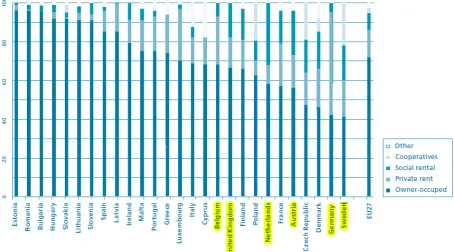
(27) (Onwuegbuzie & Leech, 2007, p. 242). Countries selected should have a (most) similar climate 8, economically stable, and regional and local jurisdiction concerning energy efficiency policies for private house owners should be (most) similar. The countries selected based upon these criteria are Austria, Belgium, Germany, Sweden and the United Kingdom. The selected countries all have between 42% and 70% of owner-occupied dwellings of their total housing stock, as depicted in figure 3.2-1.. Figure 3.2-1: Tenure split in the 27 EU member states as a percentage of the total housing stock Source: (CECODHAS, 2012, p. 10). 3.2.3 Data collection The data needed for the cross-sectional analysis will be collected using two distinct sources: (1) policy white papers and evaluation reports (found in the MURE II database (www. muredatabase.org), the UNFCCC website (www.unfccc.int) and the website of the EU Commission (www.ec.europa.eu), and (2) additional correspondence with selected national experts (contact details found in policy white papers etc., government websites). Notably, the selected country’s National Energy Efficiency Actions Plans (NEEAP’s) are used as a source of instrument information.. 3.2.4 Data analysis In the selected countries some similar policies are found. Mostly generic these are subsidies for energy efficient measures (solar panels for example, building shell subsidies). These will therefore be clustered. Also, in some countries specific policies are found that cannot be clustered and need to be presented separately as they cannot be viewed the same as other policies due to being context-. Countries with similar climates have likely a more similar need of for example insulation. Austria, with a minimum temperature below zero degrees Celsius, will likely have a larger need of insulation then for example Spain, where the minimum temperature is above zero degrees Celsius. 8. Page | 27.
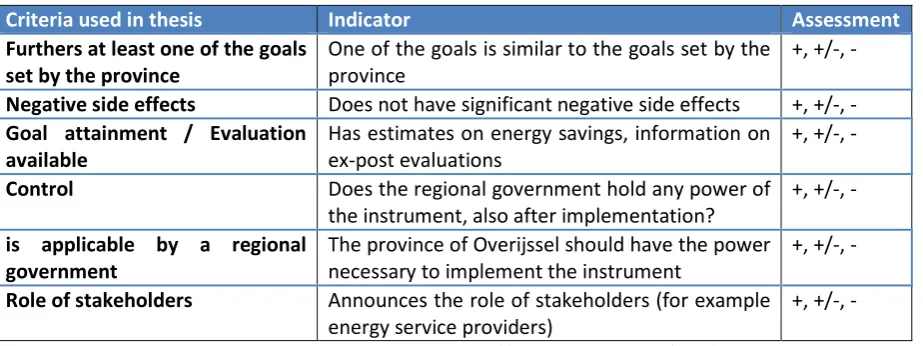
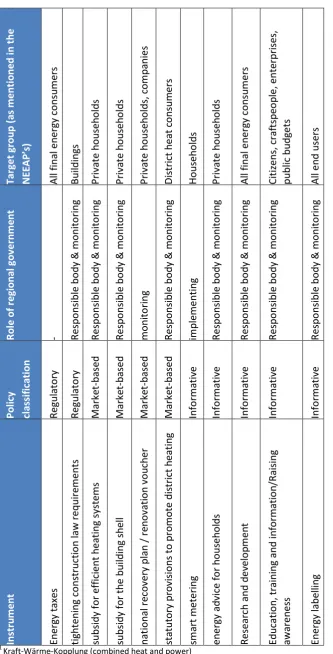
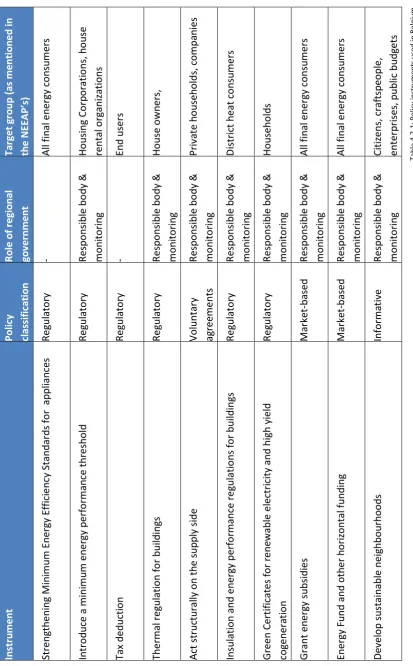
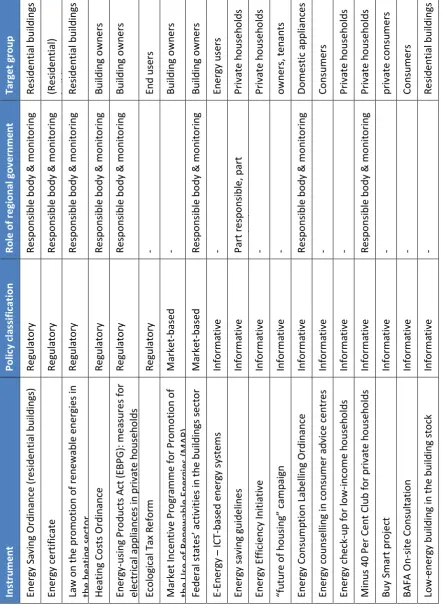
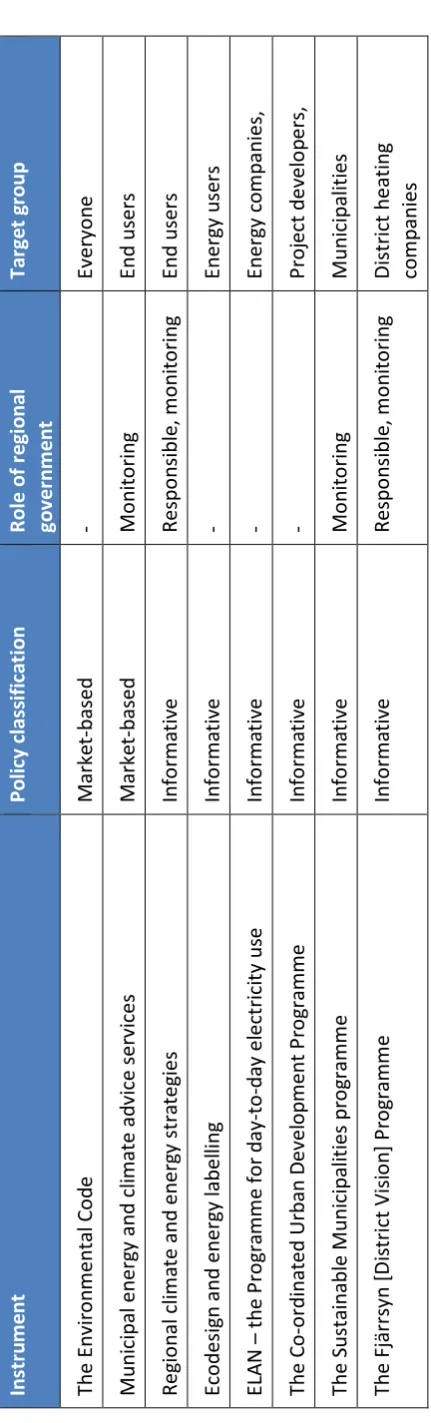
(28) related or having very specific usages. In selected policies the EU measures are filtered out as they are already incorporated to some extent in all selected country’s national policies 9. The instruments that form the conclusion of the first sub question of this research (Which policy instruments or packages were used in five selected Western European countries between 2000 and 2013?) and consecutively will be used in the main phase of this research are chosen based upon a set of selection criteria. This set is based upon the criteria provided by the US Congress Office of Technology Assessment (1995) 10. However, due to the policy instruments needing to be applied on a regional level of governance, the criteria are adapted and supplemented to some extent to better fit this thesis. The criteria on which policy instruments have to score are included in table 3.2-2 on the next page. An instrument scores positively (+) on a criterion when it not only provides information regarding the criterion, but also assesses the extent to which it complies with the indicator and fits the criterion. A neutral assessment (+/-) will be given when the indicator is only mentioned, but fits criterion, and a negative score (-) will be given when an indicator is not mentioned or does not fit the criterion. All criteria must be graded neutral or higher for the instrument to be included in the Overijssel assessment of policy instruments. Criteria used in thesis Furthers at least one of the goals set by the province Negative side effects Goal attainment / Evaluation available Control. Indicator One of the goals is similar to the goals set by the province Does not have significant negative side effects Has estimates on energy savings, information on ex-post evaluations Does the regional government hold any power of the instrument, also after implementation? is applicable by a regional The province of Overijssel should have the power government necessary to implement the instrument Role of stakeholders Announces the role of stakeholders (for example energy service providers). Assessment +, +/-, +, +/-, +, +/-, +, +/-, +, +/-, +, +/-, -. Table 3.2-2: Criteria used for policy instrument comparison. The analysis for the effectiveness in terms of policy goal attainment of the policy instruments found builds upon the previous criteria, but extends to that as well. The relative effectiveness of policy instruments can be difficult to measure. One method entails using policy goals stated and measuring goal attainment as a measure for the success of the instrument. A second method will be used to try and measure the relative success of policy instruments found. This second method is based upon the idea that an instrument would logically try to (1) promote a certain action or (2) regulate actions. In this line of thought an instrument will try to diminish possible barriers that are perceived. The success of the instrument then is measured by the diminishing of a perceived barrier. A second notion on policy instrument effectiveness comes in the form of stakeholder participation. It is argued that stakeholder participation can have a positive effect on the effectiveness of a policy instrument. Lorenzoni et al. (2006) claim that stakeholders should however be included in various Also, instruments not eligible for the province of Overijssel on the basis of the Overijssel context not applying and instruments for which the province not having the necessary authorizations / autonomy are filtered out. 10 See Appendix E. 9. Page | 28.
(29) distinct ways according to the type of policy problem and the type of policy network stakeholders are engaged in. In this thesis then a participatory instrument can be deemed as successful once it should provide the ability for stakeholders to participate in a bi-directional relationship with not only the government (initiator and facilitator of the debate), but also with all other involved stakeholders. The selected instruments and instrument clusters are analysed on multiple aspects in order to conduct a comprehensive analysis of the policy instrument effectiveness. The first indicator is availability of evaluation reports. A second in indicator is goal attainment, as this most often reflects policy instrument effectiveness. The third indicator used for policy effectiveness is stakeholder involvement, as this can have a positive impact on policy effectiveness (Lorenzoni et al., 2007). The last indicator used is barriers tackled; if an instrument can tackle a barrier perceived by consumers it can also be an effective instrument11. In summary, the following indicators are used to assess policy instrument effectiveness: 1. Goals stated / attained; 2. Available evaluations;. 3.3. 3. Overcome barriers. 4. Stakeholders involvement;. Part 2: Stakeholders’ survey on perceived appropriateness of policy instruments. The main phase consists of the application of the policy instruments found in the exploratory research done in five EU member states. This phase resolves around the multi-criteria decision making technique ‘Analytical Hierarchical Process’ (Pohekar & Ramachandran, 2004).. 3.3.1 Research design The study will entail the usage of the exploratory research on policy instrument in selected EU member states 11 in the field of energy efficiency for private house owners as the input of the multicriteria decision making technique Analytical Hierarchy Process (AHP). In the AHP a survey will be used to assist in identifying and weighing selection criteria for instruments (Saaty, 1980).. 3.3.2 Sample / stakeholder selection Han et al. (2011) argue local and regional governments play an important role in promoting and facilitating energy neutral housing developments; the authors also identify project developers and energy consultants as important stakeholders in the development process. Home owners can also be regarded as important stakeholders. However, home owners are not included in the development stage (UrbAct, 2012), making them unsuitable for this thesis which resolves around the development stage 12. The respondents for the survey chosen are persons representing the following stakeholders: the Province of Overijssel, municipalities in Overijssel, energy suppliers, energy grid operators, project developers, construction companies, advisory companies in this sector and expert marketing companies for this sector.. 11 12. See Chapter 3.2.2 See Chapter 2.7 Page | 29.
(30) A total 150 companies and governments are invited to the survey, divided in the following groups: Energy suppliers Grid operators / Net suppliers Project Developers Construction companies. 21 2 2 64. municipalities province Marketing companies Advisory companies. 25 1 2 33. These companies are all invited digitally to partake in the survey. A two month period is established to collect the data.. 3.3.3 Data collection Data is collected through means of an online survey. As the format has some strict requirements, a special website was designed to format the questionnaire following the ‘paper’ example in Appendix F. The survey is accessible by everyone who received a link using a mailing list. The survey itself will consist of a selection of (1) open questions used to identify groups of stakeholders and (2) pair-wise comparisons. Pair-wise comparisons will be formed in order to weigh instruments and goals with each other. Their usage helps in determining the relative importance of each alternative in terms of each criterion. Questions will be formed as follows: In order to achieve energy efficiency in private households, how important are the following two instruments in relation to each other? Instrument A Instrument B Respondents choose their answer on a scale proposed by Saaty (1980). This scale is comprised of the following set of values: {9, 8, 7, 6, 5, 4, 3, 2, 1, 1/2, 1/3, 1/4, 1/5, 1/6, 1/7, 1/8, 1/9} This scale has been made fit to use for nine possible answers (Triantaphyllou & Mann, 1995): 1 2 3 4 5 6 7 8 9. 9 7 5 3 1 1/3 1/5 1/7 1/9. Instrument A is a lot more important than instrument B Instrument A is more important than instrument B Instrument A is a bit more important than instrument B Instrument A is slightly more important than instrument B Instruments A and B are equally important Instrument B is slightly more important than instrument A Instrument B is a bit more important than instrument A Instrument B is more important than instrument A Instrument B is a lot more important than instrument A. The survey will be accompanied by a reference sheet, on which brief descriptions of policy instruments are found. Both the final survey as the reference sheet is included in Appendix F. The survey takes around 30 minutes, which matches the pre-test conducted on a sample of 10 respondents. In this pre-test the respondent's understanding of the questions and the ease of access were addressed. The questionnaire answers fit the desired framework for the AHP, and respondents Page | 30.
Figure
+7

Related documents
Based on the idea, we have put forward novel routing strategies for Barrat- Barthelemy- Vespignani (BBV) weighted network. By defining the weight of edges as
Applications of Fourier transform ion cyclotron resonance (FT-ICR) and orbitrap based high resolution mass spectrometry in metabolomics and lipidomics. LC–MS-based holistic metabolic
Variations in the concentration of elements in plant samples of the tunnel #504 on the sampling profi le Analysis of the results suggests that the point with the highest
Type of trap: Combined, with 4-3 way and against fault Water column Pleistocene Pliocene Upper Miocene Middle Miocene Lower Miocene Oligocene Mobile clay Eocene Paleocene
This program demonstrates (ISC)²’s dedication to advancing the profession through education and research, and providing opportunities for information security professionals
This is proved by minimal damage generally without any loss of life when moderate to severe earthquake strikes developed countries, where as even a moderate earthquake
For 31 P-NMR investigations, great benefit is obtained from the fact that most surface tissues do not contain detectable amounts of phosphorus metabolites, and simple muscle
