ISSN Online: 2473-1900 ISSN Print: 2473-1889
DOI: 10.4236/ojogas.2018.32013 Apr. 28, 2018 147 Open Journal of Yangtze Gas and Oil
The Mantle Plume Debates
Xueping Li
Geology and Geophysics Department, Missouri University of Science and Technology, Rolla, USA
Abstract
We all know that most volcanic activities occur at the plate boundaries because some deformations take place on plate margins. However, some volcanoes are found in oceans which are not plate margins and always form liner islands and seamount, such as the Hawaiian Emperor chain in the Pacific. So, we would consider why they are different from other normal volcanic activities, and we are also interested in the reasons for their formation. In addition, we are also curious about the relationship between island chains and plate motions. According to a lot of researches, scientists suggest a hypothesis that hotspots are the origination of island chains. And the hotspots are identified to originate from mantle plumes. Herefrom, mantle plumes become the focus of discussion, and at the same time, some geological structures extending from mantle plumes are also used as the research objects, like large igneous plumes (LIPs), Large low-shear velocity provinces (LLSVP’s), mid ocean ridge basalt (MORB), ocean island basalt (OIB), plate motions, extensive of major mantle plumes, and so on. The above topics will be discussed in this paper. There are some controversies over mantle plumes because some facts are in contradiction to the theory of mantle plumes, which will also be talked about.
Keywords
Mantle Plume, Hotspots, Plate Motion
1. Introduction
About mantle plumes, there are a lot of definitions, two of which are in the majority. One is W. J. Morgan’s original definition of a mantle plume—a thin, hot column of mantle material moves up the core-mantle boundary. And he also called them the mantle source “hotspots” that rose from the lower mantle that made the overlying lithosphere thinned [1]. The other one is from Anderson who proposed that plumes involved high temperature, great depth, rapid How to cite this paper: Li, X.P. (2018) The
Mantle Plume Debates. Open Journal of Yangtze Gas and Oil, 3, 147-152.
https://doi.org/10.4236/ojogas.2018.32013
Received: January 7, 2017 Accepted: April 25, 2018 Published: April 28, 2018
Copyright © 2018 by author and Scientific Research Publishing Inc. This work is licensed under the Creative Commons Attribution International License (CC BY 4.0).
http://creativecommons.org/licenses/by/4.0/
DOI: 10.4236/ojogas.2018.32013 148 Open Journal of Yangtze Gas and Oil upwelling and a mechanism that involved bottom heating of an isothermal homogeneous fluid [2].
In addition, when talking about mantle plumes, we also mention the following geological structures which have a relationship with plumes. This paper will illustrate relevant conceptions of large igneous provinces (LIPs), large low-shear velocity provinces (LLSVP’s), mid-ocean ridge basalt (MORB) and ocean island basalt (OIB).
Besides, Anderson thought that the upwelling from a long-isolated and more primitive reservoir often caused high 4He/3He or 21Ne/22Ne ratios of hotspot lavas [3]. Therefore, as hotspots igneous rocks and igneous rocks are associated with normal volcanoes, some differences appear. As we know, igneous rocks congregate crystal minerals from molten material in the earth’s mantle. They often have two types, intrusive rocks and extrusive rocks. Nonetheless, the composition of hotspots igneous rocks is more complex. The lower parts of these volcanic rocks are formed by tholeiitic basalt, while the upper parts are formed by alkali basalts which are affluent in Na and K [4].
2. Concept of Geological Structures
with Mantle Plumes
2.1. Large Igneous Provinces
Large igneous provinces (LIPs), which represent anomalously high magmatic fluxes, create from processes other than “normal” seafloor spreading and they are formed by intrusive rock and extrusive rock, both of which are rich in Mg and Fe [5]. Some basaltic volcanisms which do not happen at plate boundaries and probably from mantle plumes, like continental flood basalts and giant oceanic plateaus, can cover large areas. Sometimes those volcanic activities form LIPs.
2.2. Large Low-Shear Velocity Provinces
Large low-shear velocity provinces (LLSVP’s) respect the largest shear wave velocity gradient. These two provinces have a certain association. Austermann et al. supported that statistical tests would show a significant correlation between the location of LIPs and the margins of LLSVPs if plumes were generated randomly throughout region of slower-than-average shear wave velocity in the deep mantle [6].
2.3. Mid-Ocean Ridge Basalt and Ocean Island Basalt
DOI: 10.4236/ojogas.2018.32013 149 Open Journal of Yangtze Gas and Oil
3. Mantle Plumes and Hotspots
3.1. The Number of Plumes
[image:3.595.210.536.255.508.2]How many plumes are there all over the world? Anderson and Natland pointed that the number of plumes rises from the original about 20 to as many as 5200 for the number of moderate-size plumes [2]. And there are about 7 primary plumes that come from the D’ region above the core-mantle boundary, Iceland, Tristan da Cunha, Afar, Reunion, Hawaii, Louisville, and Easter. So how to infer mantle plumes from surface observations? The main method is the distribution of hotspots. According to the definition of hotspots, they represent the surface of mantle plumes. Therefore, the distribution of mantle plumes can be shown by hotspots (Figure 1 [8]).
Figure 1. Global distribution of hotspots.
3.2. Detecting Plumes
DOI: 10.4236/ojogas.2018.32013 150 Open Journal of Yangtze Gas and Oil amount of modeling and data analysis job. From the research of Montelli et al., the maximum depth of shallow plumes is 100 km and deep plumes are from the core-mantle boundary [9]. Because of the small velocity contrast and small diameter, the depth of extent of the columns is poorly constrained.
4. Plate Motion
Morgan proposed that hotspots are manifestations of convection in the lower mantle provides the motive force for continent drift because asthenosphere currents flowing radically away from each of these plumes can generate stress to move plates [1]. In his opinion, this is based on following observations. 1) Most hotspots are located near rise crest or each of the ridge triple junctions. 2) Hotspots become active before continents split apart. 3) Hotspots are not just surface volcanism. 4) Both rises and trenches do not drive the plates. Therefore, hotspots tracks represent the chains of islands and seamounts extending away from active volcanic hotspots. For example, well-known is the Hawaiian Emperor chain which is 6000 km long in the southeast to extinct. Morgan also supported that fixed hotspots which means that volcanic hotspots do not move relative to each other. So the mantle plumes remain stationary and plates move over them. Based on fixed hotspot assumption, the plate motions over the mantle are determined for the past 200 Ma. So far, there are about 40 hotspots being accepted around the world.
5. Controversies
Although it seems reasonable to explain volcanoes which do not erupt at the plate boundaries, there are also a lot of controversies over the presence of mantle plumes.
5.1. Fixed or Active Hotpots
First of all, we all know that Morgan pointed that volcanic hotspots do not move relatively to each other because he thought that the viscosity of lower mantle is very high so that it would be immobile, and this provided the fixed hotspots reasonably [10]. However, in the modern view, the lower mantle has a moderate viscosity and its convection is quite active. So it is unclear to say that hotspots are fixed. From this controversy, whether mantle plumes are fixed or moving slowly is a problem to discuss. In addition, from the results of former discussions, like Hawaiian hotspots, the hotspots tracks usually allow the straight chain. Conversely, some hotspots tracks do not show a simple line chain but seem more complicated so that it is difficult to measure their age progression and plate motions. Nevertheless, most scientists approve the mantle plumes theory because they are more accurate and useful to explain many geological phenomena.
5.2. Future Work
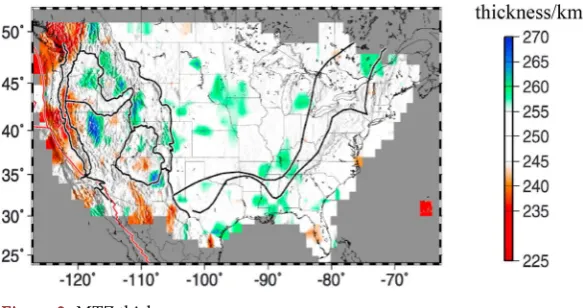
DOI: 10.4236/ojogas.2018.32013 151 Open Journal of Yangtze Gas and Oil problems for future work. The first one is temperature. For example, we know that mantle plumes are usually hotter than normal plumes because they could rise from lower mantle. However, according to Gao and Liu’s research, Yellowstone is not associated with higher temperature than that of normal mantle transition zone (Figure 2) [11].
Figure 2. MTZ thickness.
Similarly, some scientists thought that the Baikal rift zone in Siberia relates to a mantle plume. Yet Liu and Gao suggested that this mantle transition zone beneath the Baikal rift zone is not hot [12]. Therefore, it is hard to explain the mantle plumes have anomalous temperature and we should examine it more. From Anderson [2], although Hawaii is considered to be a plume, some studies pointed out that the lithosphere under Hawaii would be thinned because of plume heating, but it is not yet clear whether this condition was before the magmatism or a result of it. Large volumes of melt can be both from fertile mantle and hot mantle particularly. So it still needs to be researched in the future. In addition, due to the difference of continental and oceanic hotspots, there is a lack of continental hotspots. So the scientists need to search more evidences to find continental hotspots.
6. Conclusion
DOI: 10.4236/ojogas.2018.32013 152 Open Journal of Yangtze Gas and Oil about the mantle plumes.
Acknowledgements
I am grateful to thank to Dr. Stephen Shangxing Gao who is the professor of geophysics.
References
[1] Morgan, W.J. (1971) Convection Plumes in the Lower Mantle. Nature, 230, 42-43. https://doi.org/10.1038/230042a0
[2] Anderson, D.L. and Natland, J.H. (2005) A Brief History of the Plume Hypothesis and Its Competitors: Concept and Controversy. Special Paper 388: Plates, Plumes and Paradigms, 119-145. https://doi.org/10.1130/0-8137-2388-4.119
[3] Anderson, D.L. (1998) The Helium Paradoxes. Proceedings of the National Academy of Sciences, 95, 4822-4827. https://doi.org/10.1073/pnas.95.9.4822
[4] Karl, D.M., McMurtry, G.M., Malahoff, A. and Garcia, M.O. (1988) Loihi Seamount, Hawaii: A Mid-Plate Volcano with a Distinctive Hydrothermal System. Nature, 335, 532-535. https://doi.org/10.1038/335532a0
[5] Coffin, M.F. and Eldholm, O. (1994) Large Igneous Provinces: Crustal Structure, Dimensions, and External Consequences. Reviews of Geophysics, 32, 1.
https://doi.org/10.1029/93RG02508
[6] Austermann, J., Kaye, B.T., Mitrovica, J.X. and Huybers, P. (2014) A Statistical Analysis of the Correlation between Large Igneous Provinces and Lower Mantle Seismic Structure. Geophysical Journal International, 197, 1-9.
https://doi.org/10.1093/gji/ggt500
[7] Armienti, P. and Gasperini, D. (2007) Do We Really Need Mantle Components to Define Mantle Composition? Journal of Petrology, 48, 693-709.
https://doi.org/10.1093/petrology/egl078
[8] Wölbern, I. https://commons.wikimedia.org/wiki/File:Hotspots.jpg
[9] Montelli, R. (2004) Finite-Frequency Tomography Reveals a Variety of Plumes in the Mantle. Science, 303, 338-343. https://doi.org/10.1126/science.1092485
[10]Morgan, W.J. (1968) Rises, Trenches, Great Faults, and Crustal Blocks. Journal of Geophysical Research, 73, 1959-1982. https://doi.org/10.1029/JB073i006p01959 [11]Gao, S.S. and Liu, K.H. (2014) Mantle Transition Zone Discontinuities Beneath the
Contiguous United States. Journal of Geophysical Research: Solid Earth, 119, 6452-6468. https://doi.org/10.1002/2014JB011253