Some contributions of MAGIC to the physics of cosmic rays
S.R.Gozzini1,afor the MAGIC Collaboration2
1Deutsches Elektronen-Synchrotron (DESY) Zeuthen, Germany 2Observatorio del Roque de los Muchachos, La Palma, Spain
Abstract. Cosmic ray interactions can be investigated indirectly inγray astronomy, with the observation of
spectral and morphological features of certain classes of sources. MAGIC is a stereoscopic system of twoγ
ray telescopes, located at La Palma (Canaries), with access to the energy window between 50 GeV and 30 TeV. Sources of high relevance for the study of very high energy hadronic interactions are active galactic nuclei, as blazars and radio galaxies. MAGIC has detected about fifty such extragalactic objects; we will present some where the emission is explained with accelerated hadrons in interaction with ambient photons. We will also mention cosmic ray acceleration in galaxy clusters. Other than that, hadron-hadron interactions are supposed to take place in some supernova remnants in interaction with surrounding molecular clouds; we will show some results, in connection with cosmic rays of galactic origin. Finally, about other possible components, we will mention the measurement of the diffuse electron and positron spectrum. Trustingly, the close connection between particle physics and astrophysics will contribute in future years to many new interesting observations.
1 Introduction
This paper presents a sample of the results obtained with the MAGIC telescopes, focused on the connection be-tween high energy γ-rays (GeV–TeV regime, observed
with Cherenkov telescopes) and their parent particles, which can be electrons, protons or nuclei accelerated to high energies. Electrons produce γrays mainly through
inverse Compton scattering; hadrons radiate via two main channels of inelastic collisions: hadronic interactions of protons and nuclei on ambient molecular gas
pN→M0+X→γ+X, (1)
where M0is a neutral meson (
π0,η), or via photo-meson
production on ambient photons
pγ→∆→π0+X→γ+X. (2)
The cross section for pN interactions is more than two orders of magnitude larger than for pγ, but the second
pro-cess dominates in sources that have a high photon number density. Target baryons are found in the diffuse interstellar medium or in molecular clouds; seed photons belong to the ambient (cosmic microwave background, diffuse inter-stellar radiation field) or to the source itself (synchrotron radiation, accretion disk). For astrophysical applications, cross sections for hadronic processes are obtained with Monte Carlo simulations (SOPHIA, SIBYLL, QGSJET, [1–3]) and often presented in parameterized form [4–6]. Rates are obtained multiplying cross sections with target densities, and folding them with a spectrum of accelerated
ae-mail: [email protected]
projectiles. Both densities and spectra are in principle un-known. The uncertainties on the computed photon spectra are currently dominated by large uncertainties on spectral parameters and quantities describing the environment. For the latter (such as target densities, magnetic field strength), in some cases independent measurements exist.
2 The detection of
γ
rays and the MAGIC
telescopes
Showers induced by photons in the atmosphere emit Cherenkov light that can be recorded by a photomulti-plier camera; this is the method used by imaging atmo-spheric Cherenkov telescopes. These instruments perform ‘traditional’ astronomical observations, pointed at selected sources whose positions are known from observations at other energies. Photon arrival direction and energy are re-constructed to yield energy spectrum and morphology of the source observed, after filtering background of diff er-ent origins (atmospheric hadrons, muons, night sky light, electronics). MAGIC is a stereo system of two dishes (17 metres diameter, 3.5◦ field of view) located at La Palma,
Canaries. The energy window accessible with this tele-scope ranges from 50 GeV to about 30 TeV; at energies larger than 300 GeV, MAGIC has a sensitivity of 0.8% of the Crab flux in 50 hours, an angular resolution of 0.07◦,
and an energy resolution of 17%. The two telescopes op-erate in stereo mode since 2009; an upgrade of camera and readout has been completed in summer 2012. Other tech-nical details can be found in [7].
C
Owned by the authors, published by EDP Sciences, 2013
This is an Open Access article distributed under the terms of the Creative Commons Attribution License 2 0 , which . permits unrestricted use, distributi and reproduction in any medium, provided the original work is properly cited.
3 Extragalactic sources and accelerated
hadrons
Active galactic nuclei (AGN) are thought to be principal accelerators of cosmic rays [8]. In these sources, a pre-sumed super-massive black hole (107 −109M
⊙) powers
the acceleration of particles through the formation of an active accretion disk that is thought to generate powerful, relativistic highly collimated jets. Hadronic models ex-plain the observed emission by the interactions of protons with ambient photons of different origins: light from the accretion disk, or synchrotron radiation produced by elec-trons co-accelerated with protons in presence of magnetic field. In the simplest models, accelerated particles are con-fined inside a blob which moves coherently along the jet. In the blob, photons are radiated directly from decays of baryons or mesons and synchrotron radiation; electromag-netic cascades are initiated by all charged secondary par-ticles produced in photo-hadronic interactions. Acceler-ation and emission features in AGNs are explained in a unified model [9], and the sources and their characteristics in different energy bands depend on the orientation of the jet relative to the observer. The optical depth inside the blob must be relatively small for photons to escape self-interactions and reach the observer; the blob size is corre-lated with the time scale of variability (flares) observed in this class of sources.
3.1 Monitored blazars: Markarian 421 and Markarian 501
Blazars are all AGNs whose jet points in the direction of the observer. Markarian 421 and Markarian 501 are two AGNs observed with complete campaigns (several instru-ments and many years of coverage)[10, 11]. Models of their spectral energy distribution, so far, cannot confirm nor exclude the acceleration of hadrons. Figure 1 shows a sample hadronic model hadronic model for Markarian 421, which reproduces the emission with accelerated pro-tons. The emission is due to photons fromπ0 decay, and
from cascades. Cascades are sequences of electromag-netic processes, initiated by π0 decay, by electrons from
pion and muon decays, and by synchrotron photons radi-ated from initial protons, or from any unstable interme-diate charged particle (π±, µ±) before decaying (see
cap-tion). For Markarian 501, the quiescent emission can be explained with leptons; however, flares have been inter-preted with a change in the composition of accelerated par-ticles [12].
3.2 Radio galaxies: Perseus and Virgo Cluster
Powerful radio lobes and large scale jets have been looked at as interesting accelerators in the quest for sources of cosmic rays [13]. Perseus is one of the brightest clusters in X rays; it contains two radio galaxies visible at very high energies: NGC 1275 and IC 310 (shown in the map in figure 2)[14]. The radiation of γ rays is supposed to
originate from cosmic ray interactions with the intraclus-ter medium. Constraints on inintraclus-teractions between cosmic
rays and the interstellar medium have been obtained from the non-detection of anyγray excess for NGC 1275 above
630 GeV. Limits have been established on the ratio be-tween cosmic ray and thermal pressure (smaller than a few percent) and on the central magnetic field (larger than 4-9
µG)[14].
The central active galaxy in the Virgo cluster, M87, has been rather discouraging from the perspective of the search for cosmic ray sources. Monitoring campaigns with MAGIC favour leptonic models for the low emission state [15]. Ejection events seen in multi-wavelength campaigns [16] are also interpreted with accelerated electrons emit-ting through synchrotron and inverse Compton processes.
3.3 Flat spectrum radio quasars
Flat spectrum radio quasars are a class of AGNs with a strong accretion disk, that forms an additional target pho-ton field for pγinteractions. These sources show atomic
emission lines originating in the disk in what is called the "broad line region". It is believed that theγ-ray emission
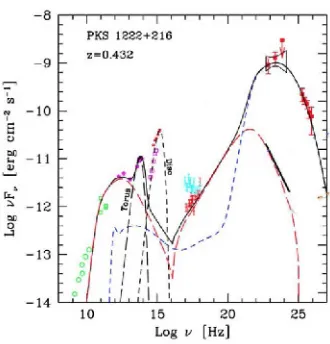
has a strong contribution from the interaction of the blob with a region characterized by an extremely high photon number density; this correlates also the size of the broad line region, and its distance from the central black hole, with the scale of variability. There is no definitive evi-dence that flat spectrum radio quasars are hadron acceler-ators, but many models hint in this direction. One example is the flat spectrum radio quasar 3C 279, the most distant source detected at very high energy [17], whose emission is explained with proton and muon synchrotron and rel-ative cascades [18]. The emission of other flat spectrum radio quasars is under debate. One of the latest discover-ies in this regard is the source PKS 1222+216 (red shift
z = 0.432) [19]. The spectral energy distribution
mea-sured with Fermi-LAT and MAGIC meamea-sured with Fermi and MAGIC [19] are compatible with a simple power law
Figure 1. Spectral energy distribution of Markarian 421
inter-preted with a hadronic model [10]. The fit has parameters: mag-netic field B = 50 G, blob radius=4·1014cm and an initial spectrum of protons following a power law with index -1.9. Cas-cades fromπ0,π±, muon synchrotron and proton synchrotron are
Figure 2. Significance sky map of the Perseus cluster, as
ob-served with MAGIC [14], above 150 GeV (top) and above 630 GeV (bottom). The white cross at the centre of the map marks the position of NGC 1275, the black cross IC 310, which is still visible above 630 GeV. The white circle shows the 0.15◦region
used to compute the constraints mentioned in the text.
Figure 3. Spectral energy distribution of the flat spectrum radio
quasar PKS 1222+216. See text for details.
from 3 to 400GeV. The lack of a cut-offsuggests that the emssion originates outside the broad line region, that re-sults opaque to high-energy photons due to photon-photon absorption. On the other hand, the observed short vari-ability of this source (of hour time scale) implies that the emitting region is rather small, hence located close to the central black hole. The spectral energy distribution and models of PKS 1222+216 are shown in figure 3.
Figure 4. Spectral energy distribution of the blazar 1ES
1959+650. The origin of the emission of this source cannot be explained with simple single zone models.
3.4 Blazars whose emission model is uncertain
There are some sources whose spectral energy distribu-tion is not yet satisfactorily modeled. This includes the situation in which simple assumptions do not work (as in multi-zone models), and that in which no model, leptonic or hadronic, fits the observed spectrum. This is the situ-ation for the blazar PKS 1424+240 [21], whose spectral energy distribution requires at least two different popula-tions of leptons to be explained (a two-zone model). An-other is the situation for 1ES 1959+650 [20] (figure 4), whose unusual plateau at high energies is not a feature of any leptonic model (based on inverse self Compton scat-tering). Hadronic models have failed to consistently model the source [20].
4 Sources connected with galactic cosmic
rays
Supernova remnants are thought to be the sources of galac-tic cosmic rays, with energies up to about 1015 eV [22].
The supposed acceleration mechanism in such objects is first order (diffuse shock) Fermi acceleration [23], which happens through scattering between upstream turbulence and the shock front (requiring a magnetized plasma up-stream of the strong shock). This, being a process of elec-tromagnetic nature, applies to both electrons and hadrons without differences. There is a class of supernova rem-nants surrounded by molecular clouds that is of particular interest for cosmic ray acceleration; in these sources, the radiation ofγrays from hadrons can occur through
proton-nucleus interactions, and is related to a high number den-sity of target nuclei in the molecular environment.
4.1 Hints in favour of a hadronic component in W51C
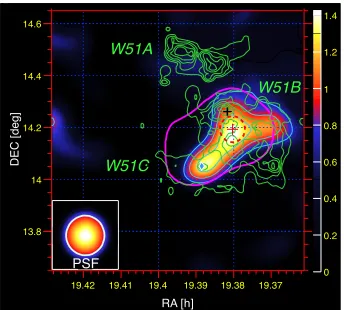
energy ranges [26]. Both the morphology and the spec-trum of this source indicate a possibly hadronic nature of the emission. The maximum of the emission coincides with interaction between the shock front and the molec-ular cloud in the nearby star forming region W51B, re-vealed as high velocity hydrohen (figure 5). The spectral energy distribution is best fit with a model having its main contribution fromπ0decay (figure 6).
4/2 4/1 4/3 4/0 -/2 -/1 !"#$%& '()#$*+,& -./0 -1 -1/2 -1/1 -1/3 4 4/2 4/1 4/3 4/0 --/2 -/1 -7/.6 -7/.0 -7/.7 -7/1 -7/1--7/12 89: !"#$ !"#& !"#%
Figure 5. Relative flux map (excess/background) with MAGIC
[26] (in colours), for energies larger than 1 TeV, overlaid with the region of shocked gas of the target molecular cloud [25] (red dashed ellipse), and the 21 cm radio continuum emission [24] (green contours). Pink contours mark the shape of the source first discovered by Fermi/LAT [27].
10-16 10-15 10-14 10-13 10-12 10-11 10-10 10-9
10-5 100 105 1010 1015
ν
Fν
/(erg s
-1 cm -2) E/eV Archival data This work pi0 decay IC Bremsstr. Synchrotron total
Figure 6. Spectral energy distribution of W51C, explained with
a main hadronic contribution.γrays are produced from decays of
neutral pions produced in proton-nucleus collisions. In the model shown here, the ratio of protons to electrons is 80:1. Simple leptonic models fail to fit the spectrum.
The non-spherical morphology of the γray emission
disfavours a scenario in which cosmic rays uniformly dif-fuse away from the shell [29]. Instead, those scenarios in whichγare radiated in the shock regions, close to the
acceleration site of their parent particles, which are more consistent with the high ionisation measurements in the cloud [28]. Re-acceleration of cosmic rays in the forward shock is not excluded [30].
5 Electron Spectrum
Cosmic ray electrons, whose propagation length is about 105light years, provide information about the diffuse spec-trum of sources within a distance of order a few kilopar-secs. MAGIC measures cosmic ray electrons as standard background, as they initiate electromagnetic showers not correlated with the position of a source. Figure 7 shows the most recent MAGIC spectrum (in red), together with other existing measurements (in black), and the discrepancy of the observed electron spectrum from a pure power law that is supposed to describe the diffuse cosmic spectrum [31]. The origin of this contribution at high energy could be sec-ondary electrons generated in interactions of cosmic rays with interstellar medium, or electrons from supernova ex-plosions or pulsars. In exotic physics scenarios these are due to contributions from dark matter annihilation [31].
Energy [GeV]
10 102 3
10 ] 2 GeV -1 sr -1 s -2 )/dE [m + +e d(e × 3 E 10 2 10 HEAT Emulsion chambers AMS-01 PPB-BETS H.E.S.S. low energy H.E.S.S. high energy ATIC Fermi-LAT low energy Fermi-LAT high energy Pamela e-MAGIC Electron positron flux
PRELIMINARY
Figure 7. Electron spectrum measured with MAGIC (in red),
overlaid with existing measurements [31]. The excess seen at high energy, still unexplained, could be due to secondary inter-actions of cosmic rays with the interstellar medium, supernova explosions, pulsars or dark matter contributions.
6 Conclusions
There are several classes of of sources detectable withγ
-ray telescopes, that are suggested as possible cosmic -ray accelerators: AGNs, radio galaxies, pulsars, supernova remnants. Extra-galactic sources appear point-like, so the only analysis that can be performed is the modelling of spectral energy distributions. Models based on accelerated hadrons provide a possible explanation for the emission of many AGNs. Some basic features of the accelerated parti-cle spectra, as indices, breaks, cut-offs and normalisations, can be obtained from fits of energy distributions. In most models, the cosmic ray composition is averaged over pro-tons and nuclei. It is not possible to constrain models for hadronic cross sections using onlyγ-ray data since the
Hadron acceleration in sources would be confirmed with coordinated observation of neutrinos from decay of charged pions [6]. Coordination betweenγ-ray and
neu-trino telescopes has been suggested [32]. Neuneu-trino events with coordinates close to preselected candidate sources are used to alertγ-ray observations. To date, only upper limits
have been produced by the TeV observations.
7 Acknowledgments
We would like to thank the Instituto de Astrofísica de Canarias for the excellent working conditions at the Ob-servatorio del Roque de los Muchachos in La Palma. The support of the German BMBF and MPG, the Ital-ian INFN, the Swiss National Fund SNF, and the Span-ish MICINN is gratefully acknowledged. This work was also supported by the CPAN CSD2007-00042 and Multi-Dark CSD2009-00064 projects of the Spanish Consolider-Ingenio 2010 programme, by grant DO02-353 of the Bul-garian NSF, by grant 127740 of the Academy of Finland, by the DFG Cluster of Excellence “Origin and Structure of the Universe”, by the DFG Collaborative Research Centers SFB823/C4 and SFB876/C3, and by the Polish MNiSzW grant 745/N-HESS-MAGIC/2010/0.
References
[1] Mücke, A., Engel, R., Rachen, J. P., Protheroe, R. J., Stanev, T., Comp. Phys. Commun. 124, 290 (2000) [2] Ahn, E.-J., Engel, R., Gaisser, T. K., Lipari, P., Stanev,
T., Phys. Rev. D 80, 094003 (2009)
[3] Ostapchenko, S., Nuclear Physics B Proceedings Sup-plements, 151, 143-146 (2006)
[4] Kelner, S. R., Aharonian, F. A., Bugayov, V. V., Phys. Rev. D.74, 034018 (2006)
[5] Hillas, J. Phys. G31, R95 (2005)
[6] Kelner, S. R., Aharonian, F. A., Phys.Rev.D.78, 034013 (2008)
[7] Aleksi´c, J. et al for the MAGIC Collaboration, As-troparticle Physics, 35, 435 (2012)
[8] Pierre Auger Collaboration, Science, 318, 938 (2007) [9] Urry, C. M. and Padovani, P., Publications of the
As-tronomical Society of the Pacific, 107, 803 (1995) [10] Fermi-LAT and MAGIC, Aph. J. 736, 131 (2011) [11] Fermi-LAT, MAGIC, VERITAS, Aph. J. 727, 129
(2011)
[12] Mücke, A., Protheroe, R. J., Engel, R., Rachen, J. P., Stanev, T., Astroparticle Physics 18, 593 (2003) [13] Hillas A. M., Astroparticle Physics, 32, 160 (2009) [14] Aleksi´c, J. et al for the MAGIC Collaboration,
As-tronomy & Astrophysics, 541, 99A (2012)
[15] Aleksi´c, J. et al for the MAGIC Collaboration, As-tronomy & Astrophysics, 544, 96 (2012)
[16] Abramowski, A. et al. (HESS, MAGIC, VERITAS Collaboration), The Astrophysical Journal 746 (2012) [17] Aleksi´c, J. et al for the MAGIC Collaboration,
Sci-ence 320, 1752 (2008)
[18] Böttcher, M., Reimer, A., Marscher, A. P., The As-trophysical Journal 703, 1168 (2009)
[19] Stamerra, A. et al. (on behalf of the MAGIC collabo-ration), proceedings of the III Fermi Symposium (2011) [20] Backes, M. (on behalf of the MAGIC collaboration), proceedings of the 5th International Symposium on High-Energy Gamma-Ray Astronomy, in press (2012) [21] Prandini, E. (on behalf of the MAGIC collaboration),
proceedings of the 5th International Symposium on High-Energy Gamma-Ray Astronomy, in press (2012) [22] Baade, W., Zwicky, F., Cosmic Rays from
Super-novae, Proc. of the National Academy of Science (1934)
[23] Fermi, E., Physical Review, 75, 1169 (1949) [24] Moon, D-S., Koo B-C., The Astrophysical Journal,
475 (1997)
[25] Carpenter, J.M. , Sanders, D.B., The Astronomical Journal, 116, 1856 (1998)
[26] Aleksi´c J. et al for the MAGIC Collaboration, As-tronomy & Astrophysics, 541 (2012)
[27] Abdo, A. A. et al, The Astrophysical Journal Letters,
706, L1 (2009)
[28] Ceccarelli C. et al, The Astrophysical Journal Let-ters, 740 (2011)
[29] Gabici, S., Aharonian, F. A., Casanova, S. Mon. Not. R. Astron. Soc., 396, 1629 (2009)
[30] Uchiyama, Y., Blandford R. D., Funk, S., Tajima, H., Tanaka, T. Astrophysical Journal Letters, 723, L122, (2010)
[31] Borla Tridon, D. (on behalf of the MAGIC collab-oration), proceedings of the International Cosmic Ray Conference (ICRC) (2011)
![Figure 1. Spectral energy distribution of Markarian 421 inter-preted with a hadronic model [10]](https://thumb-us.123doks.com/thumbv2/123dok_us/8747497.1434927/2.595.329.519.551.686/figure-spectral-energy-distribution-markarian-inter-preted-hadronic.webp)