EXPERIMENTAL DESIGN APPROACH TO OPTIMAL AND KINETIC EVALUATION OF COAG
FLOCCULATION PERFORMANCE OF
M.C. Menkiti
1*, S.M. Obiorah
1 Chemical Engineering Department, Nnamdi Az
2 Materials and Metallurgical Engineering Department, Nnamdi Az
ARTICLE INFO ABSTRACT
23- central composite design(CCD) optimization and kinetics of coal washery effluent (CWE) coag flocculation by
test. Afzelia bella
Ghebremichael. The combined effects of pH, dosage and settling time on the particle removal was studied using surface response methodology. Kinetic data generat
models for the evaluation of functional coag
pH, dosage and settling time were recorded at 6,300mg/l and 30min,respectively. The results of the major kinetic para
flocculation reaction rate constant and coagulation period, respectively. The minimum removal efficiency recorded was > 95% at 3 mins of coag
can be applied as a coag
INTRODUCTION
Coal washery effluent ,in raw state is a risk to the environment due to presence of dissolved organic and inorganic loads, microscopic organisms, and various suspended inorganic materials (Borovickova and Dolejs;2006). To make the CWE environment friendly, a principal treatment option such as coag-flocculation is a prime choice. Coag-flocculation is accomplished by the addition of ions having opposite charge to that of colloid particles. Typically, the ion species are from metal salts (Al and Fe), capable of destabilizing stable colloids in suspension, such that they can agglomerate into settleable floc (Moussas and Zouboulis,2008;Oladoja
Although the metal salts are widely used, there are health, environmental and cost challenges.(Oladoja
al,2009). Attempt to confront these challenges highlights the needed focus on sustainable water treatment agent that are low cost, eco friendly and robust (Menkiti and Onukwuli, 2012). ABC possesses these qualities and provides suitable alternative to the metal salts. Afzelia bella is of leguminous plant, rich in protein, fat and starch. It is edible, non toxic and abundant in Nigeria (Ezeagu et al, 2006; Menkiti , 2010). effectiveness of ABC has been demonstrated using conventional, one factor at a time (OFAT) method(Menkiti and Onukwuli,2011a) . With OFAT, study is usually carried out by varying a single factor while keeping all other factors fixed at a specific set of conditions. It is no
consuming, but also usually incapable of reaching the true optimum due to ignoring the interactions among variables.
*Corresponding author: [email protected]
ISSN: 0975-833X
International Journal of Current Research Vol.
Article History:
Received 9th
July, 2012 Received in revised form
4th
August, 2012
Accepted 7th
September, 2012
Published online 30th
October, 2012
Key words:
.Afzelia bella, Coagulation, flocculation, Factorial Design, Optimization, coal effluent
RESEARCH ARTICLE
EXPERIMENTAL DESIGN APPROACH TO OPTIMAL AND KINETIC EVALUATION OF COAG
FLOCCULATION PERFORMANCE OF
AFZELIA BELLA
EXTRACT IN COAL WASHERY EFFLUENT.
S.M. Obiorah
2, C.C. Okoye
1and O.D. Onukwuli
Chemical Engineering Department, Nnamdi Azikiwe University, Awka, Nigeria
Materials and Metallurgical Engineering Department, Nnamdi Azikiwe University, Awka, Nigeria
ABSTRACT
central composite design(CCD) optimization and kinetics of coal washery effluent (CWE) coag flocculation by Afzelia bella seed has been studied at room temperature via standard bench s
Afzelia bella coag-flocculant (ABC) was produced according to work reported by Ghebremichael. The combined effects of pH, dosage and settling time on the particle removal was studied using surface response methodology. Kinetic data generated were fitted with specified kinetic models for the evaluation of functional coag-flocculation kinetic parameters. The optimal values of pH, dosage and settling time were recorded at 6,300mg/l and 30min,respectively. The results of the major kinetic parameters recorded were 2, 7x10⁻⁵ l /mg.min and 1.34min for order of reaction, coag flocculation reaction rate constant and coagulation period, respectively. The minimum removal efficiency recorded was > 95% at 3 mins of coag-flocculation. The results demon
can be applied as a coag-flocculant in the treatment of water at the conditions of the experiment.
Copy Right, IJCR, 2012, Academic Journals
Coal washery effluent ,in raw state is a risk to the environment due to presence of dissolved organic and inorganic loads, microscopic organisms, and various suspended inorganic and Dolejs;2006). To make the CWE environment friendly, a principal treatment option such as flocculation is accomplished by the addition of ions having opposite charge ion species are from metal salts (Al and Fe), capable of destabilizing stable colloids in suspension, such that they can agglomerate into settleable floc (Moussas and Zouboulis,2008;Oladoja et al ,2009). Although the metal salts are widely used, there are inherent
health, environmental and cost challenges.(Oladoja et
Attempt to confront these challenges highlights the needed focus on sustainable water treatment agent that are low cost, eco friendly and robust (Menkiti and Onukwuli, 2012). esses these qualities and provides suitable is of leguminous plant, rich in protein, fat and starch. It is edible, non toxic and , 2006; Menkiti , 2010). The C has been demonstrated using conventional, one factor at a time (OFAT) method(Menkiti and Onukwuli,2011a) . With OFAT, study is usually carried out by varying a single factor while keeping all other factors fixed at a specific set of conditions. It is not only time consuming, but also usually incapable of reaching the true optimum due to ignoring the interactions among variables.
On the bases of this constraint, response surface methodology (RSM) has been proposed to determine the influence of factors and their interaction on the output responses. The RSM is a statistical method for planning experiments, crafting models, evaluating the effects of several factors and tracking optimum conditions for the desirable response. With RSM, the interaction of possible influencing parameters on treatment efficiency can be evaluated with limited number of planned experiments (Montgomery,1992; Khuri and Cornell 1996; .Mason et al,2003; Trinh and Kang,2010; Menkiti and Onukwuli 2011b) . In this study, the RSM was employed for the optimal and kinetic evaluation of coag
process. The experiment was carried out by jar test for evaluation of treatment process efficiency and optimization of coagulation pH, coagulant dosage and settling time. The interaction effects of the experimental factors were also investigated. The suspended and dissolved particles (SDP) removal were chosen as the dependent output variable, while efficiency (%) was monitored to determine the effe
of ABC as effluent treatment agent with prospect of large scale application for the upliftment of our eco
situation in Nigeria is typical of water system in developing countries and the results can be extended to similar situation to promote healthy environment.
MATERIALS AND METHOD
Material Collection, Preparation and Characterization
Coal Washery Effluent
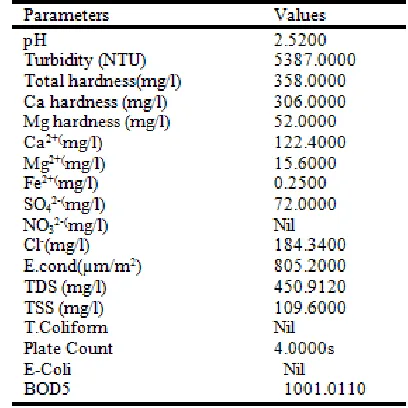
The effluent was taken from a coal mine in Enugu, Enugu State of Eastern Nigeria. The characteris
ternational Journal of Current Research Vol. 4, Issue, 10, pp.218-223, October,2012
OF CURRENT RESEARCH
EXPERIMENTAL DESIGN APPROACH TO OPTIMAL AND KINETIC EVALUATION OF
COAG-EXTRACT IN COAL WASHERY EFFLUENT.
and O.D. Onukwuli
1ikiwe University, Awka, Nigeria
ikiwe University, Awka, Nigeria
central composite design(CCD) optimization and kinetics of coal washery effluent (CWE) coag-seed has been studied at room temperature via standard bench scale jar flocculant (ABC) was produced according to work reported by Ghebremichael. The combined effects of pH, dosage and settling time on the particle removal was ed were fitted with specified kinetic flocculation kinetic parameters. The optimal values of pH, dosage and settling time were recorded at 6,300mg/l and 30min,respectively. The results of the l /mg.min and 1.34min for order of reaction, coag-flocculation reaction rate constant and coagulation period, respectively. The minimum removal
flocculation. The results demonstrated that ABC flocculant in the treatment of water at the conditions of the experiment.
, Academic Journals. All rights reserved.
On the bases of this constraint, response surface methodology sed to determine the influence of factors and their interaction on the output responses. The RSM is a statistical method for planning experiments, crafting models, evaluating the effects of several factors and tracking optimum response. With RSM, the interaction of possible influencing parameters on treatment efficiency can be evaluated with limited number of planned experiments (Montgomery,1992; Khuri and Cornell 1996; .Mason et al,2003; Trinh and Kang,2010; Menkiti and In this study, the RSM was employed for the optimal and kinetic evaluation of coag-flocculation process. The experiment was carried out by jar test for evaluation of treatment process efficiency and optimization of dosage and settling time. The interaction effects of the experimental factors were also investigated. The suspended and dissolved particles (SDP) removal were chosen as the dependent output variable, while efficiency (%) was monitored to determine the effectiveness of ABC as effluent treatment agent with prospect of large scale application for the upliftment of our eco-system. The situation in Nigeria is typical of water system in developing countries and the results can be extended to similar situation to
MATERIALS AND METHOD
Material Collection, Preparation and Characterization
presented in table 1 were determined based on standard method (Clesceri,1999).
Afzelia bella sample
Afzelia bella seeds (precursor to ABC) were sourced from Nsugbe,Anambra State, Nigeria. ABC was prepared according to procedure reported by Ghebremichael (2004). The characteristics of the seed sample on the bases of AOAC (1993) standard method are presented in table 2.
Coag-flocculation Experiments
In this present work, ABC (Plant extract) was used as a coagulant. In order to carry out the study, jar tests were used to perform the coagulation-flocculation (coag-flocculation) process. The experiments were carried out using 2L square jars, with six paddle stirrers, manufactured by Phipps and Birds, VA USA. The coag-flocculation pH was adjusted using 0.1M H2SO4 or 0.1MNaOH just before dosing of the
coagulant. The time and speed for rapid and slow mixing were set with an automatic controller as follow: Rapid mixing at 250rpm(G=550 sec-1) for 1 minutes after ABC addition, followed by slow mixing at 30 rpm(G=22 sec-1 ) for 30 minutes, and then settling time for 3- 30 minutes range. During settling, samples were withdrawn using pipette from 2cm depth and analyzed for optimization with SDP (mg/l) removal as a response.
Experimental design and data analysis
In this study, CCD and RSM were applied to optimize three important operating variables: coagulation pH, coagulant dosage and settling time. Experiments were initiated as a preliminary study for determining a narrower range of pH, coagulant dosage and settling time prior to designing the experimental runs. Accordingly, pH from 1 were tried and the increment continued until appreciable reductions were observed in the process response(SDP). Likewise, a wide dosage and time range of 100-1000mg/l and 5-50 minutes, respectively were examined to search for a narrower and more effective range. The preliminary search range of settling time was pegged at 5-50minutes. As a result, the study ranges and levels displayed in table 3 were chosen. Applied CCD matrix (not shown) is of 32 full factorial design with three star points, six center points and two replications that generated 34 runs and responses. .The experimental results of the 23-CCD were studied and interpreted by software, MATLAB 7.0.
THEORY
Coag-flocculation optimization
Full 23-CCD (design matrix omitted) was employed for the coag-flocculation factorial optimization. pH , dosage and settling time were chosen as independent variables while particle (SDP) uptake is the output response. 34 experiments were generated from three star points, six centre points and two replications. The behavior of the system is explained by the multivariable polynomial equation presented below: Y=bo+b1X1+b2X2+b3X3+b12X1X2+b13X1X3+b23X2X3+b11X21+b 22X22+b33X23
…1
X1 is Ph, X2 is dosage, X3 is settling time, Y is SDP uptake
Upon the determination of polynomial coefficients(b0,b1,b33
etc), statistical analysis (CSI,G-test,F-test,T-test e.t.c) were performed to develop model that is adequate , significant and homogenous (variance wise)(Montgomery,1992).
Coag-flocculation kinetic
The rate of successful collision between particles of sizes i and j to form particle of size k is (Jin, (2005):
1
(
,
)
)
,
(
2
1
i BR i k
k j
i BR i j
k
n
n
k
i
n
n
j
i
dt
dn
…2
where βBR(i,j) is Brownian aggregation factor for flocculation
transport mechanism, ninj is particle aggregation concentration
for particles of size i and j, respectively. It has been established that [Jin,(2005); Hunter,(1993)]:
K
BT
p BR
3
8
…3
where KB,T ,η, εp are Boltzmann constant, temperature,
viscosity and collision efficiency factor, respectively. It can be shown that:
BR
pK
R
K
m2
1
…4
t m t
N
K
dt
dN
…5
KR is defined as Von Smoluchowski rate constant for rapid
coagulation. Km is Menkonu coag-flocculation rate constant
accounting for Brownian coag-flocculation transport of destabilized particles at αth order. Nt is the concentration of
SDP at time, t [(Van Zanten and Elimelech,1992; Menkiti and
Onukwuli, 2010;Menkiti et al ,2010 Menkiti and
Onulwuli,2011c; Menkiti and Onulwuli,2012 ]. Graphical
representation of linear form of equation 5 at α=2 provides Km
from the slope of equation below:
0
1
1
N
t
K
N
m
…6
where N0 is upper limit of Nt at t>0.
N0 is Nt at t=0.
Equation 6 can be solved to obtain coag-flocculation period, τ1/2
1 0 2
/
1
(
0
.
5
)
N
K
m
…7
1
2 / 1
2 / 1
0 ) (
1
1
mt m
t
N
N
…8 m=1(monomer), m=2(doublet),m=3(triplet)
Efficiency of coag-flocculation is expressed as:
100
(%)
0 0
N
N
N
E
t…9
RESULTS AND DISCUSSION
Statistical Analysis
The process variables investigated were pH, dosage and settling time. The study of the process was achieved by response surface methodology via 23-CCD. The measurement anchors on how the SDP removal (dependent output response) was affected by independent variables: CWE pH (X1);
coag-flocculant dosage (X2), settling time (X3). The variables range
were between 2 and 10, 100 and 500 mg/l and 10 and 20 minutes for Ph, dosage and settling time, respectively as shown in table 3. In order to study the combined effects of these factors, experiments were performed at different combinations of the physical parameters using statistically design (design matrix omitted) experiments. The main effects of the variables and response of the system are predicted by equation 10.
Y=295.48+23.86X15.75X2+31.88X3+28.50X1X2+11.90X1X3+
26.58X2X3+34.06X21+19.57X22+1.45X23
…10
The CCD multivariable mathematical equation are predicted as a calculated sum of constant, three first order effects ( terms in X1,X2,X3), three interactive effects (X1X2, X1X3,
X2X3) and three second order effects(X1 2
, X2 2
, X3 2
) according to equation 10.The results obtained were then analyzed by means of ANOVA to asses the “goodness of fit”. Equation from the initial ANOVA analysis are usually modified (where applicable) by eliminating the terms found statistically insignificant via CSI-test. Equation 10 amply depicts the non-reduced quadratic model of the present study in terms of coded factors. Equation 10 indicates that the coefficients of first order variables (X1,X2,X3), interactive terms (X1X2,X1X3,
X2X3) and quadratic interaction(X1 2
,X2 2
,X2 3
) proved to be significant at CSI of 0.3973, since the magnitude of the coefficients were greater than 0.3973. ANOVA results demonstrate that the model is significance at 5% confidence level since p-value at 0.0049 is less than 0.05.The F-test indicates that the model equation is adequate since 0.8737 is less than F-table (15.373). This describes the variation of the data around the fitted model. The results affirmed that there is significant model correlation between the variables and process response. The R2 coefficient gives the proportion of the total variation in the response predicted by the model, indicating ratio of sum of squares due to regression (SSR) to
[image:3.612.333.537.70.274.2]Table 2 :Characteristics of ABC precursor
Table 3: Experimental range and levels of Independent process variables
[image:3.612.318.563.409.693.2]Figure 1: Coag-flocculation surface / contour plots of ABC in CWE showing interaction effects of pH and dosage
Figure 2 : Coag-flocculation surface / contour plots of ABC in CWE showing interaction effects of pH and settling time
Figure 3: Coag-flocculation surface / contour plots of ABC in CWE showing interaction effects of dosage and settling time
adjustment of the multivariable polynomial model to the experimental data . The fact that ANOVA report gives high R2 and adjusted R2 correlation factors of 98.919 and 98.001, respectively allows for the presentation of the CCD model and DOE procedures as a consistent statistical method for analyzing the system under study at the conditions of the experiment. This aspect is very important in order to scale up the results of the current investigation on the bases that model applied to this phenomena explains properly the behavior of the system . The Chochrain’s test (G-test) indicates that holistically the variance is homogeneous since G at 0.2411 is less than
0.4388.
Process optimization and analysis
The optimization results obtained from equation 10 as interpreted by MATLAB 7.0 are presented in table 4. With the aim of reducing the initial concentration of SDP, the optimal pH, dosage and settling time were recorded at 6, 300mg/l and 30min, respectively. It can be deduced that at optimal conditions, the SDP was reduced from initial concentration of 21204.72mg/l to 255.03mg/l. This translates to about 98.7972% SDP removal from the CWE. The corresponding interactive factors of the surface response plots are depicted in figures 1 to 3.Figure 1 shows response between pH and dosage with respect to SDP removal from CWE. Figures 2 and 3 show the interactive effect between pH and settling time, and between dosage and settling time, respectively. Figures 1,2 and 3 demonstrated that SDP were reduced to 290mg/l, 260mg/l and 260mg/l, respectively. These values lie within the neighborhood of result shown in table 4. The most important graphical representation in RSM is the surface (3D) plots shown in figures 1-3. It plots equation 10 and allows to evaluate from qualitative point of view how the behavior of the whole system is. With SDP removal as the response, the obvious trough in the response surfaces (figures 1-3) indicates that the optimal conditions for the two interacting variables were exactly located inside the design boundary. Obviously, the surface response (figures 1 to 3), provides avenue to observe the surface area of the curve within which the process can perform optimally. The significance of these interaction effects between the variables would have been lost if the experiments were carried out by traditional method.
Time dependent Removal Efficiency of SDP from CWE
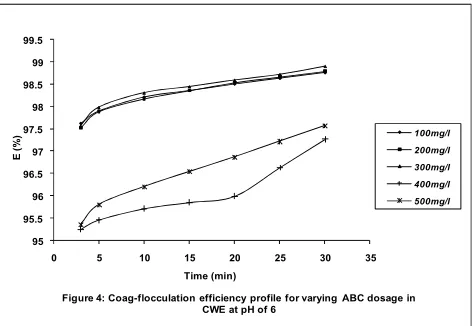
Time course removal efficiency (in %) assesses the effectiveness of given dose of ABC (at optimal pH and 95
95.5 96 96.5 97 97.5 98 98.5 99 99.5
0 5 10 15 20 25 30 35
E
(
%
)
Time (min)
Figure 4: Coag-flocculation efficiency profile for varying ABC dosage in CWE at pH of 6
100mg/l
200mg/l
300mg/l
400mg/l
500mg/l
0 1E+24 2E+24 3E+24 4E+24 5E+24 6E+24 7E+24 8E+24 9E+24
0 5 10 15 20 25 30 35
N
o
o
f
p
art
ic
le
s
(
/l
)
[image:4.612.71.287.213.351.2]Time (min)
Figure 5:Time evolution of the cluster size distribution for ABC in CWE at half life of 1.34min
[image:4.612.71.286.399.534.2] [image:4.612.62.298.571.734.2]evaluated from equation 9 are shown in figure 4 for 100-500 mg/l ABC doses. The best performance is recorded at 300mg/l, with the initial SDP of 21204.72 mg/l reduced by 97.500 % and 99.15% at the end of 3 and 30 minutes, respectively .This indicates clearly, the case of perikinetics aggregation. The least performance is recorded for 400mg/l and 3minutes at removal efficiency of 95.400%. With the least recorded E(%) > 95.00 % for all the cases of doses considered , it establishes at the conditions of the experiment, the effectiveness of ABC to remove turbidity from the CWE at the end of 30minutes of coag-flocculation. It is arguable from figures 1-3 that pH and dosage at the experimental conditions do not constitute much hindrance to effective performance of ABC in this study. Typical phenomenon that empowers ABC to be such effective is the magnitude of coordinating amine charge (+) generated from possible olation and cross- bridging of such complex species that facilitate strong attraction, adsorption and sweeping away of the particles as the complex settles under gravity. It should be noted that proteins are amphoteric and the value of pH in relation to isoelectric point is a critical consideration. The relationship can favour and equally disfavor the progress of coag-flocculation depending on whether the buffer pH is higher or lower than the isoelectric point (Ghebremichael, 2004) .The results are in close agreement with the ones shown in table 4.
Coag-floculation kinetics
Results of the functional kinetics parameters at optimum conditions are shown in table 5. Table 5 indicates that experimental data (with R2>0.90) were significantly described by equation 6. Km is determined from the slope of equation 6
on plotting 1/N vs. time. Km (and βBR) values shown in table 6
vary minimally with dosage variation. This may be explained by the close efficiency level achieved by the individual dosages as depicted in figure 4. The variation of KR=fn (T,η)
is minimal, resulting from insignificant changes in the values of temperature and viscosity of the effluent. At approximately constant KR, εp relates directly to 2 Km= βBR. Thus , high εp
results in high kinetic energy to overcome the forces of repulsion. The coag-flocculation period τ1/2, is evaluated from
equation 7. In this case, τ1/2=fn (N0). The higher the N0, the
lesser the τ1/2. This accounts for high settling rate associated
with water of high turbidity load. From theoretical point of view, τ1/2, εp and KR are considered effectiveness factor,
understood to be accounting for the coag-flocculation efficiency before flocculation sets in.
Time evolution of cluster size distribution
Using Km obtained from equation 6, equation 8 is able to
predict the time evolution of aggregates (monomers, dimmers; trimers for m=1,2,3,respectively). The obvious nature of the curves in response to period of 1.340 minute is demonstrated in figure 5. The primary particles (monomers) and total number of particle can be seen to decrease more rapidly. This is an evidence of high rate of coag-flocculation demonstrated at low τ1/2 of 1.340 minute. The mechanism that accounts for
this distribution includes both charge neutralization and sweep floc (Menkiti and Onukwuli, 2011a; Menkiti and Onukwuli 2012) . One or the other may predominate, but each is always
usually neutralize particle charges ( and zeta potential) and effectively lowering or removing DLVO energy barrier. With negligible zeta potential among the particles, the ABC instantly sweeps away the SDP (Menkiti et al, 2011; Ravina,, 1993).Colloid entrapment predominates where relatively overdose is obtained or the positive charges of coagulant overwhelm the active colloidal particle charges. Though charge neutralization occurs, most of the SDP were literally swept from the fluid by becoming enmeshed in the settling mega positively adsorptive amine complex.
Conclusion
ABC has been effectively applied at pilot scale as coag-flocculant in the treatment of high turbid CWE. The removal of more than 90% of initial value of SDP within the first three minutes of treatment affirms that the process was rapid with low coagulation period. The work also demonstrated the utilization of statistically designed experiment in pinning optimal conditions for ABC driven coag-flocculation performance in CWE. Performance model developed significantly predicts the process behaviour and was plotted as 3-D response. Optimal operation was recorded at pH6, 300mg/l dosage and 30 minutes settling time at the conditions of the experiments.
REFERENCES
AOAC,.1993.Official methods of Analysis. Association of official analytical chemist.14th edition ,USA.
Borovickova, M. and Dolejs,P.2006.Chitosan-A new type of polymer coagulant. Institute of chemistry and technology of environmental protection, faculty of chemistry, Brno University of technology, Brno, Czech Republic.
Clesceri, LS., Greoenberg, A E. and Eaton, AD. 1999.
Standard methods for the examinatin of water and waste water. 20thediton,APHA, USA.
Ezeagu, IE., Metges, CC., Proll, J. and Akinsoyinu,AO. 2006.Chemical composition and nutritive value of some
wild gathered tropical plant seeds.Deutscher
Akademischer Austaischdienst,German Institue for
human nutrition,Bonn Germany:3-4.
Ghebremichael, K. 2004. Moringa Seed and pumice as
alternative natural materials for drinking water treatment. TRITA-LWR PHD 1013 Ph.D Thesis, KTH land and Water Resources Engineering.
Hunter,RJ.1993. Introduction to Modern Colloid Science. 4th edition, University Press, New York. 33-38, 289-290. Khuri, A.I. and Cornell, J.A. 1996. Response surface, design
and analysis, 2nd edition, Marcel Dekker Inc., New York.
Mason, R.L., Gunst, R.F. and Hess, J.L. 2003. Statistical design and analysis of experiment, Eight application to Engineering and Science, 2ndedition, Wiley, New York.
Menkiti, M. C.2010 .Sequential treatments of coal washery and brewery effluents by biocoag-flocculation and activated carbon adsorption.Ph.D Thesis. Chemical Engineering Department, Nnamdi Azikiwe University, Awka, Nigeria.
Menkiti, M.C and Onukwuli,O.D. 2010. Coag-floccuation of
Nephelometric approach. Journal of American Science. 6(12):788-806
Menkiti, M.C. and Onukwuli O.D. 2012. Coag-flocculation of
Mucuna seed coag-flocculant(MSC) in coal washery effluent(CWE) using light scattering effects. AICHE Journal. 57(5): DOI: 10.1002/aic.12665..
Menkiti, M.C. and Onukwuli, O.D. 2011a Coag-flocculation studies of Afzelia bella coagulant (ABC) in coal effluent using single and simulated multi angle nephelometry.
Journal of Mineral and Material Characterisation and Engineering. .10 (3): 279-298.
Menkiti, M.C. and Onukwuli, O.D. 2011c. Single and Multi angle nephelometric approach to the study of Coag-flocculation of coal effluent medium using Brachystegia eurycoma coagulant. World journal of engineering.8 (1):61-76.
Menkiti, M.C., Nnaji, P.C. and Onukwuli, O.D. 2009. Coag-flocculation kinetics and functional parameters response of periwinkle shell coagulant(PSC) to pH variation in organic rich coal effluent medium. Nature and Science.
7(6): 1-18.
Menkiti, M.C.,Mbah G.O. and Onukwuli O.D.
2011.Turbidimetric perikinetics behavior of Afzelia bella
seed biomass for coag-flocculation treatment of pH varying brewery effluent. International Journal of Chemistry, 3(4):104-115.
Menkiti, M.C.and Onukwuli.O.D. 2011b Response surface methodology and kinetics application to the optimization treatment of brewery waste water by Afzelia bella coag-flocculant, In: Water: Ecological disasters and sustainable development, Lambert Press, Germany, pp.92-107,
Menkiti,M.C., Nnaji,P.C., Nwoye, C.I. and Onukwuli,
O.D.2010. Coag-flocculation kinetics and functional parameters response of mucuna seed coagulant to pH variation in organic rich coal effluent medium. Journal of Minerals & Materials Characterization &Engineering.
9(2):89-103.
Montgomery, D C. 1992. Design and Analysis of Experiments.
3rdedition,Wiley, New York.
Moussas, PA. and Zouboulis, A I. 2008. A study on the properties and coagulation behavior of modified inorganic polymeric coagulant-poly ferric silicate sulphate (PFSS).
Separation and purification Technology. 63: 475-483. Oladoja, A N. and Aliu,YD. 2009. Snail shell as coagulant aid
in the alum precipitation of malachite green from aqua system. Journal of Hazardous materials. 164,(2-3):1496-1502.
Ravina,L.1993 Every thing you want to know about coagulation and flocculation. Fourth edition ZetaMeter Inc., Virginia , USA.
Swift,D L. and Friedlander,S.K. 1964.The coagulation of hydrosol by Brownian motion and laminar shear flow.
Journal of Colloid Scienc 19:621.
Trinh, T.K. and Kang, L.S.2010. Application of response surface method as an experimental design to optimize
coagulation test. Environmental Engineering
Research..15 (2): 063-070.
Van Zanten, JH. and Elimelech, M. 1992. Determination of Rate constants by multi angle light scattering. Journal of colloid and interface. 154(1): 621.