Proceedings of the 16th Workshop on Computational Research in Phonetics, Phonology, and Morphology, pages 95–103 95
UDPipe at SIGMORPHON 2019: Contextualized Embeddings,
Regularization with Morphological Categories, Corpora Merging
Milan Straka and Jana Strakov´a and Jan Hajiˇc Charles University
Faculty of Mathematics and Physics Institute of Formal and Applied Linguistics
{straka,strakova,hajic}@ufal.mff.cuni.cz
Abstract
We present our contribution to the SIGMOR-PHON 2019 Shared Task: Crosslinguality and Context in Morphology, Task 2: contextual morphological analysis and lemmatization.
We submitted a modification of the UDPipe 2.0, one of best-performing systems of the CoNLL 2018 Shared Task: Multilingual Pars-ing from Raw Text to Universal Dependencies and an overall winner of theThe 2018 Shared Task on Extrinsic Parser Evaluation.
As our first improvement, we use the pre-trained contextualized embeddings (BERT) as additional inputs to the network; secondly, we use individual morphological features as reg-ularization; and finally, we merge the selected corpora of the same language.
In the lemmatization task, our system exceeds all the submitted systems by a wide margin with lemmatization accuracy 95.78 (second best was95.00, third94.46). In the morpho-logical analysis, our system placed tightly sec-ond: our morphological analysis accuracy was
93.19, the winning system’s93.23.
1 Introduction
This work describes our participant system in the
SIGMORPHON 2019 Shared Task: Crosslingual-ity and Context in Morphology. We contributed a system in Task 2: contextual morphological analy-sis and lemmatization.
Given a segmented and tokenized text in a CoNLL-U format with surface forms (column 2) as in the following example:
# sent-id = 1
# text = They buy and sell books.
1 They _ _ _ _ ...
2 buy _ _ _ _ ...
3 and _ _ _ _ ...
4 sell _ _ _ _ ...
5 books _ _ _ _ ...
6 . _ _ _ _ ...
the task is to infer lemmas (column 3) and mor-phological analysis (column 6) in the form of con-catenated morphological features:
# sent-id = 1
# text = They buy and sell books.
1 They they _ _ N;NOM;PL ...
2 buy buy _ _ V;SG;1;PRS ...
3 and and _ _ CONJ ...
4 sell sell _ _ V;PL;3;PRS ...
5 books book _ _ N;PL ...
6 . . _ _ PUNCT ...
The SIGMORPHON 2019 data consists of 66
distinct languages in107corpora (McCarthy et al.,
2018).
We submitted a modifiedUDPipe 2.0 (Straka,
2018), one of the three winning systems of the
CoNLL 2018 Shared Task: Multilingual Parsing from Raw Text to Universal Dependencies(Zeman et al.,2018) and an overall winner of theThe 2018 Shared Task on Extrinsic Parser Evaluation(Fares et al.,2018).
Our improvements to theUDPipe 2.0are three-fold:
• We use the pretrained contextualized embed-dings (BERT) as additional inputs to the net-work (described in Section3.3).
• Apart from predicting the whole POS tag, we regularize the model by also predicting indi-vidual morphological features (Section3.4).
• In some languages, we merge all the corpora of the same language (Section3.5).
Our system placed first in lemmatization and closely second in morphological analysis.
We give an overview of the related work in Sec-tion2, we describe our methodology in Section3, the results with ablation experiments are given in Section4and we conclude in Section5.
2 Related Work
The proposed embeddings, called ELMo, were ob-tained from internal states of deep bidirectional language model, pretrained on a large text corpus. The idea of ELMos was extended byDevlin et al.
(2018), who instead of a bidirectional recurrent language model employ a Transformer (Vaswani et al.,2017) architecture.
The Universal Dependencies project (Nivre et al., 2016) seeks to develop cross-linguistically consistent treebank annotation of morphology and syntax for many languages. In 2017 and 2018 CoNLL Shared Tasks Multilingual Parsing from Raw Text to Universal Dependencies (Zeman et al., 2017, 2018), the goal was to process raw texts into tokenized sentences with POS tags, lem-mas, morphological features and dependency trees of Universal Dependencies. Straka (2018) was one of the winning systems of the 2018 shared task, performing the POS tagging, lemmatization and dependency parsing jointly. Another winning system of Che et al. (2018) employed manually trained ELMo-like contextual word embeddings and ensembling, reporting7.9%error reduction in LAS parsing performance.
The Universal Morphology (UniMorph) is also a project seeking to provide annotation schema for morphosyntactic details of language (
Sylak-Glassman, 2016). Each POS tag consists of a
set of morphological features, each belonging to a morphological category (also called a dimension of meaning).
3 Methods
3.1 Architecture Overview
Our baseline is the UDPipe 2.0 (Straka,
2018). The original UDPipe 2.0 is available at
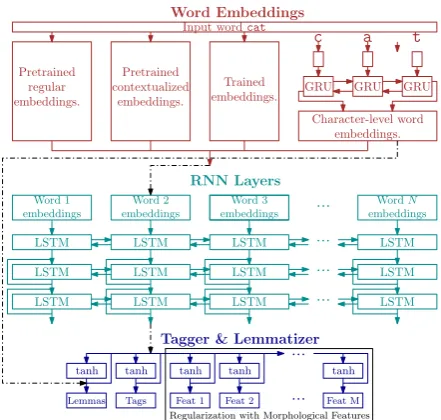
http://github.com/CoNLL-UD-2018/ UDPipe-Future. Here, we describe the overall architecture, focusing on the modifications made for theSIGMORPHON 2019. The resulting model is presented in Figure1.
In short,UDPipe 2.0is a multi-task model pre-dicting POS tags, lemmas and dependency trees. For the SIGMORPHON 2019, we naturally train and predict only the POS tags (morphosyntac-tic features) and lemmas. After embedding input words, three shared bidirectional LSTM ( Hochre-iter and Schmidhuber,1997) layers are performed. Then, softmax classifiers process the output and generate the lemmas and POS tags (morphosyn-tactic features).
Input wordcat
Pretrained regular embeddings.
Trained embeddings.
c a t
GRU GRU GRU
Character-level word embeddings.
Word 1
embeddings ...
...
LSTM ...
LSTM
Word 2 embeddings
LSTM LSTM
WordN embeddings
LSTM LSTM
Word Embeddings
RNN Layers
tanh
Tagger & Lemmatizer Pretrained
contextualized embeddings.
Word 3 embeddings
LSTM LSTM
LSTM LSTM LSTM ... LSTM
Lemmas tanh
Tags
tanh tanh
Feat 1 Feat 2
...
tanh
Feat M
...
[image:2.595.306.527.60.270.2]Regularization with Morphological Features
Figure 1: The overall system architecture
The lemmas are generated by classifying into a set of edit scripts which process input word form and produce lemmas by performing character-level edits on the word prefix and suffix. The lemma classifier additionally takes the character-level word embeddings as input. The lemmatiza-tion is further described in Seclemmatiza-tion3.2.
The input word embeddings are the same as in theUDPipe 2.0(Straka,2018):
• end-to-end word embeddings,
• word embeddings (WE): We use FastText word embeddings (Bojanowski et al., 2017) of dimension300, which we pretrain for each language on plain texts provided by CoNLL 2017 UD Shared Task, using segmentation and tokenization trained from the UD data.1 For languages not present in the CoNLL 2017 UD Shared Task, we use pretrained embed-dings from (Grave et al.,2018), if available.
• character-level word embeddings (CLE):
We employ bidirectional GRUs (Cho et al.,
2014;Graves and Schmidhuber,2005) of di-mension256in line with (Ling et al.,2015): we represent every Unicode character with a vector of dimension 256, and concatenate GRU output for forward and reversed word characters. The character-level word embed-dings are trained together with UDPipe net-work.
We refer the readers for detailed description of the architecture and the training procedure to
1We use
Lemma Rule Casing Script Edit Script Most Frequent Examples ↓0;d¦ all lowercase do nothing the→the to→to and→and
↑0¦↓1;d¦ first upper, then lower do nothing Bush→Bush Iraq→Iraq Enron→Enron
↓0;d¦- all lowercase remove last character your→you an→a years→year
↓0;abe all lowercase ignore form, usebe is→be was→be ’s→be
↑0;d¦ all uppercase do nothing I→I US→US NASA→NASA
↓0;d¦-- all lowercase remove last 2 chars been→be does→do called→call
↓0;d¦--- all lowercase remove last 3 chars going→go being→be looking→look
↓0;d--+b¦ all lowercase change first 2 chars tob are→be ’re→be Are→be
↓0;d¦-+v+e all lowercase change last char tove has→have had→have Has→have
↓0;d¦---+e all lowercase change last 3 chars toe having→have using→use making→make
[image:3.595.83.514.62.189.2]↓0;d¦-+o→ all lowercase change last but 1 char too n’t→not knew→know grew→grow
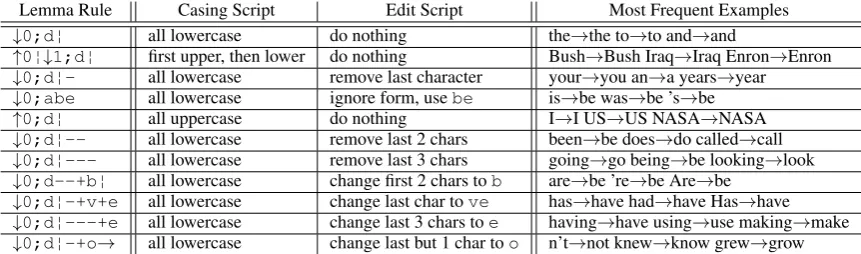
Table 1: Eleven most frequent lemma rules in English EWT corpus, ordered from the most frequent one.
Straka(2018).
The main modifications to the UDPipe 2.0are the following:
• contextualized embeddings (BERT): We add pretrained contextual word embeddings as another input to the neural network. We describe this modification in Section3.3.
• regularization with individual morpholog-ical features: We predict not only the full POS tag, but regularize the model by also predicting individual morphological features, which is described in Section3.4.
• corpora merging: In some cases, we merge the corpora of the same language. We de-scribe this step in Section3.5.
Furthermore, we also employ model ensem-bling, which we describe in Section3.6.
3.2 Lemmatization
The lemmatization is modeled as a multi-class classification, in which the classes are the com-plete rules which lead from input forms to the lem-mas. We call each class encoding a transition from input form to lemma a lemma rule. We create a lemma rule by firstly encoding the correct casing as a casing script and secondly by creating a se-quence of character edits, anedit script.
Firstly, we deal with the casing by creating a
casing script. By default, word form and lemma characters are treated as lowercased. If the lemma however contains upper-cased characters, a rule is added to the casing script to uppercase the corre-sponding characters in the resulting lemma. For example, the most frequent casing script is “keep the lemma lowercased (don’t do anything)” and the second most frequent casing script is “upper-case the first character and keep the rest lower-cased”.
As a second step, anedit scriptis created to con-vert input lowercased form to lowercased lemma. To ensure meaningful editing, the form is split to three parts, which are then processed separately: a prefix, a root (stem) and a suffix. The root is dis-covered by matching the longest substring shared between the form and the lemma; if no match-ing substrmatch-ing is found (e.g., formwentand lemma
go), we consider the word irregular, do not pro-cess it with any edits and directly replace the word form with the lemma. Otherwise, we proceed with the edit scripts, which process the prefix and the suffix separately and keep the root unchanged. The allowed character-wise operations are charac-ter copy, addition and deletion.
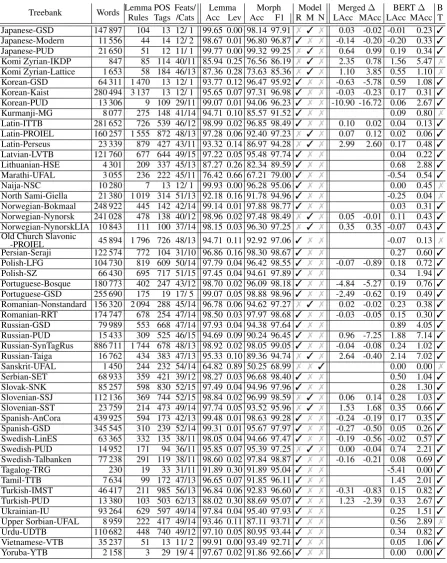
The resultinglemma ruleis a concatenation of a casing script and an edit script. The most common lemma rules in English EWT corpus are presented in Table1, and the number of lemma rules for ev-ery language is displayed in Tables5and6.
Using the generated lemma rules, the task of lemmatization is then reduced to a multiclass clas-sification task, in which the artificial neural net-work predicts the correct lemma rule.
3.3 Contextual Word Embeddings (BERT)
We add pretrained contextual word embeddings as another input to the neural network. We use the pretrained contextual word embeddings called BERT (Devlin et al., 2018).2 For En-glish, we use the native English model (BERT-Base English), for Chinese use use the native
Chi-nese model (BERT-Base Chinese) and for all
other languages, we use the Multilingual model (BERT-Base Uncased). All models provide
con-textualized embeddings of dimension768.
2https://github.com/google-research/
We average the last four layers of the BERT model to produce the embeddings. Because BERT utilizes word pieces, we decompose words into ap-propriate subwords and then average the generated embeddings over subwords belonging to the same word.
Contrary to finetuning approach used by the BERT authors (Devlin et al.,2018), we never fine-tune the embeddings.
3.4 Regularization with Individual Morphological Features
Our model predicts the POS tags as a unit, i.e., the whole set of morphological features at once. There are other possible alternatives – for exam-ple, we could predict the morphological features individually. However, such a prediction needs to decide which morphological categories to use and should use a classifier capable of handling de-pendencies between the predicted features, and all our attempts to design such a classifier resulted in systems with suboptimal performance. Using a whole-set classifier alleviates the need for find-ing a correct set of categories for a word and han-dling the feature dependencies, but suffers from the curse of dimensionality, especially on smaller corpora with richer morphology.
Nevertheless, the performance of a whole-set classifier can be improved by regularizing with the individual morphological feature prediction. Similarly toKondratyuk et al. (2018), our model predicts not only the full set of morphological features at once, but also the individual features. Specifically, we employ as many additional soft-max output layers as the number of morphological categories used in the corpus, each predicting the corresponding feature or a special value ofNone. The averaged cross-entropy loss of all predicted categories multiplied by a weightwis added to the training loss. The predicted features are not used in any way during inference and act only as model regularization.
The number of full POS tags (complete sets of morphological features), individual morpho-logical features and number of used morphologi-cal categories for every corpus is provided in Ta-bles5and6.
3.5 Corpora Merging
Given that the shared task data consists of multiple corpora for some of the languages, it is a natural approach to concatenate all corpora of the same
language and use the resulting so-called merged modelfor prediction on individual corpora.
In theory, concatenating all corpora of the same language should be always beneficial consider-ing the universal scheme used for annotation. Nonetheless, the merged model exhibits worse performance in many cases, compared to a spe-cialized model trained on the corpus training data only, supposedly because of systematically dif-ferent annotation. We consequently improve the merged model performance during inference by allowing only such lemma rules and morphologi-cal feature sets that are present in the training data of the predicted corpus.
3.6 Model Ensembling
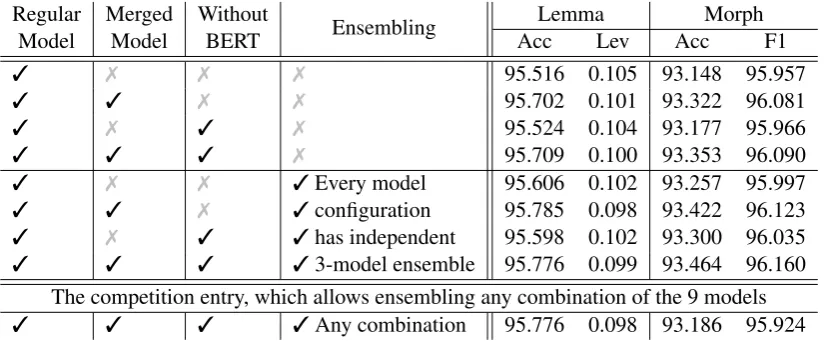
For every corpus, we consider three model config-urations – the regular model with BERT embed-dings trained only on the corpus data, the merged model with BERT embeddings trained on all cor-pora of the corresponding language, and the no-BERT model trained only on the corpus data.
To allow automatic model selection and to ob-tain highest performance, we use ensembling. Namely, we train three models for every model configuration, obtaining nine models for every language. Then, we choose a model subset whose ensemble achieves the highest performance on the development data. The chosen subsets then formed the competition entry of our system.
However, post-competition examination using half of development data for ensemble selection and the other for evaluation revealed that the model selection can overfit, sometimes choosing one or two models with high performance caused by noise instead of high-quality generalization. Therefore, we also consider another model selec-tion method – we ensemble the three models for every configuration, and choose the best configu-ration out of three ensembles on the development data. This second system has been submitted as a post-competition entry.
4 Results
4.1 SIGMORPHON 2019Test Results
Lemma Accuracy
UFALPRAGUE-01 95.78
CHARLES-SAARLAND-02 95.00
ITU-01 94.46
baseline-test-00 94.17
CBNU-01 94.07
Morph Accuracy
CHARLES-SAARLAND-02 93.23
UFALPRAGUE-01 93.19
RUG-01 90.53
EDINBURGH-01 88.93
RUG-02 88.80
Lemma Levenshtein
UFALPRAGUE-01 0.098
CHARLES-SAARLAND-02 0.108
ITU-01 0.108
CBNU-01 0.127
baseline-test-00 0.129
Morph F1
CHARLES-SAARLAND-02 96.02
UFALPRAGUE-01 95.92
RUG-01 94.54
RUG-02 93.22
[image:5.595.121.482.72.238.2]EDINBURGH-01 92.89
Table 2: Top 5 results in lemma accuracy, lemma Levenshtein, morphological accuracy and morphological F1.
Word
BERT Feature Lemma Morph Embeddings Regularization Acc Lev Acc F1
7 7 7 94.251 0.168 90.506 93.585
3FT only 7 7 95.229 0.109 91.704 94.745
3 7 7 95.294 0.107 91.828 94.849
7 3 7 95.440 0.106 92.789 95.614
3 3 7 95.534 0.104 92.980 95.755
7 7 3w= 1 95.120 0.111 91.468 94.672
3 7 3w= 1 95.365 0.104 92.135 95.189
3 3 3w= 1 95.516 0.105 93.148 95.957
3 3 3w= 0.5 95.534 0.105 93.172 95.939
[image:5.595.122.478.295.463.2]3 3 3w= 2 95.539 0.105 93.175 95.965
Table 3: Lemma accuracy, lemma Levenshtein, morphological accuracy, and morphological F1 results of ablation experiments. For comparison, theFT onlyembeddings denote the pretrained embeddings of (Grave et al.,2018).
Regular Merged Without
Ensembling Lemma Morph
Model Model BERT Acc Lev Acc F1
3 7 7 7 95.516 0.105 93.148 95.957
3 3 7 7 95.702 0.101 93.322 96.081
3 7 3 7 95.524 0.104 93.177 95.966
3 3 3 7 95.709 0.100 93.353 96.090
3 7 7 3Every model 95.606 0.102 93.257 95.997
3 3 7 3configuration 95.785 0.098 93.422 96.123
3 7 3 3has independent 95.598 0.102 93.300 96.035
3 3 3 33-model ensemble 95.776 0.099 93.464 96.160 The competition entry, which allows ensembling any combination of the 9 models
3 3 3 3Any combination 95.776 0.098 93.186 95.924
[image:5.595.94.511.531.704.2]Our participant system placed as one of the win-ning systems of the shared task. In the lemmati-zation task, our system exceeds all the submitted systems by a wide margin with lemmatization ac-curacy95.78(second best was95.00, third94.46). In the morphological analysis, our system placed tightly second: our morphological analysis accu-racy was93.19, the winning system’s93.23.
4.2 Ablation Experiments
The effect of pretrained word embeddings, BERT contextualized embeddings and regularization with morphological features is evaluated in Ta-ble3. Even the baseline model without any of the mentioned enhancements achieves relatively high performance and would place third in both lemma-tization and tagging accuracy (when not consider-ing our competition entry).
Pretrained word embeddings improve the per-formance of both the lemmatizer and the tagger by a substantial margin. For comparison with the embeddings we trained on CoNLL 2017 UD Shared Task plain texts, we also evaluate the em-beddings provided by Grave et al. (2018), which achieve only slightly lower performance than our embeddings – we presume the difference is caused mostly by different tokenization, given that the training data comes from Wikipedia and Com-monCrawl in both cases.
BERT contextualized embeddings further con-siderably improve POS tagging performance, and have minor impact on lemmatization improve-ment.
When used in isolation, the regularization with morphological categories provides quite consid-erable gain for both lemmatization and tagging, nearly comparable to the effect of adding precom-puted word embeddings. Combining all the en-hancements together then produces a model with the highest performance.
4.3 Model Combinations
For every corpus, we consider three model config-urations – a regular model, then a model trained on the merged corpora of a corresponding language, and a model without BERT embeddings (which we consider since even if BERT embeddings can be computed for any language, the results might be misleading if the language was not present in the BERT training data). For every model configura-tion, we train three models using different random initialization.
The test set results of choosing the best model configuration on a development set are provided in Table 4. Employing the merged model in ad-dition to the regular model increases the perfor-mance slightly, and the introduction of no-BERT model results in minimal gains. Finally, ensem-bling the models of a same configuration provides the highest performance.
As discussed in Section3.6, our competition en-try selected the ensemble using arbitrary subset of all the nine models which achieved best perfor-mance on the development data. This choice re-sulted in overfitting on POS tag prediction, with results worse than no ensembling.
4.4 Detailed Results
Tables5and6present detailed results of our best system from Table 4. Note that while this sys-tem is not our competition entry, it utilizes the same models as the competition entry, only com-bined in a different way. Furthermore, because one model configuration was chosen for every lan-guage, we can examine which configuration per-formed best, and quantify what the exact effect of corpora merging and BERT embeddings are.
5 Conclusions
We described our system which participated in the
SIGMORPHON 2019 Shared Task: Crosslingual-ity and Context in Morphology, Task 2: contextual morphological analysis and lemmatization, which placed first in lemmatization and closely second in morphological analysis. The contributed archi-tecture is a modified UDPipe 2.0 with three im-provements: addition of pretrained contextualized BERT embeddings, regularization with morpho-logical categories and corpora merging in some languages. We described these improvements and published the related ablation experiment results.
Acknowledgements
Treebank Words Lemma POS Feats/ Lemma Morph Model Merged∆ BERT∆ B Rules Tags /Cats Acc Lev Acc F1 R M N LAcc MAcc LAcc MAcc T Afrikaans-AfriBooms 38 843 185 41 29/ 9 99.10 0.01 99.26 99.40 3 7 7 0.15 0.64 3
Akkadian-PISANDUB 1 425 548 12 11/ 1 55.94 1.50 86.63 86.46 7 7 3 0.99 -4.45 7
Amharic-ATT 7 952 1 54 35/10 100.00 0.00 89.70 93.24 3 7 7 0.00 0.57 3
Ancient Greek-PROIEL 171 478 6 843 887 49/14 94.04 0.15 92.99 97.92 7 3 7 0.65 0.30 -0.04 -0.01 7
Ancient Greek-Perseus 162 164 9 088 795 44/11 91.91 0.21 91.91 96.74 7 3 7 0.78 0.26 -0.05 0.01 7
Arabic-PADT 225 494 3 174 287 35/12 96.09 0.11 95.38 97.48 3 7 7 -0.09 0.02 0.35 0.66 3
Arabic-PUD 16 845 3 919 371 39/12 79.26 0.78 86.52 95.30 3 7 7 0.46 3.22 3
Armenian-ArmTDP 18 595 277 360 65/16 95.91 0.08 93.63 96.54 3 7 7 0.62 1.90 3
Bambara-CRB 11 205 311 43 32/ 9 92.10 0.12 94.00 95.62 3 7 7 -0.84 0.07 7
Basque-BDT 97 336 1 168 865 136/15 97.14 0.06 93.56 96.47 3 7 7 0.53 4.37 3
Belarusian-HSE 6 541 229 291 46/14 92.39 0.15 90.28 95.24 3 7 7 0.00 3.16 3
Breton-KEB 8 062 329 87 36/13 93.03 0.15 91.44 93.95 3 7 7 0.09 0.89 3
Bulgarian-BTB 124 749 605 316 44/15 98.34 0.05 97.84 99.03 3 7 7 0.25 0.21 3
Buryat-BDT 8 029 132 167 41/12 90.38 0.23 87.98 89.94 3 7 7 0.76 1.35 7
Cantonese-HK 5 121 17 13 12/ 1 100.00 0.00 91.25 88.86 3 7 7 0.00 0.54 3
Catalan-AnCora 427 672 579 145 41/13 99.32 0.01 98.66 99.35 3 7 7 0.09 0.34 3
Chinese-CFL 5 688 14 13 12/ 1 99.76 0.00 94.21 93.34 3 7 7 0.00 -0.12 0.00 3.43 3
Chinese-GSD 98 734 26 27 21/ 8 99.98 0.00 96.64 96.51 3 7 7 0.00 0.11 -0.01 2.61 3
Coptic-Scriptorium 17 624 181 53 26/ 9 97.31 0.06 95.85 96.82 3 7 7 -0.05 -0.56 7
Croatian-SET 157 446 578 818 51/16 97.45 0.05 94.16 97.67 3 7 7 0.22 0.83 3
Czech-CAC 395 043 929 960 57/15 99.31 0.01 97.78 99.20 3 7 7 -0.18 -0.37 0.06 0.73 3
Czech-CLTT 28 649 229 350 48/15 99.22 0.02 95.42 98.30 7 3 7 0.11 -0.06 0.37 1.00 3
Czech-FicTree 133 300 692 971 53/15 98.80 0.02 96.30 98.53 3 7 7 0.36 -0.23 0.12 0.65 3
Czech-PDT 1 207 922 1 661 1 123 57/15 99.37 0.01 98.02 99.25 3 7 7 -0.05 -0.15 0.04 0.44 3
Czech-PUD 14 814 349 549 56/15 98.13 0.03 94.46 98.14 7 3 7 2.59 3.94 0.77 3.84 3
Danish-DDT 80 964 426 128 41/14 98.30 0.03 97.76 98.49 3 7 7 0.44 0.84 3
Dutch-Alpino 167 187 631 43 33/10 98.45 0.03 97.59 98.20 7 3 7 -0.03 -0.03 0.12 0.39 3
Dutch-LassySmall 78 638 527 41 31/10 98.34 0.03 97.86 98.29 7 3 7 0.28 0.18 0.07 0.56 3
English-EWT 204 839 235 76 36/12 99.01 0.02 97.53 98.27 3 7 7 -0.18 -0.38 0.30 0.99 3
English-GUM 63 862 160 74 37/12 98.53 0.02 97.29 98.01 3 7 7 -0.84 -1.23 0.26 1.23 3
English-LinES 66 428 166 78 36/12 98.62 0.02 97.52 98.14 3 7 7 -0.83 -1.13 0.22 0.87 3
English-PUD 16 921 70 66 35/12 97.79 0.03 96.32 97.28 3 7 7 -1.76 -0.54 0.83 2.55 3
English-ParTUT 39 302 115 83 33/10 98.37 0.03 96.25 96.92 3 7 7 -0.48 -2.36 0.21 1.19 3
Estonian-EDT 346 986 3 294 494 52/14 96.59 0.06 96.72 98.37 3 7 7 0.35 0.44 3
Faroese-OFT 7 994 297 234 36/13 90.30 0.18 88.28 94.29 3 7 7 1.64 2.11 7
Finnish-FTB 127 536 1 211 660 53/12 96.05 0.08 96.55 97.98 3 7 7 0.37 0.44 3
Finnish-PUD 12 553 889 284 50/12 88.90 0.19 96.58 98.33 7 3 7 2.15 1.97 1.21 2.09 3
Finnish-TDT 161 582 2 650 565 51/12 95.91 0.08 96.81 98.21 3 7 7 -0.20 -0.08 0.34 0.39 3
French-GSD 320 404 736 134 40/13 98.82 0.02 97.82 98.71 3 7 7 0.01 -0.15 0.11 0.38 3
French-ParTUT 22 627 219 111 34/10 96.66 0.06 95.84 98.02 3 7 7 0.12 0.88 3
French-Sequoia 56 484 317 126 35/12 99.01 0.02 98.15 99.13 3 7 7 0.14 0.56 3
French-Spoken 28 182 208 13 12/ 1 98.91 0.02 98.12 98.15 3 7 7 0.14 0.25 3
Galician-CTG 111 034 160 14 13/ 2 98.87 0.02 98.28 98.12 3 7 7 0.00 -0.04 0.11 0.29 3
Galician-TreeGal 20 566 147 161 44/13 98.49 0.03 95.71 97.63 3 7 7 -0.03 -11.16 0.38 1.27 3
German-GSD 234 161 841 600 41/12 97.70 0.05 89.89 95.64 3 7 7 0.21 0.79 3
Gothic-PROIEL 44 660 1 130 540 43/13 95.61 0.09 90.50 96.39 7 7 3 -0.04 -0.13 7
Greek-GDT 50 567 1 285 243 40/12 96.85 0.08 95.89 98.36 3 7 7 0.09 0.86 3
Hebrew-HTB 129 425 387 236 38/13 98.18 0.03 97.51 98.24 3 7 7 0.19 0.45 3
Hindi-HDTB 281 948 286 738 49/12 98.89 0.01 93.23 97.83 3 7 7 0.07 0.53 3
Hungarian-Szeged 33 463 329 427 59/14 97.45 0.05 95.22 98.32 3 7 7 0.25 2.21 3
Indonesian-GSD 97 213 65 129 27/ 9 99.62 0.01 92.06 94.75 3 7 7 0.05 0.67 3
Irish-IDT 18 996 476 163 37/12 92.06 0.18 86.41 91.51 3 7 7 0.00 0.49 3
Italian-ISDT 239 381 321 142 38/11 98.86 0.02 98.30 99.03 7 3 7 0.01 0.19 0.13 0.33 3
Italian-PUD 18 834 167 159 38/14 97.57 0.05 96.33 98.34 3 7 7 0.41 -11.18 0.46 2.19 3
Italian-ParTUT 44 556 194 110 34/11 99.26 0.02 98.66 99.16 7 3 7 0.78 0.85 0.04 0.58 3
Italian-PoSTWITA 99 067 945 122 33/10 97.82 0.05 96.52 97.49 3 7 7 -0.13 -0.10 0.33 0.67 3
Treebank Words Lemma POS Feats/ Lemma Morph Model Merged∆ BERT∆ B Rules Tags /Cats Acc Lev Acc F1 R M N LAcc MAcc LAcc MAcc T Japanese-GSD 147 897 104 13 12/ 1 99.65 0.00 98.14 97.91 7 3 7 0.03 -0.02 -0.01 0.23 3
Japanese-Modern 11 556 44 14 12/ 2 98.67 0.01 96.80 96.87 3 7 7 -0.14 -0.20 -0.20 0.33 3
Japanese-PUD 21 650 51 12 11/ 1 99.77 0.00 99.32 99.25 7 3 7 0.64 0.99 0.19 0.34 3
Komi Zyrian-IKDP 847 85 114 40/11 85.94 0.25 76.56 86.19 7 3 7 2.35 0.78 1.56 5.47 7
Komi Zyrian-Lattice 1 653 58 184 46/13 87.36 0.28 73.63 85.36 7 3 7 1.10 3.85 0.55 1.10 7
Korean-GSD 64 311 1 470 13 12/ 1 93.77 0.12 96.47 95.92 3 7 7 -0.63 -5.78 0.59 1.08 3
Korean-Kaist 280 494 3 137 13 12/ 1 95.65 0.07 97.31 96.98 3 7 7 -0.03 -0.23 0.17 0.31 3
Korean-PUD 13 306 9 109 29/11 99.07 0.01 94.06 96.23 3 7 7 -10.90 -16.72 0.06 2.67 3
Kurmanji-MG 8 077 275 148 41/14 94.71 0.10 85.57 91.52 3 7 7 0.09 0.80 7
Latin-ITTB 281 652 726 539 46/12 98.99 0.02 96.85 98.49 3 7 7 0.10 0.02 0.04 0.13 3
Latin-PROIEL 160 257 1 555 872 48/13 97.28 0.06 92.40 97.23 7 3 7 0.07 0.12 0.02 0.06 3
Latin-Perseus 23 339 879 427 43/11 93.32 0.14 86.97 94.28 7 3 7 2.99 2.60 0.17 0.48 3
Latvian-LVTB 121 760 677 644 49/15 97.22 0.05 95.48 97.74 3 7 7 0.04 0.22 3
Lithuanian-HSE 4 301 209 337 45/13 87.27 0.26 82.34 89.59 3 7 7 0.68 2.88 3
Marathi-UFAL 3 055 236 222 45/11 76.42 0.66 67.21 79.00 3 7 7 -0.54 0.54 3
Naija-NSC 10 280 7 13 12/ 1 99.93 0.00 96.28 95.06 3 7 7 0.00 0.45 7
North Sami-Giella 21 380 1 019 314 51/13 92.18 0.16 91.78 94.96 3 7 7 -0.25 0.04 7
Norwegian-Bokmaal 248 922 445 142 42/14 99.14 0.01 97.88 98.77 3 7 7 0.03 0.31 3
Norwegian-Nynorsk 241 028 478 138 40/12 98.96 0.02 97.48 98.49 7 3 7 0.05 -0.01 0.11 0.43 3
Norwegian-NynorskLIA 10 843 111 100 37/14 98.15 0.03 96.30 97.25 7 3 7 0.35 0.35 -0.07 0.43 3
Old Church Slavonic
-PROIEL 45 894 1 796 726 48/13 94.71 0.11 92.92 97.06 3 7 7 -0.07 0.13 7 Persian-Seraji 122 574 772 104 31/10 96.86 0.16 98.30 98.67 3 7 7 0.27 0.60 3
Polish-LFG 104 730 819 609 50/14 97.79 0.04 96.42 98.55 3 7 7 -0.07 -0.89 0.18 0.72 3
Polish-SZ 66 430 695 717 51/15 97.45 0.04 94.61 97.89 3 7 7 0.34 1.94 3
Portuguese-Bosque 180 773 402 247 43/12 98.70 0.02 96.09 98.18 3 7 7 -4.84 -5.27 0.19 0.76 3
Portuguese-GSD 255 690 175 19 17/ 5 99.07 0.05 98.88 98.96 3 7 7 -2.49 -0.62 0.19 0.49 3
Romanian-Nonstandard 156 320 2 094 288 45/14 96.78 0.06 94.62 97.27 7 3 7 0.02 -0.02 0.23 0.38 3
Romanian-RRT 174 747 678 254 47/14 98.50 0.03 97.97 98.68 3 7 7 -0.03 -0.05 0.15 0.30 3
Russian-GSD 79 989 553 668 47/14 97.93 0.04 94.38 97.64 3 7 7 0.89 4.05 3
Russian-PUD 15 433 309 525 46/15 94.69 0.09 90.24 96.45 3 7 7 0.96 -7.25 1.88 7.14 3
Russian-SynTagRus 886 711 1 744 678 48/13 98.92 0.02 98.05 99.05 3 7 7 -0.04 -0.08 0.24 1.02 3
Russian-Taiga 16 762 434 383 47/13 95.33 0.10 89.36 94.74 7 3 7 2.64 -0.40 2.14 7.02 3
Sanskrit-UFAL 1 450 244 232 54/14 64.82 0.89 50.25 68.99 7 7 3 0.00 0.00 7
Serbian-SET 68 933 359 421 39/12 98.27 0.03 96.68 98.40 3 7 7 0.50 1.04 3
Slovak-SNK 85 257 598 830 52/15 97.49 0.04 94.96 97.96 3 7 7 0.28 1.30 3
Slovenian-SSJ 112 136 369 744 52/15 98.84 0.02 96.99 98.59 7 3 7 0.06 0.14 0.28 1.03 3
Slovenian-SST 23 759 214 473 49/14 97.74 0.05 93.52 95.96 7 3 7 1.53 1.68 0.35 0.66 3
Spanish-AnCora 439 925 594 173 42/13 99.48 0.01 98.63 99.28 3 7 7 -0.24 -0.19 0.17 0.35 3
Spanish-GSD 345 545 310 239 52/14 99.31 0.01 95.67 97.97 3 7 7 -0.27 -0.50 0.05 0.26 3
Swedish-LinES 63 365 332 135 38/11 98.05 0.04 94.66 97.47 3 7 7 -0.19 -0.56 -0.02 0.57 3
Swedish-PUD 14 952 171 94 36/11 95.85 0.07 95.39 97.25 7 3 7 0.00 -0.04 0.74 2.21 3
Swedish-Talbanken 77 238 291 119 38/11 98.60 0.02 97.84 98.87 3 7 7 -0.16 -0.21 0.08 0.69 3
Tagalog-TRG 230 19 33 31/11 91.89 0.30 91.89 95.04 3 7 7 -5.41 0.00 3
Tamil-TTB 7 634 99 172 47/13 96.65 0.07 91.85 96.11 3 7 7 1.45 2.01 3
Turkish-IMST 46 417 211 985 56/13 96.84 0.06 92.83 96.60 3 7 7 -0.31 -0.83 0.15 0.82 3
Turkish-PUD 13 380 103 503 62/13 88.02 0.30 88.69 95.07 3 7 7 1.23 -2.39 0.33 2.67 3
Ukrainian-IU 93 264 629 597 49/14 97.84 0.04 95.40 97.93 3 7 7 0.25 1.51 3
Upper Sorbian-UFAL 8 959 222 417 49/14 93.46 0.11 87.11 93.71 3 7 7 0.56 2.89 7
Urdu-UDTB 110 682 448 740 49/12 97.10 0.05 80.95 93.44 3 7 7 0.34 0.82 3
Vietnamese-VTB 35 237 51 13 11/ 2 99.91 0.00 93.49 92.71 3 7 7 0.05 1.06 3
[image:8.595.76.524.88.652.2]Yoruba-YTB 2 158 3 29 19/ 4 97.67 0.02 91.86 92.66 3 7 7 0.00 0.00 3
References
Piotr Bojanowski, Edouard Grave, Armand Joulin, and Tomas Mikolov. 2017. Enriching Word Vectors with
Subword Information. Transactions of the
Associa-tion for ComputaAssocia-tional Linguistics, 5:135–146.
Wanxiang Che, Yijia Liu, Yuxuan Wang, Bo Zheng, and Ting Liu. 2018. Towards better UD parsing: Deep contextualized word embeddings, ensemble,
and treebank concatenation. InProceedings of the
CoNLL 2018 Shared Task: Multilingual Parsing from Raw Text to Universal Dependencies, pages 55–64, Brussels, Belgium. Association for Compu-tational Linguistics.
KyungHyun Cho, Bart van Merrienboer, Dzmitry Bah-danau, and Yoshua Bengio. 2014. On the Properties of Neural Machine Translation: Encoder-Decoder Approaches. CoRR.
Jacob Devlin, Ming-Wei Chang, Kenton Lee, and Kristina Toutanova. 2018. BERT: Pre-training of Deep Bidirectional Transformers for Language Un-derstanding.
Murhaf Fares, Stephan Oepen, Lilja Øvrelid, Jari Bj¨orne, and Richard Johansson. 2018. The 2018 Shared Task on Extrinsic Parser Evaluation: On the Downstream Utility of English Universal
Depen-dency Parsers. InProceedings of the CoNLL 2018
Shared Task: Multilingual Parsing from Raw Text to Universal Dependencies, pages 22–33. Association for Computational Linguistics.
Edouard Grave, Piotr Bojanowski, Prakhar Gupta, Ar-mand Joulin, and Tomas Mikolov. 2018. Learning word vectors for 157 languages. In Proceedings of the International Conference on Language Re-sources and Evaluation (LREC 2018).
Alex Graves and J¨urgen Schmidhuber. 2005. Frame-wise phoneme classification with bidirectional lstm and other neural network architectures. Neural Net-works, pages 5–6.
Sepp Hochreiter and J¨urgen Schmidhuber. 1997. Long Short-Term Memory. Neural Comput., 9(8):1735– 1780.
Daniel Kondratyuk, Tomas Gavenciak, Milan Straka, and Jan Hajic. 2018. Lemmatag: Jointly tagging and lemmatizing for morphologically rich languages
with brnns. InProceedings of the 2018 Conference
on Empirical Methods in Natural Language Pro-cessing, Brussels, Belgium, October 31 - November 4, 2018, pages 4921–4928. Association for Compu-tational Linguistics.
Wang Ling, Tiago Lu´ıs, Lu´ıs Marujo, Ram´on Fernan-dez Astudillo, Silvio Amir, Chris Dyer, Alan W. Black, and Isabel Trancoso. 2015. Finding Function in Form: Compositional Character Models for Open Vocabulary Word Representation. CoRR.
Arya D. McCarthy, Miikka Silfverberg, Ryan Cotterell, Mans Hulden, and David Yarowsky. 2018. Mar-rying Universal Dependencies and Universal
Mor-phology. In Proceedings of the Second Workshop
on Universal Dependencies (UDW 2018), pages 91– 101, Brussels, Belgium. Association for Computa-tional Linguistics.
Joakim Nivre, Marie-Catherine de Marneffe, Filip Gin-ter, Yoav Goldberg, Jan Hajiˇc, Christopher Man-ning, Ryan McDonald, Slav Petrov, Sampo Pyysalo, Natalia Silveira, Reut Tsarfaty, and Daniel Zeman. 2016. Universal Dependencies v1: A multilingual treebank collection. InProceedings of the 10th In-ternational Conference on Language Resources and Evaluation (LREC 2016), pages 1659–1666, Por-toroˇz, Slovenia. European Language Resources As-sociation.
Matthew Peters, Mark Neumann, Mohit Iyyer, Matt Gardner, Christopher Clark, Kenton Lee, and Luke Zettlemoyer. 2018. Deep Contextualized Word Rep-resentations. InProceedings of the 2018 Conference of the North American Chapter of the Association for Computational Linguistics: Human Language Technologies, Volume 1 (Long Papers), pages 2227– 2237. Association for Computational Linguistics.
Milan Straka. 2018. UDPipe 2.0 Prototype at CoNLL 2018 UD Shared Task. InProceedings of CoNLL 2018: The SIGNLL Conference on Com-putational Natural Language Learning, pages 197– 207, Stroudsburg, PA, USA. Association for Com-putational Linguistics.
John Sylak-Glassman. 2016. The composition and use of the universal morphological feature schema (uni-morph schema).
Ashish Vaswani, Noam Shazeer, Niki Parmar, Jakob Uszkoreit, Llion Jones, Aidan N. Gomez, Lukasz Kaiser, and Illia Polosukhin. 2017. Attention is all
you need.CoRR, abs/1706.03762.
Daniel Zeman, Filip Ginter, Jan Hajiˇc, Joakim Nivre, Martin Popel, and Milan Straka. 2018. CoNLL 2018 Shared Task: Multilingual Parsing from Raw Text to Universal Dependencies. InProceedings of the CoNLL 2018 Shared Task: Multilingual Pars-ing from Raw Text to Universal Dependencies, Brus-sels, Belgium. Association for Computational Lin-guistics.