Object Hallucination in Image Captioning
Anna Rohrbach∗1, Lisa Anne Hendricks∗1,
Kaylee Burns1 ,Trevor Darrell1,Kate Saenko2
1 UC Berkeley,2 Boston University
Abstract
Despite continuously improving performance, contemporary image captioning models are prone to “hallucinating” objects that are not actually in a scene. One problem is that stan-dard metrics only measure similarity to ground truth captions and may not fully capture im-age relevance. In this work, we propose a new image relevance metric to evaluate current models with veridical visual labels and assess their rate of object hallucination. We analyze how captioning model architectures and learn-ing objectives contribute to object hallucina-tion, explore when hallucination is likely due to image misclassification or language priors, and assess how well current sentence metrics capture object hallucination. We investigate these questions on the standard image caption-ing benchmark, MSCOCO, uscaption-ing a diverse set of models. Our analysis yields several inter-esting findings, including that models which score best on standard sentence metrics do not always have lower hallucination and that mod-els which hallucinate more tend to make errors driven by language priors.
1 Introduction
Image captioning performance has dramatically improved over the past decade. Despite such impressive results, it is unclear to what extent captioning models actually rely on image con-tent: as we show, existing metrics fall short of fully capturing the captions’ relevance to the im-age. In Figure 1 we show an example where a competitive captioning model, Neural Baby Talk (NBT) (Lu et al., 2018), incorrectly generates the object “bench.” We refer to this issue as object hallucination.
While missing salient objects is also a failure mode, captions are summaries and thus generally
* Denotes equal contribution.
NBT: A woman talking on a cell phone while sitting on a bench. CIDEr: 0.87, METEOR: 0.23, SPICE: 0.22, CHs: 1.00, CHi: 0.33
TopDown: A woman is talking on a cell phone.
[image:1.595.341.493.225.324.2]CIDEr: 0.54, METEOR: 0.26, SPICE: 0.13, CHs: 0.00, CHi: 0.00
Figure 1: Image captioning models often “hallucinate” objects that may appear in a given context, like e.g. a
benchhere. Moreover, the sentence metrics do not al-ways appropriately penalize such hallucination. Our proposed metrics (CHAIRs and CHAIRi) reflect hallu-cination. For CHAIRlower is better.
not expected to describe all objects in the scene. On the other hand, describing objects that arenot present in the image has been shown to be less preferable to humans. For example, the LSMDC challenge (Rohrbach et al., 2017a) documents that correctness is more important to human judges than specificity. In another study, (MacLeod et al., 2017) analyzed how visually impaired people re-act to automatic image captions. They found that people vary in their preference of either coverage or correctness. For many visually impaired who value correctness over coverage, hallucination is an obvious concern.
Besides being poorly received by humans, ob-ject hallucination reveals an internal issue of a cap-tioning model, such as not learning a very good representation of the visual scene or overfitting to its loss function.
first question we aim to answer is: Which mod-els are more prone to hallucination? We analyze this question on a diverse set of captioning models, spanning different architectures and learning ob-jectives. To measure object hallucination, we pro-pose a new metric,CHAIR (Caption Hallucination Assessment with Image Relevance), which cap-tures image relevance of the generated captions. Specifically, we consider both ground truth object annotations (MSCOCO Object segmentation (Lin et al., 2014)) and ground truth sentence annota-tions (MSCOCO Capannota-tions (Chen et al., 2015)). In-terestingly, we find that models which score best on standard sentence metrics do not always hallu-cinate less.
The second question we raise is: What are the likely causes of hallucination? While hallucina-tion may occur due to a number of reasons, we believe the top factors include visual misclassifi-cation and over-reliance on language priors. The latter may result in memorizing which words “go together” regardless of image content, which may lead to poor generalization, once the test distri-bution is changed. We propose image and lan-guage model consistencyscores to investigate this issue, and find that models which hallucinate more tend to make mistakes consistent with a language model.
Finally, we ask: How well do the standard metrics capture hallucination? It is a common practice to rely on automatic sentence metrics, e.g. CIDEr (Vedantam et al., 2015), to evaluate captioning performance during development, and few employ human evaluation to measure the fi-nal performance of their models. As we largely rely on these metrics, it is important to under-stand how well they capture the hallucination phe-nomenon. In Figure 1 we show how two sen-tences, from NBT with hallucination and from TopDown model (Anderson et al., 2018) – with-out, are scored by the standard metrics. As we see, hallucination is not always appropriately pe-nalized. We find that by using additional ground truth data about the image in the form of object la-bels, our metric CHAIR allows us to catch discrep-ancies that the standard captioning metrics cannot fully capture. We then investigate ways to assess object hallucination risk with the standard metrics. Finally, we show that CHAIR is complementary to the standard metrics in terms of capturing human preference.
2 Caption Hallucination Assessment
We first introduce our image relevance metric, CHAIR, which assesses captions w.r.t. objects that are actually in an image. It is used as a main tool in our evaluation. Next we discuss the notions of image and language model consistency, which we use to reason about the causes of hallucination.
2.1 The CHAIR Metric
To measure object hallucination, we propose the CHAIR (Caption Hallucination Assessment with Image Relevance) metric, which calculates what proportion of words generated are actually in the image according to the ground truth sentences and object segmentations. This metric has two vari-ants: per-instance, or what fraction of object in-stances are hallucinated (denoted as CHAIRi), and per-sentence, or what fraction of sentences include a hallucinated object (denoted as CHAIRs):
CHAIRi =
|{hallucinated objects}| |{all objects mentioned}|
CHAIRs=
|{sentences with hallucinated object}| |{all sentences}|
For easier analysis, we restrict our study to the 80 MSCOCO objects which appear in the MSCOCO segmentation challenge. To determine whether a generated sentence contains halluci-nated objects, we first tokenize each sentence and then singularize each word. We then use a list of synonyms for MSCOCO objects (based on the list from Lu et al. (2018)) to map words (e.g., “player”) to MSCOCO objects (e.g., “per-son”). Additionally, for sentences which in-clude two word compounds (e.g., “hot dog”) we take care that other MSCOCO objects (in this case “dog”) are not incorrectly assigned to the list of MSCOCO objects in the sentence. For each ground truth sentence, we determine a list of MSCOCO objects in the same way. The MSCOCO segmentation annotations are used by simply relying on the provided object labels.
scrape ground truth objects, we account for vari-ation in how human annotators refer to different objects. Inversely, we find that frequently humans will not mention all objects in a scene. Qualita-tively, we observe that both annotations are impor-tant to capture hallucination. Empirically, we ver-ify that using only segmentation labels or only ref-erence captions leads to higher hallucination (and practically incorrect) rates.
2.2 Image Consistency
We define a notion of image consistency, or how consistent errors from the captioning model are with a model which predicts objects based on an image alone. To measure image consistency for a particular generated word, we train an image model and recordP(w|I)or the probability of pre-dicting the word given only the image. To score the image consistency of a caption we use the av-erage ofP(w|I)for all MSCOCO objects, where higher values mean that errors are more consis-tent with the image model. Our image model is a multi-label classification model with labels corre-sponding to MSCOCO objects (labels determined the same way as is done for CHAIR) which shares the visual features with the caption models.
2.3 Language Consistency
We also introduce a notion of language consis-tency, i.e. how consistent errors from the cap-tioning model are with a model which predicts words based only on previously generated words. We train an LSTM (Hochreiter and Schmidhu-ber, 1997) based language model which pre-dicts a word wt given previous words w0:t−1
on MSCOCO data. We report language consis-tency as1/R(wt)whereR(wt)is the rank of the predicted word in the language model. Again, for a caption we report average rank across all MSCOCO objects in the sentence and higher lan-guage consistency implies that errors are more consistent with the language model.
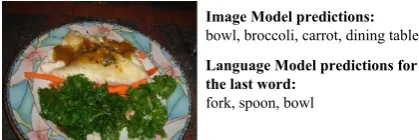
We illustrate image and language consistency in Figure 2, i.e. the hallucination error (“fork”) is more consistent with the Language Model predic-tions than with the Image Model predicpredic-tions. We use these consistency measures in Section 3.3 to help us investigate the causes of hallucination.
Generated caption: A plate of food with broccoli and a fork. Image Model predictions: bowl, broccoli, carrot, dining table
Language Model predictions for the last word:
[image:3.595.309.519.65.135.2]fork, spoon, bowl
Figure 2: Example of image and language consistency. The hallucination error (“fork”) is more consistent with the Language Model.
3 Evaluation
In this section we present the findings of our study, where we aim to answer the questions posed in Section 1: Which models are more prone to hal-lucination? What are the likely causes of halluci-nation? How well do the standard metrics capture hallucination?
3.1 Baseline Captioning Models
We compare object hallucination across a wide range of models. We define two axes for compari-son: model architecture and learning objective.
Model architecture. Regarding model architec-ture, we consider models both with and without attention mechanisms. In this work, we use “at-tention” to refer to any mechanism which learns to focus on different image regions, whether im-age regions be determined by a high level feature map, or by object proposals from a trained de-tector. All models are end-to-end trainable and use a recurrent neural network (LSTM (Hochre-iter and Schmidhuber, 1997) in our case) to output text. For non-attention based methods we consider the FC model from Rennie et al. (2017) which incorporates visual information by initializing the LSTM hidden state with high level image features. We also consider LRCN (Donahue et al., 2015) which considers visual information at each time step, as opposed to just initializing the LSTM hid-den state with extracted features.
Generally attention mechanisms operate over high level convolutional layers. The attention mecha-nism from (Anderson et al., 2018) can be used on such feature maps, but Anderson et al. also con-sider feature maps corresponding to object pro-posals from a detection model. We consider both models, denoted as TopDown (feature map ex-tracted from high level convolutional layer) and TopDown-BB(feature map extracted from object proposals from a detection model). Finally, we consider the recently proposedNeural Baby Talk (NBT) model (Lu et al., 2018) which explicitly uses object detections (as opposed to just bound-ing boxes) for sentence generation.
Learning objective. All of the above models are trained with the standard cross entropy (CE) loss as well as the self-critical (SC) loss pro-posed by Rennie et al. (2017) (with an exception of NBT, where only the CE version is included). The SC loss directly optimizes the CIDEr metric with a reinforcement learning technique. We ad-ditionally consider a model trained with a GAN loss (Shetty et al., 2017) (denoted GAN), which applies adversarial training to obtain more diverse and “human-like” captions, and their respective non-GAN baseline with the CE loss.
TopDown deconstruction. To better evaluate how each component of a model might influ-ence hallucination, we “deconstruct” the Top-Down model by gradually removing components until it is equivalent to the FC model. The interme-diate networks areNoAttention, in which the atten-tion mechanism is replaced by mean pooling, No-Convin which spatial feature maps are not input into the network (the model is provided with fully connected feature maps), SingleLayer in which only one LSTM is included in the model, and fi-nally, instead of inputting visual features at each time step, visual features are used to initialize the LSTM embedding as is done in the FC model. By deconstructing the TopDown model in this way, we ensure that model design choices and hyperpa-rameters do not confound results.
Implementation details. All the baseline mod-els employ features extracted from the fourth layer of ResNet-101 (He et al., 2016), except for the GAN model which employs ResNet-152. Mod-els without attention traditionally use fully con-nected layers as opposed to convolutional layers. However, as ResNet-101 does not have intermedi-ate fully connected layers, it is standard to average
pool convolutional activations and input these fea-tures into non-attention based description models. Note that this means the difference between the NoAttentionandNoConvmodel is that the NoAt-tentionmodel learns a visual embedding of spatial feature maps as opposed to relying on pre-pooled feature maps. All models except for TopDown-BB, NBT, and GAN are implemented in the same open source framework from Luo et al. (2018).1
Training/Test splits. We evaluate the captioning models on two MSCOCO splits. First, we con-sider the split from Karpathy et al. (Karpathy and Fei-Fei, 2015), specifically in that case the mod-els are trained on the respective Karpathy Training set, tuned on Karpathy Validation set and the re-ported numbers are on the Karpathy Test set. We also consider theRobust split, introduced in (Lu et al., 2018), which provides a compositional split for MSCOCO. Specifically, it is ensured that the object pairs present in the training, validation and test captions do not overlap. In this case the cap-tioning models are trained on the Robust Training set, tuned on the Robust Validation set and the re-ported numbers are on the Robust Test set.
3.2 Which Models Are More Prone To Hallucination?
We first present how well competitive models perform on our proposed CHAIR metric (Ta-ble 1). We report CHAIR at sentence-level and at instance-level (CHs and CHi in the table). In general, we see that models which perform ter on standard evaluation metrics, perform bet-ter on CHAIR, though this is not always true. In particular, models which optimize for CIDEr fre-quently hallucinate more. Out of all generated captions on the Karpathy Test set, anywhere be-tween 7.4% and 17.7% include a hallucinated ob-ject. When shifting to more difficult training sce-narios in which new combinations of objects are seen at test time, hallucination consistently in-creases (Table 2).
Karpathy Test set. Table 1 presents object hal-lucination on the Karpathy Test set. All sentences are generated using beam search and a beam size of 5. We note a few important trends. First, mod-els with attention tend to perform better on the CHAIR metric than models without attention. As we explore later, this is likely because they have
1https://github.com/ruotianluo/
Cross Entropy Self Critical
Model Att. S M C CHs CHi S M C CHs CHi
LRCN* 17.0 23.9 90.8 17.7 12.6 16.9 23.5 93.0 17.7 12.9
FC* 17.9 24.9 95.8 15.4 10.9 18.4 25.0 103.9 14.4 10.1
Att2In* X 18.9 25.8 102.0 10.8 7.8 19.0 25.7 106.7 12.2 8.4
TopDown* X 19.9 26.7 107.6 8.4 6.0 20.4 27.0 117.2 13.6 8.8
TopDown-BB† X 20.4 27.1 113.7 8.3 5.9 21.4 27.7 120.6 10.4 6.9
NBT† X 19.4 26.2 105.1 7.4 5.4 - - -
-Cross Entropy GAN
[image:5.595.108.491.63.181.2]GAN‡ 18.7 25.7 100.4 10.6 7.6 16.6 22.7 79.3 8.2 6.5
Table 1:Hallucination analysis on the Karpathy Test set: Spice (S), CIDEr (C) and METEOR (M) scores across different image captioning models as well as CHAIRs (sentence level, CHs) and CHAIRi (instance level, CHi). All models are generated with beam search (beam size=5). * are trained/evaluated within the same implementation (Luo et al., 2018),†are trained/evaluated with implementation publicly released with corresponding papers, and‡ sentences obtained directly from the author. For discussion see Section 3.2.
a better understanding of the image. In particular, methods that incorporate bounding box attention (as opposed to relying on coarse feature maps), consistently have lower hallucination as measured by our CHAIR metric. Note that the NBT model does not perform as well on standard captioning metrics as the TopDown-BB model but has lower hallucination. This is perhaps because bounding box proposals come from the MSCOCO detec-tion task and are thus “in-domain” as opposed to the TopDown-BB model which relies on proposals learned from the Visual Genome (Krishna et al., 2017) dataset. Second, frequently training mod-els with the self-critical loss actually increases the amount of hallucination. One hypothesis is that CIDEr does not penalize object hallucination suf-ficiently, leading to both increased CIDEr and in-creased hallucination. Finally, the LRCN model has a higher hallucination rate than the FC model, indicating that inputting the visual features only at the first step, instead of at every step, leads to more image relevant captions.
We also consider a GAN based model (Shetty et al., 2017) in our analysis. We include a base-line model (trained with CE) as well as a model trained with the GAN loss.2 Unlike other mod-els, the GAN model uses a stronger visual network (ResNet-152) which could explain the lower hal-lucination rate for both the baseline and the GAN model. Interestingly, when comparing the baseline and the GAN model (both trained with ResNet-152), standard metrics decrease substantially, even though human evaluations from (Shetty et al., 2017) demonstrate that sentences are of compa-rable quality. On the other hand, hallucination
2Sentences were procured directly from the authors.
Att S M C CHs CHi
FC* 15.5 22.7 76.2 21.3 15.3
Att2In* X 16.9 24.0 85.8 14.1 10.1 TopDown* X 17.7 24.7 89.8 11.3 7.9
NBT† X 18.1 24.8 94.5 6.8 4.6
Table 2: Hallucination Analysis on the Robust Test set: Spice (S), CIDEr (C) and METEOR (M) scores across dif-ferent image captioning models as well as CHAIRs (sen-tence level, CHs) and CHAIRi (instance level, CHi). * are trained/evaluated within the same implementation (Luo et al., 2018),†are trained/evaluated with implementation publicly released with corresponding papers. All models trained with cross-entropy loss. See Section 3.2.
decreases, implying that the GAN loss actually helps decrease hallucination. Unlike the self crit-ical loss, the GAN loss encourages sentences to be human-like as opposed to optimizing a metric. Human-like sentences are not likely to hallucinate objects, and a hallucinated object is likely a strong signal to the discriminator that a sentence is gen-erated, and is not from a human.
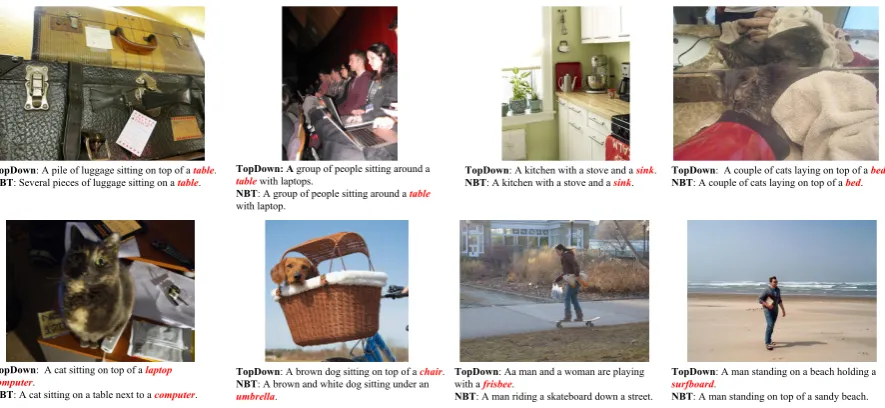
[image:5.595.333.498.262.323.2]TopDown: A pile of luggage sitting on top of a table.
NBT: Several pieces of luggage sitting on a table.
TopDown: A group of people sitting around a table with laptops.
NBT: A group of people sitting around a table with laptop.
TopDown: A couple of cats laying on top of a bed.
NBT: A couple of cats laying on top of a bed.
TopDown: A kitchen with a stove and a sink.
NBT: A kitchen with a stove and a sink.
TopDown: Aa man and a woman are playing with a frisbee.
NBT: A man riding a skateboard down a street.
TopDown: A cat sitting on top of a laptop computer.
NBT: A cat sitting on a table next to a computer.
TopDown: A small brown dog standing on top of a chair.
NBT: A brown dog standing on top of a white
chair.
TopDown: A brown dog sitting on top of a chair.
NBT: A brown and white dog sitting under an umbrella.
TopDown: A man standing on a beach holding a surfboard.
NBT: A man standing on top of a sandy beach.
Figure 3: Examples of object hallucination from two state-of-the-art captioning models, TopDown and NBT, see Section 3.2.
hallucination is more critical in scenarios where test examples can not be assumed to have the same distribution as train examples. We again note that attention is helpful for decreasing hallucination. We note that the NBT model actually has lower hallucination scores on the robust split. This is in part because when generating sentences we use the detector outputs provided by Lu et al. (2018). Separate detectors on the Karpathy test and robust split are not available and the detector has access to images in the robust split during training. Con-sequently, the comparison between NBT and other models is not completely fair, but we include the number for completeness.
In addition to the Robust Test set, we also con-sider a set of MSCOCO in which certain ob-jects are held out, which we call the Novel Ob-ject split(Hendricks et al., 2016). We train on the training set outlined in (Hendricks et al., 2016) and test on the Karpathy test split, which includes ob-jects unseen during training. Similarly to the Ro-bust Test set, we see hallucination increase sub-stantially on this split. For example, for the Top-Down model hallucination increases from 8.4% to 12.1% for CHAIRs and 6.0% to 9.1% for CHAIRi.
We find no obvious correlation between the av-erage length of the generated captions and the hal-lucination rate. Moreover, vocabulary size does not correlate with hallucination either, i.e. mod-els with more diverse descriptions may actually hallucinate less. We notice that hallucinated ob-jects tend to be mentioned towardsthe end of the sentence (on average at position 6, with average
sentence length 9), suggesting that some of the preceding words may have triggered hallucination. We investigate this below.
[image:6.595.79.522.61.265.2]Figure 4: Image and Language model consistency (IM, LM) and CHAIRi (instance-level, CHi) on deconstructed TopDown models. Images with less hallucination tend to make errors consistent with the image model, whereas models with more hallucination tend to make errors consistent with the language model, see Section 3.3.
there are cases where objects are hallucinated out of context (e.g. “bed” in the bathroom, Figure 3, row 1, example 4).
3.3 What Are The Likely Causes Of Hallucination?
In this section we investigate the likely causes of object hallucination. We have earlier described how we deconstruct the TopDown model to en-able a controlled experimental setup. We rely on the deconstructed TopDown models to analyze the impact of model components on hallucination.
First, we summarize the hallucination analysis on the deconstructed TopDown models (Table 3). Interestingly, theNoAttention model does not do substantially worse than the full model (w.r.t. sen-tence metrics and CHAIR). However, removing Conv input (NoConvmodel) and relying only on FC features, decreases the performance dramati-cally. This suggests that much of the gain in at-tention based models is primarily due toaccess to feature maps with spatial locality, not the actual attention mechanism. Also, similar to LRCN vs. FC in Table 1, initializing the LSTM hidden state with image features, as opposed to inputting image features at each time step, leads to lower halluci-nation (Single Layer vs. FC). This is somewhat surprising, as a model which has access to image information at each time step should be less likely to “forget” image content and hallucinate objects. However, it is possible that models which include image inputs at each time step with no access to spatial features overfit to the visual features.
Now we investigate what causes hallucination using the deconstructed TopDown models and the image consistency and language consistency scores, introduced in Sections 2.2 and 2.3 which capture how consistent the hallucinations errors are with image- / language-only models.
Karpathy Split METEOR CIDEr SPICE CHs CHi TD 26.10 103.40 19.50 10.80 7.40 No Attention 25.60 99.70 18.80 14.20 9.40 No Conv 22.90 81.30 15.70 25.70 17.70 Single Layer 22.70 80.20 15.50 25.60 18.00 FC 23.30 85.10 16.40 23.60 15.70
Table 3:Hallucination analysis on deconstructed TopDown models with sentence metrics, CHAIRs (sentence level, CHs) and CHAIRi (instance level, CHi). See Section 3.3.
Figure 4 shows the CHAIR metric, image con-sistency and language concon-sistency for the decon-structed TopDown models on the Karpathy Test set (left) and the Robust Test set (right). We note that models with lesshallucination tend to make errors consistent with the image model, whereas models withmore hallucination tend to make er-rors consistent with the language model. This im-plies that models with less hallucination are bet-ter at integrating knowledge from an image into the sentence generation process. When looking at the Robust Test set, Figure 4 (right), which is more challenging, as we have shown earlier, we see that image consistencydecreases when com-paring to the same models on the Karpathy split, whereas language consistency is similar across all models trained on the Robust split. This is perhaps because the Robust split contains novel composi-tions of objects at test time, and all of the models are heavily biased by language.
TD: A cat is sitting on a bed in a room.
S: 12.1 M: 23.8 C: 69.7 TD Restrict: A bed with a blanket and a pillow on it. S: 23.5 M: 25.4 C: 52.5
TD: A cat laying on the ground with a frisbee.
[image:8.595.77.286.62.202.2]S: 8.0 M: 13.1 C: 37.0 TD Restrict: A black and white animal laying on the ground. S: 7.7 M: 15.9 C: 17.4
Figure 5: Examples of how TopDown (TD) sentences change when we enforce that objects cannot be hallucinated: SPICE (S), Meteor (M), CIDEr (C), see Section 3.4.
3.4 How Well Do The Standard Metrics Capture Hallucination?
In this section we analyze how well SPICE (An-derson et al., 2016), METEOR (Banerjee and Lavie, 2005), and CIDEr (Vedantam et al., 2015) capture hallucination. All three metrics do penal-ize sentences for mentioning incorrect words, ei-ther via an F score (METEOR and SPICE) or co-sine distance (CIDEr). However, if a caption men-tions enough words correctly, it can have a high METEOR, SPICE, or CIDEr score while still hal-lucinating specific objects.
Our first analysis tool is the TD-Restrict model. This is a modification of the TopDown model, where we enforce that MSCOCO objects which are not present in an image are not generated in the caption. We determine which words refer to objects absent in an image following our approach in Section 2.1. We then set the log probability for such words to a very low value. We generate sen-tences with the TopDown and TD-Restrict model with beam search of size1, meaning all words pro-duced by both models are the same, until the Top-Down model produces a hallucinated word.
We compare which scores are assigned to such captions in Figure 5. TD-Restrict generates cap-tions that do not contain hallucinated objects, while TD hallucinates a “cat” in both cases. In Figure 5 (left) we see that CIDEr scores the more correct caption much lower. In Figure 5 (right), the TopDown model incorrectly calls the animal a “cat.” Interestingly, it then correctly identifies the “frisbee,” which the TD-Restrict model fails to mention, leading to lower SPICE and CIDEr.
In Table 4 we compute Pearson correlation co-efficient between individual sentence scores and
CIDEr METEOR SPICE
FC 0.197 0.198 0.266
Att2In 0.177 0.178 0.246
[image:8.595.331.504.63.114.2]TopDown 0.135 0.140 0.172
Table 4:Pearson correlation coefficients between 1-CHs and CIDEr, METEOR, and SPICE scores, see Section 3.4.
Fully Connected:
A clock sitting on top of a wooden table.
SPICE: 7.4
TopDown:
A clock on a wall in a room. SPICE: 7.7
Figure 6: Difference in percentage of sentences withno hal-lucination for TopDown and FC models when SPICE scores fall into specific ranges. For sentences with low SPICE scores, the hallucination is generally larger for the FC model, even though the SPICE scores are similar, see Section 3.4.
theabsenceof hallucination, i.e. 1−CHAIRs; we find that SPICE consistently correlates higher with 1−CHAIRs. E.g., for the FC model the correlation for SPICE is 0.27, while for METEOR and CIDEr – around 0.2.
We further analyze the metrics in terms of their predictiveness of hallucination risk. Predictive-ness means that a certain score should imply a cer-tain percentage of hallucination. Here we show the results for SPICE and the captioning models FC and TopDown. For each model and a score in-terval (e.g.10−20) we compute the percentage of captionswithouthallucination (1−CHAIRs). We plot the difference between the percentages from both models (TopDown - FC) in Figure 6. Com-paring the models, we note that even when scores are similar (e.g., all sentences with SPICE score in the range of10−20), the TopDown model has fewer sentences with hallucinated objects. We see similar trends across other metrics. Consequently, object hallucination can not be always predicted based on the traditional sentence metrics.
[image:8.595.317.515.166.317.2]Metric Metric Metric +(1-CHs) +(1-CHi)
METEOR 0.269 0.299 0.304
CIDEr 0.282 0.321 0.322
[image:9.595.75.288.64.135.2]SPICE 0.248 0.277 0.281
Table 5: Pearson correlation coefficients between individ-ual/combined metrics and human scores. See Section 3.4.
human evaluation (via the Amazon Mechanical Turk). We have randomly selected 500 test images and respective captions from 5 models: non-GAN baseline, GAN, NBT, TopDown and TopDown -Self Critical. The AMT workers were asked to score the presented captions w.r.t. the given image based on their preference. They could score each caption from 5 (very good) to 1 (very bad). We did not use ranking, i.e. different captions could get the same score; each image was scored by three annotators, and the average score is used as the fi-nal human score. For each image we consider the 5 captions from all models and their correspond-ing sentence scores (METEOR, CIDEr, SPICE). We then compute Pearson correlation between the human scores and sentence scores; we also con-sider a simple combination of sentence metrics and 1-CHAIRs or 1-CHAIRi by summation. The final correlation is computed by averaging across all 500 images. The results are presented in Ta-ble 5. Our findings indicate that a simple combi-nation of CHAIRs or CHAIRi with the sentence metrics leads to an increased correlation with the human scores, showing the usefulness and com-plementarity of our proposed metrics.
Does hallucination impact generation of other words? Hallucinating objects impacts sentence quality not only because an object is predicted in-correctly, but also because the hallucinated word impacts generation of other words in the sen-tence. Comparing the sentences generated by Top-Down and TD-Restrict allows us to analyze this phenomenon. We find that after the hallucinated word is generated, the following words in the sen-tence are different 47.3% of the time. This im-plies that hallucination impacts sentence quality beyond simply naming an incorrect object. We ob-serve that one hallucination may lead to another, e.g. hallucinating a “cat” leading to hallucinating a “chair”, hallucinating a “dog” – to a “frisbee”.
4 Discussion
In this work we closely analyze hallucination in object captioning models. Our work is similar to other works which attempt to characterize flaws of different evaluation metrics (Kilickaya et al., 2016), though we focus specifically on halluci-nation. Likewise, our work is related to other work which aims to build better evaluation tools ((Vedantam et al., 2015), (Anderson et al., 2016), (Cui et al., 2018)). However, we focus on carefully quantifying and characterizing one important type of error: object hallucination.
A significant number of objects are hallucinated in current captioning models (between 5.5% and 13.1% of MSCOCO objects). Furthermore, hal-lucination does not always agree with the output of standard captioning metrics. For instance, the popular self critical loss increases CIDEr score, but also the amount of hallucination. Addition-ally, we find that given two sentences with similar CIDEr, SPICE, or METEOR scores from two dif-ferent models, the number of hallucinated objects might be quite different. This is especially appar-ent when standard metrics assign a low score to a generated sentence. Thus, for challenging cap-tion tasks on which standard metrics are currently poor (e.g., the LSMDC dataset (Rohrbach et al., 2017b)), the CHAIR metric might be helpful to tease apart the most favorable model. Our results indicate that CHAIR complements the standard sentence metrics in capturing human preference.
Additionally, attention lowers hallucination, but it appears that much of the gain from attention models is due to access to the underlying convo-lutional features as opposed the attention mecha-nism itself. Furthermore, we see that models with strongerimage consistencyfrequently hallucinate fewer objects, suggesting that strong visual pro-cessing is important for avoiding hallucination.
References
Peter Anderson, Basura Fernando, Mark Johnson, and Stephen Gould. 2016. Spice: Semantic propo-sitional image caption evaluation. In European Conference on Computer Vision, pages 382–398. Springer.
Peter Anderson, Xiaodong He, Chris Buehler, Damien Teney, Mark Johnson, Stephen Gould, and Lei Zhang. 2018. Bottom-up and top-down attention for image captioning and vqa. In Proceedings of the IEEE Conference on Computer Vision and Pattern Recognition.
Satanjeev Banerjee and Alon Lavie. 2005. Meteor: An automatic metric for mt evaluation with improved correlation with human judgments. In Proceed-ings of the ACL Workshop on Intrinsic and Extrin-sic Evaluation Measures for Machine Translation and/or Summarization, pages 65–72.
Xinlei Chen, Hao Fang, Tsung-Yi Lin, Ramakr-ishna Vedantam, Saurabh Gupta, Piotr Doll´ar, and C Lawrence Zitnick. 2015. Microsoft coco captions: Data collection and evaluation server. arXiv preprint arXiv:1504.00325.
Yin Cui, Guandao Yang, Andreas Veit, Xun Huang, and Serge Belongie. 2018. Learning to evaluate im-age captioning. InCVPR.
Jeffrey Donahue, Lisa Anne Hendricks, Sergio Guadar-rama, Marcus Rohrbach, Subhashini Venugopalan, Kate Saenko, and Trevor Darrell. 2015. Long-term recurrent convolutional networks for visual recogni-tion and descriprecogni-tion. In Proceedings of the IEEE Conference on Computer Vision and Pattern Recog-nition, pages 2625–2634.
Kaiming He, Xiangyu Zhang, Shaoqing Ren, and Jian Sun. 2016. Deep residual learning for image recog-nition. In Proceedings of the IEEE conference on computer vision and pattern recognition, pages 770– 778.
Lisa Anne Hendricks, Subhashini Venugopalan, Mar-cus Rohrbach, Raymond Mooney, Kate Saenko, and Trevor Darrell. 2016. Deep compositional cap-tioning: Describing novel object categories without paired training data. In Proceedings of the IEEE Conference on Computer Vision and Pattern Recog-nition, pages 1–10.
Sepp Hochreiter and J¨urgen Schmidhuber. 1997. Long short-term memory. Neural computation, 9(8):1735–1780.
Andrej Karpathy and Li Fei-Fei. 2015. Deep visual-semantic alignments for generating image descrip-tions. In Proceedings of the IEEE conference on computer vision and pattern recognition, pages 3128–3137.
Mert Kilickaya, Aykut Erdem, Nazli Ikizler-Cinbis, and Erkut Erdem. 2016. Re-evaluating automatic
metrics for image captioning. InEuropean Chapter of the Association for Computational Linguistics.
Ranjay Krishna, Yuke Zhu, Oliver Groth, Justin John-son, Kenji Hata, Joshua Kravitz, Stephanie Chen, Yannis Kalantidis, Li-Jia Li, David A Shamma, et al. 2017. Visual genome: Connecting language and vision using crowdsourced dense image anno-tations. International Journal of Computer Vision, 123(1):32–73.
Tsung-Yi Lin, Michael Maire, Serge Belongie, James Hays, Pietro Perona, Deva Ramanan, Piotr Doll´ar, and C Lawrence Zitnick. 2014. Microsoft coco: Common objects in context. In European confer-ence on computer vision, pages 740–755. Springer.
Jiasen Lu, Jianwei Yang, Dhruv Batra, and Devi Parikh. 2018. Neural baby talk. InProceedings of the IEEE Conference on Computer Vision and Pat-tern Recognition.
Ruotian Luo, Brian Price, Scott Cohen, and Gregory Shakhnarovich. 2018. Discriminability objective for training descriptive captions. InProceedings of the IEEE Conference on Computer Vision and Pattern Recognition.
Haley MacLeod, Cynthia L. Bennett, Meredith Ringel Morris, and Edward Cutrell. 2017. Understanding blind peoples experiences with computer-generated captions of social media images. InProceedings of the 2017 SIGCHI Conference on Human Factors in Computing Systems.
Steven J Rennie, Etienne Marcheret, Youssef Mroueh, Jarret Ross, and Vaibhava Goel. 2017. Self-critical sequence training for image captioning. In Proceed-ings of the IEEE Conference on Computer Vision and Pattern Recognition.
Anna Rohrbach, Makarand Tapaswi, Atousa Torabi, Tegan Maharaj, Marcus Rohrbach, Sanja Fi-dler Christopher Pal, and Bernt Schiele. 2017a. The Joint Video and Language Understand-ing Workshop: MovieQA and The Large Scale Movie Description Challenge (LSMDC).
https://sites.google.com/site/
describingmovies/lsmdc-2017.
Anna Rohrbach, Atousa Torabi, Marcus Rohrbach, Niket Tandon, Christopher Pal, Hugo Larochelle, Aaron Courville, and Bernt Schiele. 2017b. Movie description. International Journal of Computer Vi-sion, 123(1):94–120.
Rakshith Shetty, Marcus Rohrbach, Lisa Anne Hen-dricks, Mario Fritz, and Bernt Schiele. 2017. Speak-ing the same language: MatchSpeak-ing machine to human captions by adversarial training. InProceedings of the IEEE International Conference on Computer Vi-sion (ICCV).
Conference on Computer Vision and Pattern Recog-nition, pages 4566–4575.