Abstract— Logistics networks configuration is such kind of
problems concerning facility location, production and distribution planning along the whole process of material flow. Abundant research has been done in this field from modeling by considering different scenarios to methods such as different heuristic methods. However, the models do not consider the influence of the important postponement strategy on logistics networks in the era of mass customization. Furthermore, the multi-commodity models till now do not consider the influence of commonality among products. In this paper, a logistics network model considering product commonality and postponement is formulated. This model is expected to be used to analyze the impacts of commonality and postponement strategies on location-allocation decisions in logistics network planning.
Index Terms—logistics network planning, location allocation,
commonality, postponement.
I. INTRODUCTION
In the environment of global economy, enterprises must configure and utilize worldwide resources to keep the advantages of competition. How to source products from the most appropriate manufacturing facility, how to keep the balance between inventory, transportation and manufacturing costs, and how to match supply and demand under uncertainty are concerned by each company, especially the multinational companies [1]. It is impossible to realize the strategic goal without a well developed and realizable logistics system. High efficient international logistics system will become the core competence for an enterprise to control cost, reach high-level customer service, and hence realize global business successfully.
The importance of logistics network design, and the need for the coordination of production and distribution decisions, has long been evident. Facility location, as the decision at the strategic level in logistics system, plays an important role. Some strategic decisions concerned by facility location include selecting the right suppliers, determining the appropriate number of facilities such as plants and
Manuscript received January 6, 2009.
Prof. Dr.-Ing. L. Schulze: Head of Department Planning and Controlling of Warehouse and Transport Systems (PSLT), Leibniz University Hannover, Germany (phone: +49(0)511/7624885; fax: +49(0)511/7623005; e-mail: [email protected]).
Dr. L. Li: Research assistant, Department Planning and Controlling of Warehouse and Transport Systems, Leibniz University Hannover, Germany (e-mail: [email protected]).
warehouses, determining the location of each facility, determining the size of each facility, determining sourcing requirements, i.e., assigning activities to the facilities, determining distribution strategies, i.e., the flows of raw materials and finished products in the network. The objective of design or reconfiguration of the logistics network is to minimize annual system wide cost subject to a variety of service level requirements.
Abundant researches have been done in location-allocation problems, ranging from the so-called p-median problem to uncapacitated facility location problem and capacitated facility location problem, to the versions considering dynamic and stochastic properties of the supply chain network, multiple products, and/or multiple layers/echelons with or without intra-layer flows, to some models integrating tactical and operational decisions in the logistics system, like production decisions, inventory management, and routing, to some models considering risk management, financial aspects, and international factors, etc. Abundant research has been done in this field from modeling by considering different scenarios to methods such as different heuristic methods. However, there are specially two issues to be highlighted. As we all know that under the paradigms of mass customization, many companies have been modifying their supply chain with considering the strategies like platform commonality and postponement. These two strategies are the issues to be discussed.
Commonality reflects the sharing degree of the platform among products within a product family which is essential for economies of scale for the company. The sharing refers to common features or attributes in either the product or the manufacturing process for a set of products [2]. The commonality can reduce the overall inventory cost by reallocating inventories to upstream stages towards raw materials [3]. When inventory decisions are integrated with facility location decisions, the commonality strategy has to be considered as one factor in facility location decision making when incorporating inventory decisions simultaneously.
Postponement is another issue to be highlighted, which has also been emphasized in the review article of [4]. The strategy of postponement means that the differentiation point of a product will be skipped to the end of the production process. The later the postponement point is sited in a process, the lower is the cost of providing variety. The evolution of postponement as a supply chain concept can be found by the researchers interested in supply chain in [5]. They addressed the challenges of extending postponement research beyond
Location-Allocation Model for Logistics
Networks with Implementing Commonality and
Postponement Strategies
the manufacturing context. Schulze et al. have discussed the logistics management issues and strategies when products are individualized late in the supply china [6]. It is implemented only during the processes in the whole logistics network which can not produce interest.
This paper concerns such kind of logistics networks which distribute a family of products with different levels of commonality. Furthermore, postponement is adopted in the supply chain from plants to distribution centers. The problem of location-allocation considering commonality and postponement are identified and described in this paper, together with the developed model.
The rest of the paper is organized as follows. Section 2 describes the location-allocation problem in logistics network planning for product family with commonality and
postponement. Section 3 introduces the models for such problem. Section 4 concludes the paper by identifying the future work, especially the potential solution techniques for the new model.
II.LITERATURE REVIEW
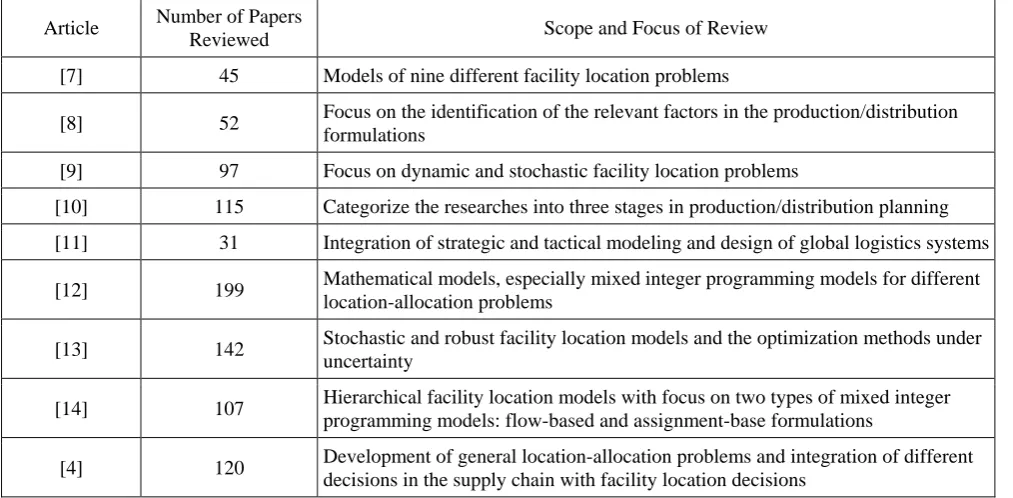
Since from time to time, there are quite some review papers in the field of location-allocation, we summarizes the main review papers in the literature in chronological order, as shown in Table I. From time to time, there was a review about different models and methods for different facility location problems from different aspects.
[image:2.595.48.555.272.521.2]
Table I: Review papers on location-allocation problem
Article Number of Papers
Reviewed Scope and Focus of Review
[7] 45 Models of nine different facility location problems
[8] 52 Focus on the identification of the relevant factors in the production/distribution formulations
[9] 97 Focus on dynamic and stochastic facility location problems
[10] 115 Categorize the researches into three stages in production/distribution planning [11] 31 Integration of strategic and tactical modeling and design of global logistics systems [12] 199 Mathematical models, especially mixed integer programming models for different
location-allocation problems
[13] 142 Stochastic and robust facility location models and the optimization methods under uncertainty
[14] 107 Hierarchical facility location models with focus on two types of mixed integer programming models: flow-based and assignment-base formulations
[4] 120 Development of general location-allocation problems and integration of different decisions in the supply chain with facility location decisions
An early review was given in [7]. This paper clearly summarized the models of nine different facility location problems. Klose and Drexl reviewed further the papers from the mathematical modelling viewpoint and categorized the location-allocation research into continuous location models, network location models, and mixed-integer programming models [12].
Goetschalckx et al. reviewed the mixed integer programming models of location-allocation problems as the foundation, and then focused on the identification of relevant factors included in the formulations, such as stochastic feature, dynamic characteristics, and status of facilities [11]. Erenguec et al. reviewed mainly the researches of facility location problems which integrated production decisions. The authors reported the decisions and models of the three stages, namely supplier stage, plant stage, and distribution stage in production/distribution planning [10].
Owen and Daskin reported on literature which explicitly addresses the stochastic and dynamic characteristics of facility location problems with a wide range of model formations and solution approaches [9]. Dynamic
formulations focus on the difficult timing issues involved in locating facilities over an extended horizon. Stochastic formulations attempt to capture the uncertainty in problem input parameters such as forecast demand or distance values. Snzder did recently another survey regarding the inclusion of stochastic features in facility location models [13]. The paper illustrated the optimization approaches under uncertainty and the applications to facility location problems.
Vidal and Goetschalckx summarized the basic international features considered for model formulation in the existing literature [8]. Based on this categorization, Goetschalckx et al. expanded the international characteristics of the logistics models [11]. Sahin and Süral focused on the hierarchical facility location models. They classified the problems based on flow pattern, service availability at each level of the hierarchy, and spatial configuration of services in addition to the objectives to locate facilities [14].
introduction of properties and decisions of location-allocation problems from different aspects of supply chain, such as inventory, production, and routing, etc. Reverse logistics was emphasized since this topic has been receiving more attention. Solution techniques from the literature were also summarized.
III. PROBLEM IDENTIFICATION
To describe the location-allocation problem with considering commonality and postponement strategies in the logistics network, it is firstly essential to present in which formats the commonality and postponement strategies are used. Swaminathan and Tayur analyzed the final assembly process problem with an example which incorporates commonality and postponement. In the example, management decided to pilot an assembly process based on semi-finished products called vanilla boxes [15]. Fig. 1 shows the fictitious a product family with three products P1, P2, and P3 made of four components a, b, c, and d.
P1 P2 P3
Products:
Components:
a b c d
Vanilla box V1 containing (a, b) supports (P1, P3)
[image:3.595.50.286.312.477.2]Vanilla box V2 containing (b, d) supports (P2, P3) Examples of Vanilla Boxes
Fig. 1: Product Family
The bills of material for the products are P1 = (a, b, c), P2 = (b, c, d), and P3 = (a, b, d). These products share more or less the same components with one another. For example, P1 and P2 both have the components b and c. V1, V2, and V3 are examples of feasible for the three products. V1 can be used in the assembly of P1 and P3 because these products can be assembled from it, by adding appropriate components. Thus a vanilla assembly process enabled assembly of customized products within much shorter lead times. To achieve this, though, the manufacturer had to carry additional inventory of vanilla boxes. However, in addition to the intermediate vanilla boxes form, the vanilla boxes are extremely allowed to be in the forms as components and as finished products. That is to say, there are multiple points of differentiation, in that there is no restriction on the type of vanilla box that can be stored as inventory. In general, when a customer order comes in, the product may be already ready, or produced by adding additional components to a vanilla box, or assembled directly from all of the components.
Swaminathan and Tayur developed a stochastic integer program to determine the optimal types of vanilla boxes as well as their inventory levels [15]. They also explored the benefits of postponement through vanilla boxes under various settings. Among other results, they show that
postponement using the intermediate form of vanilla boxes, i.e., semi-finished products outperforms both extreme forms of vanilla boxes as components or final products when the assembly capacity available is neither too slack nor too tight in the most real environments. However, in the model, the whole assembly or production process was piloted at one location. Hence, the decisions of which components should be present in the different vanilla boxes and how those vanilla boxes are allocated to the different products are used mainly to determine the time point to implement postponement strategy during the production process.
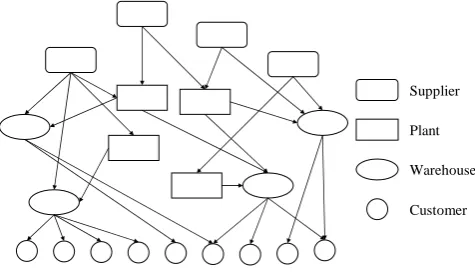
By extending the context of this example from production to production and distribution in the supply chain networks, we formulate the location-allocation problem with considering commonality and postponement. In this logistics networks, the postponement can be implemented not only in the manufacturing or assembly plants, but also in the warehouses. Furthermore, the decisions where to produce the vanilla boxes, where to assemble the final products are to be made too. Since we focus on disclosing the influence of commonality and postponement on location-allocation problems, we consider the location problems with multiple products with sharing some common components, in multiple echelons, and multiple periods. Consider a supply chain like the one depicted by [16] with four main layers composed of suppliers, manufacturers, warehouses and distribution centers, and customers, as shown in Fig. 2. From the original suppliers of components a, b, c and d, the final products P1, P2, and P3 are distributed to the final customers with deterministic demands for each kind of products.
Supplier
Plant
Warehouse
Customer
Fig. 2: General Logistics Network
In this network, suppliers provide components a, b, c, and d from their locations to the plants to produce vanilla boxes or final products or directly to the warehouses for assembling the final products with the vanilla boxes. This implies that the postponement is even implemented during the distribution process. Suppose that for each component, not only one, but some suppliers are available at different locations. The suppliers will offer on the fixed cost if it is selected to deliver more materials than a given quantity. Considering that the common components among products, different transportation distance and quantity may influence the final cost of the network, decisions are to be made on the selection of suppliers.
[image:3.595.309.547.433.569.2]products without capacity limitations. Where to build the plants and which form of vanilla boxes and how many of them to be produced and kept in each plant are to be determined. The same as plants, the warehouses also have potential locations to be selected. Besides that, where to store the corresponding forms of vanilla boxes are general distribution decisions to be considered. One issue needs to be highlighted is that plants can not be used only for storing components, but they must produce semi-finished or final products. That means they can hold the inventory of different components. However, warehouses can not only hold components without vanilla boxes in the form of semi-finished or final products.
IV. MODEL FORMULATION A. Sets
S
: set of suppliers, indexed bys
.P
: set of potential locations for plants, indexed byp
.W
: set of potential locations for warehouses, indexed byw
.F
: set of products, indexed byf
.C
: set of customers, indexed byc
.R
: set of components, indexed byr
.V
: set of vanilla boxes, indexed byv
. fR
: set of components used in productf
. fV
: set of vanilla boxes used in productf
. rF
: set of products which need componentr
. rV
: set of vanilla boxes which need componentr
. vF
: set of products which need vanilla boxv
. fP
: subset of plants at which productf
can be made. fW
: subset of warehouses at which productf
can be stored.r
S
: subset of suppliers that can provide componentr
. fC
: set of customers which require productf
.V
R
F
K
=
∪
∪
: set of all commodities represented in the model, indexed byk
.W
P
S
O
=
∪
∪
: set of potential origins for the commodities, indexed by o.C
W
P
D
=
∪
∪
: set of potential destinations for the commodities, indexed by d.k
O
: set of potential origins for commodityk
. kD
: set of potential destinations for commodityk
. The notations ofK
,O
, andD
are defined for notational convenience, with reference to [17] in their research. From the above definitions, we can getO
r=
S
rfor any component
r
∈
R
,O
v=
P
v for any vanilla boxV
v
∈
, andO
f=
P
f∪
W
f for any productf
∈
F
. Similarly, possible destinations for a component r are plants at which products requiring this component can be made, i.e.,f F f r
P
D
=
∪
∈ r . Furthermore, possible destinations for a vanilla box v are warehouses at which products requiring thisvanilla box can be finally assembled, i.e., f
F v v
W
D
=
∪
∈ v . Finally, the set of possible destinations for a product f is defined asD
f=
W
f∪
C
fB. Parameters rf
a
: quantity of componentr
required in the production of one unit of productf
.rv
b
: quantity of componentr
required in the production of one unit of vanilla boxv
.vf
c
: quantity of vanilla boxv
required in the production of one unit of productf
.f c
d
: demand of customerc
for productf
. oc
: fixed cost of selecting the origino
. ko
c
: operation cost of one unit of commodityk
at origino
. kod
c
: transportation cost of one unit of commodityk
from origino
to destinationd
.s
cs
: capacity of suppliers
. pcp
: capacity of plantp
. wcw
: capacity of warehousew
. vF
n
: total element number of the setF
v. oU
: middle parameter to represent if the origin is active, if0
=
∑ ∑
∈K ∈ k d Dk od
x
,U
o=
0
, else,U
o=
1
.∑
∈
=
D d
k od k
o
x
U
: middle parameter to represent the amount of commodityk
operated by origino
.k
q
: lowest quantity of the commodity operated by one origin to have a discount for operation.k
l
: discount onc
ok, ifU
ok≥
q
k,0
≤
l
k≤
1
, if kk
o
q
U
<
,l
k=
1
. C. VariablesIn the models in the literature, the variables are quite often defined in three levels. The first level refers to binary variables. They are defined to represent which origin is selected for delivering a kind of commodity. For example, for each supplier, there is a binary variable to represent if the supplier is selected to deliver the material or not. Similarly, binary variables are defined for the potential locations of plants and warehouses. If the variable is equal to 1, normally, it means this location is selected to build a plant or warehouse. The second level means the variables which represent the quantity of commodities delivered from an origin or a destination in the network. The third level variables are used to represent the flow quantity of commodities between each possible pair of origin and destination.
activity of the second level variables depends on the value of the first level variables. Furthermore, the activity of the third level variables depends on the value of the second level variables. Of course, indirectly, the first level variables control the activity of the third level variables. For example, if the variable for a supplier is equal to 0, that means this supplier is not selected to deliver the material. Hence, the variable at the second level representing the quantity delivered by this supplier is not active. Subsequently, the variable at the third level representing the flow quantity from this supplier as the origin can not be active either.
To solve the activity problem induced by the variables in three levels, conditional constraints are added to ensure that the higher level variables can not be assigned value. In this paper, we release such constraints by using only the third level variables. These variables implicitly represent which origin is selected to deliver which commodity and the quantity too.
k od
x
: quantity of commodityk
transported from the origino
to the destinationd
. D.ConstraintsP
p
R
r
x
b
x
a
x
vpwS
s f F vV w W
rv f pw W w rf r sp
r r r
∈
∈
=
−
−
∑
∑
∑
∑ ∑
∈ ∈ ∈ ∈ ∈,
,
0
(1)R
r
W
w
x
a
x
b
x
a
x
f r r r C c f wc rf V v p Pv pw rv
F f p P
f pw rf S s r sw
∈
∈
=
−
+
+
∑
∑∑
∑∑
∑
∈ ∪ ∈ ∈ ∈ ∈,
,
0
(2) f C c f wc P p f pw P p v pw vfV
v
W
w
F
f
x
x
x
c
f∈
∈
∈
=
−
+
∑
∑
∑
∈ ∈ ∈,
,
,
0
(3) f W w f c fwc
d
f
F
c
C
x
∑
∈∈
∈
=
−
0
,
,
(4)
S
s
cs
x
x
s W w r sw P p rsp
+
∑
≤
∈
∑
∈ ∈
,
(5)P
p
cp
n
c
x
x
F pF f
vf
V v wW
v pw F
f wW f pw v v
∈
≤
+
∑ ∑
∑
∑ ∑
∈ ∈ ∈ ∈ ∈,
)
/
/(
(6)W
w
cw
x
w F f cCf wc f
∈
≤
∑ ∑
∈ ∈,
(7)Constraints (1) ensure that the total amount of component r shipped to plant p is equal to the total amount required by all vanilla boxes and products made at this plant. Constraints (2) and (3) ensure that all finished products, vanilla boxes, and components that enter a warehouse also leave that warehouse. Demand satisfaction constraints are imposed by Equation (4). Constraints (5), (6), and (7) are the capacity
constraints for suppliers, plants, and warehouses respectively.
E. Objective Function
]
)
(
[
min.
∑
∑
∑
∉ ∈ ∈
+
+
O
o k K d D
k od k od k o k o o o k
x
c
U
c
U
c
(8)The objective function (8) minimizes the sum of all fixed and variable costs.
V.CONCLUSIONS
This paper has summarized the development of logistics networks planning by analyzing the review papers in the literature. From the study, the research gap is identified. A new location-allocation model is formulated with considering the commonality among the products and postponement strategies in the logistics networks. The model can be used to make not only the general facility location decisions, like where to build the plant or warehouse, the allocation of commodities, but also the decisions on where to build the final products and vanilla boxes in the plants or warehouses.
Based on the proposed new location-allocation problem and model, further researches are to develop the method for solving such problems. Some mathematical optimization techniques have been widely adopted. Exact algorithms are used to find the optimal solutions, and heuristics are used to find good, but no necessarily optimal solutions. Simulation models are also well-known with the mechanism to evaluate specified design alternatives created by the designer.
Furthermore, some management issues and hints can be obtained by analyzing and comparing the results among the models with different scenarios, namely the models with only considering commonality or postponement, with considering both commonality and postponement, and without considering commonality and postponement.
Finally, one issue must be highlighted. Since the original emphasis of the paper is to discover the influence of commonality and postponement strategies on location-allocation decisions in logistics system planning, the basic model does not include uncertainty and time-period. However, considering that the spirit of commonality and postponement is to reduce the uncertainty of customer demand, the model would be more practical if it is extended for dynamic and stochastic logistics network scenarios.
REFERENCES
[1] D. Simchi-Levi, P. Kaminsky, and E. Simchi-Levi, Designing and Managing the Supply Chain: Concepts, Strategies, and Case Studies. New York: McGraw-Hill/Irwin, 2008.
[2] T. W. Simpson, J. R. A. Maier, and F. Mistree, "Product platform design: method and application," Research in Engineering Design, 13(1), 2001, pp.2-22.
[4] M. T. Melo, S. Nickel, and F. Saldanha-da-Gama, "Facility location and supply chain management – A review," European Journal of Operational Research, 2008, pp.1-12.
[5] C. A. Boone, C. W. Craighead, and J. B. Hanna, "Postponement: an evolving supply chain concept," International Journal of Physical Distribution & Logistics Management, 37(8), 2007, pp.594-611. [6] L. Schulze, M. Gerasch, S. Mansky, and L. Li, "Logistics management
of late product individualisation - application in the automotive industry," International Journal of Logistics Economics and Globalization, to be published.
[7] C. H. Aikens, "Facility location models for distribution planning," European Journal of Operational Research, 22, 1985, pp.263-279. [8] C. J. Vidal, and M. Goetschalckx, "Strategic production-distribution
models: a critical review with emphasis on global supply chain models," European Journal of Operational Research, 98, 1997, pp.1-18. [9] S. H. Owen, and M. S. Daskin, "Strategic facility location: A review,"
European Journal of Operational Research, 111(3), 1998.
[10] S. S. Erenguec, N. C. Simpson, and A. J. Vakharia, "Integrated production/distribution planning in supply chains: An invited review " European Journal of Operational Research, 115, 1999, pp.219-236. [11] M. Goetschalckx, C. J. Vidal, and K. Dogan, "Modeling and design of
global logistics systems: A review of integrated strategic and tactical models and design algorithms," European Journal of Operational Research, 143, 2002, pp.1-16.
[12] A. Klose, and A. Drexl, "Facility location models for distribution system design," European Journal of Operational Research, 162, 2005, pp.4-29.
[13] L. V. Snzder, "Facility location under uncertainty: a review," IIE Transactions, 38, 2006, pp.537-554.
[14] G. Sahin, and H. Süral, "A review of hierarchical facility location models," Computers & Operations Research, 34, 2007, pp.2310-2331. [15] J. M. Swaminathan, and S. R. Tayur, "Managing broader product lines through delayed differentiation using vanilla boxes," Management Science, 44(12), 1998, pp.161-172.
[16] P. N. Thanh, N. Bostel, and O. Peton, "A dynamic model for facility location in the design of complex supply chains," International Journal of Production Economics, 113, 2008, pp.678-693.