Spectral Learning for Non-Deterministic Dependency Parsing
Franco M. Luque
Universidad Nacional de C´ordoba and CONICET
C´ordoba X5000HUA, Argentina
Ariadna Quattoni and Borja Balle and Xavier Carreras
Universitat Polit`ecnica de Catalunya Barcelona E-08034
{aquattoni,bballe,carreras}@lsi.upc.edu
Abstract
In this paper we study spectral learning methods for non-deterministic split head-automata grammars, a powerful hidden-state formalism for dependency parsing. We present a learning algorithm that, like other spectral methods, is efficient and non-susceptible to local minima. We show how this algorithm can be formulated as a technique for inducing hidden structure from distributions computed by forward-backward recursions. Furthermore, we also present an inside-outside algorithm for the parsing model that runs in cubic time, hence maintaining the standard pars-ing costs for context-free grammars.
1 Introduction
Dependency structures of natural language sen-tences exhibit a significant amount of non-local phenomena. Historically, there have been two main approaches to model non-locality: (1) in-creasing the order of the factors of a dependency model (e.g. with sibling and grandparent relations (Eisner, 2000; McDonald and Pereira, 2006; Car-reras, 2007; Martins et al., 2009; Koo and Collins, 2010)), and (2) using hidden states to pass in-formation across factors (Matsuzaki et al., 2005; Petrov et al., 2006; Musillo and Merlo, 2008).
Higher-order models have the advantage that they are relatively easy to train, because estimat-ing the parameters of the model can be expressed as a convex optimization. However, they have two main drawbacks. (1) The number of param-eters grows significantly with the size of the fac-tors, leading to potential data-sparsity problems. A solution to address the data-sparsity problem
is to explicitly tell the model what properties of higher-order factors need to be remembered. This can be achieved by means of feature engineering, but compressing such information into a state of bounded size will typically be labor intensive, and will not generalize across languages. (2) Increas-ing the size of the factors generally results in poly-nomial increases in the parsing cost.
In principle, hidden variable models could solve some of the problems of feature engineering in higher-order factorizations, since they could automatically induce the information in a deriva-tion history that should be passed across factors. Potentially, they would require less feature engi-neering since they can learn from an annotated corpus an optimal way to compress derivations into hidden states. For example, one line of work has added hidden annotations to the non-terminals of a phrase-structure grammar (Matsuzaki et al., 2005; Petrov et al., 2006; Musillo and Merlo, 2008), resulting in compact grammars that ob-tain parsing accuracies comparable to lexicalized grammars. A second line of work has modeled hidden sequential structure, like in our case, but using PDFA (Infante-Lopez and de Rijke, 2004). Finally, a third line of work has induced hidden structure from the history of actions of a parser (Titov and Henderson, 2007).
However, the main drawback of the hidden variable approach to parsing is that, to the best of our knowledge, there has not been any convex formulation of the learning problem. As a result, training a hidden-variable model is both expen-sive and prone to local minima issues.
In this paper we present a learning algorithm for hidden-state split head-automata grammars (SHAG) (Eisner and Satta, 1999). In this
malism, head-modifier sequences are generated by a collection of finite-state automata. In our case, the underlying machines are probabilistic non-deterministic finite state automata (PNFA), which we parameterize using theoperator model
representation. This representation allows the use of simple spectral algorithms for estimating the model parameters from data (Hsu et al., 2009; Bailly, 2011; Balle et al., 2012). In all previous work, the algorithms used to induce hidden struc-ture require running repeated inference on train-ing data—e.g. Expectation-Maximization (Demp-ster et al., 1977), or split-merge algorithms. In contrast, spectral methods are simple and very ef-ficient —parameter estimation is reduced to com-puting some data statistics, performing SVD, and inverting matrices.
The main contributions of this paper are:
• We present a spectral learning algorithm for inducing PNFA with applications to head-automata dependency grammars. Our for-mulation is based on thinking about the dis-tribution generated by a PNFA in terms of the forward-backward recursions.
• Spectral learning algorithms in previous work only use statistics of prefixes of se-quences. In contrast, our algorithm is able to learn from substring statistics.
• We derive an inside-outside algorithm for non-deterministic SHAG that runs in cubic time, keeping the costs of CFG parsing.
• In experiments we show that adding non-determinism improves the accuracy of sev-eral baselines. When we compare our algo-rithm to EM we observe a reduction of two orders of magnitude in training time.
The paper is organized as follows. Next section describes the necessary background on SHAG and operator models. Section 3 introduces Op-erator SHAG for parsing, and presents a spectral learning algorithm. Section 4 presents a parsing algorithm. Section 5 presents experiments and analysis of results, and section 6 concludes.
2 Preliminaries
2.1 Head-Automata Dependency Grammars
In this work we use split head-automata gram-mars (SHAG) (Eisner and Satta, 1999;
Eis-ner, 2000), a context-free grammatical formal-ism whose derivations are projective dependency trees. We will use xi:j = xixi+1· · ·xj to
de-note a sequence of symbolsxtwith i ≤ t ≤ j.
A SHAG generates sentences s0:N, where
sym-bolsst ∈ X with1 ≤ t ≤ N are regular words
ands0 = ? 6∈ X is a special root symbol. Let
¯
X = X ∪ {?}. A derivation y, i.e. a
depen-dency tree, is a collection of head-modifier se-quences hh, d, x1:Ti, where h ∈ X¯ is a word,
d ∈ {LEFT,RIGHT} is a direction, and x1:T is
a sequence of T words, where each xt ∈ X is
a modifierof h in directiond. We say that h is theheadof eachxt. Modifier sequencesx1:T are
ordered head-outwards, i.e. amongx1:T,x1is the word closest tohin the derived sentence, andxT
is the furthest. A derivationyof a sentences0:N
consists of aLEFTand aRIGHThead-modifier se-quence for eachst. As special cases, theLEFT
se-quence of the root symbol is always empty, while the RIGHT one consists of a single word corre-sponding to the head of the sentence. We denote byY the set of all valid derivations.
Assume a derivationycontainshh,LEFT, x1:Ti
andhh,RIGHT, x01:T0i. LetL(y, h)be the derived
sentenceheadedbyh, which can be expressed as
L(y, xT)· · · L(y, x1) h L(y, x01)· · · L(y, x0T0).1
The language generated by a SHAG are the stringsL(y, ?)for anyy ∈ Y.
In this paper we use probabilistic versions of SHAG where probabilities of head-modifier se-quences in a derivation are independent of each other:
P(y) =
Y
hh,d,x1:Ti∈y
P(x1:T|h, d) . (1)
In the literature, standardarc-factoredmodels fur-ther assume that
P(x1:T|h, d) = T+1
Y
t=1
P(xt|h, d, σt) , (2)
wherexT+1is always a specialSTOPword, andσt
is the state of a deterministic automaton generat-ingx1:T+1. For example, settingσ1=FIRSTand σt>1 = REST corresponds to first-order models, while settingσ1 =NULLandσt>1=xt−1 corre-sponds to sibling models (Eisner, 2000; McDon-ald et al., 2005; McDonMcDon-ald and Pereira, 2006).
1
2.2 Operator Models
An operator model A with n states is a tuple
hα1, α>∞,{Aa}a∈Xi, whereAa∈Rn×nis an op-erator matrix andα1, α∞ ∈ Rn are vectors. A
computes a functionf :X∗ →
Ras follows:
f(x1:T) =α>∞AxT · · · Ax1 α1 . (3)
One intuitive way of understanding operator models is to consider the case wheref computes a probability distribution over strings. Such a dis-tribution can be described in two equivalent ways: by making some independence assumptions and providing the corresponding parameters, or by ex-plaining the process used to computef. This is akin to describing the distribution defined by an HMM in terms of a factorization and its corre-sponding transition and emission parameters, or using the inductive equations of the forward al-gorithm. The operator model representation takes the latter approach.
Operator models have had numerous applica-tions. For example, they can be used as an alter-native parameterization of the function computed by an HMM (Hsu et al., 2009). Consider an HMM withnhidden states and initial-state probabilities π ∈ Rn, transition probabilities T ∈
Rn×n, and
observation probabilities Oa ∈ Rn×n for each
a∈ X, with the following meaning:
• π(i)is the probability of starting at statei,
• T(i, j) is the probability of transitioning from statejto statei,
• Oais a diagonal matrix, such thatOa(i, i)is
the probability of generating symbolafrom statei.
Given an HMM, an equivalent operator model can be defined by setting α1 = π, Aa = T Oa
andα∞ =~1. To see this, let us show that the
for-ward algorithm computes the expression in equa-tion (3). Let σt denote the state of the HMM
at time t. Consider a state-distribution vector αt ∈ Rn, whereαt(i) = P(x1:t−1, σt=i).
Ini-tiallyα1 =π. At each step in the chain of prod-ucts (3), αt+1 = Axt αt updates the state
dis-tribution from positions t to t + 1 by applying the appropriate operator, i.e. by emitting symbol xtand transitioning to the new state distribution.
The probability of x1:T is given by
P
iαT+1(i). Hence, Aa(i, j) is the probability of generating
symbolaand moving to stateigiven that we are at statej.
HMM are only one example of distributions that can be parameterized by operator models. In general, operator models can parameterize any PNFA, where the parameters of the model corre-spond to probabilities of emitting a symbol from a stateandmoving to the next state.
The advantage of working with operator mod-els is that, under certain mild assumptions on the operator parameters, there exist algorithms that can estimate the operators from observable statis-tics of the input sequences. These algorithms are extremely efficient and are not susceptible to local minima issues. See (Hsu et al., 2009) for theoret-ical proofs of the learnability of HMM under the operator model representation.
In the following, we write x = xi:j ∈ X∗ to
denote sequences of symbols, and useAxi:j as a
shorthand forAxj· · ·Axi. Also, for convenience
we assumeX ={1, . . . , l}, so that we can index vectors and matrices by symbols inX.
3 Learning Operator SHAG
We will define a SHAG using a collection of op-erator models to compute probabilities. Assume that for each possible headhin the vocabularyX¯
and each directiond ∈ {LEFT,RIGHT} we have an operator model that computes probabilities of modifier sequences as follows:
P(x1:T|h, d) = (αh,d∞)>Ah,dxT · · · A h,d x1 α
h,d
1 .
Then, this collection of operator models defines an operator SHAG that assigns a probability to eachy ∈ Yaccording to (1). To learn the model parameters, namely hαh,d1 , αh,d∞,{Ah,da }a∈Xi for
can find operators in the projected space that pa-rameterize the sameprobability distribution over sequences.
In the rest of this section we describe an algo-rithm for learning an operator model. We will as-sume a fixed head word and direction, and droph anddfrom all terms. Hence, our goal is to learn the following distribution, parameterized by oper-atorsα1,{Aa}a∈X, andα∞:
P(x1:T) =α>∞AxT · · · Ax1 α1 . (4)
Our algorithm shares many features with the previous spectral algorithms of Hsu et al. (2009) and Bailly (2011), though the derivation given here is based upon the general formulation of Balle et al. (2012). The main difference is that our algorithm is able to learn operator models fromsubstringstatistics, while algorithms in vious works were restricted to statistics on pre-fixes. In principle, our algorithm should extract much more information from a sample.
3.1 Preliminary Definitions
The spectral learning algorithm will use statistics estimated from samples of the target distribution. More specifically, consider the function that com-putes the expected number of occurrences of a substringxin a random stringx0drawn fromP:
f(x) =E(xv]x0)
= X
x0∈X∗
(xv]x0)P(x0)
= X
p,s∈X∗
P(pxs) , (5)
wherex v] x0 denotes the number of timesx ap-pears in x0. Here we assume that the true values off(x)for bigrams are known, though in practice the algorithm will work with empirical estimates of these.
The information about f known by the algo-rithm is organized in matrix form as follows. Let P ∈Rl×lbe a matrix containing the value off(x)
for all strings of length two, i.e. bigrams.2. That is, each entry inP ∈ Rl×l contains the expected
number of occurrences of a given bigram:
P(b, a) =E(abv]x) . (6)
2
In fact, while we restrict ourselves to strings of length two, an analogous algorithm can be derived that considers longer strings to defineP. See (Balle et al., 2012) for details.
Furthermore, for eachb∈ X letPb ∈Rl×ldenote
the matrix whose entries are given by
Pb(c, a) =E(abcv]x) , (7)
the expected number of occurrences of trigrams. Finally, we define vectorsp1 ∈ Rlandp∞ ∈ Rl
as follows: p1(a) = Ps∈X∗P(as), the
probabil-ity that a string begins with a particular symbol; andp∞(a) = Pp∈X∗P(pa), the probability that
a string ends with a particular symbol.
Now we show a particularly useful way to ex-press the quantities defined above in terms of the operators hα1, α>∞,{Aa}a∈Xi of P. First, note
that each entry ofP can be written in this form:
P(b, a) = X
p,s∈X∗
P(pabs) (8)
= X
p,s∈X∗
α∞> AsAb AaApα1
= (α>∞
X
s∈X∗
As)AbAa(
X
p∈X∗
Apα1) .
It is not hard to see that, sincePis a probability
distribution over X∗, actually α> ∞
P
s∈X∗As =
~1>. Furthermore, since P
p∈X∗Ap =
P
k≥0(
P
a∈XAa)k = (I − Pa∈XAa)−1,
we writeα˜1 = (I−Pa∈XAa)−1α1. From (8) it is natural to define aforward matrixF ∈ Rn×l
whoseath column contains the sum of all hidden-state vectors obtained after generating all prefixes ended ina:
F(:, a) =Aa
X
p∈X∗
Apα1=Aaα˜1 . (9)
Conversely, we also define a backward matrix B ∈Rl×nwhoseath row contains the probability
of generatingafrom any possible state:
B(a,:) =α>∞ X
s∈X∗
AsAa=~1>Aa . (10)
By plugging the forward and backward matri-ces into (8) one obtains the factorization P =
BF. With similar arguments it is easy to see that one also hasPb = BAbF,p1 = B α1, and p>∞=α>∞F. Hence, ifBandFwere known, one could in principle invert these expressions in order to recover the operators of the model from em-pirical estimations computed from a sample. In the next section we show that in fact one does not need to knowBandF to learn an operator model forP, but rather that having a “good” factorization
3.2 Inducing a Hidden-State Space
We have shown that an operator model A com-putingPinduces a factorization of the matrixP,
namelyP =BF. More generally, it turns out that when the rank ofP equals the minimal number of states of an operator model that computesP, then
one can prove a duality relation between opera-tors and factorizations ofP. In particular, one can show that, for any rank factorizationP =QR, the operators given by α¯1 = Q+p1, α¯>∞ = p>∞R+,
andA¯a =Q+PaR+, yield an operator model for P. A key fact in proving this result is that the
func-tionPis invariant to the basis chosen to represent
operator matrices. See (Balle et al., 2012) for fur-ther details.
Thus, we can recover an operator model forP
from any rank factorization ofP, provided a rank assumption on P holds (which hereafter we as-sume to be the case). Since we only have access to an approximation ofP, it seems reasonable to choose a factorization which is robust to estima-tion errors. A natural such choice is the thin SVD decomposition ofP (i.e. using topnsingular vec-tors), given by: P = U(ΣV>) = U(U>P). Intuitively, we can think of U andU>P as pro-jected backward and forward matrices. Now that we have a factorization ofP we can construct an operator model forPas follows:3
¯
α1 = U>p1 , (11)
¯
α>∞= p>∞(U>P)+ , (12)
¯
Aa= U>Pa(U>P)+ . (13)
Algorithm 1 presents pseudo-code for an algo-rithm learning operators of a SHAG from train-ing head-modifier sequences ustrain-ing this spectral method. Note that each operator model in the
3
To see that equations (11-13) define a model forP, one must first see that the matrixM =F(ΣV>)+is invertible with inverseM−1 = U>
B. Using this and recalling that
p1=Bα1,Pa=BAaF,p>∞=α>∞F, one obtains that:
¯
α1 = U>Bα1=M−1α1 ,
¯
α>∞ = α > ∞F(U
>
BF)+=α>∞M ,
¯
Aa = U>BAaF(U>BF)+=M−1AaM .
Finally:
P(x1:T) = α>∞AxT· · ·Ax1α1
= α>∞M M−1AxTM· · ·M −1
Ax1M M
−1
α1
= α¯>∞A¯xT · · ·A¯x1α¯1
Algorithm 1Learn Operator SHAG inputs:
• An alphabetX
• A training setTRAIN={hhi, di, xi1:Ti}Mi=1 • The number of hidden statesn
1: for eachh∈X¯andd∈ {LEFT,RIGHT}do 2: Compute an empirical estimate fromTRAINof
statistics matricespb1,pb∞,Pb, and{Pab }a∈X 3: Compute the SVD ofPband letUbbe the matrix
of topnleft singular vectors ofPb
4: Compute the observable operators forhandd:
5: αbh,d1 =Ub>bp1
6: (αbh,d∞ )> =pb>∞(Ub>Pb)+
7: Abh,da =Ub>Pba(Ub>Pb)+ for eacha∈ X
8: end for
9: return Operatorshαbh,d1 ,αbh,d
∞ ,Abh,da i
for eachh∈X¯,d∈ {LEFT,RIGHT},a∈ X
SHAG is learned separately. The running time of the algorithm is dominated by two computa-tions. First, a pass over the training sequences to compute statistics over unigrams, bigrams and tri-grams. Second, SVD and matrix operations for computing the operators, which run in time cubic in the number of symbolsl. However, note that when dealing with sparse matrices many of these operations can be performed more efficiently.
4 Parsing Algorithms
Given a sentence s0:N we would like
to find its most likely derivation, yˆ = argmaxy∈Y(s0:N)P(y). This problem, known as
Let(si, sj)denote a dependency between head
word i and modifier word j. The posterior ormarginal probability of a dependency(si, sj)
given a sentences0:N is defined as
µi,j =P((si, sj)|s0:N) =
X
y∈Y(s0:N) : (si,sj)∈y
P(y) .
To compute marginals, the sum over derivations can be decomposed into a product of inside and outside quantities (Baker, 1979). Below we de-scribe an inside-outside algorithm for our gram-mars. Given a sentences0:N and marginal scores
µi,j, we compute the parse tree fors0:N as
ˆ
y= argmax
y∈Y(s0:N)
X
(si,sj)∈y
logµi,j (14)
using the standard projective parsing algorithm for arc-factored models (Eisner, 2000). Overall we use a two-pass parsing process, first to com-pute marginals and then to comcom-pute the best tree.
4.1 An Inside-Outside Algorithm
In this section we sketch an algorithm to com-pute marginal probabilities of dependencies. Our algorithm is an adaptation of the parsing algo-rithm for SHAG by Eisner and Satta (1999) to the case of non-deterministic head-automata, and has a runtime cost of O(n2N3), wheren is the number of states of the model, and N is the length of the input sentence. Hence the algorithm maintains the standard cubic cost on the sentence length, while the quadratic cost on n is inher-ent to the computations defined by our model in Eq. (3). The main insight behind our extension is that, because the computations of our model in-volve state-distribution vectors, we need to extend the standard inside/outside quantities to be in the form of such state-distribution quantities.4
Throughout this section we assume a fixed sen-tences0:N. LetY(xi:j) be the set of derivations
that yield a subsequencexi:j. For a derivation y,
we use root(y) to indicate the root word of it, and use (xi, xj) ∈ y to refer a dependency in y
from head xi to modifier xj. Following Eisner
4Technically, when working with the projected operators
the state-distribution vectors will not be distributions in the formal sense. However, they correspond to a projection of a state distribution, for some projection that we do not recover from data (namelyM−1in footnote 3). This projection has no effect on the computations because it cancels out.
and Satta (1999), we use decoding structures re-lated to complete half-constituents (or “triangles”, denoted C) and incomplete half-constituents (or “trapezoids”, denotedI), each decorated with a di-rection (denotedLandR). We assume familiarity with their algorithm.
We defineθi,jI,R ∈ Rnas the inside score-vector
of a right trapezoid dominated by dependency
(si, sj),
θi,jI,R = X
y∈Y(si:j) : (si,sj)∈y , y={hsi,R,x1:ti} ∪y0, xt=sj
P(y0)αsi,R(x1:t) . (15)
The termP(y0)is the probability of head-modifier
sequences in the range si:j that do not involve
si. The term αsi,R(x1:t) is a forward
state-distribution vector —the qth coordinate of the vector is the probability that si generates right
modifiersx1:t and remains at state q. Similarly,
we defineφI,Ri,j ∈ Rn as the outside score-vector
of a right trapezoid, as
φI,Ri,j = X
y∈Y(s0:isj:n) : root(y)=s0,
y={hsi,R,xt:Ti} ∪y0, xt=sj
P(y0)βsi,R(xt+1:T) , (16)
where βsi,R(x
t+1:T) ∈ Rn is a backward
state-distribution vector —the qth coordinate is the probability of being at state q of the right au-tomaton ofsi and generatingxt+1:T. Analogous
inside-outside expressions can be defined for the rest of structures (left/right triangles and trape-zoids). With these quantities, we can compute marginals as
µi,j =
(
(φI,Ri,j)>θi,jI,R Z−1 ifi < j ,
(φi,jI,L)>θI,Li,j Z−1 ifj < i , (17)
whereZ=P
y∈Y(s0:N)P(y) = (α ?,R
∞)>θ0C,R,N.
Finally, we sketch the equations for computing inside scores inO(N3) time. The outside equa-tions can be derived analogously (see (Paskin, 2001)). For0≤i < j ≤N:
θC,Ri,i =αsi,R
1 (18)
θC,Ri,j =
j
X
k=i+1 θI,Ri,k
(αsk,R
∞ )>θk,jC,R
(19)
θi,jI,R =
j
X
k=i
Asi,R
sj θ
C,R
i,k
(αs∞j,L)>θkC,L+1,j
5 Experiments
The goal of our experiments is to show that in-corporating hidden states in a SHAG using oper-ator models can consistently improve parsing ac-curacy. A second goal is to compare the spec-tral learning algorithm to EM, a standard learning method that also induces hidden states.
The first set of experiments involve fully unlex-icalized models, i.e. parsing part-of-speech tag se-quences. While this setting falls behind the state-of-the-art, it is nonetheless valid to analyze empir-ically the effect of incorporating hidden states via operator models, which results in large improve-ments. In a second set of experiments, we com-bine the unlexicalized hidden-state models with simple lexicalized models. Finally, we present some analysis of the automaton learned by the spectral algorithm to see the information that is captured in the hidden state space.
5.1 Fully Unlexicalized Grammars
We trained fully unlexicalized dependency gram-mars from dependency treebanks, that is, X are PoS tags and we parse PoS tag sequences. In all cases, our modifier sequences include special STARTandSTOPsymbols at the boundaries. 5 6 We compare the following SHAG models:
• DET: a baseline deterministic grammar with a single state.
• DET+F: a deterministic grammar with two states, one emitting the first modifier of a sequence, and another emitting the rest (see (Eisner and Smith, 2010) for a similar deter-ministic baseline).
• SPECTRAL: a non-deterministic grammar withnhidden states trained with the spectral algorithm.nis a parameter of the model.
• EM: a non-deterministic grammar with n states trained with EM. Here, we estimate operators hαb1,αb∞,Ab
h,d
a i using
forward-backward for the E step. To initialize, we mimicked an HMM initialization: (1) we set
b
α1 andαb∞ randomly; (2) we created a ran-dom transition matrix T ∈ Rn×n; (3) we
5
Even though the operatorsα1 andα∞of a PNFA ac-count for start and stop probabilities, in preliminary experi-ments we found that having explicitSTARTandSTOP sym-bols results in more accurate models.
6
Note that, for parsing, the operators for theSTARTand STOPsymbols can be packed intoα1 andα∞respectively. One just definesα01=ASTARTα1andα0>∞ =α>∞ASTOP.
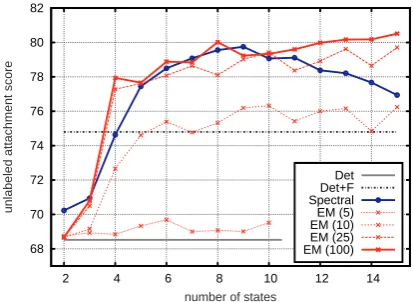
68 70 72 74 76 78 80 82
2 4 6 8 10 12 14
unlabeled attachment score
number of states
[image:7.595.311.518.72.223.2]Det Det+F Spectral EM (5) EM (10) EM (25) EM (100)
Figure 1: Accuracy curve on English development set for fully unlexicalized models.
created a diagonal matrix Oh,da ∈ Rn×n,
whereOah,d(i, i)is the probability of
gener-ating symbolafromhandd(estimated from training); (4) we setAb
h,d
a =T Oh,da .
We trained SHAG models using the standard WSJ sections of the English Penn Treebank (Mar-cus et al., 1994). Figure 1 shows the Unlabeled Attachment Score (UAS) curve on the develop-ment set, in terms of the number of hidden states for the spectral and EM models. We can see that DET+F largely outperforms DET7, while the hidden-state models obtain much larger improve-ments. For the EM model, we show the accuracy curve after 5, 10, 25 and 100 iterations.8
In terms of peak accuracies, EM gives a slightly better result than the spectral method (80.51% for EM with 15 states versus 79.75% for the spectral method with 9 states). However, the spectral al-gorithm is much faster to train. With our Matlab implementation, it took about 30 seconds, while
each iterationof EM took from 2 to 3 minutes, depending on the number of states. To give a con-crete example, to reach an accuracy close to 80%, there is a factor of 150 between the training times of the spectral method and EM (where we com-pare the peak performance of the spectral method versus EM at 25 iterations with 13 states).
7
For parsing with deterministic SHAG we employ MBR inference, even though Viterbi inference can be performed exactly. In experiments on development data DETimproved from 62.65% using Viterbi to 68.52% using MBR, and DET+F improved from 72.72% to 74.80%.
8We ran EM 10 times under different initial conditions
DET DET+F SPECTRAL EM
[image:8.595.312.518.71.223.2]WSJ 69.45% 75.91% 80.44% 81.68%
Table 1: Unlabeled Attachment Score of fully unlexi-calized models on the WSJ test set.
Table 1 shows results on WSJ test data, se-lecting the models that obtain peak performances in development. We observe the same behavior: hidden-states largely improve over deterministic baselines, and EM obtains a slight improvement over the spectral algorithm. Comparing to previ-ous work on parsing WSJ PoS sequences, Eisner and Smith (2010) obtained an accuracy of 75.6% using a deterministic SHAG that uses informa-tion about dependency lengths. However, they used Viterbi inference, which we found to per-form worse than MBR inference (see footnote 7).
5.2 Experiments with Lexicalized Grammars
We now turn to combining lexicalized determinis-tic grammars with the unlexicalized grammars ob-tained in the previous experiment using the spec-tral algorithm. The goal behind this experiment is to show that the information captured in hidden states is complimentary to head-modifier lexical preferences.
In this caseX consists of lexical items, and we assume access to the PoS tag of each lexical item. We will denote astaandwathe PoS tag and word
of a symbol a ∈ X¯. We will estimate condi-tional distributions P(a | h, d, σ), wherea ∈ X
is a modifier, h ∈ X¯ is a head, dis a direction, andσ is a deterministic state. Following Collins (1999), we use three configurations of determin-istic states:
• LEX: a single state.
• LEX+F: two distinct states for first modifier and rest of modifiers.
• LEX+FCP: four distinct states, encoding: first modifier, previous modifier was a coor-dination, previous modifier was punctuation, and previous modifier was some other word.
To estimatePwe use a back-off strategy:
P(a|h, d, σ) =PA(ta|h, d, σ)PB(wa|ta, h, d, δ)
To estimate PA we use two back-off levels,
the fine level conditions on {wh, d, σ} and the
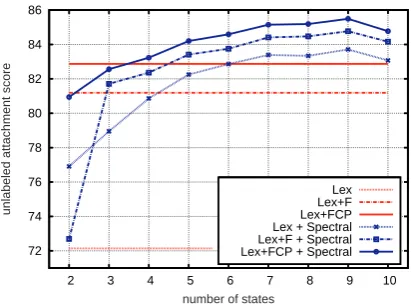
72 74 76 78 80 82 84 86
2 3 4 5 6 7 8 9 10
unlabeled attachment score
number of states
Lex Lex+F Lex+FCP Lex + Spectral Lex+F + Spectral Lex+FCP + Spectral
Figure 2: Accuracy curve on English development set for lexicalized models.
coarse level conditions on{th, d, σ}. ForPB we
use three levels, which from fine to coarse are
{ta, wh, d, σ},{ta, th, d, σ}and{ta}. We follow
Collins (1999) to estimatePAandPBfrom a
tree-bank using a back-off strategy.
We use a simple approach to combine lexical models with the unlexical hidden-state models we obtained in the previous experiment. Namely, we use a log-linear model that computes scores for head-modifier sequences as
s(hh, d, x1:Ti) = logPsp(x1:T|h, d) (21)
+ logPdet(x1:T|h, d) ,
wherePsp andPdetare respectively spectral and deterministic probabilistic models. We tested combinations of each deterministic model with the spectral unlexicalized model using different number of states. Figure 2 shows the accuracies of single deterministic models, together with combi-nations using different number of states. In all cases, the combinations largely improve over the purely deterministic lexical counterparts, suggest-ing that the information encoded in hidden states is complementary to lexical preferences.
5.3 Results Analysis
We conclude the experiments by analyzing the state space learned by the spectral algorithm. Consider the space Rn where the forward-state
cc
jj dt nnp prp$ vbg jjs
rb vbn pos jj in dt cd
1 5
7 I
2
0
3
cc nns
cd
,
$ nnp
cd nns
STOP
,
prp$ rb pos jj dt nnp
9
$ nn jjr nnp
STOP STOP
cc
nn STOP
cc nn
,
[image:9.595.93.268.68.317.2]prp$ nn pos
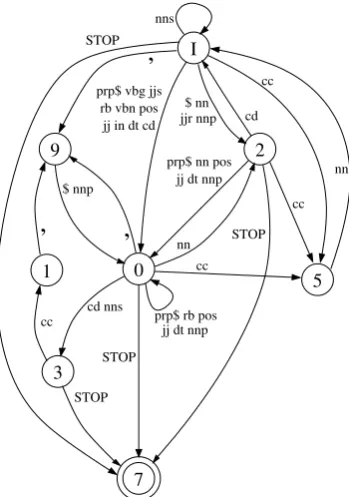
Figure 3: DFA approximation for the generation of NN left modifier sequences.
To build a DFA, we computed the forward vec-tors corresponding to frequent prefixes of modi-fier sequences of the development set. Then, we clustered these vectors using a Group Average Agglomerative algorithm using the cosine larity measure (Manning et al., 2008). This simi-larity measure is appropriate because it compares the angle between vectors, and is not affected by their magnitude (the magnitude of forward vec-tors decreases with the number of modifiers gen-erated). Each clusteridefines a state in the DFA, and we say that a sequencex1:tis in stateiif its
corresponding forward vector at timetis in clus-teri. Then, transitions in the DFA are defined us-ing a procedure that looks at how sequences tra-verse the states. If a sequencex1:tis at stateiat
timet−1, and goes to statej at timet, then we define a transition from stateito statej with la-belxt. This procedure may require merging states
to give a consistent DFA, because different se-quences may define different transitions for the same states and modifiers. After doing a merge, new merges may be required, so the procedure must be repeated until a DFA is obtained.
For this analysis, we took the spectral model with 9 states, and built DFA from the non-deterministic automata corresponding to heads and directions where we saw largest
improve-ments in accuracy with respect to the baselines. A DFA for the automaton(NN,LEFT)is shown in Figure 3. The vectors were originally divided in ten clusters, but the DFA construction required two state mergings, leading to a eight state au-tomaton. The state named I is the initial state. Clearly, we can see that there are special states for punctuation (state 9) and coordination (states 1 and 5). States 0 and 2 are harder to interpret. To understand them better, we computed an esti-mation of the probabilities of the transitions, by counting the number of times each of them is used. We found that our estimation of generating
STOPfrom state 0 is 0.67, and from state 2 it is 0.15. Interestingly, state 2 can transition to state 0 generatingprp$,POS orDT, that are usual end-ings of modifier sequences for nouns (recall that modifiers are generated head-outwards, so for a left automaton the final modifier is the left-most modifier in the sentence).
6 Conclusion
Our main contribution is a basic tool for inducing sequential hidden structure in dependency gram-mars. Most of the recent work in dependency parsing has explored explicit feature engineering. In part, this may be attributed to the high cost of using tools such as EM to induce representations. Our experiments have shown that adding hidden-structure improves parsing accuracy, and that our spectral algorithm is highly scalable.
Our methods may be used to enrich the rep-resentational power of more sophisticated depen-dency models. For example, future work should consider enhancing lexicalized dependency gram-mars with hidden states that summarize lexical dependencies. Another line for future research should extend the learning algorithm to be able to capture vertical hidden relations in the depen-dency tree, in addition to sequential relations.
References
Raphael Bailly. 2011. Quadratic weighted automata: Spectral algorithm and likelihood maximization. JMLR Workshop and Conference Proceedings – ACML.
James K. Baker. 1979. Trainable grammars for speech recognition. In D. H. Klatt and J. J. Wolf, editors, Speech Communication Papers for the 97th Meeting of the Acoustical Society of America, pages 547– 550.
Borja Balle, Ariadna Quattoni, and Xavier Carreras. 2012. Local loss optimization in operator models: A new insight into spectral learning. Technical Re-port LSI-12-5-R, Departament de Llenguatges i Sis-temes Inform`atics (LSI), Universitat Polit`ecnica de Catalunya (UPC).
Xavier Carreras. 2007. Experiments with a higher-order projective dependency parser. In Proceed-ings of the CoNLL Shared Task Session of EMNLP-CoNLL 2007, pages 957–961, Prague, Czech Re-public, June. Association for Computational Lin-guistics.
Stephen Clark and James R. Curran. 2004. Parsing the wsj using ccg and log-linear models. In Pro-ceedings of the 42nd Meeting of the Association for Computational Linguistics (ACL’04), Main Volume, pages 103–110, Barcelona, Spain, July.
Michael Collins. 1999. Head-Driven Statistical Mod-els for Natural Language Parsing. Ph.D. thesis, University of Pennsylvania.
Arthur P. Dempster, Nan M. Laird, and Donald B. Ru-bin. 1977. Maximum likelihood from incomplete data via the em algorithm.Journal of the royal sta-tistical society, Series B, 39(1):1–38.
Jason Eisner and Giorgio Satta. 1999. Efficient pars-ing for bilexical context-free grammars and head-automaton grammars. InProceedings of the 37th Annual Meeting of the Association for Computa-tional Linguistics (ACL), pages 457–464, Univer-sity of Maryland, June.
Jason Eisner and Noah A. Smith. 2010. Favor short dependencies: Parsing with soft and hard con-straints on dependency length. In Harry Bunt, Paola Merlo, and Joakim Nivre, editors,Trends in Parsing Technology: Dependency Parsing, Domain Adapta-tion, and Deep Parsing, chapter 8, pages 121–150. Springer.
Jason Eisner. 2000. Bilexical grammars and their cubic-time parsing algorithms. In Harry Bunt and Anton Nijholt, editors, Advances in Probabilis-tic and Other Parsing Technologies, pages 29–62. Kluwer Academic Publishers, October.
Joshua Goodman. 1996. Parsing algorithms and met-rics. InProceedings of the 34th Annual Meeting of the Association for Computational Linguistics, pages 177–183, Santa Cruz, California, USA, June. Association for Computational Linguistics.
Daniel Hsu, Sham M. Kakade, and Tong Zhang. 2009. A spectral algorithm for learning hidden markov models. InCOLT 2009 - The 22nd Conference on Learning Theory.
Gabriel Infante-Lopez and Maarten de Rijke. 2004. Alternative approaches for generating bodies of grammar rules. InProceedings of the 42nd Meet-ing of the Association for Computational Lin-guistics (ACL’04), Main Volume, pages 454–461, Barcelona, Spain, July.
Terry Koo and Michael Collins. 2010. Efficient third-order dependency parsers. In Proceedings of the 48th Annual Meeting of the Association for Compu-tational Linguistics, pages 1–11, Uppsala, Sweden, July. Association for Computational Linguistics. Christopher D. Manning, Prabhakar Raghavan, and
Hinrich Sch¨utze. 2008. Introduction to Information Retrieval. Cambridge University Press, Cambridge, first edition, July.
Mitchell P. Marcus, Beatrice Santorini, and Mary A. Marcinkiewicz. 1994. Building a large annotated corpus of english: The penn treebank. Computa-tional Linguistics, 19.
Andre Martins, Noah Smith, and Eric Xing. 2009. Concise integer linear programming formulations for dependency parsing. InProceedings of the Joint Conference of the 47th Annual Meeting of the ACL and the 4th International Joint Conference on Natu-ral Language Processing of the AFNLP, pages 342– 350, Suntec, Singapore, August. Association for Computational Linguistics.
Takuya Matsuzaki, Yusuke Miyao, and Jun’ichi Tsujii. 2005. Probabilistic CFG with latent annotations. In Proceedings of the 43rd Annual Meeting of the As-sociation for Computational Linguistics (ACL’05), pages 75–82, Ann Arbor, Michigan, June. Associa-tion for ComputaAssocia-tional Linguistics.
Ryan McDonald and Fernando Pereira. 2006. Online learning of approximate dependency parsing algo-rithms. In Proceedings of the 11th Conference of the European Chapter of the Association for Com-putational Linguistics, pages 81–88.
Ryan McDonald, Fernando Pereira, Kiril Ribarov, and Jan Hajic. 2005. Non-projective dependency pars-ing uspars-ing spannpars-ing tree algorithms. In Proceed-ings of Human Language Technology Conference and Conference on Empirical Methods in Natural Language Processing, pages 523–530, Vancouver, British Columbia, Canada, October. Association for Computational Linguistics.
Gabriele Antonio Musillo and Paola Merlo. 2008. Un-lexicalised hidden variable models of split depen-dency grammars. InProceedings of ACL-08: HLT, Short Papers, pages 213–216, Columbus, Ohio, June. Association for Computational Linguistics. James D. Park and Adnan Darwiche. 2004.
explanations. Journal of Artificial Intelligence Re-search, 21:101–133.
Mark Paskin. 2001. Cubic-time parsing and learning algorithms for grammatical bigram models. Techni-cal Report UCB/CSD-01-1148, University of Cali-fornia, Berkeley.
Slav Petrov and Dan Klein. 2007. Improved infer-ence for unlexicalized parsing. InHuman Language Technologies 2007: The Conference of the North American Chapter of the Association for Computa-tional Linguistics; Proceedings of the Main Confer-ence, pages 404–411, Rochester, New York, April. Association for Computational Linguistics. Slav Petrov, Leon Barrett, Romain Thibaux, and Dan
Klein. 2006. Learning accurate, compact, and in-terpretable tree annotation. InProceedings of the 21st International Conference on Computational Linguistics and 44th Annual Meeting of the Asso-ciation for Computational Linguistics, pages 433– 440, Sydney, Australia, July. Association for Com-putational Linguistics.
Ivan Titov and James Henderson. 2006. Loss mini-mization in parse reranking. InProceedings of the 2006 Conference on Empirical Methods in Natu-ral Language Processing, pages 560–567, Sydney, Australia, July. Association for Computational Lin-guistics.