Proceedings of the 2019 Conference on Empirical Methods in Natural Language Processing 1500
Towards Making a Dependency Parser See
Michalina Strzyz David Vilares Carlos G´omez-Rodr´ıguez
Universidade da Coru˜na, CITIC
FASTPARSE Lab, LyS Research Group, Departamento de Computaci´on Campus de Elvi˜na, s/n, 15071 A Coru˜na, Spain
{michalina.strzyz,david.vilares,carlos.gomez}@udc.es
Abstract
We explore whether it is possible to lever-age eye-tracking data in an RNN dependency parser (for English) when such information is only available during training – i.e. no aggre-gated or token-level gaze features are used at inference time. To do so, we train a multi-task learning model that parses sentences as sequence labeling and leverages gaze features as auxiliary tasks. Our method also learns to train from disjoint datasets, i.e. it can be used to test whether already collected gaze fea-tures are useful to improve the performance on newnon-gazed annotated treebanks. Ac-curacy gains are modest but positive, showing the feasibility of the approach. It can serve as a first step towards architectures that can bet-ter leverage eye-tracking data or other comple-mentary information available only for train-ing sentences, possibly leadtrain-ing to improve-ments in syntactic parsing.
1 Introduction
Eye trackers and gaze features collected from them have been recently applied to natural lan-guage processing (NLP) tasks, such as
part-of-speech tagging (Duffy et al., 1988; Nilsson and Nivre,2009;Barrett and Søgaard,2015a), named-entity recognition (Tokunaga et al.,2017) or read-ability (Gonz´alez-Gardu˜no and Søgaard, 2018). Eye-movement data has been also used for pars-ing. For example, Barrett and Søgaard (2015b) rank discriminative features to predict syntactic categories (e.g. subject vs. object) and use them to improve a transition-based parser, trained on a structured perceptron with discrete features (Collins,2002;Zhang and Nivre,2011). However, the experiments were carried out on a parallel toy treebank and the performance was relatively low.
Lopopolo et al.(2019) follow the inverse path, and use dependency parsing features to predict
eye-regression during training, i.e. cases where the reader goes back to a word of the sentence.
In this context, how to retrieve and leverage eye-tracking data has become an active area of re-search in different NLP fields. Previous studies (Barrett and Søgaard,2015b;Barrett et al.,2016) suggest that real-time eye-tracking data can be col-lected at inference time, so that token-level gaze features are used during training but also at test time. However, even if in the near future every user has an eye tracker on top of their screen – a scenario which is far from guaranteed, and raises privacy concerns (Liebling and Preibusch,2014) – many runningNLP applications that process data from various Internet sources will not expect to have any human being reading massive amounts of data. Other studies (Barrett and Søgaard, 2015a;
Hollenstein and Zhang,2019) instead derive gaze features from the training set: in particular, they collecttype-level gaze features from the vocabu-lary in the training set; which are then aggregated to create a lookup table and used as a sort of pre-computed gaze input when a given word in the test set matches an entry, otherwise, a token has an un-known gaze feature value. In this manner, the in-fluence of gaze features on unseen data depends on the vocabulary encountered during training. For instance,Hollenstein et al.(2019) report that un-known tokens make up 41.09% on new data for their research on named-entity recognition (NER)
with eye-tracking data. To our knowledge, this kind of approaches have not been applied to syn-tactic parsing.
More in the line of our work, Barrett et al.
anal-ysis a the sentence level). Moreover, it has been shown that both constituency (Vilares et al.,2019) and dependency (Strzyz et al.,2019a) parsing can benefit from multi-task learning. Also related to our work with human data,Gonz´alez-Gardu˜no and Søgaard(2017) show that gaze features learned in a multi-task (MTL) setup can lead to improvements
in readability assessment.
Contribution In this work we leverage gaze
learning for dependency parsing assuming that gaze features are likely to be only available dur-ing traindur-ing – and no gaze features are given, in any form, at inference time. Our ap-proach learns eye-movement features as auxil-iary tasks in a multitask framework where both parsing and gaze prediction are addressed as sequence labeling. To test its effect on syn-tactic analysis, we experiment on parallel and disjoint datasets with dependency parsing and gaze annotations. The source code can be
found at https://github.com/mstrise/
dep2label-eye-tracking-data.
2 Methods and materials
This section describes in detail the data and the models used in our work.
2.1 Data
We will use both parallel data (containing de-pendency and gaze annotations) anddisjointdata (where one dataset contains only parsing annota-tions and the other one just gaze data).
Parallel data The Dundee corpus (Kennedy et al.,2003) contains recordings of measurements for eye movements of ten English-speaking partic-ipants during reading 20newspaper articles from
The Independentmaking in total2368unique sen-tences. This dataset was used as the starting point to create a corpus that fits the purpose of depen-dency parsing, the Dundee treebank (Barrett et al.,
2015). This treebank augments sentences from the Dundee corpus with syntactic annotations accord-ing to the Universal Dependencies (UD) guide-lines (Nivre et al., 2016). We will use this tree-bank as the parallel data for our models. We split the data(80−10−10)into training, development and test. Sentences were randomly shuffled with assurance that the same sentence coming from the
10 participants is included only in one of the sets.1
Disjointdata Most of dependency treebanks do not contain gaze annotations. With this setup, in addition to the assumption that eye-movement data is available during training, we aim to show whether we improve the performance of a de-pendency parser with gaze-annotated data com-ing from a different corpus. We will use two datasets: one with dependency annotations and an-other one labeled with eye-movement data. For the former we use the Penn Treebank (PTB) ( Mar-cus et al., 1993), which contains sentences from
The Wall Street Journal annotated with phrase-structure trees. We convert it into Stanford Depen-dencies (de Marneffe et al., 2006) and apply the standard splits for dependency parsing: sections 2−21for training,22for development set and23 for testing, whereas PoS tags are predicted by the Stanford tagger (Toutanova et al.,2003). For gaze-annotated data, we will employ the eye-movement annotations from the Dundee Treebank but using a different split(90−10−0).2
2.2 Gaze-averaged sequence labeling parsing
During training we opt to emulate recent cognitive studies that suggest that human sentence under-standing recruits the same brain regions for lex-ical and syntactic processing, consistent with a sequence-tagging-like process (Fedorenko et al.,
2018), which is also a natural and intuitive way to learn to predict eye-movement information. To do so, we rely on standard bidirectional long short-term memory networks (BILSTMs) (Hochreiter and Schmidhuber, 1997; Schuster and Paliwal,
1997).
We denote LSTMθ(w) as the abstraction of a
long short-term memory network, that processes an input sentence w=[w1, ..., wn] to generate an
output of hidden representations h=[h1, ...,hn].
Thus, a BILSTM can be seen as BILSTMθ(w)
= LSTMlθ(wi:m)·LSTMrθ(wm:n) =hl·hr.3 In
this work we will stack two layers of BILSTMs before decoding the output. BILSTMs are com-monly used for sequence labeling tasks (Reimers
1
In addition we removed40sentences (4unique sentences read by the10participants) that contained cases of incoher-ence in their syntactic dependency annotation resulting in
23640sentences in total (2364unique sentences).
2
During testing we will be just testing the performance on the PTB test set.
3LSTMl processes the sentences from left-to-right and
and Gurevych,2017), where a word-level predic-tion can be generated for each token, by adding a feed forward network to predict an output label at each time step, using a softmax(W×hi +b).
In this paper we propose to learn to leverage eye-movement data as a sequence labeling task. To jointly learn dependency parsing in a common framework, we also cast parsing as sequence la-beling and learn both tasks in a multitask learning (MTL) setup (Caruana,1997). The main compo-nents are described in the following paragraphs.
Dependency parsing as sequence labeling We
proceed similarly toStrzyz et al. (2019b). Given a linearization functionFw :T|w|→Lw, for each
wordwi,Strzyz et al.’s approach generates a label li ∈ (oi, pi, di) that encodes the binary
relation-ship betweenwi and its head, where: di encodes
the dependency relation, and the sub-pair (oi, pi)
the index of such head term, with oi ∈ N and pi ∈ P (a part-of-speech set). If oi is positive,
then the head ofwi is theoi-th token to the right
that has the part-of-speech tagpi. Ifoiis negative,
then the head ofwi is the|oi|-th token to the left
whose PoS tag ispi.
This parser obtains similar results to compet-itive transition- and graph-based parsers such as BIST (Kiperwasser and Goldberg, 2016) and can be taken as a strong baseline to test the effect of eye-movement data for dependency parsing.
Gaze information In previous studies the
choice of number of gaze features used in the ex-periments has varied, seemingly, depending on the
NLP task of interest. For instance, Barrett et al.
(2016) distinguish31features (where22are gaze features) for part-of-speech tagging while Hollen-stein and Zhang(2019) use17features in theNER
task. In another piece of work,5gaze features are used for relation classification and sentiment anal-ysis (Hollenstein et al.,2019). Finally,Singh et al.
(2016) use gaze features in order to automatically predict reading times for a new text. However, the model predicts only4features that are then used as features for readability assessment.
We have chosen12gaze features and based on the previous work (Barrett et al., 2016; Hollen-stein and Zhang,2019) we have divided them into 4 groups. In particular, we explore the informa-tiveness of thebasic gaze features: total fixation duration on a wordw(total fix dur), mean fixation duration on w (mean fix dur,
num-ber fixations on w (n fix) and fixation proba-bility onw(fix prob). Asearly gaze features
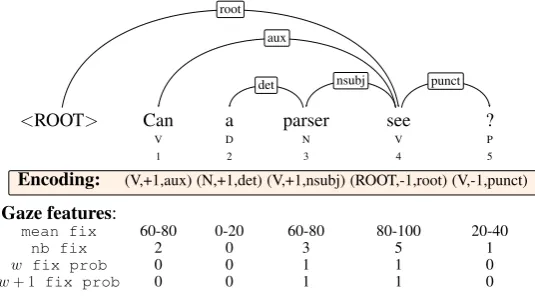
we consider: first fixation duration onw(first fix dur) and first pass duration (first pass dur), while aslate gaze features: number of re-fixations on w(nre-fix) and reread probabil-ity ofw(reread prob). We also take account of the neighboring words and treat them as con-text features: fixation probability on the previous and next word (w −1 and w + 1 fix prob) as well as fixation duration on the previous and next word (w−1andw+ 1fix dur). Figure1
depicts an exemplary (linearized) dependency tree with some of the gaze features used in the experi-ments. Following previous work (Hollenstein and Zhang,2019), we discretize gaze features.4
Multitask learning We previously argued that gaze-annotated data is unlikely to be available at inference time. However, previous related work for dependency parsing usually assumes that such information will be collected during testing and fed as input features to the model (Barrett and Søgaard, 2015b; Hollenstein and Zhang, 2019). What we propose instead is to leverage such in-formation during training. To do so, we rely on MTL and auxiliary tasks. Our work focuses on ex-ploiting the utility of gaze information using just a standard BILSTM, directly building on top of previous work of dependency parsing as sequence labeling (Strzyz et al.,2019b), and ignoring extra tools such as attention. In this line, a future pos-sible solution could be to apply the approach by
Barrett et al. (2018) to structured prediction and word-level classification. In their work they used human data as an inductive bias to update the at-tention weights of the network.
In our setup, dependency parsing as sequence labeling is addressed through two main tasks: one to predict the index of the head term, i.e. the sub-index (oi, pi), and another one to predict the
de-pendency relation (di). Eye-movement discrete
labels are learned as auxiliary tasks. We use a hard-sharing architecture where the BILSTMs are fully shared and followed by an independent feed-forward layer (followed by a softmax) to predict the corresponding label for each of the tasks. The main idea is that the eye-movement signal(s) will
4Total fix dur
<ROOT> Can a parser see ?
V D N V P
1 2 3 4 5
Encoding: (V,+1,aux) (N,+1,det) (V,+1,nsubj) (ROOT,-1,root) (V,-1,punct)
Gaze features:
mean fix 60-80 0-20 60-80 80-100 20-40
nb fix 2 0 3 5 1
w fix prob 0 0 1 1 0
w+ 1 fix prob 0 0 1 1 0
aux
det nsubj root
[image:4.595.166.434.74.224.2]punct
Figure 1: A dependency tree with its encoding and some of the corresponding gaze features.
be back-propagated to update the weights of the shared BILSTM, building a model that latently encodes such information and helps dependency parsing.
For the parallel data setup, the model is trained in a standard way, and the cross-entropy loss is computed asL=L(o,p)+Ld+P
aβa∗La. For the
disjoint setup, during the training process for each batch we randomly pick all its samples from one of the treebanks (samples that have not been yet taken, either from the dependency parsing corpus or the gaze-annotated one) and run the network to make the predictions. Then, we back-propagate the loss for the outputs associated to that treebank and ignore the rest, i.e. L = τ(L(o,p) +Ld) + (1−τ)P
βauxLaux, whereτ is a binary flag set
to 1 when the batch contains dependency parsing samples, and to 0 otherwise.
For both setups we will test: (i) predicting one
of the gaze features as an auxiliary task (ii) pre-dicting multiple gaze labels as multiple auxiliary tasks.
3 Experiments
We conduct an explanatory study for the general viability of our method. We will compare results on the development and test set to verify whether the improvements are consistent. In particular, we carry out two experiments:
• Experiment 1 (on parallel data): Tests how eye-tracking data influences the performance when both gaze features and syntactic depen-dencies are extracted from the same data (in this case the Dundee treebank). The baseline is a model where no gaze features were used.
• Experiment 2 (on disjoint data):
As previously said, we wish to test whether we can leverage existing gaze-annotated datasets to improve the performance in other non-gazed annotated dependency treebanks. Also, note that the Dundee treebank is rela-tively small (∼2k sentences) and results from the previous Experiment can be not as repre-sentative as those obtained in larger corpora. In this setup, we train models using gaze in-formation from the Dundee treebank and de-pendency relations from PTB, evaluating on the latter.5 The baseline is obtained by train-ing a model only on the dependency relations retrieved from PTB.
Metrics We evaluate the parsers with
Unla-beled and LaUnla-beled Attachment Score (UAS and LAS) excluding punctuation (following the stan-dard methodology for experiments on the PTB).
3.1 Results
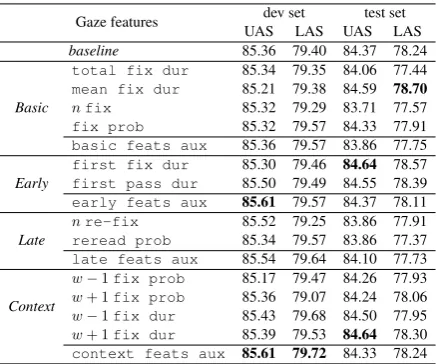
Table1shows the results for Experiment 1 (on the Dundee treebank, i.e. on parallel data), suggest-ing that the degree of informativeness of the gaze features that a parser can leverage differ among each other. In particular, we observe that the im-provements across different models and the devel-opment and test sets are unstable. The evaluation on the dev set shows that gaze features fromearly
andcontextgroup used as multiple auxiliary tasks (early andcontext feats aux) modestly improve the model in comparison with the base-line. With respect to the results on the test set, the most informative features are: mean fix dur,
5Note that the set of fine-tuned embeddings can be slightly
Gaze features dev set test set UAS LAS UAS LAS baseline 85.36 79.40 84.37 78.24
Basic
total fix dur 85.34 79.35 84.06 77.44 mean fix dur 85.21 79.38 84.59 78.70
nfix 85.32 79.29 83.71 77.57 fix prob 85.32 79.57 84.33 77.91 basic feats aux 85.36 79.57 83.86 77.75
Early
first fix dur 85.30 79.46 84.64 78.57 first pass dur 85.50 79.49 84.55 78.39 early feats aux 85.61 79.57 84.37 78.11
Late
nre-fix 85.52 79.25 83.86 77.91 reread prob 85.34 79.57 83.86 77.37 late feats aux 85.54 79.64 84.10 77.73
Context
[image:5.595.72.292.61.243.2]w−1fix prob 85.17 79.47 84.26 77.93 w+ 1fix prob 85.36 79.07 84.24 78.06 w−1fix dur 85.43 79.68 84.50 77.95 w+ 1fix dur 85.39 79.53 84.64 78.30 context feats aux 85.61 79.72 84.33 78.24
Table 1: Impact of various gaze features as auxiliary task(s) on the score (UAS/LAS) of dependency parsing as the main task evaluated on Dundee treebank (parallel setup).
Gaze features dev set test set UAS LAS UAS LAS baseline 93.98 91.67 93.86 91.80
Basic
total fix dur 93.94 91.60 93.99 91.92 mean fix dur 94.12 91.84 93.95 91.82 nfix 93.97 91.70 93.91 91.87 fix prob 93.98 91.71 93.99 91.93 basic feats aux 94.00 91.69 93.84 91.81
Early first fix dur 94.07 91.81 93.87 91.80 first pass dur 93.93 91.58 93.79 91.70 early feats aux 94.04 91.78 93.96 91.88
Late nre-fix 94.01 91.69 93.87 91.79 reread prob 94.03 91.74 93.98 91.89 late feats aux 93.98 91.58 93.92 91.90
Context
w−1fix prob 94.02 91.65 93.95 91.93 w+ 1fix prob 93.88 91.61 93.89 91.82 w−1fix dur 94.06 91.65 93.86 91.83 w+ 1fix dur 93.91 91.69 93.89 91.84 context feats aux 93.93 91.63 94.01 91.98
Table 2: Results for dependency parsing evaluated on PTB treebank with gaze features as auxiliary task(s) learned from the disjoint dataset: Dundee treebank.
which improves the LAS by +0.46, andfirst fix durby+0.33.
Table2shows the results for Experiment 2 (us-ing Dundee gaze data and PTB dependencies). Under this setup, the gains decrease in compar-ison with the results on the parallel setup. This could be partially caused by not using parallel data. The improvements seem to be more consis-tent between the development and test sets. This could be related to the fact that we use a larger (more representative) treebank. When looking at the dev set scores, the most discriminative gaze feature ismean fix durthat increases LAS by +0.17 andfirst fix durby+0.14. On the other hand, evaluation on the test set shows that
the most informative gaze features are from the
context group learned as multiple auxiliary tasks (context feats aux) and they improve the LAS score by+0.18, followed byfix proband
w−1fix probwith+0.13,total fix dur with+0.12andlate feats auxwith+0.10. Results from both datasets suggest that grouping gaze features and treating them as multiple auxil-iary tasks can improve the model’s learning.
Discussion The experiments show that our
method can give moderate gains for dependency parsing when leveraging gaze information.6 How-ever, the experiments also show that there is room for improvement, especially coming from gen-eralization capabilities across different treebanks. This also opens the question of whether a different architecture could better suit the purpose of lever-aging the gaze information in a consistent way. In this context, a potential line of work could adapt human-attention approaches (Barrett et al.,2018) for structured prediction and word-level classifica-tion, although it would come at a cost of speed for parsing as sequence labeling (Strzyz et al.,2019b).
4 Conclusion
This paper has explored how to leverage human data with a competitive dependency parser dur-ing traindur-ing. This contrasts with most of previ-ous work on parsing and gaze annotations, which worked under the assumption that eye-tracking data would be available at inference time. We ad-dress this problem and propose a method of lever-aging gaze features by using it as an auxiliary task both with and without parallel data. We obtain modest but positive improvements, which opens the question about how to increase the leverage of eye-tracking or other complementary data that is only available during training or comes from a dif-ferent dataset.
Acknowledgements
This work has received funding from the ropean Research Council (ERC), under the Eu-ropean Union’s Horizon 2020 research and in-novation programme (FASTPARSE, grant agree-ment No 714150), from the ANSWER-ASAP project (TIN2017-85160-C2-1-R) from MINECO, and from Xunta de Galicia (ED431B 2017/01).
6Nevertheless, our approach can be employed also to
References
Maria Barrett, ˇZeljko Agi´c, and Anders Søgaard. 2015. The Dundee treebank. In The 14th International Workshop on Treebanks and Linguistic Theories (TLT 14).
Maria Barrett, Joachim Bingel, Nora Hollenstein, Marek Rei, and Anders Søgaard. 2018. Sequence classification with human attention. InProceedings of the 22nd Conference on Computational Natural Language Learning, pages 302–312, Brussels, Bel-gium. Association for Computational Linguistics.
Maria Barrett, Joachim Bingel, Frank Keller, and An-ders Søgaard. 2016. Weakly supervised part-of-speech tagging using eye-tracking data. In Proceed-ings of the 54th Annual Meeting of the Association for Computational Linguistics (Volume 2: Short Pa-pers), pages 579–584, Berlin, Germany. Association for Computational Linguistics.
Maria Barrett and Anders Søgaard. 2015a. Reading behavior predicts syntactic categories. In Proceed-ings of the Nineteenth Conference on Computational Natural Language Learning, pages 345–349, Bei-jing, China. Association for Computational Linguis-tics.
Maria Barrett and Anders Søgaard. 2015b. Using read-ing behavior to predict grammatical functions. In Proceedings of the Sixth Workshop on Cognitive As-pects of Computational Language Learning, pages 1–5, Lisbon, Portugal. Association for Computa-tional Linguistics.
Rich Caruana. 1997. Multitask learning. Mach. Learn., 28(1):41–75.
Michael Collins. 2002. Discriminative training meth-ods for hidden Markov models: Theory and ex-periments with perceptron algorithms. In Proceed-ings of the 2002 Conference on Empirical Methods in Natural Language Processing (EMNLP 2002), pages 1–8. Association for Computational Linguis-tics.
Susan A Duffy, Robin K Morris, and Keith Rayner. 1988. Lexical ambiguity and fixation times in read-ing. Journal of memory and language, 27(4):429– 446.
Evelina Fedorenko, Zachary Mineroff, Matthew Siegelman, and Idan Blank. 2018. Word meanings and sentence structure recruit the same set of fronto-temporal regions during comprehension. bioRxiv, page 477851.
Ana V. Gonz´alez-Gardu˜no and Anders Søgaard. 2018. Learning to predict readability using eye-movement data from natives and learners. In32nd AAAI Con-ference on Artificial Intelligence, AAAI 2018, Pro-ceedings, pages 5118–5124.
Ana Valeria Gonz´alez-Gardu˜no and Anders Søgaard. 2017.Using gaze to predict text readability. In Pro-ceedings of the 12th Workshop on Innovative Use of NLP for Building Educational Applications, pages 438–443, Copenhagen, Denmark. Association for Computational Linguistics.
Sepp Hochreiter and J¨urgen Schmidhuber. 1997. Long short-term memory. Neural Comput., 9(8):1735– 1780.
Nora Hollenstein, Maria Barrett, Marius Troendle, Francesco Bigiolli, Nicolas Langer, and Ce Zhang. 2019.Advancing NLP with cognitive language pro-cessing signals.CoRR, abs/1904.02682.
Nora Hollenstein and Ce Zhang. 2019. Entity recog-nition at first sight: Improving NER with eye move-ment information. InProceedings of the 2019 Con-ference of the North American Chapter of the Asso-ciation for Computational Linguistics: Human Lan-guage Technologies, Volume 1 (Long and Short Pa-pers), pages 1–10, Minneapolis, Minnesota. Associ-ation for ComputAssoci-ational Linguistics.
Alan Kennedy, Robin Hill, and Jo¨el Pynte. 2003. The Dundee corpus. In Proceedings of the 12th Euro-pean conference on eye movement.
Eliyahu Kiperwasser and Yoav Goldberg. 2016. Sim-ple and accurate dependency parsing using bidirec-tional LSTM feature representations. Transactions of the Association for Computational Linguistics, 4:313–327.
Daniel J. Liebling and S¨oren Preibusch. 2014. Privacy considerations for a pervasive eye tracking world. InProceedings of the 2014 ACM International Joint Conference on Pervasive and Ubiquitous Comput-ing: Adjunct Publication, UbiComp ’14 Adjunct, pages 1169–1177, New York, NY, USA. ACM.
Alessandro Lopopolo, Stefan L. Frank, Antal van den Bosch, and Roel Willems. 2019. Dependency pars-ing with your eyes: Dependency structure predicts eye regressions during reading. InProceedings of the Workshop on Cognitive Modeling and Computa-tional Linguistics, pages 77–85, Minneapolis, Min-nesota. Association for Computational Linguistics.
Mitchell P. Marcus, Mary Ann Marcinkiewicz, and Beatrice Santorini. 1993.Building a large annotated corpus of english: The penn treebank.Comput. Lin-guist., 19(2):313–330.
Marie-Catherine de Marneffe, Bill MacCartney, and Christopher D. Manning. 2006. Generating typed dependency parses from phrase structure parses. In Proceedings of the Fifth International Conference on Language Resources and Evaluation (LREC’06), Genoa, Italy. European Language Resources Asso-ciation (ELRA).
reading. InProceedings of the Thirteenth Confer-ence on Computational Natural Language Learning (CoNLL-2009), pages 93–101, Boulder, Colorado. Association for Computational Linguistics.
Joakim Nivre, Marie-Catherine de Marneffe, Filip Gin-ter, Yoav Goldberg, Jan Hajiˇc, Christopher D. Man-ning, Ryan McDonald, Slav Petrov, Sampo Pyysalo, Natalia Silveira, Reut Tsarfaty, and Daniel Zeman. 2016. Universal dependencies v1: A multilingual treebank collection. InProceedings of the Tenth In-ternational Conference on Language Resources and Evaluation (LREC 2016), pages 1659–1666, Por-toroˇz, Slovenia. European Language Resources As-sociation (ELRA).
Nils Reimers and Iryna Gurevych. 2017. Reporting Score Distributions Makes a Difference: Perfor-mance Study of LSTM-networks for Sequence Tag-ging. In Proceedings of the 2017 Conference on Empirical Methods in Natural Language Processing (EMNLP), pages 338–348, Copenhagen, Denmark.
M. Schuster and K.K. Paliwal. 1997. Bidirectional recurrent neural networks. Trans. Sig. Proc., 45(11):2673–2681.
Abhinav Deep Singh, Poojan Mehta, Samar Husain, and Rajkumar Rajakrishnan. 2016. Quantifying sentence complexity based on eye-tracking mea-sures. In Proceedings of the Workshop on Com-putational Linguistics for Linguistic Complexity (CL4LC), pages 202–212, Osaka, Japan. The COL-ING 2016 Organizing Committee.
Michalina Strzyz, David Vilares, and Carlos G´omez-Rodr´ıguez. 2019a. Sequence labeling parsing by learning across representations. InProceedings of the 57th Annual Meeting of the Association for Com-putational Linguistics, pages 5350–5357, Florence, Italy. Association for Computational Linguistics.
Michalina Strzyz, David Vilares, and Carlos G´omez-Rodr´ıguez. 2019b. Viable dependency parsing as sequence labeling. InProceedings of the 2019 Con-ference of the North American Chapter of the Asso-ciation for Computational Linguistics: Human Lan-guage Technologies, Volume 1 (Long and Short Pa-pers), pages 717–723, Minneapolis, Minnesota. As-sociation for Computational Linguistics.
Takenobu Tokunaga, Hitoshi Nishikawa, and Tomoya Iwakura. 2017. An eye-tracking study of named en-tity annotation. InProceedings of the International Conference Recent Advances in Natural Language Processing, RANLP 2017, pages 758–764, Varna, Bulgaria. INCOMA Ltd.
Kristina Toutanova, Dan Klein, Christopher D. Man-ning, and Yoram Singer. 2003. Feature-rich part-of-speech tagging with a cyclic dependency network. InProceedings of the 2003 Human Language Tech-nology Conference of the North American Chapter of the Association for Computational Linguistics, pages 252–259.
David Vilares, Mostafa Abdou, and Anders Søgaard. 2019. Better, faster, stronger sequence tagging con-stituent parsers. InProceedings of the 2019 Confer-ence of the North American Chapter of the Associ-ation for ComputAssoci-ational Linguistics: Human Lan-guage Technologies, Volume 1 (Long and Short Pa-pers), pages 3372–3383, Minneapolis, Minnesota. Association for Computational Linguistics.