Proceedings of the 2019 Conference on Empirical Methods in Natural Language Processing
2796
Interactive Language Learning by Question Answering
Xingdi Yuan♥∗ Marc-Alexandre Cˆot´e♥∗ Jie Fu♣♠ Zhouhan Lin♦♠ Christopher Pal♣♠ Yoshua Bengio♦♠ Adam Trischler♥
♥Microsoft Research, Montr´eal ♣Polytechnique Montr´eal ♦Universit´e de Montr´eal ♠Mila
[email protected] [email protected]
Abstract
Humans observe and interact with the world to acquire knowledge. However, most existing machine reading comprehension (MRC) tasks miss the interactive, information-seeking com-ponent of comprehension. Such tasks present models with static documents that contain all necessary information, usually concentrated in a single short substring. Thus, models can achieve strong performance through simple word- and phrase-based pattern matching. We address this problem by formulating a novel text-based question answering task: Ques-tion Answering with Interactive Text (QAit)1.
In QAit, an agent must interact with a par-tially observable text-based environment to gather information required to answer ques-tions. QAit poses questions about the exis-tence, location, and attributes of objects found in the environment. The data is built using a text-based game generator that defines the un-derlying dynamics of interaction with the en-vironment. We propose and evaluate a set of baseline models for the QAit task that includes deep reinforcement learning agents. Experi-ments show that the task presents a major chal-lenge for machine reading systems, while hu-mans solve it with relative ease.
1 Introduction
The research community has defined the task of machine reading comprehension (MRC) to teach machines to read and understand text. In most MRC tasks, given a knowledge source (usually a text document) and a question on its content, a model is required to answer the question either by pointing to words in the source or by generating a text string. Recent years have seen a flourishing of MRC works, including the release of numerous
∗ Equal contribution.
1The dataset and implementation of our baseline
agents are publicly available athttps://github.com/ xingdi-eric-yuan/qait_public.
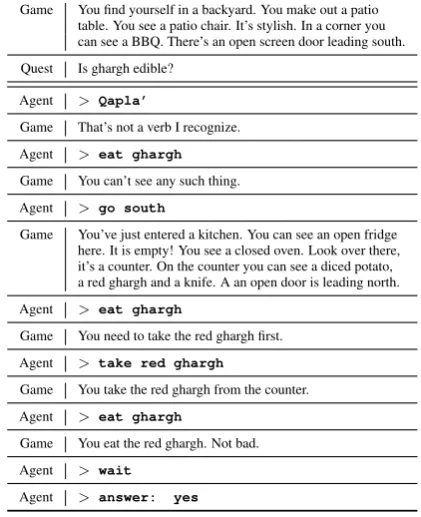
[image:1.595.310.521.225.484.2]Game You find yourself in a backyard. You make out a patio table. You see a patio chair. It’s stylish. In a corner you can see a BBQ. There’s an open screen door leading south.
Quest Is ghargh edible?
Agent > Qapla’
Game That’s not a verb I recognize.
Agent > eat ghargh
Game You can’t see any such thing.
Agent > go south
Game You’ve just entered a kitchen. You can see an open fridge here. It is empty! You see a closed oven. Look over there, it’s a counter. On the counter you can see a diced potato, a red ghargh and a knife. A an open door is leading north.
Agent > eat ghargh
Game You need to take the red ghargh first.
Agent > take red ghargh
Game You take the red ghargh from the counter.
Agent > eat ghargh
Game You eat the red ghargh. Not bad.
Agent > wait
Agent > answer: yes
Table 1: Example of a player interacting with an envi-ronment to gather knowledge and answer a question.
datasets (Rajpurkar et al., 2016; Trischler et al.,
2016; Nguyen et al., 2016; Reddy et al., 2018;
Yang et al.,2018) and a host of neural models that address them (Wang and Jiang,2016;Wang et al.,
2017;Chen et al.,2017).
(2016) show that a simple Information Retrieval method can achieve high sentence-level accuracy on SQuAD.
Second, the information that supports predict-ing the answer from the source is often fully
observed: the source is static, sufficient, and
presented in its entirety. This does not match the information-seeking procedure that arises in answering many natural questions (Kwiatkowski et al.,2019), nor can it model the way humans ob-serve and interact with the world to acquire knowl-edge.
Third, most existing MRC studies focus on
declarativeknowledge — the knowledge of facts
or events that can be stated explicitly (i.e., clared) in short text snippets. Given a static de-scription of an entity, declarative knowledge can often be extracted straightforwardly through pat-tern matching. For example, given the EMNLP website text, the conference deadline can be extracted by matching against a date mention. This focus overlooks another essential category of knowledge — procedural knowledge. Procedu-ral knowledge entails executable sequences of ac-tions. These might comprise the procedure for ty-ing ones shoes, cookty-ing a meal, or gatherty-ing new declarative knowledge. The latter will be our fo-cus in this work. As an example, a more general way to determine EMNLP’s deadline is to open a browser, head to the website, and then match against the deadline mention; this involves execut-ing several mouse and keyboard interactions.
In order to teach MRC systems proceduresfor question answering, we propose a novel task: Question Answering with Interactive Text (QAit). Given a questionq ∈ Q, rather than presenting a model with a static documentd∈Dto read, QAit requires the model to interact with a partially ob-servable environment e ∈ E over a sequence of turns. The model must collect and aggregate evi-dence as it interacts, then produce an answerato
qbased on its experience.
In our case, the environment eis a text-based game with no explicit objective. The game places an agent in a simple modern house populated by various everyday objects. The agent may explore and manipulate the environment by issuing text commands. An example is shown in Table1. We build a corpus of related text-based games using a generator fromCˆot´e et al.(2018), which enables us to draw games from a controlled distribution.
This means there are random variations across the environment setE, in map layouts and in the exis-tence, location, and names of objects, etc. Conse-quently, an agent cannot answer questions merely by memorizing games it has seen before. Because environments are partially observable (i.e., not all necessary information is available at a single turn), an agent must take a sequence of decisions – anal-ogous to following a search and reasoning pro-cedure – to gather the required information. The learning target in QAit is thus not the declarative knowledgeaitself, but theprocedurefor arriving ataby collecting evidence.
The main contributions of this work are as fol-lows:
1. We introduce a novel MRC dataset, QAit, which focuses onproceduralknowledge. In it, an agent interacts with an environment to discover the answer to a given question.
2. We introduce to the MRC domain the prac-tice of generating training data on the fly. We sample training examples from a distribu-tion; hence, an agent is highly unlikely to en-counter the same training example more than once. This helps to prevent overfitting and rote memorization.
3. We evaluate a collection of baseline agents on QAit, including state-of-the-art deep rein-forcement learning agents and humans, and discuss limitations of existing approaches.
2 The QAit Dataset
2.1 Overview
We make the question answering problem interac-tive by building text-based games along with rel-evant question-answer pairs. We use TextWorld (Cˆot´e et al.,2018) to generate these games. Each interactive environment is composed of multiple locations with paths connecting them in a ran-domly drawn graph. Several interactable objects are scattered across the locations. A player sends text commands to interact with the world, while the game’s interpreter only recognizes a small sub-set of all possible command strings (we call these the valid commands). The environment changes state in response to a valid command and returns a string of text feedback describing the change.
edible drinkable portable openable cuttable shar
p
heat
sour
ce
cookable holder
Butter knife 1 1
Oven 1 1 1
Raw chicken 1 1 1
[image:3.595.82.279.63.144.2]Fried chicken 1 1 1 1
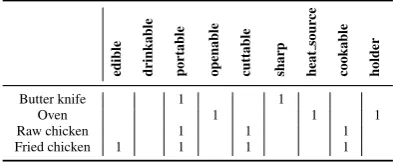
Table 2: Supported attributes along with examples.
doors are openable), and a set of rules (e.g., open-ing a closed door makes the connected room ac-cessible). The supported attributes are shown in Table2, while the rules can be inferred from the list of supported commands (see Appendix C). Note that player interactions might affect an ob-ject’s attributes. For instance, cooking a piece of
raw chickenon the stove with a frying pan makes
it edible, transforming it intofried chicken. In each game, the existence of objects, the lo-cation of objects, and their names are randomly sampled. Depending on the task, a name can be a made-up word. However, game dynamics are con-stant across all games – e.g., there will never be a drinkable heat source.
Text in QAit is generated by the TextWorld en-gine according to English templates, so it does not express the full variation of natural language. However, taking inspiration from the bAbI tasks (Weston et al.,2015), we posit that controlled sim-plifications of natural language are useful for iso-lating more complex reasoning behaviors.
2.2 Available Information
At every game step, the environment returns an
observation stringdescribing the information
visi-ble to the agent, as well as thecommand feedback, which is text describing the response to the previ-ously issued command.
Optional Information: Since we have access
to the underlying state representation of a gener-ated game, various optional information can be made available. For instance, it is possible to access the subset of commands that are valid at the current game step. Other available meta-information includes all objects that exist in the game, plus their locations, attributes, and states.
During training, one is free to use any optional information to guide the agent’s learning, e.g., to shape the rewards. However, at test time, only the
observation stringand thecommand feedbackare
available.
2.3 Question Types and Difficulty Levels
Using the game information described above, we can generate questions with known ground truth answers for any given game.
2.3.1 Question Types
For this initial version of QAit we consider three straightforward question types.
Location: (“Where is the can of soda?”) Given
an object name, the agent must answer with the name of the container that most directly holds the object. This can be either a location, a holder within a location, or the player’s inventory. For example, if the can of soda is in a fridge which is in the kitchen, the answer would be “fridge”.
Existence: (“Is there a raw egg in the world?”)
Given the name of an object, the agent must learn to answer whether the object exists in the game environmente.
Attribute: (“Isgharghedible?”) Given an
ob-ject name and an attribute, the agent must answer with the value of the given attribute for the given object. Note that all attributes in our dataset are binary-valued. To discourage an agent from sim-ply memorizing attribute values given an object name (Anand et al.,2018) (e.g., apples are always edible so agents can answer without interaction), we replace object names with unique, randomly drawn made-up words for this question type.
2.3.2 Difficulty Levels
To better analyze the limitations of learning al-gorithms and to facilitate curriculum learning ap-proaches, we define two difficulty levels based on the environment layout.
Fixed Map: The map (location names and
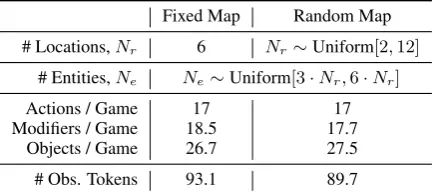
lay-out) is fixed across games. Random objects are distributed across the map in each game. Statistics for this game configuration are shown in Table3.
Random Map: Both map layouts and objects
are randomly sampled in each game.
2.4 Action Space
Fixed Map Random Map
# Locations,Nr 6 Nr∼Uniform[2,12]
# Entities,Ne Ne∼Uniform[3·Nr,6·Nr]
Actions / Game 17 17
Modifiers / Game 18.5 17.7 Objects / Game 26.7 27.5
[image:4.595.73.290.63.160.2]# Obs. Tokens 93.1 89.7
Table 3: Statistics of the QAit dataset. Numbers are averaged over 10,000 randomly sampled games.
Information Gathering The player generates
text commands word by word to navigate through and interact with the environment. On encounter-ing an object, the player must interact with it to discover its attributes. To succeed, an agent must map the feedback received from the environment, in text, to a useful state representation. This is a form of reading comprehension.
To make the QAit task more tractable, all text commands are triplets of the form {action, mod-ifier, object} (e.g., open wooden door). When
there is no ambiguity, the environment under-stands commands without modifiers (e.g., eat
apple will result in eating the “red apple”
pro-vided it is the only apple in the player’s inventory). We list all supported commands in AppendixC.
Each game provides a set of three lexicons that divide the full vocabulary into actions, modifiers, and objects. Statistics are shown in Table 3. A model can generate a command at each game step by, e.g., sampling from a probability distribution induced over each lexicon. This reduces the size of the action space compared to a sequential, free-form setting where a model can pick any vocabu-lary word at any generation step.
An agent decides when to stop interacting with the environment to answer the question by gen-erating a special waitcommand2. However, the
number of interaction steps is limited: we use 80 steps in all experiments. When an agent has ex-hausted its available steps, the game terminates and the agent is forced to answer the question.
Question Answering Currently, all QAit
an-swers are one word. For existence and attribute questions, the answer is eitheryesorno; for
loca-2We call it “wait” because when playing multiple games
in a batch, batched environment will terminate only when all agents have issued the terminating command. Before that, some agent will wait. This is analogous to paddings in natural language processing tasks.
tion questions, the answer can be any word in an observation string.
2.5 Evaluation Settings and Metrics
We evaluate an agent’s performance on QAit by its accuracy in answering questions. We propose three distinct settings for the evaluation.
Solving Training Games: We use QA accuracy
during training, averaged over a window of train-ing time, to evaluate an agent’s traintrain-ing perfor-mance. We provide 5 training sets for this pur-pose with [1, 2, 10, 100, 500] games, respectively. Each game in these sets is associated with multiple questions.
Unlimited Games: We implement a setup
where games are randomly generated on the fly during training, rather than selected from a finite set as above. The distribution we draw from is controlled by a few parameters: number of loca-tions, number of objects, type of map, and a ran-dom seed. From the fixed map game distribu-tion described in Table3, more than1040
different games can be drawn. This means that a game is unlikely to be seen more than once during training. We expect that only a model with strong general-ization capabilities will perform well in this set-ting.
Zero-shot Evaluation: For each game setting
and question type, we provide 500 held out games that are never seen during training, each with one question. These are used to benchmark general-ization in models in a reproducible manner, no matter the training setting. This set is analogous to the test set used in traditional supervised learn-ing tasks, and can be used in conjunction with any training setting.
3 Baseline Models
3.1 Random Baseline
Our simplest baseline does not interact with the environment to answer questions; it samples an answer word uniformly from the QA action space (yesandnofor attribute and existence questions; all possible object names in the game for location questions).
3.2 Human Baseline
if stop info gathering:
[�−1; �; �−1]
�� , �� , �� ,
ℎ�
ℎ�� Encoder Aggregator
Command Generator
�|�,�
Question Answerer
��
[image:5.595.81.282.63.150.2]��
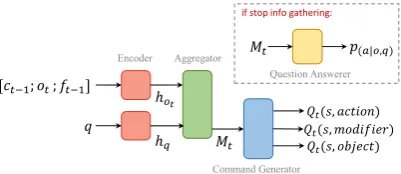
Figure 1: Overall architecture of our baseline agent.
QA accuracy. Participants played games they had not seen previously from a set generated by sam-pling 4 game-question pairs for each question type and difficulty level. The human results presented below always represent an average over 3 partici-pants.
3.3 QA-DQN
We propose a neural baseline agent, QA-DQN, which takes inspiration from the work of
Narasimhan et al.(2015) andYu et al.(2018). The agent consists of three main components: an en-coder, a command generator, and a question an-swerer. More precisely, at game step t, the en-coder takes observationotand questionqas input
to generate hidden representations.3 In the infor-mation gathering phase, the command generator generates Q-values for all action, modifier, and ob-ject words, with rankings of these Q-values used to generate text commandsct. At any game step, the
agent may decide to terminate information gather-ing and answer the question (or it is forced to do so if it has used up all of its moves). The question an-swerer uses the hidden representations at the final information-gathering step to generate a probabil-ity distribution over possible answers.
An overview of this architecture is shown in Figure1and full details are given in AppendixA.
3.3.1 Reward Shaping
We design the following two rewards to help QA-DQN learn more efficiently; both used for train-ing the command generator. Note that these re-wards are part of the design of QA-DQN, but are not used to evaluate its performance. Question an-swering accuracy is the only evaluation metric for QAit tasks.
Sufficient Information Bonus: To tackle QAit
tasks, an intelligent agent should know when to
3We concatenateo
t with the command generated at
pre-vious game step and the text feedback returned by the game, as described in Section2.2.
stop interacting – it should stop as soon as it has gathered enough information to answer the ques-tion correctly. For guiding the agent to learn this behavior, we give an additional reward when the agent stops with sufficient information. Specifi-cally, assuming the agent decides to stop at game stepk:
• Location: reward is 1 if the entity mentioned in the question is a sub-string of ok,
other-wise it is 0. This means whenever an agent observes the entity, it has sufficient informa-tion to infer the entity’s locainforma-tion.
• Existence: when the correct answer isyes, a
reward of 1 is assigned only if the entity is a sub-string ofok. When the correct answer is no, a reward between 0 and 1 is given. The
reward value corresponds to the exploration coverage of the environment, i.e., how many locations the agent has visited, and how many containers have been opened.
• Attribute: we heuristically define a set of con-ditions to verify each attribute, and reward the agent based on its fulfilment of these con-ditions. For instance, determining if an
ob-jectX is sharp corresponds to checking the
outcome of a cut command (slice,chop, or dice) while holding the object Xand a
cut-table food item. If the outcome is success-ful then the objectX is sharp otherwise it is not. Alternatively, if trying to take the object
Xresults in a failure, then we can deduces it
is not sharp as all sharp objects are portable. The list of conditions for each attribute used in our experiments is shown in AppendixD.
Episodic Discovery Bonus: Following Yuan
et al.(2018), we use an episodic counting reward to encourage the agent to discover unseen game states. The agent is assigned a positive reward whenever it encounters a new state (in text-based games, states are simply represented as strings):
r(ot) =
(
1.0 ifn(ot) = 1,
0.0 otherwise,
wheren(·)is reset to zero after each episode.
3.3.2 Training Strategy
We apply different training strategies for the com-mand generator and the question answerer.
Command Generation: Text-based games
be described naturally by partially observable Markov decision processes (POMDPs) (Kaelbling et al.,1998). We use the Q-Learning (Watkins and Dayan,1992) paradigm to train our agent. Specif-ically, followingMnih et al. (2015), our Q-value function is approximated with a deep neural net-work. Beyond vanilla DQN, we also apply several extensions, such as Rainbow (Hessel et al.,2017), to our training process. Details are provided in Section4.
Question Answering: During training, we
push all question answering transitions (obser-vation strings when interaction stops, question strings, ground-truth answers) into a replay buffer. After every 20 game steps, we randomly sample a mini-batch of such transitions from the replay buffer and train the question answerer with super-vised learning (e.g., using negative log-likelihood (NLL) loss).
4 Experimental Results
In this section, we report experimental results by difficulty levels. All random baseline performance values are averaged over 100 different runs. In the following subsections, we use “DQN”, “DDQN” and “Rainbow” to indicate QA-DQN trained with vanilla DQN, Double DQN with prioritized expe-rience replay, and Rainbow, respectively. Train-ing curves shown in the followTrain-ing figures repre-sent a sliding-window average with a window size of 500. Moreover, each curve is the average of 3 random seeds. For evaluation, we selected the model with the random seed yielding the highest training accuracy to compute its accuracy on the test games. Due to space limitations, we only re-port some key results here. See Appendix Efor the full experimental results.
4.1 Fixed Map
Figure2 shows the training curves for the neural baseline agents when trained using 10 games, 500 games and the “unlimited” games settings. Table4
reports their zero-shot test performance.
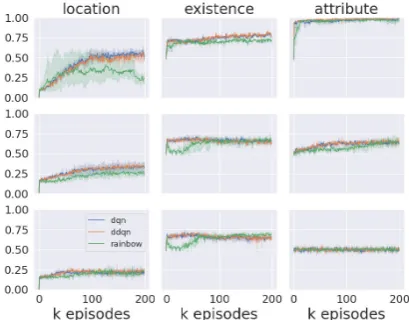
From Figure 2, we observe that when training data size is small (e.g., 10 games), our baseline agent trained with all the three RL methods suc-cessfully master the training games. Vanilla DQN and DDQN are particularly strong at memoriz-ing the trainmemoriz-ing games. When trainmemoriz-ing on more games (e.g., 500 games and unlimited games), in which case memorization is more difficult,
Rain-Figure 2: Training accuracy over episodes on fixed mapsetup. Upper row: 10 games; middle row: 500 games; lower row: unlimited games.
Fixed Map Random Map
Model Loc. Exi. Att. Loc. Exi. Att.
Human 1.000 1.000 1.000 1.000 1.000 0.750 Random 0.027 0.497 0.496 0.034 0.500 0.499
10 games
DQN 0.180 0.568 0.518 0.156 0.566 0.518 DDQN 0.188 0.566 0.516 0.142 0.606 0.500 Rainbow 0.156 0.590 0.520 0.144 0.586 0.530
500 games
DQN 0.224 0.674 0.534 0.204 0.678 0.530 DDQN 0.218 0.626 0.508 0.222 0.656 0.486 Rainbow 0.190 0.656 0.496 0.172 0.678 0.494
unlimited games
[image:6.595.313.518.63.223.2]DQN 0.216 0.662 0.514 0.188 0.668 0.506 DDQN 0.258 0.628 0.480 0.206 0.694 0.482 Rainbow 0.280 0.692 0.514 0.258 0.686 0.470
Table 4: Agent performance on zero-shot test games when trained on 10 games, 500 games and “unlimited” games settings. Note Att. and Exi. are binary questions with expected accuracy of 0.5.
[image:6.595.312.520.285.465.2]Figure 3: Training accuracy on therandom mapsetup. Upper row: 10 games; middle row: 500 games; lower row: unlimited games.
can also be observed in AppendixE, where in at-tribute question experiments, the training accuracy is high, and sufficient information bonus is low (even close to 0).
4.2 Random Map
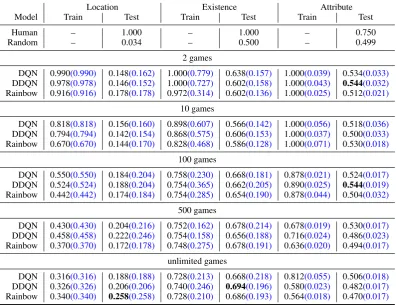
Figure3 shows the training curves for the neural baseline agents when trained using 10 games, 500 games and “unlimited” games settings. The trends of our agents’ performance on random map games are consistent with on fixed map games. How-ever, because there exist easier games (as listed in Table 3, number of rooms is sampled between 2 and 12), agents show better training performance in such setting thanfixed mapsetting in general.
Interestingly, we observe one of the DQN agent starts to learn in the unlimited games, attribute question setting. This may be because in games with smaller map size and less objects, there is a higher chance to accomplish some sub-tasks (e.g., it is easier to find an object when there are less rooms), and the agent learn such skills and apply them to similar tasks. Unfortunately, as shown in Table4 that agent does not perform significantly better than random on test set. We expect with more training episodes, the agent can have a better generalization performance.
4.3 Question Answering Given Sufficient
Information
The challenge in QAit is learning the interactive procedure for arriving at a state with the informa-tion needed to answer the quesinforma-tion. We conduct the following experiments on location questions to investigate this challenge.
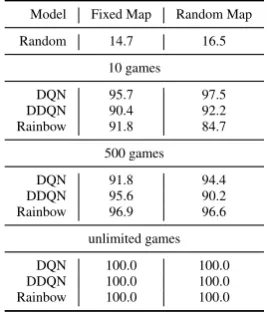
Model Fixed Map Random Map
Random 14.7 16.5
10 games
DQN 95.7 97.5 DDQN 90.4 92.2 Rainbow 91.8 84.7
500 games
DQN 91.8 94.4 DDQN 95.6 90.2 Rainbow 96.9 96.6
unlimited games
[image:7.595.79.282.63.222.2]DQN 100.0 100.0 DDQN 100.0 100.0 Rainbow 100.0 100.0
Table 5: Test performance given sufficient information.
Based on the results in Table4, we compute an agent’s test accuracyonly if it has obtained suffi-cient information – i.e., when the suffisuffi-cient infor-mation bonus is 1. Results shown in Table5 sup-port our assumption that the QA module can learn (and generalize) effectively to answer given suf-ficient information. Similarly, experiments show that when objects being asked about are in the current observation, the random baseline’s perfor-mance goes up significantly as well. We report our baseline agents’ question answering accuracy and sufficient information bonuses on all experiment settings in AppendixE.
4.4 Full Information Setup
To reframe the QAit games as a standard MRC task, we also designed an experimental setting that eliminates the need to gather information inter-actively. From a heuristic trajectory through the game environment that is guaranteed to observe sufficient information for q, we concatenate all observations into a static “document” d to build a {d, q, a} triplet. A model then uses this fully observed document as input to answer the ques-tion. We split this data into training, validation, and test sets and follow the evaluation protocol for standard supervised MRC tasks. We take an off-the-shelf MRC model, Match-LSTM (Wang and Jiang,2016), trained with negative log-likelihood loss as a baseline.
high accuracy.
5 Related Work
5.1 MRC Datasets
Many large-scale machine reading comprehension and question answering datasets have been pro-posed recently. The datasets of Rajpurkar et al.
(2016); Trischler et al. (2016) contain crowd-sourced questions based on single documents from Wikipedia and CNN news, respectively. Nguyen et al. (2016); Joshi et al. (2017); Dunn et al.
(2017); Clark et al. (2018); Kwiatkowski et al.
(2019) present question-answering corpora har-vested from information retrieval systems, of-ten containing multiple supporting documents for each question. This means a model must sift through a larger quantity of information and possi-bly reconcile competing viewpoints. Berant et al.
(2013); Welbl et al. (2017); Talmor and Berant
(2018) propose to leverage knowledge bases to generate question-answer pairs.Yang et al.(2018) focuses on questions that require multi-hop rea-soning to answer, by building questions composi-tionally.Reddy et al.(2018);Choi et al.(2018) ex-plore conversational question answering, in which a full understanding of the question depends on the conversation’s history.
Most of these datasets focus on declarative knowledge and are static, with all information fully observable to a model. We contend that this setup, unlike QAit, encourages word matching. Supporting this contention, several studies high-light empirically that existing MRC tasks require little comprehension or reasoning. In Rychalska et al.(2018), it was shown that a question’s main verb exerts almost no influence on the answer pre-diction: in over 90% of examined cases, swapping verbs for their antonyms does not change a sys-tem’s decision. Jia and Liang(2017) show the ac-curacy of neural models drops from an average of 75%F1 score to 36%F1 when they manually in-sert adversarial sentences into SQuAD.
5.2 Interactive Environments
Several embodied or visual question answering datasets have been presented recently to address some of the problems of interest in our work, such as those ofBrodeur et al.(2017);Das et al.(2017);
Gordon et al.(2017). In contrast with these, our purely text-based environment circumvents chal-lenges inherent to modelling interactions between
separate data modalities. Furthermore, most vi-sual question answering environments only sup-port navigating and moving the camera as inter-actions. In text-based environments, however, it is relatively cheap to build worlds with complex interactions. This is because text enables us to model interactions abstractly without the need for, e.g., a costly physics engine.
Closely related to QAit is BabyAI ( Chevalier-Boisvert et al.,2018). BabyAI is a gridworld en-vironment that also features constrained language for generating simple home-based scenarios (i.e., instructions). However, observations and actions in BabyAI are not text-based. World of Bits (Shi et al., 2017) is a platform for training agents to interact with the internet to accomplish tasks like flight booking. Agents generally do not need to gather information in World of Bits, and the focus is on accomplishing tasks rather than answering questions.
5.3 Information Seeking
Information seeking behavior is an important ca-pacity of intelligent systems that has been dis-cussed for many years.Kuhlthau(2004) propose a holistic view of information search as a six-stage process. Schmidhuber (2010) discusses the con-nection between information seeking and formal notions of fun, creativity, and intrinsic motiva-tion. Das et al.(2018) propose a model that con-tinuously determines all entities’ locations during reading and dynamically updates the associated representations in a knowledge graph. Bachman et al.(2016) propose a collection of tasks and neu-ral methods for learning to gathering information efficiently in an environment.
To our knowledge, we are the first to consider interactive information-seeking tasks for ques-tion answering in worlds with complex dynam-ics. The QAit task was designed such that sim-ple word matching methods do not apply, while more human-like information seeking models are encouraged.
6 Discussion and Future Work
Monitoring Information Seeking: In QAit, the
Appendix E. We observe that while the baseline agents can reach a training accuracy of 100% for answering attribute questions when trained on a few games, the sufficient information bonus is close to 0. This is a clear indication that the agent overfits to the question-answer mapping of the games rather than learning how to gather use-ful information. This aligns with our observation that the agent does not perform better than random on the unlimited games setting, because it fails to gather the needed information.
Challenges in QAit: QAit focuses on learning
procedural knowledge from interactive environ-ments, so it is natural to use deep RL methods to tackle it. Experiments suggest the dataset presents a major challenge for existing systems, including Rainbow, which set the state of the art on Atari games. As a simplified and controllable text-based environment, QAit can drive research in both the RL and language communities, especially where they intersect. Until recently, the RL community focused mainly on solving single environments (i.e., training and testing on the same game). Now, we see a shift towards solving multiple games and testing for generalization (Cobbe et al.,2018;
Justesen et al.,2018). We believe QAit serves this purpose.
Templated Language: As QAit is based on
TextWorld, it has the obvious limitation of us-ing templated English. However, TextWorld pro-vides approximately 500human-writtentemplates for describing rooms and objects, so some tex-tual diversity exists, and since game narratives are generated compositionally, this diversity increases along with the complexity of a game. We believe simplified and controlled text environments offer a bridge to full natural language, on which we can isolate the learning of useful behaviors like infor-mation seeking and command generation. Never-theless, it would be interesting to further diversify the language in QAit, for instance by having hu-man writers paraphrase questions.
Future Work: Based on our present efforts to
tackle QAit, we propose the following directions for future work.
Astructured memory(e.g., a dynamic
knowl-edge graph as proposed inDas et al.(2018); Am-manabrolu and Riedl(2019a)) could be helpful for explicitly memorizing the places and objects that an agent has observed. This is especially useful
when an agent must revisit a location or object or should avoid doing so.
Likewise, a variety of external knowledge
could be leveraged by agents. For instance, incor-porating a pretrained language model could im-prove command generation by imparting knowl-edge of word and object affordances. In recent work, Hausknecht et al. (2019) show that pre-trained modules together with handcrafted sub-policies help in solving text-based games, while
Yin and May (2019) use BERT (Devlin et al.,
2018) to inject ‘weak common sense’ into agents for text-based games. Ammanabrolu and Riedl
(2019b) show that knowledge graphs and their associated neural encodings can be used as a medium for domain transfer across text-based games.
In finite game settings we observed significant overfitting, especially for attribute questions – as shown in Appendix E, our agent achieves high QA accuracy but low sufficient information bonus on the single-game setting. Sometimes attributes require long procedures to verify, and thus, we believe that denser rewards would help with this problem. One possible solution is to provide
in-termediate rewardswhenever the agent achieves
a sub-task.
Acknowledgments
The authors thank Romain Laroche, R´emi Tachet des Combes, Matthew Hausknecht, Philip Bach-man, and Layla El Asri for insightful ideas and discussions. We thank Tavian Barnes, Wendy Tay, and Emery Fine for their work on the TextWorld framework. We also thank the anony-mous EMNLP reviewers for their helpful feedback and suggestions.
References
Ammanabrolu, P. and Riedl, M. (2019a). Playing text-adventure games with graph-based deep reinforce-ment learning. InNAACL, pages 3557–3565, Min-neapolis, Minnesota. Association for Computational Linguistics.
Ammanabrolu, P. and Riedl, M. (2019b). Trans-fer in deep reinforcement learning using knowledge graphs.CoRR, abs/1908.06556.
Bachman, P., Sordoni, A., and Trischler, A. (2016). Towards information-seeking agents. CoRR, abs/1612.02605.
Berant, J., Chou, A., Frostig, R., and Liang, P. (2013). Semantic parsing on freebase from question-answer pairs. InEMNLP, pages 1533–1544. ACL.
Brodeur, S., Perez, E., Anand, A., Golemo, F., Celotti, L., Strub, F., Rouat, J., Larochelle, H., and Courville, A. C. (2017). Home: a household multi-modal environment. CoRR, abs/1711.11017.
Chen, D., Fisch, A., Weston, J., and Bordes, A. (2017). Reading wikipedia to answer open-domain ques-tions. CoRR, abs/1704.00051.
Chevalier-Boisvert, M., Bahdanau, D., Lahlou, S., Willems, L., Saharia, C., Nguyen, T. H., and Ben-gio, Y. (2018). Babyai: First steps towards grounded language learning with a human in the loop. CoRR, abs/1810.08272.
Choi, E., He, H., Iyyer, M., Yatskar, M., Yih, W., Choi, Y., Liang, P., and Zettlemoyer, L. (2018). Quac : Question answering in context. CoRR, abs/1808.07036.
Clark, P., Cowhey, I., Etzioni, O., Khot, T., Sabharwal, A., Schoenick, C., and Tafjord, O. (2018). Think you have solved question answering? try arc, the AI2 reasoning challenge. CoRR, abs/1803.05457.
Cobbe, K., Klimov, O., Hesse, C., Kim, T., and Schul-man, J. (2018). Quantifying generalization in rein-forcement learning. CoRR, abs/1812.02341.
Cˆot´e, M.-A., K´ad´ar, A., Yuan, X., Kybartas, B., Barnes, T., Fine, E., Moore, J., Hausknecht, M., Asri, L. E., Adada, M., Tay, W., and Trischler, A. (2018). Textworld: A learning environment for text-based games. CoRR, abs/1806.11532.
Das, A., Datta, S., Gkioxari, G., Lee, S., Parikh, D., and Batra, D. (2017). Embodied question answer-ing. CoRR, abs/1711.11543.
Das, R., Munkhdalai, T., Yuan, X., Trischler, A., and McCallum, A. (2018). Building dynamic knowl-edge graphs from text using machine reading com-prehension. CoRR, abs/1810.05682.
Devlin, J., Chang, M., Lee, K., and Toutanova, K. (2018). BERT: pre-training of deep bidirectional transformers for language understanding. CoRR, abs/1810.04805.
Dunn, M., Sagun, L., Higgins, M., G¨uney, V. U., Cirik, V., and Cho, K. (2017). Searchqa: A new q&a dataset augmented with context from a search en-gine. CoRR, abs/1704.05179.
Fortunato, M., Azar, M. G., Piot, B., Menick, J., Os-band, I., Graves, A., Mnih, V., Munos, R., Hass-abis, D., Pietquin, O., Blundell, C., and Legg, S. (2017). Noisy networks for exploration. CoRR, abs/1706.10295.
Gordon, D., Kembhavi, A., Rastegari, M., Redmon, J., Fox, D., and Farhadi, A. (2017). IQA: visual ques-tion answering in interactive environments. CoRR, abs/1712.03316.
Hausknecht, M., Loynd, R., Yang, G., Swaminathan, A., and Williams, J. D. (2019). Nail: A general in-teractive fiction agent.
Hessel, M., Modayil, J., van Hasselt, H., Schaul, T., Ostrovski, G., Dabney, W., Horgan, D., Piot, B., Azar, M. G., and Silver, D. (2017). Rainbow: Com-bining improvements in deep reinforcement learn-ing.CoRR, abs/1710.02298.
Jia, R. and Liang, P. (2017). Adversarial examples for evaluating reading comprehension systems. arXiv preprint arXiv:1707.07328.
Joshi, M., Choi, E., Weld, D. S., and Zettlemoyer, L. (2017). Triviaqa: A large scale distantly super-vised challenge dataset for reading comprehension.
CoRR, abs/1705.03551.
Justesen, N., Torrado, R. R., Bontrager, P., Khalifa, A., Togelius, J., and Risi, S. (2018). Procedural level generation improves generality of deep reinforce-ment learning. CoRR, abs/1806.10729.
Kaelbling, L. P., Littman, M. L., and Cassandra, A. R. (1998). Planning and acting in partially observable stochastic domains. Artificial intelligence, 101(1-2):99–134.
Kingma, D. P. and Ba, J. (2014). Adam: A method for stochastic optimization. arXiv preprint arXiv:1412.6980.
Kuhlthau, C. (2004).Seeking Meaning: A Process Ap-proach to Library and Information Services. Infor-mation management, policy, and services. Libraries Unlimited.
Kwiatkowski, T., Palomaki, J., Redfield, O., Collins, M., Parikh, A., Alberti, C., Epstein, D., Polosukhin, I., Kelcey, M., Devlin, J., Lee, K., Toutanova, K. N., Jones, L., Chang, M.-W., Dai, A., Uszkoreit, J., Le, Q., and Petrov, S. (2019). Natural questions: a benchmark for question answering research. Trans-actions of the Association of Computational Linguis-tics.
Mikolov, T., Grave, E., Bojanowski, P., Puhrsch, C., and Joulin, A. (2018). Advances in pre-training dis-tributed word representations. InProceedings of the International Conference on Language Resources
and Evaluation (LREC 2018).
Narasimhan, K., Kulkarni, T., and Barzilay, R. (2015). Language understanding for text-based games us-ing deep reinforcement learnus-ing. arXiv preprint
arXiv:1506.08941.
Nguyen, T., Rosenberg, M., Song, X., Gao, J., Ti-wary, S., Majumder, R., and Deng, L. (2016). MS MARCO: A human generated machine reading comprehension dataset. CoRR, abs/1611.09268.
Paszke, A., Gross, S., Chintala, S., Chanan, G., Yang, E., DeVito, Z., Lin, Z., Desmaison, A., Antiga, L., and Lerer, A. (2017). Automatic differentiation in pytorch. InNIPS-W.
Rajpurkar, P., Zhang, J., Lopyrev, K., and Liang, P. (2016). Squad: 100, 000+ questions for machine comprehension of text. CoRR, abs/1606.05250.
Reddy, S., Chen, D., and Manning, C. D. (2018). Coqa: A conversational question answering chal-lenge. CoRR, abs/1808.07042.
Rychalska, B., Basaj, D., Biecek, P., and Wroblewska, A. (2018). Does it care what you asked? under-standing importance of verbs in deep learning qa system.
Schmidhuber, J. (2010). Formal theory of creativity, fun, and intrinsic motivation (1990–2010). IEEE Trans. on Auton. Ment. Dev., 2(3):230–247.
Shi, T., Karpathy, A., Fan, L., Hernandez, J., and Liang, P. (2017). World of bits: An open-domain plat-form for web-based agents. In Precup, D. and Teh, Y. W., editors,Proceedings of the 34th International
Conference on Machine Learning, volume 70 of
Proceedings of Machine Learning Research, pages
3135–3144, International Convention Centre, Syd-ney, Australia. PMLR.
Srivastava, R. K., Greff, K., and Schmidhu-ber, J. (2015). Highway networks. CoRR, abs/1505.00387.
Talmor, A. and Berant, J. (2018). The web as a knowledge-base for answering complex questions.
CoRR, abs/1803.06643.
Trischler, A., Wang, T., Yuan, X., Harris, J., Sor-doni, A., Bachman, P., and Suleman, K. (2016). Newsqa: A machine comprehension dataset. CoRR, abs/1611.09830.
Wang, S. and Jiang, J. (2016). Machine comprehen-sion using match-lstm and answer pointer. CoRR, abs/1608.07905.
Wang, W., Yang, N., Wei, F., Chang, B., and Zhou, M. (2017). Gated self-matching networks for read-ing comprehension and question answerread-ing. In Pro-ceedings of the 55th Annual Meeting of the Associa-tion for ComputaAssocia-tional Linguistics (Volume 1: Long
Papers), pages 189–198. Association for
Computa-tional Linguistics.
Watkins, C. J. C. H. and Dayan, P. (1992). Q-learning.
Machine Learning, 8(3):279–292.
Welbl, J., Stenetorp, P., and Riedel, S. (2017). Con-structing datasets for multi-hop reading comprehen-sion across documents. CoRR, abs/1710.06481.
Weston, J., Bordes, A., Chopra, S., Rush, A. M., van Merrinboer, B., Joulin, A., and Mikolov, T. (2015). Towards ai-complete question answering: A set of prerequisite toy tasks.CoRR.
Yang, Z., Qi, P., Zhang, S., Bengio, Y., Cohen, W. W., Salakhutdinov, R., and Manning, C. D. (2018). Hot-potqa: A dataset for diverse, explainable multi-hop question answering.CoRR, abs/1809.09600.
Yin, X. and May, J. (2019). Learn how to cook a new recipe in a new house: Using map familiarization, curriculum learning, and common sense to learn families of text-based adventure games. CoRR, abs/1908.04777.
Yu, A. W., Dohan, D., Luong, M.-T., Zhao, R., Chen, K., Norouzi, M., and Le, Q. V. (2018). Qanet: Combining local convolution with global self-attention for reading comprehension. arXiv preprint arXiv:1804.09541.
A Details of QA-DQN
Notations
In this section, we usegame steptto denote one round of interaction between an agent with the QAit environment. We use ot to denote text
ob-servation at game stept, andq to denote question text. We useLto refer to a linear transformation. Brackets[·;·]denote vector concatenation.
A.1 Encoder
We use a transformer-based text encoder, which consists of an embedding layer, two stacks of transformer blocks (denoted as encoder transformer blocks and aggregation transformer blocks), and an attention layer.
In the embedding layer, we aggregate both word- and character-level information to pro-duce a vector for each token in text. Specif-ically, word embeddings are initialized by the 300-dimensional fastText (Mikolov et al., 2018) word vectors trained on Common Crawl (600B tokens), they are fixed during training. Charac-ter level embedding vectors are initialized with 32-dimensional random vectors. A convolutional layer with 64 kernels of size 5 is then used to ag-gregate the sequence of characters. We use a max pooling layer on the character dimension, then a multi-layer perceptron (MLP) of output size 64 is used to aggregate the concatenation of word- and character-level representations. Highway network (Srivastava et al., 2015) is applied on top of this MLP. The resulting vectors are used as input to the encoding transformer blocks.
Each encoding transformer block consists of a stack of convolutional layers, a self-attention layer, and an MLP. In which, each convolutional layer has 64 filters, each kernel’s size is 7, there are 2 such convolutional layers that share weights. In the self-attention layer, we use a block hidden size of 64, as well as a single head attention mech-anism. Layernorm and dropout are applied after each component inside the block. We add posi-tional encoding into each block’s input. We use one layer of such an encoding block.
At a game stept, the encoder processes text ob-servationotand questionq, context aware
encod-ing hot ∈ R
Lot×H1 andh
q ∈ RL
q×H
1 are
gen-erated, where Lot and Lq denote number of
to-kens inotandqrespectively,H1is 64. Following (Yu et al.,2018), we use an context-query atten-tion layer to aggregate the two representaatten-tionshot
andhq.
Specifically, the attention layer first uses two MLPs to convert both hot and hq into the same
space, the resulting tensors are denoted ash′ot ∈ RLot×H2 andh′
q ∈RL
q×H
2, in whichH
2is 64. Then, a tri-linear similarity function is used to compute the similarities between each pair ofh′ot
andh′qitems:
S=W[h′ot;h′q;h′ot ⊙h′q], (1)
where ⊙ indicates element-wise multiplication,
W is trainable parameters of size 64.
Softmax of the resulting similarity matrix S
along both dimensions are computed, this pro-ducesSA andSB. Information in the two
repre-sentations are then aggregated by:
hoq= [h′ot;P;h
′
ot⊙P;h
′
ot⊙Q], P =Sqh′⊤q ,
Q=SqSo⊤th
′⊤
ot,
(2)
wherehoqis aggregated observation
representa-tion.
On top of the attention layer, a stack of aggre-gation transformer blocks is used to further map the observation representations to action represen-tations and answer represenrepresen-tations. The structure of aggregation transformer blocks are the same as the encoder transformer blocks, except the kernel size of convolutional layer is 5, and the number of blocks is 3.
Let Mt ∈ RLot×H3 denote the output of the
stack of aggregation transformer blocks, whereH3 is 64.
A.2 Command Generator
The command generator takes the hidden repre-sentationsMtas input, it estimates Q-values for all
action, modifier, and object words, respectively. It consists of a shared Multi-layer Perceptron (MLP) and three MLPs for each of the components:
Rt=ReLU(Lshared(mean(Mt)),
Qt,action =Laction(Rt),
Qt,modif ier =Lmodifier(Rt), Qt,object =Lobject(Rt).
(3)
In which, the output size ofLsharedis 64; the
and object words available, respectively. The over-all Q-value is the sum of the three components:
Qt=Qt,action+Qt,modif ier+Qt,object. (4)
A.3 Question Answerer
Similar to (Yu et al., 2018), we append an extra stacks of aggregation transformer blocks on top of the aggregation transformer blocks to compute an-swer positions:
U =ReLU(L0[Mt;Mt′]).
β= softmax(L1(U)).
(5)
In whichMt′ ∈ RLot×H3 is output of the extra
transformer stack,L0,L1are trainable parameters with output size 64 and 1, respectively.
For location questions, the agent outputs β as the probability distribution of each word in obser-vationotbeing the answer of the question.
For binary classification questions, we apply an MLP, which takes weighted sum of matching rep-resentations as input, to compute a probability dis-tributionp(y)over both possible answers:
D=X
i
(βi·Mt′),
p(y) = softmax(L4(tanh(L3(D))). (6)
Output size of L3 and L4 are 64 and 2, respec-tively.
A.4 Deep Q-Learning
In a text-based game, an agent takes an actiona4in statesby consulting a state-action value function
Q(s, a), this value function is as a measure of the action’s expected long-term reward. Q-Learning helps the agent to learn an optimalQ(s, a)value function. The agent starts from a random Q-function, it gradually updates its Q-values by inter-acting with environment, and obtaining rewards. Following Mnih et al. (2015), the Q-value func-tion is approximated with a deep neural network.
We make use of a replay buffer. During playing the game, we cache all transitions into the replay buffer without updating the parameters. We peri-odically sample a random batch of transitions from the replay buffer. In each transition, we update the parameters θ to reduce the discrepancy between the predicted value of current stateQ(st, at) and
4In our case,ais a triplet contains{action, modifier,
ob-ject}as described in Section2.4.
the expected Q-value given the rewardrt and the
value of next statemaxaQ(st+1, a).
We minimize the temporal difference (TD) er-ror,δ:
δ =Q(st, at)−(rt+γmax
a Q(st+1, a)), (7)
in which,γ indicates the discount factor. Follow-ing the common practice, we use the Huber loss to minimize the TD error. For a randomly sampled batch with batch sizeB, we minimize:
L= 1
|B|
X
L(δ),
whereL(δ) =
(1 2δ
2
for|δ| ≤1,
|δ| −1
2 otherwise. (8)
As described in Section 3.3.1, we design the sufficient information bonus to teach an agent to stop as soon as it has gathered enough information to answer the question. Therefore we assign this reward at the game step where the agent generates
waitcommand (or it is forced to stop).
It is worth mentioning that for attribute type questions (considerably the most difficult question type in QAit, where the training signal is very sparse), we provide extra rewards to help QA-DQN to learn.
Specifically, we take a reward similar to as used in location questions: 1.0 if the agent has observed the object mentioned in the question. we also use a reward similar to as used in existence questions: the agent is rewarded by the coverage of its ex-ploration. The two extra rewards are finally added onto the sufficient information bonus for attribute question, both with coefficient of 0.1.
B Implementation Details
During training with vanilla DQN, we use a re-play memory of size 500,000. We use ǫ-greedy, where the value ofǫanneals from 1.0 to 0.1 within 100,000 episodes. We start updating parameters after 1,000 episodes of playing. We update our network after every 20 game steps. During updat-ing, we use a mini-batch of size 64. We useAdam
(Kingma and Ba, 2014) as the step rule for opti-mization, The learning rate is set to 0.00025.
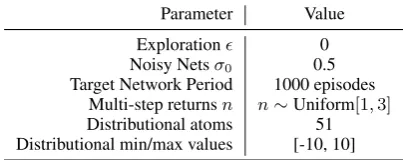
When our agent is trained with Rainbow al-gorithm, we follow Hessel et al. (2017) on most of the hyper-parameter settings. The four MLPs
in Eqn. 3are Noisy Nets layers (Fortunato et al.,
2017) when the agent is trained in Rainbow set-ting. Detailed hyper-parameter setting of our Rainbow agent are shown in Table6.
Parameter Value
Explorationǫ 0 Noisy Netsσ0 0.5
Target Network Period 1000 episodes Multi-step returnsn n∼Uniform[1,3]
[image:14.595.79.281.130.210.2]Distributional atoms 51 Distributional min/max values [-10, 10]
Table 6: Hyper-parameter setup for rainbow agent.
The model is implemented using PyTorch (Paszke et al.,2017).
C Supported Text Commands
All supported text commands are listed in Table7.
D Heuristic Conditions for Attribute Questions
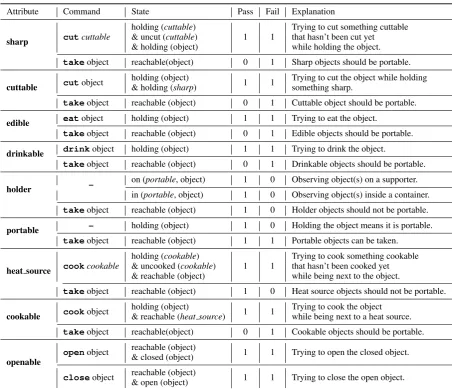
Here, we derived some heuristic conditions to de-termine when an agent has gathered enough infor-mation to answer a given attribute question. Those conditions are used as part of the reward shaping for our proposed agent (Section3.3.1). In Table8, for each attribute we list all the commands for which their outcome (pass or fail) gives enough in-formation to answer the question correctly. Also, in order for a command’s outcome to be informa-tive, each command needs to be executed while some state conditions hold. For example, to de-termine if an object is indeed aheat source, the agent needs to try to cook something that is cook-able and uncooked while standing next to the given object.
E Full results
Command Description
look describe the current location
inventory display the player’s inventory
go hdiri move the player to north, east, south, or west
examine ... examine something more closely
open ... open a door or a container
close ... close a door or a container
eat ... eat edible object
drink ... drink drinkable object
drop ... drop an object on the floor
take ... take an object from the floor, a container, or a supporter
put ... put an object onto a supporter (supporter must be present at the location)
insert ... insert an object into a container (container must be present at the location)
cook ... cook an object (heat source must be present at the location)
slice ... slice cuttable object (a sharp object must be in the player’s inventory)
chop ... chop cuttable object (a sharp object must be in the player’s inventory
dice ... dice cuttable object (a sharp object must be in the player’s inventory)
[image:15.595.124.475.64.259.2]wait stop interaction
Table 7: Supported command list.
Attribute Command State Pass Fail Explanation
sharp cutcuttable
holding (cuttable)
1 1
Trying to cut something cuttable & uncut (cuttable) that hasn’t been cut yet & holding (object) while holding the object.
takeobject reachable(object) 0 1 Sharp objects should be portable.
cuttable cutobject
holding (object)
1 1 Trying to cut the object while holding & holding (sharp) something sharp.
takeobject reachable (object) 0 1 Cuttable object should be portable.
edible eatobject holding (object) 1 1 Trying to eat the object.
takeobject reachable (object) 0 1 Edible objects should be portable.
drinkable drinkobject holding (object) 1 1 Trying to drink the object.
takeobject reachable (object) 0 1 Drinkable objects should be portable.
holder –
on (portable, object) 1 0 Observing object(s) on a supporter.
in (portable, object) 1 0 Observing object(s) inside a container.
takeobject reachable (object) 1 0 Holder objects should not be portable.
portable – holding (object) 1 0 Holding the object means it is portable. takeobject reachable (object) 1 1 Portable objects can be taken.
heat source cookcookable
holding (cookable)
1 1
Trying to cook something cookable & uncooked (cookable) that hasn’t been cooked yet & reachable (object) while being next to the object.
takeobject reachable (object) 1 0 Heat source objects should not be portable.
cookable cookobject
holding (object)
1 1 Trying to cook the object & reachable (heat source) while being next to a heat source.
takeobject reachable(object) 0 1 Cookable objects should be portable.
openable
openobject reachable (object) 1 1 Trying to open the closed object. & closed (object)
closeobject reachable (object) 1 1 Trying to close the open object.
& open (object)
Table 8: Heuristic conditions for determining whether the agent has enough information to answer a given attribute question. We use “object” to refer to the object mentioned in the question. Words in italics represents placeholder that can be replaced by any object from the environment that has the appropriate attribute (e.g. carrot could be used as a cuttable). The columns Pass and Fail represent how much reward the agent will receive given the corresponding command’s outcome (resp. success or failure). NB:cutcan mean any of the following commands:
[image:15.595.72.527.288.678.2]Location Existence Attribute
Model Train Test Train Test Train Test
Human – 1.000 – 1.000 – 1.000
Random – 0.027 – 0.497 – 0.496
1 game
DQN 0.972(0.972) 0.122(0.160) 1.000(0.881) 0.628(0.124) 1.000(0.049) 0.500(0.035)
DDQN 0.960(0.960) 0.156(0.178) 1.000(0.647) 0.624(0.148) 1.000(0.023) 0.498(0.033)
Rainbow 0.562(0.562) 0.164(0.178) 1.000(0.187) 0.616(0.083) 1.000(0.049) 0.516(0.039)
2 games
DQN 0.698(0.698) 0.168(0.182) 0.948(0.700) 0.574(0.136) 1.000(0.011) 0.510(0.028)
DDQN 0.702(0.702) 0.172(0.178) 0.882(0.571) 0.550(0.109) 1.000(0.098) 0.508(0.036)
Rainbow 0.734(0.734) 0.160(0.168) 0.878(0.287) 0.616(0.085) 1.000(0.030) 0.524(0.022)
10 games
DQN 0.654(0.654) 0.180(0.188) 0.822(0.390) 0.568(0.156) 1.000(0.055) 0.518(0.030)
DDQN 0.608(0.608) 0.188(0.208) 0.842(0.479) 0.566(0.128) 1.000(0.064) 0.516(0.036)
Rainbow 0.616(0.616) 0.156(0.170) 0.768(0.266) 0.590(0.131) 0.998(0.059) 0.520(0.023)
100 games
DQN 0.498(0.498) 0.194(0.206) 0.756(0.139) 0.614(0.160) 0.838(0.019) 0.498(0.014)
DDQN 0.456(0.458) 0.168(0.196) 0.768(0.134) 0.650(0.216) 0.878(0.020) 0.528(0.017)
Rainbow 0.340(0.340) 0.156(0.160) 0.762(0.129) 0.602(0.207) 0.924(0.044) 0.524(0.022)
500 games
DQN 0.430(0.430) 0.224(0.244) 0.742(0.136) 0.674(0.279) 0.700(0.015) 0.534(0.014)
DDQN 0.406(0.406) 0.218(0.228) 0.734(0.173) 0.626(0.213) 0.714(0.021) 0.508(0.026)
Rainbow 0.358(0.358) 0.190(0.196) 0.768(0.187) 0.656(0.207) 0.736(0.032) 0.496(0.029)
unlimited games
DQN 0.300(0.300) 0.216(0.216) 0.752(0.119) 0.662(0.246) 0.562(0.034) 0.514(0.016)
DDQN 0.318(0.318) 0.258(0.258) 0.744(0.168) 0.628(0.134) 0.572(0.027) 0.480(0.024)
[image:16.595.99.502.216.576.2]Rainbow 0.316(0.330) 0.280(0.280) 0.734(0.157) 0.692(0.157) 0.566(0.017) 0.514(0.014)
Location Existence Attribute
Model Train Test Train Test Train Test
Human – 1.000 – 1.000 – 0.750
Random – 0.034 – 0.500 – 0.499
2 games
DQN 0.990(0.990) 0.148(0.162) 1.000(0.779) 0.638(0.157) 1.000(0.039) 0.534(0.033)
DDQN 0.978(0.978) 0.146(0.152) 1.000(0.727) 0.602(0.158) 1.000(0.043) 0.544(0.032)
Rainbow 0.916(0.916) 0.178(0.178) 0.972(0.314) 0.602(0.136) 1.000(0.025) 0.512(0.021)
10 games
DQN 0.818(0.818) 0.156(0.160) 0.898(0.607) 0.566(0.142) 1.000(0.056) 0.518(0.036)
DDQN 0.794(0.794) 0.142(0.154) 0.868(0.575) 0.606(0.153) 1.000(0.037) 0.500(0.033)
Rainbow 0.670(0.670) 0.144(0.170) 0.828(0.468) 0.586(0.128) 1.000(0.071) 0.530(0.018)
100 games
DQN 0.550(0.550) 0.184(0.204) 0.758(0.230) 0.668(0.181) 0.878(0.021) 0.524(0.017)
DDQN 0.524(0.524) 0.188(0.204) 0.754(0.365) 0.662(0.205) 0.890(0.025) 0.544(0.019)
Rainbow 0.442(0.442) 0.174(0.184) 0.754(0.285) 0.654(0.190) 0.878(0.044) 0.504(0.032)
500 games
DQN 0.430(0.430) 0.204(0.216) 0.752(0.162) 0.678(0.214) 0.678(0.019) 0.530(0.017)
DDQN 0.458(0.458) 0.222(0.246) 0.754(0.158) 0.656(0.188) 0.716(0.024) 0.486(0.023)
Rainbow 0.370(0.370) 0.172(0.178) 0.748(0.275) 0.678(0.191) 0.636(0.020) 0.494(0.017)
unlimited games
DQN 0.316(0.316) 0.188(0.188) 0.728(0.213) 0.668(0.218) 0.812(0.055) 0.506(0.018)
DDQN 0.326(0.326) 0.206(0.206) 0.740(0.246) 0.694(0.196) 0.580(0.023) 0.482(0.017)
[image:17.595.101.499.244.549.2]Rainbow 0.340(0.340) 0.258(0.258) 0.728(0.210) 0.686(0.193) 0.564(0.018) 0.470(0.017)
Figure 4: Training accuracy over episodes onlocationquestions. Upper row:fixed map, 1/2/10/100/500/unlimited games; Lower row:random map, 2/10/100/500/unlimited games.
Figure 5: Training accuracy over episodes onexistencequestions. Upper row: fixed map, 1/2/10/100/500/unlim-ited games; Lower row:random map, 2/10/100/500/unlimited games.
[image:18.595.88.517.563.700.2]