Proceedings of the 55th Annual Meeting of the Association for Computational Linguistics (Short Papers), pages 510–517 Vancouver, Canada, July 30 - August 4, 2017. c2017 Association for Computational Linguistics
Proceedings of the 55th Annual Meeting of the Association for Computational Linguistics (Short Papers), pages 510–517 Vancouver, Canada, July 30 - August 4, 2017. c2017 Association for Computational Linguistics
Question Answering through Transfer Learning
from Large Fine-grained Supervision Data
Sewon Min∗ Seoul National University
Minjoon Seo University of Washington
Hannaneh Hajishirzi University of Washington
Abstract
We show that the task of question answer-ing (QA) can significantly benefit from the transfer learning of models trained on a different large, fine-grained QA dataset. We achieve the state of the art in two well-studied QA datasets, WikiQA and SemEval-2016 (Task 3A), through a basic transfer learning technique from SQuAD. For WikiQA, our model outperforms the previous best model by more than 8%. We demonstrate that finer supervision pro-vides better guidance for learning lexical and syntactic information than coarser su-pervision, through quantitative results and visual analysis. We also show that a sim-ilar transfer learning procedure achieves the state of the art on an entailment task.
1 Introduction
Question answering (QA) is a long-standing chal-lenge in NLP, and the community has introduced several paradigms and datasets for the task over the past few years. These paradigms differ from each other in the type of questions and answers and the size of the training data, from a few hun-dreds to millions of examples.
We are particularly interested in the context-aware QA paradigm, where the answer to each question can be obtained by referring to its accom-panying context (paragraph or a list of sentences). Under this setting, the two most notable types of supervisions are coarse sentence-level and fine-grainedspan-level. In sentence-level QA, the task is to pick sentences that are most relevant to the question among a list of candidates (Yang et al., 2015). In span-level QA, the task is to locate the
∗All work was done while the author was an exchange
student at University of Washington.
smallest span in the given paragraph that answers the question (Rajpurkar et al.,2016).
In this paper, we address coarser, sentence-level QA through a standard transfer learning1 technique of a model trained on a large, span-supervised QA dataset. We demonstrate that the target task not only benefits from the scale of the source dataset but also the capability of the fine-grained span supervision to better learn syntactic and lexical information.
For the source dataset, we pretrain on SQuAD (Rajpurkar et al., 2016), a recently-released, span-supervised QA dataset. For the source and target models, we adopt BiDAF (Seo et al., 2017), one of the top-performing mod-els in the dataset’s leaderboard. For the tar-get datasets, we evaluate on two recent QA datasets, WikiQA (Yang et al., 2015) and Se-mEval 2016 (Task 3A) (Nakov et al.,2016), which possess sufficiently different characteristics from that of SQuAD. Our results show 8% improve-ment in WikiQA and 1% improeveimprove-ment in Se-mEval. In addition, we report state-of-the-art re-sults on recognizing textual entailment (RTE) in SICK (Marelli et al.,2014) with a similar transfer learning procedure.
2 Background and Data
Modern machine learning models, especially deep neural networks, often significantly benefit from transfer learning. In computer vision, deep con-volutional neural networks trained on a large im-age classification dataset such as Imim-ageNet (Deng et al., 2009) have proved to be useful for initial-izing models on other vision tasks, such as ob-ject detection (Zeiler and Fergus, 2014). In
nat-1 The borderline between transfer learning and domain
Span-level QA Sentence-level QA RTE
SQuAD WikiQA SemEval-2016 Task 3A SICK
Q Which company madeSpectre? Q Who made airbus I saw an ad, data entry jobs online. It req-uired we give a fee and they promise fixed P Four kids aredoing backbends amount every month. Is this a scam? in the park.
C
Spectre (2015) is the C1 Airbus SAS is an aircraft manufacturing subsi- well probably is so i be more careful if i Four girls are 24th James Bond film diary of EADS, a European aerospace company. were u. Why you looking for online jobs doing backbends produced by Eon C2 Airbus began as an union of aircraft companies. SCAM!!!!!!!!!!!!!!!!!!!!!! H and playing Productions. It C3 Aerospace companies allowed the establishment Bcoz i got a baby and iam nt intrested to outdoors. features (...) of a joint-stock company, owned by EADS. sent him in a day care. thats y iam (...)
[image:2.595.74.530.63.166.2]A “Eon Productions” A C1(Yes), C2(No), C3(No) C1(Good), C2(Good), C3(Bad) A Entailment
Table 1: Examples of question-context pairs from QA datasets and premise-hypothesis pair from RTE dataset. Qindicates question,Cindicates context,Aindicates answer,Pindicates premise andHindicates hypothesis.
ural language processing, domain adaptation has traditionally been an important topic for syntactic parsing (McClosky et al.,2010) and named entity recognition (Chiticariu et al., 2010), among oth-ers. With the popularity of distributed represen-tation, pre-trained word embedding models such as word2vec (Mikolov et al., 2013b,a) and glove (Pennington et al., 2014) are also widely used for natural language tasks (Karpathy and Fei-Fei, 2015;Kumar et al., 2016). Instead of these, we initialize our models from a QA dataset and show how standard transfer learning can achieve state-of-the-art in target QA datasets.
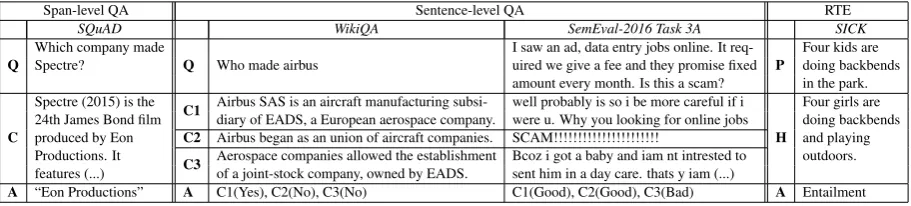
There have been several QA paradigms in NLP, which can be categorized by the context and su-pervision used to answer questions. This context can range from structured and confined knowl-edge bases (Berant et al., 2013) to unstructured and unbounded natural language form (e.g., doc-uments on the web (Voorhees and Tice, 2000)) and unstructured, but restricted in size (e.g., a paragraph or multiple sentences (Hermann et al., 2015)). The recent advances in neural question an-swering lead to numerous datasets and successful models in these paradigms (Rajpurkar et al.,2016; Yang et al., 2015;Nguyen et al., 2016;Trischler et al., 2016). The answer types in these datasets are largely divided into three categories: sentence-level, in-context span, and generation. In this paper, we specifically focus on the former two and show that span-supervised models can better learn syntactic and lexical features. Among these datasets, we briefly describe three QA datasets to be used for the experiments in this paper. We also give the description of an RTE dataset for an ex-ample of a non-QA task. Refer to Table1 to see the examples of the datasets.
SQuAD (Rajpurkar et al.,2016) is a recent span-based QA dataset, containing 100k/10k train/dev examples. Each example is a pair of context
para-graph from Wikipedia and a question created by a human, and the answer is a span in the context.
SQUAD-T is our modification of SQuAD dataset to allow for sentence selection QA. (‘T’ for senTence). We split the context paragraph into sentences and formulate the task as classi-fying whether each sentence contains the answer. This enables us to make a fair comparison between pretraining with span-supervised and sentence-supervised QA datasets.
WikiQA (Yang et al.,2015) is a sentence-level QA dataset, containing 1.9k/0.3k train/dev an-swerable examples. Each example consists of a real user’s Bing query and a snippet of a Wikipedia article retrieved by Bing, containing 18.6 sen-tences on average. The task is to classify whether each sentence provides the answer to the query.
SemEval 2016 (Task 3A) (Nakov et al., 2016) is a sentence-level QA dataset, containing 1.8k/0.2k/0.3k train/dev/test examples. Each ex-ample consists of a community question by a user and 10 comments. The task is to classify whether each comment is relevant to the question.
SICK (Marelli et al., 2014) is a dataset for recognizing textual entailment (RTE), containing 4.5K/0.5K/5.0K train/dev/test examples. Each ex-ample consists of a hypothesis and a premise, and the goal is to determine if the premise is entailed by, contradicts, or is neutral to the hypothesis (hence classification problem). We also report re-sults on SICK to show that span-supervised QA dataset can be also useful for non-QA datasets.
3 Model
Among numerous models proposed for span-level QA tasks (Xiong et al., 2017; Wang and Jiang, 2017b), we adopt an open-sourced model, BiDAF2(Seo et al.,2017).
BiDAF. The inputs to the model are a ques-tion q, and a context paragraph x. Then the model selects the best answer span, which is arg max(i,j)ystart
i yjend, where i <= j. Here, ystarti andyendi are start and end position proba-bilities ofi-th element, respectively.
Here, we briefly describe the answer mod-ule which is important for transfer learning to sentence-level QA. The input to the answer mod-ule is a sequence of vectors {hi} each of which
encodes enough information about the i-th con-text word and its relationship with its surrounding words and the question words. Then the role of the answer module is to map each vectorhito its start
and end position probabilities,ystarti andyendi .
BiDAF-T refers to the modified version of BiDAF to make it compatible with sentence-level QA. (‘T’ for senTence). In this task, the inputs are a question q and a list of sentences,x1, . . . ,xT,
whereTis the number of the sentences. Note that, unlike BiDAF, which outputs single answer per example, Here we need to output a C-way clas-sification for eachk-th sentence.
Since BiDAF is a span-selection model, it can-not be directly used for sentence-level classifica-tion. Hence we replace the original answer mod-ule of BiDAF with a different answer modmod-ule, and keep the other modules identical to those of BiDAF. Given the input to the new answer mod-ule, {hk
1, . . . ,hkN}, where the superscript is the
sentence index (1 ≤ k ≤ T), we obtain the C–way classification scores for thek-th sentence, ˜
yk∈[0,1]Cvia max-pooling method:
˜
yk = softmax(Wmax(hk1, . . . ,hkN) +b) (1)
whereW ∈ RC×d,b ∈ RC are trainable weight
matrix and bias, respectively, andmax()function is applied elementwise.
For WikiQA and SemEval 2016, the number of classes (C) is2, i.e. each sentence (or comment) is either relevant or not relevant. Since some of the metrics used for these datasets require full rank-ing, we use the predicted probability for “relevant” label to rank the sentences.
Note that BiDAF-T can be also used for the RTE dataset, where we can consider the hypothesis as a question and the premise as a context sentence (T = 1), and classify each example into ‘entail-ment’, ‘neutral’, or ‘contradiction’ (C = 3).
Transfer Learning. Transfer learning between the same model architectures3 is straightforward: we first initialize the weights of the target model with the weights of the source model pretrained on the source dataset, and then we further train (fine-tune) on the target model with the target dataset. To transfer from BiDAF (on SQuAD) to BiDAF-T, we transfer all the weights of the identical modules, and initialize the new answer module in BiDAF-T with random values. For more training details, refer to AppendixA.
4 Experiments
Pretrained Fine- WikiQA SemEval-2016 dataset tuned MAP MRR P@1 MAP MRR AvgR
- - 62.96 64.47 49.38 76.40 82.20 86.51 SQuAD-T No 75.22 76.40 62.96 47.23 49.31 60.01 SQuAD No 75.19 76.31 62.55 57.80 66.10 71.13 SQuAD-T Yes 76.44 77.85 64.61 76.30 82.51 86.64 SQuAD Yes 79.90 82.01 70.37 78.37 85.58 87.68 SQuAD* Yes 83.20 84.58 75.31 80.20 86.44 89.14
[image:3.595.307.527.252.358.2]Rank 1 74.33 75,45 - 79.19 86.42 88.82 Rank 2 74.17 75.88 64.61 77.66 84.93 88.05 Rank 3 70.69 72.65 - 77.58 85.21 88.14
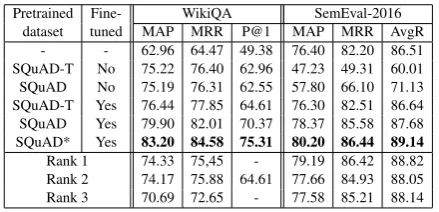
Table 2:Results on WikiQA and SemEval-2016 (Task 3A). The first row is a result from non-pretrained model, and * in-dicates ensemble method. Metrics used are Mean Average Precision (MAP), Mean Reciprocal Rank (MRR), Precision at rank 1 (P@1), and Average Recall (AvgR). Rank 1,2,3 indi-cate the results by previous works, ordered by MAP. For Wik-iQA, they are fromWang and Jiang(2017a);Tymoshenko et al.(2016);Miller et al.(2016), respectively. For SemEval-2016, they are fromFilice et al.(2016);Joty et al.(2016); Mihaylov and Nakov(2016). SQuAD*&Yes sets the new state of the art on both datasets.
Question Answering Results. Table 2 reports the state-of-the-art results of our transfer learn-ing on WikiQA and SemEval-2016 and the per-formance of previous models as well as several ablations that use no pretraining or no finetuning. There are multiple interesting observations from Table2as follows:
(a) If we only train the BiDAF-T model on the target datasets with no pretraining (first row of Ta-ble2), the results are poor. This shows the impor-tance of both pretraining and finetuning.
(b) Pretraining on SQuAD and SQuAD-T with no finetuning (second and third row) achieves re-sults close to the state-of-the-art in the WikiQA dataset, but not in SemEval-2016. Interestingly, our result on SemEval-2016 is not better than only training without transfer learning. We con-jecture that this is due to the significant differ-ence between the domain of SemEval-2016 and
that of SQuAD, which are from community and Wikipedia, respectively.
(c) Pretraining on SQuAD and SQuAD-T with finetuning (fourth and fifth row) significantly out-performs (by more than 5%) the highest-rank sys-tems on WikiQA. It also outperforms the second ranking system in SemEval-2016 and is only 1% behind the first ranking system.
(d) Transfer learning models achieve better re-sults with pretraining on span-level supervision (SQuAD) than coarser sentence-level supervision (SQuAD-T).4
Finally, we also use the ensemble of 12 differ-ent training runs on the same BiDAF architecture, which obtains the state of the art in both datasets. This system outperforms the highest-ranking tem in WikiQA by more than 8% and the best sys-tem in SemEval-2016 by 1% in every metric. It is important to note that, while we definitely benefit from the scale of SQuAD for transfer learning to smaller WikiQA, given the gap between SQuAD-T and SQuAD (> 3%), we see a clear sign that span-supervision plays a significant role well.
Varying the size of pretraining dataset. We vary the size of SQuAD dataset used during pre-training, and test on WikiQA with finetuning. Re-sults are shown in Table3. As expected, MAP on WikiQA drops as the size of SQuAD decreases. It is worth noting that pretraining on SQuAD-T (Ta-ble2) yields 0.5 point lower MAP than pretraining on 50% of SQuAD. In other words, roughly speak-ing, span-level supervision data is worth more than twice the size of sentence-level supervision data for the purpose of pretraining. Also, even a small size of fine-grained supervision data helps; pre-training with 12.5% of SQuAD gives an advantage of more than 7 points than no pretraining.
Analysis. Figure1shows the latently-learned at-tention maps between the question and one of the context sentences from a WikiQA example in Ta-ble 1. The top map is pretrained on SQuAD-T (corresponding to SQuAD-SQuAD-T&Yes in SQuAD-Table 2) and the bottom map is pretrained on SQuAD (SQuAD&Yes). The more red the color, the higher
4We additionally perform Mann-Whitney U Test and
Mc-Nemars Test to show the statistical significance of the advan-tage of span-level pretraining over sentence-level pretraining. For WikiQA, the advantage is statistically significant with the confidence levels of 97.1% and 99.6%, respectively. For Se-mEval, we obtain the confidence levels of 97.8% and 99.9%, respectively.
Percentage of used SQuAD dataset MAP
100% 79.90
50% 76.94
25% 74.39
[image:4.595.312.526.166.265.2]12.5% 70.76
Table 3:Results with varying sizes of SQuAD dataset used during pretraining. All of them are finetuned and tested on WikiQA.
who
made
airbus
who
made
airbus
Figure 1:Attention maps showing correspondence between the words of a question (vertical) and the subset of its context (horizontal) in WikiQA for (top) SQuAD-T-pretrained model and (bottom) SQuAD-pretrained model. The more red, the higher the correspondence.
the relevance between the words. There are two interesting observations here.
First, in SQuAD-pretrained model (bottom), we see a high correspondence between ques-tion’s airbus and context’s aircraft and aerospace, but the SQuAD-T-pretrained model fails to learn such correspondence.
Second, we see that the attention map of the SQuAD-pretrained model is more sparse, indicat-ing that it is able to more precisely localize cor-respondence between question and context words. In fact, we compare the sparsity of WikiQA test examples in SQuAD&Y and SQuAD-T&Y. Fol-lowingHurley and Rickard(2009), the sparsity of an attention map is defined by
sparsity = | {x∈V|x≤} |
|V| (2)
whereVis a set of values between0 and1in at-tention map, andis a small value which we de-fine0.01 for here. A histogram of the sparsity is shown in Figure2. There is a large gap in the av-erage sparsity of WikiQA test examples between SQuAD&Yes and SQuAD-T&Yes, which are0.84 and0.56, respectively.
More analyses including error analysis and more visualizations are shown in AppendixB.
trans-0 20 40 60 80
0
0.1 0.2 0.3 0.4 0.5 0.6 0.7 0.8 0.9
#
o
f e
xamples
[image:5.595.76.285.62.181.2]sparsity
Figure 2: Histogram of the sparsity (Equation 2) of the attention maps of SQuAD-T-pretrained model (SQuAD-T&Yes, blue) and SQuAD-pretrained model (SQuAD&Yes, red). Mean sparsity of SQuAD-pretrained model (0.84)
is clearly higher than that of SQuAD-T-pretrained model (0.56).
Pretrained dataset / Previous work Accuracy
- 77.96
SQuAD-T 81.49 SQuAD 82.86 SQuAD* 84.38 SNLI 83.20 SQuAD-T+SNLI 85.00 SQuAD+SNLI 86.63 SQuAD+SNLI* 88.22 Yin et al.(2016) 86.2
Lai and Hockenmaier(2014) 84.57
Zhao et al.(2014) 83.64
Jimenez et al.(2014) 83.05
Mou et al.(2016) 70.9
Mou et al.(2016) (pretrained on SNLI) 77.6
Table 4: Results on SICK after finetuning. The first row is only trained on SICK. * indicates ensemble method.
fer learning results of BiDAF-T on SICK dataset (Marelli et al.,2014), with various pretraining rou-tines. Note that SNLI (Bowman et al., 2015) is a similar task to SICK and is significantly larger (150K/10K/10K train/dev/test examples). Here we highlight three observations:
(a) BiDAF-T pretrained on SQuAD outperforms that without any pretraining by 6% and that pre-trained on SQuAD-T by 2%, which demonstrates that the transfer learning from large span-based QA gives a clear improvement.
(b) Pretraining on SQuAD+SNLI outperforms pretraining on SNLI only. Given that SNLI is larger than SQuAD, the difference in their perfor-mance is a strong indicator that we are benefiting from not only the scale of SQuAD, but also the fine-grained supervision that it provides.
(c) We outperform the previous state of the art by 2% with the ensemble of SQuAD+SNLI pre-training routine.
It is worth noting that Mou et al. (2016) also shows improvement on SICK by pretraining on SNLI.
5 Conclusion
In this paper, we show state-of-the-art results on WikiQA and SemEval-2016 (Task 3A) as well as an entailment task, SICK, outperforming previous results by 8%, 1%, and 2%, respectively. We show that question answering with sentence-level super-vision can greatly benefit from standard transfer learning of a question answering model trained on a large, span-level supervision. We additionally show that such transfer learning can be applicable in other NLP tasks such as textual entailment.
Acknowledgments
This research was supported by the NSF (IIS 1616112), Allen Institute for AI (66-9175), Allen Distinguished Investigator Award, and Google Re-search Faculty Award. We thank the anonymous reviewers for their helpful comments.
References
Jonathan Berant, Andrew Chou, Roy Frostig, and Percy Liang. 2013. Semantic parsing on freebase from
question-answer pairs. InEMNLP.
Samuel R Bowman, Gabor Angeli, Christopher Potts, and Christopher D Manning. 2015. A large anno-tated corpus for learning natural language inference. InEMNLP.
Laura Chiticariu, Rajasekar Krishnamurthy, Yunyao Li, Frederick Reiss, and Shivakumar Vaithyanathan. 2010. Domain adaptation of rule-based annotators
for named-entity recognition tasks. InEMNLP.
Jia Deng, Wei Dong, Richard Socher, Li-Jia Li, Kai Li, and Li Fei-Fei. 2009. Imagenet: A large-scale hierarchical image database. InCVPR.
Simone Filice, Danilo Croce, Alessandro Moschitti, and Roberto Basili. 2016. Kelp at semeval-2016 task 3: Learning semantic relations between
ques-tions and answers. SemEval16:1116–1123.
Karl Moritz Hermann, Tomas Kocisky, Edward Grefenstette, Lasse Espeholt, Will Kay, Mustafa Su-leyman, and Phil Blunsom. 2015. Teaching ma-chines to read and comprehend. InNIPS.
Niall Hurley and Scott Rickard. 2009. Comparing
measures of sparsity. IEEE Transactions on
Infor-mation Theory55(10):4723–4741.
[image:5.595.94.268.254.405.2]Shafiq Joty, Alessandro Moschitti, Fahad A Al Obaidli, Salvatore Romeo, Kateryna Tymoshenko, and Anto-nio Uva. 2016. Convkn at semeval-2016 task 3: An-swer and question selection for question anAn-swering
on arabic and english fora. SemEvalpages 896–903.
Andrej Karpathy and Li Fei-Fei. 2015. Deep visual-semantic alignments for generating image descrip-tions. InCVPR.
Ankit Kumar, Ozan Irsoy, Jonathan Su, James Brad-bury, Robert English, Brian Pierce, Peter Ondruska, Ishaan Gulrajani, and Richard Socher. 2016. Ask me anything: Dynamic memory networks for natu-ral language processing. InICML.
Alice Lai and Julia Hockenmaier. 2014. Illinois-lh: A denotational and distributional approach to seman-tics. SemEval.
Marco Marelli, Stefano Menini, Marco Baroni, Luisa Bentivogli, Raffaella Bernardi, and Roberto Zam-parelli. 2014. A sick cure for the evaluation of com-positional distributional semantic models. InLREC. David McClosky, Eugene Charniak, and Mark John-son. 2010. Automatic domain adaptation for
pars-ing. InNAACL-HLT.
Todor Mihaylov and Preslav Nakov. 2016. Semanticz at semeval-2016 task 3: Ranking relevant answers in community question answering using semantic
sim-ilarity based on fine-tuned word embeddings.
Se-mEvalpages 879–886.
Tomas Mikolov, Kai Chen, Greg Corrado, and Jeffrey Dean. 2013a. Efficient estimation of word represen-tations in vector space. InICLR.
Tomas Mikolov, Ilya Sutskever, Kai Chen, Greg S Cor-rado, and Jeff Dean. 2013b. Distributed representa-tions of words and phrases and their compositional-ity. InNIPS.
Alexander Miller, Adam Fisch, Jesse Dodge, Amir-Hossein Karimi, Antoine Bordes, and Jason We-ston. 2016. Key-value memory networks for directly
reading documents. InEMNLP.
Lili Mou, Zhao Meng, Rui Yan, Ge Li, Yan Xu, Lu Zhang, and Zhi Jin. 2016. How transferable are
neural networks in nlp applications? InEMNLP.
Preslav Nakov, Llus Mrquez, Alessandro Moschitti, Walid Magdy Mubarak Hamdy Hamdy, abed Al-hakim Freihat, Jim Glass, and Bilal Randeree. 2016. Semeval-2016 task 3: Community question answer-ing. SemEvalpages 525–545.
Tri Nguyen, Mir Rosenberg, Xia Song, Jianfeng Gao, Saurabh Tiwary, Rangan Majumder, and Li Deng. 2016. Ms marco: A human generated machine
read-ing comprehension dataset. InNIPS Workshop.
Jeffrey Pennington, Richard Socher, and Christo-pher D. Manning. 2014. Glove: Global vectors for
word representation. InEMNLP.
Pranav Rajpurkar, Jian Zhang, Konstantin Lopyrev, and Percy Liang. 2016. Squad: 100,000+ questions for
machine comprehension of text. InEMNLP.
Minjoon Seo, Aniruddha Kembhavi, Ali Farhadi, and Hannaneh Hajishirzi. 2017. Bidirectional attention
flow for machine comprehension. InICLR.
Adam Trischler, Tong Wang, Xingdi Yuan, Justin Har-ris, Alessandro Sordoni, Philip Bachman, and Ka-heer Suleman. 2016. Newsqa: A machine compre-hension dataset. arXiv preprint arXiv:1611.09830.
Kateryna Tymoshenko, Daniele Bonadiman, and Alessandro Moschitti. 2016. Convolutional neural networks vs. convolution kernels: Feature
engineer-ing for answer sentence rerankengineer-ing. InNAACL-HLT.
Ellen M Voorhees and Dawn M Tice. 2000. Building a question answering test collection. InACM SIGIR.
Shuohang Wang and Jing Jiang. 2017a. A compare-aggregate model for matching text sequences. In ICLR.
Shuohang Wang and Jing Jiang. 2017b. Machine com-prehension using match-lstm and answer pointer. In ICLR.
Zhiguo Wang, Wael Hamza, and Radu Florian. 2017. Bilateral multi-perspective matching for natural
lan-guage sentences. arXiv preprint arXiv:1702.03814
.
Caiming Xiong, Victor Zhong, and Richard Socher. 2017. Dynamic coattention networks for question answering. InICLR.
Yi Yang, Wen-tau Yih, and Christopher Meek. 2015. Wikiqa: A challenge dataset for open-domain
ques-tion answering. InEMNLP.
Wenpeng Yin, Hinrich Sch¨utze, Bing Xiang, and Bowen Zhou. 2016. Abcnn: Attention-based convo-lutional neural network for modeling sentence pairs. TACL.
Matthew D Zeiler. 2012. Adadelta: an adaptive learn-ing rate method.arXiv preprint arXiv:1212.5701.
Matthew D Zeiler and Rob Fergus. 2014. Visualiz-ing and understandVisualiz-ing convolutional networks. In ECCV.
Jiang Zhao, Tian Tian Zhu, and Man Lan. 2014. Ecnu: One stone two birds: Ensemble of heterogenous measures for semantic relatedness and textual
A Training details
Parameters. For pretraining BiDAF on SQuAD, we follow the exact same procedure in Seo et al. (2017). For pretraining BiDAF-T on SQuAD-T, we use the same hyperparameters for all modules except the answer module, for which we use the hidden state size of200. The learning rate is controlled by AdaDelta (Zeiler,2012) with the initial learning rate of0.5and minibatch size of 50. We maintain the moving averages of all weights of the model with the exponential decay rate of 0.999 during training and use them at test. The loss function is the cross entropy betweeny˜k and the one-hot vector of the correct classification.
Convergence. For all settings, we train models until performance on development set continue to decrease for 5k steps. Table 5shows the median selected step on each setting.
Dataset Pretrained selected step
SQuAD - 18k
SQuAD-T - 50k
WikiQA - 6k
WikiQA SQuAD-T 6k WikiQA SQuAD 3k SemEval-2016 - 9k SemEval-2016 SQuAD-T 4k SemEval-2016 SQuAD 3k
SICK - 13k
SNLI - 55k
[image:7.595.308.519.63.576.2]SICK SQuAD-T 9k SNLI SQuAD-T 31k SICK SQuAD 18k SNLI SQuAD 49k SICK SQuAD-T+SNLI 7k SICK SQuAD+SNLI 7k
Table 5: Median global step, which has the best perfor-mance on development set.
B More Analysis
Attention maps. We show some more examples of attention maps in Figure3. (Top) We see high correspondence between same word from ques-tion and context such as senator and john, in SQuAD-pretrained model, but the SQuAD-T-pretrained model fails to learn such correspon-dence. (Bottom) We see high correspondence between stems from question and stem from context (left) as well as plant from question and plants from context (right), in SQuAD-pretrained model, but the SQuAD-T-SQuAD-pretrained model fails to learn such correspondence.
Error Analysis. Table 7shows the comparison between answers by SQuAD-T-pretrained model and SQuAD-pretrained model on the example
what
are
the
parts
of
plant stems
what
are
the
parts
of
plant stems
what
state
was
john mccain
a
senator
in
during
the
2008
election
what
state
was
john
mccain
a
senator
in
during
the
2008
[image:7.595.95.269.327.492.2]election
Figure 3:More attention maps showing correspondence be-tween the words of a question (vertical) and one of candidate sentences (horizontal) in WikiQA for (top in each subfigure) SQuAD-MC-pretrained model and (bottom in each subfig-ure) SQuAD-pretrained model. The more red, the higher the correspondence.
of WikiQA and SemEval-2016 from Table 1. On WikiQA, SQuAD-T-pretrained model selects C2 instead of the groundtruth answer C1. On SemEval-2016, SQuAD-pretrained model ranks C3 (bad comment) higher than C2 (good com-ment).
Category Id Category Example Question Relevant Sentence
1 Exact Match When did SpongeBob first air? The pilot episode of SpongeBob SquarePants first aired in theUnited States on May 1, 1999, following the ... 2 Paraphrase When was How the West Was Won filmed? How the West Was Won is a 1962 American epic Western film. 3 No Clear Clue When was Mary Anderson born? Mary Anderson (1866-1953) was a real estate developer, .... 4 Need prior sentence (pronoun) When did Texas become a state? In 1845, it joined the United States as the 28th state.
5 Need prior sentence (context) How do you play spades?
Its major difference as compared to other Whist variants is that, instead of trump being decided by the highest bidder or at random, the Spade suit is always trump, hence the name.
6 Hard to answer How kimberlite pipes form? Volcanic pipes are relatively rare.
Category Id Category Example Question Id Example Question
1 Asking information Q347 R25 hi all is there any IKEA showroom in and around DOHA? Kindly reply thank you
2
Asking opinion or
Q326 R90
Salam I am mechanical Eng. 15 years experience i got a job for Rasgas co. direct recommendation in hire I am married and i have 2 kids 5 and 3 years old.my life style
specific situation is average. Is 8.000 QR enough as a basic salary? (...)
3 Asking feelings inspecific situation Q348 R67 oh i wish they will build Disneyland in Qatar : ) how do you think guys? It will beperfect for Qatar : )
4 Asking abstract thing Q341 R11 id like to get to know more about Al Jazeera International from anyone on QATARLIVING who works at Al Jazeera.
5 Not Asking Q337 R21 I just stumbled across this news article about the the American university campusesat Education City and thought some of you may also find it interesting.
6 Asking a lot of things at once Q337 R16
How good are Karwa services? Are they : 1. Courteous/Rude? 2. Taking the correct route/Longer route? (...) 7. A
[image:8.595.81.532.62.294.2]pleasure/displeasure to ride?
Table 6:Examples from each category on (top) WikiQA and (bottom) SemEval-2016 (Task 3A).
WikiQA SemEval-2016 SQuAD-T&Yes C2>C1>C3 C1>C3>C2 SQuAD&Yes C1>C2>C3 C2>C1>C3
[image:8.595.73.290.419.496.2]Groundtruth C1(Y), C2(N), C3(N) C1(Good), C2(Good), C3(Bad)
Table 7: Comparison of ranked answers by SQuAD-T-pretrained model (SQuAD-T&Yes) and SQuAD-SQuAD-T-pretrained model (SQuAD&Yes) of examples from WikiQA and SemEval-2016 (Task 3A) in Table1.
Pretrained dataset total Category Id
SQuAD-T-Y SQuAD-Y 1 2 3 4 5 6
total 100 37 38 6 15 2 2
Correct Correct 49 28 14 3 4 0 0
Wrong Correct 26 8 14 1 3 0 0
Correct Wrong 9 1 4 1 3 0 0
Wrong Wrong 16 0 6 1 5 2 2
Table 8: Comparison of performance of SQuAD-T-pretrained model (SQuAD-T-Y) and SQuAD-SQuAD-T-pretrained model (SQuAD-Y) on WikiQA.
Pretrained dataset total Category Id
No Pretrain SQuAD-Y 1 2 3 4 5 6
total 100 29 38 7 12 9 5
Correct Correct 30 12 11 2 5 0 0
Wrong Correct 22 6 10 0 2 2 2
Correct Wrong 5 0 1 2 1 0 1
Wrong Wrong 43 11 16 3 4 7 2
Table 9: Comparison of performance of model with-out pretraining (No Pretrain) and SQuAD-pretrained model (SQuAD-Y) on SemEval-2016 (Task 3A).
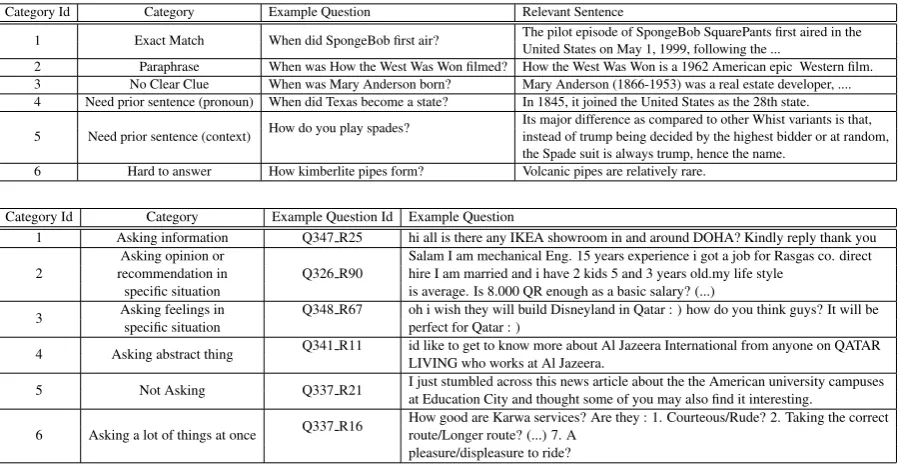
from WikiQA and SemEval-2016, and classified them into 6 categories(Table 6). In Table8, we compare the performance on these WikiQA exam-ples by T-pretrained model and SQuAD-pretrained model. It shows that span supervision clearly helps answering questions on Category 1 and 2, which are easier to answer, with answering
correctly on most of the questions in Category 1. Similarly, we show the comparison of the perfor-mance on classified examples of the model with-out pretraining and SQuAD-pretrained model on SemEval-2016. It also shows that span supervi-sion helps answering questions asking information or opinion/recommendation.
C More Results
SQuAD-T. To better understand SQuAD-T dataset, we show the performance BiDAF-T with different training routines. We get MAP 89.46 and accuracy 85.34% with SQuAD-trained BiDAF model, and MAP 90.18 and accuracy 84.69% with SQuAD-T-trained BiDAF-T model. There is no large gap between the two models, as each para-graph of SQuAD-T has 5 sentences on average, which makes the classification problem easier than WikiQA.
[image:8.595.72.291.540.618.2]