Proceedings of the 2019 EMNLP and the 9th IJCNLP (System Demonstrations), pages 19–24 19
Applying BERT to Document Retrieval with Birch
Zeynep Akkalyoncu Yilmaz, Shengjin Wang, Wei Yang, Haotian Zhang, and Jimmy Lin
David R. Cheriton School of Computer Science University of Waterloo
Abstract
We present Birch, a system that applies BERT to document retrieval via integration with the open-source Anserini information retrieval toolkit to demonstrate end-to-end search over large document collections. Birch implements simple ranking models that achieve state-of-the-art effectiveness on standard TREC newswire and social media test collections. This demonstration focuses on technical chal-lenges in the integration of NLP and IR capa-bilities, along with the design rationale behind our approach to tightly-coupled integration be-tween Python (to support neural networks) and the Java Virtual Machine (to support document retrieval using the open-source Lucene search library). We demonstrate integration of Birch with an existing search interface as well as in-teractive notebooks that highlight its capabili-ties in an easy-to-understand manner.
1 Introduction
The information retrieval community, much like the natural language processing community, has witnessed the growing dominance of approaches based on neural networks. Applications of neu-ral networks to document ranking usually involve multi-stage architectures, beginning with a tra-ditional term-matching technique (e.g., BM25) over a standard inverted index, followed by a reranker that rescores the candidate list of docu-ments (Asadi and Lin,2013).
Researchers have developed a panoply of neural ranking models—see Mitra and Craswell (2019) for a recent overview—but there is emerging evi-dence that BERT (Devlin et al.,2019) outperforms previous approaches to document retrieval (Yang et al., 2019c; MacAvaney et al., 2019) as well as search-related tasks such as question answer-ing (Nogueira and Cho,2019;Yang et al.,2019b).
We share with the community Birch,1 which in-tegrates the Anserini information retrieval toolkit2 with a BERT-based document ranking model that provides an end-to-end opsource search en-gine. Birch allows the community to replicate the state-of-the-art document ranking results pre-sented in Yilmaz et al. (2019) and Yang et al. (2019c). Here we summarize those results, but our focus is on system architecture and the rationale behind a number of implementation design deci-sions, as opposed to the ranking model itself.
2 Integration Challenges
The problem we are trying to solve, and the focus of this work, is how to bridge the worlds of infor-mation retrieval and natural language processing from a software engineering perspective, for appli-cations to document retrieval. Following the stan-dard formulation, we assume a (potentially large) corpusDthat users wish to search. For a keyword query Q, the system’s task is to return a ranked list of documents that maximizes a retrieval met-ric such as average precision (AP). This stands in contrast to reading comprehension tasks such as SQuAD (Rajpurkar et al.,2016) and many formu-lations of question answering today such as Wiki-QA (Yang et al.,2015) and the MS MARCO QA Task (Bajaj et al.,2018), where there is no (or min-imal) retrieval component. These are better char-acterized as “selection” tasks on (pre-determined) text passages.
Within the information retrieval community, there exists a disconnect between academic re-searchers and industry practitioners. Outside of a few large organizations that deploy custom infras-tructure (mostly commercial search engine com-panies), Lucene (along with the closely-related
1
projects Solr and Elasticsearch) has become the de facto platform for building real-world search ap-plications, deployed at Twitter, Netflix, eBay, and numerous other organizations. However, many re-searchers still rely on academic systems such as Indri3 and Terrier,4 which are mostly unknown in real-world production environments. This gap hinders technology transfer and the potential im-pact of research results.
Even assuming Lucene as a “common denom-inator” that academic researchers learn to adopt, there is still one technical hurdle: Lucene is im-plemented in Java, and hence runs on the Java Vir-tual Machine (JVM). However, most deep learn-ing toolkits today, includlearn-ing TensorFlow and Py-Torch, are written in Python with a C++backend. Bridging Python and the JVM presents a technical challenge for NLP/IR integration.
3 Birch
3.1 Anserini
Anserini (Yang et al.,2017,2018) represents an at-tempt to better align academic researchers with in-dustry practitioners by building a research-focused toolkit on top of the open-source Lucene search library. Further standardizing on a common plat-form within the academic community can foster greater replicability and reproducibility, a growing concern in the community (Lin et al.,2016).
Already, Anserini has proven to be effective and has gained some traction: For example, Nogueira and Cho(2019) used Anserini for generating can-didate documents before applying BERT to rank-ing passages in the TREC Complex Answer Re-trieval (CAR) task (Dietz et al.,2017), which led to a large increase in effectiveness. Yang et al. (2019b) also combined Anserini and BERT to demonstrate large improvements in open-domain question answering directly on Wikipedia.
3.2 Design Decisions
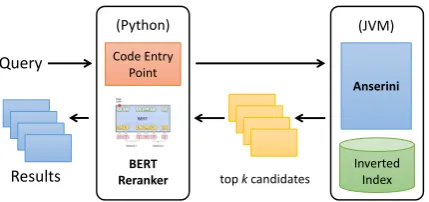
The architecture of Birch is shown in Figure 1, which codifies a two-stage pipeline architecture where Anserini is responsible for retrieval, the out-put of which is passed to a BERT-based reranker. Since our research group has standardized on Py-Torch, the central challenge we tackle is: How do we integrate the deep learning toolkit with Anserini?
3
https://www.lemurproject.org/ 4http://terrier.org/
(Python)
Query
top kcandidates
Results RerankerBERT
(JVM)
Inverted Index Code Entry
Point
[image:2.595.310.525.62.163.2]Anserini
Figure 1: Architecture of Birch, illustrating a tight integration between Python and the Java Virtual Ma-chine. The main code entry point is in Python, which calls Anserini for retrieval; candidate documents from Anserini are then reranked by our BERT models.
At the outset, we ruled out “loosely-coupled” integration approaches: For example, passing in-termediate text files is not a sustainable solution in the long term. It is not only inefficient, but inter-change formats frequently inter-change (whether inten-tionally or accidentally), breaking code between multiple components. We also ruled out integra-tion via REST APIs for similar reasons: efficiency (overhead of HTTP calls) and stability (imperfect solutions for enforcing API contracts, particularly in a research environment).
There are a few options for the “tightly-coupled” integration we desired. In principle, we could adopt the Java Virtual Machine (JVM) as the primary code entry point, with integration to the Torch backend via JNI, but this was ruled out because it would create two separate code paths (JVM to C++ for execution and Python to C++
for model development), which presents maintain-ability issues. After some exploration, we de-cided on Python as the primary development en-vironment, integrating Anserini using the Pyjnius Python library5 for accessing Java classes. The library was originally developed to facilitate An-droid development in Python, and allows Python code to directly manipulate Java classes and ob-jects. Thus, Birch supports Python as the main development language (and code entry point, as shown in Figure 1), connecting to the backend JVM to access retrieval capabilities.
3.3 Models
Our document ranking approach is detailed in Yil-maz et al.(2019) andYang et al.(2019c). We fol-lowNogueira and Cho (2019) in adapting BERT for binary (specifically, relevance) classification over text. Candidate documents from Anserini
2011 2012 2013 2014
Model AP P@30 AP P@30 AP P@30 AP P@30
QL 0.3576 0.4000 0.2091 0.3311 0.2532 0.4450 0.3924 0.6182
RM3 0.3824 0.4211 0.2342 0.3452 0.2766 0.4733 0.4480 0.6339
MP-HCNN (Rao et al.,2019) 0.4043 0.4293 0.2460 0.3791 0.2896 0.5294 0.4420 0.6394 BiCNN (Shi et al.,2018) 0.4293 0.4728 0.2621 0.4147 0.2990 0.5367 0.4563 0.6806
Birch 0.4697 0.5040 0.3073 0.4356 0.3357 0.5656 0.5176 0.7006
Table 1: Results on test collections from the TREC Microblog Tracks, comparing BERT with selected neural ranking models. The first two blocks of the table contain results copied fromRao et al.(2019).
are processed individually. As model input, we concatenate the queryQ and documentD into a text sequence [[CLS],Q, [SEP], D, [SEP]], and then pad each text sequence in a mini-batch toN tokens, where N is the maximum length in the batch. The [CLS] vector is then taken as input to a single layer neural network. Starting from a pre-trained BERT model, we fine-tune with exist-ing relevance judgments usexist-ing cross-entropy loss. BERT inference scores are then combined with the original retrieval scores, in the simplest case, using linear interpolation.
In this simple approach, long documents pose a problem since BERT wasn’t specifically de-signed to perform inference on long input texts. We present a simple solution: inference is applied over each sentence in a candidate document and sentence-level evidence is aggregated for ranking documents as follows:
Sf =a·Sdoc+ (1−a)· n
X
i=1
wi·Si (1)
where Sdoc is the original document score and Si is the i-th top-scoring sentence according to
BERT; aandwi’s are parameters that need to be
learned. In practice, we only consider up to the three top-scoring sentences in each document.
The intuition behind this approach comes from Zhang et al.(2018b,a), who found that the “best” sentence or paragraph in a document provides a good proxy for document relevance. From a dif-ferent perspective, we are essentially implement-ing a form of passage retrieval.
4 Retrieval Results
4.1 TREC 2011–2014 Microblog Tracks
As originally reported inYang et al.(2019c), Birch was evaluated on tweet test collections from the TREC Microblog Tracks, 2011 to 2014 (Lin et al.,
2014). Since tweets are short, relevance judg-ments can be directly used to fine-tune the BERT model (Section3.3). For evaluation on each year’s dataset, we used the remaining years for fine-tuning, e.g., tuning on 2011–2013 data, testing on 2014 data. Additional details on the fine-tuning strategy and experimental settings are described inYang et al.(2019c).
At retrieval (inference) time, query likelihood (QL) with RM3 relevance feedback (Nasreen et al., 2004) was used to provide the initial pool of candidates (to depth 1000). Since tweets are short, we can apply inference over each candidate document in its entirety. The interpolation weight between the BERT scores and the retrieval scores was tuned on the validation data.
Experimental results are shown in Table 1, where we present average precision (AP) and pre-cision at rank 30 (P@30), the two official met-rics of the evaluation (Ounis et al., 2011). The first two blocks of the table are copied fromRao et al. (2019), who compared bag-of-words base-lines (QL and RM3) to several popular neural ranking models as well as MP-HCNN, the model they introduced. The results of Rao et al.(2019) were further improved in Shi et al. (2018); in all cases, the neural models include interpolation with the original document scores. We see that Birch yields a large jump in effectiveness across all Mi-croblog collections.
4.2 TREC 2004 Robust Track
Model AP P@20 NDCG@20
BM25+RM3 0.2903 0.3821 0.4407
1S: BERT 0.3676 0.4610 0.5239
2S: BERT 0.3697 0.4657 0.5324
3S: BERT 0.3691 0.4669 0.5325
Table 2: Results on Robust04, wherenS denotes com-bining scores from the topnsentences in a document.
descriptions of our approach and presents experi-ments on more test collections.
The additional challenge with ranking newswire articles is the lack of training data to fine-tune the BERT models, since relevance judgments are provided at the document level. That is, in the standard formulation of document ranking, a doc-ument is considered relevant if any part of it is relevant—but documents are typically longer than the lengths of text BERT was designed to handle. The surprising finding ofYilmaz et al. (2019) is that BERT models fine-tuned with the Microblog test collections in Section4.1 can bedirectly ap-plied to rank newswire documents, despite the dif-ferences in domain (social media posts vs. news articles). Furthermore, it appears that out-of-domain passage-level relevance judgments fortu-itouslyavailable, such as the MS MARCO passage dataset (Bajaj et al., 2018) and the TREC CAR dataset (Dietz et al.,2017), are also beneficial.
Thus, it appears that BERT is able to learn
cross-domain,sentence-levelnotions of relevance that can be exploited for ranking newswire doc-uments. Table 2 presents an extract of results fromYilmaz et al.(2019) for Robust04, where we find that the best results are achieved by first fine-tuning on MS MARCO and then on the Microblog data. Scores from BERT are then combined with document scores (BM25+RM3) based on Eq (1). The notation “1S”, “2S”, and “3S” refer to ag-gregating scores from the top one, two, and three sentences, respectively. Including more sentences doesn’t help and ranking is already quite good if we just consider the top-scoring sentence. This re-sult, surprisingly, suggests that document ranking can be distilled into relevance prediction primarily at the sentence level. Based on the meta-analysis byYang et al.(2019a), this is not only the highest known AP reported on the Robust04 dataset for neural models, but also exceeds the previous best known AP score of 0.3686, which is a non-neural method based on ensembles.
5 Demonstration
We demonstrate the integration of Birch with the search frontend from HiCAL (Abualsaud et al., 2018b) and interactive Google Colab notebooks.
5.1 HiCAL
The goal of the HiCAL system6 is to help human assessors efficiently find as many relevant doc-uments as possible in a large document collec-tion to achieve high recall on a search task. The system comprises two main components: a Con-tinuous Active Learning (CAL) model (Cormack and Grossman,2014) and a search model. In the CAL model, a machine-learned classifier selects the most likely relevant document or paragraph for the assessor to judge; judgments are then fed back to retrain the classifier. In the current Hi-CAL implementation, Anserini provides the back-end search capabilities.
For the TREC Common Core Tracks in 2017 and 2018, a small group of researchers used HiCAL to find and judge relevant documents. The runs generated based on their assessments achieved the highest AP scores among all the submitted runs for two consecutive years (Zhang et al.,2017;Abualsaud et al.,2018a). The effec-tiveness of the system was further demonstrated in Zhang et al.(2018a).
We further augment the Anserini backend for HiCAL with Birch in two ways: First, HiCAL can directly take advantage of improved rankings pro-vided by BERT. Second, the top-scoring sentences can be highlighted in the document to aid in as-sessment. A sample screenshot is shown in Fig-ure2. For query 336 “black bear attacks” from Ro-bust04, we show part of the highest-scoring docu-mentLA081689-0039with one of the top three sentences (according to BERT) highlighted.
5.2 Interactive Colab Notebooks
We present Google Colab7notebooks that make it possible for anyone to reproduce our end-to-end document retrieval pipeline in an interactive man-ner.8 We make all our data and pre-trained mod-els available, although users may also opt to re-build them from scratch; the Colab GPU backend enables fine-tuning BERT models directly in the notebook environment.
6
https://github.com/hical 7
https://colab.research.google.com/ 8To ensure long-term availability, sample notebooks are
Figure 2: Screenshot of HiCAL using Birch to identify the most relevant sentences in a document retrieved for the query “black bear attacks”.
Our notebooks are set up to allow relevance scores to be computed for an entire test collection in batch, and also to support interactive querying. When the user issues a query through the interac-tive notebook, candidate documents from the cor-pus are first retrieved using Anserini. A sentence-level dataset is created on the fly from the initial ranking by splitting each document into its con-stituent sentences. Each sentence is fed into our BERT model to obtain a relevance score. These relevance scores are then aggregated with docu-ment scores to rerank the candidate docudocu-ments, per Eq (1). The notebook setting allows a user to step through each part of the process and examine intermediate results to gain a better understanding of our approach.
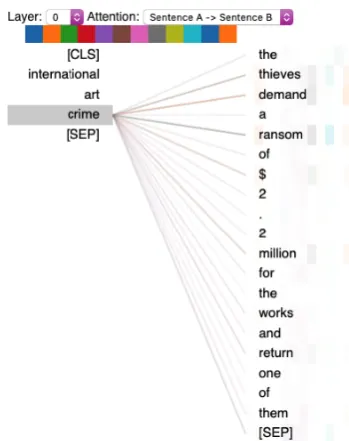
In addition, we have implemented two meth-ods to visualize the relevant documents for a given query from a test collection, hopefully conveying even more insights. First, we generate a table that displays the document scores juxtaposed with the BERT scores of constituent sentences. Sentences with low document scores but high BERT scores (and vice versa) are highlighted, allowing the user to examine the relative contributions of exact term matching and semantic matching, as contributed by BERT. Second, we incorporatebertviz,9an open-source tool for visualizing attention in trans-former models, to explore the interaction between multiple attention heads. In Figure3, we show a sentence with a high BERT score in a document retrieved for query 322 “international art crime” from Robust04. Note that this sentence doesnot
9https://github.com/jessevig/bertviz
Figure 3: Screenshot of attention visualization for a sentence with a high BERT score from a document re-trieved for the query “international art crime”. Note the lack of exact matches with query terms.
contain any of the query terms, but yet appears to be relevant. If we examine the attention vi-sualization for the query term “crime”, we see that the model attends to obviously-related terms like “thieves”, “demand”, and “ransom”, illustrat-ing the semantic knowledge that is captured in the BERT model.
6 Conclusions
This paper describes the system architecture and motivation behind a straightforward application of BERT to document ranking, via sentence-level inference and simple score aggregation. With the implementation of this system, we have also overcome the technical challenge of integrating a Lucene-based backend on the JVM with PyTorch to enable development in an environment NLP researchers and practitioners are already familiar with. The fruits of our labor are released in an open-source system for the community to continue explorations in search-related tasks with BERT.
Acknowledgments
[image:5.595.325.500.64.285.2]References
M. Abualsaud, G. Cormack, N. Ghelani, A. Ghenai, M. Grossman, S. Rahbariasl, M. Smucker, and H. Zhang. 2018a. UWaterlooMDS at the TREC 2018 Common Core Track. InTREC.
M. Abualsaud, N. Ghelani, H. Zhang, M. Smucker, G. Cormack, and M. Grossman. 2018b. A system for efficient high-recall retrieval. In SIGIR, pages 1317–1320.
N. Asadi and J. Lin. 2013. Effectiveness/efficiency tradeoffs for candidate generation in multi-stage re-trieval architectures. InSIGIR, pages 997–1000.
P. Bajaj, D. Campos, N. Craswell, L. Deng, J. Gao, X. Liu, R. Majumder, A. McNamara, B. Mitra, T. Nguyen, M. Rosenberg, X. Song, A. Stoica, S. Ti-wary, and T. Wang. 2018. MS MARCO: A hu-man generated MAchine Reading COmprehension dataset. arXiv:1611.09268v3.
G. Cormack and M. Grossman. 2014. Evaluation of machine-learning protocols for technology-assisted review in electronic discovery. InSIGIR, pages 153– 162.
J. Devlin, M. Chang, K. Lee, and K. Toutanova. 2019. BERT: Pre-training of deep bidirectional transform-ers for language undtransform-erstanding. In NAACL, pages 4171–4186.
L. Dietz, M. Verma, F. Radlinski, and N. Craswell. 2017. TREC Complex Answer Retrieval overview. InTREC.
J. Lin, M. Crane, A. Trotman, J. Callan, I. Chattopad-hyaya, J. Foley, G. Ingersoll, C. Macdonald, and S. Vigna. 2016. Toward reproducible baselines: The open-source IR reproducibility challenge. InECIR 2016, pages 408–420.
J. Lin, M. Efron, Y. Wang, and G. Sherman. 2014. Overview of the TREC-2014 Microblog Track. In
TREC.
S. MacAvaney, A. Yates, A. Cohan, and N. Goharian. 2019. CEDR: Contextualized embeddings for docu-ment ranking. InSIGIR, pages 1101–1104.
B. Mitra and N. Craswell. 2019. An introduction to neural information retrieval. Foundations and Trends in Information Retrieval, 13(1):1–126.
A. Nasreen, J. Allan, W. B. Croft, F. Diaz, L. Larkey, X. Li, D. Metzler, M. Smucker, T. Strohman, H. Tur-tle, and C. Wade. 2004. UMass at TREC 2004: Nov-elty and HARD. InTREC.
R. Nogueira and K. Cho. 2019. Passage re-ranking with BERT. arXiv:1901.04085.
I. Ounis, C. Macdonald, J. Lin, and I. Soboroff. 2011. Overview of the TREC-2011 Microblog Track. In
TREC 2011.
P. Rajpurkar, J. Zhang, K. Lopyrev, and P. Liang. 2016. SQuAD: 100,000+ questions for machine compre-hension of text. InEMNLP 2016, pages 2383–2392.
J. Rao, W. Yang, Y. Zhang, F. Ture, and J. Lin. 2019. Multi-perspective relevance matching with hierar-chical ConvNets for social media search. AAAI, pages 232–240.
P. Shi, J. Rao, and J. Lin. 2018. Simple attention-based representation learning for ranking short social me-dia posts. InNAACL, pages 2212–2217.
E. Voorhees. 2004. Overview of the TREC 2004 Ro-bust Track. InTREC 2004, pages 52–69.
P. Yang, H. Fang, and J. Lin. 2017. Anserini: Enabling the use of Lucene for information retrieval research. InSIGIR 2017, pages 1253–1256.
P. Yang, H. Fang, and J. Lin. 2018. Anserini: Repro-ducible ranking baselines using Lucene. Journal of Data and Information Quality, 10(4):Article 16.
W. Yang, K. Lu, P. Yang, and J. Lin. 2019a. Critically examining the “neural hype”: weak baselines and the additivity of effectiveness gains from neural ranking models. InSIGIR, pages 1129–1132.
W. Yang, Y. Xie, A. Lin, X. Li, L. Tan, K. Xiong, M. Li, and J. Lin. 2019b. End-to-end open-domain ques-tion answering with BERTserini. InNAACL Demo, pages 72–77.
W. Yang, H. Zhang, and J. Lin. 2019c. Simple ap-plications of BERT for ad hoc document retrieval.
arXiv:1903.10972.
Y. Yang, W. Yih, and C. Meek. 2015. WikiQA: A chal-lenge dataset for open-domain question answering. InEMNLP, pages 2013–2018.
Z. Akkalyoncu Yilmaz, W. Yang, H. Zhang, and J. Lin. 2019. Cross-domain modeling of sentence-level ev-idence for document retrieval. InEMNLP.
H. Zhang, M. Abualsaud, N. Ghelani, A. Ghosh, M. Smucker, G. Cormack, and M. Grossman. 2017. UWaterlooMDS at the TREC 2017 Common Core Track. InTREC.
H. Zhang, M. Abualsaud, N. Ghelani, M. Smucker, G. Cormack, and M. Grossman. 2018a. Effective user interaction for high-recall retrieval: less is more. InCIKM, pages 187–196.