DaSCE: Data Security for Cloud Environment
Pawan Kumar Shefali Kanwar
B. Tech Student B. Tech Student
Department of Computer Science & Engineering Department of Computer Science & Engineering SRM University, Chennai, India SRM University, Chennai, India
R. Subash
Guide
Department of Computer Science & Engineering SRM University, Chennai, India
Abstract
In this venture we significantly offering constant information security in distributed computing. Giving security to petabyte s of information is imperative. A current study on cloud security States that the security of clients' information has the most astounding need and also concern. In this manner, to give secure cloud structure I have proposed a framework named secure distributed computing system (SCCF). To upgrade security, we proposed to include programmed interruption recognition and aversion strategy for Brute compel and SQL infusion assaults. At last the information proprietor records are encoded utilizing RC5 encryption calculation and put away out in the open distributed storage named cloudMe.
Keywords: Data Security, Cloud Storage, Encryption, Web Application & Injection
________________________________________________________________________________________________________
I. INTRODUCTION
Distributed computing and its components has been a talk point in the past a few years. It has been a plan for association connotation because of advantages in cost-reserve funds, change in work efficiencies, business dexterity and nature of administrations. With the quick ascent in distributed computing, programming as a service(SaaS) is especially popular, since it offers benefits that suit clients' need. For instance, Health informatics can help medicinal scientist’s analyses testing ailments and tumors. Budgetary examination can guarantee precise and quick recreations to be accessible for financial specialists. Instruction as an administration enhances the nature of training and conveyance. Versatile applications permit clients to play web based amusements and simple to-utilize applications to communicate with their companions.
While more individuals and associations utilize the cloud administrations, security and protection turn out to be critical to make that every one of the information they utilize and share are all around scrambled. A few specialists given that security ought to be executed before the utilization of any cloud benefits in area. This makes a testing reception situation for association since security ought to be upheld and executed in parallel.
The security, the product building and improvement process ought to dependably configuration, execute and test security highlights [4]. suppositions on particular premise. Aggressors spread PC infections, malevolent codes and furthermore direct DDoS assaults.
The server farms have experienced difficulties of quick increment in the information. For instance, in a server farm that the lead creator used to work with day by day increment of 100 terabytes of information was normal. On the off chance that the association has experienced a fast ascent of information development and can't react rapidly and productively, issues, for example, information activity, information security and administration level assentation issues can happen.
Aside from the server farm security administration for fast development in information, the product building procedure ought to be sufficiently strong to withstand assaults and unapproved get to. The whole procedure can be additionally solidified with the improvement of a structure to take care of the specialized plan and executions, administration and approaches related with great practices. This persuades us to build up a structure, Data Security for cloud environment (DaSCE), to help associations effectively embrace and convey any cloud administrations and tasks.
Recorded in the's client profile. The Detection server contrasts client designs and the SC designs gathered in aggressor profile, and those in client profiles individually recognize vindictive practices and distinguish the assailant continuously. Likewise, a nearby computational lattice is required to store client log documents, client profiles and assailant profiles.
(IJSTE/ Volume 3 / Issue 11 / 001)
II. MODULE
Identity Administer
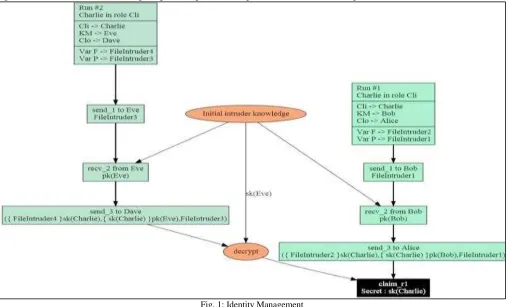
The character administration is partitioned into two parts: customer and the security supervisor are taking after.
Customer: Users can encode each key from his piece and his own key. They can part documents into pieces, scramble them with the key, They can part records into squares, encode them with the key, trailed by marking the subsequent encoded pieces and making the capacity ask. For each document, this key will be utilized to decode and revamp the first record amid the recovery stage. The client likewise utilizes single sign-on to get to each square with a minimal mark plot.
Fig. 1: Identity Management
Security Manager: Three parts are offered by the security chief. To begin with, it can validate clients amid the capacity/recovery stage. Second, it can get to control. Third, it can encode/decode information amongst clients and their cloud. great practices. This persuades us to build up a structure, Cloud.
Instruction Detection and Prevention
In this module programmed Intrusion identification framework (IDS), encryption, profound bundle assessment (DPI) and report the outcome to the controller. The principle objective of OpenSec is to permit arrange administrators to depict security approaches for particular stream. The strategies incorporate a portrayal of the stream, a rundown of security administrations that apply to the stream and how to respond on the off chance that malignant substance is found. The response can be to caution just or to isolate movement or even piece all parcels from a particular source. Consequently, we have considered programmed direction recognition and alarming system administrator naturally interruption discovery and cautioning system administrator naturally when gatecrasher tries brute constrain, SQL infusion and wrapping assault.
SQL Injection
SQL Injection is a standout amongst the most broadly abused web application weakness of the web time. SQL Injection is utilized by programmers to take information from online organizations' and associations' sites. This web application weakness is commonly found in web applications which don't approve the client's information.
Therefore, a noxious client can infuse SQL proclamations through the site and into the database to have them executed. On the off chance that a web application is defenseless against SQL infusion, a programmer can execute any malignant SQL inquiry or order through the web application.
This implies he or she can recover every one of the information put away in the database, for example, client data, MasterCard subtle elements, government managed savings numbers and qualification to get to private zones of the gateway, for example, the manager entry. By abusing a SQL infusion, it is additionally conceivable to drop (erase) tables from the database. In this way with a SQL Injection the pernicious client has full access to the database.
Wrapping Attack
The ambush uses a strategy known as XML check wrapping and shows vulnerabilities while executing the web advantage inquire. In wrapping attack, the attacker tries to install the dangerous segment in the SOAP (Simple Object Access Protocol) message structure in Transport Layer Service (TLS) and consequent to implanting the pernicious code, fake substance of the message is copied into the server and remembering that executing, cloud server working is thwarted by the assailant.
Encription
Time-based Group Key Management calculation for cryptographic distributed storage applications, which utilizes the intermediary re-encryption calculation to exchange real figuring errand of the gathering key administration to the cloud server.
Along these lines, the proposed conspire enormously lessens the client's calculation and capacity overhead and makes full utilization of cloud server to accomplish an effective gathering key administration for the cryptographic distributed storage applications.
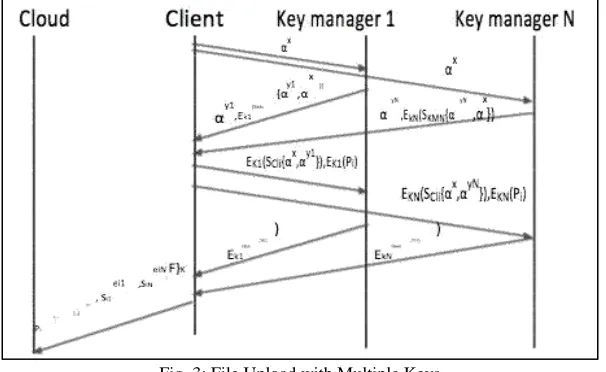
Fig. 3: File Upload with Multiple Keys
Also, we acquaint a key seed system with create a period based element amass key which adequately fortifies the cloud information security.
Our security investigation and execution assessments both demonstrate that the proposed TGKM plan is a safe and effective gathering key administration convention for the distributed storage applications with low overheads of calculation and correspondence.
III. RC 5 ALGORITHM
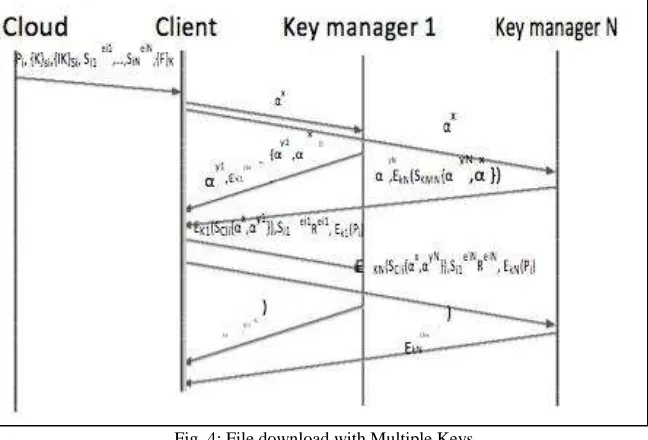
1) The customer produces an irregular number “x” and calculates “αx” mod “p” and sends to the RC.
2) The RC produces an irregular number y and figures αy mod p. The RC likewise figures (αx)y as a session key, EK ,amongst customer and RC.
3) The RC produces computerized signature over {αy, αx} (SRC{αy, αx}) and scrambles it with the created session key to create EK (SRC{αy, αx}).
4) The RC sends (αy , EK (SRC{αy, αx})) to the customer.
5) The customer confirms the mark utilizing the general population key of the RC and figures the session key as (αy)x.
(IJSTE/ Volume 3 / Issue 11 / 001)
7) The RC verifies the signature of the client. Upon successful verification, the RC decrypts Pi and generates (ei, ni) with Pi. 8) The RC encrypts (ei, ni) with the EK to generate (EK(ei, ni)), which is sent to the client.
9) The client encrypts the file F with key K, calculates MAC with IK; and encrypts K and IK with Si. After- wards Si is encrypted with “ei”. Subsequently, the client sends all the encrypted data to cloud.
10) The client erases all of the keys except public key parameters received from the RC.
Fig. 4: File download with Multiple Keys
IV. CLOUD STORAGE
Open distributed storage is a distributed storage show that empowers people and associations alike to store, alter and oversee information. This kind of capacity exists on a remote cloud server and is available over the
Internet. In this venture, we proposed cloudMe.
Open distributed storage is given by a capacity specialist organization that hosts, oversees and sources the capacity foundation freely to a wide range of clients.
Open distributed storage administration is otherwise called stockpiling as an administration, utility stockpiling and online stockpiling.
V. CONCLUSION
Our paper has shown Cloud Computing Multi-layered security for the information security in the Data Center under the proposition and suggestion of security rules. We clarified the method of reasoning, outline, parts in the Cloud Environment, where the plan depended on the prerequisites and the execution was delineated by its multi-layered security. The outcome uncovered that the convention can be for all intents and purposes utilized for mists for security of outsourced information.
REFERENCES
[1] M. Armbrust, A. Fox, R. Griffith, A.D. Joseph, R. Ktaz, A. Konwin- ski, G. Lee, D. Patterson, A. Rabkin, I. Stoics, and M. Zaharia, “A View of Cloud Computing,” Communications of the ACM, Vol. 53, No. 4, 2010, pp. 50-58.
[2] M. S. Blumenthal, “Is Security Lost in the Clouds?” Communica- tions and Strategies, No. 81, 2011, pp. 69-86. [3] C.Cachinand M.Schunter, "A cloud you can trust," IEEE Spectrum, Vol. 48, No. 12, 2011,pp. 28-51
[4] C. Cremers, "The Scyther Tool: Verification, falsification, and analysis of security protocols." In Computer Aided Verification, Springer Berlin Heidelberg, 2008, pp. 414-418.
[5] Cloud Security Alliance https://downloads.cloudsecurityalliance.org/initiatives/cdg/CSA _CCAQIS_Survey.pdf (accessed March 24, 2013).
[6] W. Diffie, P. C. V. Oorschot, and M. J. Wiener, “Authentication and authenticated key exchanges,” Designs, Codes and Cryptography, Vol. 2, No. 2, 1992, pp. 107-125.
[7] M. Ali, K. Bilal, S. U. Khan, B. Veeravalli, K. Li, and A. Y. Zomaya, “DROPS: Division and Replication of Data in the Cloud for Opti- mal Performance and Security,” IEEE Transactions on Cloud Com- puting, 2015, DOI: 10.1109/TCC.2015.2400460.
[8] N. En and N. Srensson, “An extensible SAT-solver,” Lecture Notes in Computer Science, vol. 2919, Springer, 2003, pp. 502-530. [9] C P. Gomes, H. Kautz, A. Sabharwal, and B. Selman, “Satisfia-bility solvers,” In Handbook of Knowledge Representation, Elsevier, 2007.
[10] M. Ali, S. U. Khan, and A. V. Vasilakos, “Security in cloud compu- ting: Opportunities and challenges,” Information Sciences, Vol. 305, 2015, pp. 357-383.
[14] H. Lin and W. Tzeng, “A secure decentralized erasure code for distributed network storage,” IEEE Transactions on Parallel and Dis- tributed Systems, vol. 21, no. 11, Nov. 2010, pp. 1586-159.
[15] H. Lin and W. Tzeng, “A secure erasure code-based cloud storage system with secure data forwarding,” IEEE Transactions on Parallel and Distributed Systems, vol. 23, no. 6, June 2012, pp. 995-1003
[16] S. U. R. Malik, S. K. Srinivasan, S. U. Khan, and L. Wang, “A Methodology for OSPF Routing Protocol Verification,” 12th Inter- national Conference on Scalable Computing and Communications (ScalCom), Changzhou, China Dec 12
[17] L. Moura and N. Bjrner, “Satisfiability Modulo Theories: An appetizer,” Lecture Notes in Computer Science, Vol. 5902, Springer, 2009 , pp. 23-36. [18] Murata, “Petri Nets: Properties, Analysis and Applications,” Proc. IEEE, Vol. 77, No. 4, pp. 541-580, Apr 1989.
[19] A. Shamir, “How to Share a Secret,” Comm. ACM, Vol. 22, No. 11, Nov. 1979, pp. 612-613
[20] H. Takabi, J. B. D. Joshi, and G. J. Ahn, "Security and privacy challenges in cloud computing environments," IEEE Security and Privacy, Vol. 8, No. 6, 2010,pp. 24-31.