Using Argument-based Features to Predict and Analyse Review
Helpfulness
Haijing Liu1,2, Yang Gao1, Pin Lv1, Mengxue Li1,2, Shiqiang Geng3,
Minglan Li1,2and Hao Wang1
1Institute of Software, Chinese Academy of Sciences 2University of Chinese Academy of Sciences 3Beijing Information Science and Technology University
{haijing2015, gaoyang, lvpin, mengxue2015}@iscas.ac.cn [email protected],{minglan2015, wanghao}@iscas.ac.cn
Abstract
We study the helpful product reviews i-dentification problem in this paper. We observe that the evidence-conclusion dis-course relations, also known as argu-ments, often appear in product reviews, and we hypothesise that some argumen-t-based features, e.g. the percentage of argumentative sentences, the evidences-conclusions ratios, are good indicators of helpful reviews. To validate this hy-pothesis, we manually annotate arguments in 110 hotel reviews, and investigate the effectiveness of several combinations of argument-based features. Experiments suggest that, when being used togeth-er with the argument-based features, the state-of-the-art baseline features can enjoy a performance boost (in terms of F1) of 11.01% in average.
1 Introduction
Product reviews have significant influences on po-tential customers’ opinions and their purchase de-cisions (Chatterjee,2001;Chen et al.,2004; Del-larocas et al., 2004). Instead of reading a long list of reviews, customers usually are only will-ing to view a handful of helpful reviewsto make their purchase decisions. In other words, helpful reviews have even greater influences on the po-tential customers’ decision-making processes and thus on the sales; as a result, the automatic identi-fication of helpful reviews has received consider-able research attentions in recent years (Kim et al.,
2006;Liu et al.,2008;Mudambi,2010;Xiong and Litman, 2014;Martin and Pu, 2014;Yang et al.,
2015,2016).
Existing works on helpful reviews identifica-tion mostly focus on designing efficient features.
Widely used features include external features, (e.g. date (Liu et al.,2008), product rating (Kim et al., 2006) and product type (Mudambi, 2010)) and intrinsic features (e.g. semantic dictionar-ies (Yang et al.,2015) and emotional dictionaries (Martin and Pu,2014)). Compared to external fea-tures, intrinsic features can provide some insight-s and explanationinsight-s for the prediction reinsight-sultinsight-s, and support better cross-domain generalisation. In this work, we investigate a new form of intrinsic fea-tures: theargumentfeatures.
An argument is a basic unit people use to per-suade their audiences to accept a particular state of affairs (Eckle-Kohler et al., 2015). An argu-ment usually consists of a claim (also known as conclusion) and some premises (also known as evidences) offered in support of the claim. For example, consider the following review excerpt: “The staff were amazing, they went out of their way to help us”; the texts before the comma con-stitute a claim, and the texts after the comma give a premise supporting the claim. Argumen-tation mining (Moens, 2013; Lippi and Torroni,
2016) receives growing research interests in var-ious domains (Palau and Moens,2009;Contractor et al.,2012;Park and Cardie,2014;Madnani et al.,
2012; Kirschner et al., 2015; Wachsmuth et al.,
2014,2015). Recent advances in automatic argu-ments identification (Stab and Gurevych, 2014), has stimulated the usage of argument features in multiple domains, e.g. essay scoring (Wachsmuth et al.,2016) and online forum comments ranking (Wei12 et al.,2016).
The motivation of this work is a hypothesis that, the helpfulness of a review is closely relat-ed to some argument-relatrelat-ed features, e.g. the percentage of argumentative sentences, the aver-age number of premises in each argument, etc. To validate our hypothesis, we manually anno-tate arguments in 110 hotel reviews so as to use
these “ground truth” arguments to testify the ef-fectiveness of argument-based features for detect-ing helpful hotel reviews. Empirical results sug-gest that, for four baseline feature sets we test, their performances can be improved, in average, by 11.01% in terms of F1-score and 10.40% in terms of AUC when they are used together with some argument-based features. Furthermore, we use the effective argument-based features to give some insights into which product reviews are more helpful.
2 Corpus
We use the Tripadvisor hotel reviews corpus built by (O’Mahony and Smyth, 2010) to test the per-formance of our helpful reviews classifier. Each entry in this corpus includes the review texts, the number of people that have viewed this review (denoted by Y) and the number of people that think this review is helpful (denoted by X).
We randomly sample 110 hotel reviews from this corpus to annotate the “ground truth” argu-ment structures1. In line with (Wachsmuth et al., 2015), we view each sub-sentence in the review as aclauseand ask three annotators independently to annotate each clause as one of the following seven argument components:
Major Claim: a summary of the main opinion of a review. For instance, “I have enjoyed the s-tay in the hotel”, “I am sad to say that i am very disappointed with this hotel”;
Claim: a subjective opinion on a certain aspect of a hotel. For example,“The staff was amazing”, “The room is spacious”;
Premise:an objective reason/evidence support-ing a claim. For instance, “The staff went out of their way to help us”, it supports the first example claim above; “We had a sitting room as well as a balcony”, it supports the second example claim above;
Premise Supporting an Implicit Claim (PSIC): an objective reason/evidence that supporting an implicit claim, which does appear in review. For instance, “just five minutes’ walk to the down town”supports some implicit claims like“the lo-cation of the hotel is good”, although this implicit claims has never appeared in the review;
Background:an objective description that does not give direct opinions but provides some
back-1The annotated corpus can be obtained by contacting the
first author
Component Type Number Kappa
Major claim 143 0.86
Claim 581 0.77
Premise 206 0.65
PSIC 121 0.94
Background 80 0.89
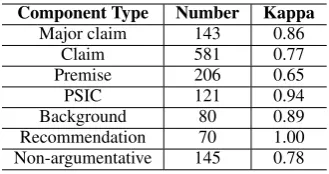
[image:2.595.334.499.61.148.2]Recommendation 70 1.00 Non-argumentative 145 0.78
Table 1: The number and Fleiss’ kappa for each argument component type we annotate.
ground information. For example, “We checked into this hotel at midnight”, “I stayed five nights at this hotel because i was attending a conference at the hotel”;
Recommendation: a positive or negative rec-ommendation for the hotel. For instance,“I would definitely come to this hotel again the next time I visit London”, “Do not come to this hotel if you look for some clean places to live”;
Non-argumentative:for all the other clauses. We use the Fleiss’ kappa metric (Fleiss,1971) to evaluate the quality of the obtained annotation-s, and the results are presented in Table 1. We can see that the lowest Kappa scores (for Premise) is still above 0.6, suggesting that the quality of the annotations aresubstantial(Landis and Koch,
1977); in other words, there exist little noises in the ground truth argument structures. We aggre-gate the annotations using majority voting.
3 Features
In line with (Yang et al., 2015), we consider the helpfulness as an intrinsic characteristic of product reviews, and thus only consider the following four intrinsic features as our baseline features.
Structural features (STR) (Kim et al.,2006; X-iong and Litman, 2014): we use the following structural features: total number of tokens, total number of sentences, average length of sentences, number of exclamation marks, and the percentage of question sentences.
Unigram features (UGR) (Kim et al.,2006; X-iong and Litman,2014): we remove all stopwords and non-frequent words (tf < 3) to build the un-igram vocabulary. Each review is represented by the vocabulary withtf-idf weighting for each ap-peared term.
Emotional features (GALC) (Martin and Pu,
real feature vector with the number of occurrences of each emotional word plus one additional dimen-sion for the number of non-emotional words.
Semantic features (INQUIRER) (Yang et al.,
2015): the General Inquirer (INQUIRER) dictio-nary proposed by (Stone et al., 1962) maps each word to some semantic tags, e.g. word absurd is mapped to tags NEG and VICE; similar to the GALC features, the semantic features include the number of occurrences of each semantic tag.
3.1 Argument-based Features
The argument-based features can have differen-t granularidifferen-ty: for example, differen-the number of argu-ment components can be used as features, and the number of tokens (words) in the argument compo-nents can also be used as features. We consider four granularity of argument features, detailed as follows.
Component-level argument features. A nat-ural feature that we believe to be useful is the ratio of different argument component number-s. For example, we may be interested in the ratio between the number of premises and that of claims; a high ratio suggests that there are more premises supporting each claim, indicat-ing that the review gives many evidences. To generalise this component ratio feature, we pro-pose component-combination ratio features: we compute the ratios between any two argumen-t componenargumen-ts combinaargumen-tions. For example, we may be interested in the ratio between the num-ber of MajorClaim+Claim+Premise and that of Background+Non-argumentative. As there are 7 types of labels, the number of possible combina-tions is27−1 = 127, and thus the possible number
of combination ratio pairs is127×126 = 16002. In other words, the component-level feature is a 16002-dimensional real vector.
Token-level argument features. In a finer-granularity, we consider the number of tokens in argument components to build features: for ex-ample, suppose a review has only two claims, one has 10 words and the other has 5 words; we may want to know the average number of words con-tained in each claim, the total number of words in claims, etc. In total, for each argument component type, we consider 5 types of token-level statistic-s: the total number of words in the given com-ponent type, the length (in terms of word) of the shortest/longest component of the given type, and
the mean/variance of the number of words in each component of the given type. Thus, there are in to-tal7×5 = 35features to represent the token-level statistics.
In addition, the ratio of some token-level statis-tics may also be of interests: for example, given a review, we may want to know the ratio between the number of words in Claims+MajorClaims and that in Premises. Thus, the combination ratio can also be applied here. We consider only the com-bination ratio for two statistics: the total num-ber of words and the average numnum-ber of words in each component-combination; hence, there are 16002×2 = 32004 dimensions for the combi-nation ratio for the statistics. In total, there are 32004 + 35 = 32039 dimensions for the token-level argument features.
Letter-level argument features. In the finest-granularity, we consider the letter-level features, which may give some information the token-level features do not contain: for example, if a review has a big number of letters and a small number of words, it may suggests that many long and com-plex words are used in this review, which, in turn, may suggests that the linguistic complexity of the review is relative high and the review may gives some very professional opinions. Similar to the token-level features above, we design 5 types of statistics and their combination ratios. Thus, the dimension for the letter-level features is the same to that of the token-level features.
position-Accuracy Precision Recall F1-score AUC
AF 0.617 0.625 0.617 0.620 0.611
STR 0.600 0.360 0.600 0.450 0.500
STR+AF 0.604 0.614 0.604 0.607 0.599
UGR 0.697 0.760 0.697 0.646 0.627
UGR+AF 0.718 0.718 0.719 0.717 0.706
GALC 0.621 0.605 0.621 0.579 0.560
GALC+AF 0.647 0.654 0.647 0.649 0.640
INQUIRER 0.533 0.512 0.533 0.517 0.493
[image:4.595.159.440.61.168.2]INQUIRER+AF 0.657 0.664 0.657 0.659 0.651
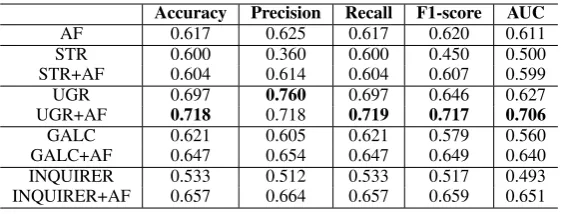
Table 2: Helpful reviews identification performances using argument-based features and/or baseline fea-tures. AF stands for argument-based feafea-tures.
level features. 4 Experiments
Following (O’Mahony and Smyth, 2010; Martin and Pu, 2014), we model the helpfulness predic-tion task as a classificapredic-tion problem; thus, we use accuracy, precision, recall, macro F1 and area un-der the curve (AUC) to as evaluation metrics. Sim-ilar to (O’Mahony and Smyth,2010), we consider a review as helpful if and only if at least 75% opin-ions for the review are positive, i.e. X/Y ≥0.75 (see X and Y in Sect. 2). For the features whose number of dimensions is more than 10k (i.e. the UGR features and argument-based features), to re-duce their dimensions and to improve the perfor-mance, we only use the positive-information-gain features in these feature sets. In line with most ex-isting works on helpfulness prediction (Martin and Pu,2014;Yang et al.,2015), we use the LibSVM (Chang and Lin,2011) as our classifier.
The performances of different features are pre-sented in Table2. Each number in the table is the average performance in 10-fold cross-validation tests. From the table we can see that, when be-ing used together with the argument-based fea-tures, either of the four baseline features enjoys a performance boost in terms of all metrics we consider. To be more specific, in terms of accu-racy, precision, recall, F1 and AUC, the average improvement for the baseline features are 4.33%, 10.30%, 4.32%, 11.01% and 10.40%, respective-ly. However, we observe that the precision of U-GR+AF, although gives the second highest score among all feature combinations, is lower than that of UGR; we leave it for future work. Also, we notice that when using the argument-based fea-tures alone, its performance (in terms of Preci-sion, F1 and AUC) is superior to those of STR, GALC and INQUIRER, and is only inferior to U-GR. However, a major drawback of the UGR
fea-ture is its huge and document-dependent dimen-sionality, while the dimensionality of argument-based features is fixed, regardless of the size of the input documents. Moreover, the UGR features are sparse and problematic in online learning. To summarise, compared with the other state-of-the-art features, argument-based features are effective in identifying helpful reviews, and can represen-t some complemenrepresen-tary informarepresen-tion represen-tharepresen-t cannorepresen-t be represented in other features.
5 What Makes a Review Helpful ?
Moreover, among all the argument-based fea-tures with positive information gain values, a quar-ter of features are the position-level argument fea-ture. This is because the position of each argumen-t componenargumen-t influences argumen-the logic flow of reviews, which, in turn, influences the readability, convinc-ingness and helpfulness of the reviews. This infor-mation can hardly be represented by all the base-line features we considered, and we believe this explains why the performances of the baseline fea-tures are improved when being used together with the argument-based features. However, among al-l the argument-based features with positive infor-mation gain values, only 10% are the component-level argument feature. This indicates that com-pared to three finer-granularity argument features above, the component-level argument feature pro-vides less useful information in review helpfulness identification.
6 Conclusion and Future Work
In this work, we propose a novel set of intrinsic features of identifying helpful reviews, namely the argument-based features. We manually annotate 110 hotel reviews, and compare the performances of argument-based features with those of some state-of-the-art features. Empirical results suggest that, argument-based features include some com-plementary information that the other feature sets do not include; as a result, for each baseline fea-ture, the performance (in terms of various met-rics) of jointly using this feature and argument-based features is higher than using this baseline feature alone. In addition, by analysing the effec-tiveness of different argument-based features, we give some insights into which reviews are more likely to be helpful, from an argumentation per-spective.
For future work, an immediate next step is to explore the usage of automatically extracted arguments in helpful reviews identification: in this work, all argument-based features are based on manually annotated arguments; deep-learning based argument mining (Li et al.,2017;Eger et al.,
2017) has produced some promising results re-cently, and we plan to investigate whether the au-tomatically extracted arguments can be used to i-dentify helpful reviews, and how the errors made in the argument extraction stage will influence the performance of helpful reviews identification. We also plan to investigate the effectiveness of
argument-based features in other domains.
Acknowledgements
Yang Gao is supported by National Natural Science Foundation of China (NSFC) grant 61602453, and Hao Wang is supported by NSFC grant 61672501, 61402447 and 61502466.
References
Chih-Chung Chang and Chih-Jen Lin. 2011. Libsvm: a
library for support vector machines. ACM
transac-tions on intelligent systems and technology (TIST), 2(3):27.
Patrali Chatterjee. 2001. Online reviews: Do
con-sumers use them? ACR North American Advances.
Pei-Yu Chen, Shin-yi Wu, and Jungsun Yoon. 2004. The impact of online recommendations and
con-sumer feedback on sales. ICIS 2004 Proceedings,
page 58.
Danish Contractor, Yufan Guo, and Anna Korhonen. 2012. Using argumentative zones for extractive summarization of scientific articles. Incoling, vol-ume 12, pages 663–678.
Chrysanthos Dellarocas, Neveen Awad, and Xiaoquan Zhang. 2004. Exploring the value of online reviews to organizations: Implications for revenue forecast-ing and plannforecast-ing. ICIS 2004 Proceedings, page 30. Judith Eckle-Kohler, Roland Kluge, and Iryna
Gurevych. 2015. On the role of discourse markers for discriminating claims and premises in
argumen-tative discourse. InEMNLP, pages 2236–2242.
Steffen Eger, Johannes Daxenberger, and Iryna
Gurevych. 2017. Neural end-to-end learning
for computational argumentation mining. arXiv
preprint arXiv:1704.06104.
Joseph L Fleiss. 1971. Measuring nominal scale
agree-ment among many raters. Psychological bulletin,
76(5):378.
Soo-Min Kim, Patrick Pantel, Tim Chklovski, and Mar-co Pennacchiotti. 2006. Automatically assessing
re-view helpfulness. InProceedings of the 2006
Con-ference on empirical methods in natural language processing, pages 423–430. Association for Compu-tational Linguistics.
Christian Kirschner, Judith Eckle-Kohler, and Iryna Gurevych. 2015. Linking the thoughts: Analysis of argumentation structures in scientific
publication-s. InArgMining@ HLT-NAACL, pages 1–11.
J Richard Landis and Gary G Koch. 1977. The mea-surement of observer agreement for categorical data.
Minglan Li, Yang Gao, Hui Wen, Yang Du, Haijing Liu, and Hao Wang. 2017. Joint rnn model for
argu-ment component boundary detection. arXiv preprint
arXiv:1705.02131.
Marco Lippi and Paolo Torroni. 2016. Argumenta-tion mining: State of the art and emerging trends.
ACM Transactions on Internet Technology (TOIT), 16(2):10.
Yang Liu, Xiangji Huang, Aijun An, and Xiaohui Yu. 2008. Modeling and predicting the
helpful-ness of online reviews. In Data mining, 2008.
ICDM’08. Eighth IEEE international conference on, pages 443–452. IEEE.
Nitin Madnani, Michael Heilman, Joel Tetreault, and Martin Chodorow. 2012. Identifying high-level or-ganizational elements in argumentative discourse. InProceedings of the 2012 Conference of the North American Chapter of the Association for Computa-tional Linguistics: Human Language Technologies, pages 20–28. Association for Computational Lin-guistics.
Lionel Martin and Pearl Pu. 2014. Prediction of
help-ful reviews using emotions extraction. In
Proceed-ings of the 28th AAAI Conference on Artificial Intel-ligence (AAAI-14), EPFL-CONF-210749.
Marie-Francine Moens. 2013. Argumentation mining: Where are we now, where do we want to be and how
do we get there? In Post-Proceedings of the 4th
and 5th Workshops of the Forum for Information Re-trieval Evaluation, page 2. ACM.
Susan M Mudambi. 2010. What makes a helpful on-line review? astudy of customer reviews on amazon. com. MIS Quarterly, 34(1):185–200.
Michael P O’Mahony and Barry Smyth. 2010. A classification-based review recommender.
Knowledge-Based Systems, 23(4):323–329.
Raquel Mochales Palau and Marie-Francine Moens. 2009. Argumentation mining: the detection, clas-sification and structure of arguments in text. In Pro-ceedings of the 12th international conference on ar-tificial intelligence and law, pages 98–107. ACM. Joonsuk Park and Claire Cardie. 2014. Identifying
appropriate support for propositions in online user
comments. InArgMining@ ACL, pages 29–38.
Klaus R Scherer. 2005. What are emotions? and how
can they be measured? Social science information,
44(4):695–729.
Christian Stab and Iryna Gurevych. 2014. Identifying argumentative discourse structures in persuasive
es-says. InEMNLP, pages 46–56.
Philip J Stone, Robert F Bales, J Zvi Namenwirth, and Daniel M Ogilvie. 1962. The general inquirer: A computer system for content analysis and retrieval based on the sentence as a unit of information. Be-havioral Science, 7(4):484–498.
Henning Wachsmuth, Khalid Al Khatib, and Benno Stein. 2016. Using argument mining to assess the
argumentation quality of essays. InCOLING, pages
1680–1691.
Henning Wachsmuth, Johannes Kiesel, and Benno Stein. 2015. Sentiment flow-a general model of web
review argumentation. InEMNLP, pages 601–611.
Henning Wachsmuth, Martin Trenkmann, Benno Stein, and Gregor Engels. 2014. Modeling review
argu-mentation for robust sentiment analysis. In
COL-ING, pages 553–564.
Zhongyu Wei12, Yang Liu, and Yi Li. 2016. Is this post persuasive? ranking argumentative comments
in the online forum. InThe 54th Annual Meeting of
the Association for Computational Linguistics, page 195.
Wenting Xiong and Diane J Litman. 2014. Empirical analysis of exploiting review helpfulness for
extrac-tive summarization of online reviews. InCOLING,
pages 1985–1995.
Yinfei Yang, Cen Chen, and Forrest Sheng Bao. 2016. Aspect-based helpfulness prediction for online prod-uct reviews. InTools with Artificial Intelligence (IC-TAI), 2016 IEEE 28th International Conference on, pages 836–843. IEEE.