SYNTHESIS AND CHARACTERIZATION OF METAL
COMPLEXES OF SCHIFF BASE LIGANDS DERIVED FROM
4-AMINOANTIPYRINE WITH 4-AMINOBENZOIC ACID AND
BENZOIN
Rehab K. Al-Shemary
[a]*and Maysoon T. Tawfiq
[a]Keywords: Benzoin; 4-aminobenzoic acid; 4-aminoantipyrine; Schiff bases, metal complexes; biological activity.
Two chelate-forming Schiff bases derived from 4-aminoantipyrine with 4-aminobenzoic acid and benzoin, namely (Z)-4-(4-amino-1,5-dimethyl-2-phenyl-1H-pyrazol-3(2H)-ylideneamino)benzoic acid (HL1) and
4-((E)-4-((E)-((R)-2-hydroxy-1,2-diphenylethylidene)amino)-1,5-dimethyl-2-phenyl-1H-pyrazol-3(2H)-ylideneamino)benzoic acid (H2L2) were prepared and complexed with copper(II), nickel(II),
cobalt(II), manganese(II) and mercury(II)chlorides in ethanol. The M(HL1)
2Cl2 and M(HL2)2 type complexes could be isolated. The ligands
and theirs metal complexes were characterized using elemental analysis, infrared and electronic, 1H and 13C NMR spectroscopy, molar
conductance and magnetic moment measurements. The measurements showed that the HL1 ligand is coordinated in their complexes with
N,N-bidendate mode, while HL2 ionic ligand in NNO tridentate pattern through the azomethine nitrogen, amino-group and the depotonated
hydroxyl group of benzoin. The stability constants of complexes were determined spectrophotometricaly. All the studies reveal a six coordinated octahedral structure of M(HL2)
2 type complexes. In vitro tests for antibacterial and antifungal activities showed that most of the
prepared compounds display a good activity towards S. aureus, E. coli, B. subtilis, P. aureginosa, A. niger, A. flavus, R. stolonifer and C. albicans .
*Corresponding Authors
E-Mail: [email protected]; [email protected]
[a] Department of Chemistry, College of Education for Pure Sciences / Ibn -Al-Haitham, University of Baghdad
Introduction
Schiff bases and their complexes, containing azomethine nitrogen atom coordinated to metals, belong to a widely studied ligands with high biological activity such as anticancer, antifungal, antibacterial and antimalarial activities.1-3 Transition metal complexes containing
4-aminoantipyrine and its derivatives have shown a wide range of biological activity, for example copper complexes derived from 4-aminoantipyrine enhances DNA cleavage.4-11
Schiff-base complexes belong to the main type of compounds used in the development of "stereochemical models" of coordination chemistry due to their structural diversity. Bidentate and multidendate ligands containing imine groups could be used as modulators of structural and electronic properties of transition metal centers.12,13
In the present work, an NN bidendate Schiff base ligand, ((Z)-4-(4-amino-1,5-dimethyl-2-phenyl-1H-pyrazol-3(2H)-ylidene-amino)benzoic acid (HL1) and an NNO tridendate
Schiff base ligand, (4-((E)-4-((E)-((R)-2-hydroxy-1,2- diphenylethylidene)amino)-1,5-dimethyl-2-phenyl-1H-pyra-zol-3(2H)-ylideneamino)benzoic acid (H2L2) and theirs
complexes formed by their reaction with copper(II), nickel(II), cobalt(II), manganese(II) and mercury(II) chlorides (M(HL1)
2Cl2 and M(HL2)2 types, respectively)
were synthesized and characterized.
Materials and Methods
4-Aminoantipyrine, 4-aminobenzoic acid, benzoin, and the metal(II) chlorides were purchased from Merck. Anhydrous grade methanol and DMSO were purified according to standard procedures. Microanalytical data, 1H-NMR and 13
C-NMR spectra of the compounds were recorded on a Bruker Specrospin Ultrashield Magnets 300 MHz instrument using tetramethylsilane (TMS) as internal standard and DMSO-d6
as solvent. FT-IR spectra in the range of 4000-400 cm-1 were
recorded using KBr disk on a SHIMADZUFT-IR 8300 spectrophotometer. UV-Vis spectra were recorded on a Varian Uv-Cary-100 spectrophotometers by using DMSO as solvent. The chloride content of complexes was determined using potentiometric titration method with using 686–Titro Processor–665 Dosim A–Metrohm (Switzerland) instrument. Solid state magnetic susceptibility measurement were performed at room temperature using a Bruker BM6 instrument. Microanalysis (C, H, and N) of the synthesized compounds was carried out using a Perkin Elmer 2400 series analyzer. Melting points were determined in Gallen Kamp melting point apparatus and were uncorrected.
at 37 ℃ for 24 h. During this period, the test solution diffused and the growth of the inoculated bacteria and fungi were affected. The inhibition zone developed on the plate was measured. The inhibitory concentration (MIC) values of the compounds were determined by serial dilution technique.
Synthesis of Schiff bases
Synthesis of the (Z)-4-(4-amino-1,5-dimethyl-2-phenyl-1H-pyrazol-3(2H)-ylideneamino)benzoic acid (HL1)
An ethanolic solution (50 mL) of 4-aminoantipyrine (0.01 mol, 2.03 g) and 4-aminobenzoic acid (0.01 mol, 1.37g) were refluxed for 36 h after addition of 3-4 drops of glacial acetic acid. The mixture was filtered, the resulting solution was concentrated to (20 mL) on a water bath. On cooling the reaction mixture, sharp yellow crystals product separated out (yield 85 %, m.p. 240 0C) which was collected by filtration
and washed thoroughly with ethanol and then dried in vacuum. The purity of product was checked by TLC method and characterized by elemental and spectral analysis.
Synthesis of 4-((E)-4-((E)-((R )-2-hydroxy-1,2-diphenylethy-lidene)amino)-1,5-dimethyl-2-phenyl-1H-pyrazole-3(2H )-ylideneamino)benzoic acid (H2L2)
An ethanolic solution (50 mL) of Schiff base (HL1)
(0.01mol, 3.62 g) and benzoin (0.01 mol, 1.37 g ) were mixed and refluxed at 70 0C for 6-7 h after adding anhydrous
potassium carbonate. The mixture was filtered and the resulting solution was evaporated to 20 mL on a water bath. The product was filtered off, washed thoroughly with ethanol and subsequently dried at ambient temperature. The purity was confirmed by TLC (yield 82 % , m.p.>280 0C).15
Synthesis of metal complexes
The solutions of the hydrated chloride salts and HgCl2
(0.001 mol) and the Schiff base ligands (HL1or H
2L2) (0.002
mol) in ethanol (50 mL) was refluxed for 1 h. The solution was evaporated to 15 mL and the mixture was cooled to room temperature. The solid complex formed was removed by filtration, washed with hot ethanol until the filtrate becomes colourless. The resulting product was recrystallized from EtOH and dried in a vacuum desiccator over anhydrous CaCl2
(yields = 70-85 %).
Results and Discussion
The analytical values for the ligands (HL1 and H
2L2) and
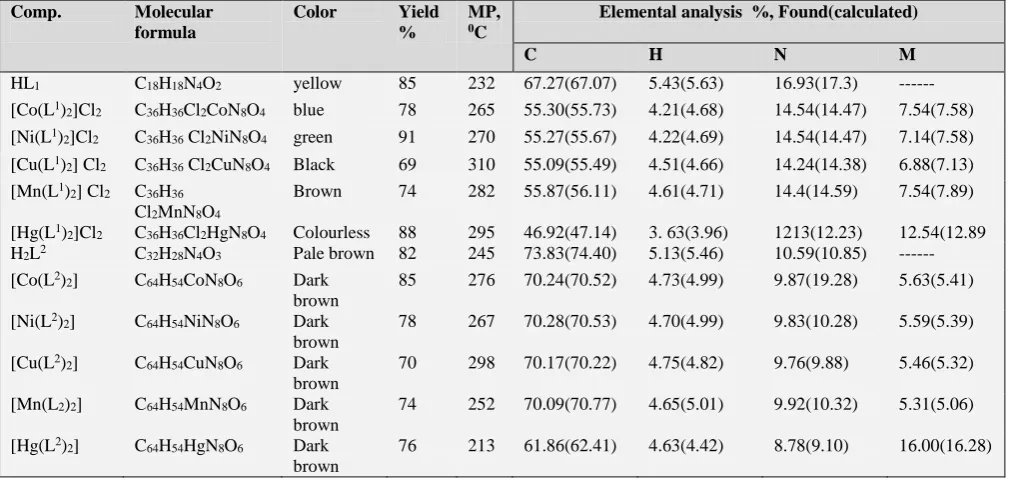
their complexes together with some physical characteristics are outlined in table 1. The analytical data of the complexes confirm the general formula [M(HL1)
2]Cl2 for HL1 =
C18H18N4O2 and [M(HL2)2] for H2L2 = C32H28N4O3 ligands,
where M = Cu(II), Ni(II), Co(II), Mn(II) and Hg(II).
All the metal complexes are coloured solids, stable in air at room temperature. The ligands are soluble in most of the organic solvents and all the complexes found to be insoluble in water and freely soluble in methanol and ethanol, CHCl3,
DMF and DMSO. The metal complexes exhibit 1:2 (metal-ligand) stoichiometry of the type [M(HL1)
2]Cl2 and
[M(HL2)
2] where HL1 acts as bidentate and HL2(1-) acts as a
tridentate ligand.
O O H
NH2
36 h reflux
EtOH, HOAc +
N
N O
C H3
C
H3 NH2
O
OH N
N N C H3
C
H3 NH2
HL1
HL1
H2L2
O
OH N
N N H3C
H3C N OH
OH O
+
Reflux
6-7 h
Table 1. Physical characterization data of the Schiff base ligands (HL1and H2L2) and their complexes
IR spectra
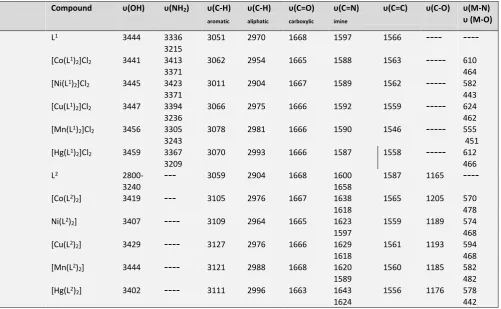
In order to study the binding mode of the Schiff bases in the complexes, IR data of the ligands and complexes have been compared (Table 2). The peaks appearing in the region of 3444-3359 cm-1 are assigned to the uncoordinated O-H
stretchings of the ligand (alcoholic and carboxylate OH) in the complexes.
The ligand L1 shows the characteristic -C=N- band at
1637-1625 cm-1 and two NH
2 bands at 3336 and 3215cm-1, which
shifts in the complexes to the range 3423 ~ 3305 cm-1 and
3371~3209 cm-1, while in the ligand L2 two peaks of
characteristic -C=N- bands appear at 1647~1616 cm-1, which
are shifted toward lower frequencies in the spectra of complexes (1638~1589 cm-1). The metal coordination causes
appearing of new frequencies in the range 482~450 cm-1 and
594~570 cm-1, which are assigned to the fashioning of M-O
and M-N bonds, respectively.7,8 It can thus be concluded that
the ligand HL1 acts as bidendate neutral unit with NN
coordination mode, while the ligand H2L2 behaves as anionic
tridentate unit and coordination to the metal ion through deprotonated alcoholic oxygen and via the two azomethine nitrogen atoms of the Schiff base.
NMR spectra
1H-NMR (DMSO-d
6) of HL1: δ = 2.26 (3H, -C-CH3), 2.47
(DMSO), 3.11 (3H, =N-CH3), 4.95 (2H, -NH2), 6.5-8.12 (5H,
m, C6H5), 12.83 (1H, COOH).9 1H-NMR (DMSO-d
6) of H2L2: δ = 2.26 (1H, OH in
benzoin), 2.37 (3H, -C-CH3), 2.479 (DMSO), 2.53 (3H,
-N-CH3), 5.21 (1H, -CH-OH), 6.4-7.98 (5H, m, C6H5), 12.82 (1H,
COOH).10
13C-NMR (DMSO-d
6) of HL1: δ = 10.12 (=C-CH3), 33.70
(-N-CH3), 40.38 (DMSO), 106.14 (-N-CH3), 115.38
(-C-CO), 123.56-149.97 (m, C6H5), 161.17 (-C=O), 165.79
(C=N).11
13C-NMR (DMSO-d
6) of H2L2: δ = 10.12 (=C-CH3), 33.70
(-N-CH3), 40.38 (DMSO), 75.66 (-C-OH), 106.08 (=C-N),
115.34 (-C-CO), 123.57-149.54 (m, C6H5), 161.17-162.54
(-C=N groups), 165.79 (COOH).12
Electronic absorption spectra
UV-Vis spectra provide the most detailed information about the structure. Electronic spectrum of the HL1 ligand
displays two bands at 37453 cm-1 and 28571 cm-1 attributed
to π–π* and n–π* transitions. In the spectrum of the complexes of HL1, the bands observed at range 35714-34722
cm-1 and 29154-27548 cm-1 are assigned ligand field and
LMCT charge transfer transitions. Weak and broad peaks can be shown in the spectrum of the complexes at 23870-14104 cm-1 and are assigned to the d-d transitions. The cobalt(II)
complex showed one band from d-d transition at 17982 cm-1
which may be assigned to 1A
1 →1B1transiton in case of
tetrahedral environment around the Co2+ ion. The magnetic
moment of Co(II) complex was found to be 3.9 B.M. which is at the lower end of magnetic moments expected for tetrahedral Co(II) complex.13
The absorption spectrum of copper complex showed a band at about 18635 cm-1attributed to 2B
2→2A1 transition of a
Cu-complex with tetrahedral geometry. The magnetic moment (μeff) for this complex was found to be 2.2 B.M. per Cu ion
which was in usual range for tetrahedral copper complex.14
Comp. Molecular formula
Color Yield %
MP,
0C
Elemental analysis %, Found(calculated)
C H N M
HL1 C18H18N4O2 yellow 85 232 67.27(67.07) 5.43(5.63) 16.93(17.3) ---
[Co(L1)
2]Cl2 C36H36Cl2CoN8O4 blue 78 265 55.30(55.73) 4.21(4.68) 14.54(14.47) 7.54(7.58)
[Ni(L1)
2]Cl2 C36H36 Cl2NiN8O4 green 91 270 55.27(55.67) 4.22(4.69) 14.54(14.47) 7.14(7.58)
[Cu(L1)
2] Cl2 C36H36 Cl2CuN8O4 Black 69 310 55.09(55.49) 4.51(4.66) 14.24(14.38) 6.88(7.13)
[Mn(L1)
2] Cl2 C36H36
Cl2MnN8O4
Brown 74 282 55.87(56.11) 4.61(4.71) 14.4(14.59) 7.54(7.89)
[Hg(L1)
2]Cl2 C36H36Cl2HgN8O4 Colourless 88 295 46.92(47.14) 3. 63(3.96) 1213(12.23) 12.54(12.89
H2L2 C32H28N4O3 Pale brown 82 245 73.83(74.40) 5.13(5.46) 10.59(10.85) ---
[Co(L2)
2] C64H54CoN8O6 Dark
brown
85 276 70.24(70.52) 4.73(4.99) 9.87(19.28) 5.63(5.41)
[Ni(L2)
2] C64H54NiN8O6 Dark
brown
78 267 70.28(70.53) 4.70(4.99) 9.83(10.28) 5.59(5.39)
[Cu(L2)
2] C64H54CuN8O6 Dark
brown
70 298 70.17(70.22) 4.75(4.82) 9.76(9.88) 5.46(5.32)
[Mn(L2)2] C64H54MnN8O6 Dark
brown
74 252 70.09(70.77) 4.65(5.01) 9.92(10.32) 5.31(5.06)
[Hg(L2)
2] C64H54HgN8O6 Dark
brown
Table 2. Infrared spectral data( ύ wave number) cm-1 for the ligands (HL1, H
2L2) and their complexes.
υ(M-N) υ (M-O) υ(C-O) υ(C=C) υ(C=N) imine υ(C=O) carboxylic υ(C-H) aliphatic υ(C-H) aromatic
υ(NH2)
υ(OH) Compound
----1566 1597 1668 2970 3051 3336 3215 3444 L1 610 464---
1563 1588 1665 2954 3062 3413 3371 3441[Co(L1)2]Cl2
582 443
---
1562 1589 1667 2904 3011 3423 3371 3445[Ni(L1)2]Cl2
624 462
---
1559 1592 1666 2975 3066 3394 3236 3447[Cu(L1)2]Cl2
555 451
---
1546 1590 1666 2981 3078 3305 3243 3456[Mn(L1)2]Cl2
612 466
---
1558 1587 1666 2993 3070 3367 3209 3459[Hg(L1)2]Cl2
----1165 1587 1600 1658 1668 2904 3059 --- 2800-3240 L2 570 478 1205 1565 1638 1618 1667 2976 3105 ---3419 [Co(L2)2]574 468 1189 1559 1623 1597 1665 2964 3109
----3407 Ni(L2)2]594 468 1193 1561 1629 1618 1666 2976 3127
----3429 [Cu(L2)2] 582 482 1185 1560 1620 1589 1668 2988 3121
----
3444 [Mn(L2)2]578 442 1176 1556 1643 1624 1663 2996 3111
----
3402 [Hg(L2)2]The electronic spectra of the Ni(II) complex showed bands at 23870 cm-1 and 17233 cm-1 that may be assigned to the 1A
1→1A2 and 1A1 →1B1 transitions, indicating a tetrahedral
environment around the nickel(II) metal ions.
The peak at 14104 cm-1, which may be assigned to 6A
1→4E(G), transition is characteristic for tetrahedral Mn(II)
complexes.15 The magnetic moment of manganese(II)
complex is 5.70 B.M. which suggest that the complex is four coordinated.
The electronic spectrum of free Schiff base (H2L2) showed
two bands at 36363 cm-1 and 32362 cm-1 due to π→π* and
n→π* transitions. In the spectrum of the complexes, these bands observed at the range 36496-35842 cm-1 and
31250-30303 cm-1, which are assigned to ligand field and charge
transfer (LMCT) transitions.
UV-Vis spectrum of the cobalt(II) complex of H2L2 showed
the d-d transition bands at 10710, 15943 and 22765 cm-1,
which are assigned to4T
1g(F)→4A2g(F), 4T1g(F)→4A2g(F) and 4T
1g(F)→4T1g(P) transitions, respectively. These transitions
correspond to the octahedral configuration of the complex, which is also supported by the magnetic moment value (4.86 µB) of the complex.16
The electronic spectrum of the copper (II) complex displayed in the region of 13523 cm-1. This transition may be
attributed to the charge transfer band or the d–d transition band which of 2Eg→2T
2g transition. This d–d transition band
supports a distorted octahedral configuration around the metal ion, which is also supported by its magnetic moment value (1.66 µB).17
The UV-Vis spectrum of the nickel(II) complex shows d–d peaks at 10309, 15587 and 26130 cm-1 due to 3A
2g(F)→3T1g(F), 3A
2g(F)→3T2g(F) and 3A2g(F)→3T1g(P) transitions, respectively,
indicating an octahedral geometry. This configuration is further supported by its magnetic moment value (2.89 µB).18
The electronic spectrum of Mn(II) complex shows an absorption peak at17605 cm-1 assigned to d–d electronic
transition type 6A
1g → 4T1g(G) which suggests octahedral
geometry around Mn(II). This geometry is further supported
by the magnetic susceptibility value (5.64 µB).
The complex of Hg(II) is diamagnetic. According to the empirical formula, the same octahedral geometry might be supposed for this complex as well.19
Molar conductivity
The molar conductivities of 10-3 M of ethanol solution at
room temperature were measured. The molar conductivity data of Co(II), Cu(II), Ni(II), Mn(II), and Hg(II) chelates of HL1 were found to be 72, 77, 86, 82 and 88 ohm-1 cm2 mol-1,
respectively. It is obvious from these data that these chelates are ionic in nature and they belong to the type of 1:2 electrolytes.20
In addition the low conductance values of Co(II), Cu(II), Ni(II), Mn(II), and Hg(II) chelates of H2L2 lie in the range
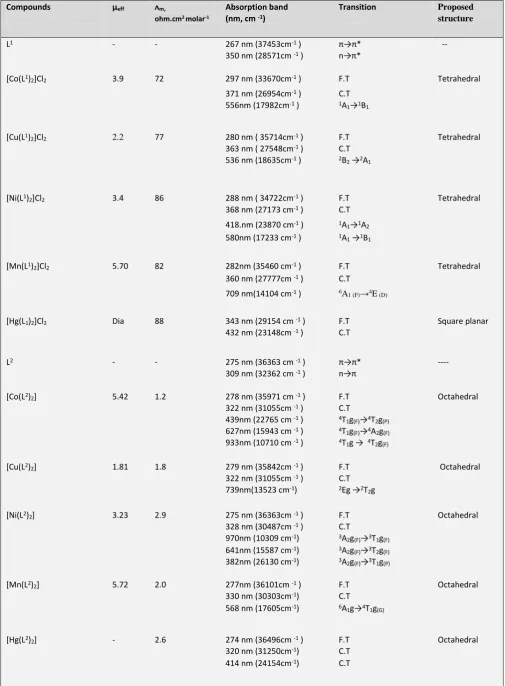
Table 3. Electronic spectral data of the ligands and their metal complexes
Compounds µeff ᴧm,
ohm.cm2 molar-1
Absorption band
(nm, cm -1)
Transition Proposed
structure
L1 - - 267 nm (37453cm-1 ) π→π* --
350 nm (28571cm -1 ) n→π*
[Co(L1)
2]Cl2 3.9 72 297 nm (33670cm-1 ) F.T Tetrahedral
371 nm (26954cm-1 ) C.T
556nm (17982cm-1 ) 1A1→1B1
[Cu(L1)2]Cl2 2.2 77 280 nm ( 35714cm-1 ) F.T Tetrahedral
363 nm ( 27548cm-1 ) C.T
536 nm (18635cm-1 ) 2B2 →2A1
[Ni(L1)2]Cl2 3.4 86 288 nm ( 34722cm-1 ) F.T Tetrahedral
368 nm (27173 cm-1 ) C.T
418.nm (23870 cm-1 ) 1A1→1A2
580nm (17233 cm-1 ) 1A1 →1B1
[Mn(L1)2]Cl2 5.70 82 282nm (35460 cm-1 ) F.T Tetrahedral
360 nm (27777cm -1 ) C.T
709 nm(14104 cm-1 ) 6A
1 (F)→4E (D)
[Hg(L1)2]Cl2 Dia 88 343 nm (29154 cm -1 ) F.T Square planar
432 nm (23148cm -1 ) C.T
L2 - - 275 nm (36363 cm -1 ) π→π* ----
309 nm (32362 cm -1 ) n→π
[Co(L2)2] 5.42 1.2 278 nm (35971 cm -1 ) F.T Octahedral
322 nm (31055cm -1 ) C.T
439nm (22765 cm -1 ) 4T
1g(F)→4T2g(P)
627nm (15943 cm -1 ) 4T1g(F)→4A2g(F)
933nm (10710 cm -1 ) 4T1g → 4T2g(F)
[Cu(L2)
2] 1.81 1.8 279 nm (35842cm -1 ) F.T Octahedral
322 nm (31055cm -1 ) C.T
739nm(13523 cm-1) 2Eg →2T2g
[Ni(L2)2] 3.23 2.9 275 nm (36363cm -1 ) F.T Octahedral
328 nm (30487cm -1 ) C.T
970nm (10309 cm-1) 3A
2g(F)→3T1g(F)
641nm (15587 cm-1) 3A2g(F)→3T2g(F)
382nm (26130 cm-1) 3A2g(F)→3T1g(P)
[Mn(L2)
2] 5.72 2.0 277nm (36101cm -1 ) F.T Octahedral
330 nm (30303cm-1) C.T
568 nm (17605cm-1) 6A1g→4T1g(G)
[Hg(L2)2] - 2.6 274 nm (36496cm -1 ) F.T Octahedral
320 nm (31250cm-1) C.T
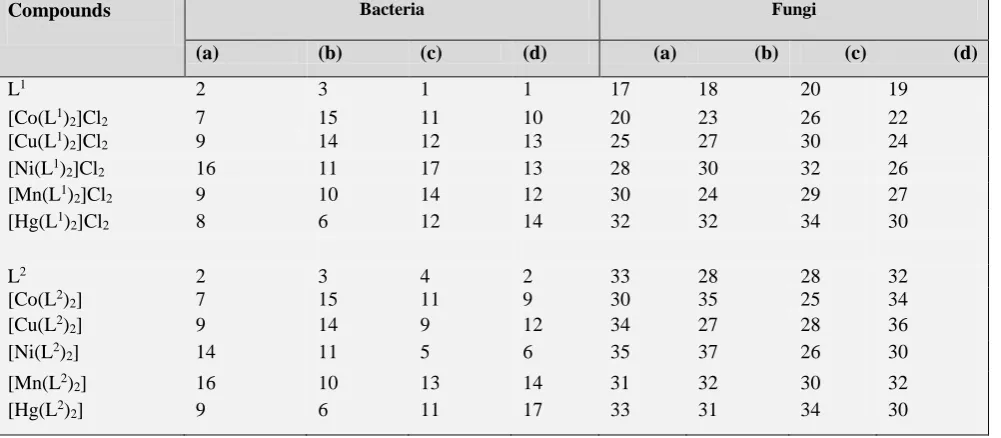
Table 4. Results of antibacterial bioassay (concentration used 100μg mL-1 of DMSO). (a) E. coli, (b) S.aurous(c) B. subtilis (d)P. aeruginosa,
antifungal bioassay (concentration used 200 μg mL-1). (a)A. niger(b) A. flavus (c)R. stolonifer and (d)C. albicans .10<: weak; >10: moderate;
>16:significant.
Antibacterial and antifungal activities
The ligands and their complexes have been tested for in vitro growth inhibitory activity against gram(+) (Staphylococcus aureus) and gram(-) (Escherichia Coli, Bacillus subtilis, Pseudomonasaureginosa) by using well-diffusion process. The minimum inhibitory concentration (MIC) values of the investigated compounds are summarized in Table 4. As it can be seen from the Table 4, the complexes have high antimicrobial and intermediate antifungal activities. The metal complexes have higher antimicrobial activity than the ligands. The increase in antimicrobial activity might be the consequence of easier diffusion of metal complexes and higher cell permeability.21-23
Conclusions
Two new Schiff ligands, namely(Z)-4-(4-amino-1,5-dimethyl-2-phenyl-1H-pyrazol-3(2H)-ylideneamino)benzoic acid (HL1) and
4-((E)-4-((E)-((R)-2-hydroxy-1,2- diphenylethylidene)amino)-1,5-dimethyl-2-phenyl-1H-pyra-zol-3(2H)-ylideneamino)benzoic acid (H2L2) and their metal
complexes were synthesized. Based on the results of molar conductivity, elemental analysis, UV–Vis,1H- and 13C-NMR
and FT-IR spectral studies, it si concluded these ligands form [M(HL1)
2]Cl2 and [M(L2)2] type metal complexes, where
M=Co(II), Cu(II), Ni(II), Mn(II) and Hg(II).
The metal (II) ions are coordinated by NN mode with involving the imine (H-C=N) and the amine (NH2)groups in
the case of HL1 and one deprotonated alcoholic O atom and
two imine (H-C=N) groups in the case of H2L2. UV-VIS
spectroscopic and magnetic data show that all complexes are four-coordinated in the case of HL1 and six-coordinated in the
case of H2L2 ligands. The synthesized compounds showed
strong antibacterial and intermediate antifungal properties. The microbicide actions of complexes are higher than those of the free ligands.
Acknowledgments
Sincere thanks are expressed to the Department of Chemistry, College of Education for Pure Sciences, Ibn-Al-Haitham, University of Baghdad for financial support.
References
1Barboiu, C. T.,Luca, M.,Pop, C., Brewster,E., Dinculescu, E. M.,
Eur. J. Med. Chem., 1996, 31, 597.
2El-Ansary, A. L., Abdel-Fattah, H. M. and Abdel-Kader, N. S., J.
Coord. Chem., 2008, 61(18), 2950–2960.
3Reham, H.,Hassan, A., Manal, M., Nehad, A. L., J. Chem.,2013,
20(13), 10.
4Azzellini, M. A. A. Bagatin I. A. and Ferreira, A. M. D. C.,Redox Report, 11, 25 (1996).
5Raman,N., Kulandaisamy, A.,S hunmugasundaram, A.,
Jeyasubramanium, K., Transitio. Met. Chem., 2001, 26, 131– 135.
6Raman, N., Sakthivel, A., Rajasekaran, K., Mycobiology, 2007,
35(3),150–153.
7Tabassum, S, Parveen, S., Arjmand, F., Indian J. Chem., 2004, 43,
270–277.
8Mishra A. P., Pandey, L. R. ,Indian J. Chem., 2005, 44A, 1800–
1805.
9Raman, N. S., Sobha, S. Mitu, L., J. Saudi Chem. Soc.,2013, 17,
151–159.
10Santos, M. L. P., Faljoni, A. A., Mangrich, A. S., Ferreira, A. M.
D. C., J. Inorg. Biochem., 1998, 71, 71.
11Santos, M. L. P., Bagatin, I. A., Pereira, E. M., Ferreira, A. M. D.
C., J. Chem. Soc. Dalton Trans., 2001,838.
12Sumathi, A. S., Tharmaraj,P., Sheela,C. D., Int. J. Inorg. Chem.,
2011, 8.
13Kalanithi, M.; Rajarajan, M.; Tharmaraj, P., J. Coord. Chem.,2011,
64, 1436–1445.
Compounds Bacteria Fungi
(a) (b) (c) (d) (a) (b) (c) (d)
L1 2 3 1 1 17 18 20 19
[Co(L1)
2]Cl2 7 15 11 10 20 23 26 22
[Cu(L1)
2]Cl2 9 14 12 13 25 27 30 24
[Ni(L1)
2]Cl2 16 11 17 13 28 30 32 26
[Mn(L1)
2]Cl2 9 10 14 12 30 24 29 27
[Hg(L1)
2]Cl2 8 6 12 14 32 32 34 30
L2 2 3 4 2 33 28 28 32
[Co(L2)
2] 7 15 11 9 30 35 25 34
[Cu(L2)
2] 9 14 9 12 34 27 28 36
[Ni(L2)
2] 14 11 5 6 35 37 26 30
[Mn(L2)
2] 16 10 13 14 31 32 30 32
[Hg(L2)
14Dharmaraj, N., Viswanathamurthi, P., Natarajan, K., Transition
Met. Chem., 2001, 26, 105–109.
15Muna, A. H. ,Acta Chim. Pharm. Indica, 2013, 3(2), 127-134. 16Sharma, R., Samadhiya, P., Srivastava, S. D., Srivastava, S. K.,
Org. Commun., 2011, 4(2),42-51.
17Suresh, M.S., Praksh,V., E-J. Chem., 2011, 8(3), 1408-1416. 18Fernandez-Torres, M. J., Int. J. Chem., 2013, 9(2), 33-40. 19Raman, T. S., Dhaveethuraja, J., Neelakadan, M.A., Banerjee, S.,
J. Chilean Chem. Soc., 2008, 53(1), 1450.
20Bahl, B. S., Bahl, A., Elementary Organic Chemistry, S. Chand
and Company Ltd., New Delhi, 1993, 60-66.
21Ergene, E., Sivas, H., Benkli, K., Turk. J. Biol., 2010, 34, 379-387.
22Layla, A. M., Muna, A. H., Methaq S.M., J. Chem. Chem, Sci.,
2013, 3, 48-96.
23Gupta, A. K. S., Barhate, V. D., Res. J. Pharm., Biol. Chem. Sci., 2012, 3(3),1014-1020.
24Singh, P., Dhakarey, R. K. S., Rasayan J. Chem., 2009, 2(4),
869-874.
25El-Ansary, A. L., Abdel-Kader, N. S., Int. J. Inorg. Chem., 2012,
13.