Machine Layout Evaluation for Laminated Bamboo
Manufacturing by Computer Simulation
N. Sangsai, V. Laemlaksakul
Abstract
—
This research was to select the optimal machine layout for laminated bamboo manufacturing by computer simulation. The laminating process was to cut bamboo trunk as laminated piece. This process was important to total total time of production line so the computer simulation was applied to run each machine layout alternatives and gather the decided parameters. Production rate (pieces/day), total time, WIP and wait time were compared for making decision. The optimal machine layout had Production rate at 12,120 12,390 laminated pieces/day and production line efficiency at 89.32%.KeyWords
—
Laminated Bamboo, Machine Layout, SimulationI. INTRODUCTION
Currently, the manufacturing system has rapidly changed. In the past, the market demand was unlimited and there were not too various product requirements. This was called “Mass Production”. The machine layout was then settled on products having high demand. However, the market demand has turned up side down at which customers require more variety of products and less demand. This is called “Mass Customization”. The size of products must be determined in “Batch” in order to be flexible for production. Clearly, the manufacturing systems must adapt to “Flexible Manufacturing System (FMS)”. FMS is wellsuited for Mass Customization era because it can manufacture various products for small or medium batch size and for short time. The machine layout is an important factor for FMS because it can directly help production line less total time, work in process (WIP) and set up time. Finally, the business can enhance potential competitiveness and customer satisfaction [1].
The machine layout is based on 2 key parameters that are (1) the variety of products and (2) the quantity of products. If the customer requirements tend to be more various products but less quantity demand, the product layout or cellular manufacturing system (CM) should be considered [2].
Manuscript received December 30, 2007. This research was a part of a research project titled “Development of Laminated Bamboo Furniture Manufacturing” supported by King Mongkut’s University of Technology North Bangkok, Thailand (the fiscal year 2007) under code: 5003110525032.
V. Laemlaksakul is an Associate Professor with the Department of Industrial Engineering Technology, King Mongkut’s University of Technology North Bangkok, Bangsue, Bangkok 10800 Thailand (corresponding author phone: +6629132500; fax: +6625874356; email: vcl@ kmitnb.ac.th).
N. Sangsai is a lecturer with the Department of Mechanical Engineering Technology, King Mongkut’s University of Technology North Bangkok, Bangsue, Bangkok 10800 Thailand (email: [email protected])
Irani [3] applied production flow analysis to machine layout. McAuley [4] used similarity coefficient value given by machine and product matrix to solve problems. King [5] and Rajamani [6] presented the developed matrix methodology for solving machine layout problems by considering weight scores for each row and column. Then the weight scores were ranked from large to small in order to group related products or machines. If the customer requirements tend to be less various products but more quantity demand, the process layout or production line system should be applied. There are also some factors to be concerned such as line balancing and economy.
Thailand has long produced bamboo furniture. Most designs are built in roundshape styles. After that the surface finishing are later done such as painting, coating.
[image:1.595.343.514.462.570.2]The traditional bamboo furniture design only assembled the round shape stem bamboo together as shown in Figure 1. There was no any processing on bamboo. This could limit the styles or designs of bamboo furniture. The new bamboo furniture design turns to use the laminated bamboo instead as shown in Figure 2. The laminated bamboo can help designing furniture more styles and standardized. This research was to design the appropriate machine layout for laminated bamboo manufacturing.
Fig. 1 The traditional bamboo furniture design
[image:1.595.340.516.605.722.2]II. METHODOLOGY
Decided factors used for selecting the best machine layout for laminated bamboo manufacturing were based on these criteria; (1) production rate, (2) total time, (3) WIP and (4) wait time. The computer simulation was then constructed to compare each machine layout design. The more details for computer simulation are described in next section.
A. Modeling and Simulation
[image:2.595.326.527.95.339.2]Preliminary step for laminated bamboo manufacturing study was to collect possible data related to manufacturing. The pre processes were as follows; (1) bamboo surface finishing for cutting in laminated specimen (width x length x thickness) (2) soaking all specimen in boron compound for 24 hours [7]. Table 1
Manufacturing process for bamboo strip
Bamboo Process Description Splitting
Remove 2 sides
Planning to thickness
1 st trimmed to width
2 nd trimmed to width
Bamboo strip
From preliminary step, the complicated tasks for machine layout simulation were (1) surface finishing and (2) cutting into laminated pieces. The outline manufacturing flow for line A and B is shown in Figure 3.
The ARENA software was used to construct the simulation model for line A and B [8]. The production rate, total time, WIP and wait time were key factors to decide which machine layout was best appropriate.
(a)
(b)
Fig. 3 Machine Layout (a) line A and (b) lineB
B. Input Modeling and Data Analysis
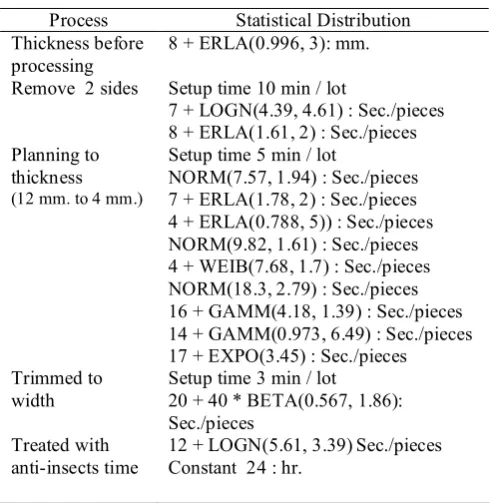
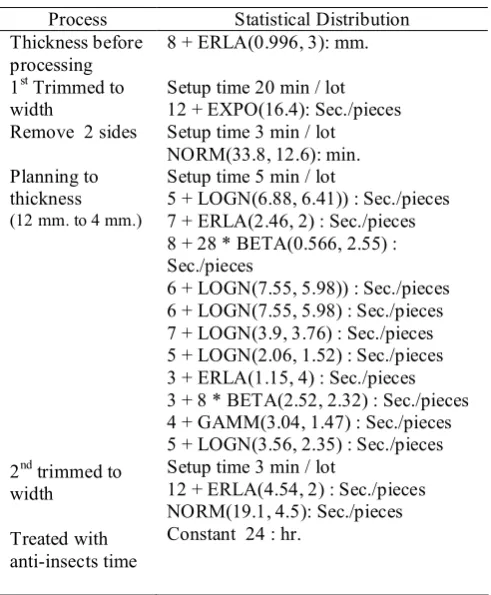
[image:2.595.47.290.284.588.2]From the preliminary step performed, the related data for simulation were as follows; (1) the original bamboo thickness before surface finishing (the bamboo thickness are different depending on its diameter) and (2) processing time varying with its thickness. All data were statistically analyzed to find its distribution and summarized in Table 2 and 3.
Table 2
The statistical distribution for each processing time in lineA Process Statistical Distribution Thickness before
processing Remove 2 sides
Planning to thickness
(12 mm. to 4 mm.)
Trimmed to width Treated with antiinsects time
8 + ERLA(0.996, 3): mm. Setup time 10 min / lot
7 + LOGN(4.39, 4.61) : Sec./pieces 8 + ERLA(1.61, 2) : Sec./pieces Setup time 5 min / lot
NORM(7.57, 1.94) : Sec./pieces 7 + ERLA(1.78, 2) : Sec./pieces 4 + ERLA(0.788, 5)) : Sec./pieces NORM(9.82, 1.61) : Sec./pieces 4 + WEIB(7.68, 1.7) : Sec./pieces NORM(18.3, 2.79) : Sec./pieces 16 + GAMM(4.18, 1.39) : Sec./pieces 14 + GAMM(0.973, 6.49) : Sec./pieces 17 + EXPO(3.45) : Sec./pieces Setup time 3 min / lot
20 + 40 * BETA(0.567, 1.86): Sec./pieces
12 + LOGN(5.61, 3.39) Sec./pieces Constant 24 : hr.
M1
M2
M3
M4
M5
Bamboo splits
Remove 2 sides
Planning to thickness
1 st trimmed
to width
2 nd trimmed to width
Treated with antiinsects
M1
M2
M3
M4
M5
Bamboo splits
1 st trimmed
to width
Remove 2 sides
Planning to thickness
2 nd trimmed
to width
[image:2.595.305.551.500.752.2]Table 3
The statistical distribution for each processing time in line B Process Statistical Distribution Thickness before
processing 1 st Trimmed to width
Remove 2 sides Planning to thickness
(12 mm. to 4 mm.)
2 nd trimmed to width
Treated with antiinsects time
8 + ERLA(0.996, 3): mm. Setup time 20 min / lot 12 + EXPO(16.4): Sec./pieces Setup time 3 min / lot NORM(33.8, 12.6): min. Setup time 5 min / lot
5 + LOGN(6.88, 6.41)) : Sec./pieces 7 + ERLA(2.46, 2) : Sec./pieces 8 + 28 * BETA(0.566, 2.55) : Sec./pieces
6 + LOGN(7.55, 5.98)) : Sec./pieces 6 + LOGN(7.55, 5.98) : Sec./pieces 7 + LOGN(3.9, 3.76) : Sec./pieces 5 + LOGN(2.06, 1.52) : Sec./pieces 3 + ERLA(1.15, 4) : Sec./pieces 3 + 8 * BETA(2.52, 2.32) : Sec./pieces 4 + GAMM(3.04, 1.47) : Sec./pieces 5 + LOGN(3.56, 2.35) : Sec./pieces Setup time 3 min / lot
12 + ERLA(4.54, 2) : Sec./pieces NORM(19.1, 4.5): Sec./pieces Constant 24 : hr.
C. Model Verification and Validation
The Verification and Validation (V&V) for new production was very difficult because there was no existed production line to compare so the model was tested by running simulation as many times as possible (Figure 4). Furthermore, the data from experiences and the adjacent production lines can be helpful for V&V.[2]
Fig. 4 The simulation program on V&V step
D. Output Modeling
The output from running the simulation for each machine layout design is production rate , total time, WIP and wait time. These factors were considered to compare the efficiency of each layout. The efficiency of each layout was such as the WIP area, the maximum machine Production rate and the bottlenecks of production line. When the real machine layout is implemented, the efficiency of each layout will be an important criterion to decide which layout will be the most appropriate.
III. RESULTS
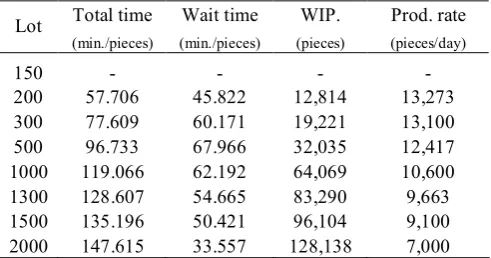
The simulation time of each machine layout was run by 30 consecutive days and each simulation run was performed 50 replications. After that the output of each machine layout was pairwised and tested the different by ttest ( a =0. 05 ). The summarized data of each machine layout is shown in Table 3 and 4.
A. Production Lot Size
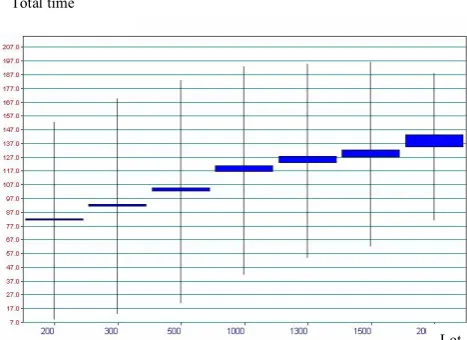
Simulation was run to find the optimal lot size by comparing the production line A and B. Small lot size (150 – 300 pieces/lot) yields the production rate more than large lot size (500 – 2,000 pieces/lot). Production rate from line B is higher than from line A by 5.96% but lower than from line B by 5.71% when lot size is increased to 2,000 pieces/lot.
B. Bottlenecks of production line.
In case of bottleneck, the average utilization of each machine is of interest to consider which machine or production line is in trouble.
· From production line A, there are 2 machines showing bottlenecks that are M1 and M2. The average utilization is 100% and 95% respectively. These machines are in remove 2 sides and planning to thickness processes because these machines can cut the bamboo size only one at a time. If the machine can improve as progressive cutting, its total time will definitely decrease. This points the guidelines for further improving.
· From production line B, there are 2 bottleneck machines that are M1 and M3. The average utilization is 100% and 92% respectively. These machines are in trimmed to width and planning to thickness processes as same as production line A. The work in process of production line B is less than of production line A so the production rate is also high.
C. Work in process / Total time/ Wait time
[image:3.595.45.293.540.696.2]Production rate (pieces/day)
[image:4.595.307.546.93.249.2]Fig. 5 Production rate (pieces/day) at different lot sizes of production line A
[image:4.595.52.282.320.489.2] [image:4.595.310.544.324.494.2]Fig. 6 Total time at different lot sizes of production line A
Fig. 7 Waiting time at different lot sizes of production line A
Production rate (pieces/day)
Fig. 8 Production rate (pieces/day) at different lot sizes of production line B
Fig. 9 Total time at different lot sizes of production line B
Fig. 10 Waiting time at different lot sizes of production line B
Total time
Lot
Lot
Total time
Lot
Lot
Wait time Wait time
Lot
[image:4.595.52.283.540.690.2] [image:4.595.312.543.541.692.2]Table 4
Work in process and utilization of machines in line A Utilization Lot WIP
[image:5.595.306.549.111.239.2](pieces) M1 M2 M3 M4 150 7,934 1 0.991 0.275 0.161 200 10,578 1 0.988 0.268 0.159 300 15,868 1 0.983 0.262 0.153 500 26,446 1 0.972 0.247 0.148 1000 52,892 1 0.944 0.223 0.127 1300 68,760 1 0.927 0.211 0.124 1500 79,338 1 0.916 0.194 0.112 2000 105,784 1 0.889 0.166 0.096 Table 5
KPI of each lot size in line A (Adding more machines in bottlenecks)
Total time Wait time WIP. Prod. rate Lot
(min./pieces) (min./pieces) (pieces) (pieces/day)
150 48.041 39.402 8,669 12,390 200 64.007 52.63 11,559 12,327 300 81.079 64.277 17,338 12,120 500 98.003 69.997 28,897 11,467 1000 117.401 62.036 57,794 10,033 1300 126.355 54.519 75,132 9,143 1500 133.795 51.065 86,691 8,850 2000 146.442 36.31 115,588 7,400 Table 6
Utilization of machines in line A (Adding more machines in bottlenecks)
Utilization Lot
M1 M2 M3 M4 150 1.00 0.99 0.54 0.33 200 1.00 0.98 0.53 0.32 300 1.00 0.97 0.51 0.31 500 1.00 0.96 0.49 0.29 1000 1.00 0.91 0.44 0.25 1300 1.00 0.89 0.42 0.23 1500 1.00 0.87 0.39 0.22 2000 1.00 0.83 0.34 0.19 D. Productivity Improvement
The simulation run for laminated bamboo manufacturing can benefits as;
· Combining the processes
The right and left cutting process can be combined into one process in order to use the same machine. The efficiency of production line A increased from 57.93% to 77.23%.
· Adding more machines in Bottlenecks
[image:5.595.305.551.289.418.2]When adding more machines in production line A and B (by simulation approach), the efficiency of production line A and B is higher from 57.93% to 66 .26% and 79 .32% to 86.24% respectively. Furthermore, production rate of each
Table 7
Work in process and utilization of machines in line B Utilization Lot WIP
(pieces) M1 M2 M3 M4 150 200 10,421 1 0.950 0.982 0.395 300 15,632 1 0.962 0.973 0.383 500 26,053 1 0.960 0.957 0.367 1000 52,106 1 0.928 0.916 0.328 1300 67,738 1 0.894 0.891 0.303 1500 78,159 1 0.892 0.875 0.293 2000 104,212 1 0.878 0.834 0.249 Table 8
KPI of each lot size in line B (Adding more machines in bottlenecks)
Total time Wait time WIP. Prod. rate Lot
(min./pieces) (min./pieces) (pieces) (pieces/day)
150 200 57.706 45.822 12,814 13,273 300 77.609 60.171 19,221 13,100 500 96.733 67.966 32,035 12,417 1000 119.066 62.192 64,069 10,600 1300 128.607 54.665 83,290 9,663 1500 135.196 50.421 96,104 9,100 2000 147.615 33.557 128,138 7,000 Table 9
Utilization of machines in line B (Adding more machines in bottlenecks)
Utilization Lot
M1 M2 M3 M4 150 200 1.00 0.94 0.98 0.78 300 1.00 0.96 0.97 0.75 500 1.00 0.95 0.94 0.72 1000 1.00 0.92 0.89 0.62 1300 1.00 0.91 0.85 0.58 1500 1.00 0.91 0.83 0.53 2000 1.00 0.88 0.78 0.45
IV. CONCLUSIONS
[image:5.595.45.291.290.420.2] [image:5.595.303.549.468.603.2] [image:5.595.43.290.469.600.2]ACKNOWLEDGMENT
Authors thank the College of Industrial Technology, King Mongkut’s University of Technology North Bangkok, Thailand for supporting the experimental equipments to conduct this research.
REFERENCES
[1] J. Yang, R. H. Deane, “Setup time reduction and competitive advantage in a closed manufacturing cell,” European Journal of Operational Research, 69, 1993, pp. 413 – 423.
[2] E. F. Watson, R. P. Sadowski, “Developing and analyzing flexible cell systems using simulation,” Proceeding of the 1994 Winter Simulation Conference,1994, pp. 978 – 985.
[3] S. A. Irani, Handbook of Cellular Manufacturing Systems. New York: John Wiley & Sons Inc, 1999.
[4] J. McAuley “Machine grouping for efficient production,” The production engineer ,51(2) , 1972 , pp.5357.
[5] J. R. King, “Machinecomponent grouping in production flow analysis,” International Journal of Production Research, 8, 1980, pp. 213 – 237. [6] D. Rajamani, N. Singh, Cellular manufacturing systems. New York:
Chapman & Hall, 1996.
[7] V. Laemlaksakul, S. Kaewkuekool, “Laminated bamboo materials for furniture–A systematic approach to innovative product design,” WSEAS Trans. on. Advances in Engineering Education, 5 (3), 2006, pp 435450.